- Product Description Description
- Table of Contents TOC
- List of Table & Figure LOT
- Get Free Sample PDF Sample PDF
Europe Cosmetic Packaging Market Report Summary
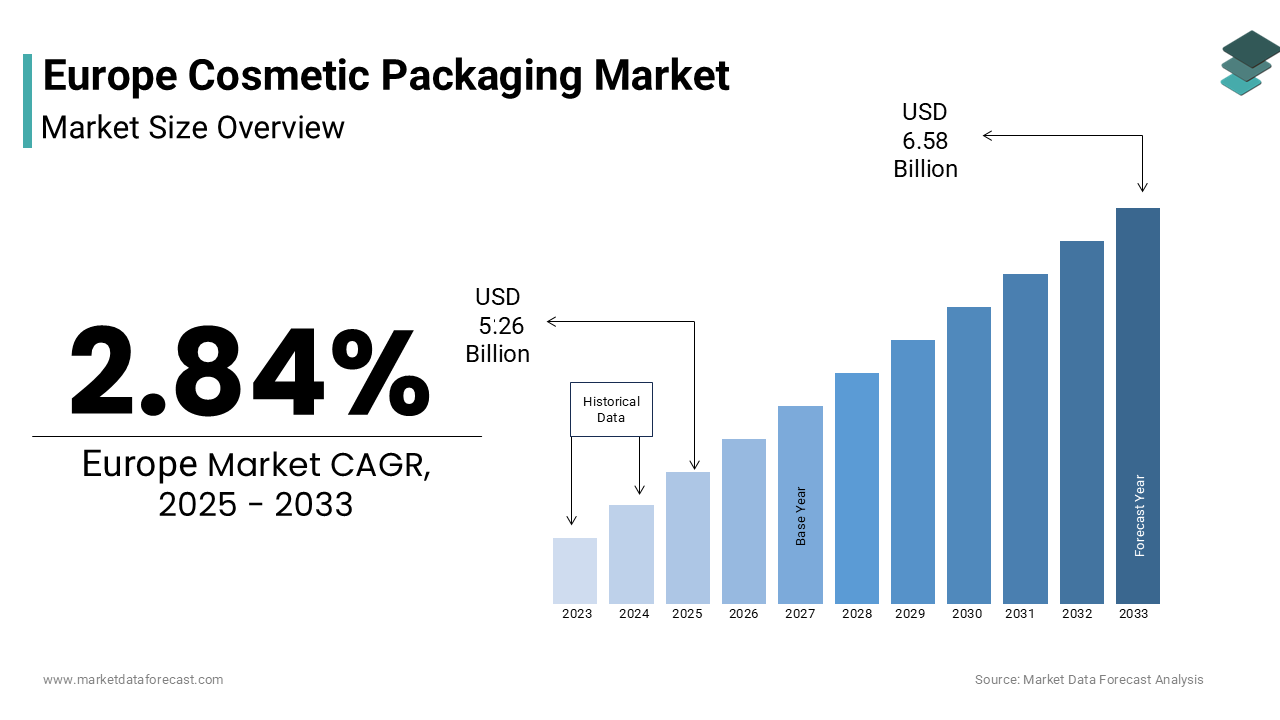
The Europe cosmetic packaging market was valued at USD 5.11 billion in 2024, is estimated to reach USD 5.26 billion in 2025, and is projected to reach USD 6.58 billion by 2033, growing at a CAGR of 2.84% during the forecast period from 2025 to 2033. The growth of the Europe cosmetic packaging market is driven by mandatory compliance with the EU Packaging and Packaging Waste Regulation, increasing adoption of refillable and reusable packaging systems, and rising consumer demand for sustainable, recyclable, and low-impact cosmetic packaging. Strong regulatory oversight, coupled with brand commitments to circular economy principles, is reshaping packaging design toward mono-material formats, recycled content, and chemical-safe components. The convergence of aesthetic differentiation, regulatory pressure, and sustainability accountability positions Europe as one of the most structurally advanced cosmetic packaging markets globally.
Key Market Trends
- Accelerated shift toward mono-material plastic and glass packaging to meet EU recyclability mandates.
- Rising adoption of refillable and reusable cosmetic packaging, particularly in skincare and fragrance categories.
- Growing use of digital watermarks and traceability technologies to enable automated sorting and circularity.
- Increased regulatory scrutiny on inks, adhesives, and indirect contact materials under REACH and SVHC rules.
- Localization of cosmetic packaging manufacturing under the EU Net Zero Industry Act to reduce emissions and import dependency.
Segmental Insights
- Based on material type, the plastic segment was the largest and held 52.3% of the Europe cosmetic packaging market share in 2024. The dominance of this segment is driven by lightweight properties, cost efficiency, and regulatory adaptation, particularly the shift toward mono-PET and mono-polypropylene designs that are fully compatible with municipal recycling systems. Plastic packaging also delivers logistical efficiency and lower transport emissions, supporting corporate carbon reporting obligations.
- Based on product type, the bottles and jars segment accounted for the largest share of the Europe cosmetic packaging market in 2024. This leadership is attributed to their widespread use in skincare, fragrances, and refill systems, along with compatibility with airless inserts and standardized closures that support reuse and circular packaging models.
- Based on distribution channel, the indirect sales segment dominated the market in 2024, supported by Europe’s extensive network of pharmacies, supermarkets, and specialty beauty retailers that require high-volume, standardized, and regulation-compliant packaging.
Regional Insights
The Europe cosmetic packaging market demonstrates strong performance across major economies, supported by robust regulatory enforcement, luxury beauty production, and sustainability leadership.
- France was the largest contributor, accounting for 24.3% of the Europe cosmetic packaging market share in 2024, driven by its role as a global luxury beauty hub and its pioneering environmental legislation such as the AGEC Law, which mandates recyclable and refillable cosmetic packaging.
- Germany followed with a 19.3% market share, supported by its strong dermocosmetic sector, precision engineering capabilities, and leadership in mono-material and airless packaging production.
- Italy remains a key market due to its dominance in premium and artisanal cosmetic packaging, particularly glass bottles, ceramic jars, and bespoke luxury designs for export-oriented beauty brands.
- The United Kingdom is emerging as a fast-moving market driven by direct-to-consumer brands, packaging innovation, and flexible regulatory experimentation, while Spain continues to serve as a major hub for mass-market and sun-care cosmetic packaging.
Competitive Landscape
The Europe cosmetic packaging market is characterized by competition between established industrial leaders, specialized luxury packaging suppliers, and sustainability-driven innovators. Market differentiation is driven by regulatory readiness, circular design capability, and material science expertise, rather than pricing alone. Leading players are investing in mono-material systems, refillable formats, digital watermarking, and localized recycled-content supply chains. Participation in EU-funded initiatives and alignment with Extended Producer Responsibility fee structures have become decisive competitive advantages. Prominent players in the Europe cosmetic packaging market include Albéa Group, HCP Packaging, Gerresheimer, AptarGroup, Verescence, Bormioli Luigi, Zignago Vetro, Lumson, Baralan, and Berlin Packaging
Europe Cosmetic Packaging Market Size
The europe cosmetic packaging market size was valued at USD 5.11 billion in 2024 and is anticipated to reach USD 5.26 billion in 2025 from USD 6.58 billion by 2033, growing at a CAGR of 2.84% during the forecast period from 2025 to 2033.
The cosmetic packaging is the design production and integration of primary and secondary containers for skincare haircare fragrances and color cosmetics that fulfill functional protective and experiential roles while adhering to stringent regulatory and sustainability mandates. Unlike generic packaging sectors cosmetic packaging in Europe is deeply intertwined with consumer identity brand storytelling and environmental accountability. The European Union’s legislative framework, particularly the Packaging and Packaging Waste Regulation and the EU Ecolabel that imposes binding requirements on material recyclability recycled content and chemical safety that shape form and function. This integration of aesthetic demand regulatory pressure and circular economy imperatives defines Europe’s cosmetic packaging landscape as a sophisticated nexus of design innovation compliance and material science.
MARKET DRIVERS
Mandatory EU Packaging and Packaging Waste Regulation Compliance
The European Union’s revised Packaging and Packaging Waste Regulation has institutionalized circular design principles, across the cosmetic sector through binding targets and material restrictions. The mandatory EU packaging and packaging waste regulation compliance is driving the growth of Europe cosmetic packaging market. The regulation also prohibits unnecessary packaging layers and mandates that all containers be designed for recyclability in existing municipal streams by eliminating multi material laminates and metallized finishes that previously dominated luxury segments. National Extended Producer Responsibility schemes in France, Germany, and Italy, now charge fee modulations based on packaging recyclability scores incentivizing lightweight mono material designs. This legal architecture transforms sustainability from a marketing claim into a technical and financial imperative ensuring consistent demand for compliant materials like mono PET glass and aluminum irrespective of consumer trends.
Rise of Refillable and Reusable Packaging Systems Driven by Consumer Legislation
Europe’s progressive consumer protection laws are accelerating the adoption of refillable and reusable cosmetic packaging to reduce single use waste. The rise of refillable and reusable packaging systems is accelerating the growth of Europe cosmetic packaging market. According to the European Commission’s Circular Economy Action Plan, member states must implement reuse targets for packaging by 2026 with France already mandating that 10% of cosmetic sales occur through refill systems by 2027. As per the European Consumer Organisation, some of European shoppers now consider refillability a key purchase criterion in Germany and the Nordic countries, where deposit return schemes are culturally entrenched. These systems require durable primary containers and standardized refill cartridges driving innovation in tamper evident closures and material compatibility.
MARKET RESTRAINTS
Complexity of Multi Material Packaging in Legacy Product Lines
Many established cosmetic brands continue to rely on multi material packaging, such as aluminum tubes with plastic liners or glass bottles with composite pumps that are technically non-recyclable under current European municipal systems. The complexity of multi material packaging in legacy product lines is limiting the growth of Europe cosmetic packaging market. According to the European Environment Agency, less cosmetic packaging containing polymer metal or glass combinations can be effectively separated in standard material recovery facilities. As per the German Environment Agency, cosmetic waste collected in 2024 was downcycled or landfilled due to inseparable laminates and mixed resins. The revised Packaging and Packaging Waste Regulation explicitly targets these designs for phase out by 2027 yet reformulating legacy bestsellers involves extensive stability testing regulatory re approval and consumer re-education processes that can take 18 to 36 months per SKU. This technical inertia forces brands into costly dual portfolios, compliant new lines alongside non-recyclable heritage products.
Stringent Restrictions on Substances of Very High Concern in Packaging Inks and Adhesives
The European Union’s chemical legislation extends beyond product formulation to include indirect contact materials, such as printing inks adhesives and varnishes used in cosmetic packaging. The stringent restrictions on substance of very high concern in packaging inks and adhesives is additionally limiting the growth of Europe cosmetic packaging market. According to the European Chemicals Agency, over 30 substances previously common in decorative packaging, such as bisphenol A phthalates and certain UV filters are now restricted under REACH due to migration risks. As per the European Commission’s 2024 enforcement report few of cosmetic packaging imports were rejected at EU borders for non-compliant ink formulations. Compliance requires suppliers to reformulate with bio based or mineral alternatives, which often lack equivalent gloss adhesion or durability. The German Federal Institute for Risk Assessment notes that alternative inks increase production costs, while reducing print resolution and shelf appeal. This chemical compliance burden disproportionately impacts artisanal and indie brands that rely on third party decorators intensifying market consolidation and limiting design diversity in the premium segment.
MARKET OPPORTUNITIES
Integration of Digital Watermarks for Automated Sorting and Traceability
The adoption of digital watermarking technologies, such as HolyGrail 2.0 to enhance the recyclability of cosmetic packaging through intelligent sorting, which is creating new opportunities for the growth of Europe cosmetic packaging market. According to the European Brands Association, over 85 consumer goods companies including L’Oréal and Beiersdorf participated in 2024 pilot programs embedding imperceptible QR style codes into packaging labels that are readable by AI powered near infrared scanners in recycling facilities. As per the German Dual System Grüner Punkt, these watermarks improved material identification accuracy by enabling precise separation of black PET mono materials and refillable glass. The European Commission’s Circular Plastics Alliance has endorsed digital watermarks as a key enabler of the 2030 recycled content targets. This innovation bridges the gap between design ambition and recycling reality turning previously non-recyclable formats into viable secondary feedstocks.
Expansion of Localized Mono Material Production Hubs Under the Net Zero Industry Act
The European Union’s Net Zero Industry Act is investment in regional mono material packaging production to reduce import dependency and carbon footprint. The expansion of localised mono material production hubs under the net zero industry act is additionally to escalate the growth of Europe cosmetic packaging market. According to the European Commission, over 1.2 billion euros in state aid was approved in 2024 for advanced recycling and packaging manufacturing facilities in Poland Spain and Belgium under the Net Zero Industry Act’s strategic value chain provisions. Companies like Albéa and Gerresheimer have partnered with these clusters to secure long term supply of compliant tubes jars and closures. The proximity to both waste collection networks and brand headquarters reduces logistics emissions and ensures alignment with national Extended Producer Responsibility fee structures. This localized circular ecosystem transforms packaging from a global commodity into a regionally anchored low carbon asset class aligned with the European Green Deal’s industrial strategy.
MARKET CHALLENGES
Inconsistent National Implementation of Deposit Return and Refill Infrastructure
The rollout of reuse and refill infrastructure varies dramatically across member states creating operational fragmentation for pan European brands. The inconsistent national implementation of deposit return and refill infrastructure is one of the challenges for the growth of Europe cosmetic packaging market. According to the European Consumer Organisation, only six countries France, Germany, the Netherlands, Sweden, Finland, and Austria have operational cosmetic refill networks as of 2024, while Southern and Eastern European countries lack standardized collection points or consumer incentives. This disparity forces multinational brands to maintain multiple packaging strategies, where reusable systems in the North and single use in the South increasing complexity and cost. The European Commission’s Reuse Roadmap acknowledges this gap yet binding harmonization before 2027.
Limited Availability of Certified Recycled Cosmetic Grade Materials at Scale
The cosmetic industry’s demand for high purity post-consumer recycled content, supply gap due to limited availability of food grade compliant secondary materials is also degrading the growth of Europe cosmetic packaging market. As per the European Food Safety Authority, stringent migration limits for recycled plastics restrict their use in direct contact applications unless processed through super clean decontamination lines which exist in only three facilities across the continent. This scarcity inflates prices compared to virgin resin according to Plastics Europe and forces brands into long term offtake agreements with limited flexibility. Small and medium enterprises without purchasing power are often excluded from these allocations relying instead on downcycled content that fails EU Ecolabel criteria.
REPORT COVERAGE
| REPORT METRIC | DETAILS |
| Market Size Available | 2024 to 2033 |
| Base Year | 2024 |
| Forecast Period | 2025 to 2033 |
| Segments Covered | By Material Type, Product Type, Distribution Channel, and Region. |
| Various Analyses Covered | Global, Regional, and Country Level Analysis, Segment-Level Analysis, DROC, PESTLE Analysis, Porter’s Five Forces Analysis, Competitive Landscape, Analyst Overview of Investment Opportunities |
| Regions Covered | United Kingdom, France, Spain, Germany, Italy, Russia, Sweden, Denmark, Switzerland, the Netherlands, Turkey, and the Czech Republic. |
| Market Leaders Profiled | Albéa Group, HCP Packaging, Gerresheimer, AptarGroup, Verescence, Bormioli Luigi, Zignago Vetro, Lumson, Baralan, and Berlin Packaging. |
SEGMENTAL ANALYSIS
By Material Type Insights
The plastic segment was accounted in holding 52.3% of the Europe cosmetic packaging market in 2024, which is sustained not by inertia but by regulatory adaptation and functional versatility. The European Union’s Packaging and Packaging Waste Regulation has driven a strategic shift from multi-layer laminates to mono material plastic designs that are fully recyclable in existing municipal streams. According to the European Environment Agency, new plastic cosmetic packaging launched in 2024 used mono PET or mono polypropylene structures in 2021 by enabling compatibility with standard sorting facilities. Brands like L’Oréal and Nivea reformulated over 200 SKUs in 2024 to eliminate aluminum liners and metallized films that previously rendered tubes and bottles non-recyclable. The French Extended Producer Responsibility scheme now applies lower fee to mono material packaging compared to composites creating direct financial incentives. This regulatory realignment has transformed plastic from a sustainability liability into a compliant circular solution when engineered correctly. Plastic’s low density offers significant advantages in transport emissions and shelf efficiency metrics under the EU’s Corporate Sustainability Reporting Directive. As per the German Logistics Association, switching from glass to plastic in e commerce shipments reduced average parcel weight by enabling more units per delivery van. This logistical efficiency is increasingly factored into brand carbon accounting with firms like Beiersdorf publishing full life cycle assessments that favor optimized plastic formats.
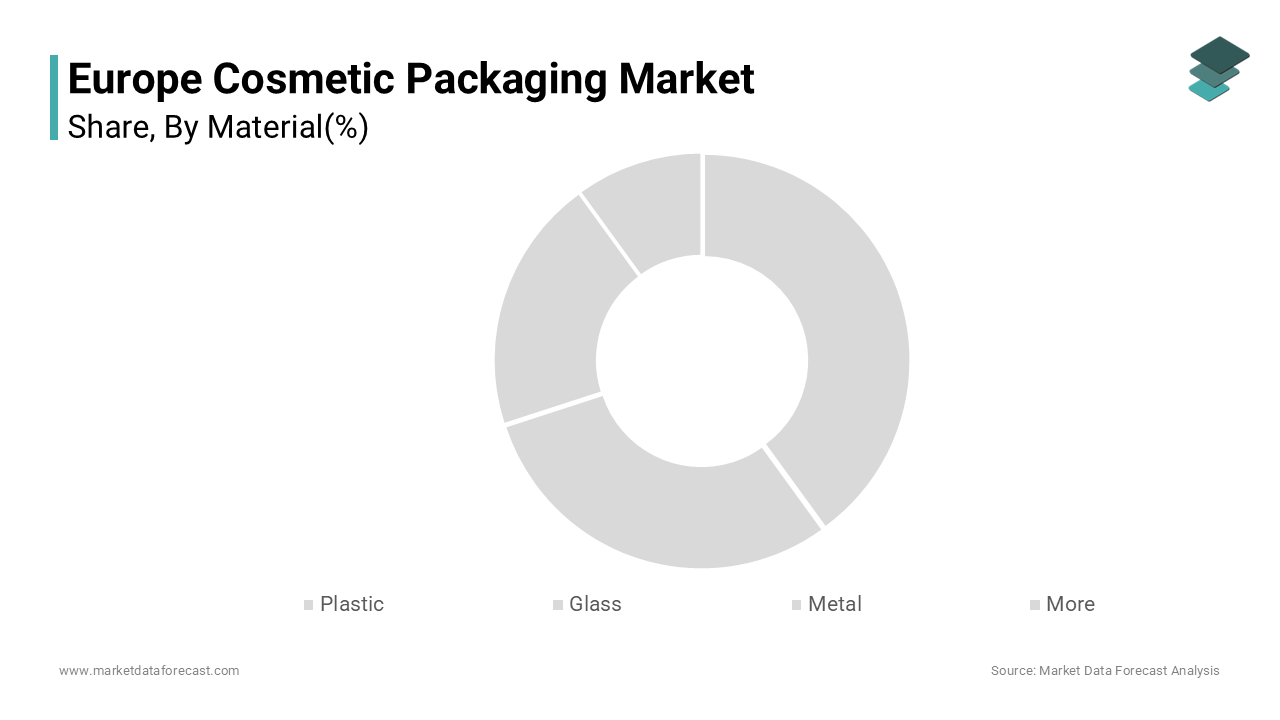
The glass segment is projected to witness a fastest CAGR of 7.4% during the forecast period. Glass is experiencing renewed demand in prestige and clean beauty segments due to its perceived purity and indefinite recyclability. According to the European Commission, glass retains 100% of its quality through infinite recycling loops, unlike plastic which degrades after 2 to 3 cycles. Brands like Chanel and Diptyque leverage glass to signal premium quality and sustainability authenticity particularly in markets like France and Italy, where consumers associate it with heritage and safety. Government backed deposit schemes are dramatically improving glass recovery rates across Northern and Western Europe. As per the German Dual System Grüner Punkt, the 15 cent deposit on cosmetic bottles increased return rates within six months of implementation. These high purity streams feed local cullet processors like Vetropack and Verallia enabling closed loop production with lower carbon emissions than virgin glass.
By Product Type Insights
The Bottles and Jars segment held 38.2% of the Europe cosmetic packaging market share in 2024. As per the French Beauty Federation, many facial care products launched in Europe in 2024 used glass or plastic jars due to their wide openings suitability for finger dipping and compatibility with airless inserts. Similarly, 85% of eau de parfum and eau de toilette products rely on glass bottles with standardized neck finishes enabling interchangeable caps and pumps. Bottles and jars are the foundational formats for Europe’s expanding refill infrastructure due to their durable primary containers and standardized secondary refills. The EU Ecolabel now awards bonus points for reusable primary containers accelerating adoption among mid tier brands.
The pump dispenser and droppers segment is expected to register a fastest CAGR of 9.1% from 2025 to 2033. The rise of high concentration actives, such as retinoids, vitamin C, and hyaluronic acid has intensified demand for contamination free dosing systems. According to the German Federal Institute for Drugs and Medical Devices, medical grade cosmeceuticals launched in Europe in 2024 used airless pumps or calibrated droppers to ensure product stability and prevent microbial ingress. Brands like La Roche Posay and Eucerin have standardized dropper formats across their clinical lines enabling consistent user experience and reducing formulation waste. This clinical endorsement transforms dispensers from functional components into therapeutic enablers. Modern pump and dropper systems are increasingly engineered as mono material plastic units to comply with EU recyclability rules. The European Commission’s Packaging and Packaging Waste Regulation explicitly recognizes mono material dispensers as compliant formats accelerating adoption among brands facing 2025 recycled content deadlines.
By Distribution Channel Insights
The indirect segment was accounted in holding a prominent share of the Europe cosmetic packaging market in 2024. Europe’s dense network of pharmacies supermarkets and specialty beauty retailers drives standardized high volume packaging demand. This scale necessitates robust primary packaging that withstands shipping stacking and shelf-life requirements favoring bottles jars and folding cartons with tamper evidence and brand visibility. The indirect channel’s logistical complexity creates structural demand for packaging that balances protection aesthetics and regulatory labeling across multiple languages. As per the German Logistics Association, brands redesigned their secondary packaging in 2024 to eliminate excess void fill and reduce box dimensions to lower shipping costs and carbon footprint. This shift favors folding cartons and shrink wrapped bundles that nest efficiently in automated fulfillment centers. Retailers like Sephora now mandate that all e-commerce SKUs pass drop test certifications ensuring product integrity during last mile delivery.
The direct sales channel segment is lucratively to grow at a fastest CAGR of 12.3% during the forecast period. Direct to consumer cosmetic brands are leveraging packaging, as a core brand differentiator through bespoke unboxing experiences and sustainable storytelling. Brands like BYBI and Typology use minimalist packaging with QR codes linking to ingredient transparency and carbon footprint data fostering trust without third party retail markups. This direct relationship enables rapid iteration and emotional connection impossible in indirect channels.
The D to C brands segment is likely to grow at fastest CAGR of 12.2% from 2025 to 2033, which is pioneering closed loop packaging systems by embedding return logistics into their customer journey. According to the French Environment and Energy Management Agency, European D to C cosmetic companies offered prepaid return labels for empty containers in 2024. As per the Swedish Environmental Protection Agency, brands like L:A Bruket achieved 91% return rates through loyalty point incentives and doorstep collection partnerships with postal services. The European Commission’s Reuse Action Plan explicitly endorses these models as scalable pathways to circularity.
REGIONAL ANALYSIS
France Cosmetic Packaging Market Analysis
France was the top performer of the Europe cosmetic packaging market by capturing 24.3% of share in 2024, driven by its dual identity as the birthplace of luxury beauty and a pioneer in environmental regulation. According to the French Beauty Federation, the global luxury cosmetic production with houses like L’Oréal LVMH and Chanel driving demand for high end glass bottles and refillable compacts. Simultaneously, France’s Anti Waste Law for a Circular Economy mandates that all cosmetic packaging be reusable recyclable or compostable by 2025 with refill sales target by 2027. The nation’s Extended Producer Responsibility scheme also imposes fee modulations based on recyclability scores incentivizing mono material innovation. This unique fusion of heritage craftsmanship and legislative ambition makes France the continent’s most influential and technologically advanced packaging market.
Germany Cosmetic Packaging Market Analysis
Germany cosmetic packaging market was positioned second by holding 19.3% of share in 2024 with its robust dermocosmetic sector and engineering precision. According to the German Federal Statistical Office, over 22,000 pharmacies nationwide generated 9.4 billion euros in cosmetic sales in 2024 requiring standardized medical grade packaging with tamper evidence and clear labeling. As per the German Environment Agency, brands reformulated SKUs in 2024 to eliminate non-recyclable composites ahead of 2025 deadlines. Germany also hosts Europe’s largest mono material production cluster in Bavaria with firms like Gerresheimer and Aptar supplying airless pumps and glass vials to global brands.
Italy Cosmetic Packaging Market Analysis
Italy cosmetic packaging market growth is likely to grow with its fusion of artistic heritage and manufacturing excellence. According to the Italian Cosmetic Association, the country produced over 15 billion euros of cosmetics in 2024 with 60% exported as premium goods requiring bespoke glass bottles ceramic jars and metal compacts. Italian packaging suppliers like Bormioli Luigi and Vetreria Pernici specialize in hand finished glass with custom textures colors and shapes that convey brand identity. Italy’s unique position as both a luxury producer and SME incubator creates a dynamic market where craftsmanship meets compliance.
UK Cosmetic Packaging Market Analysis
The UK cosmetic packaging market growth is anticipated to have significant growth opportunities with its vibrant direct to consumer ecosystem and agile regulatory approach. The UK’s departure from the European Union enabled faster adoption of innovative materials like bio-based polymers under its independent Chemicals Strategy. London’s status as a global fashion capital also drives trend led packaging with limited editions and interactive elements. This entrepreneurial environment fosters rapid experimentation and consumer engagement unmatched in more regulated continental markets.
Spain Cosmetic Packaging Market Analysis
Spain cosmetic packaging market growth is likely to grow with the primary hub for mass and sun care packaging in Southern Europe. Spanish brands like Natura Siberica and Bella Aurora prioritize cost efficient plastic bottles and tubes with high recycled content to meet EU mandates, while maintaining price competitiveness. Spain’s strategic location and bilingual workforce, also make it a logistics gateway for Latin American brands entering Europe requiring compliant yet economical packaging solutions.
COMPETITIVE LANDSCAPE
Competition in the Europe cosmetic packaging market is characterized by a dynamic interplay between legacy industrial leaders agile specialty converters and sustainability driven startups all navigating a uniquely stringent regulatory environment. The landscape is not defined by price alone but by the ability to deliver technically compliant aesthetically compelling and circularly viable solutions within the framework of the Packaging and Packaging Waste Regulation EU Ecolabel and Extended Producer Responsibility schemes. Incumbents leverage decades of brand relationships and integrated manufacturing to scale mono material and refillable systems while niche players differentiate through bio based materials artisanal glass or smart packaging. The market is moderately consolidated with strategic acquisitions targeting digital capabilities recycling tech and refill logistics rather than volume alone. Crucially competition is increasingly shaped by speed of regulatory adaptation brands favor partners who can pre certify packaging for recyclability and recycled content. This creates a high barrier to entry for non-EU players unfamiliar with chemical restrictions digital watermarking or national fee modulation systems.
KEY MARKET PLAYERS
Some of the companies that are playing a dominating role in the Europe cosmetic packaging market include
- Albéa Group
- HCP Packaging
- Gerresheimer
- AptarGrou
- Verescence
- Bormioli Luigi
- Zignago Vetro
- Lumson
- Baralan
- Berlin Packaging
Top Players in the Europe Cosmetic Packaging Market
Albéa Group
Albéa Group is a leading European developer of cosmetic packaging solutions with a strong focus on sustainability and innovation across tubes jars and applicators. Headquartered in France, the company operates 25 manufacturing sites globally and supplies major beauty brands with mono material recyclable and refillable systems. Albéa actively contributes to global circular economy standards by co founding the HolyGrail 2.0 digital watermarking initiative and developing the EcoFusion pump made entirely from polypropylene. Albéa also partners with European research institutions to advance bio based resins and post consumer recycled content integration reinforcing its role as a technology bridge between regulatory ambition and industrial scalability in both European and international markets.
Gerresheimer AG
Gerresheimer AG is a German based global leader in glass and plastic packaging for the cosmetics and pharmaceutical industries with deep integration across Europe’s premium and dermocosmetic sectors. The company specializes in high precision glass bottles vials and airless systems that meet stringent chemical compatibility and aesthetic requirements. Gerresheimer has accelerated its sustainability transformation by investing in hybrid electric glass furnaces that reduce CO2 emissions by up to 40% and launching its DuraSens line of refillable containers with integrated smart sensors. Its R and D centers in Germany and Italy drive material innovation that is subsequently deployed in manufacturing hubs across the Americas and Asia strengthening its global influence through European engineered solutions.
Aptar Beauty + Home
Aptar Beauty + Home maintains a strategic presence in the Europe cosmetic packaging market through its advanced dispensing systems including pumps droppers and spray mechanisms engineered for precision and sustainability. The company’s European operations span France Spain and the UK serving both mass market and prestige brands with mono material airless solutions compliant with EU recyclability mandates. The company co leads the European Union funded CIRCUL-A-BILITY project to standardize reusable packaging infrastructure across retail channels. Globally Aptar leverages its European regulatory expertise to shape sustainable dispensing standards in North America and Asia ensuring that its innovations in functionality and compliance remain at the forefront of the global beauty packaging evolution.
Top Strategies Used by the Key Market Participants
Key players in the Europe cosmetic packaging market pursue integrated strategies centered on regulatory foresight material innovation and circular system design. Companies are reformulating packaging into mono material constructions to ensure compatibility with municipal recycling streams as mandated by the Packaging and Packaging Waste Regulation. They invest heavily in refillable and reusable platforms supported by in store return infrastructure and digital tracking. Strategic participation in EU funded initiatives like HolyGrail 2.0 and CIRCUL A BILITY accelerates adoption of digital watermarks and standardized reuse protocols. Firms also localize production of recycled content through partnerships with regional cullet processors to secure verified feedstock and reduce carbon footprint. Additionally, they embed sustainability data into packaging via QR codes enabling consumer transparency and compliance with the EU Green Claims Directive. These strategies collectively align product development with Europe’s binding environmental and consumer protection framework.
MARKET SEGMENTATION
This research report on the europe cosmetic packaging market has been segmented and sub–segmented into the following categories.
By Material Type
- Plastic
- Glass
- Metal
- More
By Product Type
- Bottles and Jars
- Tubes and Sticks
- Folding Cartons
- Pump Dispenser and Dropper
- More
By Distribution Channel
- Direct Sales
- Indirect Sales
By Country
- UK
- France
- Spain
- Germany
- Italy
- Russia
- Sweden
- Denmark
- Switzerland
- Netherlands
- Turkey
- Czech Republic
- Rest of Europe