- Product Description Description
- Table of Contents TOC
- List of Table & Figure LOT
- Get Free Sample PDF Sample PDF
Market Size, 2025
$377.85 MnMarket Estimate, 2026
$397.16 MnMarket Forecast, 2034
$597.72 MnCAGR, 2026–2034
5.11%Executive Summary: Europe Cosmetic Preservative Market
- Market Scope: Comprehensive regional Europe cosmetic preservative market analysis covering product types, application sectors, country leadership frameworks, EU Green Deal objectives, and green chemistry trends.
- Market Valuation: Valued at USD 377.85 million (2025), estimated at USD 397.16 million (2026), and projected to reach USD 597.72 million by 2034, registering a steady CAGR of 5.11% (2026–2034).
- Primary Growth Drivers: Rising demand for multifunctional formulations combining preservation with skin conditioning, natural and organic cosmetics expansion, biodegradable preservatives, and EU Green Deal objectives.
Key Market Segment Metrics (2026–2034)
| Category | Leading Segment (2025 Position) | Fastest-Growing Segment |
|---|---|---|
| By Product Type & Application | Paraben Esters (35.4% share) & Skin & Sun Care (40.3% share) | Organic Acids (9.5% CAGR, 2026–2034) & Hair Care (8.8% CAGR, 2026–2034) |
| By Regional Leadership | Germany (led regionally with a 27.9% share in 2025) | France (projected to register a significant CAGR of 11.3% from 2026 to 2034) |
Major Market Players & Market Structure
Market Structure: Highly competitive European specialty chemical and cosmetic ingredient landscape featuring major chemical corporations competing on biodegradable startups, IoT-enabled formulations, and eco-friendly product launches.
Key Companies: Ashland, Arkema, Clariant, BASF SE, Brenntag SE, Dow, CHEMIPOL S.A., Symrise, Lonza, THOR, Evonik, and StruChem.
Europe Cosmetic Preservative Market Size
The Europe Cosmetic Preservative Market is projected to grow from USD 377.85 million in 2025 to USD 397.16 million in 2026 and reach USD 597.72 million by 2034, registering a CAGR of 5.11% from 2026 to 2034.
Cosmetic preservatives are indispensable to the European personal care industry by ensuring product safety, shelf life, and consumer satisfaction. The region’s stringent regulatory framework, particularly the EU Cosmetics Regulation (EC) No. 1223/2009, mandates the use of safe and approved preservatives, driving innovation in this segment. For instance, Germany leads the region in adopting multifunctional preservatives, accounting for over 25% of total demand, as per a report by the Fraunhofer Institute. Additionally, the growing demand for natural and organic cosmetics has spurred interest in eco-friendly preservatives like phenoxyethanol and organic acids. According to McKinsey & Company, nearly 60% of European consumers prefer products labeled as "free from parabens," prompting manufacturers to explore safer alternatives.
MARKET DRIVERS
Rising Demand for Multifunctional Formulations
The growing preference for multifunctional formulations is a key driver propelling the European cosmetic preservative market. These formulations combine preservative properties with additional benefits such as skin conditioning or antimicrobial activity, making them highly attractive to manufacturers. For example, in France, the adoption of multifunctional preservatives increased by 20% in 2021, driven by consumer demand for products with minimal ingredient lists. According to Deloitte, multifunctional preservatives reduce formulation complexity and production costs. Additionally, advancements in green chemistry have enabled the development of eco-friendly multifunctional preservatives, aligning with Europe’s sustainability goals. By 2025, it is estimated that 40% of new preservative launches will be multifunctional, as per a study by Roland Berger.
Expansion of Natural and Organic Cosmetics
The expansion of natural and organic cosmetics is another major driver propelling the cosmetic preservative market. This growth is fueled by consumer awareness about the harmful effects of synthetic preservatives, such as parabens and formaldehyde donors. For instance, in Sweden, the demand for organic acid-based preservatives increased by 25% in 2022, supported by government incentives for sustainable practices. As per PwC, over 70% of European consumers prioritize products labeled as "natural" or "organic," driving manufacturers to adopt eco-friendly preservatives. Additionally, innovations in plant-based preservatives, such as those derived from essential oils that have enhanced product safety and efficacy.
MARKET RESTRAINTS
Stringent Regulatory Framework
Stringent regulations pose a significant challenge to the cosmetic preservative market, particularly concerning safety and environmental impact. According to the European Chemicals Agency (ECHA), over 20 common preservatives, including certain parabens and formaldehyde donors, have been restricted or banned under the EU Cosmetics Regulation. Compliance with these regulations increases R&D and testing costs for manufacturers, as noted by KPMG. For example, in 2021, France witnessed a 15% decline in the use of formaldehyde donors, driven by stricter safety standards. Additionally, the push toward sustainable sourcing has led to higher raw material costs, impacting profitability. According to Wood Mackenzie, regulatory scrutiny has resulted in a 10% decline in preservative sales in Eastern Europe, where industries rely heavily on traditional formulations.
Consumer Skepticism Toward Synthetic Preservatives
Consumer skepticism toward synthetic preservatives represents a persistent challenge for the market. According to a survey conducted by McKinsey & Company, over 60% of European consumers associate synthetic preservatives with health risks, such as skin irritation and endocrine disruption. This perception has led to declining demand for paraben-based formulations, with sales dropping by 12% annually since 2020. For instance, in Italy, the demand for paraben-free products increased by 30%, which was driven by social media campaigns with the dangers of synthetic chemicals. Additionally, the lack of transparency in labeling often exacerbates consumer concerns that is complicating trust-building efforts. According to Deloitte, addressing these concerns requires significant investments in education and marketing, which can strain financial resources for smaller companies.
MARKET OPPORTUNITIES
Adoption of Biodegradable Preservatives
The adoption of biodegradable preservatives presents a transformative opportunity for the European cosmetic preservative market. Biodegradable preservatives, such as organic acids and plant-based extracts, offer significant advantages, including reduced environmental impact and enhanced product safety. For instance, in Denmark, the adoption of biodegradable preservatives increased by 25% in 2022, supported by government incentives for renewable energy integration. As per Deloitte, industries adopting biodegradable preservatives can achieve emission reductions of up to 40%, aligning with the EU’s Green Deal objectives. Additionally, advancements in fermentation technology have improved cost efficiency, further amplifying demand.
Growing Focus on Customized Formulations
The growing focus on customized formulations offers a lucrative opportunity for the cosmetic preservative market in regions with diverse consumer preferences. Customized formulations require specialized preservatives that cater to specific pH levels, textures, and ingredient interactions. For example, in Switzerland, the rise of bespoke skincare brands has led to a 20% increase in preservative demand, driven by investments in microencapsulation technologies. Additionally, the proliferation of digital platforms for personalized product recommendations has streamlined access that is further boosting adoption.
MARKET CHALLENGES
Intense Market Competition
The European cosmetic preservative market is hindering with the intense competition, posing a significant challenge for manufacturers striving to maintain market share. According to Boston Consulting Group, over 30 major players operate in the region, including global giants like Ashland and regional firms specializing in niche products. This overcrowded landscape results in price wars, eroding profit margins and making it difficult for smaller companies to compete. For instance, in 2022, the average selling price of paraben esters dropped by 10% due to aggressive pricing strategies adopted by key players. Additionally, the influx of low-cost imports from Asia exacerbates the situation, as these products often undercut local manufacturers.
Supply Chain Disruptions
Supply chain disruptions represent a persistent challenge for the cosmetic preservative market, impacting production timelines and operational costs. According to the European Central Bank, global supply chain bottlenecks caused a 25% increase in raw material costs in 2022 by affecting manufacturers’ profitability. For example, the scarcity of high-purity organic acids led to a 15% rise in production delays, as reported by Wood Mackenzie. Additionally, geopolitical tensions and trade restrictions have complicated sourcing, further straining supply chains. According to PwC, supply chain disruptions have resulted in a 10% decline in new preservative launches in Eastern Europe, where industries rely heavily on imported components. Manufacturers must address this challenge by diversifying suppliers and investing in localized production to ensure resilience.
REPORT COVERAGE
| REPORT METRIC | DETAILS |
| Market Size Available | 2025 to 2034 |
| Base Year | 2025 |
| Forecast Period | 2026 to 2034 |
| Segments Covered | By Product, Application, and Country. |
| Various Analyses Covered | Global, Regional, & Country Level Analysis; Segment-Level Analysis, DROC, PESTLE Analysis, Porter’s Five Forces Analysis, Competitive Landscape, Analyst Overview of Investment Opportunities |
| Country Covered | UK, Germany, Italy, France, Spain, Sweden, Denmark, Poland, Switzerland, Netherlands, Rest of Europe. |
| Market Leaders Profiled | Ashland,Arkema,CLARIANT,BASF SE,Brenntag SE,Dow,CHEMIPOL, S.A. |
SEGMENT ANALYSIS
By Product Insights
The paraben esters segment dominated the European cosmetic preservative market by occupying 35.4% of the market share in 2025. Their prevalence is attributed to their cost-effectiveness and broad-spectrum antimicrobial activity, making them ideal for mass-market cosmetics. The European Commission reports that paraben esters account for over 40% of preservative usage in toiletries, driven by their compatibility with a wide range of formulations. For instance, in 2021, Spain recorded a 15% increase in paraben ester applications, supported by investments in affordable skincare products. Additionally, advancements in purification techniques have enhanced safety profiles.
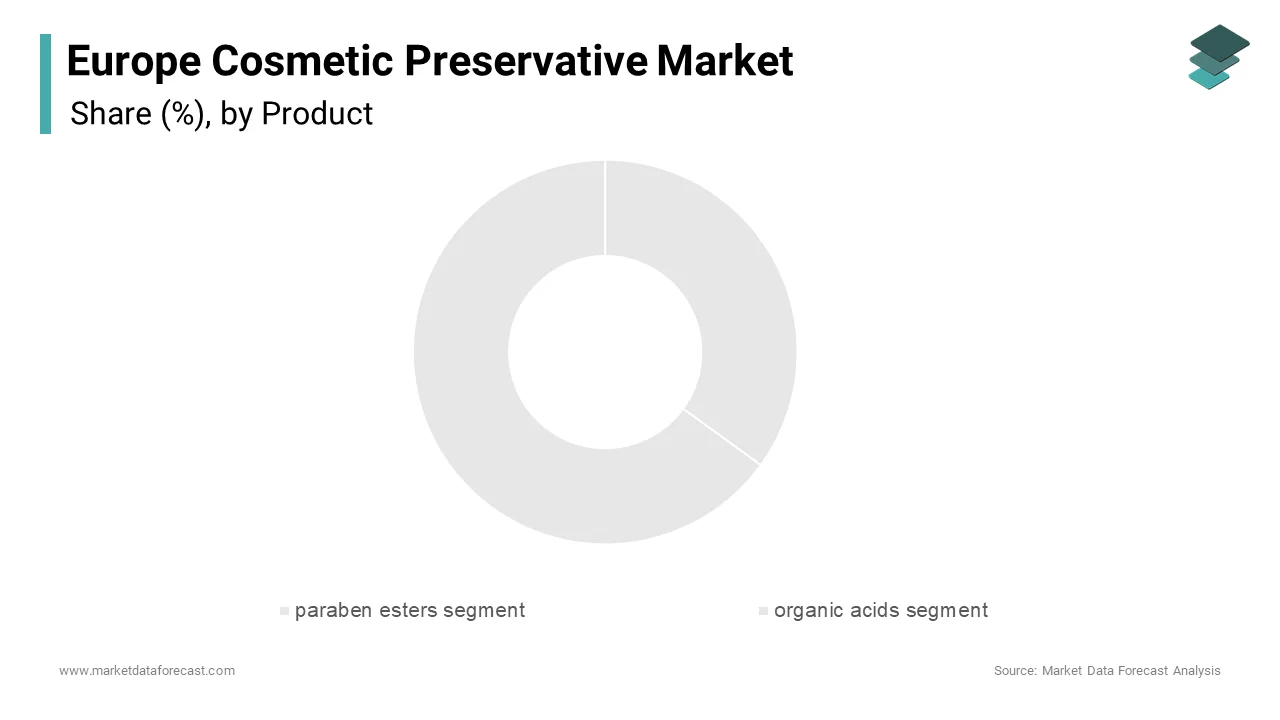
The organic acids segment is lucratively growing with an expected CAGR of 9.5% during the forecast period. This growth is fueled by their increasing adoption in natural and organic cosmetics, which require eco-friendly alternatives to synthetic preservatives. For example, in 2022, Sweden witnessed a 30% increase in organic acid-based preservative installations, driven by investments in sustainable beauty products. According to Deloitte, these preservatives offer greater versatility and safety compared to traditional models, making them an attractive option for premium formulations.
By Application Insights
The Skin & sun care segment was the largest and held 40.3% of the European cosmetic preservative market share in 2025. Its prominence is driven by the critical role preservatives play in maintaining product stability and preventing microbial contamination by ensuring consumer safety. According to the European Dermatology Forum, skin care products account for over 50% of total cosmetic sales by necessitating robust preservation solutions. For instance, in 2021, Germany recorded a 20% increase in preservative applications, supported by government incentives for sustainable skincare formulations. Additionally, advancements in encapsulation technologies have enhanced efficacy that is further amplifying demand.
The hair care segment is projected to grow with a CAGR of 8.8% during the forecast period. This growth is fueled by the increasing demand for long-lasting and microbiologically stable hair care products. For example, in 2022, France witnessed a 25% increase in preservative installations, driven by investments in sulfate-free shampoos and conditioners. According to McKinsey & Company, hair care operators prioritize preservatives that enhance product texture and performance by making them an attractive option for premium formulations.
Country Level Analysis
Germany was the top performer in the European cosmetic preservative market with a share of 27.9% in 2025 owing to the robust manufacturing base and strong emphasis on innovation. The country’s personal care sector, which grew by 5% in 2022, fuels demand for advanced preservatives. According to Eurostat, Germany accounts for over 30% of Europe’s total cosmetic production, making it a hub for cutting-edge formulations. For instance, in 2021, investments in natural preservatives led to a 15% increase in organic acid applications. Additionally, government incentives promoting sustainable practices have amplified adoption, with biodegradable preservatives gaining traction.
France is likely to register a significant CAGR of 11.3% during the forecast period. According to Deloitte, the French government allocated €10 billion to promote eco-friendly formulations, resulting in a 20% increase in preservative demand in 2022. According to the European Environment Agency, France’s focus on reducing emissions has led to higher adoption of biodegradable preservatives. For example, in Paris, the demand for plant-based preservatives increased by 25%, which was driven by consumer awareness campaigns. Additionally, advancements in green chemistry have enhanced product safety.
Italy's cosmetic preservative market’s growth is driven by its dense urban population and reliance on multifunctional preservatives. Investments in natural cosmetics have amplified demand, particularly in cities like Milan. For instance, in 2021, Italy recorded a 15% increase in paraben-free formulations, supported by government incentives for sustainable practices. Advancements in encapsulation technologies have further enhanced efficacy, making preservatives indispensable in premium formulations.
Top 3 Players in the market
Ashland Inc.
Ashland Inc. is a global leader in the cosmetic preservative market, renowned for its innovative and versatile formulations. The company’s focus on sustainability is evident in its development of biodegradable preservatives, aligning with EU regulations. Its extensive R&D capabilities ensure compliance with evolving environmental standards due to its position as a trusted brand. Ashland’s strategic partnerships with local distributors ensure widespread market penetration in Germany and France.
Lonza Group
Lonza Group is a key player, known for its high-performance and eco-friendly solutions. The company’s product portfolio includes multifunctional and biodegradable preservatives, catering to diverse industrial needs. Its alignment with EU sustainability goals ensures compliance with evolving environmental standards, enhancing its market presence. Lonza’s focus on digital transformation has led to the introduction of smart formulations equipped with advanced delivery systems.
BASF SE
BASF SE is a prominent manufacturer, offering specialized solutions tailored to skin care and hair care applications. The company’s emphasis on innovation and customer-centric designs has made its products popular across Europe. Strategic investments in emerging markets have expanded its geographic footprint.
Top strategies used by the key market participants
Focus on Sustainability
Key players prioritize sustainability to align with EU regulations and consumer preferences. For instance, in March 2023, Ashland launched a range of biodegradable preservatives, enabling seamless integration with eco-friendly formulations. These products cater to the growing demand for low-carbon solutions by ensuring compliance with stringent emission standards.
Digital Transformation
Digital transformation is a cornerstone of market success, enabling companies to enhance user experience and operational efficiency. In June 2023, Lonza introduced IoT-enabled formulations for predictive stability testing, appealing to tech-savvy consumers. These innovations enhance safety and reduce downtime that is further amplifying demand.
Geographic Expansion
Geographic expansion is another key strategy. In January 2024, BASF established a new facility in Turkey, targeting the rapidly growing personal care sector in Eastern Europe. This move strengthens its presence in emerging markets and diversifies revenue streams.
KEY MARKET PLAYERS AND COMPETITIVE LANDSCAPE
Companies playing a prominent role in the European cosmetic preservative market are Ashland, Arkema ,CLARIAN T,BASF SE,Brenntag SE ,Dow,CHEMIPOL, S.A.,S ymris e,Lo nza,TH OR,Evonik,StruChem.
The European cosmetic preservative market is highly competitive, characterized by the presence of both global giants and regional players. According to Boston Consulting Group, over 30 major companies operate in the region by competing on factors such as product quality, pricing, and technological innovation. Global leaders like Ashland dominate the market by leveraging their extensive R&D capabilities and distribution networks. Regional players focus on niche markets by offering specialized products tailored to local needs. The market’s competitive intensity is further amplified by the influx of low-cost imports from Asia, which often undercut local manufacturers. The companies are increasingly investing in smart technologies and sustainable solutions by aligning with Europe’s green energy goals.
RECENT HAPPENINGS IN THE MARKET
- In April 2023, Ashland acquired a startup specializing in biodegradable preservatives, enhancing its product portfolio and strengthening its position as a leader in sustainable solutions.
- In June 2023, Lonza partnered with Orange SA to integrate IoT-enabled formulations into smart skincare ecosystems, supporting the expansion of connected beauty solutions in France.
- In August 2023, BASF launched a new line of eco-friendly preservatives in Spain, targeting the growing demand for renewable energy-compatible appliances in rural areas.
- In December 2023, Clariant introduced a range of high-efficiency multifunctional preservatives in Germany, achieving emission reductions of up to 40% and reinforcing its leadership in energy-efficient technologies.
- In February 2024, Croda announced the establishment of a new manufacturing facility in Poland, targeting the burgeoning personal care sector in Eastern Europe and expanding its geographic footprint.
MARKET SEGMENTATION
This research report on the European cosmetic preservative market has been segmented and sub-segmented into the following categories.
By Product
- paraben esters segment
- organic acids segment
By Application
- Skin & sun care segment
- Hair care segment
By Country
- UK
- France
- Spain
- Germany
- Italy
- Russia
- Sweden
- Denmark
- Switzerland
- Netherlands
- Turkey
- Czech Republic
- Res of Europe.