- Product Description Description
- Table of Contents TOC
- List of Table & Figure LOT
- Get Free Sample PDF Sample PDF
Europe Cross Laminated Timber Market Report Summary
The Europe cross laminated timber (CLT) market was valued at USD 326.87 million in 2024, is expected to reach USD 378.80 million in 2025, and is projected to grow to USD 1,231.83 million by 2033, registering a CAGR of 15.88% during the forecast period from 2025 to 2033. Market growth is driven by EU green building mandates, rising adoption of low-carbon structural systems, and increasing use of prefabricated timber construction to address urban housing shortages. CLT has evolved from a niche material into a strategic pillar of Europe’s decarbonization and sustainable construction agenda, supported by harmonized standards, renewable forest resources, and lifecycle carbon accounting requirements.
Key Market Trends
- Strong shift from concrete and steel to bio-based structural systems
- Rising adoption of prefabricated and modular CLT construction
- Integration of BIM and digital fabrication in mass timber projects
- Expanding use of CLT in public infrastructure such as schools and hospitals
- Increasing focus on whole-life carbon accounting in building approvals
Segmental Insights
- Based on bonding technology, the adhesive-bonded CLT segment dominated the Europe cross laminated timber market in 2024 due to its superior structural integrity, manufacturing scalability, and compliance with performance-based building codes. Adhesive systems enable monolithic panels with consistent load distribution, making them indispensable for multi-storey construction.
- Based on element type, floor panels accounted for the largest share of the market in 2024, driven by their acoustic performance, vibration control, and suitability for high-density residential buildings. Prefabricated CLT floor cassettes also support rapid installation and integrated MEP systems.
- Based on application, the residential segment led the market with a 64.5% share in 2024, supported by social housing programs, urban densification policies, and affordability pressures across European cities. The non-residential segment is expected to grow fastest due to public procurement mandates and institutional sustainability targets.
Regional Insights
- Austria led the Europe cross laminated timber market with a 22.3% share in 2024, benefiting from its long-established wood processing industry, advanced CLT manufacturing capacity, and leadership in R&D and certification.
- Germany followed with a 19.7% market share, driven by large-scale housing demand, stringent building regulations, and strong policy support under the Energiewende and low-carbon construction incentives.
- Sweden remains a key contributor due to national carbon policies, welfare-oriented housing programs, and sustainable forest management practices.
- France is emerging as one of the fastest-institutionalizing markets, supported by the RE2020 building code, which enforces strict embodied carbon limits on new constructions.
- Switzerland continues to grow steadily, leveraging high-precision engineering expertise and premium CLT applications in seismic-resistant and alpine construction.
Competitive Landscape
The Europe cross laminated timber market is characterized by technology-driven and sustainability-focused competition, where differentiation is based on certified carbon performance, structural reliability, fire safety validation, and digital workflow integration rather than price. Regulatory alignment with EN 16351, public procurement policies, and carbon disclosure requirements favors vertically integrated players with strong testing credentials and forest-to-factory control. While large forestry groups dominate volume supply, specialized manufacturers gain traction in complex architectural and modular construction applications.
Major players operating in the Europe cross laminated timber market include Stora Enso, Binderholz Group, KLH Massivholz GmbH, Mayr-Melnhof Holz, Metsä Wood, Egger Group, Hasslacher Group, and Holz100.
Europe Cross Laminated Timber Market Size
The europe cross laminated timber market size was valued at USD 326.87 million in 2024 and is anticipated to reach USD 378.80 million in 2025 from USD 1231.83 million by 2033, growing at a CAGR of 15.88% during the forecast period from 2025 to 2033.
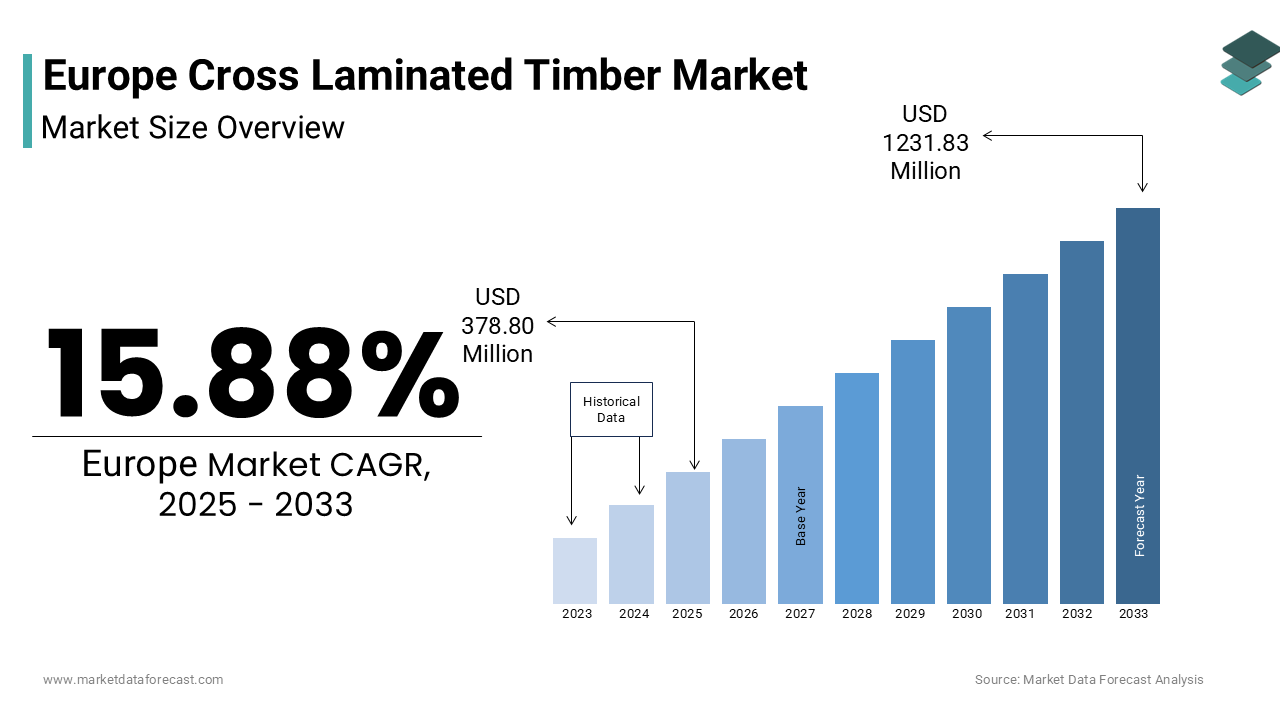
Cross laminated timber refers to the engineered wood panels composed of orthogonal layers of kiln dried lumber bonded with structural adhesives to form load bearing elements for floors walls and roofs. Unlike traditional timber CLT offers dimensional stability fire resistance and prefabrication efficiency making it a cornerstone of modern sustainable construction. Buildings are a major focus for energy efficiency initiatives, as they account for a substantial amount of total energy consumption and greenhouse gas emissions in the European Union. Forests, covering a significant portion of Europe's land area, provide a renewable resource base for materials like engineered wood products. Harmonized technical specifications exist for cross-border recognition of mass timber products such as cross-laminated timber (CLT), which helps facilitate their integration into mainstream construction. CLT has shifted from a niche application to a strategic component in Europe’s decarbonization efforts, supporting goals to improve the energy performance of buildings and promote low-carbon materials across the region.
MARKET DRIVERS
EU Green Building Mandates Accelerate Adoption of Low Carbon Structural Systems
The region’s aggressive regulatory framework for building sustainability propels the growth of the Europe cross laminated timber market. This has positioned cross laminated timber as a preferred alternative to concrete and steel in public and private construction. A directive requires that all new public buildings meet nearly zero energy standards by a specific date, with this requirement extending to all new buildings a few years later. The life cycle assessments for buildings now include embodied carbon considerations. In one national context, a majority of publicly funded school and housing projects are specifying cross-laminated timber (CLT) as a primary structural material, valued for its carbon capture potential and minimal associated energy. A low carbon construction label in another country mandates that new buildings meet a specific low carbon footprint threshold, which encourages the use of bio-based structural systems. Buildings constructed with CLT are noted to store a significant amount of biogenic carbon per cubic meter, which effectively allows these structures to function as carbon sinks. The integration of whole life carbon accounting into national building codes means that CLT's environmental advantage is no longer just a choice, but a necessary compliance measure.
Urban Housing Shortages Drive Prefabricated Timber Construction
The region's acute housing deficit, particularly in high growth cities, has intensified demand for rapid and scalable construction methods, which fuels the expansion of the Europe cross laminated timber market. Cross-laminated timber excels in meeting this demand through off-site manufacturing and fast on-site assembly. Many households in the European Union reside in overcrowded or inadequate housing as major cities face low vacancy rates. Modular construction using Cross-Laminated Timber (CLT) reduces on-site timelines compared to traditional building methods. The use of CLT-based modular systems facilitates the rapid delivery of multi-story residential blocks. Prefabricated CLT cassettes allow for the completion of large social housing complexes with minimal construction waste and fewer logistical deliveries. Prefabrication has become a significant evaluation factor in new urban housing tenders. This urgency to deliver quality housing at speed aligns perfectly with CLT’s industrialized workflow making it a strategic tool in addressing Europe’s urban affordability crisis.
MAKRET RESTRAINTS
Limited CLT Manufacturing Capacity Constrains Project Scalability
A structural barrier in production infrastructure restricts supply responsiveness and project feasibility, and thereby inhibits the growth of the Europe cross laminated timber market. Cross-laminated timber (CLT) production capacity across the European Union is concentrated in a few key nations. The current supply chain is experiencing extended lead times for CLT panels, which has increased significantly in recent years due to production capacity saturation. This limitation means that developers face a choice between postponing their building projects or using alternative construction materials, potentially impacting project sustainability objectives. Expanding the market capacity is challenging because new production facilities require substantial capital investment and several years for the necessary permitting and commissioning processes. Failure to invest in regional CLT hubs through public-private partnerships will lead to underserved markets in southern and eastern Europe, thereby increasing both transportation emissions and costs. Cross-laminated timber (CLT) use will be limited by current supply chain inertia and manufacturing capacity rather than technical or regulatory issues, until production scales up to match policy ambition.
Fire Safety Perception Gaps Hinder Regulatory Acceptance in High Rise Segments
Persistent misconceptions about the fire performance of mass timber continue to limit cross-laminated timber's (CLT) use in mid- and high-rise buildings and constrain the expansion of the Europe cross laminated timber market. This is despite extensive scientific validation of its charring behavior and structural integrity. However national building authorities in countries like the UK and Italy still impose height restrictions or require costly fire engineering assessments for CLT structures above four stories. Public perception further complicates adoption as post Grenfell safety concerns amplify skepticism toward any combustible material.
MARKET OPPORTUNITIES
Integration of CLT in Public Infrastructure Projects Opens New Demand Vortices
The expansion of cross laminated timber beyond residential into schools hospitals and transport hubs offers a potential opportunity driven by public sector dominance. This is expected to drive the growth of the Europe cross laminated timber market. Public infrastructure funding is increasingly incorporating sustainability considerations, which often prioritize the use of bio-based materials. Educational facilities in some regions are being constructed using mass timber, such as Cross-Laminated Timber (CLT), and are designed to meet rigorous energy efficiency standards. Transportation infrastructure, including railway stations, is undergoing renovation programs that utilize CLT to lower the amount of embodied carbon associated with these projects. Financial institutions are providing favorable financing terms for the construction of public buildings that use certified mass timber products. These projects not only validate CLT’s performance in demanding environments but also create demonstration effects that influence private developers. The normalization of CLT as a material is being fueled by public procurement, which pushes it into mainstream institutional use.
Digital Twin and BIM Integration Enhances Design and Construction Efficiency
The convergence of building information modeling and digital fabrication is creating fresh prospects for the expansion of the Europe cross laminated timber market. This opens unprecedented precision and waste reduction in CLT projects across the region. Cross-laminated timber (CLT) projects often utilize Building Information Modeling (BIM) for better organization and detection of potential problems early on in the process. This integrated digital approach helps in optimizing material usage and minimizing waste during construction. These collaborative digital processes improve coordination and streamline construction workflows for wood-based projects. Companies offer BIM to factory integration where architectural models directly generate CNC machine instructions eliminating manual interpretation errors. The maturing of EU digital construction mandates under the Digital Twin Europe initiative is expected to strengthen the link between virtual planning and physical execution, increasing CLT’s competitive edge over conventional building methods.
MARKET CHALLENGES
Fragmented Certification and Approval Processes Delay Project Timelines
The lack of harmonized technical approval procedures across member states, despite the existence of EN 16351, is among the major obstacles to the Europe cross laminated timber market. National authorities in several European countries, including Spain, Italy, and Poland, often require country-specific technical assessments for cross-laminated timber (CLT) panels. This is sometimes the case even when the panels already have CE marking under the Construction Products Regulation. Projects in some regions can face significant delays in permitting because of these redundant structural verifications. The fragmentation in requirements means that manufacturers must often maintain multiple certification dossiers, which increases their overall costs for compliance Architects and developers face uncertainty when scaling across borders deterring pan European CLT adoption. The market will remain inefficient and fragmented, compromising the single market ideal, until the EU mandates that CE marked CLT is mutually recognized as sufficient for structural approval by all member nations.
Skilled Labor Shortages Impede On Site Assembly Quality and Speed
The shortage of workers trained in the specific tasks of crane coordination and connection installation also hinders the expansion of the Europe cross laminated timber market. Construction firms in several European countries have reported difficulty finding workers trained in mass timber assembly. In one nation, a limited number of craftspeople completed specialized training modules related to cross-laminated timber (CLT) during a recent period. This gap leads to assembly errors delayed schedules and compromised structural performance particularly in complex joints. Failure to urgently invest in standardized training certification and digital work instructions risks the industry suffering reputational damage due to poor execution, especially as policy momentum increases. Labor readiness is thus a decisive bottleneck in translating CLT’s technical promise into built reality.
REPORT COVERAGE
| REPORT METRIC | DETAILS |
| Market Size Available | 2024 to 2033 |
| Base Year | 2024 |
| Forecast Period | 2025 to 2033 |
| Segments Analysed | By Bonding Technology, Raw-Material Species, Element Type, Application and Region |
| Various Analyses Covered | Global, Regional & Country Level Analysis, Segment-Level Analysis, Drivers, Restraints, Opportunities, Challenges; PESTLE Analysis; Porter's Five Forces Analysis, Competitive Landscape, Analyst Overview of Investment Opportunities |
| Regions Analysed | United Kingdom, France, Spain, Germany, Italy, Russia, Sweden, Denmark, Switzerland, the Netherlands, Turkey, and the Czech Republic. |
| Market Leaders Profiled | Stora Enso, Binderholz Group, KLH Massivholz GmbH (Schweighofer Group), Mayr-Melnhof Holz Holding AG, Holzindustrie Schweighofer, Metsä Wood, Egger Group, Hasslacher Group, Binderholz GmbH, and Holz100 (Massivholz GmbH) |
SEGMENTAL ANALYSIS
By Bonding Technology Insights
In 2024, the adhesive bonded segment dominated the Europe cross laminated timber market by accounting for a substantial share. The dominance of the adhesive bonded segment is driven by the structural integrity, dimensional stability, and manufacturing efficiency enabled by advanced adhesive systems. Adhesive bonding remains the standard due to its ability to create monolithic panels with uniform load distribution and minimal deflection, critical for multi story buildings. These adhesives ensure interlaminar shear strength exceeding 1.0 N/mm² even under wet conditions, a benchmark unattainable with mechanical alternatives. Mainstream adoption of adhesive technology is non-negotiable because building codes emphasize performance standards over specific assembly methods. The economics of CLT production are fundamentally aligned with adhesive bonding due to high speed automated lamination lines that would be impractical with mechanical fasteners. Mechanically fastened systems require drilling insertion and torque control at thousands of points per panel. Besides, adhesive joints eliminate stress concentrations caused by nails or screws which can compromise long term fatigue resistance in seismic or dynamic loading scenarios. Europe’s focus on off-site construction, driven by the need to address labor shortages and ensure quality, finds its sole path to industrial scalability through the use of adhesive bonding. Adhesives will maintain their dominant structural and economic position until robotic fastening technology can match their speed and reliability.
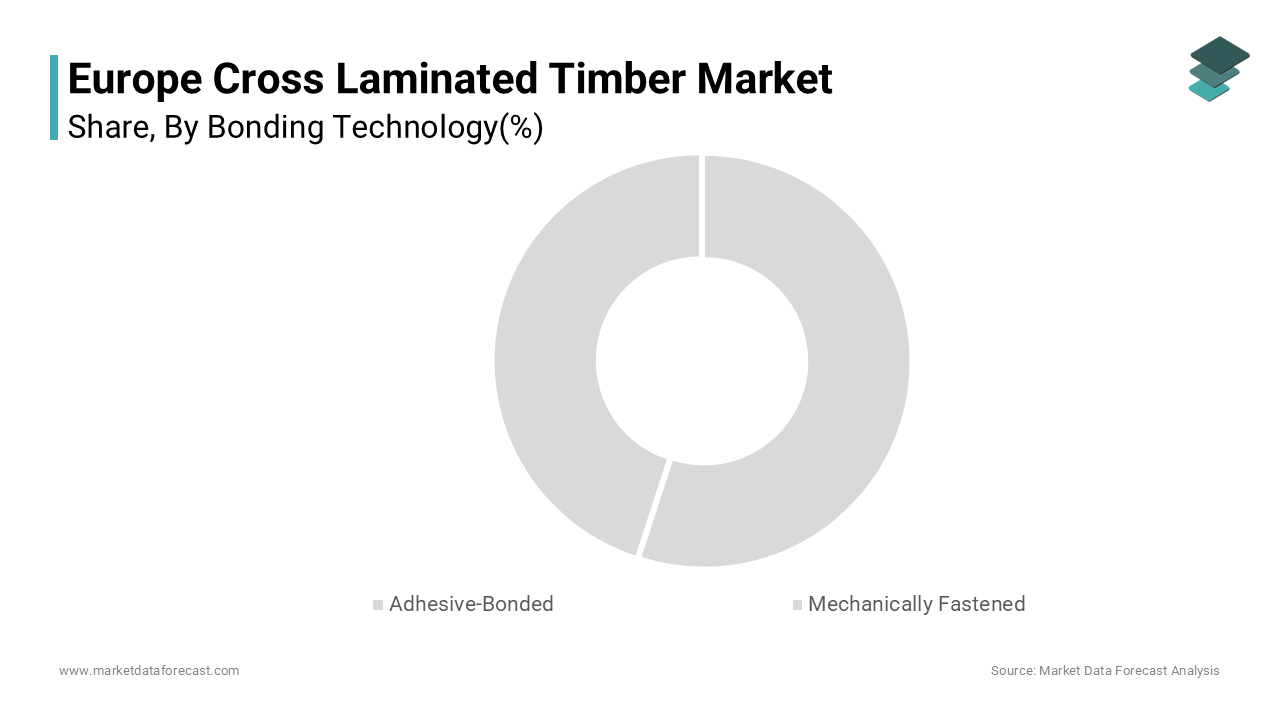
The mechanically fastened segment is predicted to witness the highest CAGR of 7.4% from 2025 to 2033. The rapid growth of the mechanically fastened segment is propelled by circular economy imperatives and disassembly needs. The EU’s Circular Economy Action Plan and Level(s) sustainability framework are incentivizing reversible construction systems where materials can be recovered and reused at end of life. Mechanically fastened CLT, using dowels screws or proprietary connectors, enables panel separation without destructive demolition. The lower structural strength of these systems is less of a concern in temporary and modular applications, which are increasingly using them because the ability to reuse them outweighs the need for high initial strength. The integration of circularity metrics into building certification is expected to spur strategic growth in this sector. Recent advances in engineered connectors are narrowing the performance gap between mechanical and adhesive systems while preserving reversibility. Companies have launched concealed steel connectors that transfer shear loads without visible hardware maintaining aesthetic continuity. Besides, digital fabrication allows CNC pre drilling with micron level precision ensuring consistent joint performance. These innovations enable the use of mechanically fastened CLT for student housing and modular infrastructure; however, they have not yet reached the structural requirements for high-rise elevator and stair cores.
By Element Type Insights
The floor panels segment led the Europe cross laminated timber market by capturing a 48.4% share in 2024. The supremacy of the floor panels is credited to acoustic and vibration performance, and thermal bridging reduction. Floor panels command the largest share due to CLT’s superior acoustic and dynamic response characteristics essential in dense urban housing. Prefabricated floor cassettes also integrate MEP channels and underfloor heating conduits during factory production eliminating on site penetrations that compromise integrity. European densification policies drive demand for high-performing CLT floors, prized for combining structural speed with acoustic and thermal advantages. Wall panels are increasingly specified to minimize thermal bridges and enhance building envelope performance under tightening EU energy codes. Unlike concrete or steel CLT’s low thermal conductivity prevents cold bridging at junctions reducing mold risk and improving indoor air quality.
The roof panels segment segment is estimated to register the fastest CAGR of 8.1% during the forecast period due to lightweighting needs and renewable energy integration. The push for on site renewable energy is transforming roofs into power generation platforms where CLT’s lightweight nature offers distinct advantages over concrete or steel decks. Additionally, the biogenic carbon stored in roof elements contributes directly to whole building carbon accounting under the EU Taxonomy. The expansion of solar mandates under the Renewable Energy Directive is fundamentally transforming roof panels; their new role as active energy assets, rather than passive protective elements, is driving quick uptake. The rise of modular and emergency housing is accelerating demand for fully enclosed CLT roof cassettes that enable rapid enclosure and weatherproofing. These cassettes integrate insulation vapor barriers and roofing underlays eliminating multiple trades on site. The intensification of climate displacement and urban housing crises highlights the critical need for fast-deployable shelters. Roof panels are vital for humanitarian and social infrastructure and represent a significant growth opportunity past traditional construction.
By Application Insights
In 2024, the residential segment held the leading 64.5% share of the European cross-laminated timber market. This growth is propelled by urban housing policies that prioritize timber in social and mid-rise developments, alongside educational and health infrastructure embracing biophilic design principles. Residential dominance is anchored in national housing strategies that explicitly favor mass timber for affordability and sustainability. A notable amount of EU cohesion funds were allocated to social housing, with requirements focusing on low-embodied carbon materials to meet sustainability criteria. Certain cities have directed significant municipal funding toward timber-based social housing initiatives, establishing cross-laminated timber (CLT) as a common structural standard for a range of multi-story projects. Across various national housing developments, CLT has been increasingly adopted to align with established regional carbon budget regulations. The use of CLT in construction has been observed to improve project timelines, which leads to faster tenant occupancy in areas where housing is in high demand. In light of the general demand for affordable homes, residential CLT is often considered a feasible solution for quickly delivering scalable housing units in alignment with existing housing policies. Non residential growth is driven by public sector investment in schools hospitals and civic buildings that leverage CLT’s biophilic benefits for occupant well being.
The non residential segment is anticipated to witness the fastest CAGR of 9.3% over the forecast period owing to public procurement and institutional sustainability mandates. EU public procurement reforms are systematically favoring CLT in government funded non residential projects through explicit carbon thresholds. Public procurement criteria are encouraging lower whole life carbon in new buildings. Achieving these reduced carbon levels often involves the use of bio-based structural systems. The use of mass timber products, such as cross-laminated timber, has become a common approach for building floors, walls, and roofs in some regions. Governments are providing significant financial incentives and support for construction projects that incorporate mass timber. The mandates create predictable demand independent of market cycles ensuring long term growth in schools courts and administrative buildings across Europe. Private sector sustainability pledges are driving CLT use in commercial offices where embodied carbon is now a key tenant and investor metric. Companies have specified CLT in their European headquarters to meet science-based targets. Hence, commercial developers increasingly view CLT not as a cost but as a value enhancing asset that attracts ESG focused tenants and investors.
REGIONAL ANALYSIS
Austria Cross Laminated Timber Market Analysis
Austria outperformed other countries in the Europe cross laminated timber market and accounted for a 22.3% share in 2024. The supremacy of Austrian market is credited to its century long wood processing heritage and role as the birthplace of modern CLT. The country is a key location for advanced cross-laminated timber facilities within Europe. Several major producers operate significant plants there. Some facilities have been instrumental in the early development of certified timber panels. A majority of public schools constructed recently have incorporated cross-laminated timber as a primary structural material. This construction approach is part of the national strategy concerning climate and energy goals. Austria also leads in R and D with the Wood K Plus Competence Center conducting full scale seismic and fire tests that inform Eurocode revisions. So, Austria functions as Europe’s CLT innovation engine and export hub.
Germany Cross Laminated Timber Market Analysis
Germany followed closely in the Europe cross laminated timber market and captured a 19.7% share in 2024. The expansion of the German market is attributed to its manufacturing scale stringent building codes and urban housing demands. The German government identifies a significant requirement for new social housing units in urban areas, with cross-laminated timber (CLT) being increasingly utilized to expedite construction timelines. The national technical authority for construction maintains stringent approval processes to ensure that cross-laminated timber used in the market meets specific performance standards. Major timber industry participants utilize automated facilities to produce substantial volumes of cross-laminated timber. The Energiewende policy further supports CLT through subsidies for low carbon construction under the Federal Funding for Efficient Buildings program. Germany’s blend of industrial capacity regulatory rigor and policy alignment makes it the continent’s largest and most mature CLT market.
Sweden Cross Laminated Timber Market Analysis
Sweden is also a significant player in the Europe cross laminated timber market due to its integration of CLT into national welfare architecture and carbon policy. Significant volumes of CLT have been used, with applications focused on municipal housing, schools, and elderly care facilities. Mandates require assessments for all public buildings, and CLT is specifically recognized within national rules. A major city initiative is actively promoting the construction of numerous new timber-based apartments, leveraging the use of prefabricated CLT modules. Sweden’s forests grow more wood than is harvested annually ensuring long term resource security. This systemic alignment of ecology policy and social need positions Sweden as a model for sustainable urban development.
France Cross Laminated Timber Market Analysis
France is moving ahead steadfastly in the Europe cross laminated timber market owing to aggressive regulatory timelines under the RE2020 building code which imposes strict carbon limits on all new constructions. The regulation of building emissions in France is becoming stricter, which is driving the use of low-carbon materials. New rules for construction projects mean that builders must find ways to lower the carbon footprint of their buildings. In Paris, city authorities are providing substantial funding to develop more housing using timber. This initiative includes large-scale construction projects that are already showcasing multi-story buildings made with advanced timber technology. These projects demonstrate a commitment to sustainable construction practices within the city. Across France, the use of timber in non-residential construction is seeing significant growth. France’s rapid policy shift from concrete to timber makes it Europe’s fastest institutionalizing market.
Switzerland Cross Laminated Timber Market Analysis
Switzerland is predicted to grow notably in the Europe cross laminated timber market from 2025 to 2033 due to high value engineering precision and alpine construction expertise. New multi-family buildings in dense urban zones often incorporate cross-laminated timber (CLT). Firms within the country specialize in complex geometries and seismic resistant connections suited to the terrain. The national laboratories maintain advanced CLT testing facilities. Performance in extreme conditions is a focus of the testing and validation processes. Production of the material utilizes renewable electricity. A strong focus on quality and craftsmanship in production helps deliver a premium product. The material produced serves as a benchmark for technical excellence.
COMPETITIVE LANDSCAPE
Competition in the Europe cross laminated timber market is defined by a blend of technological excellence sustainability credibility and industrial scalability. The landscape features established forest industry giants regional specialists and emerging digital fabricators vying for integration into high profile public and private projects. Differentiation centers on certified low embodied carbon precision engineering fire performance and digital workflow compatibility rather than price alone. Regulatory alignment with EN 16351 CE marking and national approval processes creates high entry barriers favoring players with decades of technical documentation and testing history. Simultaneously startups offering modular or reversible CLT systems gain traction in niche segments like temporary housing. The market remains tightly linked to policy momentum with public procurement acting as a key demand catalyst. As whole life carbon assessments become mandatory competition increasingly hinges on verifiable environmental stewardship and supply chain resilience across Europe’s forest rich but fragmented geography.
KEY MARKET PLAYERS
- Stora Enso
- Binderholz Group
- KLH Massivholz GmbH (Schweighofer Group)
- Mayr‐Melnhof Holz Holding AG
- Holzindustrie Schweighofer
- Metsä Wood
- Egger Group
- Hasslacher Group
- Binderholz GmbH
- Holz100 (Massivholz GmbH)
Top Players in the Europe Cross Laminated Timber Market
Stora Enso Oyj
Stora Enso Oyj headquartered in Finland is a global leader in renewable packaging and construction materials with a significant footprint in the Europe cross laminated timber market. The company operates advanced CLT facilities in Sweden Finland and Germany supplying structural panels for residential schools and commercial projects across the continent. Stora Enso contributes to the global market by pioneering carbon negative building solutions and promoting wood as a substitute for fossil intensive materials. It also expanded its Hallein plant in Austria to meet rising demand for certified low carbon CLT in public infrastructure projects reinforcing its role as a sustainability enabler in Europe’s green construction transition.
KLH Massivholz GmbH
KLH Massivholz GmbH based in Austria is widely recognized as the inventor of modern cross laminated timber and remains a technology benchmark in the European market. The company supplies high precision CLT panels for complex architectural projects including high rise residential and public buildings across Germany Switzerland and the Nordic region. Globally KLH sets standards for quality and fire performance through rigorous testing and transparent documentation aligned with EN 16351. These innovations strengthen its reputation as a trusted partner for ambitious sustainable construction initiatives throughout Europe.
Binderholz GmbH
Binderholz GmbH headquartered in Austria is one of Europe’s largest timber producers with integrated CLT operations spanning sawmilling panel fabrication and digital construction services. The company serves a wide range of projects from social housing to commercial offices across Germany France and Benelux countries. Binderholz contributes globally by demonstrating full value chain control from sustainably managed forests to finished structural elements. It also partnered with engineering firms to develop seismic resilient CLT solutions for alpine regions. These actions position Binderholz as a vertically integrated innovator driving industrialization and reliability in mass timber construction across Europe
Top Strategies Used by the Key Market Participants
Key players in the Europe cross laminated timber market focus on vertical integration from sustainably managed forests to finished panels to ensure traceability and quality control. They invest in digitalization through BIM compatible platforms and automated production lines to enhance precision and reduce waste. Companies actively collaborate with public authorities and architects to align CLT solutions with green public procurement and carbon accounting frameworks. Strategic expansion of manufacturing capacity in underserved regions addresses supply constraints and reduces logistics emissions. Additionally firms develop carbon transparency tools and environmental product declarations to meet tightening EU sustainability disclosure requirements and differentiate on verified climate performance.
MARKET SEGMENTATION
This research report on the europe cross laminated timber market has been segmented and sub–segmented into the following categories.
By Bonding Technology
- Adhesive-Bonded
- Mechanically Fastened
By Raw-Material Species
- Spruce
- Pine
- Fir
- Douglas-Fir
- Hardwood
By Element Type
- Wall Panels
- Floor Panels
- Roof Panels
- Others
By Application
- Residential
- Non-Residential
By Country
- UK
- France
- Spain
- Germany
- Italy
- Russia
- Sweden
- Denmark
- Switzerland
- Netherlands
- Turkey
- Czech Republic
- Rest of Europe