- Product Description Description
- Table of Contents TOC
- List of Table & Figure LOT
- Get Free Sample PDF Sample PDF
Market Size, 2025
$8.44 BnMarket Estimate, 2026
$9.95 BnMarket Forecast, 2034
$37.10 BnCAGR, 2026–2034
17.88%Europe Crowdfunding Market Report Summary
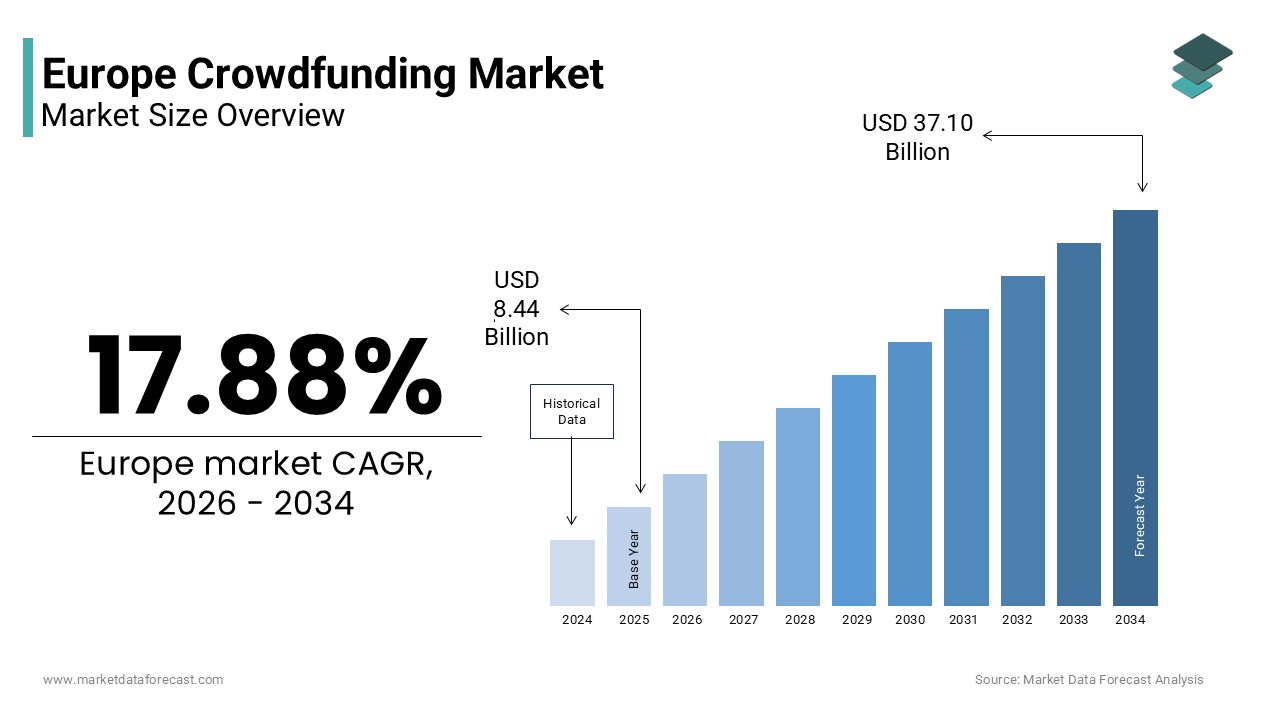
The Europe crowdfunding market was valued at USD 8.44 billion in 2025, is estimated to reach USD 9.95 billion in 2026, and is projected to reach USD 37.10 billion by 2034, growing at a CAGR of 17.88% during the forecast period from 2025 to 2033. The growth of the Europe crowdfunding market is driven by the harmonized regulatory environment under the EU Crowdfunding Service Providers Regulation (ECSPR), rising digital adoption across younger demographics, and the increasing use of crowdfunding as an alternative capital source for startups, SMEs, creative industries, and social impact initiatives. Growing participation in equity and debt-based crowdfunding, expansion of blockchain-enabled fundraising models, and strong civic engagement across Europe are further fueling market growth. Moreover, integration of crowdfunding into public procurement, green innovation programs, and community-driven investment frameworks has broadened access for both entrepreneurs and retail investors across Europe.
Key Market Trends
- Rising expansion of pan-European crowdfunding platforms supported by ECSPR passporting and standardized investor protection guidelines.
- Increasing adoption of debt-based crowdfunding among SMEs seeking fast, non-dilutive financing alternatives.
- Growing popularity of tokenized equity and blockchain-based campaigns offering fractional ownership and improved liquidity.
- Strong cultural and institutional support for social, cultural, and sustainability-oriented crowdfunding initiatives across Europe.
- Emergence of hybrid public-private funding models where municipalities and government bodies match or co-fund citizen-backed projects.
Segmental Insights
- Based on type, the debt-based crowdfunding segment was the largest and held a significant share of the Europe crowdfunding market in 2025. The segment’s dominance is attributed to its alignment with SME financing needs, shorter approval times, and enhanced regulatory clarity that improves lender confidence and platform credibility.
- Based on type, the blockchain-based crowdfunding segment is expected to register the fastest growth during the forecast period. The rapid rise of security token offerings, fractional digital securities, and automated compliance under EU crypto regulations is accelerating adoption among retail investors and early-stage ventures.
- Based on end user, the startups segment was the largest in 2024, driven by strong regional demand for early-stage capital, community-building benefits, and the ability to raise funds across multiple EU countries through ECSPR-enabled passporting.
Regional Insights
The Europe crowdfunding market is witnessing robust growth across major economies, supported by fintech maturity, strong civic participation, and favorable regulatory environments.
- United Kingdom was the largest contributor, accounting for 19.4% of the Europe crowdfunding market share in 2024, driven by a sophisticated fintech ecosystem, established investor networks, and leading platforms such as Crowdcube and Funding Circle.
- France continued to expand, supported by tax incentives for equity crowdfunding, government-backed civic funding schemes, and prominent platforms like KissKissBankBank.
- Germany reported strong growth in debt-based and green project crowdfunding, reinforced by high disclosure standards and widespread support for renewable energy cooperatives.
- Spain is emerging as a major hub for civic, cultural, and community-driven crowdfunding, aided by municipal co-funding models and active public participation.
Competitive Landscape
The Europe crowdfunding market is characterized by the presence of established global platforms and regionally specialized operators with deep community and sector expertise. Competition is driven by platform transparency, regulatory compliance, investor protection capabilities, and thematic specialization across areas such as technology, sustainability, creative industries, and tokenized assets. Leading companies are focusing on enhancing due-diligence frameworks, expanding cross-border reach, integrating secondary trading mechanisms, and partnering with public institutions to boost campaign success. Prominent players in the Europe crowdfunding market include Kickstarter, Indiegogo, GoFundMe, Crowdcube, Seedrs, FundedByMe, Ulule, KissKissBankBank, Companisto, and StartEngine.
Europe Crowdfunding Market Size
The europe crowdfunding market size was valued at USD 8.44 billion in 2025 and is anticipated to reach USD 9.95 billion in 2026 from USD 37.10 billion by 2034, growing at a CAGR of 17.88% during the forecast period from 2026 to 2034.
The European crowdfunding market is functioning as a critical enabler for early stage innovation and community initiatives. According to the European Commission, over 600 regulated crowdfunding platforms operated in Europe in 2024, facilitating funding for a high volume of projects. The European Central Bank noted that small and medium enterprises accounted for 68% of all crowdfunding campaigns, reflecting the model’s role in addressing the persistent SME financing gap. Furthermore, as per a 2023 Euro barometer survey, 9% of European citizens expressed willingness to invest in or donate to crowdfunding campaigns, which is also signalling public engagement. These socio financial dynamics position crowdfunding as a participatory economic mechanism that aligns with Europe’s values of inclusivity and digital empowerment.
MARKET DRIVERS
Harmonized EU Regulatory Framework Enhances Cross Border Platform Scalability
The introduction of the EU Crowdfunding Service Providers Regulation has significantly lowered operational and compliance barriers for platforms seeking pan European reach, which is one of the major factors propelling the expansion of the European crowdfunding market. According to the European Securities and Markets Authority, 175 platforms obtained EU passports under the ECSPR by early 2025, enabling them to offer equity and lending services across all 27 member states from a single authorization. This regulatory harmonization eliminates the prior need for 27 separate national licenses, reducing legal costs by an estimated 60% for mid-sized operators, as confirmed by the European Crowdfunding Network. For instance, Spanish platform Capital Cell expanded into Germany and France in 2024 without establishing local entities and facilitated 24 cross border health tech campaigns. Similarly, Dutch platform Oneplanetcrowd leveraged the passport to finance renewable energy projects in Italy and Greece, attracting over 15000 European investors. The regulation also mandates standardized risk disclosures and investor protection measures; a 2024 Eurobarometer survey found that 58% of potential backers felt more confident investing on ECSPR compliant platforms. This unified framework transforms crowdfunding into a scalable European capital formation channel.
Strong Cultural and Institutional Support for Social and Green Innovation Fuels Campaign Volume
European civil society and public policy actively encourage crowdfunding as a vehicle for sustainability and social entrepreneurship, which is further contributing to the growth of the European crowdfunding market. According to the European Cultural Foundation, over 9000 heritage restoration and independent arts projects were funded via donation and reward based platforms in 2024, with average success rates exceeding 70%. In France, the government’s “Participatory Democracy” initiative grants tax deductions of up to 66% for donations to eligible civic campaigns, leading to a 34% year on year increase in community energy and urban gardening projects, as reported by the French Ministry of Ecological Transition. Similarly, Germany’s KfW Development Bank partners with platforms like Startnext to co fund social startups and matches every euro raised up to 25000 euros. The European Investment Fund also allocated 120 million euros in 2024 to guarantee lending crowdfunding for green SMEs, reducing platform risk. This ecosystem of fiscal incentives and public institutional backing ensures a steady pipeline of mission driven campaigns.
MARKET RESTRAINTS
Fragmented Investor Protection Rules for Non ECSPR Platforms Undermine Trust
Despite EU harmonization for investment crowdfunding, reward based and donation based platforms remain subject to disparate national consumer laws, which is a significant impediment to the growth of the European crowdfunding market. According to the European Consumer Organisation, 41% of cross border backers in 2024 encountered difficulties obtaining refunds or project updates because platforms fell outside ECSPR oversight. In Eastern Europe, for example, Romanian and Bulgarian platforms are not required to hold funds in segregated accounts, which is a concern highlighted by the European Banking Authority after three platform failures in 2023. Furthermore, the absence of mandatory campaign verification for non-investment models allows misleading claims to proliferate; the European Commission’s 2024 Digital Services Act compliance review found that 29% of reward based campaigns lacked basic delivery timelines. This regulatory asymmetry fragments the market and discourages cross border participation.
Capital Raising Limits Under ECSPR Constrain High Growth Start-up Ambitions
The EU Crowdfunding Service Providers Regulation caps the maximum amount a company can raise via equity or lending platforms at 5 million euros over a 12 month period, which is further hampering the European crowdfunding market growth. According to the European Innovation Council, 63% of deep tech startups that used crowdfunding in 2024 required more than 8 million euros to reach commercialization, forcing them to layer crowdfunding with venture capital. In the renewable energy sector, the European Clean Tech Network reported that average project capital needs for solar microgrids or biogas plants exceed 7 million euros, making crowdfunding viable only for pilot phases. This ceiling also discourages institutional participation; asset managers surveyed by the European Fund and Asset Management Association stated that the 5 million limit renders most campaigns too small for portfolio inclusion. Without a tiered or scalable limit based on issuer maturity, the regulation risks confining crowdfunding to early validation.
MARKET OPPORTUNITIES
Integration of Crowdfunding with Public Innovation Procurement Creates New Funding Pathways
European public authorities are increasingly blending crowdfunding with public procurement to de risk innovation and validate citizen demand, which is a promising opportunity for the European crowdfunding market. According to the European Commission’s PROSO project, 18 EU member states now run “innovation partnerships” where startups must demonstrate public backing via crowdfunding to qualify for municipal contracts. In 2024, the city of Copenhagen awarded a 3.2 million euro smart waste management contract to a startup that first raised 180000 euros from citizens through Seedrs. Similarly, the Spanish Ministry of Science launched the “Civic Labs” program, requiring researchers to secure at least 30% of prototype funding via platforms like Goteo before receiving public grants. The European Institute of Innovation and Technology reported that such hybrid models increased project success rates by 44% compared to traditional grants alone. This policy innovation transforms crowdfunding into a validation mechanism within public innovation ecosystems.
Rise of Tokenized Equity and Blockchain Based Campaigns Expands Investor Accessibility
The emergence of security token offerings on regulated European blockchain platforms is redefining equity crowdfunding by enabling fractional ownership, which is another potential opportunity for the regional market. According to the European Blockchain Observatory, 14 licensed security token platforms operated in Europe in 2024, facilitating tokenized equity raises for SMEs with lower minimum investments. French biotech startup BioToken raised 4.1 million euros in Q1 2024 by issuing tokens representing shares, with 72% of investors contributing less than 2000 euros. The European Securities and Markets Authority confirmed that smart contracts on these platforms automatically enforce ECSPR investor suitability checks and reduce onboarding time by 80%. Additionally, secondary trading on multilateral trading facilities allows early backers to exit partially. Tokenized crowdfunding is poised to democratize private market access for retail investors.
MARKET CHALLENGES
Persistent Digital and Financial Literacy Gaps Limit Retail Investor Participation
Despite growing platform availability, a significant portion of the European population remains unable or unwilling to participate in crowdfunding due to insufficient understanding of financial risk, which is challenging the European crowdfunding market expansion. According to the OECD’s 2023 International Survey of Adult Financial Literacy, only 34% of Europeans could correctly answer basic questions about investment diversification and return risk trade offs. This knowledge deficit is more pronounced among older and rural populations; Eurostat reported that just 12% of citizens aged 55 and above had ever backed a crowdfunding campaign, compared to 39% of those aged 25 to 34. Platform usability further exacerbates exclusion; a 2024 study by the University of Bologna found that 57% of first time users abandoned campaigns due to complex navigation. Without targeted financial education initiatives, crowdfunding risks becoming an urban and youth dominated channel.
Lack of Standardized Data and Performance Metrics Hinders Institutional Integration
The Europe crowdfunding market suffers from inconsistent reporting standards, making it difficult for fund managers to assess aggregate risk. According to the European Systemic Risk Board, fewer than 30% of platforms disclose standardized default rates or post campaign business outcomes. In peer to peer lending, the variation is stark, as UK platforms report annualized default rates using 90 day arrears while Spanish platforms use 180 days. This opacity deters institutional capital; the European Long Term Investors Association noted that 89% of its members exclude crowdfunding from portfolios due to data unreliability. Even academic research is hampered; the European University Institute found that only 11% of academic studies on crowdfunding use verified platform data. Until the European Commission mandates uniform data templates, crowdfunding will remain a peripheral asset class.
REPORT COVERAGE
| REPORT METRIC | DETAILS |
| Market Size Available | 2026 to 2034 |
| Base Year | 2025 |
| Forecast Period | 2026 to 2034 |
| Segments Covered | By Type, Application, End-User & Region |
| Various Analyses Covered | Global, Regional & Country Level Analysis, Segment-Level Analysis, Drivers, Restraints, Opportunities, Challenges, PESTLE Analysis, Porter's Five Forces Analysis, Competitive Landscape, Analyst Overview on Investment Opportunities |
| Regions Covered | United Kingdom, France, Spain, Germany, Italy, Russia, Sweden, Denmark, Switzerland, the Netherlands, Turkey, and the Czech Republic. |
| Key Market Players | Kickstarter, Indiegogo, GoFundMe, Crowdcube, Seedrs, FundedByMe, Ulule, KissKissBankBank, Companisto, and StartEngine. |
SEGMENTAL ANALYSIS
By Type Insights
The debt based crowdfunding segment dominated the market by holding 40.8% of the regional market share in 2025. The dominance of debt based crowdfunding segment in the European market is primarily driven by its alignment with small and medium enterprise financing needs. This model offers businesses non dilutive capital with faster approval timelines than traditional banks. According to the European Central Bank, SMEs accounted for 73% of all debt crowdfunding campaigns in 2024, with average loan sizes ranging from 50000 to 300000 euros. The UK’s Funding Circle alone facilitated 1.2 billion euros in SME loans across Europe in 2024, with default rates maintained below 3% through AI driven credit scoring. Additionally, public institutions actively back this segment; the European Investment Fund provided 90 million euros in partial guarantees to European P2P platforms in 2024. This blend of regulatory clarity and SME demand solidifies debt based crowdfunding as the backbone of the alternative finance ecosystem
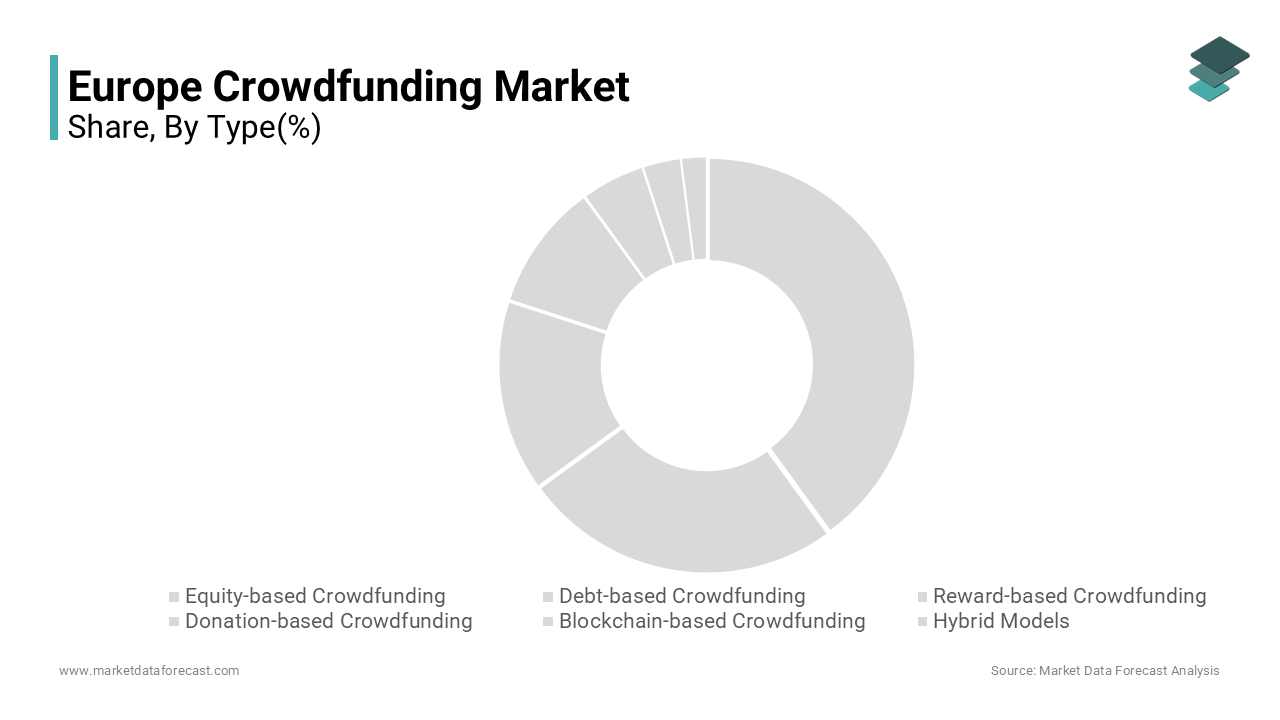
On the other hand, the blockchain based crowdfunding segment is the fastest growing segment in the Europe market and is projected to expand at a CAGR of 30.6% over the forecast period owing to the convergence of regulatory clarity under the EU’s Markets in Crypto Assets Regulation and rising demand for liquid investment instruments. According to the European Blockchain Observatory, security token offerings raised 840 million euros in Europe in 2024, with German and French deep tech startups leading issuance. Platforms like Neufund and ADDX now enable investors to purchase tokenized equity in increments as low as 100 euros. The European Securities and Markets Authority confirmed that smart contracts on these platforms automatically enforce investor accreditation and cut compliance costs by up to 50%. Furthermore, secondary trading on regulated multilateral facilities allows partial exits, enhancing appeal for retail backers.
By End User Insights
The startups segment was the largest end user segment in the Europe crowdfunding market and captured 51.5% of the regional market share in 2025. The growth of the startups segment in this regional market is primarily attributed to the model’s critical role in early stage capital formation. European startups increasingly use equity and debt crowdfunding to validate market demand and secure minority capital. According to the European Innovation Council, 68% of seed stage tech startups that raised capital in 2024 utilized crowdfunding as their first external funding source, with an average raise of 1.2 million euros. The ECSPR’s passporting mechanism enables these campaigns to attract pan European backers; Swedish clean tech startup Northvolt Energy raised 4.3 million euros from 8700 investors across 19 countries in Q2 2024. Additionally, national innovation agencies amplify success, as France’s Bpifrance matches crowdfunding up to 300000 euros for deep tech.
On the other end, the NGOs segment is the fastest growing end user segment in the Europe crowdfunding market and is estimated to showcase a CAGR of 23.2% over the forecast period owing to the rising civic engagement and digital fundraising literacy. According to the European Foundation Centre, European NGOs raised over 1.1 billion euros via donation and reward based platforms in 2024, with climate action leading cause categories. In Spain, the 2023 Social Impact Tax Law grants donors a 30% income tax deduction for contributions to registered NGOs, driving a 41% year on year increase in campaign volume. Similarly, the Dutch government’s “Civic Crowdfunding Fund” matches public donations to local sustainability projects up to 10000 euros. The European Commission’s European Solidarity Corps also integrated crowdfunding as a mandatory component for youth led social initiatives and funded 1200 campaigns in 2024.
REGIONAL ANALYSIS
United Kingdom Crowdfunding Market Analysis
The United Kingdom dominated the market with accounting for the largest share of the European market in 2025 and is likely to maintain its position as a dominant hub for crowdfunding over the next few years due to its highly developed fintech infrastructure and mature regulatory environment and by leading platforms like Crowdcube and Funding Circle. According to the Financial Conduct Authority, UK platforms facilitated 3.8 billion euros in crowdfunding in 2024, with equity and P2P lending accounting for 82% of volume. London’s status as a global financial hub attracts institutional co investors, while regional initiatives like Scotland’s Social Investment Fund boost NGO participation. The British Business Bank’s Future Fund program also mandates crowdfunding as a qualifying milestone for follow on grants.
France Crowdfunding Market Analysis
France is likely to see continued strong growth in its crowdfunding sector for the next few years, bolstered by aggressive fiscal incentives and government backed innovation programs. The French financial regulator AMF reported that 1.4 billion euros was raised via regulated platforms in 2024, with equity crowdfunding growing fastest. The “IR-PME” scheme allows individuals to deduct 25% of investments in SMEs from taxable income, a policy credited with mobilizing 320000 new retail investors in 2024, as per the French Ministry of Economy. Platforms like KissKissBankBank dominate cultural campaigns, while Sowefund specializes in tech equity.
Germany Crowdfunding Market Analysis
Germany is likely to experience steady expansion in debt-based crowdfunding for the next few years as its Mittelstand increasingly turns to digital platforms for green energy financing. According to the German Federal Financial Supervisory Authority, debt based crowdfunding dominates, representing 68% of 2024 volume. Platforms like Exporo and Zinsland specialize in real estate and solar project financing, benefiting from Germany’s Energiewende policy. The KfW Development Bank provides guarantees covering up to 70% of loan losses for green SME campaigns. With over 24000 SMEs using crowdfunding in 2024, Germany demonstrates how disciplined regulation can scale alternative finance.
Spain Crowdfunding Market Analysis
Spain is likely to solidify its role as a pioneer in civic and participatory crowdfunding for the next few years through expanded regional tax credits and municipal matching funds. The Spanish National Securities Market Commission reported 980 million euros raised in 2024, with Catalonia and Madrid accounting for 74% of activity. Platforms like Goteo and Verkami pioneered reward and donation models often integrated with municipal budgets. The 2023 Social Impact Tax Law grants donors a 30% tax deduction for contributions to certified NGOs, driving a 41% surge in civic campaigns.
Netherlands Crowdfunding Market Analysis
The Netherlands is likely to remain at the forefront of sustainable and cross-border crowdfunding for the next few years given its early adoption of EU passporting and focus on green energy. Dutch platforms like Oneplanetcrowd and Lendahand specialize in sustainable energy, with 78% of 2024 campaigns aligned with UN Sustainable Development Goals, as confirmed by the Dutch Central Bank. The Netherlands Authority for the Financial Markets was among the first to issue ECSPR passports. Additionally, the Dutch government’s Social Impact Covenant provides matching funds for NGOs raising via certified platforms.
COMPETITVE LANDSCAPE
The Europe crowdfunding market features a dual competitive dynamic where global pioneers like Crowdcube coexist with deeply rooted local platforms such as KissKissBankBank and Oneplanetcrowd, each excelling in distinct models and geographies. Competition is not primarily price based but revolves around trust, specialization, and regulatory agility. Equity platforms compete on deal quality and investor protection, while debt platforms differentiate through credit analytics and SME sector focus. Blockchain enabled entrants introduce innovation in liquidity and fractional ownership, pressuring incumbents to modernize. The regulatory harmonization under the ECSPR has lowered entry barriers but intensified scrutiny, favoring platforms with robust compliance infrastructure. At the same time, niche players thrive by embedding crowdfunding into local civic, cultural, or green ecosystems, often with public co funding. This environment rewards both scale and contextual relevance, creating a layered market where global reach and local authenticity are equally valuable.
KEY MARKET PLAYERS
Some of the companies that are playing a dominating role in the europe crowdfunding market include
- Kickstarter
- Indiegogo
- GoFundMe
- Crowdcube
- Seedrs
- FundedByMe
- Ulule
- KissKissBankBank
- Companisto
- StartEngine
Top Players in the Market
Crowdcube
Crowdcube is a UK based equity crowdfunding pioneer that has significantly shaped global standards for retail investor participation in early stage ventures. Operating across Europe under the EU Crowdfunding Service Providers Regulation passport, it enables individuals to invest in startups and scaleups for as little as 10 euros. The platform is known for its rigorous due diligence and transparent campaign disclosures, which have become benchmarks in investor protection. In 2024, Crowdcube launched a secondary liquidity pilot with regulated trading partners, allowing early backers to partially exit successful ventures. It also integrated AI driven investor matching to improve campaign visibility and introduced real time impact dashboards for ESG focused raises. These innovations reinforce its role as a bridge between grassroots capital and high growth European innovation
KissKissBankBank
KissKissBankBank is a leading French crowdfunding platform specializing in creative, cultural, and social impact projects, with growing forays into civic tech and green entrepreneurship. Founded on principles of participatory culture, it has funded over 50000 projects since inception, many in collaboration with local governments and cultural institutions. In 2024, the platform enhanced its verification system with blockchain based milestone tracking to ensure campaign accountability. It also partnered with the French Ministry of Culture to co fund heritage restoration initiatives through matched donations. By aligning with national policy objectives and embedding transparency into its model, KissKissBankBank has redefined crowdfunding as a tool for democratic co creation rather than mere fundraising.
Funding Circle
Funding Circle is a London headquartered platform that revolutionized small business lending through its data driven peer to peer debt crowdfunding model. It serves thousands of European SMEs, offering unsecured and asset backed loans sourced from retail and institutional lenders. The company contributes globally by demonstrating how alternative credit scoring can expand financial inclusion while maintaining low default rates. In 2024, Funding Circle expanded its green loan program across Germany and Spain, offering discounted rates for businesses investing in energy efficiency or circular economy practices. It also enhanced its API integration with accounting software to enable real time cash flow based lending decisions. These actions position it at the intersection of financial technology, sustainability, and SME empowerment in Europe.
Top Strategies Used by the Key Market Participants
Key players in the Europe crowdfunding market prioritize regulatory compliance by obtaining EU Crowdfunding Service Providers Regulation passports to operate across member states seamlessly. They invest in advanced risk assessment tools using artificial intelligence and alternative data to evaluate borrower or issuer credibility. Platforms enhance investor trust through transparent campaign disclosures regular progress updates and third party verification of milestones. Strategic partnerships with public institutions such as national development banks and cultural ministries amplify campaign reach and de risk capital through matching grants. Companies also expand into thematic niches like climate tech social impact and tokenized assets to differentiate offerings. Additionally they develop secondary liquidity solutions and investor education resources to improve long term engagement. These strategies collectively address scalability trust and sustainability in a fragmented yet high potential market
MARKET SEGMENTATION
This research report on the europe crowdfunding market is segmented and sub–segmented into the following categories.
By Type
- Equity-based Crowdfunding
- Debt-based Crowdfunding
- Reward-based Crowdfunding
- Donation-based Crowdfunding
- Blockchain-based Crowdfunding
- Hybrid Models
- Others
By End User
- Startups & Entrepreneurs
- NGOs & Non-profits
- Individuals
- Small & Medium Enterprises (SMEs)
- Creative Professionals (Artists, Musicians, etc.)
By Application
- Technology
- Healthcare
- Real Estate
- Food & Beverage
- Media & Entertainment
- Education
- Social Causes
- Others
By Country
- UK
- France
- Spain
- Germany
- Italy
- Russia
- Sweden
- Denmark
- Switzerland
- Netherlands
- Turkey
- Czech Republic
- Rest of Europe