- Product Description Description
- Table of Contents TOC
- List of Table & Figure LOT
- Get Free Sample PDF Sample PDF
Market Size, 2025
$19.38 BnMarket Estimate, 2026
$24.57 BnMarket Forecast, 2034
$164.30 BnCAGR, 2026–2034
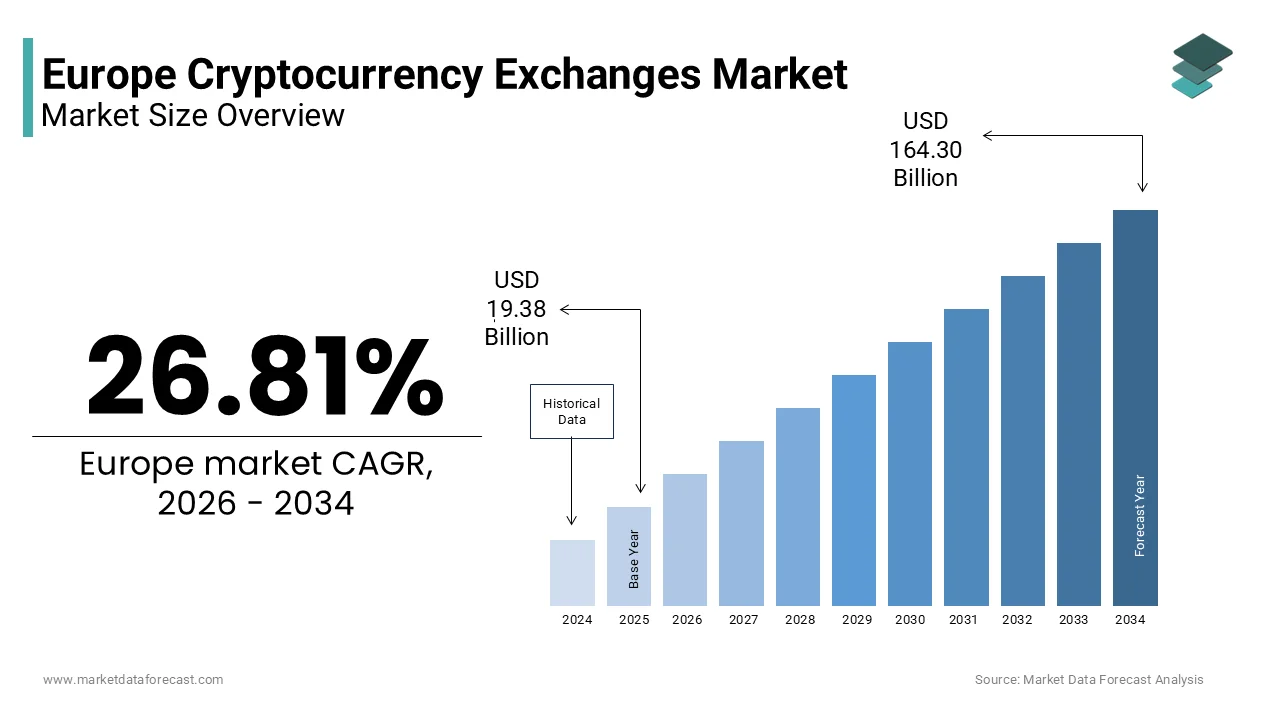
26.81%Europe Cryptocurrency Exchanges Market Report Summary
The Europe cryptocurrency exchanges market was valued at USD 19.38 billion in 2025 and is estimated to reach USD 24.57 billion in 2026, with the market projected to grow to USD 164.30 billion by 2034, registering a strong CAGR of 26.81% during the forecast period. Market growth is driven by increasing adoption of digital assets, rising retail and institutional participation, and expanding blockchain based financial ecosystems. Supportive regulatory developments in certain European countries, growing interest in decentralized finance, and rising demand for secure and user friendly trading platforms are further accelerating market expansion across the region.
Key Market Trends
- Rapid growth in retail cryptocurrency trading supported by mobile trading applications and simplified onboarding processes.
- Increasing institutional participation and integration of digital assets into mainstream investment portfolios.
- Expansion of decentralized finance platforms and tokenized assets.
- Growing focus on regulatory compliance, transparency, and enhanced security frameworks.
- Rising adoption of advanced trading features such as derivatives, staking, and crypto based payment solutions.
Segmental Insights
- Based on cryptocurrency type, the bitcoin segment dominated the Europe cryptocurrency exchanges market by accounting for 52.4 percent of the market share in 2025. Bitcoin maintains its leadership position due to its high liquidity, strong brand recognition, and widespread acceptance among retail and institutional investors.
- Based on end use, the personal segment led the market by capturing a significant share in 2025. Growth in this segment is supported by increasing retail investor participation, higher digital asset awareness, and growing use of cryptocurrencies for trading and investment purposes.
Regional Insights
- Germany outperformed other European countries in the cryptocurrency exchanges market by holding 24.6 percent of the regional market share in 2025. The country’s strong fintech ecosystem, progressive regulatory stance toward digital assets, and growing investor base contribute to its leadership position.
- Other European markets are also witnessing rapid adoption, driven by technological innovation, increasing digital payment adoption, and expanding crypto investment platforms.
Competitive Landscape
The Europe cryptocurrency exchanges market is highly competitive and innovation driven, with global and regional exchanges competing on security, liquidity, regulatory compliance, and product offerings. Companies are investing in advanced cybersecurity measures, diversified trading instruments, and strategic partnerships to expand their market presence. Prominent players operating in the market include AirSwap, FTX, Robinhood Markets Inc Class A, Binance.US, eToro USA, Monex Group Inc, Kraken Robotics Inc, Bitstamp, Coinbase Global Inc Ordinary Shares Class A, Wellfield Technologies Inc, and BLOK Technologies Inc.
Europe Cryptocurrency Exchanges Market Size
The Europe cryptocurrency exchanges market size was valued at USD 19.38 billion in 2025 and is projected to reach USD 164.30 billion by 2034 from USD 24.57 billion in 2026, growing at a CAGR of 26.81%.
Cryptocurrency exchanges are digital marketplaces that allow users to buy, sell, and trade cryptocurrencies like Bitcoin, Ethereum, and Tether. These platforms function similarly to traditional stock brokerages, providing the infrastructure to swap digital assets for other cryptocurrencies or for government-backed fiat money. These platforms serve as the primary on and off ramps connecting traditional fiat currencies to the decentralized blockchain ecosystem. The market’s current structure is being fundamentally reshaped by the European Union’s landmark Markets in Crypto Assets (MiCA) regulation, which establishes the world’s first comprehensive legal framework for crypto asset service providers. The EU's new, standardized regulatory regime is driving a shift from national to unified licensing, which is maturing and consolidating the digital asset industry. Despite the volatile nature of digital currencies, a growing number of European households are entering the crypto market, driven by increased accessibility and interest, which in turn is quietly deepening the digital asset sector's connection to the broader financial system. This context positions the exchanges market at the critical intersection of financial innovation, consumer protection, and regulatory compliance.
MARKET DRIVERS
Implementation of the EU’s MiCA Regulatory Framework
The phased implementation of the Markets in Crypto Assets (MiCA) regulation drives the growth of the growth of the Europe cryptocurrency exchanges market. This landmark legislation provides long awaited legal clarity and a harmonized licensing regime across all twenty seven EU member states, replacing a fragmented patchwork of national rules. MiCA mandates stringent requirements for capital adequacy, custody of client assets, market abuse prevention, and transparency, which effectively raises the barrier to entry and forces unregulated or undercapitalized operators to exit the market. The European Union is actively creating a unified, secure, and transparent digital environment for digital assets, enabling responsible innovation to flourish while putting robust safeguards in place to protect everyday consumers and ensure financial stability. This regulatory certainty is a powerful catalyst for institutional adoption. Large financial firms and traditional banks, which previously avoided the space due to its Wild West reputation, are now entering the market with compliant exchange offerings. The transition to a regulated environment is transforming the market from a speculative frontier into a legitimate component of the European financial system, driving demand for secure, transparent, and professionally managed exchange services.
Growing Institutional and Retail Adoption of Digital Assets
The accelerating adoption of cryptocurrencies and digital assets by both institutional investors and mainstream retail consumers across the region further propels the expansion of the Europe cryptocurrency exchanges market. Institutional interest has surged as pension funds, asset managers, and family offices begin to allocate a small percentage of their portfolios to Bitcoin and Ethereum as a hedge against inflation and a source of uncorrelated returns. Simultaneously, retail adoption has moved beyond early adopters into the mainstream, facilitated by user friendly mobile apps and integrated financial services. Cryptocurrency ownership among adults in the Eurozone has grown significantly, with the number of investors increasing substantially in recent years due to rising consumer confidence and new regulations. This broadening user base creates a sustained and growing demand for reliable, secure, and easy to use exchange platforms. The need for these platforms is not just for trading but for safe custody, price discovery, and access to a diverse range of digital assets, making exchanges the essential infrastructure for the entire digital asset economy in Europe.
MARKET RESTRAINTS
Stringent Anti Money Laundering and Counter Terrorist Financing Requirements
The exceptionally stringent application of Anti-Money Laundering (AML) and Counter-Terrorist Financing (CTF) regulations, primarily under the EU’s 5th and 6th Anti-Money Laundering Directives, is a significant operational and financial restraint on the European cryptocurrency exchange market. These rules require exchanges to implement rigorous Know Your Customer (KYC) procedures, conduct ongoing transaction monitoring, and report suspicious activities to national Financial Intelligence Units. The compliance burden is immense, often requiring exchanges to invest millions of euros in specialized compliance staff, sophisticated monitoring software, and legal counsel. According to the European Banking Authority, the financial burden of implementing necessary anti-money laundering and counter-terrorist financing systems for mid-sized crypto firms in the EU is rising significantly, driven by the tightening regulatory framework. This high cost of compliance acts as a major barrier to entry for new startups and can squeeze the profit margins of established players, potentially stifling innovation and limiting the diversity of service providers in the market. The constant threat of regulatory penalties for non compliance further adds to the operational risk and financial pressure.
Restrictive Stance on Privacy Coins and Decentralized Finance Protocols
The European regulatory environment is increasingly hostile toward privacy enhancing technologies within the crypto ecosystem, which acts as a significant constraint on the scope of services exchanges can offer. This in turn affects the expansion of the Europe cryptocurrency exchanges market. Several EU member states have taken a de facto ban on privacy coins like Monero and Zcash, which are designed to obscure transaction details. Exchanges operating in these jurisdictions are forced to delist these assets to maintain their regulatory licenses. Furthermore, the MiCA framework currently excludes decentralized finance (DeFi) protocols, creating a legal gray area for any exchange that wishes to integrate with or provide access to these non custodial platforms. As per sources, there is a strong regulatory preference for fully identifiable and traceable transactions, which is at odds with the core ethos of much of the crypto space. This restrictive stance limits the product offering of European exchanges, potentially driving users toward less regulated offshore platforms and hindering Europe’s ability to be a leader in the full spectrum of blockchain innovation.
MARKET OPPORTUNITIES
Integration of Tokenized Real World Assets onto Exchange Platforms
The listing and trading of tokenized real world assets (RWAs) create new prospects for the growth of the Europe cryptocurrency exchanges market. The MiCA regulation explicitly provides a legal pathway for the issuance and trading of asset referenced tokens and electronic money tokens, which can represent ownership in traditional assets like government bonds, corporate debt, real estate, or even fine art. This convergence of traditional finance and blockchain technology opens a vast new market. For example, an exchange could list a tokenized German government bond fund, allowing retail investors to buy fractional shares with near 24/7 liquidity. Major financial analyses suggest that as digital ledger technology becomes integrated into European capital markets, the tokenization of physical and financial assets is poised for significant, widespread adoption, with the potential to revolutionize how large-scale investments are managed by the end of the decade. Exchanges can anchor themselves in the future European financial system by pivoting to stable, income-yielding digital securities, moving beyond speculation to attract a broader, risk-averse audience.
Provision of Embedded Financial Services Beyond Trading
European exchanges have a major opportunity to evolve from simple trading venues into full service digital asset banks by offering a suite of embedded financial services, which is predicted to fuel the expansion of the Europe cryptocurrency exchanges market. Leveraging their existing user base and regulatory licenses under MiCA, they can provide services such as interest bearing savings accounts for idle crypto, secured lending against digital asset collateral, and payment solutions for everyday transactions. This strategy transforms the customer relationship from a transactional one to a holistic financial partnership. For instance, a user could deposit Bitcoin, earn a yield on it, use it as collateral for a euro loan to make a purchase, and then repay the loan over time. As the cryptocurrency market matures, a substantial number of digital asset owners are moving beyond simple trading to seek practical financial utility. Individuals are increasingly looking to leverage their holdings for everyday banking needs, treating their digital assets as active tools for building savings and accessing credit. Exchanges can cement their status as essential digital age financial hubs by developing an integrated ecosystem, thereby enhancing customer retention and diversifying revenue.
MARKET CHALLENGES
Volatility of Crypto Asset Prices and Its Impact on User Trust
The extreme price volatility inherent to the underlying digital assets continues to be a persistent and fundamental challenge for the Europe cryptocurrency exchanges market. Sharp, unpredictable price swings can lead to significant user losses, eroding trust in the platform itself, regardless of its security or regulatory standing. A sudden market crash can trigger a wave of customer support inquiries, withdrawal requests, and negative publicity, straining operational resources and damaging the brand’s reputation. According to sources, periods of high market volatility are consistently correlated with a spike in investor complaints against crypto asset service providers. This volatility makes it difficult for exchanges to build a stable, long term customer base, as many users treat the platform as a short term speculation tool rather than a core financial service. Managing user expectations and providing robust risk warnings is a constant challenge, and the association with a highly speculative asset class remains a significant reputational headwind, particularly when trying to attract conservative institutional capital.
Evolving and Uncertain Tax Treatment Across Member States
The lack of a consistent European tax policy makes tax reporting and compliance exceptionally difficult for cryptocurrency operators and investors, which limits the expansion of the Europe cryptocurrency exchanges market. While the EU has made progress on regulation through MiCA, taxation remains the sole competence of individual member states, leading to a fragmented landscape of capital gains tax rates, income tax treatments, and reporting requirements. An exchange user who is a citizen of one country but resides in another may face conflicting tax obligations. This complexity deters mainstream adoption, as potential users are confused by their liabilities. For exchanges, it creates a massive compliance burden. They must navigate and adhere to the specific tax reporting rules of every country in which they operate, which can be costly and technically challenging. As per research, this lack of tax harmonization is a major obstacle to the creation of a true single market for crypto assets, and until it is resolved, it will continue to act as a friction point that hinders the market’s growth and user experience.
REPORT COVERAGE
| REPORT METRIC | DETAILS |
| Market Size Available | 2025 to 2034 |
| Base Year | 2025 |
| Forecast Period | 2026 to 2034 |
| CAGR | 26.81% |
| Segments Covered | By Cryptocurrency Type, End Use, and Region |
| Various Analyses Covered | Global, Regional, & Country Level Analysis; Segment-Level Analysis; DROC, PESTLE Analysis; Porter’s Five Forces Analysis; Competitive Landscape; Analyst Overview of Investment Opportunities |
| Regions Covered | UK, France, Spain, Germany, Italy, Russia, Sweden, Denmark, Switzerland, Netherlands, Turkey, and the Czech Republic |
| Market Leaders Profiled | AirSwap, FTX, Robinhood Markets Inc Class A, Binance.US, eToro USA, Monex Group Inc, Kraken Robotics Inc, Bitstamp, Coinbase Global Inc Ordinary Shares Class A, Wellfield Technologies Inc, and BLOK Technologies Inc. |
SEGMENTAL ANALYSIS
By Cryptocurrency Type Insights
The bitcoin segment dominated the Europe cryptocurrency exchanges market by accounting for a 52.4% share in 2025. The dominance of the bitcoin segment is driven by its status as the original and most widely recognized digital asset, which has fostered unparalleled trust and liquidity. The primary driver is its increasing acceptance as a legitimate reserve asset by institutional investors. European investment managers are increasingly transitioning from speculative interest to anchoring their portfolios with Bitcoin, treating it as a foundational, long-term, digital alternative to gold. This institutional endorsement has created a deep and stable pool of demand that transcends short term price volatility. Furthermore, Bitcoin’s first mover advantage means it is listed on every single regulated exchange in Europe, ensuring maximum accessibility for retail and institutional traders alike. Its simple, secure, and battle tested network provides a level of reliability that newer, more complex blockchains have yet to match, solidifying its position as the foundational asset of the European crypto ecosystem.
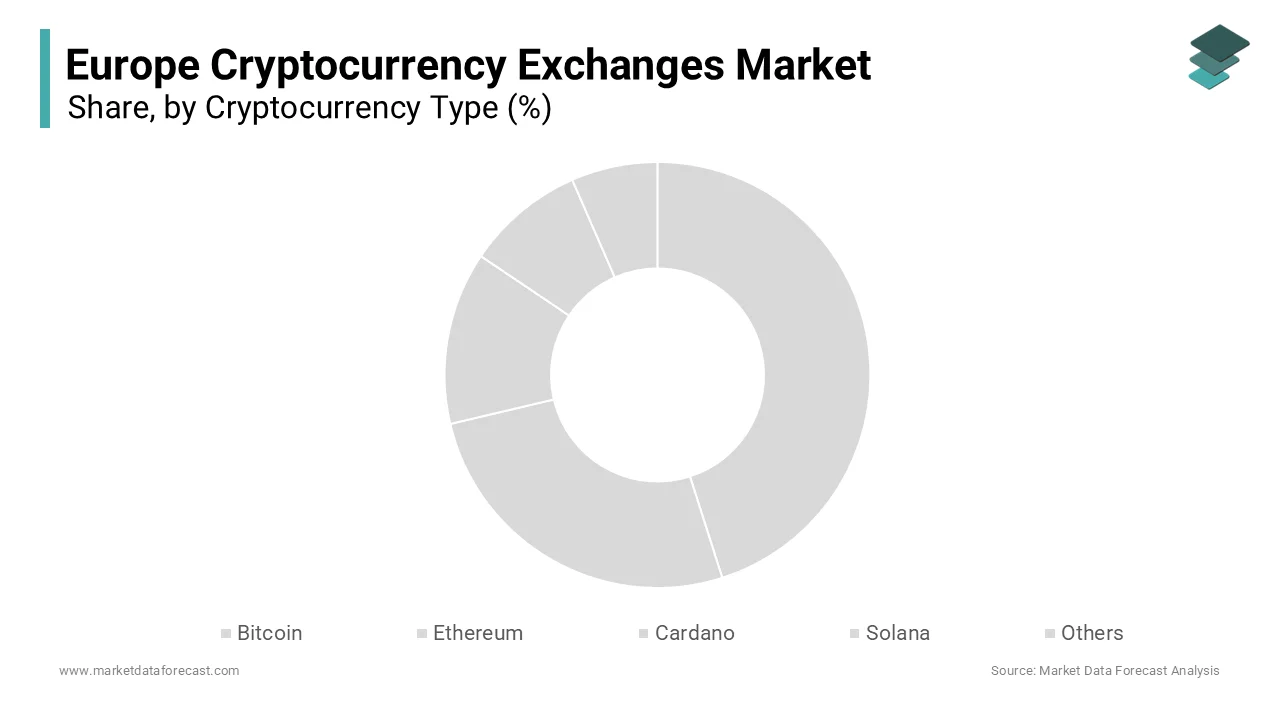
The solana segment is likely to experience the fastest CAGR of 41.7% from 2026 to 2034 due to its unique technological proposition of high speed and low cost transactions, which directly addresses the scalability limitations of older networks like Ethereum. Solana’s architecture can process over sixty five thousand transactions per second at a fraction of a cent per transaction, making it the preferred platform for a new wave of consumer facing applications in decentralized finance (DeFi) and non-fungible tokens (NFTs). A key driver is the surge in user activity. European developers and investors are increasingly moving away from slower, more expensive blockchain networks and adopting Solana, which is known for its high throughput and low fees. This vibrant ecosystem attracts both developers building new applications and users seeking a seamless, affordable experience, creating a powerful network effect that drives trading volume and exchange listings across the continent.
By End Use Insights
The personal end use segment led the Europe cryptocurrency exchanges market by capturing a significant share in 2025. The leading position of the personal end use segment is attributed to the grassroots, retail driven nature of crypto adoption on the continent. An additional driver is the widespread availability of user friendly mobile applications from regulated exchanges, which have dramatically lowered the barrier to entry for non technical users. These apps offer intuitive interfaces for buying, selling, and holding digital assets, often integrated with traditional bank accounts for easy fiat on and off ramps. Many Europeans are increasingly exploring digital assets, with ownership rising in several nations, although they predominantly use these holdings for investment purposes rather than day-to-day transactions. This massive base of individual users, motivated by a mix of investment speculation, ideological belief in decentralization, and a desire for financial self sovereignty, creates a consistent and high volume stream of trading activity that forms the bedrock of the entire exchange market.
The fintech companies segment is on the rise and is expected to be the fastest growing segment in the market by witnessing a CAGR of 33.5% during the forecast period owing to the strategic integration of crypto services into the broader digital banking and payment offerings of these agile firms. Neobanks and payment processors are leveraging their existing customer bases to offer seamless crypto trading and custody as a value added feature, turning their platforms into one stop shops for all financial needs. A key factor is the regulatory clarity provided by MiCA, which allows licensed fintechs to operate as crypto asset service providers without needing a separate, full scale exchange license. In 2024, driven by new regulatory clarity, a substantial portion of European fintech companies accelerated their digital maturity by launching or expanding their crypto services, signaling a move toward legitimizing digital assets for everyday users. This embedded finance model allows fintechs to capture a share of the crypto market without building a standalone exchange, creating a powerful new channel for user acquisition and transaction volume that is growing far faster than the traditional personal or commercial segments.
REGIONAL ANALYSIS
Germany Cryptocurrency Exchanges Market Analysis
Germany outperformed other countries in the Europe cryptocurrency exchanges market by holding a 24.6% share in 2025. The supremacy of the German market is propelled by its robust financial sector, high disposable income, and a tech savvy population with a strong interest in financial innovation. The German market is characterized by a proactive regulatory approach, with the Federal Financial Supervisory Authority (BaFin) being one of the first in Europe to establish a clear licensing regime for crypto custodians and exchanges. A key driver is the high level of institutional engagement. According to sources, several major German banks now offer crypto custody or trading services to their clients. This blend of a supportive regulatory framework, a strong institutional presence, and a large base of affluent retail investors creates a deep and resilient market that sets the standard for the rest of the continent.
United Kingdom Cryptocurrency Exchanges Market Analysis
The United Kingdom followed closely in the European cryptocurrency exchanges market by holding a 19.2% share in 2025. Despite its departure from the EU, the UK remains a global financial hub with a highly developed fintech ecosystem centered in London. The market is supported by its maturity and its concentration of major international exchange headquarters and regional offices. A critical driver is the proactive stance of the Financial Conduct Authority (FCA), which has been registering crypto firms under its Anti Money Laundering regime since 2020, providing a degree of certainty that attracted significant investment. According to research, the UK’s fintech trade body, London is home to numerous crypto and blockchain startups. This dense cluster of talent, capital, and regulatory expertise ensures the UK remains a powerhouse of crypto activity, even as it navigates its own post Brexit regulatory path separate from MiCA.
France Cryptocurrency Exchanges Market Analysis
France is also a key player in the European cryptocurrency exchanges market due to a strong government led strategy to position Paris as a leading European crypto hub. The “Crypto Assets Plan” launched by the government has created a welcoming environment for regulated businesses, with the Autorité des Marchés Financiers (AMF) operating a public registry of compliant digital asset service providers. A major factor driving the market is the influx of major international players. According to a study, many global crypto firms established their European headquarters in Paris between 2022 and 2024, drawn by the clear regulatory framework and state support. This top down approach, combined with a growing base of domestic crypto enthusiasts, has transformed France from a cautious observer into one of the most dynamic and strategically important markets in Europe.
Netherlands Cryptocurrency Exchanges Market Analysis
The Netherlands is moving ahead steadfastly in the European cryptocurrency exchanges market owing to the country’s historical role as a global trading nation, which has fostered a business friendly culture that extends to the digital asset space. The Dutch market is renowned for its progressive and pragmatic regulatory stance, with De Nederlandsche Bank (DNB) focusing on a risk based supervision model that encourages innovation while managing threats. Amsterdam has become a magnet for crypto startups and talent, with a thriving ecosystem of exchanges, custodians, and blockchain developers. According to research, the number of registered crypto service providers in the Netherlands surged in recent years. This combination of a supportive regulatory environment, a strategic geographic location, and a deep pool of technical expertise has made the Netherlands a critical gateway for crypto businesses entering the European market.
Switzerland Cryptocurrency Exchanges Market Analysis
Switzerland is anticipated to grow in the Europe cryptocurrency exchanges market from 2026 to 2034 due to its “Crypto Valley” in Zug, a canton that has established itself as a global epicenter for blockchain innovation through a combination of favorable tax policies and a clear, principle based regulatory framework from the Swiss Financial Market Supervisory Authority (FINMA). A major factor is the country’s long standing tradition of banking secrecy and wealth management, which has naturally extended into the digital asset custody space. According tosources, numerous blockchain related companies are now headquartered in Switzerland. This reputation for security, stability, and regulatory clarity attracts high net worth individuals and institutional investors from across Europe and the world, making Switzerland a premium, high value segment of the broader European market.
COMPETITIVE LANDSCAPE
The competitive landscape of the Europe cryptocurrency exchanges market is undergoing a profound transformation driven by the implementation of the MiCA regulation. The market is shifting from a fragmented, Wild West environment dominated by offshore entities to a consolidated, professionalized sector led by a handful of well capitalized, compliant firms. Global giants like Coinbase and Kraken are competing directly with established European players like Bitstamp for dominance, leveraging their scale and resources to navigate the complex licensing process. The primary battleground is now regulatory compliance, security, and the breadth of integrated financial services, rather than just trading fees. This new paradigm has raised the barrier to entry significantly, forcing smaller or non compliant exchanges to exit the market. Competition is intense but increasingly focused on building trust, offering a superior user experience, and developing innovative products that align with the EU’s vision of a safe and integrated digital asset market, creating a more stable but highly demanding competitive arena.
KEY MARKET PLAYERS
Some of the notable key players in the Europe cryptocurrency exchanges market are
- AirSwap
- FTX
- Robinhood Markets Inc Class A
- Binance.US
- eToro USA
- Monex Group Inc
- Kraken Robotics Inc
- Bitstamp
- Coinbase Global Inc Ordinary Shares Class A
- Wellfield Technologies Inc
- BLOK Technologies Inc
Top Players in the Market
- Coinbase is a leading global cryptocurrency exchange with a significant and growing presence across Europe. The company offers a comprehensive suite of services including spot trading, staking, and institutional custody, all built on a foundation of regulatory compliance. To strengthen its European foothold, Coinbase has been actively pursuing licenses under the EU’s new Markets in Crypto Assets (MiCA) framework. A key recent action was its successful registration as a Virtual Asset Service Provider, which allows it to offer its full range of services to French customers and serves as a strategic beachhead for its broader EU expansion strategy.
- Kraken is a major global exchange renowned for its deep liquidity and advanced trading features, with a strong and loyal user base in Europe. The company has made a concerted effort to position itself as a leader in regulatory compliance within the region. In a decisive move to solidify its market position, Kraken became one of the first major international exchanges to obtain a MiCA license. This authorization not only grants it full operational rights across the EU but also signals its long term commitment to the European market and its regulatory standards.
- Bitstamp is one of the oldest and most established cryptocurrency exchanges in Europe, headquartered in Luxembourg. The company has built its reputation on security, reliability, and a strong focus on institutional clients. To enhance its competitive edge, Bitstamp has been at the forefront of integrating traditional financial infrastructure with digital assets. Its most significant recent action was the launch of a fully regulated euro denominated stablecoin in partnership with a major European bank. This innovation provides its European users with a seamless and compliant fiat on ramp, directly addressing a key friction point in the trading experience.
Top Strategies Used by the Key Market Participants
Key players in the Europe cryptocurrency exchanges market are primarily deploying three core strategies to secure their competitive advantage. First, they are aggressively pursuing regulatory licenses under the EU’s MiCA framework to gain a legal passport to operate across all member states, which builds trust and deters unregulated competitors. Second, they are expanding their product offerings beyond simple spot trading to include staking, lending, and tokenized real world assets to increase customer lifetime value and create diversified revenue streams. Third, they are forging strategic partnerships with traditional banks and fintech companies to embed their services into existing financial ecosystems, thereby acquiring new users and providing seamless fiat on and off ramps that are critical for mainstream adoption.
MARKET SEGMENTATION
This research report on the European cryptocurrency exchanges market has been segmented and sub-segmented based on categories.
By Cryptocurrency Type
- Bitcoin
- Ethereum
- Cardano
- Solana
- Others
By End Use
- Commercial
- Banks
- Fintech Companies
- Credit Unions
- Others
- Personal
By Country
- UK
- France
- Spain
- Germany
- Italy
- Russia
- Sweden
- Denmark
- Switzerland
- Netherlands
- Turkey
- Czech Republic
- Rest of Europe