Europe CubeSat Market Research Report By Size, Component, Payload Type, Application, and Country (Germany, France, United Kingdom, Sweden, Spain, Rest of Europe) – Industry Analysis, Size, Share, Trends & Growth Forecast (2026 to 2034)
Europe CubeSat Market Size
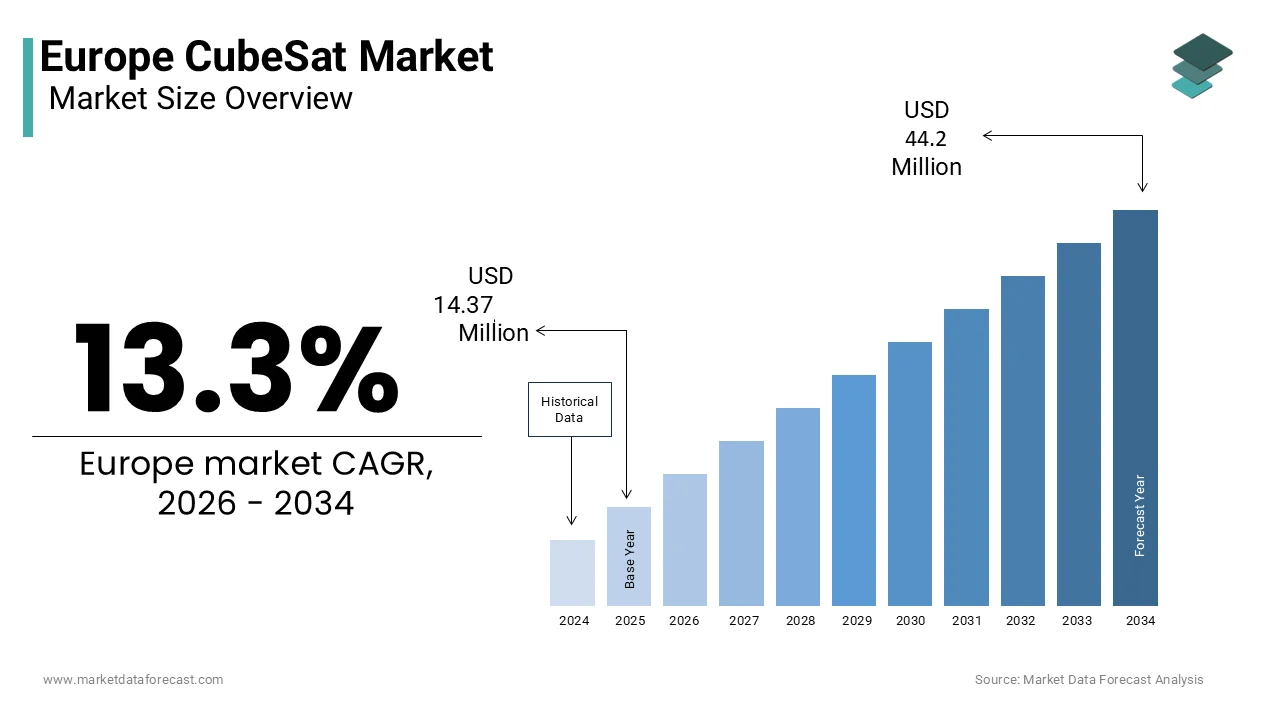
The europe cubesat market was valued at USD 14.37 million in 2025, is expected to reach USD 16.28 million in 2026, and growing at a CAGR of 13.3% from 2025 to 2033 is projected to reach USD 44.2 million by 2034.
A CubeSat refers to the design, integration, launch, and operation of standardized miniaturized satellites, typically in 1U (10x10x10 cm) to 12U configurations, for scientific research, Earth observation, technology demonstration, and educational missions in Low Earth Orbit. Unlike bespoke spacec, raft CubeSats leverage commercial off-the-shelf components and modular architectures to drastically reduce development timelines and costs. Europe’s engagement in this segment is driven by institutional demand for responsive space capabilities and academic efforts to democratize access to orbit. As per sources, a substantial increase in the number of European CubeSat launches has occurred, particularly in the period between 2022 and 2025, showing accelerated adoption. National space agencies, including CNES in France, DLR in GeGermanynd the Swedish National Space Agency, actively sponsor university-led missions under coordinated programs such as ESA’s Fly Your Satellite. The European Union also utilizes CubeSat data for environmental monitoring under the Copernicus program, with dedicated missions like the 6U FSSCat providing soil moisture and sea ice measurements. Academic institutions in a large number of European countries have established dedicated CubeSat laboratories, with financial support from programs like Horizon Europe, fostering this growth. This dual-use ecosystem, spanning classrooms, constellations, and crisis response, positions CubeSats as a critical enabler of Europe’s agile and inclusive space strategy.
MARKET DRIVERS
Integration into EU Earth Observation and Climate Monitoring Frameworks Is Fueling Institutional Adoption
The systematic incorporation of these satellites into its environmental and climate data infrastructure is driving forward the European CubeSat market. Driver of sustained institutional demand. As per a study, the Copernicus program leverages a combination of dedicated Sentinel satellites and data from numerous commercial and institutional contributing missions, including some small satellites and CubeSats, to deliver a wide range of Earth observation data to users. Research and development using data from innovative small satellite missions like FSSCat for applications such as soil moisture monitoring are ongoing, contributing to the broader data pool used in European environmental and agricultural policy evaluations. Similarly, Germany's DLR continues to be involved in CubeSat research, with past missions such as the 3U MOVE II focusing on areas like demonstrating new technologies and scientific research in low Earth orbit. The European Commission's Horizon Europe program supports a range of space-related research and innovation, which includes funding for new Earth observation technologies and data analysis methods for climate monitoring and other applications. National agencies reinforce this trend. France’s CNES funds the JANUS initiative (Joint Action for satellite Universities' Standardization), which supports multiple university CubeSat teams annually to promote space education and technology development. These structured programs transform CubeSats from educational tools into validated data sources, ensuring recurring procurement and mission continuity.
Expansion of University and Research Consortium Programs Is Democratizing Access to Orbit
A robust network of academic and research consortia has institutionalized CubeSat development as a core component of aerospace education and scientific experimentation, which is another key factor fuelling the expansion of the European CubeSat market. Apart from these, national initiatives like Germany’s REXUS BEXUS program provide annual stratospheric and orbital launch opportunities for student payloads. This academic pipeline not only trains the next generation of space engineers but also generates low-risk, high-innovation platforms for testing disruptive technologies later adopted by institutional missions. The resulting ecosystem lowers entry barriers and ensures a steady flow of mission concepts, talent, and prototype validation crucial for Europe’s long-term space competitiveness.
MARKET RESTRAINTS
Limited Access to Dedicated and Affordable European Launch Services Constricts Deployment Timelines
The lack of regular, low-cost dedicated launch options is creating significant barriers in orbital access, despite growing CubeSat activity. This restricts the growth of the European CubeSat market. As per research, Europe has a current lack of sufficient, dedicated small satellite launch options, unlike the frequent, cost-effective rideshare programs available elsewhere. Most European CubeSats rely on procuring seats on Indian PSLV or American Falcon 9 vehicles, which introduces scheduling uncertainty, export control review, and insurance complexities. This service gap was worsened by a temporary pause in operations for a key rocket type (Vega C) and the replacement rocket (Vega E) not being ready yet. New private companies aiming to provide more affordable launch services have not yet successfully reached orbit. As a result of limited competition, launching a satellite in Europe is significantly more expensive than the average price on the global market. This dependency on non-European launchers affects the EU’s strategic autonomy goals and discourages time-sensitive missions such as disaster response or rapid technology demonstration. European CubeSat developers face prolonged wait times, often exceeding several months after integration, because they lack a reliable sovereign rideshare service.
Inconsistent Radiation Hardening and Space Qualification Standards Increase Mission Risk
The widespread use of commercial off-the-shelf components in these satellites exposes European missions to elevated failure rates, which obstructs the growth of the European CubeSat market. This is due to inadequate radiation tolerance and thermal resilience in Low Earth Orbit. Unlike larger ESA missions, which mandate rigorous parts screening, CubeSat programs often operate under relaxed qualification protocols to contain costs. National agencies apply divergent standards. Established space agencies (like France’s CNES or DLR) require rigorous total ionizing dose testing and physical component assessments for high-reliability missions; however, university-led CubeSat teams may use commercial off-the-shelf (COTS) components with limited or simulation-based radiation assessments for lower-cost and higher-risk missions. This fragmentation hampers interoperability and data reliability across constellations. Although ESA’s initiative promotes standardized component libraries, ESA's adoption remains voluntary. CubeSat mission success rates in Europe will fall short of institutional benchmarks, limiting their utility in operational services, until the region harmonizes radiation hardening requirements and funds shared test facilities.
MARKET OPPORTUNITIES
Rise of Commercial Earth Data Services Is Creating New Revenue Streams for CubeSat Operators
These satellites are being transformed from cost centers into commercially viable data platforms by the rise of private businesses for high-frequency geospatial analytics, and this is setting up new opportunities for the expansion of the European CubeSat market. As per the European Association of Remote Sensing Companies, many European startups now offer subscription-based analytics derived from CubeSat constellations serving the agriculture insurance and maritime sectors. Commercial and governmental entities are increasingly utilizing radiofrequency satellite technology for tracking activities like illicit maritime shipping. Similarly, Companies are employing compact, cost-effective satellites to furnish high-resolution imagery for overseeing specific sectors, such as agricultural enterprises. Public financial entities are supporting CubeSat companies in assuming greater risk for novel data-as-a-service ventures. Furthermore, governmental initiatives are funding public bodies to utilize commercial CubeSat data for public service requirements, including weather prediction and urban development. These developments validate a sustainable business case beyond grants, enabling European smallsat firms to scale constellation, reinvest next-generation payload, and compete globally in the rapidly expanding commercial Earth observation landscape.
Adoption in NATO and EU Defense Exercises Is Opening Tactical Reconnaissance Opportunities
Increased integration into military readiness frameworks is offering low-cost responsive intelligence for tactical operations and crisis simulation, which is providing fresh prospects for the expansion of the European CubeSat market. As per sources, several European Union member nations, including key players like Germany, Italy, and Sweden, have started actively using small satellites for practical battlefield functions such as gathering imagery and intelligence during major military exercises. The North Atlantic Treaty Organization (NATO) is now formally integrating these small satellites into its long-term strategic planning, considering them vital tools for gaining a clear understanding of situations in space. Individual nations like France are funding specific small-satellite missions designed to experiment with advanced capabilities, such as using artificial intelligence to automatically identify targets on the ground. These applications leverage CubeSats’ short development cycles and expendable nature, ideal for contested scenarios where larger assets are high-value targets. This institutional validation is accelerating dual-use innovation and attracting defense primes to collaborate with academic and startup CubeSat developers.
MARKET CHALLENGES
Lack of Standardized End-of-Life Deorbiting Solutions Threatens Orbital Sustainability
The absence of uniform and reliable deorbiting mechanisms poses a growing threat to Low Earth Orbit sustainability and regulatory compliance, which constrains the growth of the European CubeSat market. As per research, a significant number of small satellites launched by European entities recently did not have special systems to remove them from orbit. Instead of using active removal technology, many of these satellites relied only on natural atmospheric drag, which can be a very slow process. This slow passive disposal method does not meet current legal requirements that demand a faster return to Earth after a mission ends. Many university teams omit drag sails due to mass budget constraints or integration complexity, even though some missions, such as the 3U URSAMAIOR from Italy, choose to deploy them. Upcoming regulations will require all future small satellites to prove they have a reliable plan for a controlled reentry. Commercial providers offer deorbit kits, but at a premium often unaffordable for academic budgets. Europe risks contributing to LEO congestion, undermining its leadership in responsible space governance, and potentially triggering stricter launch licensing that could stifle innovation, all because it lacks subsidized access to certified deorbit technologies or mandatory design rules.
Fragmented Ground Segment Infrastructure Hinders Data Downlink Efficiency and Mission Scalability
The regional CubeSat operators face persistent challenges in accessing reliable high-capacity ground stations, leading to data barriers and reduced operational utility, which hinders the expansion of the European CubeSat market. Commercial networks like KSAT and AWS Ground Station offer global coverage, but their fees are typically beyond the reach of academic budgets. ESA’s EGS-CC initiative aims to unify ground software but does not address hardware scarcity. This fragmented infrastructure forces mission designers to limit payload output or accept weeks-long data latency, contradicting the promise of responsive space. CubeSat constellations in Europe will struggle to achieve an operational tempo comparable to U.S. counterparts until the region establishes an open and shared ground segment with automated scheduling and affordable pricing.
REPORT COVERAGE
| REPORT METRIC | DETAILS |
| Market Size Available | 2025 to 2033 |
| Base Year | 2025 |
| Forecast Period | 2026 to 2034 |
| Segments Covered | By Size, Component, Payload Type, Application, and Region. |
| Various Analyses Covered | Global, Regional, and Country-Level Analysis, Segment-Level Analysis, Drivers, Restraints, Opportunities, Challenges; PESTLE Analysis; Porter’s Five Forces Analysis, Competitive Landscape, Analyst Overview of Investment Opportunities |
| Countries Covered | UK, France, Spain, Germany, Italy, Russia, Sweden, Denmark, Switzerland, Netherlands, Turkey, Czech Republic, Rest of Europe |
| Market Leaders Profiled | GomSpace Group AB, AAC Clyde Space, ISISPACE Group, EnduroSat AD, NanoAvionics, Tyvak International SRL (Terran Orbital Corporation), Berlin Space Technologies GmbH, SatRevolution S.A., Open Cosmos Ltd., Planet Labs PBC, Spire Global Inc., Surrey Satellite Technology Ltd. (SSTL), Thales Alenia Space, OHB SE, Airbus Defence and Space, D-Orbit S.p.A., Exolaunch GmbH, Leaf Space S.r.l., LuxSpace S.A., ISIS – Innovative Solutions In Space B.V. |
SEGMENTAL ANALYSIS
By Size Insights
The 3U segment held the leading share of 38.4% of the European CubeSat market in 2025. Its optimal balance of volume, payload capacity, and launch compatibility has mainly contributed to the growth of the 3Usegment. As per the European Space Agency, the 1U and 3U CubeSat form factors are widely adopted by academic and institutional missions, becoming a standard platform for educational and technology demonstration missions due to their standardized design and cost-effective access to space. This dominance is also attributed to its suitability for Earth observation payload, including multispectral imagers and GNSS reflectometry instruments, which require moderate power and pointing stability. According to the European Space Education Resource Office, many university CubeSat projects under ESA’s Fly Your Satellite! program selected the 3U form factor between 2020 and 2025 due to standardized structural kits and predictable thermal behavior, which facilitate development and testing. National agencies support this preference. The widespread availability of 3U deployers from companies like ISISPACE and compatibility with nearly all global rideshare missions further reduces integration risk and cost, making it the most accessible and reliable format for first-time and repeat developers across Europe.
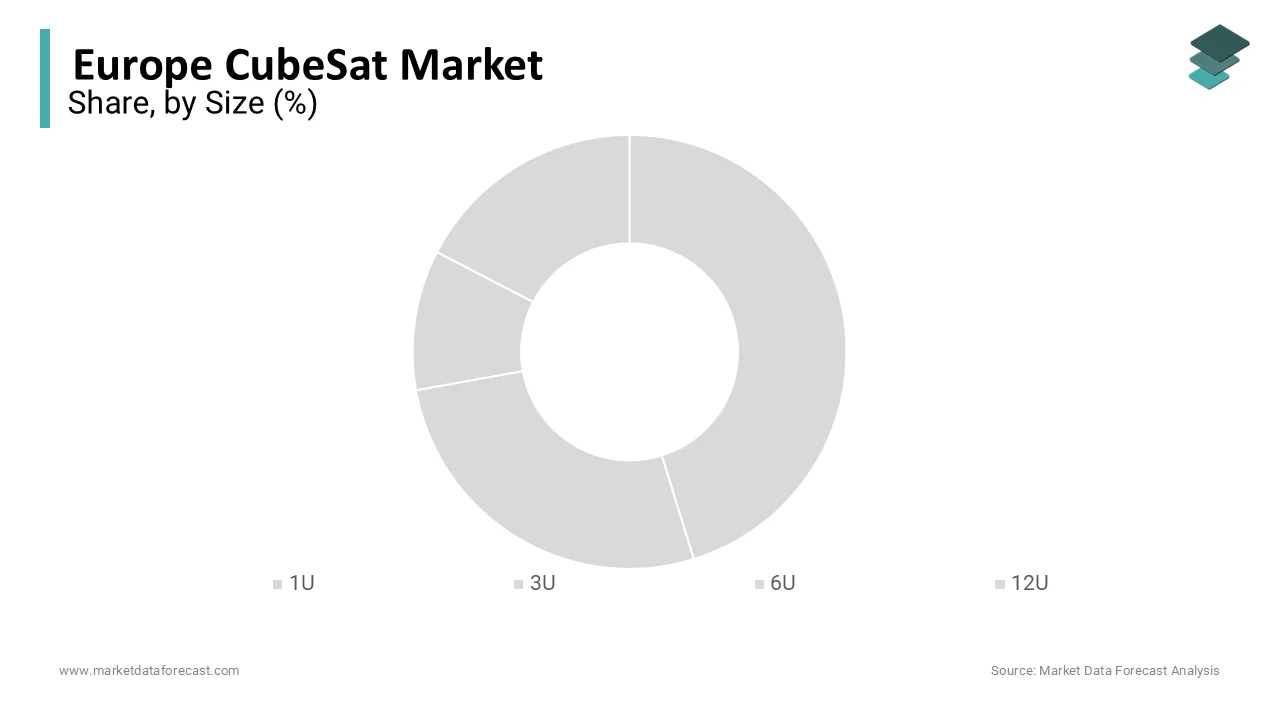
The 12U segment is predicted to witness the highest CAGR of 29.6% from 2025 to 2033 due to demand for higher performance Earth observation and communication missions that exceed the capabilities of smaller platforms. Unlike 3U or 6U systems, 12U satellites offer sufficient volume for advanced optical telescopes, high-gain antennas, and miniaturized propulsion, enabling operational rather than experimental roles. The European Defence Agency continued to support collaborative defense research and technology among its member states in 2025, in line with its long-term review. Meanwhile, NATO's Allied Command Transformation is implementing its Digital Transformation Implementation Strategy, focusing on interoperability and leveraging new technologies like sensor networks and data analytics for enhanced situational awareness. Commercial entities are also scaling up. The availability of standardized 12U deployers from European launch integrators and compatibility with upcoming Vega E rideshares are enabling this segment to transition from prototype to production, which allows for cost-effective constellations for both institutional and commercial users.
By Component Insights
The payload segment led the European CubeSat market and accounted for a 32.7% share in 2025. The mission-driven nature of CubeSat development, where sensor and instrument selection defines the entire architecture, propels the expansion of the payload segment. As per the European Space Agency, payload integration accounts for a portion of total non-recurring engineering costs in academic and institutional CubeSat programs, emphasizing its centrality. Earth observation missions dominate European activity with multispectral cameras, as synthetic aperture radar prototypes, PEs, and GNSS radio occultation receivers forming the bulk of payload types. Universities also prioritize novel scientific payloads. The rise of commercial data services further intensifies payload investment as companies like Unseenlabs and Sidus Space differentiate through proprietary RF and optical sensors. This focus ensures that payload remains the highest value and most technically demanding component in the European CubeSat value chain.
The propulsion system segment is estimated to register the fastest CAGR of 34.2% during the forecast period, owing to the need for orbital maneuvering, deorbiting, and constellation phasing. Historically, most European CubeSats were passive, but new EU regulations mandating a 5-year post-mission on disposal by 2026 have made propulsion essential. As per the European Space Agency, multiple CubeSats planned for launch after 2025 include active propulsion—up from that in 2020. Companies are leading this shift with iodine and cold gas thrusters, respectively. The European Defence Fund has allocated funds to develop secure CubeSat propulsion for tactical repositioning under the SecureSAT initiative. Propulsion is now vital for regulatory compliance, mission longevity, and operational flexibility, which is driving unprecedented investment and innovation in this segment across Europe.
By Payload Type Insights
The cameras segment dominated the European CubeSat market by capturing a 45.5% share in 2025. The dominance of the cameras segment is driven by widespread use in Earth observation education and disaster monitoring applications. As per the European Association of Remote Sensing Companies, several European CubeSats launched since 2020 carried optical or multispectral imaging systems ranging from commercial off-the-shelf DSLRs to custom CMOS sensors with resolution under 5 meters. Institutional programs prioritize imaging. Commercially, Sidus Space in the Netherlands delivers agricultural analytics using 12U platforms with narrowband filters for crop health indices. Even defense applications increasingly rely on optical CubeSats. The maturity, low cost, and immediate interpretability of camera data ensure continued dominance across academic, institutional, and commercial missions throughout Europe.
The communication equipment segment is anticipated to witness the fastest CAGR of 31.8% from 2025 to 2033. The rapid growth of the communication equipment segment is fuelled by the expansion of secure tactical networks and IoT data relay services. Unlike traditional store-and-forward architectures, new missions require real-time bidirectional links for command resilience and payload telemetry. Commercial ventures are equally active. Unseenlabs in France operates a constellation of 6U CubeSats equipped with wideband RF receivers to geolocate maritime transponders serving insurers and port authorities. Apart from these, the EU’s IRIS² precursor missions include CubeSat testbeds for encrypted LEO backhaul. The accelerating pace of spectrum allocations from national regulators and the emergence of miniaturized software-defined radios are transforming European CubeSats into active nodes in hybrid space-terrestrial networks.
By Application Insights
The Earth observation and remote sensing segment was the largest segment in the European CubeSat market and occupied a 51.5% share in 2025. The growth of the Earth observation and remote sensing segment is attributed to institutional mandates for environmental monitoring, agricultural management, and crisis response. As per the European Environment Agency, CubeSat data supplements Copernicus Sentinel missions in many operational services, including wildfire tracking, soil moisture mapping, and sea ice extent forecasting. National agencies support this trend. Universities also contribute. The European Commission allocates funds to integrate CubeSat data into public sector decision-making, ensuring sustained demand. This policy-driven ecosystem makes Earth observation the cornerstone of Europe’s CubeSat strategy.
The maritime and transport tracking segment is likely to experience the fastest CAGR of 36.5% over the forecast period, owing to regulatory pressure to combat illegal fishing and enhance supply chain transparency. Companies like Unseenlabs in France operate constellations of 6U CubeSats equipped with wideband spectrum analyzers to geolocate non-cooperative emitters serving clients including Lloyd’s List Intelligence and the European Border and Coast Guard Agency. CubeSats offer a scalable, low-cost monitoring layer that is accelerating adoption across public and private maritime stakeholders, especially as global shipping contributes to CO2 emissions and new EU regulations require emissions reporting from 2025.
COUNTRY LEVEL ANALYSIS
Germany CubeSat Market Analysis
Germany was the top performer in the European CubeSat market and accounted for a 24.1% share in 2025. The domination of the German market is primarily driven by strong engineering institutions, coordinated national programs, and industrial integration. The Federal Ministry of Economic Affairs and Climate Action allocated funds to smallsat programs with emphasis on Earth observation and propulsion. Universities are global leaders in CubeSat education, having flown more student missions than any other European country. Industrial players provide standardized buses while startups develop miniaturized payloads. Germany also hosts the European Space Agency’s Concurrent Design Facility,y, which streamlines mission design for academic teams. Germany remains the technical and operational backbone of Europe’s CubeSat ecosystem thanks to robust public funding, standardized testing protocols, and deep connections between academia, industry, and the government.
France CubeSat Market Analysis
France was the second-largest player in the European CubeSat market by capturing a 19.3% share in 2025. The growth of these satellites in France is because of strategic alignment between its space agency, the defense ministry, nd commercial innovators. Commercially, France leads in RF geolocation with Unseenlabs operating a 6U constellation for maritime surveillance used by NATO and EU agencies. The Direction Générale de l’Armement supports dual-use missions like the 6U MINOTAURE for AI-driven target recognition. France also champions propulsion innovation through ThrustMe, whose iodine thruster has flown on multiple European missions. This blend of institutional rigor, startup agility, and defense relevance ensures France’s sustained leadership in advanced CubeSat applications.
United Kingdom CubeSat Market Analysis
The United Kingdom is another key country in the European CubeSat market, with its dynamic commercial space sector and post-Brexit emphasis on sovereign capabilities. Surrey Satellite Technology Ltd (SSTL) launched the UK's first CubeSat, STRaND-1, in 2013. Glasgow is Europe’s most active CubeSat production hub with companies assembling one PocketQube per week. Academically, the University of Strathclyde leads in propulsion with its pulsed plasma thruster flown on three missions. The UK has developed a market-driven CubeSat industry, backed by agile funding, strong venture capital, and simplified regulations. This system both complements European institutional models and facilitates the export of technology worldwide.
Sweden CubeSat Market Analysis
Sweden grew steadily in the European CubeSat market due to its prowess in sustainable space technology and Arctic monitoring. Sweden has significantly expanded its small satellite activities, particularly in the development and launch of CubeSats for various scientific and technological purposes. The nation hosts a leading commercial entity, GomSpace, which is a key supplier of small satellite technology to European partners and the global market. There is a clear trend of increased national investment in space-based surveillance and security assets to enhance monitoring capabilities, especially in the strategically important Baltic Sea region. The country is developing its infrastructure for space access; the Esrange Space Center is becoming a primary European hub for launching small satellites into polar orbits and providing essential satellite tracking services. Sweden's unique ecosystem for ethical, climate-conscious CubeSat operations is a result of its abundant renewable energy, low population density, and strong academic research connections, which support its position as a northern hub for responsive space.
Spain CubeSat Market Analysis
Spain is likely to grow in the European CubeSat market between 2025 and 2033, owing to academic excellence in Earth observation and active participation in EU space programs. The Universitat Politècnica de Catalunya and Universidad Politécnica de Madrid lead in payload development with missions focused on land surface temperature and ocean color. Spain hosts the ESA Redu ground station and contributes to the EGS CC ground segment standardization effort. Additionally, Spain participates in NATO’s space surveillance initiatives using CubeSat RF data for Mediterranean maritime domain awareness. Spain's deep involvement in Copernicus, Horizon Europe, and the ESA programs enables it to consistently perform exceptionally well in scientific and operational CubeSat applications, despite its size.
COMPETITIVE LANDSCAPE
The Europe CubeSat market features a unique blend of academic excellence, industrial capability,y, and institutional support, fostering both collaboration and specialized competition. Unlike the US market,t, which is dominated by commercial mega constellations, Europe’s ecosystem is more fragmented, with national champion startups and university spin-offs coexisting under policy-driven frameworks like Copernicus Horizon Europe, and ESA programs. Competition is less about price and more about technical differentiation, mission reliability, and alignment with EU sovereignty and sustainability goals. GomSpace SSTL and ThrustMe lead through proven flight heritage, while dozens of SMEs compete in niche areas such as AI-based autonomy, quantum payload, and green propulsion. Barriers to entry remain moderate due to educational programs and shared test facilities, yet scaling requires access to capital and regulatory approvals. The market is characterized by frequent public-private partnerships, joint missions, and cross-border supply chains, reinforcing a cooperative yet dynamic competitive landscape focused on innovation rather than volume.
KEY MARKET PLAYERS
Some of the companies that are playing a dominating role in the global europe cubesat market include
- GomSpace Group AB
- AAC Clyde Space
- ISISPACE Group
- EnduroSat AD
- NanoAvionics
- Tyvak International SRL (Terran Orbital Corporation)
- Berlin Space Technologies GmbH
- SatRevolution S.A.
- Open Cosmos Ltd.
- Planet Labs PBC
- Spire Global Inc.
- Surrey Satellite Technology Ltd. (SSTL)
- Thales Alenia Space
- OHB SE
- Airbus Defence and Space
- D-Orbit S.p.A.
- Exolaunch GmbH
- Leaf Space S.r.l.
- LuxSpace S.A.
- ISIS - Innovative Solutions In Space B.V.
TOP LEADING PLAYERS IN THE MARKET
- GomSpace is a leading European CubeSat developer headquartered in Denmark with significant operations in Sweden and Luxembourg. The company specializes in end-to-end CubeSat platforms ranging from 3U to 12U for scientific, institutional, and commercial clients. GomSpace provides standardized bus power systems and mission services used by ES, national space agencies, and startups across Europe. It also launched its GomX 6U platform featuring integrated propulsion and high-speed S-band communication. GomSpace actively contributes to global smallsat markets through partnerships with NASA, JA, X, A, and commercial operators in Asia and North America, offering reliable, scalable, le and flight-proven solutions that reinforce Europe’s presence in the international CubeSat ecosystem.
- Surrey Satellite Technology Ltd is a UK-based pioneer in small satellite technology with over four decades of experience and a foundational role in establishing Europe’s CubeSat capabilities. SSTL designs and manufactures advanced 6U and 12U CubeSats equipped with high-resolution optical payloads and secure communication systems. The company supports missions for the European Commission, ESA, and international defense organizations. It also upgraded its cleanroom facilities in Guildford to support parallel assembly of multiple CubeSat missions. Heritage's rigorous testing protocols and export of bus technologies to multiple countries position it as a trusted global supplier of high-reliability smallsat solutions originating from Europe.
- ThrustMe is a French innovator specializing in miniaturized electric propulsion systems for CubeSats and is recognized globally for advancing in space mobility and sustainability. The company’s iodine-based NPT30 I2 thruster is the first to demonstrate orbit raising and controlled deorbiting on 6U and 12U platforms. ThrustMe’s technology has flown on missions for ESA, CNE, S, and commercial operators, rs enablistation-keepingion keeping constellation phasing, and end-of-life compliance. It also partnered with GomSpace to offer integrated propulsion-ready buses. Through its focus on green propellant, European manufacturing, mission-enabling performance, ThrustMe has become a critical enabler of operational CubeSat missions worldwide and a key contributor to global standards in smallsat propulsion.
TOP STRATEGIES USED BY THE KEY MARKET PARTICIPANTS
Key players in the European CubeSat market are adopting platform standardization to reduce development time and ensure compatibility with global launch providers. They are integrating propulsion and high-speed communication systems to transition from experimental to operational missions. Strategic partnerships with ESA national agencies and defense organizations secure long-term institutional demand and co-funding. Companies are also investing in vertically integrated manufacturing to control supply chains and ensure space-grade quality for critical subsystems. Furthermore, they actively participate in EU regulatory and sustainability initiatives to shape deorbiting standards and gain an early mover advantage in compliant design. These strategies enhance reliability, scalability, t,y and market relevance in both domestic and global contexts.
MARKET SEGMENTATION
This research report on the europe cubeSat market is segmented and sub-segmented into the following categories.
By Size
- 1U
- 3U
- 6U
- 12U
By Component
- Payload
- Propulsion System
- Communication Equipment
- Power System (Batteries & Solar)
- ADCS (Attitude Determination & Control System)
- On-board Computer & Avionics
- Structure & Thermal
By Payload Type
- Cameras / Optical & Multispectral Imagers
- Communication Radios & SDRs
- GNSS / Navigation Receivers
- RF & Signal Intelligence Sensors
- Scientific Instruments (e.g., atmospheric, plasma)
- SAR / Radar (where applicable)
By Application
- Earth Observation & Remote Sensing
- Maritime & Transport Tracking
- Communications & IoT Backhaul
- Technology Demonstration & Education
- Science & Research
- Defense & Security
By Country
- Germany
- France
- United Kingdom
- Sweden
- Spain
- Rest of Europe
Frequently Asked Questions
1. What are the primary applications driving growth in the Europe CubeSat Market?
Key applications include Earth observation and traffic monitoring, scientific research, communication, and space situational awareness, with Earth observation holding the largest market share.
2. How is the Europe CubeSat Market segmented by satellite size?
The market is segmented into 0.25U to 1U, 1U to 3U, 3U to 6U, 6U to 12U, and 12U and above, with the 1 to 3U segment holding the major share and expected to see continuous growth.
3. Which countries contribute most significantly to the Europe CubeSat Market?
Leading contributors include Germany, the United Kingdom, France, Italy, Spain, and Russia, with Germany and Italy showing strong growth due to thriving satellite sectors.
4. How are advancements in CubeSat technology influencing the Europe CubeSat Market?
Technological innovations such as AI integration, IoT support, laser communication systems, and solar electric propulsion are enhancing CubeSat capabilities and market expansion.
6. What role do government initiatives play in the Europe CubeSat Market?
European governments and the European Space Agency strongly support CubeSat development through funding and collaborative projects focused on sustainability, security, and innovation.
7. What are the key challenges facing the Europe CubeSat Market?
Challenges include regulatory complexities, collision avoidance in space, small satellite lifecycle management, and the need for reliable launch services.
8. How is the CubeSat Market in Europe influenced by commercial satellite operators?
Commercial satellite operators leverage CubeSats for global coverage and IoT connectivity by creating constellations of small, cost-effective satellites in low Earth orbit.
9. What are the main CubeSat subsystems driving market growth in Europe?
Important subsystems include payloads, propulsion systems, attitude control, and electrical power subsystems, all receiving significant development attention.
10. How do CubeSats contribute to environmental monitoring efforts in Europe?
Europe uses CubeSats for climate research, disaster management, biodiversity mapping, and carbon emission monitoring, supporting the region's sustainability goals.
Related Reports
Access the study in MULTIPLE FORMATS
Purchase options starting from
$ 2000
Didn’t find what you’re looking for?
TALK TO OUR ANALYST TEAM
Need something within your budget?
NO WORRIES! WE GOT YOU COVERED!
Call us on: +1 888 702 9696 (U.S Toll Free)
Write to us: sales@marketdataforecast.com