Europe Cyber Insurance Market Size, Share, Trends, & Growth Forecast Report, Segmented By Component, Insurance, Organization Size, and Country (UK, France, Spain, Germany, Italy, Russia, Sweden, Denmark, Switzerland, Netherlands, Turkey, Czech Republic & Rest of Europe), Industry Analysis From 2026 to 2034
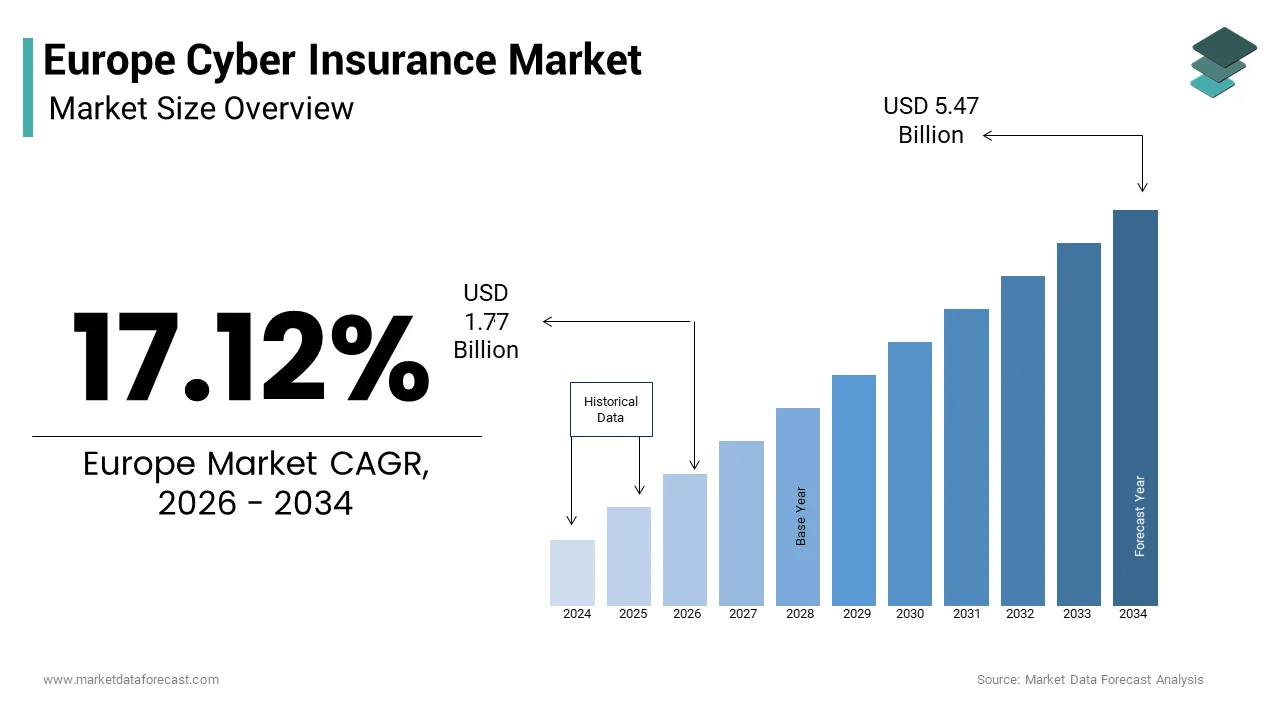
Market Size, 2025
$1.51 BnMarket Estimate, 2026
$1.77 BnMarket Forecast, 2034
$5.47 BnCAGR, 2026–2034
17.12%Europe Cyber Insurance Market Size
The Europe cyber insurance market size was valued at USD 1.51 billion in 2025 and is anticipated to reach USD 1.77 billion in 2026 to reach USD 5.47 billion by 2034, growing at a CAGR of 17.12% during the forecast period from 2026 to 2034.
Cyber insurance represents a specialized financial mechanism designed to transfer the risk associated with digital operations, data breaches, and cyberattacks from organizations to insurers through tailored coverage policies. This ecosystem has evolved from a niche product covering basic liability into a comprehensive safety net that includes business interruption losses, ransomware payments, forensic investigation costs, and regulatory fines imposed under strict European laws. The landscape is uniquely defined by the operational mandates of the General Data Protection Regulation which holds entities personally liable for data mishandling, thereby creating an urgent need for financial protection against potential penalties. As per Eurostat, a large majority of enterprises in the European Union utilized cloud computing services in the last measured period, which has expanded the attack surface and necessitated robust risk transfer solutions. According to the European Union Agency for Cybersecurity, the number of reported high impact cyber incidents across member states has increased in recent years, which is indicating the volatility of the digital threat environment. The market now functions as a critical component of corporate governance where the ability to secure coverage often dictates the viability of digital transformation projects. This evolving definition includes proactive risk management services where insurers provide pre breach assessments to lower premiums, which is shifting the model from pure indemnification to active risk mitigation. The sector operates within a complex legal framework where cross border data flows and varying national implementations of EU directives influence policy structures and claim settlements.
MARKET DRIVERS
Stringent Regulatory Liability Under GDPR and NIS2 Directive
The rigorous enforcement of the General Data Protection Regulation and the recent implementation of the Network and Information Systems Directive are propelling the growth of the European cyber insurance market. These regulations impose severe financial penalties for data breaches and mandate strict reporting timelines, which is creating a tangible liability that boards of directors seek to mitigate through insurance coverage. As per the European Data Protection Board, fines issued under GDPR have reached significant levels since inception, with individual penalties impacting major corporations, making the cost of non-compliance a substantial balance sheet risk. The NIS2 Directive further expands the scope of mandatory security measures and liability to include a wider range of essential and important entities, which is forcing previously exempt sectors to evaluate their cyber risk exposure. According to the International Association of Privacy Professionals, a majority of European chief information officers now view cyber insurance as a necessary tool to manage the financial impact of potential regulatory sanctions and legal defense costs. The requirement to demonstrate due diligence in risk management also makes insurance policies a valuable asset during regulatory audits. This legislative pressure transforms cyber insurance from an optional add on into a strategic imperative for survival in the highly regulated European business environment.
Exponential Rise in Ransomware Attacks and Business Interruption Costs
The dramatic surge in the frequency and sophistication of ransomware attacks across Europe is further contributing to the European cyber insurance market expansion. Cybercriminals increasingly target critical infrastructure and small to medium enterprises with double extortion tactics that encrypt data and threaten public release, causing massive business interruption losses that exceed traditional IT recovery budgets. As per the European Union Agency for Cybersecurity, ransomware incidents in the region have risen sharply in recent years, with downtime costs for mid sized enterprises reaching substantial levels. According to McKinsey and Company, many European businesses that experienced a significant ransomware attack would face existential threats without the financial support provided by cyber insurance policies to pay ransoms and fund rapid recovery efforts. The complexity of negotiating with criminal groups and coordinating forensic responses requires the specialized incident response teams that insurers provide as part of their coverage. Furthermore, the rising cost of data restoration and system rebuilding makes the premium for cyber insurance a cost-effective hedge against catastrophic loss. This escalating threat landscape ensures sustained demand for policies that cover both direct financial theft and indirect operational losses.
MARKET RESTRAINTS
Severe Capacity Constraints and Hardening Market Conditions
The significant reduction in underwriting capacity and the consequent hardening of market conditions is primarily hampering the regional market growth, which is limiting the availability of affordable cyber insurance coverage for many European organizations. Insurers have become increasingly risk averse following a series of large-scale claims payouts related to ransomware and state sponsored attacks, leading them to reduce their aggregate exposure and tighten eligibility criteria. As per the Geneva Association, many European insurers have reduced their cyber insurance limits or exited specific high-risk sectors in the past year to protect their solvency ratios. According to the European Central Bank, the reinsurance market that provides capital backing for primary insurers has also tightened terms, which is passing higher costs and stricter exclusions down to the end buyer. According to Marsh McLennan, renewal premiums for cyber policies in Europe have increased significantly while coverage terms have narrowed, which is leaving many small and medium sized enterprises unable to secure adequate protection. The lack of historical data to accurately model cyber risk exacerbates this caution, causing underwriters to demand extensive security audits before issuing quotes. This contraction in supply amidst growing demand creates a protection gap where organizations willing to buy coverage cannot find it at viable price points, stifling market growth.
Ambiguity in Policy Definitions and Coverage Exclusions
The lack of standardized policy language and the prevalence of ambiguous exclusions regarding war, state sponsored attacks and systemic failures create significant uncertainty that dampens demand for cyber insurance products across Europe, which is further impeding the European cyber insurance market growth. Organizations often struggle to understand the precise scope of their coverage, particularly concerning whether acts of cyber warfare by nation states are excluded, which is leading to hesitation in purchasing policies that may not pay out when needed most. As per Lloyd’s of London Market Committee, the definition of "cyber war" remains legally contested in many European jurisdictions, which is resulting in prolonged disputes and delayed claim settlements that erode trust in the product. As per the European Insurance and Occupational Pensions Authority, inconsistent application of exclusions across different carriers makes it difficult for buyers to compare products effectively. According to the Chartered Insurance Institute, a significant portion of denied cyber insurance claims in Europe stem from disputes over policy wording and interpretation of exclusions rather than the validity of the incident itself. This opacity forces legal teams to spend excessive resources reviewing contracts and creates a perception of unreliable protection. Until the industry adopts standardized definitions and clearer exclusion clauses, this confusion will continue to act as a barrier to widespread adoption.
MARKET OPPORTUNITIES
Integration of Proactive Risk Management and Prevention Services
The shift from reactive indemnification to proactive risk management is a promising opportunity for the European cyber insurance market. By bundling insurance policies with access to advanced threat detection tools, vulnerability scanning, and employee training programs, carriers can help clients prevent incidents before they occur, which is creating a value-added service model. As per Gartner, many European cyber insurance providers plan to integrate real time security posture monitoring into their policies in the coming years to dynamically adjust premiums based on actual risk levels. This approach allows insurers to gather granular data on client security hygiene, enabling more accurate pricing and reducing the frequency of costly claims. According to the European Cyber Security Organisation, organizations utilizing insurer provided prevention services tend to experience fewer successful cyberattacks compared to those relying solely on internal measures. The ability to offer immediate remediation guidance upon detecting vulnerabilities turns the insurer into a strategic partner rather than just a payer of last resort. Furthermore, this data driven approach helps build a robust historical database for modeling cyber risk, addressing one of the key challenges in underwriting. As the market matures, the integration of prevention services will become a standard expectation, driving growth through enhanced customer retention and lower loss ratios.
Expansion of Coverage for Small and Medium Sized Enterprises
The vast underserved segment of small and medium sized enterprises offers a substantial opportunity for market expansion as these entities face increasing cyber threats but currently lack access to tailored and affordable insurance products. Most existing policies are designed for large corporations with complex needs and high premiums, leaving millions of smaller European businesses exposed and unprotected despite being frequent targets of automated attacks. As per the European Commission, SMEs constitute the overwhelming majority of businesses in the EU, yet only a minority possess any form of cyber insurance due to cost and complexity barriers. Insurers who develop simplified, modular, and digitally distributed policies specifically for this demographic can unlock a massive new revenue stream. According to the Organisation for Economic Cooperation and Development, cyberattacks on small businesses have risen in recent years, which is creating an urgent unmet need for protection. By leveraging automation for underwriting and claims processing, carriers can lower administrative costs and offer micro policies that cover essential risks like ransomware and data breach notification at accessible price points. This democratization of cyber protection aligns with EU initiatives to strengthen the digital resilience of the entire economic fabric, ensuring sustained market growth.
MARKET CHALLENGES
Difficulty in Accumulating and Modeling Historical Loss Data
The inherent challenge of accumulating sufficient high quality historical loss data to accurately model cyber risk and price policies remains a formidable challenge for the Europe cyber insurance market. Unlike natural disasters or auto accidents which have centuries of actuarial data, cyber risk is a relatively new phenomenon characterized by rapidly evolving threat vectors and non stationary loss distributions. As per the European Actuarial Journal, the lack of standardized data sharing mechanisms between insurers results in fragmented datasets that hinder the development of robust predictive models for extreme events. According to the Swiss Re Institute, the dynamic nature of cyber threats means that past loss experiences are often poor predictors of future exposures, leading to significant pricing volatility and conservative underwriting stances. The proprietary nature of breach data due to reputational concerns further limits the pool of available information for analysis. Without reliable models to quantify tail risks such as systemic cloud outages or global ransomware waves, insurers struggle to set adequate reserves and capital requirements. This data scarcity forces carriers to rely on qualitative assessments and expert judgment which are subjective and inconsistent. Until a comprehensive and anonymized industry wide data repository is established, the inability to precisely model risk will continue to constrain market stability and capacity.
Emergence of Systemic Cyber Risks and Aggregation Exposure
The growing potential for systemic cyber events that could trigger simultaneous claims across a vast portfolio of insured entities is further challenging the European cyber insurance market expansion. A single catastrophic event such as a failure of a major cloud service provider or a widespread software vulnerability could impact thousands of policyholders at once, creating an accumulation of losses that exceeds the capital reserves of many insurers. As per the European Systemic Risk Board, the interconnectedness of the digital economy means that a localized cyber incident can cascade rapidly across borders and sectors, creating a scenario akin to a financial systemic crisis. According to the Bank for International Settlements, current reinsurance structures may be insufficient to cover losses from a major systemic cyber event, which could reach extremely high levels. The difficulty in defining correlation boundaries and excluding systemic perils without rendering policies useless creates a delicate balancing act for underwriters. Regulators are increasingly scrutinizing aggregation limits and stress testing scenarios, adding pressure on insurers to limit their exposure. This fear of a black swan event that could bankrupt multiple carriers simultaneously acts as a persistent check on market expansion and capacity deployment.
REPORT COVERAGE
| REPORT METRIC | DETAILS |
| Market Size Available | 2025 to 2034 |
| Base Year | 2025 |
| Forecast Period | 2026 to 2034 |
| CAGR | 17.12% |
| Segments Covered | By Component, Insurance, Organization Size, and Countries |
| Various Analyses Covered | Regional & Country Level Analysis, Segment-Level Analysis, DROC, PESTLE Analysis, Porter’s Five Forces Analysis, Competitive Landscape, Analyst Overview on Investment Opportunities |
| Regions Covered | UK, France, Spain, Germany, Italy, Russia, Sweden, Denmark, Switzerland, Netherlands, Turkey, Czech Republic, & Rest of Europe |
| Market Leaders Profiled | Aon Plc., American International Group, Inc. (AIG), Allianz Group, Berkshire Hathaway, Inc., Lockton Companies, Inc., Chubb Limited, Munich Re Group, AXA XL SA, Zurich Insurance Group |
SEGMENT ANALYSIS
By Component Insights
The services segment dominated the market by capturing the largest share of the European cyber insurance market in 2025. The dominance of services segment in the European market is attributed to the critical necessity for specialized expertise in incident response, forensic investigation, and legal counsel which policyholders cannot easily maintain in-house. This category encompasses pre-breach risk assessments, post-breach containment, regulatory compliance support, and public relations management. The acute shortage of internal cybersecurity talent within European organizations, which is forcing them to rely heavily on insurer-provided panels of experts during a crisis is further propelling the growth of the services segment in the European market. When a breach occurs, the immediate need for digital forensics, legal advice regarding GDPR notification timelines, and negotiation with ransomware attackers requires highly specialized skills that are prohibitively expensive to retain permanently. According to data from the Centre for European Policy Studies the European Union faces a shortfall of over three hundred thousand cybersecurity professionals, making external service providers essential for effective incident management. Statistics from the European Union Agency for Cybersecurity indicate that organizations utilizing insurer-mandated incident response teams recover forty percent faster than those attempting to manage breaches internally due to the established protocols and experience of these vendors. The complexity of cross-border data breach notifications under European law further necessitates expert legal guidance included in service packages. Furthermore, the cost of hiring top-tier forensic firms on an emergency basis often exceeds the premium savings of a policy without services, making the service component the most valuable part of the coverage. This reliance on external expertise ensures that services remain the largest revenue generator in the market landscape.
On the other hand, the solutions segment is estimated to grow at a CAGR of 17.7% over the forecast period in the European cyber insurance market due to the integration of advanced technological tools directly into insurance platforms to automate risk quantification and claims processing. The adoption of sophisticated software solutions that provide real-time monitoring of an organization's security posture that allow insurers to dynamically adjust premiums based on actual risk levels rather than static questionnaires is further driving the expansion of the solutions segment in the European market. These technologies include automated scanning tools, dark web monitoring platforms, and threat intelligence feeds that continuously evaluate exposure and alert both the insurer and the insured to emerging vulnerabilities. According to a study by Gartner over sixty percent of leading European cyber insurers plan to deploy integrated risk monitoring solutions by 2026 to enable usage-based insurance models similar to telematics in auto insurance. Data from the European Cyber Security Organisation indicates that policies linked to real-time monitoring solutions have seen a twenty five percent increase in adoption rates as businesses seek transparency and fairness in pricing. The ability to visualize risk metrics on dashboards empowers companies to take immediate corrective actions, reducing the likelihood of a claim. Furthermore, the automation of data collection reduces the administrative burden on underwriters, enabling faster quote generation and policy issuance. This shift towards data-driven, technology-enabled underwriting drives aggressive investment in proprietary and third-party security solutions, making it the highest growth area.
By Insurance Insights
The stand-alone policies segment accounted for the dominant share of the Europe cyber insurance market in 2025 due to the increasing complexity of cyber risks which requires specialized coverage limits and terms that bundled policies cannot adequately provide. Organizations are moving away from add-on clauses in general liability policies to dedicated cyber instruments. The necessity for substantial and specific coverage limits that address the unique and potentially catastrophic financial impacts of modern cyberattacks, which often exceed the sub-limits available in packaged policies is further contributing to the dominance of the stand-alone policies segment in the European market. General liability or property insurance bundles typically offer inadequate caps for costs associated with massive data breaches, business interruption from ransomware, and regulatory fines under GDPR. As per the Lloyd's of London Market Committee, most large European enterprises now prefer stand-alone cyber policies because they offer significantly higher coverage limits compared to bundled products. According to the International Insurance Society, the average cost of a data breach in Europe has risen considerably, making packaged coverage insufficient for meaningful protection. Stand-alone policies also provide clarity on covered perils, explicitly including extortion payments, forensic costs, and reputational damage management without the ambiguity often present in broad form bundles. The ability to tailor deductibles, retention levels, and specific extensions to the unique risk profile of an organization makes stand-alone products the preferred choice for risk managers. This demand for robust and unambiguous protection ensures that stand-alone policies remain the market leader.
On the other side, the packaged policies segment and is estimated to witness a CAGR of 15.4% over the forecast period owing to the increasing accessibility of basic cyber coverage for small and medium-sized enterprises through simplified bundle offerings. The strategic efforts of insurers to penetrate the underserved small and medium-sized enterprise market by offering affordable and easy-to-understand cyber coverage as part of broader business insurance packages is further boosting the expansion of the packaged policies segment in the European market. SMEs often lack the resources and expertise to navigate complex stand-alone cyber policies, making bundled options that include cyber liability alongside property and general liability an attractive and manageable solution. As per the European Commission, SMEs constitute the overwhelming majority of businesses in the EU yet historically have had low cyber insurance penetration due to perceived complexity and cost. According to the Organisation for Economic Co-operation and Development, introducing cyber coverage as a standard option in business owner policies has increased uptake among SMEs in recent years. Insurers are leveraging digital distribution channels to offer these packaged deals with streamlined underwriting questions, reducing the time to purchase from weeks to minutes. The lower premium thresholds and simplified terms remove barriers to entry for smaller firms that face rising cyber threats but have limited budgets. This democratization of access through bundling ensures that the packaged segment grows rapidly as millions of smaller entities finally obtain basic protection.
By Organization Size Insights
The large enterprises segment led the market by commanding for the leading share of the European cyber insurance market in 2025. The growth of the large enterprises segment in the European market is attributed to their vast digital footprints, high-value data assets, and the critical necessity to protect against existential threats that could destabilize their operations and reputation. These organizations typically possess the budget and risk awareness to purchase comprehensive coverage. The immense exposure of large enterprises to catastrophic financial losses stemming from cyberattacks that can result in damages far exceeding the risk tolerance of their balance sheets is further contributing to the growth of the large enterprises segment in the European market. Multinational corporations, banks, and industrial giants in Europe manage petabytes of sensitive customer data and operate critical infrastructure where even brief downtime can halt global supply chains and incur massive penalties. As per the European Central Bank, the average cost of a significant cyber incident for a large European financial institution is substantial, necessitating high insurance limits. According to Allianz, large enterprises account for the majority of total cyber insurance premiums in Europe due to their need for high-limit policies that can absorb such shocks. The regulatory scrutiny on large firms under GDPR and NIS2 means that potential fines alone can be devastating, making insurance a crucial risk transfer mechanism. Furthermore, the complexity of their IT environments involving cloud, hybrid, and legacy systems increases the probability of a breach, driving continuous demand for robust coverage. This sheer scale of potential loss ensures that large enterprises remain the primary revenue source for the cyber insurance market.
However, the small and medium-sized enterprises segment is poised to witness a CAGR of 19.1% over the forecast period in the European market owing to the rising recognition of vulnerability among smaller firms and the emergence of tailored, affordable products designed specifically for their needs. The shifting strategy of cybercriminals who increasingly view small and medium-sized enterprises as soft targets due to their generally weaker security defences compared to large corporations is further propelling the expansion of small and medium-sized enterprises segment in the European market. Attackers utilize automated tools to scan for vulnerabilities in SME networks, launching ransomware and phishing campaigns that can cripple these smaller operations which often lack dedicated IT security teams. As per the European Union Agency for Cybersecurity, attacks on SMEs in Europe have increased significantly in recent years, with many victims facing bankruptcy due to the inability to pay ransoms or recover data. According to the Federation of Small Businesses, a large portion of SMEs that suffer a significant cyberattack are unable to continue operations, highlighting the existential nature of the threat and driving urgent demand for protection. The realization that size does not offer immunity has prompted a wake-up call among business owners who previously believed they were too small to be targeted. This heightened awareness of vulnerability combined with the devastating consequences of an attack ensures that SMEs will drive the highest growth rates in the market.
By End Use Industry Insights
The BFSI segment held the highest share of the European cyber insurance market in 2025 due to the critical nature of financial data, the high frequency of targeted attacks, and the stringent regulatory capital requirements that mandate robust risk transfer mechanisms. This sector handles the most sensitive personal and financial information in the economy. The relentless targeting by sophisticated cybercriminal groups and state-sponsored actors seeking financial gain through theft of funds, data exfiltration, and disruption of trading systems are further boosting the dominance of BFSI segment in the European market. Financial institutions are the crown jewels of the cyber threat landscape, facing constant attempts at SWIFT fraud, ATM skimming, and ransomware attacks that threaten global financial stability. As per the European Banking Federation, the financial sector experiences a significant portion of reported cyber incidents in Europe, with the average cost of an attack higher than in most other industries due to direct monetary implications. According to the European Central Bank, banks allocate the largest portion of their cybersecurity budgets to insurance as a final line of defense against these persistent and evolving threats. The potential for systemic risk means that regulators closely monitor the cyber resilience of banks, indirectly pushing them to secure comprehensive coverage. The sheer volume of transactions and the value of assets under management make the stakes incredibly high, necessitating the highest limits and broadest coverage available. This constant barrage of high-stakes attacks ensures that BFSI remains the largest consumer of cyber insurance.
On the other side, the healthcare segment is projected to be the fastest growing segment in the Europe cyber insurance market and expand at a CAGR of 21.2% over the forecast period owing to the digitization of patient records, the proliferation of connected medical devices, and the life-critical nature of healthcare services which makes them prime targets for ransomware. The massive shift towards electronic health records and the widespread adoption of Internet of Medical Things devices that have exponentially expanded the attack surface for hospitals and clinics is further boosting the expansion of the healthcare segment in the European market. The transition from paper to digital systems has created vast repositories of highly valuable personal health information that attract intense criminal interest. As per the European Health Telematics Observatory, the number of connected medical devices in European hospitals has increased significantly in recent years, each representing a potential entry point for attackers. According to the World Health Organization, healthcare data breaches in Europe have risen sharply, with the cost of restoring compromised systems and notifying patients driving urgent demand for insurance. The interconnectivity of devices such as infusion pumps and MRI machines means that a breach can directly impact patient safety, elevating the risk profile significantly. The reliance on digital systems for daily operations means that any disruption can halt critical care, making business interruption coverage essential. This rapid technological adoption coupled with high vulnerability ensures exceptional growth in cyber insurance uptake.
COUNTRY ANALYSIS
Germany Cyber Insurance Market Analysis
Germany held the leading position in the European cyber insurance market in 2025 with 24.4% of the regional market share. The dominance of Germany in the European market is driven by its robust industrial base, strong manufacturing sector, and stringent data protection culture. The German market is characterized by a high level of risk awareness among Mittelstand companies and a rigorous approach to compliance with both national and EU regulations. As per the German Federal Office for Information Security, cyber incidents in German industry have risen sharply, prompting a surge in demand for specialized industrial cyber insurance products. According to the German Insurance Association, a majority of large German manufacturers now hold standalone cyber policies, a rate higher than the European average, driven by fears of intellectual property theft and production stoppages. The automotive and chemical sectors act as major engines for growth, deploying advanced coverage to protect complex supply chains and proprietary formulas. Furthermore, the strict enforcement of GDPR by German authorities has created a climate of caution where insurance is seen as a necessary buffer against potentially ruinous fines. The convergence of industrial digitization, regulatory strictness, and a strong insurance tradition keeps Germany at the forefront of the European cyber insurance landscape.
United Kingdom Cyber Insurance Market Analysis
The United Kingdom secured the second largest position in the Europe cyber insurance market in 2025 due to its mature insurance marketplace, particularly London which serves as a global hub for specialty lines and reinsurance. The market status in the UK is defined by high innovation in product development and a sophisticated broker community that drives complex risk placement. As per the Lloyd's of London Market Report, the UK writes a significant portion of the world's cyber insurance capacity, attracting international risks while maintaining a strong domestic base. According to the Prudential Regulation Authority, UK financial institutions and professional services firms are early adopters of comprehensive cyber coverage, often setting trends for policy wording and limits that are adopted globally. The presence of leading cyber security firms and think tanks in London fosters a deep understanding of risk dynamics, enabling more accurate underwriting. Post-Brexit regulatory divergence has also spurred the development of tailored products to meet specific UK statutory requirements. The combination of a deep capital pool, expert knowledge, and a proactive regulatory environment maintains the UK as a pivotal market for cyber insurance innovation and volume.
France Cyber Insurance Market Analysis
France is estimated to account for a promising share of the European cyber insurance market during the forecast period owing to the strong state involvement in cyber defense and a growing emphasis on digital sovereignty which influences insurance purchasing decisions. The French market is heavily influenced by national strategies that encourage public-private partnerships to enhance cyber resilience across critical infrastructure. As per the French National Agency for the Security of Information Systems, there has been a concerted push to raise awareness among small and medium-sized enterprises, leading to increased uptake of bundled cyber policies. According to the French Federation of Insurance Companies, the healthcare and energy sectors are driving growth, with operators seeking coverage that aligns with new European operational resilience directives. The French government's support for local cyber insurance champions and its focus on protecting strategic assets from foreign state-sponsored attacks create a unique demand dynamic. Additionally, the strict interpretation of data localization laws encourages companies to seek insurers with strong domestic capabilities. The strategic alignment of national security goals with commercial insurance solutions creates a resilient market focused on protecting national interests.
Netherlands Cyber Insurance Market Analysis
The Netherlands is predicted to witness a healthy CAGR in the European cyber insurance market during the forecast period. Netherlands is serving as a key digital gateway and logistics hub where the concentration of data centers and multinational headquarters drives significant demand. The Dutch market is defined by its advanced digital infrastructure and a progressive approach to risk management among Dutch corporations. As per the Dutch Data Protection Authority, the high density of data processing activities in the country necessitates robust cyber insurance to mitigate the risks associated with being a central node in the European internet architecture. According to the Dutch Association of Insurers, the logistics and e-commerce sectors are major drivers, with companies insuring against supply chain disruptions and data breaches that could halt trade flows. The Dutch culture of openness and collaboration facilitates information sharing on threats, which helps insurers refine their models and offer competitive rates. The presence of many global tech giants' European headquarters in Amsterdam further boosts the market for high-limit policies. This unique combination of connectivity and corporate concentration positions the Netherlands as a critical node in the European cyber insurance ecosystem.
Sweden Cyber Insurance Market Analysis
Sweden is predicted to showcase a notable CAGR in the European cyber insurance market over the forecast period. Sweden is renowned for its advanced digital maturity, high adoption of cloud services, and leadership in integrating cyber insurance with proactive risk management services. The market status in Sweden is characterized by early adoption of innovative insurance products and a strong focus on preventing losses through technology. As per Statistics Sweden, most large enterprises and a majority of SMEs utilize cloud-based business critical applications, creating a pervasive need for coverage that addresses cloud-specific risks. According to the Swedish Financial Supervisory Authority, Swedish insurers are pioneers in offering dynamic pricing models based on real-time security monitoring, appealing to tech-savvy clients. The country's vibrant startup ecosystem and leadership in fintech drive demand for flexible and scalable cyber policies. The Swedish government's ambitious digitalization goals have also raised the overall risk profile, encouraging broader insurance penetration. The convergence of digital excellence, innovative insurance practices, and a forward-looking regulatory stance ensures Sweden remains a key innovator in the evolving European cyber insurance landscape.
COMPETITIVE LANDSCAPE
The competition in the Europe cyber insurance market is intensely fierce characterized by a dynamic struggle between established global insurers specialized niche carriers and emerging insurtech startups vying for dominance amidst a rapidly evolving threat landscape. Global giants leverage their vast capital reserves and extensive distribution networks to capture large corporate contracts while niche players compete on specialized industry knowledge and flexible policy terms. The battleground has shifted from mere price competition to value-added services including proactive risk assessments, real-time monitoring, and superior incident response capabilities that address specific European regulatory concerns. The hardening market conditions and capacity constraints act as both a barrier and a catalyst forcing all participants to innovate rapidly to maintain profitability and solvency. New entrants specializing in parametric products or automated underwriting are challenging established norms by offering faster and more transparent solutions. Strategic partnerships with cybersecurity firms have become commonplace as companies seek to enhance their service offerings and reduce loss ratios. This complex ecosystem ensures that no single entity can rest on its laurels as the nature of cyber threats and regulatory requirements constantly reshape the competitive hierarchy.
KEY MARKET PLAYERS
A Powerful dominating players that are dominating the Europe cyber insurance market are
- Aon Plc.
- American International Group, Inc. (AIG)
- Allianz Group
- Berkshire Hathaway, Inc.
- Lockton Companies, Inc.
- Chubb Limited
- Munich Re Group
- AXA XL SA
- Zurich Insurance Group
Top Players In The Market
- Chubb maintains a commanding presence in the Europe cyber insurance market by offering comprehensive standalone policies that cover everything from data breach response to business interruption and cyber extortion. The company contributes globally by setting industry standards for claims handling and risk management services through its dedicated cyber practice. Recent actions to strengthen its European position include the expansion of its incident response network to provide faster local support across key markets like Germany and France. Chubb actively invests in proprietary risk assessment tools that help clients identify vulnerabilities before an attack occurs. The firm also partners with leading cybersecurity firms to offer pre-breach consulting services as part of its coverage. These strategic initiatives reinforce its reputation as a leader in delivering robust financial protection and expert guidance while addressing the specific regulatory and operational needs of European enterprises facing evolving digital threats.
- Allianz leverages its deep expertise in commercial insurance and vast global network to drive widespread adoption of cyber insurance solutions among European corporations and small businesses alike. The company contributes globally by integrating cyber coverage into broader enterprise risk management frameworks and offering specialized products for industrial sectors. Recent efforts involve launching new digital platforms that simplify the purchasing process and provide real-time risk monitoring for policyholders across Europe. Allianz actively enhances its portfolio with parametric insurance products that trigger automatic payouts based on predefined cyber events. The company also collaborates with European regulators to develop standardized policy wording that increases clarity for customers. By focusing on proactive risk prevention and rapid claims settlement Allianz strengthens its market position as a preferred partner for organizations requiring reliable and innovative cyber insurance capabilities that align with strict European compliance frameworks.
- AXA XL distinguishes itself in the Europe cyber insurance market through superior expertise in managing complex cyber risks for large multinational corporations and specialized industries such as technology and healthcare. Globally the company leads in providing tailored coverage solutions that address emerging threats like supply chain attacks and cloud service failures. Recent expansions include opening new cyber risk hubs in London and Paris to offer localized underwriting and claims support. AXA XL places a strong emphasis on integrating advanced analytics and threat intelligence into its underwriting processes to price risk more accurately. The company recently announced strategic alliances with top-tier cybersecurity firms to provide complimentary security assessments to all policyholders. By offering extensive crisis management services and clear policy terms AXA XL empowers organizations to navigate the aftermath of cyber incidents effectively. These initiatives solidify its reputation as an innovative and responsive provider in the European cyber insurance landscape.
Top Strategies Used by the Key Market Participants
Key players in the Europe cyber insurance market primarily employ strategies centered on proactive risk management and strategic partnerships to navigate the evolving threat landscape effectively. Companies are heavily investing in developing proprietary risk assessment tools and continuous monitoring platforms that allow them to evaluate client security postures in real time. Another prevalent strategy involves forming alliances with leading cybersecurity firms to provide comprehensive pre-breach consulting and post-breach incident response services as value-added components of their policies. Major insurers are also focusing on product innovation by creating parametric insurance solutions that offer automatic payouts for specific cyber events to speed up recovery times. Sustainability and resilience initiatives serve as critical differentiators as vendors commit to supporting clients in building long-term cyber hygiene practices. Further more organizations are simplifying policy language to reduce ambiguity and increase trust among potential buyers. Acquisitions of specialized tech startups allow these giants to broaden their service portfolios and offer integrated ecosystems that retain customer loyalty and drive long-term growth effectively.
MARKET SEGMENTATION
This research report on the Europe cyber insurance market is segmented and sub-segmented into the following categories.
By Component
- Solution
- Services
By Type
- Packaged
- Stand-alone
By Organization
- Small and Medium-sized enterprises
- Large Enterprises
By End-User
- BFSI
- Healthcare
- IT and Telecom
- Retail
- Others
By Country
- UK
- France
- Spain
- Germany
- Italy
- Russia
- Sweden
- Denmark
- Switzerland
- Netherlands
- Turkey
- Czech Republic
- Rest of Europe
Frequently Asked Questions
How does cyber insurance help businesses manage digital risks in Europe?
Cyber insurance provides financial protection against losses caused by data breaches, cyberattacks, and system failures.
What factors are driving the growth of the cyber insurance market in Europe?
Rising cyber threats and increasing regulatory requirements are encouraging businesses to adopt cyber insurance.
Which organizations commonly purchase cyber insurance policies?
Large enterprises, SMEs, financial institutions, healthcare providers, and technology companies widely adopt these policies.
Why is cyber insurance becoming essential for modern businesses?
It helps companies mitigate financial and operational risks associated with cyber incidents.
What types of risks are typically covered under cyber insurance policies?
Coverage often includes data breaches, ransomware attacks, business interruption, and liability claims.
How does cyber insurance support business continuity planning?
It provides financial support and recovery assistance after cyber incidents.
What challenges affect the Europe cyber insurance market?
Complex risk assessment and evolving cyber threats can make policy pricing and coverage challenging.
How are insurers adapting to the growing cyber risk landscape?
They are developing customized policies and using advanced risk assessment tools.
Which countries are key markets for cyber insurance in Europe?
The United Kingdom, Germany, France, and the Netherlands are major markets due to high digital adoption.
What future trend is expected in the Europe cyber insurance market?
Increasing demand for comprehensive and tailored cyber risk coverage is expected to drive market growth.
Access the study in MULTIPLE FORMATS
Purchase options starting from
$ 2000
Didn’t find what you’re looking for?
TALK TO OUR ANALYST TEAM
Need something within your budget?
NO WORRIES! WE GOT YOU COVERED!
Call us on: +1 888 702 9696 (U.S Toll Free)
Write to us: sales@marketdataforecast.com