- Product Description Description
- Table of Contents TOC
- List of Table & Figure LOT
- Get Free Sample PDF Sample PDF
Market Size, 2025
$1 BnMarket Estimate, 2026
$1.08 BnMarket Forecast, 2034
$1.99 BnCAGR, 2026–2034
7.97%Executive Summary: Europe Dairy Herd Management Market
- Market Scope: Comprehensive regional assessment of the European dairy herd management industry analyzing hardware and software solutions, application sectors (milk harvesting, reproduction, etc.), and country-level developments.
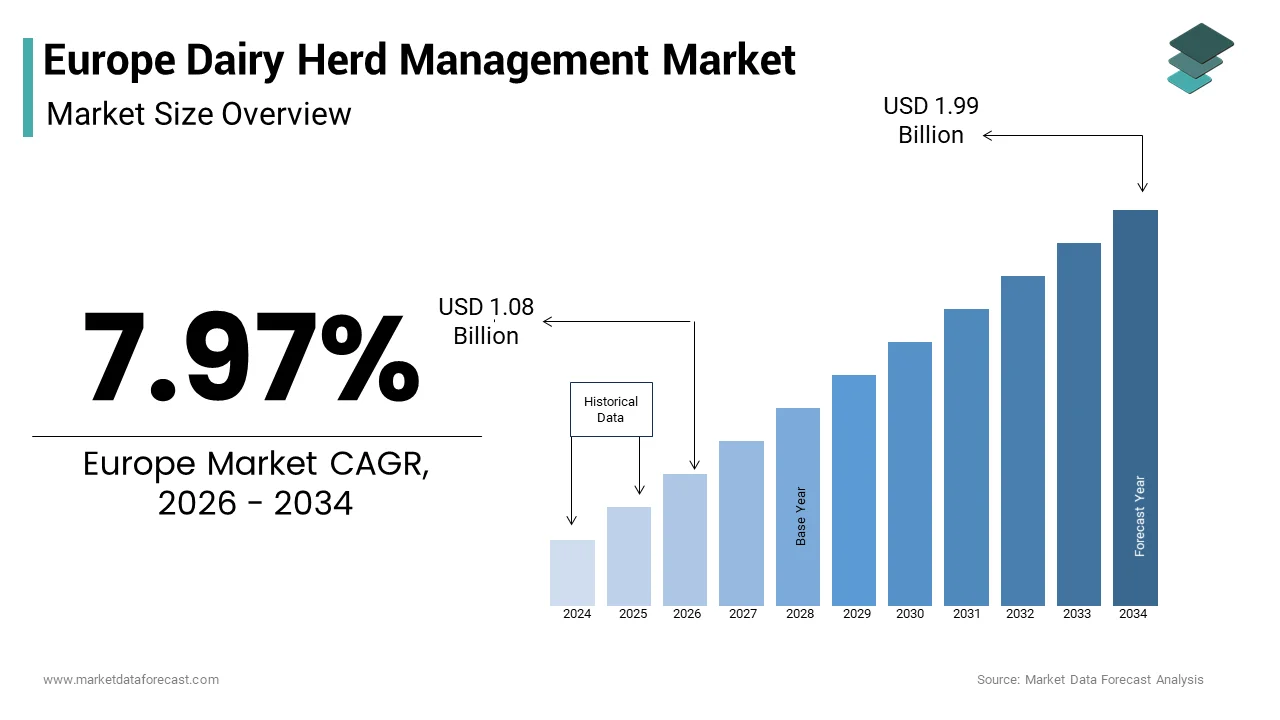
- Market Valuation: Valued at USD 1.00 billion in 2025, anticipated to reach USD 1.08 billion in 2026, and projected to scale up to USD 1.99 billion by 2034, growing at a robust CAGR of 7.97% from 2026 to 2034.
- Primary Growth Drivers: Escalating consumer demand for milk and dairy products; rising labor costs coupled with the cost-benefit of automated cattle management techniques; and technological advancements in software and smart farming.
Key Market Segment Metrics (2026–2034)
| Category | Leading Segment / Core Focus | Fastest-Growing / Key Segments |
|---|---|---|
| By Product | Hardware Systems (accounted for the largest market share due to critical demands for milk management equipment) | Standalone Software Systems (projected to register the highest growth rate driven by automated milking innovations and cost reduction) |
| By Application | Milk Harvesting (anticipated to hold the largest market share, supported by automated systems and milk yield optimization) | Reproduction Management (projected to record the highest CAGR driven by innovative tech like artificial intelligence and gestation tracking) |
| By Country | Germany, France, UK, Italy, and Spain (key European dairy hubs accounting for major regional revenue shares) | Nordic & Central European Countries (steady expansion backed by advanced smart farming and high efficiency standards) |
Major Market Players & Market Structure
Market Structure: Highly competitive landscape comprising established agricultural equipment corporations and specialized livestock tech firms focusing on automation, data analytics, and precision farming software.
Key Companies: Afimilk Ltd., BouMatic, Dairy Master, DeLaval, GEA Group AG, Infovet, Lely Holding S.A.R.L., SCR Dairy Inc., Sum-It Computer Systems, Ltd, and Valley Agriculture Software.
Europe Dairy Herd Management Market Size
The Europe dairy herd management market size was valued at USD 1 billion in 2025 and is anticipated to reach a valuation of USD 1.08 billion in 2026 and USD 1.99 billion by 2034, growing at 7.97% CAGR from 2026 to 2034.
Dairy Herd Management refers to the comprehensive practice of overseeing the health, well-being, nutrition, breeding, and overall daily operations of a group of dairy cows. Its primary goal is to maximize milk production and quality while keeping the herd healthy and the farm profitable. This market encompasses advanced solutions such as automated milking systems, wearable sensors for health monitoring, and data analytics platforms that provide real time insights into herd performance. As per Eurostat, the European Union dairy herd has experienced a long-term decline, with the population of dairy cows dropping to 19.2 million animals. market sector is increasingly driven by the need to enhance efficiency amidst shrinking labor availability and stringent environmental regulations. According to the European Commission, the average dairy farm size has increased significantly over the past decade, necessitating scalable management tools to handle larger herds effectively. Furthermore, consumer demand for traceable and sustainably produced milk products compels farmers to adopt systems that ensure transparency and compliance with animal welfare standards. The integration of Internet of Things devices allows for precise monitoring of estrus cycles, feed intake, and disease detection, reducing veterinary costs and improving yield. With the Common Agricultural Policy emphasizing sustainability and digital transformation, the adoption of herd management systems has become a strategic imperative for maintaining competitiveness in the global dairy industry while meeting rigorous ecological targets.
MARKET DRIVERS
Stringent Environmental Regulations and Sustainability Mandates Drive Technology Adoption
The implementation of rigorous environmental policies under the European Green Deal is driving the growth of the Europe dairy herd management market. Farmers are seeking to minimize their ecological footprint and comply with emission reduction targets. According to the European Environment Agency, agriculture accounts for nearly 11% of the European Union's total greenhouse gas emissions, with methane from enteric fermentation making up 49% of that sectoral share. Herd management systems enable precise monitoring of feed efficiency and manure production, allowing farmers to optimize diets and reduce methane output per liter of milk produced. As per the European Commission’s Farm to Fork Strategy, the goal is to reduce nutrient losses by at least 50% by 2030, which drives a targeted reduction in overall chemical fertilizer use by 20% across member states. These systems help identify high emitting animals and adjust management practices accordingly, ensuring compliance with evolving environmental standards. Additionally, the Carbon Border Adjustment Mechanism and other sustainability frameworks encourage the use of digital tools to verify and report environmental performance. By integrating these technologies, dairy producers can access green subsidies and premium markets that reward sustainable practices. Consequently, the regulatory pressure to decarbonize the agricultural sector transforms herd management from an operational tool into a compliance necessity, driving widespread investment in digital solutions that enhance both productivity and environmental stewardship.
Labor Shortages and Rising Operational Costs Necessitate Automation
The acute shortage of skilled agricultural labor and escalating operational costs are compelling regional dairy farmers to adopt automated herd management systems to maintain productivity and profitability, which in turn accelerates the expansion of the Europe dairy herd management market. According to Eurostat, the total volume of work performed by the European Union's agricultural workforce dropped by 19.1% within a single decade. The demographic shift forces producers to rely on technology to perform routine tasks such as health monitoring, estrus detection, and milking, which traditionally required significant manual labor. As per the Food and Agriculture Organization of the United Nations, labor costs constitute a substantial portion of dairy production expenses, and automation through herd management systems can reduce labor input by up to 40 percent while improving accuracy and consistency. Automated systems provide continuous monitoring without human fatigue, detecting early signs of illness or fertility issues that might be missed during manual checks. This efficiency gain is crucial for maintaining competitive margins in a market characterized by volatile milk prices and high energy costs. Furthermore, the ability to manage larger herds with fewer employees allows for economies of scale, enabling farms to remain viable despite shrinking workforces. The transition to automated herd management is therefore not merely a technological upgrade but a structural necessity for the survival and growth of the European dairy industry in a labor constrained environment.
MARKET RESTRAINTS
High Initial Investment Costs and Financial Constraints for Smallholders
The substantial capital expenditure required for implementing comprehensive dairy herd management systems is a significant restraint to the Europe dairy herd management market. This is particularly true for small and medium-sized enterprises that dominate the region’s agricultural landscape. According to Eurostat, approximately 75% of dairy farms in the European Union manage a herd size of under 50 livestock units, which restricts their available capital for large-scale smart farming investments. The cost of a fully automated system can exceed 100000 euros, representing a prohibitive barrier for family owned operations with limited cash flow and access to credit. As per the European Investment Bank, agricultural operators increasingly utilize specialized leasing agreements and credit facilities backed by EU sustainability guarantees to finance high-tech infrastructure expansions. The financial constraint creates a digital divide where large industrial farms can afford advanced technologies while smaller producers struggle to modernize, potentially leading to market consolidation and the exit of smaller players. Additionally, the rapid pace of technological obsolescence means that investments may lose value quickly if newer, more efficient systems emerge. The lack of flexible leasing options or government subsidies tailored specifically for digital herd management further exacerbates the issue. High entry costs will continue to block widespread adoption and stall the modernization of the European dairy sector. This stagnation will persist unless the industry introduces targeted financial support or cooperative purchasing models.
Complexity of Integration and Interoperability Issues with Legacy Systems
The technical complexity associated with integrating new herd management solutions with existing legacy infrastructure is a major impediment to the Europe dairy herd management market. This hinders seamless data flow and operational efficiency for many regional dairy farmers. According to the European Association of Animal Production, many farms operate with a mix of equipment from different manufacturers and eras, creating compatibility issues that prevent unified data collection and analysis. Proprietary software platforms often lack open application programming interfaces, forcing farmers to use multiple disjointed systems that do not communicate effectively, leading to data silos and increased administrative burden. As per the Joint Research Centre of the European Commission, the deployment of harmonized data standards and spatial administration frameworks accelerates the integration of cross-border crop and agricultural datasets. The fragmentation complicates decision making, as farmers must manually reconcile data from milking robots, feeders, and health monitors, increasing the risk of errors and reducing the reliability of insights. Furthermore, the lack of standardized protocols for data exchange discourages innovation, as developers hesitate to create solutions for a fragmented market. The absence of universal standards also increases maintenance costs and dependency on specific vendors for technical support. The complexity of system integration will remain a formidable barrier to advanced herd management technologies. This challenge will persist until industry-wide interoperability standards are officially established and adopted.
MARKET OPPORTUNITIES
Integration of Artificial Intelligence for Predictive Health and Breeding Analytics
The incorporation of artificial intelligence and machine learning into dairy herd management platforms paves the way to enhance predictive capabilities and optimize breeding strategies across farms in the region, which is anticipated to fuel the growth of the Europe dairy herd management market. According to a study, agricultural operations adopting artificial intelligence solutions experience an immediate 30% boost in overall farm productivity within the first year of integration. By analyzing vast amounts of historical and real time data from sensors, AI algorithms can predict diseases such as mastitis or lameness days before clinical symptoms appear, allowing for early intervention and reduced treatment costs. As per Wageningen University and Research, the structural integration of automated livestock phenotyping and genomic datasets accelerates long-term trait selection across major commercial livestock breeding programs. The precision approach reduces the number of unsuccessful inseminations and shortens calving intervals, directly boosting profitability. Furthermore, AI can optimize feed rations based on individual animal needs and local ingredient availability, minimizing waste and enhancing nutrient efficiency. The ability to automate complex analytical tasks empowers farmers to make data driven decisions with greater confidence and speed. Computing power is becoming more accessible and algorithms are growing more sophisticated. As a result, the integration of AI offers European dairy producers a clear pathway to achieve unprecedented efficiency and sustainability while securing their global competitive edge.
Expansion of Precision Livestock Farming in Organic and Sustainable Segments
The growing demand for organic and sustainably produced dairy products opens a major door for precision livestock farming, which is expected to boost the expansion of the Europe dairy herd management market. This expansion is accelerating because consumers and retailers now demand verifiable proof of animal welfare and environmental stewardship. According to the Research Institute of Organic Agriculture FiBL, the total organic agricultural land area in the European Union expanded steadily to reach 18.1 million hectares, representing 11.1 percent of all EU farmland. Herd management systems provide the detailed records necessary for organic certification, tracking antibiotic usage, grazing times, and feed sources with immutable accuracy. As per the European Commission's farm economic monitoring datasets, organic dairy farmers achieve a higher economic markup over marginal costs than conventional producers, strengthening their bargaining position against downstream processors. Wearable sensors and automated monitoring tools allow organic farmers to maintain high animal welfare standards without relying on prophylactic medications, aligning with consumer expectations for ethical production. Furthermore, blockchain integration with herd management data enables end to end traceability, allowing consumers to scan QR codes and view the history of the milk they purchase. This transparency builds brand loyalty and opens access to premium retail channels. European dairy producers can differentiate their products by leveraging precision technologies to substantiate their sustainability credentials. Doing so will allow them to capture higher value in an increasingly conscious marketplace.
MARKET CHALLENGES
Data Privacy Concerns and Lack of Clear Ownership Frameworks
Ambiguity surrounding data ownership and privacy rights remains a major market hurdle for the Europe Dairy Herd Management Market. This lack of clarity creates widespread uncertainty and hesitation among farmers when it comes to sharing sensitive operational information. As per the European Agricultural Machinery Association guidelines, the implementation of the European Union Data Act establishes mandatory frameworks granting farmers direct access rights to all operational data generated by their connected machinery. Farmers often fear that their proprietary data on herd performance and management practices could be exploited by technology providers or third parties for commercial gain without adequate compensation or consent. According to sources, the deployment of the joint EU Code of Conduct on agricultural data sharing clarifies contract clauses and strengthens data access guarantees for participating producers. The absence of standardized contracts and clear legal frameworks for data sharing agreements exacerbates this issue, leaving producers vulnerable to unfavorable terms. Furthermore, concerns about cybersecurity threats and potential data breaches add another layer of risk, as compromised data could reveal competitive weaknesses or disrupt operations. Skepticism will persist until harmonized regulations and industry standards establish clear rights and protections for agricultural data. This ongoing distrust directly blocks the collaborative innovation and data pooling necessary to advance the sector.
Cybersecurity Vulnerabilities in Connected Agricultural Infrastructure
The increasing connectivity of dairy herd management systems exposes farms to growing cybersecurity risks, which constrains the expansion of the Europe dairy herd management market. This poses a significant challenge to operational continuity and data integrity in the region’s agricultural sector. According to the European Union Agency for Cybersecurity, the rollout of the Cyber Resilience Act enforces standardized product lifecycle updates and mandatory vulnerability reporting for all digital devices operating in the Single Market. Ransomware attacks on smart farming systems can disrupt milking schedules, freeze automated feeders, and lock access to critical health data, causing immediate economic losses and animal welfare issues. As per research, hardware constraints on smart field sensors restrict the implementation of heavy cryptographic protocols, prompting the development of lightweight stream-cipher frameworks for low-power devices. The potential for large scale disruptions increases as farms become more interconnected, with a single breach potentially affecting entire supply chains. Furthermore, the lack of specialized cybersecurity expertise in rural areas means that farmers are ill equipped to detect and respond to threats effectively. The financial and reputational damage from a cyber incident can be devastating for small and medium sized farms. Digital adoption is slowing across the European dairy industry because farmers lack trust in the technology. This hesitation will continue as long as connected herd management systems remain highly vulnerable to security risks.
REPORT COVERAGE
| REPORT METRIC | DETAILS |
| Market Size Available | 2025 to 2034 |
| Base Year | 2025 |
| Forecast Period | 2026 to 2034 |
| CAGR | 7.97% |
| Segments Covered | By Product, Application, and By Country |
| Various Analyses Covered | Global, Regional & Country Level Analysis, Segment-Level Analysis, DROC, PESTLE Analysis, Porter’s Five Forces Analysis, Competitive Landscape, Analyst Overview on Investment Opportunities |
| Regions Covered | UK, France, Spain, Germany, Italy, Russia, Sweden, Denmark, Switzerland, Netherlands, Turkey, the Czech Republic, and the Rest of Europe |
| Market Leaders Profiled | Afimilk Ltd., BouMatic, Dairy Master, DeLaval, GEA Group AG, Infovet, Lely Holdings S.A.R.L., SCR Dairy Inc., Sum-It Computer Systems, Ltd, and Valley Agriculture Software. |
SEGMENTAL ANALYSIS
By Product Insights
Hardware
The hardware segment dominated the Europe Dairy Herd Management Market and accounted for a substantial share in 2025. This segment dominated because physical devices such as milking robots, wearable sensors, and automated feeders constitute the indispensable foundation upon which all digital management relies. According to studies, more than 60% of all robotic dairy farms operating globally are located across European countries, establishing the region as a primary center for milking automation. This dominance is structurally reinforced by the high unit cost of precision machinery compared to subscription based services, making hardware the primary revenue driver for technology providers. As per the European Agricultural Machinery Association, the network represents a collective of manufacturing entities generating a combined annual turnover of approximately 40 billion euros across various machine segments. The necessity of hardware for compliance with animal welfare regulations also bolsters sales, as automated systems provide the continuous monitoring required by law. Furthermore, the integration of hardware with farm infrastructure creates high switching costs, locking farmers into specific ecosystems and ensuring recurring revenue through maintenance and upgrades. Without these physical components, data collection and automation are impossible. This dependency secures hardware's position as the market leader, despite the growing importance of analytics.
Web Based Software
The web-based software segment is predicted to witness the highest CAGR of 14.2% between 2026 and 2034 due to the accelerating shift toward cloud computing and the need for real time remote access to herd data. According to the European Commission, the strategic focus for rural connectivity shifts toward securing universal access to fixed very high-capacity networks and expanded gigabit coverage. The infrastructure improvement allows farmers to monitor herd health, milk yields, and feeding schedules from mobile devices anywhere, enhancing operational flexibility and responsiveness. As per sources, enterprise-wide adoption of cloud architectures reduces standard IT overhead costs by 30 to 40 percent through global infrastructure standardization. The scalability of web based platforms also supports farm expansion, as users can add features or integrate new devices without significant infrastructure upgrades. Additionally, cloud platforms facilitate data aggregation across multiple farms, enabling benchmarking and collaborative insights that on premise systems cannot offer. The combination of improved rural connectivity, cost efficiency, and enhanced functionality positions web based software as the fastest growing product segment in the European dairy herd management market.
By Application Insights
Milk Harvesting
The milk harvesting segment led the Europe Dairy Herd Management Market and captured a significant share in 2025. This leading position of the segment was attributed to its direct correlation with farm revenue and its critical role in addressing chronic labor shortages across the continent. According to European Milk Board, persistent farmgate milk price volatility and high overhead costs mean that structural CAP subsidies remain crucial to keeping more than three-quarters of EU dairy operations financially stable. Automated milking systems not only increase milking frequency and consistency but also provide real time quality metrics that enable premium pricing for high grade milk. As per Wageningen University and Research, automatic milking systems increase the daily milking frequency per cow, which directly scales labor efficiency and changes internal herd dynamics. The application also directly addresses the labor crisis, with automated systems reducing milking labor requirements, allowing farmers to reallocate human resources to higher value tasks such as animal care and breeding. Furthermore, regulatory requirements for milk hygiene and traceability mandate precise recording of harvest data, which automated systems provide seamlessly. The convergence of economic necessity, labor substitution, and regulatory compliance ensures that milk harvesting remains the largest and most mature application segment in the European market.
Heat Stress Management
The heat stress management segment is estimated to register the fastest CAGR of 16.8% during the forecast period, fueled by increasing climate volatility and stringent animal welfare regulations across Europe. According to the Copernicus Climate Change Service, summer heatwaves across the European continent continue to break extreme temperature records, which alters regional hydrological cycles and intensifies seasonal drought conditions. As per the European Food Safety, thermal stress on pasture-based operations triggers behavioral changes like increased competition for shade and water resources among dairy cattle. Advanced systems now integrate environmental sensors with physiological data from wearables to predict heat stress before clinical signs appear, enabling proactive cooling interventions. The European Union’s updated animal welfare legislation increasingly mandates environmental controls in livestock housing, further driving adoption of automated ventilation and misting systems linked to herd management platforms. Additionally, insurance providers are beginning to offer premium discounts for farms with certified heat stress mitigation systems, adding another financial incentive. The combination of climate urgency, regulatory pressure, and measurable economic protection positions heat stress management as the most dynamic growth area in the European dairy technology sector.
REGIONAL ANALYSIS
Germany Dairy Herd Management Market Analysis
Germany remained the top performer in the Europe Dairy Herd Management Market and occupied the largest share in 2025. The country successfully leveraged its status as the continent’s largest milk producer and a global hub for agricultural engineering innovation. According to the German Dairy Association, the country's domestic dairy herd has undergone contraction, with the population dropping to 3.58 million cows. The nation’s strong manufacturing ecosystem, including companies like GEA and Lely, drives continuous innovation and rapid commercialization of advanced herd management solutions. As per the Federal Ministry of Food and Agriculture, direct federal funding channels provide millions of euros in financial allocations specifically targeting applied research projects for agricultural digitization. Germany’s high labor costs and aging farmer demographic further accelerate automation adoption, as producers seek to maintain competitiveness through technological efficiency. The country also leads in research collaboration between universities and industry, fostering development of next generation AI and sensor technologies. This combination of scale, industrial capacity, policy support, and demographic pressure ensures Germany’s continued dominance in shaping market trends and setting technological standards for the entire European region.
France Dairy Herd Management Market Analysis
France followed closely behind in the Europe Dairy Herd Management Market and secured a notable share in 2025. This country’s market is known for its diverse farming structures and strong cooperative networks that facilitate technology diffusion. According to FranceAgriMer, the country operates as the second-largest milk producer within the European Union, sustaining a dairy cow population that has contracted to approximately 3.5 million heads. The French dairy sector is highly organized through cooperatives that collectively invest in technology and provide shared services to members, accelerating adoption among smaller farms. As per the National Institute for Agriculture Food and Environment, large-scale quantitative evaluations utilizing national agricultural census records allow researchers to categorize and map the exact adoption profiles of digital tools among specialized producers. France’s emphasis on Protected Designation of Origin products also drives demand for traceability and quality monitoring systems that verify traditional production methods. The country’s active research institutions collaborate closely with technology providers to adapt solutions to local breeds and farming practices. This unique blend of cooperative strength, policy alignment, and quality focused production makes France a critical market for both mainstream and specialized herd management technologies.
Netherlands Dairy Herd Management Market Analysis
The Netherlands holds a significant share of the Europe dairy herd management market. This strong market presence is driven by a combination of high-intensity farming practices and top-tier agricultural research institutions. As per Statistics Netherlands, average annual milk yield per dairy cow has grown over the long term to reach nearly 8,900 liters. According to European dairy sector market intelligence, Dutch farms lead global automation trends by incorporating electronic identification networks and automatic milking stations to maximize daily herd management workflows. As per Wageningen University and Research, national development programs like NXTGEN HIGHTECH allocate nearly 200 million euros in public-private funding to accelerate hands-free agri-food technologies and robotics. The country’s dense rural broadband infrastructure and high digital literacy among farmers enable seamless integration of cloud based platforms and IoT devices. Additionally, strict environmental regulations regarding nitrogen emissions drive demand for precision feeding and manure management systems that optimize resource use. The Netherlands’ role as a knowledge hub and early adopter ensures it remains at the forefront of technological advancement, influencing product development and best practices across the entire European market.
Denmark Dairy Herd Management Market Analysis
Denmark maintains a significant position in the Europe Dairy Herd Management Market. It is renowned for its highly efficient cooperative model and early adoption of automated technologies. According to Statistics Denmark, structural consolidation across the agricultural sector has increased the average dairy herd size to 258 cows per farm. The dominant cooperative Arla Foods mandates strict quality and sustainability standards that incentivize members to adopt advanced monitoring and traceability systems. As per Danish Agriculture and Food Council, large-scale commercial dairy operators increasingly transition to batch robotic setups as a primary mechanism to mitigate domestic labor shortages. Denmark’s national digital strategy includes dedicated funding for smart farming pilots and farmer training, ensuring effective technology utilization. The country also leads in data sharing initiatives, with farmers voluntarily contributing anonymized data to collective benchmarks that drive continuous improvement. This combination of structural efficiency, cooperative leadership, and supportive policy creates a mature and innovative market environment that serves as a model for other Northern European countries.
United Kingdom Dairy Herd Management Market Analysis
The United Kingdom is also a prominent player in the Europe Dairy Herd Management Market. It is heavily driven by a large commercial dairy sector alongside a post-Brexit focus on domestic food security and technological self-sufficiency. According to the Agriculture and Horticulture Development Board, the Great Britain milking herd experienced a 2.2% annual decline, contracting to just under 1.6 million head. Post Brexit agricultural policies emphasize productivity and environmental sustainability, replacing EU subsidies with grants specifically targeting automation and precision farming. As per the Department for Environment Food and Rural Affairs, the Farming Innovation Programme routinely opens competitive funding rounds to finance collaborative small-scale R&D partnerships and feasibility studies. The UK’s strong fintech and agritech startup scene fosters innovation in data analytics and AI driven decision support tools. Additionally, major retailers’ net zero commitments drive demand for carbon footprint monitoring and welfare assurance systems integrated into herd management platforms. Despite economic headwinds, the strategic pivot toward technology enabled resilience ensures the UK remains a key growth market for advanced dairy solutions.
COMPETITIVE LANDSCAPE
The competition in the Europe Dairy Herd Management Market is characterized by a mix of established industrial giants and innovative agritech startups vying for dominance through technological superiority and service excellence. Large multinational corporations leverage their extensive manufacturing capabilities and global distribution networks to offer integrated hardware and software solutions that cover the entire dairy production chain. Smaller niche players compete by providing specialized sensors or advanced analytics platforms that offer superior precision and customization for specific farming needs. The market exhibits moderate consolidation as larger entities acquire innovative startups to bolster their digital portfolios and accelerate time to market for new features. Price competition remains intense particularly for standard hardware components prompting companies to differentiate through value added services such as remote monitoring and predictive maintenance. Customer loyalty is increasingly driven by the reliability of data insights and the quality of technical support rather than brand recognition alone. As sustainability becomes a central theme in European agriculture the ability to demonstrate measurable environmental benefits will define competitive success. Regulatory compliance with data protection laws also serves as a barrier to entry favoring established players with robust legal and security frameworks. The dynamic interplay between innovation and regulation creates a challenging yet opportunity rich environment for market participants seeking long term growth.
KEY MARKET PLAYERS
The major Europe Dairy Herd Management Market Leaders are
- Afimilk Ltd.
- BouMatic
- Dairy Master
- DeLaval
- GEA Group AG
- Infovet
- Lely Holding S.A.R.L.R.L
- SCR Dairy Inc.
- Sum-It Computer Systems, Ltd
- Valley Agriculture Software.
Top Strategies Used By Key Market Participants
Key players in the Europe Dairy Herd Management Market primarily focus on strategic partnerships and continuous product innovation to maintain their competitive advantage. Companies frequently collaborate with agricultural research institutions and technology startups to discover new algorithms and sensor technologies that enhance data accuracy and predictive capabilities. They also engage in mergers and acquisitions to expand their product portfolios and gain access to proprietary software platforms or regional distribution networks. Geographic expansion into emerging Eastern European markets is another common strategy as firms seek to capitalize on modernization efforts supported by European Union funding. Manufacturers invest heavily in educational initiatives and demonstration farms to overcome farmer skepticism and demonstrate the tangible return on investment of digital tools. Additionally companies are integrating open application programming interfaces to ensure interoperability with existing farm machinery and third party software solutions. Regulatory compliance and certification for data privacy standards are also prioritized to build trust among users concerned about data ownership. These multifaceted strategies enable firms to navigate complex regulatory landscapes and drive sustained growth in the increasingly digital European agricultural sector.
MARKET SEGMENTATION
This research report on the European dairy herd management market is segmented and sub-segmented into the following categories.
By Product
- Hardware
- Milk
- Fertility
- Feeding
- Cattle Management Systems
- Software
- On-Premise
- Web-Based
By Application
- Milk Harvesting,
- Reproduction,
- Heat Stress
- Calf Management
By Country
- UK
- France
- Spain
- Germany
- Italy
- Russia
- Sweden
- Denmark
- Switzerland
- Netherlands
- Turkey
- Czech Republic
- Rest of Europe