- Product Description Description
- Table of Contents TOC
- List of Table & Figure LOT
- Get Free Sample PDF Sample PDF
Market Size, 2025
$2.18 BnMarket Estimate, 2026
$2.35 BnMarket Forecast, 2034
$4.20 BnCAGR, 2026–2034
7.53%Europe Dating Apps Market Report Summary
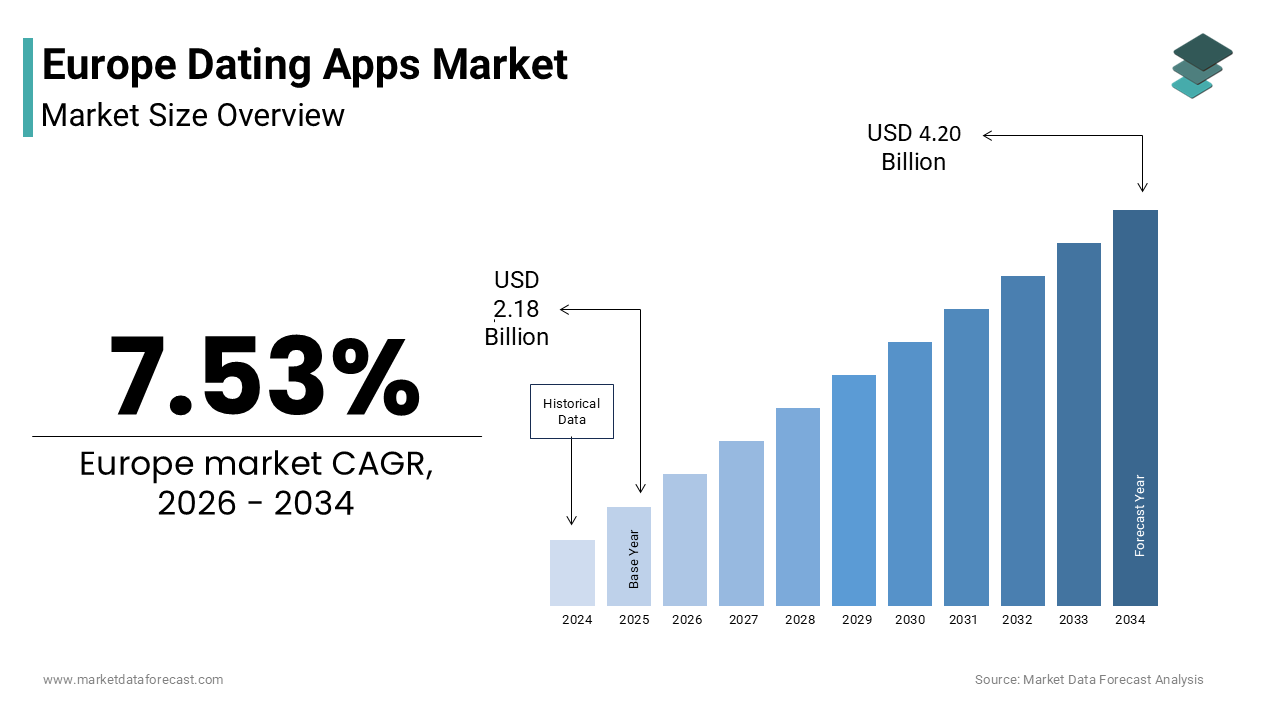
The Europe dating apps market was valued at USD 2.18 billion in 2025, is estimated to reach USD 2.35 billion in 2026, and is projected to reach USD 4.20 billion by 2034, growing at a CAGR of 7.53% during the forecast period from 2026 to 2034. The growth of the Europe dating apps market is driven by rising smartphone penetration, increasing numbers of single-person households, and the growing acceptance of digital platforms for relationship building. Dating applications enable users to discover and connect with potential partners based on location, interests, and relationship preferences through mobile platforms. Over time, these apps have evolved from simple matchmaking tools to advanced platforms incorporating artificial intelligence, video interaction, and behavioral analytics to improve compatibility matching. The widespread use of smartphones and high-speed mobile networks across Europe has significantly accelerated the adoption of dating applications, making them one of the primary methods of meeting partners among adults under the age of 40.
Key Market Trends
-
Increasing integration of artificial intelligence and machine learning to enhance compatibility matching and user engagement.
-
The rising popularity of video dating, live interaction features, and virtual events within dating platforms.
-
Growing demand for niche and community-based dating apps targeting specific demographics such as professionals, seniors, and LGBTQ+ communities.
-
Expansion of freemium subscription models where users access basic features for free and pay for premium services.
-
Increasing emphasis on data privacy, identity verification, and safety features to address user concerns about fraud and fake profiles.
Segmental Insights
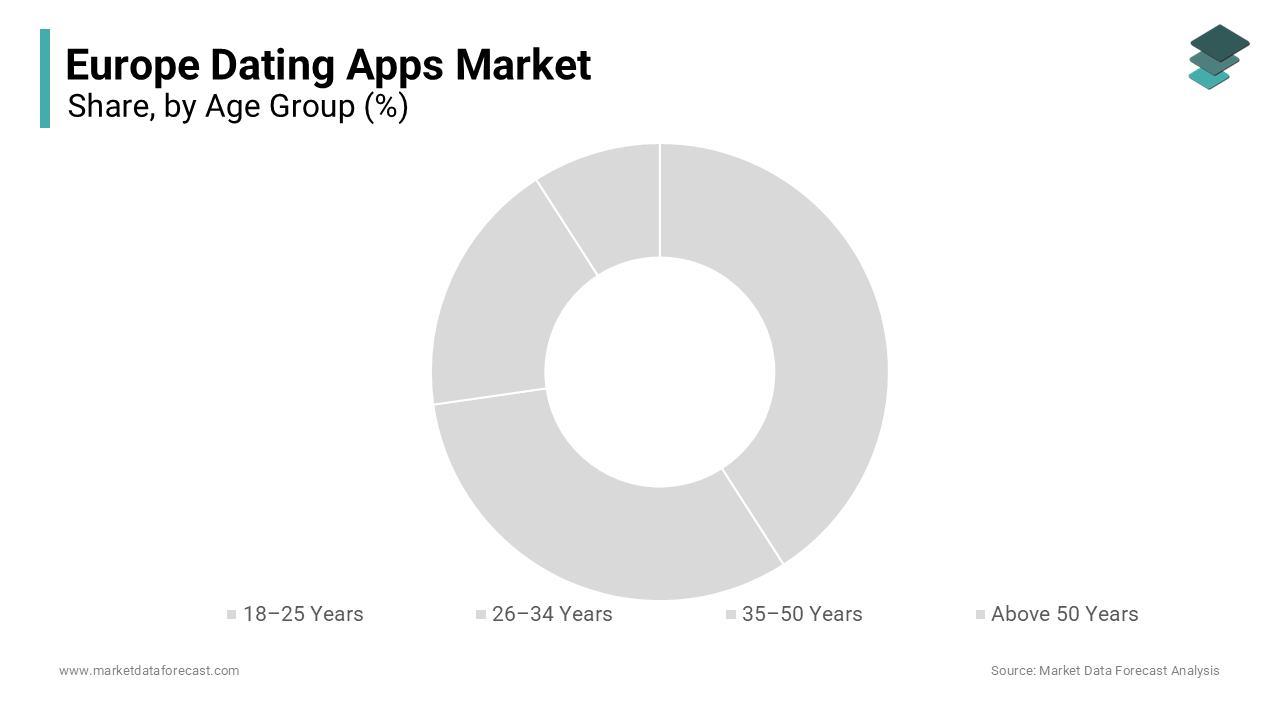
- Based on age group, the 26–34 years segment held the largest share of the Europe dating apps market in 2025, accounting for 38.1% of the market share. The dominance of this segment is attributed to individuals actively seeking long-term relationships, higher disposable income for premium subscriptions, and strong integration of digital tools into their daily lives.
- The above 50 years age segment is projected to witness the fastest CAGR of 14.8% during the forecast period. The growth of this segment is driven by increasing digital literacy among seniors, rising divorce rates among older adults, and the growing acceptance of online dating as a solution for companionship later in life.
- Based on the revenue model, subscription-based services remain the primary revenue source for dating platforms due to premium features such as unlimited swipes, profile visibility boosts, and advanced compatibility filters.
- Advertisement-based and premium models are also gaining traction as platforms diversify their monetization strategies while maintaining free access for a large user base.
Regional Insights
The Europe dating apps market shows strong growth across major countries due to urbanization, changing social dynamics, and increasing smartphone usage.
-
United Kingdom dominated the Europe dating apps market by accounting for 22.8% of the regional market share in 2025, supported by high smartphone penetration, strong digital culture, and a large urban population of singles.
-
Germany accounted for 18.8% of the market share in 2025, driven by increasing acceptance of digital matchmaking and strong demand among urban professionals.
-
France continues to play a significant role due to rising adoption of dating apps in major cities like Paris and increasing demand for niche platforms that focus on meaningful connections.
-
Italy is witnessing growing adoption as younger generations move to urban centers and traditional matchmaking methods decline.
-
Spain is emerging as a fast-growing market supported by high engagement levels, strong smartphone usage, and an expanding expatriate and digital nomad population.
Competitive Landscape
The Europe dating apps market is highly competitive and fragmented, featuring a combination of global platforms and regional niche applications. Large multinational companies dominate the market through strong brand recognition, advanced algorithms, and extensive marketing campaigns. At the same time, smaller specialized platforms attract users by targeting specific demographics or cultural communities. Market players focus heavily on improving user safety, enhancing matchmaking algorithms, and introducing innovative features such as video dating, AI-driven compatibility analysis, and personalized user experiences. Partnerships with influencers, lifestyle brands, and social media platforms are also commonly used to increase user acquisition and engagement. Prominent players in the Europe dating apps market include Match Group Inc., Bumble Inc., Badoo Ltd, happn (FTW & Co.), Spark Networks SE, Meetic SA, Grindr LLC, eHarmony Inc., OkCupid LLC, Zoosk Inc., PlentyOfFish Media ULC, and LOVOO GmbH & Co. KG.
Europe Dating Apps Market Size
The Europe dating apps market size was valued at USD 2.18 billion in 2025 and is anticipated to reach USD 2.35 billion in 2026 from USD 4.20 billion by 2034, growing at a CAGR of 7.53% during the forecast period from 2026 to 2034.
Dating apps are mobile software applications that allow users to find, connect with, and interact with potential romantic or sexual partners based on specific criteria like location, interests, and relationship goals. This sector has evolved from simple profile browsing to complex platforms utilizing artificial intelligence for behavioral compatibility and video-based interactions. The region exhibits a unique cultural tapestry where digital courtship intersects with varying social norms across nations. The number of people living alone in the European Union has shown a steady upward trajectory compared to other household types over the last decade, according to Eurostat. Furthermore, mobile connectivity is becoming a primary driver of economic growth in Europe, with a significant shift toward next-generation high-speed networks to support digital infrastructure, as noted in the State of Digital Communications report. The General Data Protection Regulation continues to shape the operational landscape, forcing platforms to adopt rigorous data privacy measures that distinguish European services from global counterparts. As traditional meeting venues decline in relevance, these applications have become the primary conduit for initiating relationships among adults under 40. The market is characterized by a blend of global giants and niche local players catering to specific demographics, religious groups, or lifestyle preferences, creating a highly segmented yet interconnected environment.
MARKET DRIVERS
Escalating Single-Person Household Demographics Fuel Digital Connection Demand
The structural transformation of European household compositions serves as a fundamental driver for the Europe dating apps market. As more individuals choose to live alone due to career prioritization, delayed marriage, or divorce, the organic opportunities for meeting partners in daily life diminish, necessitating digital intervention. The number of people living alone in the European Union is increasing at a significantly faster rate than the total number of households. This demographic reality creates a vast pool of isolated individuals actively seeking companionship through efficient digital channels. The phenomenon is particularly pronounced among millennials and Generation Z, who prioritize flexibility and often lack the community structures that previously facilitated introductions. Urbanization further exacerbates this trend, as high population density paradoxically leads to social fragmentation, making location-based apps essential for filtering potential matches within sprawling cities. The psychological need for connection in an increasingly solitary living environment drives consistent user acquisition and retention. Consequently, dating platforms have become indispensable utilities rather than optional entertainment, securing a stable and growing user base driven by the fundamental human desire for partnership amidst changing living arrangements.
Ubiquitous Smartphone Penetration and Advanced Mobile Connectivity
The near-universal adoption of smartphones coupled with robust mobile internet infrastructure acts as a critical enabler for the widespread usage of dating applications across the region and the expansion of the Europe dating apps market. Modern dating relies heavily on real-time geolocation, high-resolution image sharing, and video calling, all of which require advanced mobile hardware and fast data networks. Access to high-speed mobile connectivity is becoming nearly universal across Europe as digital infrastructure continues to expand into every segment of the population. Furthermore, the rollout of 5G networks across major European cities has reduced latency significantly, enabling seamless video interactions and augmented reality features that enhance user engagement. This technological backbone allows users to interact with potential matches instantly, regardless of their location, transforming the dating experience into an always-on activity. The integration of biometric security features in modern phones also addresses privacy concerns, encouraging users to trust apps with sensitive personal data. As mobile devices become more powerful and affordable, the barrier to entry for using sophisticated dating platforms lowers, expanding the addressable market to include older demographics and lower-income groups. This technological saturation ensures that digital dating remains the dominant method for relationship formation in the region.
MARKET RESTRAINTS
Pervasive Concerns Over Data Privacy and Algorithmic Transparency
Stringent data protection regulations and heightened consumer awareness regarding digital privacy restrict the unrestricted growth of the Europe dating apps market. This also restricts the data monetization strategies of dating apps in the region. The General Data Protection Regulation imposes rigorous requirements on how platforms collect, process, and store sensitive personal information, including sexual orientation and location data. European regulators are strictly enforcing data protection laws to ensure that digital platforms provide clear choices and protect user privacy regarding automated data processing. This regulatory environment forces companies to limit the granularity of data they can harvest for advertising and matching algorithms, potentially reducing the effectiveness of their services. Users are increasingly wary of sharing intimate details, leading to higher drop-off rates during onboarding and lower engagement levels. The requirement for explicit opt-in for every data processing activity complicates the user experience, creating friction that can deter potential subscribers. Furthermore, the lack of transparency in how matching algorithms work fosters distrust among users who fear manipulation or bias. These privacy hurdles increase operational costs for compliance and legal defense, diverting resources from innovation and marketing. Consequently, the strict European privacy framework creates a challenging landscape where balancing user trust with business viability remains a persistent struggle.
Prevalence of Fake Profiles and Cybersecurity Threats
The rampant presence of fraudulent accounts, bots, and romance scams severely undermines user trust and safety within the Europe dating apps market. Malicious actors exploit these platforms to steal personal data, solicit money, or distribute malware, creating a hazardous environment for genuine users. Fraudsters are increasingly using sophisticated tools like generative artificial intelligence to create more convincing fake identities and target victims on digital platforms. This surge in criminal activity forces platforms to invest heavily in verification technologies and moderation teams, increasing operational expenses significantly. Despite these efforts, the persistence of sophisticated fake profiles deters new users from joining and causes existing members to churn due to safety fears. The psychological impact of encountering scammers or harassment leads to a general skepticism towards digital dating, particularly among vulnerable demographics like the elderly. Platforms struggle to balance open access with rigorous security checks, as overly strict verification can hinder user growth. The reputational damage caused by high-profile security breaches further erodes brand loyalty, making it difficult for apps to differentiate themselves on safety grounds. The threat of fraud will remain a formidable restraint on market expansion. This will continue until robust, universally adopted identity verification standards are implemented.
MARKET RESTRAINTS
Integration of Artificial Intelligence for Hyper-Personalized Matching
The advancement of artificial intelligence and machine learning technologies offers a transformative opportunity for the Europe dating apps market. These tools allow platforms to deliver unprecedented levels of matching accuracy and user engagement. By analyzing vast datasets of user behavior, conversation patterns, and preference shifts, AI algorithms can predict compatibility with far greater precision than traditional static filters. AI agents are expected to become the primary method for businesses to provide highly personalized and direct communication with their customers. This capability allows platforms to reduce the fatigue associated with endless swiping by presenting highly curated matches that align with deep psychological traits rather than superficial attributes. AI can also power virtual coaching features that offer advice on profile optimization and conversation starters, enhancing the success rate of connections. Furthermore, natural language processing enables automated detection of inappropriate behavior and scams, improving platform safety without human intervention. The ability to create dynamic user experiences that evolve with individual needs fosters deeper loyalty and justifies premium subscription models. European users are increasingly discerning about the platforms they choose. Those that use AI to offer efficient and safe connections are set to lead the market and establish a new standard for digital courtship.
Expansion of Niche and Community-Specific Dating Platforms
The fragmentation of the user base into specific interest groups, lifestyles, and cultural communities provides a lucrative avenue for the development of specialized dating applications within the Europe dating apps market. Generalist platforms often fail to address the unique needs of specific demographics, creating a demand for tailored solutions that foster a sense of belonging and shared values. These platforms benefit from higher engagement rates and lower churn because users feel understood and safe within a curated community. Opportunities exist for apps catering to the growing senior population, the LGBTQ+ spectrum, or eco-conscious individuals seeking partners with similar sustainability values. By focusing on quality over quantity, niche apps can command higher subscription fees and attract dedicated advertising partners. The rise of remote work and digital nomadism also opens avenues for location-independent dating services that connect travelers and expatriates. As the market matures, the shift from mass appeal to targeted community building will drive innovation, allowing smaller players to thrive alongside industry giants by serving underserved segments with precision and care.
MARKET CHALLENGES
Intense Market Saturation and User Retention Difficulties
Extreme saturation, with hundreds of competing platforms vying for the attention of a finite user base is a formidable barrier to the Europe dating apps market. This intense competition is leading to severe retention issues. The low barrier to entry has resulted in a crowded landscape where differentiation becomes increasingly difficult, causing user fatigue and app switching behavior. Users in Europe frequently download multiple competing dating services, leading to a landscape where top-tier apps must constantly compete for active weekly engagement. This fragmentation dilutes the user pool for each platform, reducing the likelihood of successful matches and diminishing the overall value proposition. Acquiring new users has become exponentially more expensive as advertising costs rise across digital channels, squeezing profit margins. Retaining users requires constant innovation and feature updates, yet many apps struggle to move beyond the initial novelty phase. The "paradox of choice" often overwhelms users, leading to decision paralysis and eventual disengagement. Furthermore, the transient nature of success in relationships means that successful users naturally leave the platform, necessitating a continuous and costly influx of new singles to maintain liquidity. Sustaining growth in such a saturated environment demands exceptional brand positioning and superior user experience, which remains a daunting task for most market participants.
Monetization Friction and Subscription Fatigue
Converting free users into paying subscribers remains a persistent challenge for the Europe dating apps market. This struggle is exacerbated by growing consumer resistance to recurring subscription costs and economic pressures. While offering free basic services helps companies attract a large number of people, only a very small portion of those individuals eventually choose to pay for more advanced features. As people face rising costs and an abundance of digital choices, they are becoming much more careful and selective about which monthly services they continue to fund. Many users perceive premium features such as unlimited likes or profile boosts as non-essential luxuries, preferring to endure the limitations of free versions. The prevalence of ad-supported alternatives further reduces the incentive to upgrade, creating a race to the bottom on pricing. Additionally, strict app store policies and payment processing regulations in Europe add layers of complexity and cost to monetization strategies. Users are also more aware of dark patterns in subscription cancellations, leading to regulatory scrutiny and a demand for transparent billing practices. Balancing the need for revenue with the expectation of free access while navigating economic headwinds forces platforms to constantly rethink their value propositions, making sustainable profitability a significant hurdle in this competitive sector.
REPORT COVERAGE
| REPORT METRIC | DETAILS |
| Market Size Available | 2025 to 2034 |
| Base Year | 2025 |
| Forecast Period | 2026 to 2034 |
| CAGR | 7.53% |
| Segments Covered | By Age Group, Revenue Model and Region. |
| Various Analyses Covered | Global, Regional & Country Level Analysis, Segment-Level Analysis, DROC, PESTLE Analysis, Porter’s Five Forces Analysis, Competitive Landscape, Analyst Overview of Investment Opportunities |
| Country Covered | UK, France, Spain, Germany, Italy, Russia, Sweden, Denmark, Switzerland, the Netherlands, Turkey, the Czech Republic, and the Rest of Europe. |
| Market Leaders Profiled | Match Group Inc., Bumble Inc., Badoo Ltd, happn (FTW & Co.), Spark Networks SE, Meetic SA, Grindr LLC, eHarmony Inc., OkCupid LLC, Zoosk Inc., PlentyOfFish Media ULC, and LOVOO GmbH & Co. KG. |
SEGMENTAL ANALYSIS
By Age Group Insights
The 26 to 34 years age segment held the majority share of 38.1% of the Europe dating apps market in 2025. The dominance of the segment is driven by the demographic reality that individuals in this cohort are actively seeking serious relationships or marriage, possess higher disposable income for subscriptions, and have fully integrated digital solutions into their social lives. Individuals aged 26 to 34 are navigating a pivotal life stage where societal pressure and personal desire to settle down converge, creating intense demand for efficient matchmaking tools. Unlike younger users who may prioritize casual exploration, this group seeks compatibility for long-term commitment, making them willing to pay for premium features that filter serious candidates. The delay in marriage compared to previous decades extends the period of active dating, forcing reliance on algorithms to navigate complex urban social landscapes. Professionals in this group often face time scarcity due to career establishment, rendering traditional meeting methods inefficient. Consequently, they view dating apps not as games but as essential utilities for finding life partners. This urgency translates into higher conversion rates for subscription models that promise enhanced visibility and advanced filtering options. The sheer volume of users in this demographic combined with their high intent to commit solidifies their position as the primary revenue generator for the market. The financial stability characteristic of the 26 to 34 age group empowers them to subscribe to paid dating services at rates significantly higher than younger or older demographics. As individuals in this bracket typically advance in their careers, their disposable income increases, allowing them to invest in self-improvement and relationship facilitation. This group perceives value in features such as unlimited swipes, profile boosts, and the ability to see who liked them, viewing these costs as a worthwhile investment to accelerate the matching process. They are also more likely to subscribe to niche platforms catering to specific professional or educational backgrounds, which often carry higher price points. The economic capacity to maintain multiple subscriptions across different apps further amplifies their contribution to market revenue. Unlike students or retirees who may be price-sensitive, this demographic prioritizes efficiency and quality of matches over cost savings. Their readiness to spend on digital convenience ensures that they remain the most lucrative segment for platform operators, driving the overall financial health of the industry.
The above 50 years age segment is predicted to witness the highest CAGR of 14.8% from 2026 to 2034 due to the increasing digital literacy among seniors, rising divorce rates in later life, and the growing acceptance of online dating as a viable solution for combating loneliness in older age. A significant surge in "gray divorce" across Europe has created a large cohort of single individuals over 50 who are re-entering the dating market after decades of marriage. This demographic shift provides a fresh influx of users who are actively seeking companionship but lack the social networks they once had through spouses or family structures. These individuals often find traditional social venues inadequate for meeting new partners, turning instead to digital platforms designed for mature audiences. The motivation to find companionship for travel, shared interests, or emotional support drives high engagement levels. Unlike younger users who may treat dating casually, this group often approaches it with clarity and seriousness, leading to sustained usage patterns. The stigma surrounding online dating has largely vanished for this generation, replaced by a pragmatic understanding of its utility. As the population ages and life expectancy increases, the duration of post-divorce singlehood extends, ensuring a long-term growth trajectory for apps catering to this specific need. The rapid improvement in digital literacy and smartphone adoption among the senior population has removed the primary technical barrier to entry for dating apps. Older adults are increasingly comfortable using mobile devices for social interaction, banking, and healthcare, making the transition to dating platforms seamless. This connectivity is supported by user interface improvements in apps that cater to older eyes and varying levels of tech proficiency, such as larger fonts and simplified navigation. Seniors are also motivated by the desire to combat social isolation, a critical public health issue in Europe, and view dating apps as a tool for social expansion beyond just romance. Family members often encourage and assist older relatives in setting up profiles, further facilitating adoption. The combination of improved access, tailored design, and a strong psychological drive for connection positions this segment for explosive growth, transforming it from a niche market into a mainstream pillar of the industry.
REGIONAL ANALYSIS
United Kingdom Dating Apps Market Analysis
The United Kingdom dominated the Europe dating apps market with a share of 22.8% in 2025. The nation's status as a highly urbanized society with a large single population and a culture that readily embraces digital innovation drives the dominance of the UK market. London alone acts as a massive hub where fast-paced professional lives leave little time for traditional dating, forcing reliance on algorithmic matching. The UK market is characterized by high spending power, with British users showing a greater willingness to pay for premium subscriptions compared to many continental peers. The presence of major global dating app headquarters or significant operational centers in London fosters early access to new features and marketing campaigns. Furthermore, the cultural normalization of online dating in the UK means that stigma is virtually non-existent, encouraging participation across all age groups. The robust 5G infrastructure ensures seamless user experiences even in crowded urban areas. The UK is the pioneer of digital dating trends in the region. Consequently, it sets the pace for feature adoption and monetization strategies while maintaining its top spot through demographic necessity and technological readiness.
Germany Dating Apps Market Analysis
Germany was the second largest country in the Europe dating apps market and accounted for a 18.8% share in 2025. The expansion of the German market is propelled by a large population base and increasing acceptance of digital matchmaking among traditionally conservative demographics. The German market is unique due to its high emphasis on data privacy, which influences user behavior and platform preferences towards local or highly secure international apps. The demographic reality is compounded by a work culture that often limits socializing during weekdays, making weekends and digital platforms crucial for meeting partners. German users tend to be more deliberate and profile-focused, favoring apps that offer detailed compatibility metrics over quick-swipe mechanics. This preference drives engagement with premium services that provide in-depth personality analysis. The country's strong economy supports high disposable income, allowing users to invest in long-term subscriptions. Additionally, the integration of dating apps into the broader lifestyle of urban professionals in cities like Berlin and Munich fuels consistent growth. As privacy regulations like GDPR are strictly enforced, German users trust platforms that demonstrate compliance, giving an edge to transparent operators. This blend of demographic scale and specific behavioral traits ensures Germany remains a cornerstone of the European market.
France Dating Apps Market Analysis
France continues to be a major player in the Europe dating apps market due to a romantic culture that is increasingly merging with digital efficiency to facilitate connections. While historically known for meeting partners through social circles and cafes, the French are rapidly adopting dating apps due to changing urban lifestyles and the dissolution of traditional community structures. Paris serves as a critical epicenter where the density of singles and the competitive social scene make apps indispensable. French users show a distinct preference for apps that emphasize conversation and intellectual compatibility over purely visual judgments, aligning with cultural values of romance and wit. The market is also seeing a rise in niche apps catering to specific interests like gastronomy or arts, reflecting the diverse cultural landscape. Government initiatives promoting digital inclusion have further expanded the user base to include older demographics. The French market is less price-sensitive than some neighbors when it comes to quality experiences, supporting a healthy ecosystem of freemium and premium models. This cultural adaptation to digital tools while retaining a focus on meaningful interaction sustains France's strong market position.
Italy Dating Apps Market Analysis
Italy also occupies a significant position in the Europe dating apps market owing to a shifting social fabric where traditional family-mediated introductions are declining in favour of autonomous digital searching. The Italian market is evolving as younger generations delay marriage and move to urban centers for work, breaking away from the close-knit community structures that previously facilitated relationships. Research showed that the average age of first marriage in Italy has risen for men and women, extending the period of active singlehood. This delay creates a prolonged window for dating app usage, particularly in metropolitan areas like Milan and Rome where professional demands limit social time. Italian users are increasingly open to online dating, shedding past stigmas associated with digital romance. There is a growing trend towards apps that facilitate casual dating as well as serious relationships, reflecting a modernization of social norms. The high smartphone penetration rate, provides the necessary infrastructure for widespread adoption. Furthermore, the tourism sector in Italy attracts a transient population that utilizes dating apps for short-term connections, adding a unique dynamic to the user base. As the digital native generation becomes the dominant consumer force, Italy's market potential continues to expand rapidly.
Spain Dating Apps Market Analysis
Spain is likely to grow notably in the Europe dating apps market during the forecast period due to a vibrant social culture that is increasingly supplementing traditional nightlife with digital dating platforms. The Spanish market is fueled by a high proportion of young adults living independently in major cities and a lifestyle that values social interaction, yet faces time constraints due to modern work schedules. The demographic shift is driving young Spaniards to use apps not only for dating but also for expanding their social circles in a safe and controlled manner. The late-night culture of Spain complements app usage, with peaks in activity occurring later in the evening compared to other European nations. Spanish users are highly engaged with video features and gamified elements within apps, reflecting a preference for interactive and visually rich experiences. The economic recovery post-pandemic has boosted discretionary spending, allowing more users to opt for premium features. Additionally, the influx of expatriates and digital nomads in coastal and urban areas contributes to a diverse and active user base. Spain's blend of traditional sociability and modern digital adoption creates a dynamic environment for dating app growth.
COMPETITIVE LANDSCAPE
The competition within the Europe dating apps market is fierce and highly fragmented, characterized by the presence of global giants alongside numerous specialized niche platforms catering to specific demographics. Major corporations leverage their extensive resources to dominate through aggressive marketing, advanced algorithmic development, and cross-promotion within their brand portfolios. However, smaller regional players thrive by offering tailored experiences that address unique cultural or religious preferences often overlooked by mass-market applications. The battle for user attention has intensified as customer acquisition costs rise, forcing companies to innovate constantly with features like video dating, virtual events, and AI-driven compatibility testing. Safety and data privacy have become critical competitive differentiators, with users increasingly favoring platforms that demonstrate rigorous protection measures against fraud and harassment. The market sees frequent mergers and acquisitions as larger entities seek to absorb innovative startups to maintain their edge. Brand loyalty remains volatile, prompting operators to focus heavily on retention strategies and community building. This dynamic environment demands agility and continuous adaptation to shifting social norms and technological advancements to sustain growth.
KEY MARKET PLAYERS
Some of the companies that are playing a dominating role in the Europe dating apps market include
- Match Group Inc.
- Bumble Inc.
- Badoo Ltd
- happn (FTW & Co.)
- Spark Networks SE
- Meetic SA
- Grindr LLC
- eHarmony Inc.
- OkCupid LLC
- Zoosk Inc.
- PlentyOfFish Media ULC
- LOVOO GmbH & Co. KG
Top Players in the Europe Dating Apps Market
Match Group
Match Group stands as a global leader in the online dating industry, operating a vast portfolio of brands including Tinder, Hinge, and Meetic that dominate the European landscape. The company contributes significantly to the global market by pioneering algorithmic matching technologies and setting standards for user safety and engagement. In Europe, Match Group recently intensified its focus on video integration and AI-driven conversation starters to enhance user interaction quality. They have launched specific initiatives to combat fake profiles through advanced verification systems, addressing critical safety concerns in the region. Their strategy involves tailoring features to local cultural nuances while maintaining a unified technological backbone. Match Group continues to solidify its influence by acquiring niche platforms. Additionally, they are investing heavily in marketing campaigns targeting younger demographics. Their commitment to fostering meaningful connections through innovative product updates ensures they remain at the forefront of the digital romance revolution worldwide.
Bumble Inc
Bumble Inc has carved a unique position in the Europe dating apps market by empowering users, particularly women, to make the first move in heterosexual matches. The company globally champions a respectful and safe online environment, which resonates strongly with European values regarding gender equality and personal security. Recently, Bumble expanded its platform beyond dating to include networking and friendship modes, creating a holistic social ecosystem that increases user retention. They have introduced advanced privacy features such as private detector technology to prevent unsolicited explicit images, strengthening trust among European users. Bumble actively partners with local organizations to promote healthy relationship education and mental well-being. Their investment in artificial intelligence to improve match relevance and reduce harassment has been pivotal in recent growth phases. Bumble maintains a loyal and engaged community across the continent. This is achieved by continuously evolving its brand message to align with modern social movements.
Spark Networks SE
Spark Networks SE is a prominent player in the Europe dating apps market, specializing in premium services for specific demographics through brands like EliteSingles and Christian Mingle. The company contributes to the global market by focusing on high-intent users seeking serious long-term relationships rather than casual encounters. In Europe, Spark Networks has recently upgraded its personality assessment algorithms to deliver more accurate compatibility scores, enhancing the value proposition for subscribers. They have strengthened their market position by optimizing mobile user interfaces and introducing flexible subscription models tailored to European consumer preferences. The company actively invests in data security measures to comply with strict regional privacy regulations, building confidence among privacy-conscious users. By concentrating on niche markets and delivering personalized experiences, Spark Networks differentiates itself from mass-market competitors. Their strategic focus on quality over quantity ensures high conversion rates and sustained revenue growth in the competitive European landscape.
Top Strategies Used by Key Market Participants
Key players in the Europe dating apps market primarily employ product differentiation strategies by integrating artificial intelligence and video features to enhance user engagement and match quality. Companies frequently invest in robust safety and verification systems to build trust and comply with stringent European data privacy regulations. Another major strategy involves expanding into niche demographics such as seniors or specific religious groups to capture underserved market segments with higher loyalty. Market leaders also focus on freemium monetization models that offer basic services for free while gating premium features behind subscription paywalls to maximize revenue. Strategic partnerships with lifestyle brands and social influencers are utilized to boost brand visibility and attract younger users. Furthermore, firms prioritize localizing content and marketing campaigns to resonate with diverse cultural norms across different European countries. Continuous innovation in user interface design ensures seamless experiences across mobile devices, reducing churn rates significantly.
MARKET SEGMENTATION
This research report on the Europe dating apps market has been segmented and sub-segmented based on the following categories.
By Age Group
- 18–25 Years
- 26–34 Years
- 35–50 Years
- Above 50 Years
By Revenue Model
- Subscription-Based
- Advertisement-Based
- Premium
By Country
- UK
- France
- Spain
- Germany
- Italy
- Russia
- Sweden
- Denmark
- Switzerland
- Netherlands
- Turkey
- Czech Republic
- Rest of Europe