- Product Description Description
- Table of Contents TOC
- List of Table & Figure LOT
- Get Free Sample PDF Sample PDF
Market Size, 2025
$5.39 BnMarket Estimate, 2026
$5.61 BnMarket Forecast, 2034
$7.73 BnCAGR, 2026–2034
4.09%Europe Deli Meat Market Size
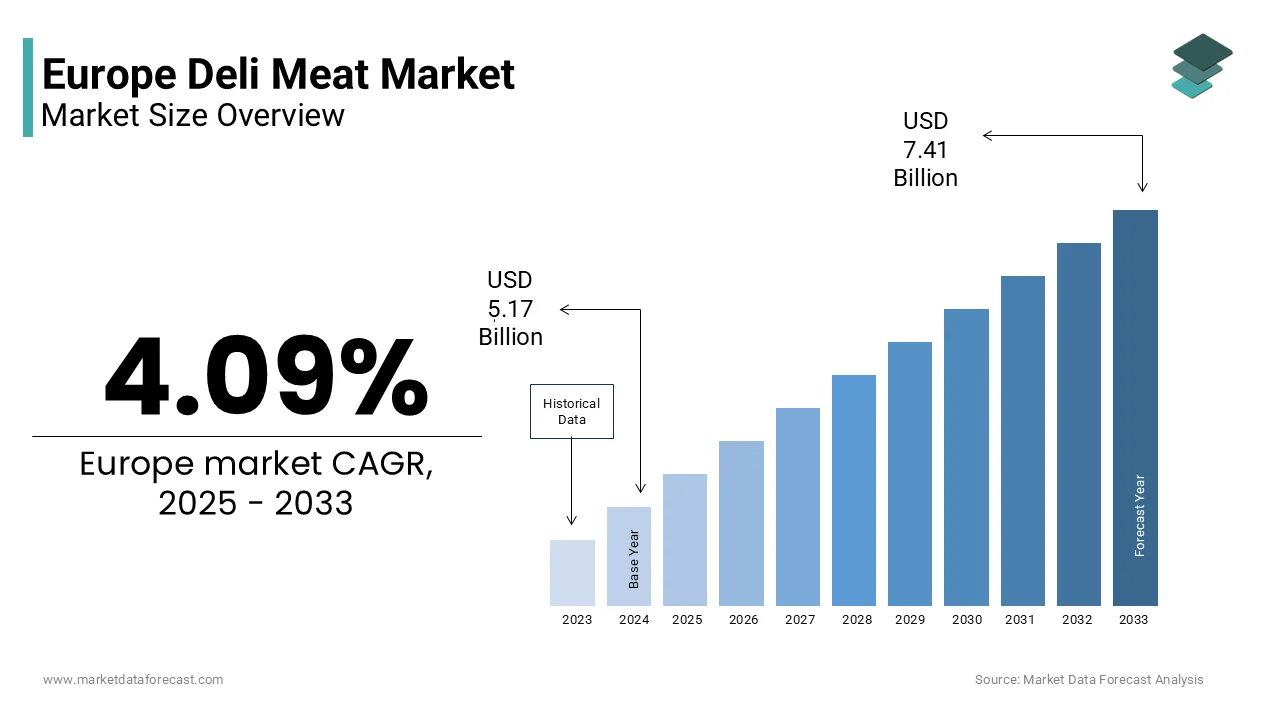
The Europe deli meat market size was valued at USD 5.39 billion in 2025 and is projected to reach USD 7.73 billion by 2034 from USD 5.61 billion in 2026, growing at a CAGR of 4.09%.
A deli is a market where you can purchase prepared foods and staples such as meat and cheese. Deli meat is fresh or canned meat sold as precooked, ready-to-eat pork, ham, beef loaves, or sausages. The meats are typically served on sandwiches and hors d'oeuvre trays and are available as loaves, canned, sliced, or prepackaged vacuum-packed portions. This meat type is also called cold cuts or luncheon meat. Deli meat is made from various types of animal meat, including beef, pork, goat, hog, chicken, turkey, veal, and ovine. A variety of deli meat products are widely available in supermarkets, hypermarkets, specialty stores, and online channels.
MARKET DRIVERS
Over the next few years, the market is expected to expand due to increased organized meat retail channels and rising awareness about the food ingredient requirements of the human body. In addition, Deli meat products provide a convenient way for consumers to prepare food, and people prefer to choose deli meat products as the change in lifestyle that will drive the market's growth. The increase in disposable income in the region will also drive the market's growth.
Considering the safety of living things, government officials issued rules and regulations allowing meat consumption. Consumers' preference for meat is growing as they become more aware of the benefits of meat consumption. It can help to overcome health issues like deficiencies and weaknesses. The manufacturers provide a wide variety of meat food, including chicken, turkey, beef, and pork. Furthermore, the change in the consumption pattern among consumers across the region is also increasing the demand for the deli meat market. These are some of the factors that will drive the market's growth during the European region's forecast period.
MARKET RESTRAINT
Some factors that may limit the growth of the European deli meat market include an increase in product recalls, which is a significant challenge for the global deli meat market. Food is recalled when it is suspected to pose a health risk due to contamination or contains allergens not listed on the label. As a result, stifle market growth by tarnishing a company's brand, reducing consumer trust and loyalty, and putting financial and operational strain on the organization. Furthermore, increased awareness about properly adopting fresh meat may hamper the market growth. Furthermore, post-COVID-19, consumers became aware of the need to avoid preservative products, which may further hinder the growth of the deli meat market.
REPORT COVERAGE
|
| DETAILS |
| Market Size Available | 2025 to 2034 |
| Base Year | 2025 |
| Forecast Period | 2026 to 2034 |
| CAGR | 4.09% |
| Segments Covered | By Sources, Products, Distribution Channel, and Region |
| Various Analyses Covered | Global, Regional, & Country Level Analysis; Segment-Level Analysis; DROC, PESTLE Analysis; Porter’s Five Forces Analysis; Competitive Landscape; Analyst Overview of Investment Opportunities |
| Regions Covered | UK, France, Spain, Germany, Italy, Russia, Sweden, Denmark, Switzerland, Netherlands, Turkey, and the Czech Republic |
| Market Leaders Profiled | Hormel Foods Corporation, Samworth Brothers Ltd, Tyson Foods Inc., Waitrose Ltd., JBS S.A., BRF S.A., Sisters Food Group, Wm Morrison supermarkets plc, Cargill Inc., Conagra Foods Inc |
MARKET SEGMENTATION
This research report on the Europe deli meat market has been segmented and sub-segmented into the following categories.
By Sources Insights
On the basis of the source, the European deli meat market is segmented by beef, pork, chicken, and others. The pork segment currently has the majority of the share in the market and is expected to grow significantly during the forecast period. Pork has a distinct flavor, crisp texture, and nutritional value. This attracts consumers to consume more pork meat than other alternatives available.
By Products Insights
Based on product types, the deli meat market is segmented by cured and uncured delis. The cured deli meat segment has gained a major share and is expected to grow during the forecast period. To preserve flavor and color, cured deli meats are commercially prepared with salt, nitrite additives, and other preservative chemicals. Curing extends the life of the meat by removing moisture and changing its flavor.
By Distribution Channel Insights
Based on distribution channels, the European deli meat market is segmented by hypermarkets and supermarkets, specialty stores, convenience stores, online channels, and others. The hypermarket and supermarkets have the largest market share in the deli meat market because a wide variety of products are available from different sources. The increase in footfall in the hypermarket and supermarket indicates that a greater number of consumers are visiting, and the likelihood of deli meat product sales is increasing, which further boosts the growth of the deli meat market. Furthermore, during the forecast period, the online channel will have the most rapid growth in the region as most stores adopt the online channel to sell their products and give the consumer door-to-door services.
REGIONAL ANALYSIS
Germany holds the largest market share in the European market, followed by France and the United Kingdom, The market in this region is expected to grow rapidly during the forecast period for various reasons, including increased demand for deli foods and ease of availability.
KEY MARKET PLAYERS
Hormel Foods Corporation, Samworth Brothers Ltd, Tyson Foods Inc., Waitrose Ltd., JBS S.A., BRF S.A., Sisters Food Group, Wm Morrison supermarkets plc, Cargill Inc., Conagra Foods Inc. are some of the notable companies in the Europe Deli Meat market.
RECENT DEVELOPMENTS IN THE MARKET
- In 2021, Tyson Foods, an American meat company, will buy 49% of Malayan Flour Mills Berhad (MFM), a Malaysian food manufacturing company, "Tyson Foods is a global food manufacturing and distribution company with a significant global manufacturing and distribution footprint." Malaysia, with high per capita poultry consumption, is a key poultry market in Southeast Asia.
- In January 2021, Cargill, a US-based agri-food company, completed a cooked meat acquisition as it expanded in the value-added segment.
- Hormel® Natural Choice® deli meat creators announced new single-serve lunchmeat options in 2019, expanding the brand's portfolio of 100 percent natural* deli meats, snacks, and cured pork made without the use of any artificial preservatives or ingredients.
MARKET SEGMENTATION
This research report on the Europe deli meat market has been segmented and sub-segmented into the following categories.
By Sources
- Beef
- Pork
- Chicken
- Others
By Products
- Cured deli Meat
- Uncured Deli Meat
By Distribution Channel
- Hypermarket/Supermarket
- Specialty Store
- Convenience Store
- Online channel
- Others
By Country
- Germany,
- France,
- U.K.,
- Italy,
- Spain,
- Turkey,
- Belgium,
- Netherlands,
- Switzerland