- Product Description Description
- Table of Contents TOC
- List of Table & Figure LOT
- Get Free Sample PDF Sample PDF
Market Size, 2025
$3.78 BnMarket Estimate, 2026
$3.97 BnMarket Forecast, 2034
$5.83 BnCAGR, 2026–2034
4.92%Europe Diesel Generators Market Report Summary
The Europe diesel generators market was valued at USD 3.78 billion in 2025, is estimated to reach USD 3.97 billion in 2026, and is projected to reach USD 5.83 billion by 2034, growing at a CAGR of 4.92% during the forecast period from 2026 to 2034. The growth of the Europe diesel generators market is driven by mandatory backup power requirements across critical infrastructure, increasing grid instability events, and sustained reliance on diesel-based standby power solutions for operational continuity. Regulatory frameworks such as the Critical Entities Resilience Directive are reinforcing procurement of backup generation across healthcare, telecom, and water sectors, while industrial and commercial operators continue to deploy diesel generators to mitigate power disruptions and manage peak demand costs. Although stringent emission regulations and decarbonization policies present long-term challenges, diesel generators remain indispensable due to their proven reliability, rapid response capability, and fuel availability during extended outages, sustaining steady demand across mission-critical applications.
Key Market Trends
-
Enforcement of resilience directives mandating backup power across essential infrastructure sectors.
-
Rising grid instability caused by extreme weather and aging transmission networks is driving standby generator deployment.
-
Increasing integration of diesel generators into hybrid microgrid architectures with renewable energy and battery storage.
-
Replacement of legacy generator fleets with Stage V-compliant systems across Eastern and Southern Europe.
-
Growing adoption of diesel generators for peak shaving and energy cost optimization among industrial consumers.
Segmental Insights
- Based on capacity, the 75 to 375 kVA segment held 42.6% of the Europe diesel generators market share in 2025, supported by its suitability for commercial facilities, hospitals, retail complexes, and distributed industrial backup applications.
- Based on application, the standby or backup power segment represented the largest share in 2025, driven by increasing reliance on generator-protected infrastructure requiring guaranteed availability during outages.
- Based on end-user, the industrial segment accounted for 52.7% of the Europe diesel generators market share in 2025, owing to stringent continuity requirements in manufacturing, mining, and process industries where downtime risks are substantial.
Regional Insights
The Europe diesel generators market demonstrates varied growth dynamics across major countries influenced by infrastructure resilience priorities, industrial presence, and regulatory environments.
-
Germany represents a key market, supported by healthcare modernization initiatives, industrial manufacturing strength, and stringent infrastructure resilience standards.
-
The United Kingdom maintains a steady demand, driven by data center expansion, telecom infrastructure resilience, and commercial backup power adoption.
-
France shows consistent growth, supported by hospital power infrastructure requirements and urban commercial resilience investments.
-
Italy contributes significantly, with emergency infrastructure upgrades and civil protection modernization initiatives sustaining procurement.
-
Nordic countries demonstrate demand for high-capacity generators, particularly across mining operations, remote industrial sites, and cold-climate applications requiring robust backup systems.
Competitive Landscape
The Europe diesel generators market is moderately consolidated, with global power technology providers competing on emission compliance, digital control capabilities, lifecycle services, and hybrid integration expertise. Leading manufacturers are prioritizing Stage V compliant engine platforms, remote monitoring solutions, and containerized modular systems to address evolving customer requirements and regulatory expectations. The market also reflects increasing strategic focus on hybrid diesel-battery systems and predictive maintenance platforms to enhance operational efficiency and extend asset lifecycle. Strong service networks, localized engineering support, and certification capabilities act as critical differentiators in securing contracts across healthcare, industrial, and digital infrastructure sectors. Key players operating in the Europe diesel generators market include Caterpillar Inc., Cummins Inc., Mitsubishi Heavy Industries Engine & Turbocharger Ltd., FG Wilson Engineering Ltd., Yanmar Holdings Co., Ltd., Generac Power Systems, Kohler Co. (Kohler-SDMO), Doosan Corporation, Atlas Copco AB, Himoinsa, Rolls-Royce Power Systems (MTU), Wärtsilä Corporation, Deutz AG, Volvo Penta AB, Aggreko PLC, AKSA Power Generation, Perkins Engines Company, Pramac Group, Grupel S.A., Wacker Neuson SE, and JCB Power Products.
 Download Free Sample Report
Europe Diesel Generators Market Size
The Europe diesel generators market size was valued at USD 3.78 billion in 2025 and is anticipated to reach USD 3.97 billion in 2026 from USD 5.83 billion by 2034, growing at a CAGR of 4.92% during the forecast period from 2026 to 2034.
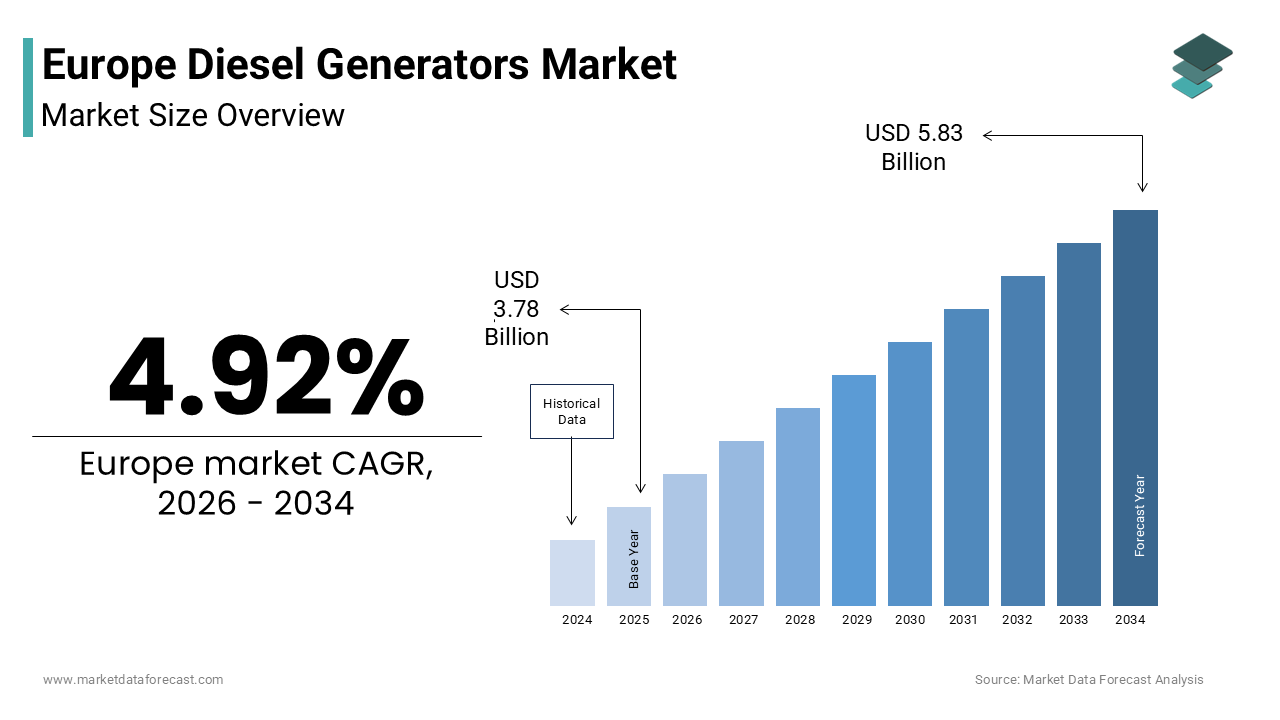
Diesel generators convert diesel fuel into electrical energy through internal combustion engines coupled with alternators, offering high power density, rapid start capability, and operational resilience under extreme conditions. The Europe diesel generators market operates within a complex regulatory environment that balances energy security needs against stringent emissions controls under the EU Stage V directive for non road mobile machinery. As per various sources, the European Union continues to face significant grid stability challenges, including major multi-country power outages linked to high-impact events. Furthermore, stricter EU-wide environmental regulations are forcing more stringent permitting and emissions controls on standby generators due to their contribution to localized nitrogen oxides (NOx) pollution. Furthermore, the European Commission’s Critical Entities Resilience Directive mandates that hospitals, telecom hubs, and water treatment plants maintain minimum backup power capacities, directly sustaining demand. Long-term decarbonization goals favor alternatives. However, diesel generators remain indispensable for mission-critical applications requiring proven reliability, immediate response, and fuel availability during extended disruptions.
MARKET DRIVERS
Mandatory Backup Power Requirements for Critical Infrastructure Under EU Resilience Directives
European regulations now legally obligate operators of essential services to maintain on site backup generation, which accelerates the growth of the Europe generators market. This creates structural demand for diesel generators despite environmental pressures. The European Commission’s Critical Entities Resilience Directive, which began applying in late 2024, requires EU Member States to identify essential entities in sectors like health, water, and digital infrastructure and ensure they adopt measures to withstand disruptions, including improved energy resilience. German authorities have intensified hospital preparedness requirements, encouraging updates to emergency power systems to meet stricter civil protection and infrastructure standards following increased threats. Similarly, the European Data Centre Association acknowledges that most high-tier data centers in Europe rely on diesel generators as primary backup power, capable of responding rapidly to grid failures to ensure continuous, high-capacity operation. Swedish authorities (MSB) continue to emphasize the importance of redundancy and backup power systems for critical water infrast. These legal imperatives transform diesel generators from optional assets into compliance necessities, ensuring steady procurement independent of energy transition timelines.
Increasing Frequency and Duration of Grid Instability Events Across the Continent
Climate-induced extreme weather and aging transmission infrastructure have significantly elevated power disruption risks, which boost the expansion of the Europe diesel generators market. This reinforces reliance on diesel generators for operational continuity. ENTSO-E confirms that extreme weather, including intense heatwaves and storms, increasingly challenges European grid capacity, with 2024 seeing significant operational stress. Additionally, in June 2024, a major grid disturbance in Southeast Europe occurred, causing widespread power losses due to cascading failures from vegetation and extreme heat. In Southern Europe, prolonged droughts reduced hydroelectric output, forcing rolling blackouts in parts of Spain and Italy. Insurers are also identifying rising risks from business interruption linked to infrastructure, driving increased corporate investment in operational resilience and onsite generation. Mining operations in Finland and telecom towers in Greece now deploy diesel generators not just as backup but as primary power during seasonal grid stress. This shift from contingency to operational necessity expands the market beyond traditional emergency roles into sustained reliability infrastructure.
MARKET DRIVERS
Stringent EU Stage V Emissions Regulations for Non Road Mobile Machinery
The enforcement of EU Stage V emission standards has significantly increased the cost and complexity of diesel generator deployment across the region, which restrains the growth of the Europe diesel generators market. EU Stage V regulations, phased in before 2023, mandate strict nitrogen oxide (NOx) and particulate matter (PM) limits for new diesel engines, including those over 19 kilowatts, often requiring selective catalytic reduction and diesel particulate filters. Compliance with stringent EU engine emissions standards increases the upfront cost of industrial generators and requires more frequent maintenance due to urea consumption and filter regeneration. German environmental regulations require licensing and potential environmental impact assessments for certain industrial generators, which can lead to extended permitting times. Similarly, French local authorities frequently restrict the operational hours of non-certified generators in urban areas, encouraging the use of cleaner Stage V engines. Due to the complexities of environmental certification and increased, costs, many European manufacturers have delayed investment in new, cleaner generator technology. These regulatory barriers disproportionately affect small and medium enterprises, slowing market penetration despite operational need.
Growing Political and Public Opposition to Diesel Fuel Use in Urban and Sensitive Areas
These generators face mounting social and political resistance in cities and ecologically protected zones due to noise, air quality, and carbon footprint concerns, which further inhibits the expansion of the Europe diesel generators market. Multiple European cities continue to face challenges meeting strict World Health Organization air quality guidelines, resulting in various localized restrictions on polluting equipment during episodes of poor air quality. Amsterdam has implemented strict, localized ordinances restricting the use of older diesel-powered machinery, pushing for cleaner alternatives, especially in densely populated or sensitive areas, in its efforts to reach zero-emission air quality. Similarly, Switzerland’s Federal Office for the Environment classifies standby generators as “temporary pollution sources” requiring special permits that are increasingly denied in alpine regions. Public opposition has also influenced corporate decisions. This stigma, amplified by media coverage of generator emissions during outages, erodes social license to operate and accelerates regulatory phase outs, particularly in Northern and Western Europe where air quality activism is strongest.
MARKET OPPORTUNITIES
Hybridization with Battery Storage and Renewable Energy Systems
Diesel generators are increasingly integrated into hybrid microgrids that combine solar, wind, and battery storage, which creates new opportunities for the Europe diesel generators market. This approach reduces fuel consumption while maintaining reliability. This configuration allows generators to operate only during peak demand or low renewable output, slashing emissions and operating costs. Industry reports indicate a rising trend in the deployment of hybrid energy systems across Europe, particularly in isolated geographies and remote industrial zones. These installations increasingly integrate renewable energy sources with traditional backup generators to enhance grid stability and reduce reliance on imported fuels. Green energy initiatives in the Greek Aegean are incorporating renewable sources, energy storage, and smart grid technology to decrease reliance on conventional, polluting power generation. Similarly, mining operators in sub-arctic regions are advancing electrification and automating, replacing diesel-powered transport systems with electric alternatives to reduce carbon emissions and operational costs The European Investment Bank provides financing to national operators for infrastructure modernization to improve energy resilience and enhance grid capacity for renewable integration. Diesel generators are transitioning from standalone to complementary assets. This shift allows them to extend their relevance while meeting decarbonization targets.
Modernization of Aging Generator Fleets in Eastern and Southern Europe
Replacing obsolete diesel generators installed before 2010 with modern, Stage V compliant units that offer higher efficiency and lower emissions provides potential prospects for the Europe diesel generators market. Industrial and public sector backup power systems in certain Eastern European countries often rely on older, less efficient units that fall below modern, more stringent EU environmental and efficiency standards. Romania’s National Recovery and Resilience Plan includes funding for modernizing hospital infrastructure, prioritizing green energy solutions and improved, efficient emergency power capabilities. Similarly, Following the 2023 floods, Italy’s Civil Protection Department has focused on updating its emergency response infrastructure, including long-term investment in, and replacement of, equipment in affected regions. These retrofits are often bundled with digital control systems that enable predictive maintenance and grid interaction. EU cohesion funds are prioritizing infrastructure resilience. This replacement wave creates a multi-year demand pipeline that offsets declines in new construction markets, particularly in regions with less mature renewable grids.
MARKET CHALLENGES
Supply Chain Constraints for Advanced Emission Control Components
The production of Stage V compliant diesel generators is hampered by shortages of specialized components, which constrains the growth of the Europe diesel generators market. These shortages include selective catalytic reduction catalysts, high-precision fuel injectors, and exhaust gas recirculation valves. These parts rely on rare earth metals and high tolerance manufacturing, with global supply concentrated in Asia. Export restrictions imposed by China on several heavy rare earth elements caused significant production disruptions for European automotive suppliers, leading to urgent calls from industry associations for transparent licensing to prevent further plant closures. Similarly, Supply chain vulnerabilities and declining sales in key markets have forced major automotive technology suppliers to implement cost-reduction strategies and reassess their production capabilities for advanced fuel injection systems. Small manufacturers like HIMOINSA and SDMO lack the purchasing power to secure priority allocations, forcing project deferrals. According to research, the European mechanical engineering sector faced a worsening economic outlook due to trade conflicts and rising costs, leading to a general decline in production output and a significant decrease in companies reporting positive business conditions. Europe's reliance on foreign emission tech leaves the market vulnerable to disruptions that jeopardize reliability promises.
Accelerated Policy Shift Toward Zero Emission Backup Power in Public Procurement
Public sector tenders across the region are rapidly excluding diesel generators in favor of battery storage and hydrogen fuel cells, which hinders the expansion of the Europe diesel generators market. This shift is shrinking a historically stable demand segment. Updated European guidelines for public purchasing now place a heavy emphasis on reducing environmental impacts for technical building systems, encouraging a shift away from fossil-fuel-based infrastructure in projects receiving regional development funding. The Dutch government is increasingly integrating large-scale battery storage solutions into the national energy strategy to stabilize the grid and reduce reliance on traditional combustion-based emergency power systems. Similarly, New procurement standards in Sweden require suppliers to provide detailed evidence of how their energy solutions align with national climate goals, creating a competitive advantage for technologies that utilize renewable fuels or electrified components. European defense authorities are accelerating the evaluation of hydrogen and hybrid energy architectures to improve the strategic autonomy and reduce the logistical footprint of military installations in the field. This policy pivot reduces long term visibility for diesel OEMs and discourages R&D investment, as public contracts once provided predictable volume. Without adaptation, the market risks becoming confined to private industrial niches with limited growth potential
REPORT COVERAGE
| REPORT METRIC | DETAILS |
| Market Size Available | 2025 to 2034 |
| Base Year | 2025 |
| Forecast Period | 2026 to 2034 |
| CAGR | 4.92% |
| Segments Covered | By Capacity, Application, End-User and Country. |
| Various Analyses Covered | Global, Regional & Country Level Analysis, Segment-Level Analysis, DROC, PESTLE Analysis, Porter’s Five Forces Analysis, Competitive Landscape, Analyst Overview of Investment Opportunities |
| Regions Covered | UK, France, Spain, Germany, Italy, Russia, Sweden, Denmark, Switzerland, the Netherlands, Turkey, the Czech Republic, and the Rest of Europe. |
| Market Leaders Profiled | Caterpillar Inc., Cummins Inc., Mitsubishi Heavy Industries Engine & Turbocharger Ltd., FG Wilson Engineering Ltd., Yanmar Holdings Co., Ltd., Generac Power Systems, Kohler Co. (Kohler-SDMO), Doosan Corporation, Atlas Copco AB, Himoinsa, Rolls-Royce Power Systems (MTU), Wärtsilä Corporation, Deutz AG, Volvo Penta AB, Aggreko PLC, AKSA Power Generation, Perkins Engines Company, Pramac Group, Grupel S.A., Wacker Neuson SE, and JCB Power Products. |
SEGMENTAL ANALYSIS
By Capacity Insights
The 75 to 375 KVA capacity segment held the majority share of 42.6% of the Europe diesel generators market in 2025. The supremacy of the segment is driven by its optimal balance of power output, mobility, and cost efficiency for commercial and mid scale industrial applications. This range satisfies the backup power needs of hospitals, data centers, retail complexes, and small manufacturing units without requiring extensive civil works or fuel infrastructure. New European regulations for critical infrastructure focus on high-level resilience and service continuity, requiring designated entities across key sectors to implement robust backup energy solutions tailored to their specific operational risk assessments. Nationwide structural reforms in Germany’s healthcare sector are driving a wave of modernization in critical building infrastructure, with significant federal funding allocated to enhance the resilience and climate neutrality of hospital power systems. Similarly, Driven by the rapid growth of digital workloads and grid limitations, data center operators across Europe are increasingly adopting modular and containerized power solutions to achieve the high levels of availability required for modern facility certification. These generators also comply with EU Stage V emissions standards through integrated selective catalytic reduction systems, avoiding the complexity of larger units. Their plug and play nature, transportability via standard trucks, and compatibility with automatic transfer switches make them the default choice for distributed resilience across urban and suburban landscapes.
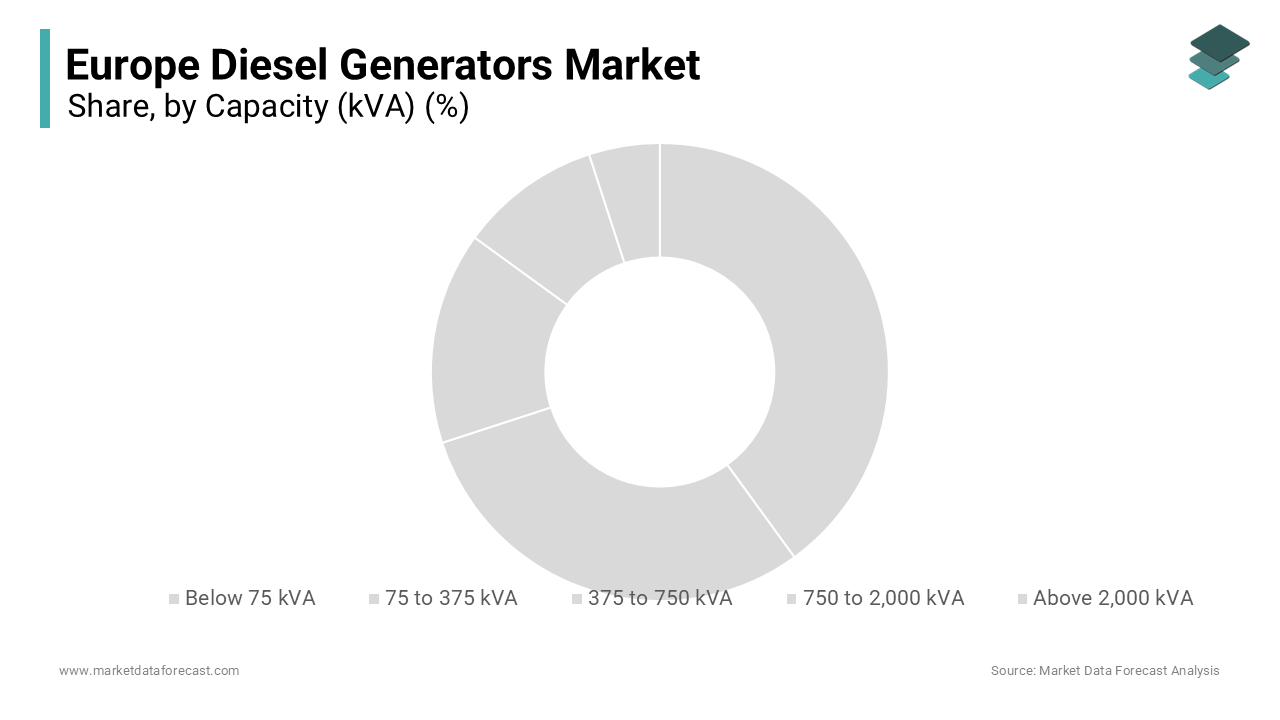
The above 2,000 KVA segment is anticipated to witness the fastest CAGR of 7.1% during the forecast period due to the rising power demands of hyperscale data centers, large mining operations, and industrial microgrids requiring multi megawatt backup or prime power. Major digital infrastructure projects across Europe are increasingly characterized by extreme power requirements, driving a substantial expansion in large-scale backup power systems to ensure the continuous availability of cloud and artificial intelligence services. Leading technology companies operating in the Nordic region leverage the high reliability of local renewable energy grids to minimize their reliance on traditional diesel-based backup systems. Additionally, mining companies like Boliden use 3,000–5,000 KVA generators as primary power in remote Arctic locations where grid extension is uneconomical. International financial institutions are significantly increasing their investments in global energy infrastructure, focusing on enhancing the stability and sustainability of power grids in regions facing rapid industrial growth. Despite rising environmental concerns, the proliferation of digital technologies and resource extraction is driving increased demand for high-capacity diesel generation, particularly where battery alternatives lack sufficient scalability and duration.
By Application Insights
The stand by or backup power segment was the largest segment in the Europe diesel generators market and accounted for a significant share in 2025. The prominence of the segment is attributed to the continent’s reliance on grid connected but generator protected critical infrastructure. Unlike prime power applications, standby units operate intermittently during outages, making diesel ideal due to its fuel stability, instant start capability, and long shelf life. New European resilience frameworks require essential service providers to implement robust continuity plans and protective measures tailored to their specific operational risks to ensure societal stability during disruptive events. Periodic large-scale regional power disruptions across the European continent continue to highlight the critical importance of localized emergency energy systems for maintaining essential services. Sweeping structural reforms in the German healthcare landscape are pushing medical facilities to modernize their infrastructure and equipment to meet stricter quality and safety standards. In addition, financial institutions maintain a high reliance on rapid-response energy technologies to safeguard digital operations and comply with strict availability requirements for critical banking infrastructure. This application thrives not on continuous operation but on guaranteed availability, a domain where diesel technology remains unmatched in performance, certification, and regulatory acceptance across Europe.
The peak shaving and load management segment is likely to experience the fastest CAGR of 8.3% over the forecast period owing to rising electricity tariffs and demand charge penalties that incentivize large consumers to offset grid usage during peak hours. According to studies, rising grid utilization fees and network charges across major European economies are incentivizing industrial energy consumers to explore behind-the-meter solutions to manage their peak load profiles and reduce overall energy expenditures. Major industrial producers in the Mediterranean region are investing in large-scale renewable energy integration and energy efficiency technologies to lower operational costs while adhering to stringent environmental targets. Similarly, Energy-intensive logistics and cold-chain providers are increasingly utilizing demand-side management strategies and advanced energy storage to mitigate the impact of peak-hour electricity price spikes. While batteries are emerging, diesel remains preferred for durations exceeding four hours and in regions with unreliable renewable supply. Dynamic pricing is spreading under EU electricity market reforms. Consequently, diesel generators are transitioning from emergency assets to strategic cost-optimization tools.
By End User Insights
The industrial segment led the Europe diesel generators market and captured a 52.7% share in 2025. The leading position of the segment is credited to stringent operational continuity requirements in manufacturing, mining, and processing facilities. Unlike commercial users, industrial sites often operate in remote locations or handle processes where even seconds of downtime cause catastrophic losses. The industrial sector remains one of the largest consumers of energy in the European Union, necessitating highly stable power supplies to prevent operational disruptions in heavy manufacturing and high-tech production environments. Major mining operations in Northern Europe are expanding their electrification efforts and leveraging regional renewable energy grids to power heavy machinery and large-scale extraction processes. Similarly, Integrated chemical complexes utilize large-scale, on-site cogeneration plants to ensure a continuous and highly reliable energy supply for both heat and electricity during critical industrial processes. Chemical manufacturers across Europe implement rigorous redundancy and backup power strategies as part of their comprehensive safety protocols to mitigate the risk of major accidents during power interruptions. These applications demand high capacity, ruggedized units with integrated load banks and remote monitoring, capabilities where industrial diesel generators excel. This mission critical dependency ensures industrial dominance despite decarbonization pressures.
The commercial end user segment is on the rise and is expected to be the fastest growing segment in the market by witnessing a CAGR of 6.9% from 2026 to 2034. The rapid growth of the segment is propelled by expanding digital infrastructure, healthcare modernization, and retail resilience mandates. Data centers, hospitals, shopping malls, and airports increasingly deploy diesel generators not just for compliance but for brand protection and service continuity. Rapid digitalisation and the expansion of artificial intelligence are driving a significant increase in both massive centralized data hubs and smaller localized facilities across Europe, necessitating a robust expansion of large-scale emergency power infrastructure. In response to increasingly frequent and severe extreme weather events, health authorities in Western Europe are reinforcing operational safety frameworks and encouraging medical facilities to modernise their climate-resilience infrastructure. Retail is also contributing. As the logistics sector faces higher energy costs and potential grid instability, there is a growing industry-wide shift toward integrating decentralized energy solutions to protect temperature-sensitive supply chains and maintain service continuity. Unlike residential users, commercial entities have capital budgets and regulatory drivers that justify investment. The increasing centrality of digital services and public health to economic stability has strengthened reliance on diesel backup, resulting in a robust, high-availability growth corridor.
COMPETITIVE LANDSCAPE
The Europe diesel generators market features a competitive landscape dominated by global engineering leaders who differentiate through emission compliance, digital intelligence, and service depth rather than price alone. Cummins, Kohler, and MTU lead by offering end to end solutions that integrate hardware, software, and lifecycle support. Competition centers on meeting stringent EU Stage V regulations, ensuring sub 10 second start times for critical loads, and providing certified uptime for data centers and hospitals. While Chinese and Indian manufacturers offer lower cost alternatives, they struggle with emission certification and service coverage in Western Europe. The market sees moderate consolidation as digital capabilities become essential—vendors without remote diagnostics or predictive maintenance platforms lose relevance. Regional strengths vary: Germany excels in high capacity industrial units, France focuses on hospital backup systems, and Nordic countries prioritize cold climate resilience. New entrants face high barriers due to type approval processes, long qualification cycles, and the need for local technical support. However, opportunities exist in hybridization and fleet modernization. Overall, success depends on transforming diesel generators from mechanical assets into intelligent, compliant nodes in resilient energy ecosystems.
KEY MARKET PLAYERS
Some of the companies that are playing a dominating role in the Europe Diesel Generators Market include
- Caterpillar Inc.
- Cummins Inc.
- Mitsubishi Heavy Industries Engine & Turbocharger Ltd.
- FG Wilson Engineering Ltd.
- Yanmar Holdings Co., Ltd.
- Generac Power Systems
- Kohler Co. (Kohler-SDMO)
- Doosan Corporation
- Atlas Copco AB
- Himoinsa
- Rolls-Royce Power Systems (MTU)
- Wärtsilä Corporation
- Deutz AG
- Volvo Penta AB
- Aggreko PLC
- AKSA Power Generation
- Perkins Engines Company
- Pramac Group
- Grupel S.A.
- Wacker Neuson SE
- JCB Power Products
Top Players in the Europe Diesel Generators Market
Cummins Inc
Cummins is a global power technology leader with a commanding presence in the Europe diesel generators market, particularly in industrial and critical infrastructure segments. The company supplies high reliability generator sets ranging from 10 KVA to over 3,000 KVA, integrating advanced emission control systems compliant with EU Stage V standards. Cummins contributes significantly to global energy resilience through its PowerCommand digital control platforms and remote monitoring capabilities. In Europe, the company has deep partnerships with data center operators, hospitals, and mining firms requiring mission critical backup. It also expanded its service network across Eastern Europe to support rapid response for industrial clients, reinforcing its reputation for uptime assurance and regulatory compliance.
Kohler Co
Kohler is a major player in the Europe diesel generators market, renowned for its robust standby and prime power solutions tailored to commercial and healthcare applications. The company’s global influence stems from its vertically integrated engine and alternator manufacturing, ensuring performance consistency and supply chain control. In Europe, Kohler emphasizes quiet operation, compact footprint, and seamless integration with building management systems, key requirements for urban hospitals and data centers. The company also partnered with European engineering firms to develop containerized microgrid solutions for remote industrial sites. These initiatives strengthen Kohler’s position as a provider of intelligent, compliant, and resilient power infrastructure across the continent.
MTU Solutions (Rolls Royce Power Systems)
MTU Solutions, a subsidiary of Rolls Royce Power Systems, is a premier European manufacturer of high capacity diesel generators, serving defense, marine, and large industrial sectors. Headquartered in Germany, MTU leverages German engineering excellence to deliver generator sets exceeding 2,000 KVA with exceptional fuel efficiency and durability. The company plays a critical role in sovereign energy security, supplying backup power to NATO bases, national grids, and critical mining operations. It also established a dedicated hybrid power lab in Friedrichshafen to develop diesel battery microgrids for non interconnected territories. These actions position MTU as an innovator in high power, low emission generation for Europe’s most demanding applications.
Top Strategies Used by the Key Market Participants
Key players in the Europe diesel generators market prioritize compliance with EU Stage V emission standards by integrating advanced aftertreatment systems like selective catalytic reduction and diesel particulate filters. They invest in digitalization through cloud based remote monitoring, predictive maintenance, and automatic load testing to enhance uptime and reduce service costs. Companies expand service networks across Eastern and Southern Europe to ensure rapid response for industrial and critical infrastructure clients. Strategic development of hybrid microgrids combining diesel generators with battery storage addresses decarbonization pressures while maintaining reliability. Vertical integration of engine and alternator production ensures quality control and supply chain resilience. Emphasis on containerized and sound attenuated designs meets urban noise and space constraints. These strategies collectively balance regulatory adherence, operational excellence, and energy transition realities.
MARKET SEGMENTATION
This research report on the Europe Diesel Generators Market has been segmented and sub-segmented based on the following categories.
By Capacity (kVA)
- Below 75 kVA
- 75 to 375 kVA
- 375 to 750 kVA
- 750 to 2,000 kVA
- Above 2,000 kVA
By Application
- Stand-by/Backup Power
- Prime/Continuous Power
- Peak-shaving/Load Management
By End User
- Residential
- Commercial
- Industrial
By Country
- UK
- France
- Spain
- Germany
- Italy
- Russia
- Sweden
- Denmark
- Switzerland
- Netherlands
- Turkey
- Czech Republic
- Rest of Europe