- Product Description Description
- Table of Contents TOC
- List of Table & Figure LOT
- Get Free Sample PDF Sample PDF
Market Size, 2025
$0.67 TnMarket Estimate, 2026
$0.77 TnMarket Forecast, 2034
$2.26 TnCAGR, 2026–2034
14.41%Europe Digital Coin Market Report Summary
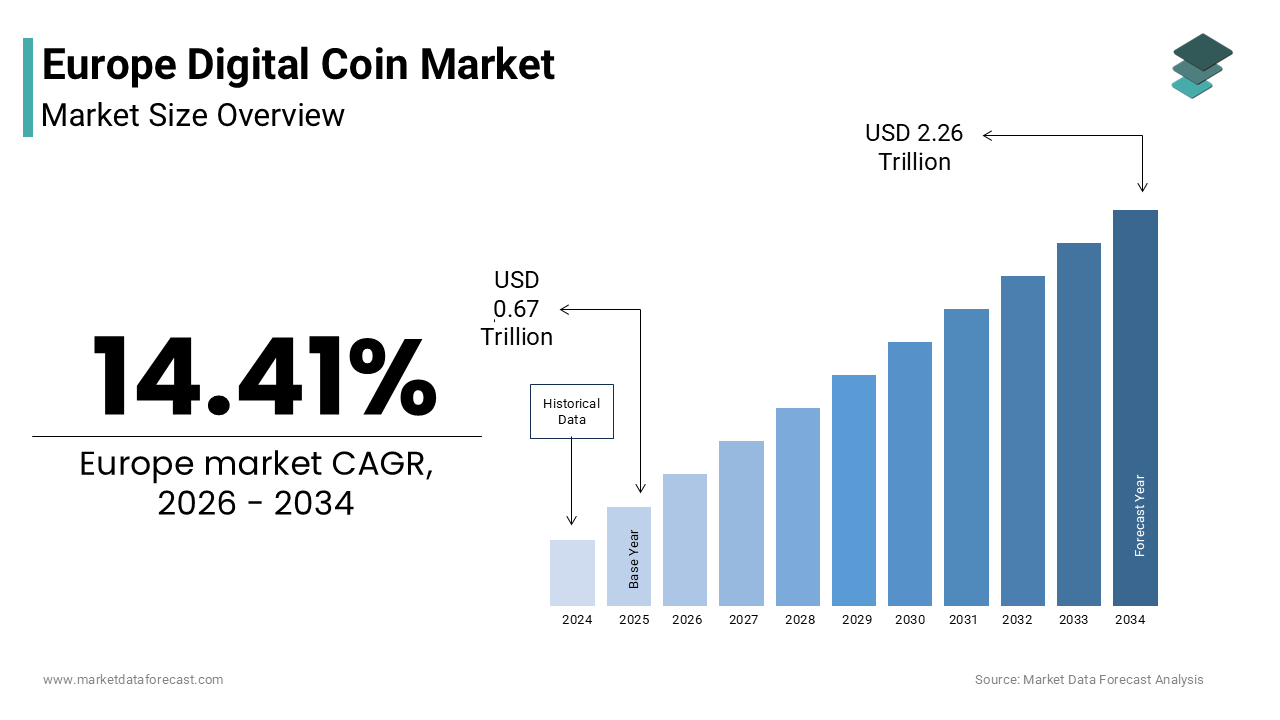
The Europe digital coin market was valued at USD 0.67 trillion in 2025, is estimated to reach USD 0.77 trillion in 2026, and is projected to reach USD 2.26 trillion by 2034, growing at a CAGR of 14.41% during the forecast period from 2026 to 2034. The growth of the Europe digital coin market is driven by increasing adoption of blockchain-based financial technologies, rising demand for decentralized financial services, and the rapid expansion of digital payment ecosystems across the region. The growing acceptance of cryptocurrencies for trading, investment, and payment applications is further strengthening the market outlook. Moreover, the introduction of regulatory frameworks such as the Markets in Crypto-Assets (MiCA) regulation and the ongoing development of the digital euro are encouraging institutional participation and accelerating the mainstream adoption of digital coins across Europe.
Key Market Trends
-
Rising adoption of decentralized finance (DeFi) platforms offering lending, staking, and yield generation opportunities for digital coin holders.
-
Increasing institutional investment in digital assets supported by regulated trading platforms and crypto exchange-traded products.
-
The growing development of central bank digital currencies (CBDCs), particularly the digital euro initiative aimed at modernizing payment systems.
-
Expansion of tokenization of real-world assets, including real estate, bonds, and commodities, enabling fractional ownership and faster settlement.
-
Increasing focus on security infrastructure, regulatory compliance, and sustainable blockchain technologies to address environmental and cybersecurity concerns.
Segmental Insights
- Based on type, the cryptocurrency segment was the largest and held a prominent share of the Europe digital coin market in 2024. The dominance of this segment is attributed to the strong adoption of major cryptocurrencies such as Bitcoin and Ethereum, which function as both investment assets and foundational infrastructure for decentralized applications and blockchain networks.
- Based on application, the trading segment accounted for 45.3% of the Europe digital coin market share in 2024. The segment’s leadership is driven by the high liquidity and volatility of digital assets, which attract both retail traders and institutional investors seeking profit opportunities through spot trading, derivatives markets, and automated trading strategies.
- Based on end-user, the retail segment represented the largest user base in the Europe digital coin market in 2025. The accessibility of crypto trading platforms and mobile applications has enabled millions of individual investors to participate in the digital asset economy through small investments, peer-to-peer transfers, and decentralized financial services.
Regional Insights
The Europe digital coin market is experiencing rapid expansion across several key economies due to strong fintech ecosystems, increasing digital payment adoption, and supportive regulatory developments.
-
The United Kingdom was the largest contributor, accounting for 22.2% of the Europe digital coin market share in 2024, driven by London’s status as a global financial hub and the presence of a large number of blockchain startups and regulated crypto platforms.
-
Germany is witnessing strong growth due to progressive financial regulations that allow banks to offer crypto custody services and institutional investors to integrate digital assets into investment portfolios.
-
France continues to expand its market presence with strong government support for blockchain innovation and tokenized securities initiatives.
-
Switzerland remains a major hub for digital asset innovation with its “Crypto Valley” ecosystem in Zug, hosting numerous blockchain companies and foundations.
-
The Netherlands is also emerging as a key digital coin market supported by advanced digital infrastructure and a thriving fintech startup ecosystem.
Competitive Landscape
The Europe digital coin market is characterized by intense competition among global cryptocurrency exchanges, regional fintech platforms, and emerging decentralized finance ecosystems. Companies are focusing on regulatory compliance, advanced cybersecurity infrastructure, and seamless fiat-to-crypto integration to strengthen market presence. Strategic partnerships with banks, payment processors, and institutional investors are becoming increasingly common as firms aim to expand services and enhance user trust. The competitive environment is also shaped by innovation in staking services, tokenized assets, and institutional trading solutions. Prominent players in the Europe digital coin market include Binance, Coinbase, Kraken, Bitstamp, Bitpanda, eToro, Crypto.com, Ledger SAS, Bitfury Holding B.V., and Payward Inc.
Europe Digital Coin Market Size
The Europe digital coin market size was valued at USD 0.67 trillion in 2025 and is anticipated to reach USD 0.77 trillion in 2026 from USD 2.26 trillion by 2034, growing at a CAGR of 14.41% during the forecast period from 2026 to 2034.
The digital coin is a sophisticated ecosystem of cryptographic assets, including decentralized cryptocurrencies like Bitcoin and Ethereum, alongside emerging Central Bank Digital Currencies (CBDCs) and stablecoins pegged to fiat currencies. The shift from physical cash and traditional electronic ledgers to distributed ledger technology will ensure transparency, immutability, and programmable value transfer. According to Eurostat, internet usage in the EU reached 93% in 2024, providing the essential digital infrastructure required for widespread adoption of blockchain-based financial instruments. As per the study, over 80% of citizens in the euro area now use digital payment methods daily by creating a fertile ground for the integration of digital coins into routine commerce. The region hosts more than 5,000 active blockchain startups by fostering an environment of rapid innovation in decentralized finance and tokenization.
MARKET DRIVERS
Implementation of Comprehensive Regulatory Frameworks
The Crypto Assets regulation by providing legal clarity and operational certainty for investors and service providers is majorly propelling the growth of Europe digital coin market. This legislation creates a harmonized set of rules across all member states by eliminating the fragmentation that previously hindered cross-border crypto activities and stifled innovation. According to the European Securities and Markets Authority, the regulatory clarity provided by this framework has led to an increase in licensed crypto asset service provider applications in 2024 compared to the previous year. Institutions that were previously hesitant due to compliance ambiguities are now entering the market, bringing significant capital and legitimacy to the sector. The regulation mandates strict reserve requirements for stablecoin issuers by ensuring that these digital coins maintain parity with their underlying assets and reducing the risk of collapse. Furthermore, it introduces robust consumer protection measures, including mandatory disclosure documents and grievance mechanisms, which build trust among retail users. By setting a global benchmark for crypto regulation, Europe attracts international firms seeking a stable operating environment, thereby accelerating market maturation and mainstream adoption across the continent.
Surging Demand for Decentralized Finance and Yield Generation
The escalating interest in decentralized finance protocols and the pursuit of higher yields in a fluctuating interest rate environment serve is additionally amplifying the growth of Europe digital coin market. European investors, particularly younger demographics and tech-savvy institutions, are increasingly allocating capital to digital coins to access lending, borrowing, and staking opportunities that traditional banking systems cannot match. The ability to earn passive income through staking mechanisms, where users lock up digital coins to secure networks in exchange for rewards, has proven highly attractive amidst periods of low sovereign bond yields. Additionally, the composability of DeFi applications allows users to leverage their digital coin holdings for complex trading strategies and liquidity provision, maximizing capital efficiency. The rise of institutional-grade DeFi platforms offering compliant yield products has further bridged the gap between traditional finance and the crypto economy.
MARKET CHALLENGES
Persistent Security Vulnerabilities and High-Profile Hacks
Recurring security breaches, sophisticated cyberattacks, and the loss of funds due to protocol exploits by eroding public trust and deterring mainstream adoption. The persistent security vulnerabilities and high profiles hacks is restricting the growth of Europe digital coin market. Despite advancements in cryptography, the ecosystem remains vulnerable to smart contract bugs, phishing scams, and exchange hacks that result in substantial financial losses for users. These incidents generate negative media coverage and reinforce perceptions of digital coins as risky and unsafe assets, causing cautious investors to remain on the sidelines. The irreversible nature of blockchain transactions means that stolen funds are rarely recovered, exacerbating the psychological impact on victims and the broader community. Furthermore, the complexity of managing private keys and securing digital wallets presents a steep learning curve for non-technical users, leading to accidental loss of assets. Until the industry can demonstrate near-perfect security standards and provide user-friendly safeguards that rival traditional banking, these vulnerabilities will continue to impede market growth and limit the scale of institutional participation.
Energy Consumption Concerns and Environmental Scrutiny
Intense scrutiny regarding the environmental impact of energy-intensive consensus mechanisms, particularly Proof of Work, serves as a major restraint on the Europe digital coin market within a region deeply committed to sustainability goals. The energy consumption concerns and environmental scrutiny is also hindering the growth of Europe digital coin market. European policymakers and the public are increasingly conscious of the carbon footprint associated with mining operations, which conflicts with the ambitious targets set by the European Green Deal. According to the European Environment Agency, the electricity consumption of certain large-scale crypto mining activities in rivals that of small nations, raising alarms about grid stability and carbon emissions. This environmental concern has led to calls for strict moratoriums on mining operations using non-renewable energy sources and has influenced investment decisions among environmentally conscious funds. Although, many networks are transitioning to more efficient Proof of Stake models, the legacy perception of digital coins as energy hogs persists, hindering acceptance among green-focused stakeholders. Public opinion polls indicate that Europeans view the environmental cost of cryptocurrencies, as a significant barrier to their adoption. Regulatory proposals aimed at mandating sustainability disclosures for crypto assets add compliance burdens that may discourage smaller projects from operating in the region.
MARKET OPPORTUNITIES
Development and Deployment of Central Bank Digital Currencies
The active research and pilot programs surrounding Central Bank Digital Currencies, potentially legitimizing the entire asset class and integrating it into the core financial infrastructure. The development and deployment of central bank digital currencies is certainly to set up new opportunities for the growth of Europe digital coin market. According to the study, over 60% of citizens expressed interest in using a digital euro for everyday transactions by signaling strong latent demand for state-backed digital coins. The introduction of a CBDC would bridge the gap between traditional fiat money and blockchain technology by offering the stability of central bank money with the efficiency of digital settlement. This initiative could spur the development of a vast ecosystem of applications, from programmable government subsidies to instant cross-border payments. Furthermore, the infrastructure built for the digital euro could be leveraged by private sector players to create innovative financial products by fostering a hybrid economy where public and private digital coins coexist. The prospect of a regulated, risk-free digital currency encourages banks and fintechs to invest heavily in compatible technologies, driving overall market maturity.
Tokenization of Real-World Assets and Securities
The burgeoning trend of tokenizing real-world assets, such as real estate, bonds, and commodities on blockchain networks offers a lucrative opportunity to unlock liquidity and democratize access to investment classes. This factor is also escalating the growth of Europe digital coin market. By converting physical assets into digital tokens, issuers can enable fractional ownership, reduce settlement times, and lower transaction costs, making high-value investments accessible to a broader range of investors. Digital coins serve as the native medium of exchange and settlement layer for these tokenized markets by creating intrinsic demand for utility tokens and stablecoins. Major European banks are already launching platforms to issue and trade tokenized securities, leveraging the immutability of blockchain to enhance trust and auditability. The ability to program compliance rules directly into tokens ensures adherence to regulatory requirements automatically, streamlining the issuance process. This emergence of traditional finance and blockchain technology opens new revenue streams for service providers and creates a more inclusive financial system.
MARKET CHALLENGES
Navigating Complex Cross-Border Taxation and Reporting Obligations
The fragmented and often ambiguous of taxation and reporting requirements across different member states is likely to act as a challenge for the growth of Europe digital coin market. While the European Union strives for harmonization, individual countries maintain distinct rules regarding the classification of digital coins, capital gains treatment, and value-added tax applicability by creating a compliance nightmare for users and businesses operating cross-border. According to the European Commission, the lack of a unified tax framework leads to significant administrative burdens, with companies forced to navigate up to 27 different tax regimes to remain compliant. This complexity discourages mobility and innovation, as firms may choose to locate in jurisdictions with more favorable or clearer tax laws, fragmenting the single market. Investors face difficulties in accurately calculating liabilities due to varying definitions of taxable events, such as swapping one digital coin for another or using coins for purchases. The introduction of new reporting standards like DAC8 aims to improve transparency but adds another layer of operational complexity for exchanges and wallet providers.
Integration with Legacy Banking Infrastructure and Interoperability Issues
The difficulty of integrating modern digital coin networks with entrenched legacy banking systems and the lack of interoperability between diverse blockchain protocols pose critical challenges to the scalability of the Europe digital coin market. Traditional financial institutions rely on decades-old infrastructure that is often incompatible with the speed, structure, and settlement mechanisms of distributed ledgers, creating friction in converting fiat to digital coins and vice versa. According to Swift, the disconnect between legacy payment rails and blockchain networks results in delayed settlements and increased operational costs for banks attempting to offer crypto services. Furthermore, the proliferation of isolated blockchain ecosystems means that digital coins on one network often cannot seamlessly interact with those on another without complex and risky bridging solutions. This fragmentation limits liquidity and hinders the creation of a unified European digital asset market. Technical hurdles related to scalability, such as network congestion during peak usage, also undermine the reliability required for mass adoption. Efforts to build interoperable layers and upgrade banking cores are underway but progress slowly due to high costs and regulatory caution.
REPORT COVERAGE
| REPORT METRIC | DETAILS |
| Market Size Available | 2025 to 2034 |
| Base Year | 2025 |
| Forecast Period | 2026 to 2034 |
| CAGR | 14.41% |
| Segments Covered | By Type, Application, End - User and Region. |
| Various Analyses Covered | Global, Regional & Country Level Analysis, Segment-Level Analysis, DROC, PESTLE Analysis, Porter’s Five Forces Analysis, Competitive Landscape, Analyst Overview of Investment Opportunities |
| Country Covered | UK, France, Spain, Germany, Italy, Russia, Sweden, Denmark, Switzerland, the Netherlands, Turkey, the Czech Republic, and the Rest of Europe. |
| Market Leaders Profiled | Binance, Coinbase, Kraken, Bitstamp, Bitpanda, eToro, Crypto.com, Ledger SAS, Bitfury Holding B.V, and Payward, Inc |
SEGMENTAL ANALYSIS
By Type Insights
The cryptocurrency segment held a prominent share of the Europe digital coin market in 2024 with the established presence of major assets like Bitcoin and Ethereum, which serve as the primary store of value and medium for decentralized applications across the continent. The primary factor fueling this leadership is the deep liquidity and widespread acceptance of these assets among both retail traders and institutional investors who view them as a hedge against inflation and currency devaluation. Furthermore, the robust infrastructure of exchanges, custodians, and wallet providers supporting these coins creates a network effect that reinforces their market position. The maturity of the ecosystem, including derivatives markets and investment funds dedicated to these assets, ensures that cryptocurrencies remain the default entry point for most participants.
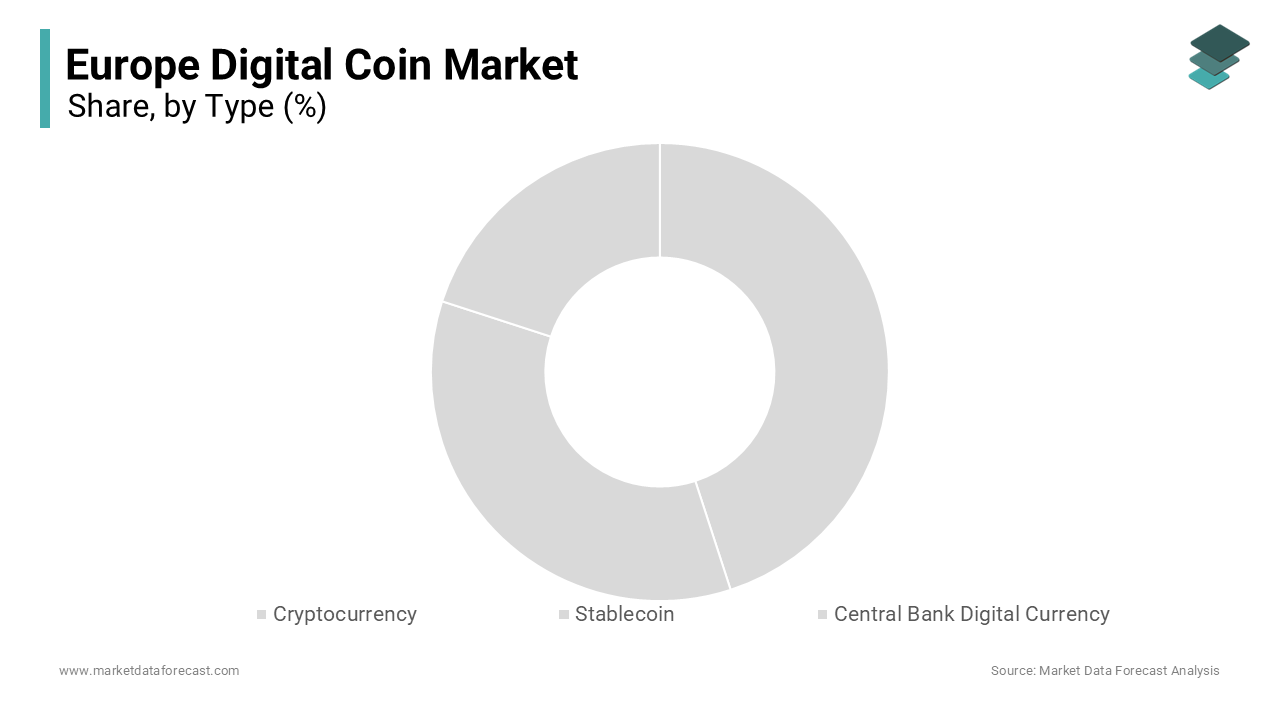
The central bank digital currency segment is emerging at a fastest CAGR of 42.5% from 2025 to 2033 owing to the advanced pilot programs and impending launch of the digital euro, which aims to modernize the monetary infrastructure of the Eurozone. A key driving factor is the strategic imperative for sovereign nations to maintain monetary sovereignty and payment efficiency in an increasingly digitized global economy where private stablecoins and foreign CBDCs pose competitive threats. The preparation phase involves significant investment in technical infrastructure, merchant acceptance networks, and public awareness campaigns, all contributing to rapid market expansion metrics even before full circulation. Government backing ensures instant credibility and trust, unlike private counterparts, accelerating adoption rates once launched.
By Application Insights
The trading segment was the largest by capturing 45.3% of the Europe digital coin market share in 2024 with the high volatility and speculative nature of digital assets, which attract a vast number of active participants seeking short-term profits through frequent buying and selling activities. The primary driver for this dominance is the sophisticated array of trading platforms and derivative products available to European users, ranging from spot exchanges to futures and options markets that leverage price fluctuations. The availability of 24/7, allows for continuous speculation, unlike traditional stock exchanges, which fuels higher transaction frequencies. Furthermore, the integration of advanced charting tools, margin trading capabilities, and automated bots has lowered barriers to entry for complex trading strategies, drawing in a diverse user base.
The payments segment is anticipated to register a fastest CAGR of 38.9% throughout the forecast period with the increasing adoption of stablecoins and central bank digital currencies for everyday commercial transactions, driven by the need for faster, cheaper, and borderless settlement mechanisms. A major driving factor is the integration of digital coin payment gateways by major e-commerce retailers and point-of-sale terminal providers across Europe, making it seamless for consumers to pay with crypto at grocery stores and online shops. According to a report by Visa, the number of merchants in Europe accepting cryptocurrency payments grew by 55% in 2024, facilitated by instant conversion services that mitigate volatility risks for businesses. The inefficiencies and high costs associated with traditional cross-border card networks are pushing businesses to adopt blockchain-based settlements, particularly for B2B transactions within the Single Market. Additionally, the rise of micropayment models for digital content and services relies heavily on the low transaction fees of certain digital coins, enabling new economic models that were previously impossible. Consumer demand for privacy and control over financial data also drives the shift towards direct peer-to-peer payments. As infrastructure matures and regulatory hurdles diminish, the use of digital coins for routine commerce is set to explode, reshaping the payment landscape.
By End-User Insights
The Retail segment represents the largest end-user group in the Europe digital coin market, accounting for an estimated 62% of total users and transaction counts in 2025. This dominance is driven by the widespread accessibility of digital asset platforms, which allow individuals with small amounts of capital to participate in the crypto economy easily via smartphones and web interfaces. The primary factor fueling this leadership is the strong narrative of financial democratization and the potential for high returns, which resonates deeply with European millennials and Gen Z populations seeking alternatives to traditional savings accounts. According to a survey by TripleA, approximately 14% of the European population owned cryptocurrency in 2024, translating to tens of millions of individual users actively managing digital wallets. The proliferation of user-friendly apps offering fractional ownership and educational resources has lowered the technical barrier, enabling mass adoption across diverse socioeconomic groups. Furthermore, the use of digital coins for remittances and peer-to-peer transfers among families and friends sustains high engagement levels within this segment. Social media influence and community-driven investment trends also play a crucial role in driving retail participation, creating viral cycles of adoption. Despite growing institutional interest, the sheer volume of individual accounts and the frequency of their smaller-scale transactions ensure that the retail sector remains the backbone of the market.
The Institutional segment is emerging as the fastest-growing end-user category in the Europe digital coin market, projected to expand at a CAGR of 45.2% from 2025 to 2030. This accelerated growth is fueled by the maturation of regulatory frameworks and the development of institutional-grade custody and trading solutions that address previous security and compliance concerns. A key driving factor is the entry of major asset managers, pension funds, and insurance companies into the space, allocating portions of their portfolios to digital assets as a distinct asset class for diversification and yield enhancement. According to PwC, institutional investment in European crypto assets increased by 70% in 2024, driven by the launch of regulated Bitcoin and Ethereum exchange-traded products. The implementation of crypto Assets regulation has provided the legal certainty required for fiduciaries to invest client funds confidently by removing a significant barrier to entry. Banks are also launching proprietary trading desks and custody services to meet rising client demand, further legitimizing the sector. The pursuit of alpha in a low-yield environment and the hedging properties of digital coins against macroeconomic instability are compelling institutions to scale up their exposure rapidly.
REGIONAL ANALYSIS
United Kingdom Digital Coin Market Analysis
The United Kingdom was the largest contributor of the Europe digital coin market by holding 22.2% of share in 2024 owing to the London's status as a global financial center with a vibrant fintech ecosystem that actively embraces blockchain innovation and digital asset entrepreneurship. British regulators have adopted a balanced approach by fostering innovation while implementing robust consumer protection measures, which attracts international crypto firms to establish headquarters there. According to the Financial Conduct Authority, the number of registered crypto asset businesses in the UK exceeded 150 in 2024, reflecting a thriving regulatory environment. The government's proactive stance on developing a stablecoin framework and exploring a potential digital pound demonstrates strong political support. High internet penetration and a culturally open attitude towards alternative investments drive significant retail and institutional participation. The UK market serves as a gateway for global players entering Europe, setting trends in product development and compliance standards that influence the broader region. Its combination of capital availability, regulatory clarity, and technological prowess ensures its continued dominance.
Germany Digital Coin Market Analysis
Germany digital coin market growth is likely to driven by its robust economy and progressive regulatory stance towards institutional crypto adoption. German financial authorities were among the first to allow banks to offer crypto custody services by paving the way for traditional finance to integrate digital assets seamlessly. According to BaFin, the German federal financial supervisory authority, licensed crypto custody providers saw a 40% increase in assets under management in 2024, highlighting strong institutional confidence. The country's strong manufacturing and export sectors are increasingly exploring blockchain for supply chain transparency by creating unique use cases beyond speculation. German investors are known for their long-term horizon, favoring secure custody solutions and regulated investment vehicles over high-risk trading. Strict data privacy laws and a focus on security appeal to risk-averse institutional clients by making Germany a safe haven for large-scale crypto operations.
France Digital Coin Market Analysis
France holds the third position in the Europe digital coin market with an estimated share of 14% in 2025, distinguished by its strong government support for blockchain research and the development of a national digital asset strategy. According to the Autorite des Marches Financiers, France approved several pioneering security token projects in 2024 by positioning itself as a leader in the tokenization of real-world assets. The government's "France 2030" investment plan includes significant funding for blockchain initiatives by fostering innovation in areas like decentralized identity and green crypto mining. French banks are increasingly partnering with fintechs to offer hybrid financial products, bridging the gap between traditional banking and digital assets. The cultural appreciation for technology and a skilled workforce in mathematics and cryptography contribute to a dynamic ecosystem. France's active role in shaping EU-wide crypto regulations ensures that its domestic market remains aligned with future continental standards, attracting international talent and capital.
Switzerland Digital Coin Market Analysis
Switzerland digital coin market growth due to its concentrated cluster of blockchain companies and foundations in the canton of Zug. The long-standing tradition of banking secrecy evolving into digital asset privacy, coupled with a highly favorable legal framework that recognizes digital assets, as property. The country's political stability, strong currency, and expertise in wealth management make it an ideal location for high-net-worth individuals and family offices to manage digital asset portfolios. Swiss universities and research institutes lead in blockchain academic research by feeding a steady stream of innovation into the commercial sector. The integration of crypto payments in local commerce, from luxury watches to public transport, demonstrates practical adoption beyond speculation.
Netherlands Digital Coin Market Analysis
The Netherlands digital coin market growth is likely to grow with its advanced digital infrastructure, high English proficiency, and status as a logistics hub facilitating cross-border crypto trade. The country's robust fiber optic network and data center capacity support high-frequency trading and mining operations efficiently. The presence of major port facilities and logistics companies exploring blockchain for supply chain tracking creates unique industrial applications for digital coins. The vibrant community of developers and entrepreneurs in Amsterdam fosters a collaborative environment for Web3 projects.
COMPETITIVE LANDSCAPE
The competition in the Europe digital coin market is intensely fierce characterized by a dynamic mix of global exchange giants, specialized regional platforms, and emerging decentralized protocols vying for dominance in a rapidly evolving regulatory environment. Market participants constantly innovate their technology stacks and product offerings to distinguish themselves in a sector where security breaches or compliance failures can lead to immediate loss of reputation and licensure. Competition extends beyond trading fees to include the quality of custodial services, the breadth of available assets, and the seamlessness of fiat integration. Strategic acquisitions and partnerships are common as firms seek to consolidate market share and acquire specific technological capabilities or regulatory approvals quickly. The rise of institutional interest has shifted focus towards providing enterprise-grade solutions and compliant investment vehicles, intensifying rivalry among top-tier providers. Success in this landscape requires a delicate balance of innovation, rigorous risk management, and proactive engagement with policymakers to maintain competitiveness and ensure sustainable growth.
KEY MARKET PLAYERS
Some of the companies that are playing a dominating role in the Europe Digital Coin Market include
- Binance
- Coinbase
- Kraken
- Bitstamp
- Bitpanda
- eToro
- Crypto.com
- Ledger SAS
- Bitfury Holding B.V
- Payward, Inc.
Top Players in the Market
Binance Holdings Ltd.
Binance Holdings Ltd. operates as a leading global cryptocurrency exchange with a substantial footprint across the European digital coin market through its localized platforms and compliance initiatives. The company provides a comprehensive suite of services including spot trading, staking, and educational resources to millions of users throughout the continent. Their global contribution involves setting high standards for liquidity and security while driving the adoption of blockchain technology in emerging economies. Recent actions to strengthen their position, include obtaining provisional regulatory registrations in multiple European Union member states to align with the countries in Crypto Assets framework. Binance actively invests in local customer support teams and partners with European fiat on-ramp providers to simplify access for retail investors. They also focus on enhancing their proof of reserves systems to build trust and transparency within the community.
Coinbase Global Inc.
Coinbase Global Inc. serves as a prominent publicly traded cryptocurrency platform that has aggressively expanded its operations within the Europe digital coin market to serve both retail and institutional clients. The company is renowned for its user-friendly interface and robust security measures that appeal to conservative investors seeking reliable access to digital assets. Their global contribution lies in bridging traditional finance with the crypto economy through regulated products like exchange-traded funds and custody solutions. Recent strategic moves involve securing licenses in key European jurisdictions, such as France and Italy to operate fully compliant services under new EU laws. Coinbase strengthens its market position by launching dedicated institutional sales desks in London and Dublin to cater to growing demand from asset managers. They also integrate with local payment networks to enable seamless euro deposits and withdrawals for users.
Bitpanda GmbH
Bitpanda GmbH stands as a homegrown European fintech unicorn that has become a dominant force in the regional digital coin market by offering a versatile investment platform for cryptocurrencies and tokenized assets. The company specializes in making digital assets accessible to everyday investors through fractional ownership and automated savings plans denominated in local currencies. Their global contribution includes pioneering the tokenization of stocks and commodities alongside crypto, creating a multi-asset ecosystem that attracts a broad demographic. Recent actions to bolster their standing involve acquiring additional banking licenses and expanding their service offerings to include business accounts for corporate clients, across the Eurozone. Bitpanda actively collaborates with European regulators to shape favorable policies and ensures full compliance with evolving anti-money laundering directives. They also focus on launching innovative features like crypto cards and staking rewards tailored specifically to European consumer preferences.
Top Strategies Used by Key Market Participants
Key players in the Europe digital coin market primarily focus on aggressive regulatory compliance by securing necessary licenses and registrations across multiple European Union member states to ensure uninterrupted operations. Companies heavily invest in advanced security infrastructure including cold storage solutions and real-time threat detection systems to protect user assets and build long-term trust. Major participants are developing strategic partnerships with traditional banks and payment processors to facilitate seamless fiat-to-crypto on-ramps and off-ramps for local currencies. Firms are expanding their product portfolios to include staking services, decentralized finance yield products, and tokenized real-world assets to diversify revenue streams. Additionally, market leaders are launching extensive educational campaigns and localized customer support initiatives to improve financial literacy and attract non-technical users. These strategies aim to navigate the complex legal landscape, enhance security posture, and drive mass adoption among diverse European demographics.
MARKET SEGMENTATION
This research report on the europe digital coin market has been segmented and sub-segmented based on the following categories.
By Type
- Cryptocurrency
- Stablecoin
- Central Bank Digital Currency
By Application
- Payments
- Trading
- Investment
- Remittances
- Others
By End-User
- Retail
- Institutional
- Government
By Country
- UK
- France
- Spain
- Germany
- Italy
- Russia
- Sweden
- Denmark
- Switzerland
- Netherlands
- Turkey
- Czech Republic
- Rest of Europe