- Product Description Description
- Table of Contents TOC
- List of Table & Figure LOT
- Get Free Sample PDF Sample PDF
Market Size, 2025
$319.23 BnMarket Estimate, 2026
$359.38 BnMarket Forecast, 2034
$926.84 BnCAGR, 2026–2034
12.84%Europe Digital Media Market Report Summary
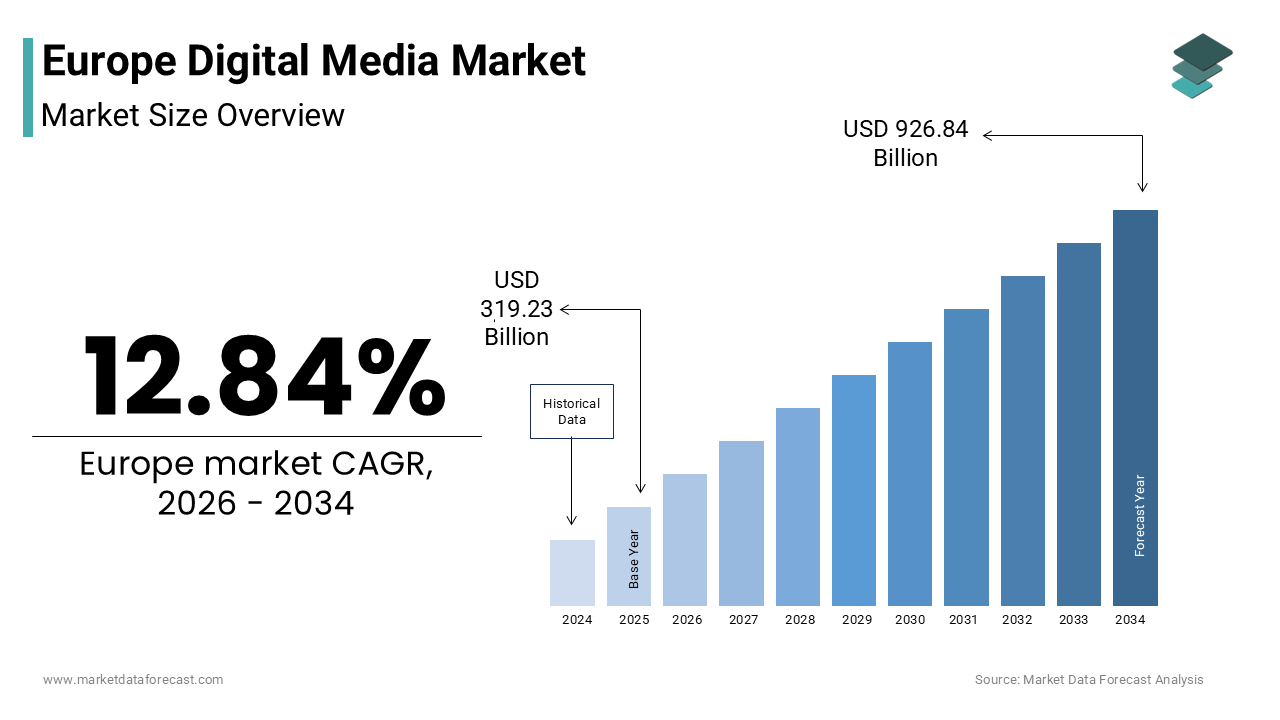
The Europe digital media market was valued at USD 319.23 billion in 2025, is estimated to reach USD 359.38 billion in 2026, and is projected to reach USD 926.84 billion by 2034, growing at a CAGR of 12.84% during the forecast period from 2026 to 2034. The growth of the Europe digital media market is driven by widespread high-speed broadband penetration, increasing smartphone adoption, rising demand for on-demand personalized content, and rapid expansion of streaming and digital advertising ecosystems. Regulatory frameworks such as the Digital Services Act and Audiovisual Media Services Directive further shape competitive dynamics, encouraging transparency and promotion of European-origin content. The integration of artificial intelligence, the growth of smart TV ecosystems, and expansion of digital learning platforms are additionally accelerating market expansion across the region.
Key Market Trends
-
Rapid growth of subscription video-on-demand (SVOD) and short-form mobile video consumption.
-
Expansion of AI-driven personalization and automated localization tools.
-
Increasing investment in local-language original European productions.
-
Strong rise in interactive media formats including shoppable video and gamified learning.
-
Growing adoption of privacy-first advertising strategies aligned with GDPR requirements.
Segmental Insights
-
Based on content type, the video segment dominated the market by holding 54.3% of the regional market share in 2024, driven by high engagement, streaming expansion, and multi-device consumption.
-
The interactive media content segment is projected to grow at the fastest CAGR of 15.2% during the forecast period owing to increasing demand for participatory and immersive experiences across gaming, education, and branded content.
-
Based on platform, the smartphone segment led the market with 58.2% share in 2024, supported by high device penetration and mobile-first media habits.
-
The television segment is anticipated to witness a CAGR of 11.7%, driven by the rapid adoption of smart TVs and hybrid broadcast-broadband integration models.
-
Based on application, the marketing and advertising segment accounted for 42.3% of the market share in 2024, supported by data-driven digital campaigns and influencer-led commerce.
-
The training and e-learning segment is expected to grow at the fastest CAGR of 14.3%, fueled by digital education initiatives, corporate upskilling programs, and immersive simulation-based learning models.
Regional Insights
The Europe digital media market shows strong regional concentration in advanced digital economies with high broadband penetration and robust creative industries.
-
The United Kingdom led the market with 19.3% share in 2024, driven by advanced telecom infrastructure, strong advertising technology presence, and vibrant creative sectors.
-
Germany held 17.3% share in 2024, supported by strong public broadcasting digitization, industrial e-learning adoption, and strict data privacy governance.
-
France is experiencing strong growth due to proactive cultural policies and heavy investment in domestic content production.
-
Italy is witnessing expansion driven by mobile-first consumption trends and multimedia transformation of traditional publishing.
-
The Netherlands is emerging as an innovation hub supported by multilingual audiences, high digital literacy, and AI-driven personalization initiatives.
Competitive Landscape
The Europe digital media market is highly competitive, with global technology giants competing alongside regional broadcasters and specialized digital platforms. Market leaders focus on localized content production, AI-driven personalization engines, privacy-compliant advertising frameworks, and smart TV ecosystem expansion. Strategic partnerships with telecom operators, content studios, and public institutions enhance market reach. Compliance with evolving EU regulations such as GDPR, the Digital Services Act, and the AI Act is a central competitive differentiator. Innovation in immersive formats, ethical AI systems, and interactive commerce experiences continues to shape the competitive environment. Major players operating in the Europe digital media market include Netflix, Spotify, YouTube, Meta Platforms, Amazon, Warner Bros. Discovery, Vivendi, RTL Group, BBC, Axel Springer, WPP, and Publicis Groupe.
Europe Digital Media Market Size
The Europe digital media market size was valued at USD 319.23 billion in 2025 and is anticipated to reach USD 359.38 billion in 2026 from USD 926.84 billion by 2034, growing at a CAGR of 12.84% during the forecast period from 2026 to 2034.
The digital media is the creation distribution and consumption of audio-visual content delivered through internet connected platforms including streaming services social networks online publishing and digital advertising ecosystems. According to Eurostat, over 92% of households in the European Union had fixed broadband access in 2024 enabling widespread high quality media consumption. As per the European Audiovisual Observatory, Europeans spent an average of 3 hours and 18 minutes daily on digital media platforms in 2023 with streaming video and short form mobile content showing the fastest growth. The European Commission’s Digital Services Act and Audiovisual Media Services Directive further influence market dynamics by mandating transparency in content moderation and promoting European cultural works.
MARKET DRIVERS
Pervasive High Speed Internet Infrastructure and Device Penetration
The near universal availability of high-speed broadband and widespread ownership of smart devices form the foundational enabler of digital media consumption. This is one of the major factors propelling the growth of Europe digital media market. According to Eurostat, 96% of urban households and 84% of rural households in the EU had access to fixed very high-capacity networks by 2024 ensuring consistent streaming quality even for 4K content. Simultaneously, smartphone penetration reached 89% among adults aged 16 to 74 as per the same source facilitating mobile first media engagement. Countries like Sweden Denmark and the Netherlands report fiber coverage exceeding 85% of premises enabling low latency interactive experiences such as cloud gaming and live social streaming. The European Electronic Communications Code has accelerated infrastructure investment with over 120 billion euros committed by national regulators between 2021 and 2024 to close the gigabit gap. This robust connectivity backbone not only supports current demand but also unlocks next generation formats including spatial audio immersive video and real time co viewing experiences that deepen user engagement and expand content monetization avenues across the digital media ecosystem.
Rising Demand for On Demand and Personalized Content Experiences
European consumers increasingly reject scheduled programming in favor of curated on demand content that aligns with individual preferences and lifestyles. According to the European Audiovisual Observatory, subscription video on demand usage grew by 24% in 2023 with over 60% of internet users regularly accessing platforms like Netflix Disney Plus and local services such as France’s Salto or Germany’s Joyn. Algorithmic recommendation engines, now drive over 70% of viewing decisions as per a 2024 study by the Copenhagen Institute for Information Studies reinforcing the value of behavioral data in content discovery. This shift is particularly pronounced among younger demographics, where Europeans aged 16 to 29 consume most of their video content via digital platforms rather than linear TV. Furthermore, the integration of interactive features such as choose your own adventure narratives and synchronized social commentary enhances immersion and retention. This demand for autonomy relevance and interactivity compels media companies to invest in data analytics artificial intelligence and agile content production to maintain audience loyalty in an attention scarce environment.
MARKET RESTRAINTS
Stringent Data Privacy Regulations Limiting Behavioral Targeting
The European Union’s General Data Protection Regulation imposes strict limitations on the collection processing and commercial use of personal data significantly constraining the precision of digital advertising and content personalization. The stringent data privacy regulations limiting behavioral targeting is restraining the growth of Europe digital media market. According to the European Data Protection Board, over 1,200 enforcement actions related to consent mechanisms and cookie compliance were initiated across EU member states in 2023 alone. The phasing out of third-party cookies accelerated by browser policies from Apple and Google that further erodes the ability of publishers to track cross site behavior. As per the Interactive Advertising Bureau, Europe contextual targeting and first party data strategies have become essential yet less effective alternatives reducing ad revenue efficiency. National data protection authorities like France’s CNIL and Ireland’s DPC have levied fines exceeding 1.5 billion euros collectively since 2021 for non-compliant tracking practices. These regulatory pressures force digital media companies to redesign user journeys adopt privacy preserving technologies and accept lower monetization yields particularly impacting independent creators and niche platforms reliant on targeted advertising for sustainability.
Fragmented Language and Cultural Markets Increasing Production Costs
The linguistic and cultural diversity is a barrier to scalable content distribution and monetization, which is hampering the growth of Europe digital media market. With 24 official EU languages and numerous regional dialects media companies must invest heavily in localization including dubbing subtitling and cultural adaptation to achieve broad reach. According to the study, producing localized versions of a single film or series can increase costs by 30 to 50% compared to monolingual countries. The Audiovisual Media Services Directive mandates that at least 30% of content on major platforms be of European origin but does not harmonize language requirements creating operational complexity. As per the European Audiovisual Observatory, European films achieve distribution in more than five EU countries due to these fragmentation effects. Streaming services mitigate this through original local productions, Netflix invested over 1.8 billion euros in European content in 2024, but smaller players lack such resources. This balkanization limits economies of scale restricts audience size for non-English content and hampers the emergence of pan European digital media champions capable of competing globally.
MARKET OPPORTUNITIES
Expansion of Local Language Streaming and Original European Content
The growing appetite for culturally resonant storytelling in native languages for digital platforms to differentiate through locally produced content is posing new opportunities for the growth of Europe digital media market. Regulatory support amplifies this trend, where the European Commission’s Creative Europe program allocated 580 million euros in 2024 to fund audiovisual works that reflect European identity and linguistic diversity. Platforms are responding strategically, Disney Plus launched Star+ originals in Italian and Dutch, while Amazon Prime Video commissioned crime dramas in Nordic and Iberian settings. These investments not only fulfill regulatory quotas but also foster viewer loyalty, where a 2024 study by the University of Amsterdam found that European audiences are more likely to subscribe long term to services offering high quality local narratives. By leveraging regional talent authentic settings and contemporary themes media companies can build defensible niches and reduce reliance on costly Hollywood licensing deals.
Integration of Artificial Intelligence for Content Creation and Curation
Artificial intelligence is unlocking new efficiencies and capabilities across the digital media value chain from scriptwriting and video editing to dynamic personalization and rights management. The integration of AI for content creation is additionally escalating the growth of Europe digital media market. According to the European Institute of Innovation and Technology, over 60% of major European broadcasters and streamers piloted generative AI tools in 2024 for tasks such as automated subtitling deepfake detection and synthetic voice dubbing. The European Broadcasting Union developed an open-source AI framework to help public service media generate multilingual summaries of news content reducing localization costs by up to 45%. Additionally, AI driven recommendation engines are evolving beyond behavioral tracking to incorporate semantic analysis of content meaning improving discovery while complying with GDPR. Startups like Synthesia in the UK and DeepZen in Germany are enabling hyperlocal ad insertion and voice cloning with minimal human input. As per the European Commission’s AI Office, these innovations are eligible for funding under the Digital Europe Programme provided they adhere to the AI Act’s transparency requirements. This responsible adoption of AI positions Europe to lead in ethical intelligent media systems that balance automation with cultural integrity.
MARKET CHALLENGES
Platform Dominance and Unequal Revenue Distribution
A handful of global technology giants control the majority of digital media distribution and advertising revenue in Europe creating systemic imbalances that threaten media pluralism and creator sustainability. The platform dominance and unequal revenue distribution is solely hampering the growth of Europe digital media market. According to the European Commission, Apple Google Amazon and Meta captured over 70% of the EU’s digital advertising market in 2024 leaving traditional publishers and independent creators with diminishing returns. The dominance of app stores further skews economics, where developers pay up commission on subscriptions limiting reinvestment in quality journalism or original content. Although, the Digital Markets Act designates these firms as gatekeepers and mandates fairer terms enforcement remains nascent. As per the European Federation of Journalists, average digital revenue per journalist fell between 2021 and 2024 despite rising audience metrics. This concentration of power discourages innovation among smaller players and reduces diversity of voices particularly in smaller language markets where local platforms struggle to compete for user attention and advertiser budgets against algorithmically optimized global feeds.
Combating Misinformation and Ensuring Content Integrity
The rapid spread of manipulated media deepfakes and coordinated disinformation campaigns poses a threat to democratic discourse and public trust in digital media, which is additionally to hamper the growth of Europe digital media market. According to the European External Action Service, over 400 disinformation incidents targeting EU elections and public health policies were documented in 2023 alone. The Digital Services Act requires very large online platforms to conduct risk assessments and deploy mitigation measures, but implementation varies widely. A 2024 audit by the European Digital Media Observatory found that only 35% of flagged false narratives were removed within 24 hours on major social networks. The rise of generative AI exacerbates the problem; synthetic audio and video can now mimic public figures with alarming realism undermining evidentiary standards. National fact checking networks like France’s Decodex and Germany’s Correctiv are scaling operations but lack real time integration with platform algorithms. Without robust cross border coordination standardized verification protocols and sustainable funding for media literacy initiatives the integrity of Europe’s digital information ecosystem remains vulnerable to exploitation and erosion.
REPORT COVERAGE
| REPORT METRIC | DETAILS |
| Market Size Available | 2025 to 2034 |
| Base Year | 2025 |
| Forecast Period | 2026 to 2034 |
| CAGR | 12.84% |
| Segments Covered | By Content Type, Platform, Application, Industry Vertical and Region |
| Various Analyses Covered | Regional & Country Level Analysis, Segment-Level Analysis, DROC, PESTLE Analysis, Porter’s Five Forces Analysis, Competitive Landscape, Analyst Overview on Investment Opportunities |
| Countries Covered | UK, France, Spain, Germany, Italy, Russia, Sweden, Denmark, Switzerland, the Netherlands, Turkey, the Czech Republic, and the Rest of Europe. |
| Market Leaders Profiled | Netflix, Spotify, YouTube, Meta Platforms, Amazon, Warner Bros. Discovery, Vivendi, RTL Group, BBC, Axel Springer, WPP, and Publicis Groupe. |
SEGMENTAL ANALYSIS
By Content Type Insights
The video segment held 54.3% of the Europe digital media market share in 2025 with its immersive nature high engagement metrics and dominance in entertainment news and social communication. According to the European Audiovisual Observatory, Europeans consumed over 280 billion hours of online video in 2024 with streaming services accounting for 62% of total viewing time. The proliferation of short form vertical video on platforms like TikTok Instagram Reels and YouTube Shorts has further accelerated consumption particularly among users under 35 who spend an average of 95 minutes daily on mobile video, as per Eurostat. National broadcasters have also digitized aggressively; France Televisions and RAI reported that over 70% of their younger audiences now access content exclusively via on demand platforms. Additionally, video’s superiority in conveying complex information supports its use in e learning corporate training and digital advertising where completion rates are 3 to 5 times higher than text based formats. This multifaceted utility across entertainment education and commerce ensures video’s continued dominance in the European digital media market.
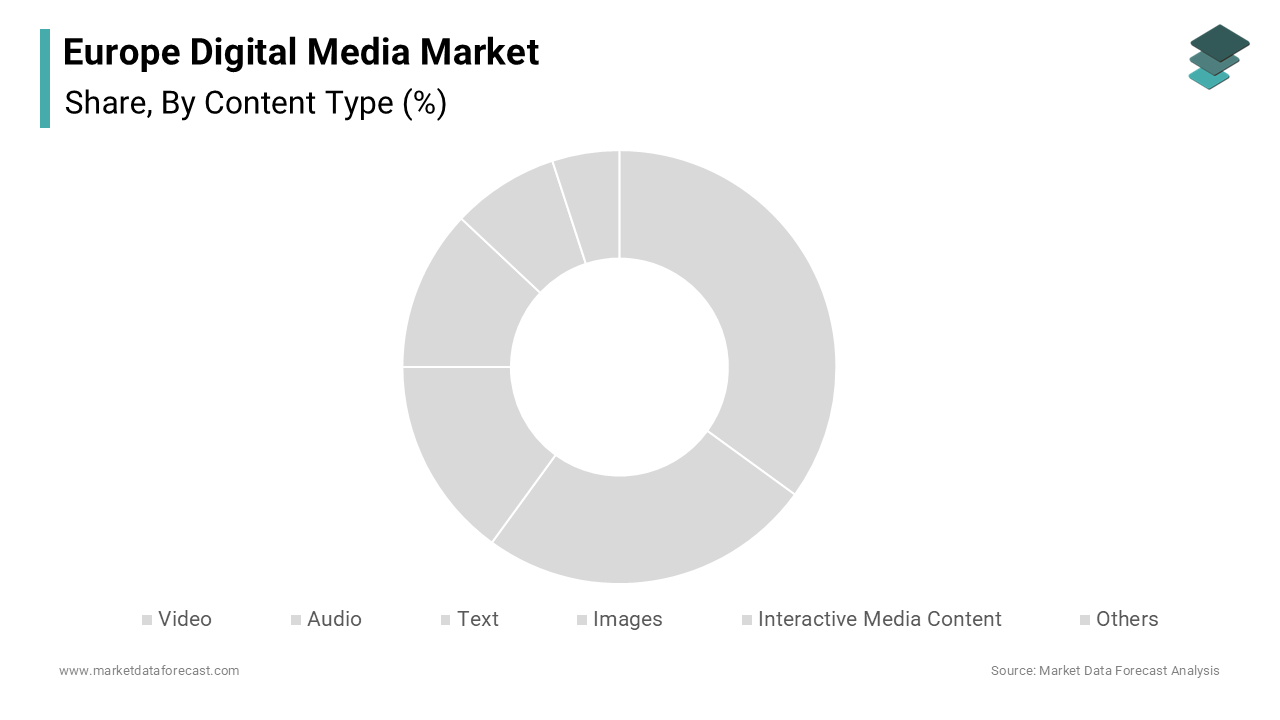
The interactive media content segment is projected to expand at a CAGR of 15.2% throughout the forecast period with the rising demand for participatory experiences in gaming education advertising and virtual events. According to the European Commission, over 45 million Europeans engaged with interactive narratives or choose your own adventure formats in 2024 primarily through streaming platforms and branded campaigns. The integration of real-time decision-making branching storylines and user generated outcomes enhances emotional investment and retention. In education, the European Institute for Innovation and Technology funded 120 projects in 2024 using interactive simulations for STEM learning showing a 40% improvement in knowledge retention compared to passive video. Furthermore, brands are adopting shoppable interactive videos L’Oréal’s virtual try on campaigns in France achieved 3.2 times higher conversion than static ads. These converging applications across entertainment commerce and pedagogy position interactive media as the frontier of next generation digital engagement.
By Platform Insights
The smartphones segment was accounted in holding 58.2% of the Europe digital media market share in 2024 due to their ubiquity portability and role as the primary gateway to digital life. According to Eurostat, 94% of Europeans aged 16 to 74 owned a smartphone in 2024 with average daily usage exceeding 3 hours for media consumption. Mobile devices enable instant access to social networks streaming apps news feeds and messaging platforms often serving as the first and last screen of the day. Urban infrastructure supports this trend, 5G coverage reached 85% of major EU cities by 2024 by enabling seamless high definition streaming and real time interactivity. Additionally, smartphones integrate cameras microphones and sensors that facilitate user generated content creation fueling platforms like TikTok and Instagram. This emergence of hardware connectivity and behavioral habit solidifies the smartphone as the central hub of digital media consumption across all age groups in Europe.
The television segment is likely to witness a fastest CAGR of 11.7% throughout the forecast period with the rapid adoption of smart connected TVs and hybrid broadcast broadband models. According to the European Audiovisual Observatory, over 78% of households in the EU owned a smart TV in 2024 up from 52% in 2020 with average weekly streaming time on these devices reaching 14 hours. The integration of Netflix, Disney Plus, Amazon Prime Video, and local services like M6 Replay or ARD Mediathek directly into TV interfaces has transformed the living room into a premium on demand entertainment center. The rollout of HbbTV 2.0 across Germany, France, and Italy, enables seamless switching between live broadcast and on demand content enhancing user experience. As per the European Telecommunications Standards Institute, over 120 million HbbTV compatible devices are now in use across Europe facilitating targeted advertising and interactive features. This renaissance of the television as a smart connected hub revitalizes its relevance in the digital era beyond passive viewing.
By Application Insights
The marketing and advertising segment was the largest by capturing 42.3% of the Europe digital media market share in 2024 with the centrality of data driven promotion in the digital economy. Brands leverage rich media, including interactive banners shoppable videos and augmented reality filters to capture attention in crowded feeds. The first party data strategies and contextual targeting have matured allowing advertisers to maintain performance, while complying with privacy norms. Major sectors such as automotive fashion and finance allocate their marketing budgets to digital channels, as per national trade associations. Additionally, the rise of influencer collaborations and native advertising on platforms like YouTube and Instagram further blurs the line between content and commerce. This strategic reliance on digital media for customer acquisition retention and brand building sustains marketing and advertising as the dominant revenue engine.
The training and e-learning segment is expected to witness a fastest CAGR of 14.3% throughout the forecast period with the structural shifts in education workforce development and corporate upskilling accelerated by post pandemic digital adoption. According to the European Centre for the Development of Vocational Training, EU enterprises implemented digital learning platforms in 2024 to address skills gaps in AI cybersecurity and green technologies. The European Commission’s Digital Education Action Plan allocated 2.1 billion euros in 2024 to modernize school and university infrastructure including immersive media labs for virtual simulations. Platforms like FutureLearn and OpenClassrooms report user growth with interactive video quizzes and gamified modules driving completion rates. In healthcare, the European Medical Association mandates 50 hours of annual digital continuing education for physicians many delivered via scenario based video modules. Furthermore, public sector initiatives such as Germany’s Qualification Opportunities Act subsidize employee training using accredited digital content. This institutional endorsement combined with proven efficacy in knowledge transfer positions e learning as a high impact high growth application across public and private domains.
REGIONAL ANALYSIS
United Kingdom Digital Media Market Analysis
The United Kingdom was the top performer of the Europe digital media market by accounting for 19.3% of share in 2024 with its advanced telecommunications infrastructure vibrant creative industries and high consumer engagement with digital platforms. According to Ofcom, over 96% of UK households had access to superfast broadband in 2024 with average monthly data consumption exceeding 650 gigabytes per household. London serves as a global hub for advertising technology and media innovation hosting headquarters or regional offices for major players like Google Meta and TikTok. Regulatory frameworks like the Online Safety Act also shape responsible content ecosystems influencing platform design across Europe. High smartphone penetration 93% and early adoption of connected TVs further amplify media consumption.
Germany Digital Media Market Analysis
Germany was ranked second by holding 17.3% of the Europe digital media market share in 2024 with the strong public broadcasting digitization high internet penetration and robust data privacy consciousness. According to the Federal Network Agency, over 91% of German households had fixed broadband access in 2024 with fiber coverage expanding rapidly in urban centers. Public broadcasters ARD and ZDF lead digital transformation with their Mediathek platforms recording over 1.2 billion monthly views in 2024. The country’s stringent interpretation of GDPR influences platform design favoring transparency and user control which shapes regional content strategies. Additionally, Germany’s dual vocational education system increasingly integrates digital media tools with over 400,000 apprentices using interactive e-learning modules, as per the Federal Ministry of Education. This blend of public service innovation regulatory rigor and industrial application anchors Germany’s influential position in the European digital media ecosystem.
France Digital Media Market Analysis
France digital media market growth is likely to grow with the proactive cultural policy strong domestic content production and high mobile media usage. According to ARCEP, France’s telecom regulator 95% of the population had 4G coverage in 2024 with 5G available in all major cities enabling high quality mobile streaming. The government’s “France Very High Broadband” plan has connected many households to fiber accelerating adoption of on demand services. Cultural sovereignty is a key driver, where the CSA mandates that 30% of streaming catalogs be European with 20% French leading to investments in local series by platforms like Salto and Canal+. In 2024, the National Center for Cinema allocated 620 million euros to support digital audiovisual works including interactive documentaries and virtual reality experiences. Social media engagement is also high, as many adults use platforms like Instagram and Snapchat daily for news and entertainment. This fusion of technological access cultural protectionism and creative output ensures France’s dynamic and distinct presence in the digital media market.
Italy Digital Media Market Analysis
Italy digital media market growth is likely to grow with the passionate mobile content consumption strong regional media identities and growing digital transformation in traditional publishing. According to some studies, Italy’s communications authority 89% of Italians accessed digital media via smartphones in 2024 spending over 2.5 hours daily on social and video platforms. Regional broadcasters like RAI and Mediaset have successfully migrated audiences to digital with their on-demand services registering 45% year on year growth. The Italian publishing industry is also adapting, where major newspapers, such as Corriere della Sera, now derive over 60% of digital revenue from multimedia storytelling including podcasts and explainer videos. Youth engagement is particularly strong that follow influencers and consume user generated content daily. Additionally, Milan’s emergence as a fashion tech hub drives innovation in shoppable video and virtual showrooms.
Netherlands Digital Media Market Analysis
The Netherlands digital media market growth is likely to be driven by the exceptional digital infrastructure multilingual content consumption and progressive media innovation policies. The country’s high English proficiency facilitates cross border content consumption with Dutch audiences regularly engaging with Nordic British and American digital media. Public broadcaster NPO leads in accessibility offering all content with subtitles audio description and interactive transcripts. Startups in Amsterdam and Utrecht are pioneering AI driven personalization and ethical recommendation engines aligned with the EU AI Act. As per the Dutch Media Authority, over 70% of citizens trust public service digital media more than commercial platforms reflecting strong institutional credibility.
COMPETITIVE LANDSCAPE
The Europe digital media market is characterized by intense competition among global technology giants regional broadcasters and agile digital natives each vying for audience attention advertising revenue and regulatory compliance. US based platforms like Netflix Amazon and Meta dominate scale and innovation but face mounting pressure from EU regulations on data privacy content quotas and platform accountability. Traditional public service broadcasters such as BBC ARD and RAI are aggressively digitizing their archives and launching on demand services to retain relevance among younger demographics. Meanwhile specialized players in gaming social audio and interactive media carve out niches through community driven models and immersive experiences. The competitive dynamic is further shaped by fragmented language markets varying broadband infrastructure and divergent national policies on copyright and taxation. Success requires balancing global efficiency with local authenticity robust compliance frameworks and continuous investment in next generation formats such as AI generated content and spatial media.
KEY MARKET PLAYERS
Some of the companies that are playing a dominating role in the Europe Digital Media Market include
- Netflix
- Spotify
- YouTube
- Meta Platforms
- Amazon
- Warner Bros. Discovery
- Vivendi
- RTL Group
- BBC
- Axel Springer
- WPP
- Publicis Groupe
Top Players in the Market
Netflix Inc
Netflix maintains a commanding presence in the Europe digital media market through its extensive library of global and locally produced content delivered via a seamless streaming platform. These localized narratives not only fulfill EU audiovisual quotas but also drive subscriber retention and cultural relevance. Netflix actively collaborates with national film institutes and independent studios to develop authentic stories that resonate with regional audiences. Recent initiatives include AI powered dubbing for real time voice localization and interactive storytelling formats tested in Nordic markets.
Meta Platforms Inc
Meta Platforms Inc exerts substantial influence over the Europe digital media landscape through its family of apps including Facebook Instagram and WhatsApp which serve as primary channels for news entertainment and user generated content consumption. The company has adapted its advertising and content moderation systems to comply with the EU Digital Services Act and General Data Protection Regulation while maintaining high engagement metrics. Meta expanded its European Creator Hub in Berlin offering training monetization tools and AI driven analytics to over 50,000 content creators across the region. It also launched Reels monetization programs in partnership with national music rights organizations to support local artists.
Amazon.com Inc
Amazon.com Inc plays a pivotal role in the Europe digital media market through its Prime Video streaming service Twitch live streaming platform and Amazon Music ecosystem. The company has intensified its investment in European storytelling commissioning high budget productions in Italy Spain and the UK while expanding live sports rights including Premier League and Bundesliga matches. Amazon’s integration of digital media with its e commerce and cloud infrastructure enables unique cross promotional opportunities and data informed personalization. It launched localized interactive shopping experiences during live streams allowing viewers to purchase featured products in real time. Additionally, Amazon Web Services supports numerous European media startups with scalable cloud solutions for content delivery and AI driven editing.
Top Strategies Used by the Key Market Participants
Key players in the Europe digital media market prioritize local content creation by commissioning region specific films series and documentaries to meet regulatory requirements and enhance cultural resonance. They invest heavily in artificial intelligence for personalized recommendation engines automated subtitling and synthetic voice localization to improve accessibility and user engagement. Companies adopt privacy preserving advertising technologies such as contextual targeting and first party data ecosystems to comply with GDPR while maintaining revenue efficiency. Strategic partnerships with national broadcasters telecom operators and educational institutions facilitate bundled offerings and expanded distribution. Additionally, firms implement transparent content moderation systems and creator monetization programs to align with the Digital Services Act and foster sustainable digital ecosystems that balance scale with responsibility.
MARKET SEGMENTATION
This research report on the Europe Digital Media Market has been segmented and sub-segmented based on the following categories.
By Content Type
- Video
- Audio
- Text
- Images
- Interactive Media Content
- Others
By Platform
- Smartphone
- Television
- Computer
- Tablets
- Others
By Application
- Marketing & Advertising
- Training & E-Learning
- Social Media
- Streaming
- Others
By Industry Vertical
- Entertainment
- Retail and E-commerce
- Healthcare
- Government
- BFSI
- Telecom
- Automotive
- Hospitality
- Non-profit Organizations
- Publishing
- Others
By Country
- UK
- France
- Spain
- Germany
- Italy
- Russia
- Sweden
- Denmark
- Switzerland
- Netherlands
- Turkey
- Czech Republic
- Rest of Europe