- Product Description Description
- Table of Contents TOC
- List of Table & Figure LOT
- Get Free Sample PDF Sample PDF
Market Size, 2025
$14.83 BnMarket Estimate, 2026
$16.54 BnMarket Forecast, 2034
$39.51 BnCAGR, 2026–2034
11.50%Europe Digital Printing Market Size
The Europe digital printing market size was calculated to be USD 14.83 billion in 2025 and is anticipated to be worth USD 39.51 billion by 2034, from USD 16.54 billion in 2026, growing at a CAGR of 11.50% during the forecast period.
The digital printing is a bypass traditional analog processes by transferring digital files directly to substrates including paper textiles packaging and rigid materials. Unlike offset or flexographic methods digital printing enables variable data personalization short run efficiency and rapid turnaround without physical plates or lengthy setup. This capability aligns with Europe’s industrial shift toward mass customization sustainability and circular economy principles. The European Commission’s Circular Economy Action Plan explicitly encourages production models that reduce waste and support reuse objectives inherently advanced by digital printing’s minimal ink and substrate waste. According to Eurostat, many European manufacturers now prioritize reducing production scrap, as a core operational goal. Additionally, the rise of e-commerce fulfillment centers across Germany Poland and the Netherlands has intensified demand for just in time printed packaging and labels.
MARKET DRIVERS
Surge in E Commerce Drives Demand for On Demand Customized Packaging and Labels
The exponential growth of online retail has fundamentally reshaped packaging requirements bby creating urgent demand for flexible digital printing solutions. This factor is majorly propelling the growth of Europe digital printing market. The e-commerce accounted for 21% of total retail sales in with over 1.2 billion parcels shipped annually across the region, as per sources. Unlike traditional retail, which relies on long print runs of uniform packaging e commerce thrives on short batch fulfillment personalized messaging and dynamic content, such as QR codes batch numbers or regional compliance labels. The online shoppers consider branded unboxing experiences a key factor in brand loyalty. This has pushed retailers and third-party logistics providers to adopt digital label and packaging printers capable of producing unique items in real time. Fulfillment hubs in the Netherlands and Poland, now integrate inline digital printers that auto generate shipping labels promotional inserts and return instructions per order. As the European Union, tightens packaging waste regulations under the Extended Producer Responsibility framework the ability to print only what is needed further enhances digital printing’s economic and environmental appeal.
Regulatory Push for Sustainable Production and Waste Reduction Favors Digital Workflows
The European environmental legislation is increasingly structuring industrial incentives around resource efficiency and waste minimization, which is additionally boosting the growth of Europe digital printing market. The EU Industrial Emissions Directive mandates that manufacturing facilities reduce process scrap with non-compliance risking fines or production limits. Traditional analog printing methods generate significant substrate waste during makeready phases often exceeding fifteen% per job, according to the European Environmental Bureau. In contrast, digital printing eliminates plate setup and enables precise ink deposition reducing material loss to under two%. Furthermore, the European Chemicals Agency has restricted several solvent based inks commonly used in offset printing due to volatile organic compound emissions pushing converters toward water based or UV curable inks compatible with digital platforms. The EU Packaging and Packaging Waste Regulation due for full enforcement by 2026 requires all packaging to be reusable or recyclable and mandates clear printed labeling of material composition with a requirement efficiently met through digital variable data printing.
MARKET RESTRAINTS
High Initial Investment and Operational Costs for Industrial Grade Digital Printers
The acquisition and operational expense of industrial digital printing systems remain significant barriers for small and mid-sized print service providers, which is one of the major restraining the growth of Europe digital printing market. This capital intensity is particularly prohibitive in Southern and Eastern Europe, where access to equipment financing is limited and profit margins in commercial printing average only eight to ten%. Additionally, the cost of specialized inks, especially food safe or durable outdoor inks can be three to five times higher than conventional analog alternatives. Maintenance complexity further compounds expenses as digital presses require certified technicians for printhead calibration and software updates a skill set scarce outside major urban centers. Although leasing models and pay per print services are emerging, as they often include volume commitments that deter cautious adopters.
Limited Substrate Versatility and Performance Gaps in Certain Industrial Applications
The material compatibility and performance limitations that restrict its use in demanding industrial sectors is also degrading the growth of Europe digital printing market. Many digital inkjet systems struggle to adhere properly to uncoated recycled paper low surface energy plastics or textured textiles without costly pre-treatment processes. In the food packaging sector migration testing for digital inks remains inconsistent with only sixteen EU approved ink formulations certified for direct food contact as of early 2026 per the European Food Safety Authority. These gaps force converters to maintain analog lines for specific jobs undermining the business case for full digital transition. Moreover, printing speed on industrial digital presses, typically 50 to 150 meters per minute lags behind flexo or gravure lines that operate at three hundred meters per minute or more.
MARKET OPPORTUNITIES
Integration of Digital Printing into Smart Factory and Industry 4.0 Ecosystems
The pivotal node in Europe’s Industry 4.0 transformation by enabling real time data driven production and product personalization is certainly a major factor to set up new opportunities for the growth of Europe digital printing market. The European Union’s Horizon Europe program has allocated over 400 million euros since 2022 to smart manufacturing initiatives that link digital printing with enterprise resource planning and machine learning systems. In Germany’s automotive supply chain for instance interior trims are now printed on demand with unique serial numbers material certifications and assembly instructions directly from production databases using cloud connected digital presses. Similarly, textile manufacturers in Italy and Portugal use digital printing to execute micro collections based on real time social media trend data reducing inventory risk.
Expansion of Digital Textile Printing Driven by Fast Fashion Sustainability Demands
The fashion industry’s urgent pivot toward sustainable on demand production is accelerating adoption of digital textile printing, which is also to surge the growth of Europe digital printing market. Traditional rotary screen printing consumes up to 150 liters of water per meter of fabric and generates toxic dye sludge, as noted by the European Environment Agency. In contrast, digital textile printing uses up to 95% less water and applies pigment only where needed drastically reducing environmental impact. Brands like H&M and Zalando have launched localized micro factory networks in Poland and the Czech Republic where digital printers produce limited runs based on regional sales data minimizing overstock. The digital textile printing capacity in Europe grew by 37% year on year driven by these sustainability and agility imperatives.
MARKET CHALLENGES
Shortage of Skilled Technicians and Workflow Integration Expertise
The successful deployment of advanced digital printing systems in Europe is hampered by a critical shortage of personnel trained in both print technology and data integration. Unlike analog printing which relies on mechanical know how digital workflows demand hybrid competencies in color management data preflighting cloud connectivity and cybersecurity. According to a 2025 workforce survey by the European Printing Industries Federation, print businesses report difficulty hiring staff capable of managing end to end digital production chains. Vocational training programs across the EU remain heavily oriented toward traditional offset and gravure methods with only nine countries offering certified digital printing curricula. This skills gap leads to underutilization of installed capacity extended troubleshooting times and reluctance to adopt advanced features like variable data or automated color calibration.
Fragmented Supply Chain for Consumables and Lack of Standardization
The European digital printing ecosystem suffers from inconsistent ink substrate and software compatibility across vendors creating operational inefficiencies and vendor lock in. The fragmented supply chain for consumable and lack of standardization is additionally to decline the growth of Europe digital printing market. Unlike analog printing, which operates on standardized ISO norms for inks and plates digital consumables are often proprietary with printheads engineered to work only with specific ink chemistries. A assessment by the European Committee for Standardization found that fewer digital printing materials adhere to harmonized performance or safety benchmarks. This fragmentation forces printers to maintain separate inventories for different press models and limits their ability to switch suppliers based on cost or sustainability criteria. Moreover, independent ink manufacturers face stringent but non uniform certification processes across EU member states delaying market entry. The absence of open data exchange protocols also complicates integration with third party workflow software increasing reliance on single vendor ecosystems.
REPORT COVERAGE
| REPORT METRIC | DETAILS |
| Market Size Available | 2025 to 2034 |
| Base Year | 2025 |
| Forecast Period | 2026 to 2034 |
| CAGR | 11.50% |
| Segments Covered | By Print-Head Type, Application, End User And Region |
| Various Analyses Covered | Global, Regional & Country Level Analysis; Segment-Level Analysis; DROC, PESTLE Analysis; Porter’s Five Forces Analysis; Competitive Landscape; Analyst Overview of Investment Opportunities |
| Regions Covered | UK, France, Spain, Germany, Italy, Russia, Sweden, Denmark, Switzerland, Netherlands, Turkey, and the Czech Republic |
| Market Leaders Profiled | HP Inc., Canon, Xerox, Epson, Ricoh, Konica Minolta, Fujifilm Holdings, Brother Industries, Durst Group, Roland DG, Agfa-Gevaert, Heidelberg Printing Machines, Mimaki Engineering, EFI, Océ |
SEGMENTAL ANALYSIS
By Print-head Type Insights
The inkjet technology segment was accounted in holding a dominant share of the Europe digital printing market in 2025 due to its versatility high resolution output and compatibility with diverse substrates from paper to flexible packaging. Its dominance is further driven by continuous innovation in piezoelectric printhead durability and pigment dispersion chemistry enabling industrial scale throughput without sacrificing color fidelity. The technology aligns with EU sustainability mandates as modern inkjet systems consume up to 40% less energy than laser alternatives and support water based and UV curable inks that meet European Chemicals Agency restrictions. Major brands in fashion and consumer goods increasingly mandate inkjet for its capacity to produce on demand micro batches reducing overproduction waste.
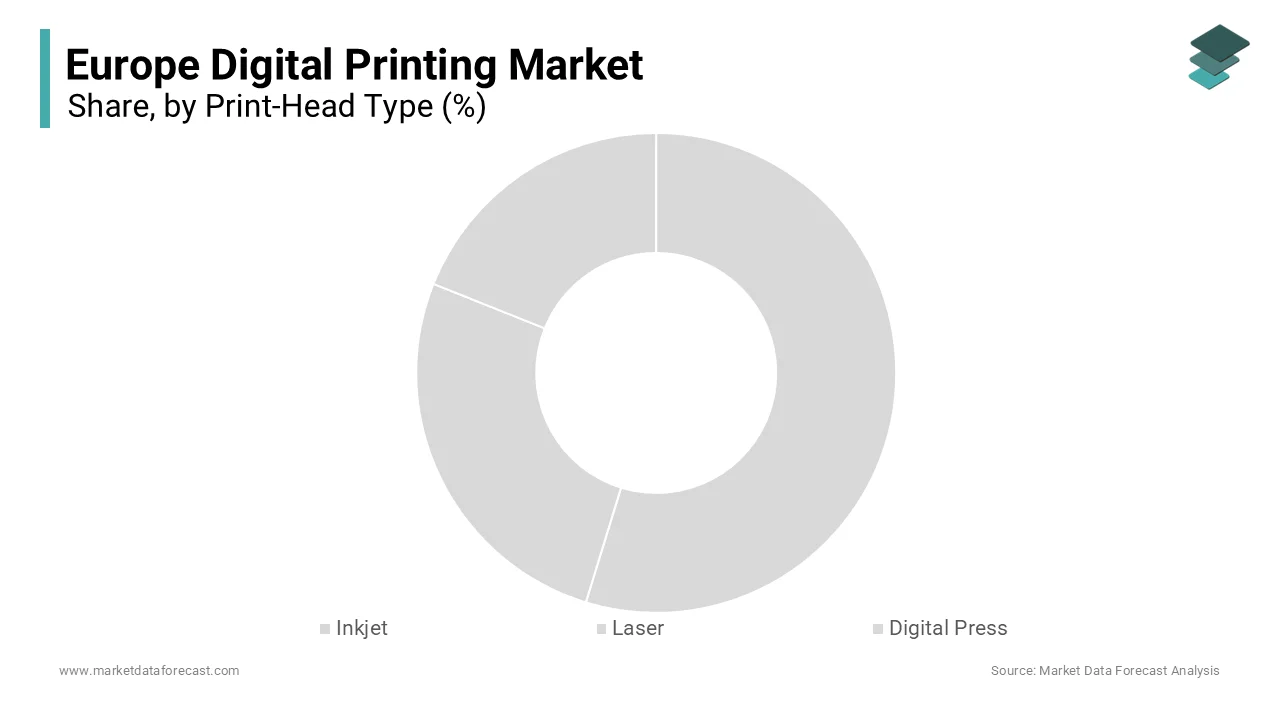
The digital presses segment is likely to witness a fastest CAGR of 16.2% from 2026 to 2034, as they bridge the gap between commercial print quality and industrial productivity. Unlike standard inkjet or laser printers, digital presses integrate offset like imaging cylinders with digital data streamsby enabling high speed production of brochures books and marketing collateral with variable content. The transformation of European publishing and corporate communications, marketing departments now prioritize personalized print materials, according to the European Association of Communications Agencies. Companies like Heidelberg and Kodak have launched sheet fed digital presses capable of 150 pages per minute with inline finishing matching offset speed, while enabling one to one customization. The German and UK publishing sectors have replaced over 30% of their offset capacity with digital presses since 2022 to comply with the EU’s Right to Repair and Circular Economy directives by printing only what is needed. This shift toward agile responsive print infrastructure positions digital presses as the strategic core of next generation commercial print workflows.
By Application Insights
The paper segment was accounted in holding 43.2% of the Europe digital printing market share in 2025 owing to the sustained demand for personalized transactional documents marketing collateral and short run publishing. The banking and insurance sectors alone generate personalized statements and policy documents annually, across the EU, as per the European Banking Federation necessitating secure high volume digital print infrastructure. Additionally, the European Union’s 2023 Directive on Consumer Rights requires clear printed disclosures in multiple languages for cross border contracts further anchoring paper’s relevance. Advances in digital paper handling, such as automated sheet feeding and inline binding have reduced waste and labor costs making short run digital printing economically viable even for small businesses.
The textile printing segment is likely to register a fastest CAGR of 12.3% from 2026 to 2034 with the fashion industry’s urgent shift toward sustainable on demand production. In contrast digital textile printing uses up to ninety five% less water and applies pigment only where needed drastically lowering environmental impact. The European Apparel and Textile Confederation, EU fashion brands now mandate digital printing for new collections to meet the EU Strategy for Sustainable and Circular Textiles. Localized micro factories in Portugal, Italy, and Poland, use digital printers to produce limited runs based on real time sales data minimizing overstock and markdowns. A 2025 EURATEX study found that digital textile printing capacity in Europe grew by 39% year on year driven by these agility and compliance imperatives.
By End-user Insights
The packaging and label printing segment was the largest by holding 36.4% of the Europe digital printing market share in 2025 due to surging demand for customized agile and compliant packaging solutions. Additionally, the EU Packaging and Packaging Waste Regulation mandates that all packaging display material composition and recycling instructions by 2026 a requirement efficiently fulfilled through digital variable data printing. Major food and beverage brands like Nestlé and Unilever have transitioned to digital label printing to enable regional flavor launches and seasonal campaigns without costly plate changes.
The clothing sector segment is anticipated to witness a fastest CAGR of 11.2% from 2026 to 2034 to align with EU sustainability mandates and consumer demand for personalization. The European Commission’s 2022 Textile Strategy prohibits unsold garment destruction by 2030 compelling brands to adopt on demand manufacturing. Digital printing enables this shift by allowing single unit production of custom designs without inventory risk. H&M, Zalando, and Mango, have established micro factories in Central and Eastern Europe where digital printers produce garments based on real time regional trend data reducing overstock, according to internal sustainability reports validated by the European Consumer Organisation. Moreover, few European consumers aged 18 to 35 express willingness to pay a premium for personalized apparel, which is driving investment in direct to garment and roll to roll digital systems.
REGIONAL ANALYSIS
Germany Digital Printing Market Analysis
Germany was the top performer of the Europe digital printing market by occupying 34.2% of share in 2025, as a hub of industrial innovation engineering precision and regulatory compliance. The country hosts major press manufacturers including Heidelberg and Durst, whose digital systems set global benchmarks for speed and color accuracy. German print service providers operate under stringent waste and emissions controls mandated by the Federal Immission Control Act driving rapid adoption of closed loop ink recovery and energy efficient inkjet systems. The commercial printers have digitized more than half their workflows since 2022 to meet client demands for personalized packaging and carbon transparent production. The government’s Industry 4.0 initiative has subsidized smart factory integration enabling presses to communicate with ERP and logistics systems in real time.
United Kingdom Digital Printing Market Analysis
The United Kingdom was ranked second by holding 12.3% of the Europe digital printing market share in 2025 with a mature publishing sector agile e commerce logistics and strong design led fashion. British print service providers have pivoted aggressively toward short run digital production to serve the UK’s e-commerce, as confirmed by the Office for National Statistics. London’s creative economy fuels demand for premium personalized print in luxury retail and event marketing, while nationwide fulfillment hubs in the Midlands integrate digital label printers for real time parcel customization. The UK’s post Brexit regulatory autonomy has enabled faster approval of novel digital inks accelerating innovation. This blend of creative demand logistical scale and regulatory agility sustains the UK’s influential role in the European market.
Italy Digital Printing Market Analysis
Italy digital printing market growth is likely to grow with its world-renowned fashion textile and luxury goods industries. The country is Europe’s largest user of digital textile printing with over two hundred fifty industrial roll to roll systems installed in Lombardy and Tuscany. Italian fashion houses leverage digital printing for limited edition collections bespoke client services and rapid response to trend cycles capabilities essential under the EU’s anti overproduction textile regulations. Additionally, Italy’s packaging sector serving food wine and cosmetics exports relies heavily on digital label printing to meet multilingual EU compliance and anti-counterfeiting requirements. The government’s Industry 4.0 Tax Credit has subsidized over one point two billion euros in digital printing equipment since 2021 by accelerating SME adoption.
France Digital Printing Market Analysis
France digital printing market growth is likely to grow with its dynamic publishing sector, luxury retail and centralized regulatory environment. The French Ministry of Culture mandates high quality printed educational and cultural materials ensuring steady demand for commercial digital presses. Simultaneously, France’s luxury conglomerates, such as LVMH and Kering deploy digital printing for exclusive client packaging and traceable product storytelling in compliance with the EU Digital Product Passport framework. According to the French National Institute of Statistics and Economic Studies, cosmetics brands now use variable data digital labels to display ingredient transparency and recycling codes. The government’s France Relance plan allocated over three hundred million euros to modernize printing SMEs including grants for eco efficient digital presses.
COMPETITION OVERVIEW
The Europe digital printing market features intense competition among global engineering giants agile specialty manufacturers and regional solution providers. German and Japanese firms such as Heidelberg and Epson dominate high end industrial segments with proprietary printhead and ink technologies while American players like Kodak ,and HP, focus on commercial and packaging workflows with strong software integration. Competition is increasingly defined by sustainability performance compliance agility and total cost of ownership rather than just print speed or resolution. Smaller European vendors differentiate through niche applications such as digital ceramic printing or security ink solutions. However, fragmentation persists due to diverse national regulatory interpretations substrate preferences and varying digital maturity across print sectors. Success hinges on balancing technological excellence with localized support and environmental accountability.
KEY MARKET PLAYERS
A few major players of the Europe digital printing market include
- HP Inc
- Canon
- Xerox
- Epson
- Ricoh
- Konica Minolta
- Fujifilm Holdings
- Brother Industries
- Durst Group
- Roland DG
- Agfa-Gevaert
- Heidelberg Printing Machines
- Mimaki Engineering
- EFI
- Océ
Top Strategies Used by the Key Market Participants
Key players in the Europe digital printing market prioritize developing energy efficient and waterless printing technologies to align with EU environmental regulations. They invest in artificial intelligence and automation to minimize setup waste and enhance color consistency across short runs. Companies form strategic partnerships with substrate and ink suppliers to ensure material compatibility and regulatory compliance particularly for food and textile applications. They expand service and training networks across Eastern and Southern Europe to support technical adoption and reduce downtime. Additionally, they integrate their presses with cloud-based enterprise systems to enable real time production tracking predictive maintenance and seamless data flow from design to delivery.
Leading Players in the Europe Digital Printing Market
- Heidelberg is a German engineering leader renowned for integrating digital printing into high speed commercial and packaging workflows. The company’s Primefire 106 digital press combines offset quality with variable data capabilities enabling European publishers and brand owners to produce personalized print at industrial scale. Heidelberg contributes globally by setting benchmarks in color precision automation and sustainability through closed loop ink systems and energy efficient drying. It also deepened integration with SAP and Microsoft Azure to enable real time job tracking and predictive maintenance. These innovations reinforce Heidelberg’s role as a catalyst for smart factory adoption in both European and global print ecosystems.
- Epson is a global imaging technology pioneer with strong European presence through its industrial inkjet printheads and SurePress digital label presses. The company supplies core printing engines to over sixty% of European digital press manufacturers enabling consistent high resolution output across packaging textile and commercial applications. Epson’s contribution to the global market lies in its development of PrecisionCore printhead technology which delivers unmatched droplet accuracy and reliability. Epson introduced a new generation of water based pigment inks compliant with EU food contact regulations accelerating adoption in sustainable packaging. The company also partnered with textile converters in Italy and Portugal to deploy low water digital printing lines aligning with the EU Strategy for Sustainable Textiles and strengthening its footprint in eco conscious sectors.
- Kodak has reestablished itself as a key player in the Europe digital printing market through its NEXPRESS and PROSPER platforms tailored for commercial publishing and transactional printing. The company enables European printers to produce high volume personalized communications such as bank statements insurance policies and marketing collateral with inline finishing and variable imaging. Globally Kodak drives innovation in aqueous and UV ink chemistry ensuring compatibility with recycled and certified substrates. It also expanded its service network across Eastern Europe to support rapid maintenance and training. These moves enhance operational efficiency for print providers navigating Europe’s demand for agile compliant and waste conscious production.
MARKET SEGMENTATION
This research report on the Europe digital printing market has been segmented and sub-segmented based on print-head type, application, end user and region.
By Print-Head Type
- Inkjet
- Laser
- Digital Press
By Application
- Paper
- Textile
- Glass
- Plastic Film
- Thick Cardstock
- Others
By End User
- Publishing
- Clothing
- Packaging & Label
- Others
By Region
- UK
- France
- Spain
- Germany
- Italy
- Russia
- Sweden
- Denmark
- Switzerland
- Netherlands
- Turkey
- Czech Republic
- Rest of Europe