Europe Digital Textile Printing Market Size, Share, Trends, & Growth Forecast Report, Segmented By Operation, Application, and By Country (UK, France, Spain, Germany, Italy, Russia, Sweden, Denmark, Switzerland, Netherlands, Turkey, Czech Republic & Rest of Europe), Industry Analysis From 2026 to 2034
Market Size, 2025
$70.41 BnMarket Estimate, 2026
$76.97 BnMarket Forecast, 2034
$156.88 BnCAGR, 2026–2034
9.31%Europe Digital Textile Printing Market Report Summary
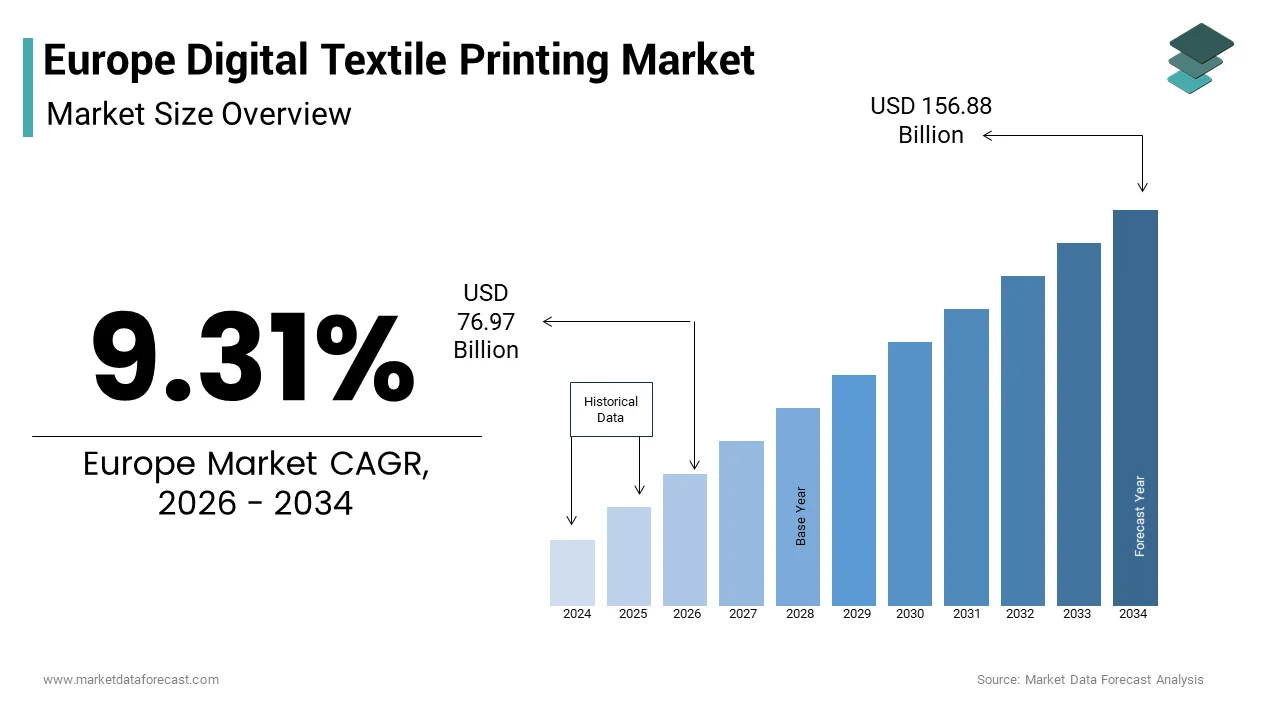
The Europe digital textile printing market was valued at USD 70.41 billion in 2025, is estimated to reach USD 76.97 billion in 2026, and is projected to reach USD 156.88 billion by 2034, growing at a CAGR of 9.31% during the forecast period from 2026 to 2034.
The growth of the Europe digital textile printing market is driven by the rapid shift toward sustainable and on-demand textile manufacturing, increasing demand for customized apparel, and the expansion of fast fashion and luxury fashion segments. Advancements in inkjet printing technologies, reduced water and chemical usage compared to conventional printing, and shorter production cycles are further accelerating market growth across Europe.
Key Market Trends
- Rising adoption of sustainable and eco-friendly printing technologies to comply with strict European environmental regulations.
- Growing demand for mass customization and short-run production, particularly in fashion and home textiles.
- Increasing use of digital textile printing in fast fashion eenablesrapid design changes and faster time-to-market.
- Technological advancements in ink formulations, print heads, and color management systems are improving print quality and durability.
- Expansion of localized textile production to reduce supply chain risks and carbon footprints.
Segmental Insights
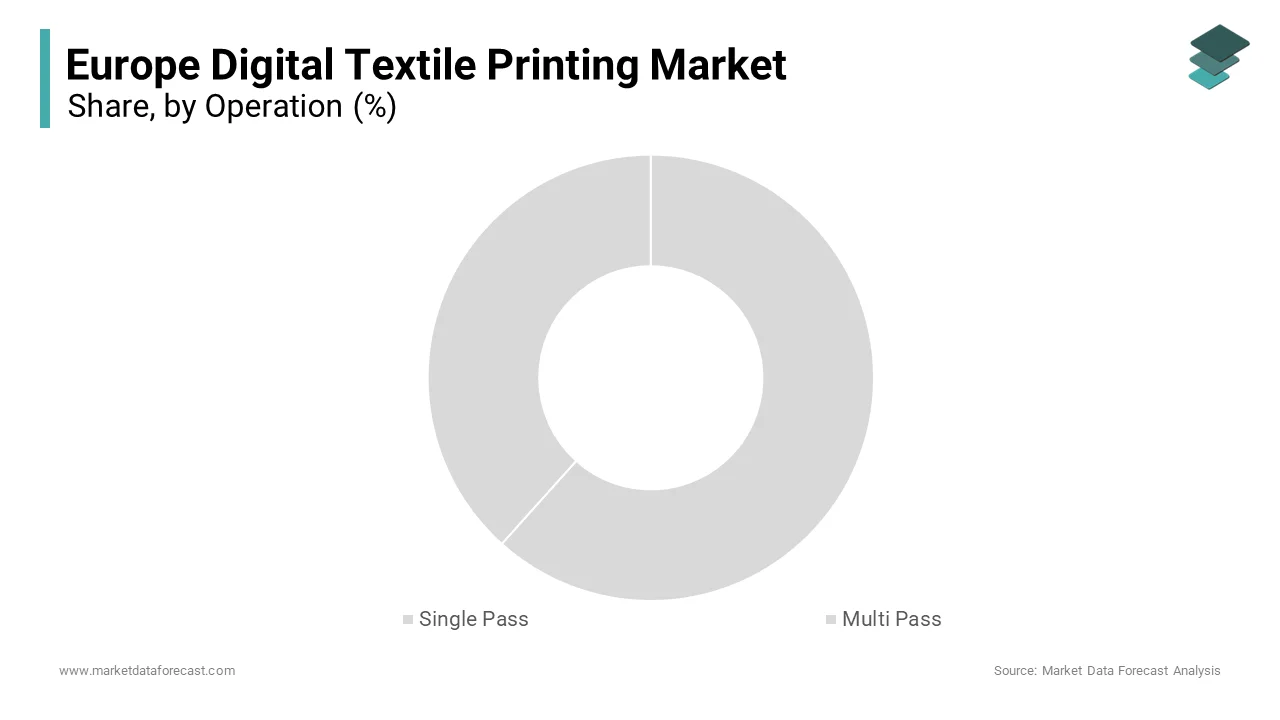
- Based on operation, the multi-pass printing segment held the majority share of the Europe digital textile printing market in 2025. Its dominance is attributed to superior print quality, high color accuracy, and suitability for premium textiles and fashion applications.
- By application, the clothing and apparel segment led the Europe digital textile printing market by accounting for 62.6% share in 2025. The segment’s growth is driven by increasing consumer preference for personalized designs, rapid fashion cycles, and rising demand for digitally printed garments in both luxury and mass-market fashion.
Regional Insights
- The Europe digital textile printing market is witnessing strong growth across key textile and fashion hubs.
Italy dominated the market by capturing 19.4% share in 2025, supported by its strong luxury fashion ecosystem, advanced textile clusters, and high adoption of innovative printing technologies. - Germany held the second-largest share at 16.8%, driven by technological leadership, automation, and industrial textile applications.
- Spain is emerging as a lucrative market due to its role as Europe’s fast fashion production hub.
France continues to grow steadily, supported by its blend of haute couture heritage and progressive sustainability policies. - The United Kingdom is expected to expand further during the forecast period, driven by digital fashion startups and demand for customized apparel.
Competitive Landscape
The Europe digital textile printing market is moderately fragmented, with global and regional players focusing on technological innovation, high-speed printing solutions, and sustainable ink technologies. Companies are investing in R&D, strategic partnerships, and expansion of localized production capabilities to strengthen their market presence.
Prominent players in the Europe digital textile printing market include Mimaki, Kornit, SPGPrints, Konica Minolta, Atexco, Dover Corporation, MS Printing, Robustelli, Kaiyuan, and SPG Prints B.V.
Europe Digital Textile Printing Market Size
The Europe digital textile printing market size was valued at USD 70.41 billion in 2025 and is anticipated to reach a valuation USD 76.97 billion in 2026 and USD 156.88 billion by 2034, growing at a CAGR of 9.31% during the forecast period from 2026 to 2034.
Current Introduction of the Europe Digital Textile Printing Market
Digital textile printing refers to the direct application of digital inkjet technology onto fabric substrates, which enableshigh-resolutionn pattern reproduction, rapid prototyping, and on-demand production without the need for screens or extensive setup. In Europe, this technology has evolved from a niche prototyping tool into a transformative force across fashion, home décor, and technical textiles, driven by sustainability mandates and shifting consumer expectations. The textile sector significantly contributes to overall carbon emissions and uses a substantial amount of water in the production of cotton fabric. Current production practices highlight a need for more sustainable alternatives in the textile industry. Digital printing methods use significantly less water and energy than conventional printing methods, and digital manufacturing is encouraged to help reduce overproduction and the use of harmful chemicals in the textile production process. The technology also aligns with the rising demand for product personalization. As per sources, a portion of European consumers aged 18 to 35 prefer customizable apparel, a trend amplified by e-commerce and social media. These converging environmental, regulatory, and behavioral currents position digital textile printing not merely as a printing method but as a strategic enabler of Europe’s textile industry transformation.
MARKET DRIVERS
Regulatory Push for Sustainable Textile Production Accelerates Technology Adoption
The European Union’s stringent environmental regulations have become a major driver for the Europe digital textile printing market growth. A strategy encourages major reductions in resource consumption and waste associated with textile production. Traditional textile printing methods tend to require a substantial amount of water, while digital printing technologies seem to offer significant reductions in water usage for fabric production. A pattern of moving towards low-impact production methods in textile dyeing and printing is apparent, and regulatory changes are encouraging the adoption of less resource-intensive production techniques. Countries like the Netherlands and Germany have introduced national textile circularity roadmaps that provide grants for digital printer acquisition. These policy instruments create both compliance pressure and financial incentive, compelling even mid-sized manufacturers to transition. Consequently, digital printing is no longer a luxury but a regulatory necessity for European textile producers aiming to remain operational under the EU’s green industrial framework.
Consumer Demand for Customization and Short-Run Fashion Drives On-Demand Printing
European consumers are increasingly rejecting mass-produced fashion in favor of limited edition and personalized garments, which contributes to the expansion of the Europe digital textile printing market. This shift is uniquely accommodated by digital textile printing. According to a study, consumers in the European Union show an increasing preference for unique fashion choices, driving demand for personalized clothing with custom designs or local cultural motifs. This behavioral trend coincides with the rise of micro brands anddirect-to-consumer e-commercee platforms, which rely on agile production models. Digital printing technology enables economically efficient small-scale production with minimal setup, providing a competitive alternative to traditional methods like rotary printing, which is more suited to large, high-volume batches. Fashion hubs in Italy and Portugal are seeing increased agility, with small studios using digital printing to rapidly create social-media-fueled micro-collections, fulfilling immediate consumer demand for trendy, small-batch items within days of being ordered. Moreover, Independent designers, particularly within major fashion hubs like Paris and Milan, are increasingly leveraging digital printing techniques due to the technology's inherent design flexibility and rapid production turnaround times. This fusion of digital commerce,e cultural expression,n and production agility has transformed digital textile printing from a backend process into a frontline driver of brand differentiation and consumer engagement across Europe.
MARKET RESTRAINTS
High Initial Investment and Operational Complexity Limit SME Accessibility
Digital textile printing remains financially and technically out of reach for many small and medium-sized enterprises in the region, despite its environmental and design advantages. This restricts the growth of the Europe digital textile printing market. The cost of industrial digital printers for textiles varies widely, with higher-end, feature-rich models being significantly more expensive than entry-level machines, a common trend in specialized industrial equipment markets. This capital barrier is especially acute in Southern and Eastern Europe, where textile SMEs operate on narrow margins. Micro, small, and medium-sized enterprises (SMEs) constitute the vast majority of firms in the European textile, clothing, leather, and footwear sectors, defining the industry's structure. Beyond acquisition cost, s operational complexity presents another hurdle. Digital printing demands precise control over fabric tension,sion ink viscosity, anpost-processingng parameters, skills not traditionally held by screen printing technicians. Across the European textile and clothing industry, there are recognized and increasing skills gaps, particularly in areas related to digitalization, automation, and sustainable practices, which is a key focus for EU initiatives. Furthermore, ongoing expenses for specialized inks and maintenance contracts further strain budgets. Many small and medium-sized enterprises (SMEs) struggle to justify the transition to sustainable practices, despite being aware of the long-term benefits, because they lack targeted public financing or access to shared manufacturing hubs. This technological divide risks consolidating production among large players and undermining Europe’s diverse artisanal textile heritage.
Fragmented Ink Standardization and Substrate Compatibility Issues Impede Scalability
The lack of standardized ink formulations and inconsistent performance across diverse fabric types further hinders the expansion of the Europe digital textile printing market. Unlike conventional dye systems, which are well characterized for specific fibers, digital inks, particularly pigment and reactive variants, exhibit variable bonding efficiency depending on fabric composition,, weav,,e and ppre-treatment According to research, Variability in digital textile printing quality, particularly concerning color consistency and wash fastness, remains a significant challenge within European manufacturing due to complex interactions between different ink formulations and textile substrates. The absence of universal ink certification further complicates supply chains. Achieving consistent and optimal digital printing results across different production facilities, even when using seemingly identical fabrics, often requires individual process adjustments and specific ink formulations adapted to local conditions or equipment. The absence of fully harmonized, finalized European-wide test methods and standards for digital ink performance presents a notable challenge for achieving seamless cross-border consistency and collaboration within the textile industry supply chain. Furthermore, many European mills still rely on legacy looms, producing fabrics with surface irregularities that disrupt inkjet droplet placement. The promise of seamless digital integration across Europe's diverse textile ecosystem will remain partially unrealized until ink manufacturers, textile producers, and machine vendors align on material specifications and performance benchmarks.
MARKET OPPORTUNITIES
Integration with Circular Fashion Models Enables Closed-Loop Production
The region's circular fashion economy is increasingly reliant on digital printing on fabric, as its on-demand capabilities significantly cut down on excess inventory and waste, which provides new opportunities for the growth of the Europe digital textile printing market. The European Environment Agency estimates that nearly 7 million tonnes of unsold or unused textiles are discarded annually in the EU, equivalent to each citizen throwing away 16 kilograms of clothing. Digital printing directly counters this by allowing brands to produce only what is ordered, eliminating the need for speculative bulk runs. Companies have adopted fully digital on-demand models, achieving near-zero deadstock while offering custom sizing and seasonal designs. As per research, the fashion industry is increasingly adopting sustainable materials, such as certified recycled polyester and organic cotton, as part of a general shift towards circular practices and reduced environmental impact. Moreover, European regulations, such as the upcoming Digital Product Passport and ecodesign requirements, are driving the industry to adopt design strategies like mono-material construction, which streamline end-of-life recycling processes and enhance material traceability. The technology also supports garment recustomization,o,n where returned or second-hand items are overprinted with new designs, extending product life. These capabilities position digital textile printing not just as a production tool but as an operational backbone for Europe’s transition to circular and regenerative fashion systems.
Expansion into Technical and Performance Textiles Opens New Industrial Applications
Beyond fashion and home décor, digital textile printing is seeing increased adoption in high-value technical textiles across the region, which is expected to fuel the expansion of the Europe digital textile printing market. Key areas include automotive interiors, medical fabrics, and smart wearables. The precision annular-contact nature of inkjet deposition allows functional inks, such as antimicrobial silver nanoparticles or conductive polymers, to be applied without compromising substrate integrity. The European market for specialized fabrics is seeing growth, with modern printing methods considered important for creating unique products. Vehicle makers are incorporating printed interior materials that have protective features applied during the process, which streamlines manufacturing steps. In healthcare, companies are utilizing precise printing techniques to add helpful substances to medical dressings, which may assist recovery. Research efforts have explored the potential use of printed temperature-controlling materials for specific high-performance clothing, like astronaut suits. These advanced applications demand minimal batch sizes, high reproducibility,y and regulatory traceability, areas where digital printing excels. Europe's focus on high-tech production and its expansion into performance-driven industries offers a durable growth avenue, better protected from the inherent volatility of fast fashion.
MARKET CHALLENGES
Energy Intensity oPost-Processingng Undermines Environmental Credentials
The environmental gains of digital printing are diminished by the substantial energy needed for secondary steps like drying and curing, despite the process itself being less resource-intensive than traditional methods, which thereby limits the growth of the Europe digital textile printing market. Digital inks, especially those that are reactive and disperse, generally need heat processing at 160 to 200 degrees Celsius for several minutes to properly bond with fibers. This heat requirement means that a substantial amount of the total energy used in some industrial digital printing lines is consumed during this post-processing phase. In locations where the majority of grid electricity is generated from coal, this high energy consumption may diminish the environmental benefits of the technology. Emerging technologies, such as cold pad batch reactive printing and UV curable inks, offer more energy-efficient options, but their use is currently restricted by limitations in substrate compatibility and color gamut. The environmental benefits often associated with digital printing may be undermined by the significant energy consumption of its necessary post-production processes until low-temperature curing becomes the industry standard.
Skilled Labor Shortage Hinders Technological Optimization and Innovation
A shortage of multidisciplinary professionals who combine expertise in textile chemistry, digital color management, ent and industrial automation also obstructs the expansion of the Europe digital textile printing market. Unlike analog printing, which relies on mechanical repetition, digital workflows demareal-timeime adjustments to color profiles, ink chemistry, and fabric feed systems, skills rarely covered in traditional textile education. A limited number of technical colleges within the region currently incorporate specialized courses related to modern textile printing technologies into their curricula. This gap is most acute in manufacturing heartlands like Italy’s Como region and Portugal’s Porto district,t where aging workforces struggle to adapt tsoftware-drivenen interfaces. A majority of printing facilities experienced production interruptions, which were linked to inadequate preparation of personnel for operating contemporary digital systems. Moreover, the absence of standardized certification programs leads to inconsistent output quality across suppliers, deterring brand adoption. Suboptimal technology deployment, constrained by a lack of coordinated EU investment in reskilling through initiatives like the Pact for Skills, will restrict productivity gains and hinder innovation in emerging applications like 3D texture mapping and responsive color-changing fabrics.
REPORT COVERAGE
| REPORT METRIC | DETAILS |
| Market Size Available | 2025 to 2034 |
| Base Year | 2025 |
| Forecast Period | 2026 to 2034 |
| CAGR | 9.31% |
| Segments Covered | By Operation, Application, and Country |
| Various Analyses Covered | Regional & Country Level Analysis, Segment-Level Analysis, DROC, PESTLE Analysis, Porter’s Five Forces Analysis, Competitive Landscape, Analyst Overview on Investment Opportunities |
| Countries Covered | UK, France, Spain, Germany, Italy, Russia, Sweden, Denmark, Switzerland, Netherlands, Turkey, Czech Republic, and the Rest of Europe |
| Market Leaders Profiled | Mimaki (Nagano, Japan), Kornit (Rosh Haayin, Israel), SPGPrints (Boxmeer, Netherlands), Konica Minolta (Tokyo, Japan), Atexco (Paris, France), Dover Corporation (MS Printing Solutions Srl) (Illinois, U.S.), MS Printing (Pertusella, VA, Italy), Robustelli (Connecticut, U.S.), Kaiyuan (Gaoxin District,t Xi'an, China), SPG Prints B.V. (Boxmeer, Netherlands) |
SEGMENTAL ANALYSIS
By Operation Insights
The multi-pass printing segment held the majority share of the Europe digital textile printing market in 2024. The dominance of the multi-pass printing segment is attributed to its adaptability to diverse fabric types, superior color accuracy, and cost effectiveness for short to medium production runs, key requirements in Europe’s fragmented and design-driven textile sector. Unlike single-pass systems that require fixed printhead arrays and high upfront investment, multi-pass printers allow variable print speeds and real-time quality adjustments by making multiple passes over the fabric, enabling fine control over ink deposition. This flexibility is essential for European fashion houses and home décor brands that frequently switch between cotton, silk, polyester, and blended substrates. Micro and small textile enterprises within the EU often favor multi-pass printing systems due to their lower initial investment and scalable production capabilities, in contrast to the substantial capital required for high-volume industrial single-pass lines. Furthermore, multi-pass technology aligns with Europe’s emphasis on customization. Recent industry analysis and technological advancements indicate a growing focus on achieving high levels of color fidelity and consistency in multi-pass digital printing, which is a crucial performance metric for textile manufacturers, particularly those producing specialized or limited-edition collections. These operational and economic advantages solidify multi-pass as the backbone of Europe’s digital textile ecosystem.
The single-pass digital printing segment is predicted to witness the highest CAGR of 18.7% from 2025 to 2033 due to the urgent need for high-throughput, sustainable production in response to fast fashion’s environmental backlash and regulatory pressure. Single-pass systems operate by printing across the entire width of the material in one fluid movement. This approach generally results in faster operational speeds when contrasted with methods that require multiple passes. The increased efficiency is a significant factor for retailers aiming to produce more collections using digital, on-demand methods to meet various strategic commitments. A notable increase has been observed in the adoption of single-pass equipment within manufacturing sectors, which is primarily intended to help meet shorter delivery deadlines specified by retailers. Additionally, evolving procurement standards and criteria tend to favor suppliers who utilize high-speed, low-waste technologies, which may accelerate their adoption within institutional contexts. The sustainability of next-generation single-pass platforms is enhanced by the incorporation of energy recovery systems and waterless pigment inks, establishing them as a key element in Europe's move towards industrial-scale digital transformation.
By Application Insights
The clothing and apparel segment led the Europe digital textile printing market by accounting for a 62.6% share in 2024. The leading position of the clothing and apparel segment is credited to Europe’s globally influential fashion industry, which spans luxury houses in Paris and Milan to agile micro brands in Berlin and Barcelona. Digital printing enables rapid design iteration, small batch production, and intricate motif reproduction, capabilities that align perfectly with the continent’s shift toward seasonal micro collections aninfluencer-drivenen trend cycles. Large quantities of clothing are being purchased by European consumers. A significant portion of younger consumers shows a preference for specialized or rare garment designs. Digital printing technology is utilized to meet the demand for unique apparel designs cost-effectively. Major luxury fashion groups are incorporating digital printing into their clothing lines. The shift toward digital production methods aims to minimize excess inventory and maintain product exclusivity. Regional environmental policies support the adoption of digital manufacturing to decrease textile waste. Digital production serves as a method to reduce the volume of fabric discarded during the manufacturing process. These converging creative, commercial, and regulatory forces ensure clothing and apparel remainthe dominant application for digital textile printing across Europe.
The soft signage segment is estimated to register the fastest CAGR of 21.3% during the forecast period, owing to the replacement of rigid PVC banners with flame-retardant, digitally printed polyester fabrics in retail events, exhibitions, ns and corporate environments, driven by sustainability regulations and aesthetic versatility. The European Union's REACH regulation has led to limitations on vinyl materials containing phthalates, encouraging companies to use textile alternatives that are recyclable. Consequently, a majority of trade shows in Germany, France, and the Netherlands now require fabric signage as part of their environmental certification programs. Digital printing enables full color photographic quality on lightweight textiles that are reusable, washable, and recyclable at the end of life. Moreover, textile graphics reduce transport emissions due to their foldability. These environmental and logistical advantages position soft signage as the highest growth frontier in Europe’s digital textile landscape.
COUNTRY ANALYSIS
Italy Digital Textile Printing Market Analysis
Italy dominated the Europe digital textile printing market and captured a 19.4% share in 2024. The supremacy of the Italian market is driven by its historic dominance in luxury fashion and high-end home textiles. The country’s textile districts, particularly in Como for silk and Prato for wool, have seamlessly integrated digital printing into artisanal workflows without compromising design heritage. There has been a significant adoption of digital printing equipment within Italian mills. A majority of this newly installed capacity is dedicated to small-scale, high-quality manufacturing. Government initiatives are actively supporting the modernization of the textile sector, focusing on the integration of automated and environmentally friendly processes. Luxury brands within Italy are increasingly incorporating digital printing methods into their operations, which facilitates a quicker turnaround from design to market. Italy maintains a leading position in the international market regarding the trade of digitally printed materials within the European context. The fusion of craftsmanship,p technological adoption, and global brand equity ensures Italy remains the creative and commercial epicenter of Europe’s digital textile transformation.
Germany Digital Textile Printing Market Analysis
Germany was the second-largest country in the Europe digital textile printing market and held a 16.8% share in 2024. The expansion of the German market is propelled by its engineering excellence and stringent environmental compliance culture. German manufacturers prioritize high-reliability industrial printers that integrate seamlessly with automated material handling and energy recovery systems. Germany is a significant exporter of digital printing systems from Europe. Its technological position is demonstrated by its emphasis on advanced printing methods. Initiatives have been put in place to help textile plants that use sustainable production processes. Within German digital production plants, waterless pigment printing has become commonplace. Financial incentives are offered to promote the use of environmentally friendly printing technologies. Major brands collaborate with local printers to achieve traceablelow-impactact production aligned with Germany’s Circular Economy Act. Furthermore, Germany hosts Europe’s largest technical textile cluster in Baden-Württemberg, where digital printing enables functional finishes for automotive and medical applications. This combination of industrial rigour,r regulatory foresight,t and cross-sector innovation cements Germany’s role as Europe’s technological backbone in digital textile printing.
Spain Digital Textile Printing Market Analysis
Spain is a lucrative country in the Europe digital textile printing market, with its strategic role as Europe’s fast fashion production hub. Centered in Galicia and Catalonia, Spanish mills serve global giants like Inditex and Mango withultra-responsivee digital printing capabilities that support weekly design drops. Spain's digital printing capacity predominantly focuses on polyester apparel production. The country's industry has been modernizing with significant funding allocated to help small and medium enterprises adopt digital technologies. The shift toward on-demand digital production methods has been associated with a reduction in pre-consumer fabric waste. Spain is also noted for leading the adoption of high-speed single-pass printing lines. The country’s agility, speed, ed and integration with global retail supply chains make it a pivotal operational engine in Europe’s digital textile ecosystem.
France Digital Textile Printing Market Analysis
France grew steadily in the Europe digital textile printing market because of its fusion of haute couture tradition and progressive environmental policy. Parisian fashion houses, including Chanel and Dior, have pioneered digital printing for intricate embroidery simulations and limited edition scarves preserving artisanal aesthetics while reducing dye waste. A notable change has been observed in the approach to fabric printing for high-end textiles. The use of digital platforms for printing luxury fabrics has become a dominant method in one region. This shift in printing methods is occurring concurrently with new regulations that encourage more sustainable practices. These regulations aim to promote textile production that can be more easily recycled or reused in the future. The move toward digital printing, which often facilitates the use of single materials, is contributing to the achievement of these sustainability goals. France also hosts Europe’s first public digital textile prototyping center in Lyon,n funded by tAuvergne-Rhône-Alpespes region, offering SMEs access to industrial printers without capital outlay. This blend of cultural influence, regulatory ambition, and shared infrastructure solidifies France’s distinctive position in the market.
The United Kingdom Digital Textile Printing Market Analysis
The United Kingdom is likely to expand in the Europe digital textile printing market from 2025 to 203,3 owing to specialized innovation in sustainable inks and technical textiles. Despite its departure from the European Union, the UK maintains a strong influence through research institutions like the University of Leeds, which developed the world’s first enzymatic pretreatment for digital cotton printing. British designers are prominent in the adoption of eco-friendly inks, such as those derived from algae or biodegradable materials, a practice that appears widespread among digital printing operations. The UK government has allocated funding to support the reduction of carbon emissions within various industries, including the textile sector. This initiative specifically supports the implementation of new technologies like low-temperature curing systems for digital printing lines. Furthermore, a sustainability initiative encourages retailers to increase their procurement of printed fabrics from digital on-demand suppliers within a specified timeframe. These initiatives position the UK as a high-value innovator focused on material science and circularity rather than volume production within the European landscape.
COMPETITIVE LANDSCAPE
Competition in the Europe digital textile printing market is characterized by a dynamic interplay between European engineering excellence and global technological innovation. The landscape features a mix of specialized European machinery builders and multinational inkjet technology providers, each vying for differentiation through sustainability, performance, speed, and substrate versatility. Unlike price-driven markets, competition here centers onthe total cost of ownership, environmental compliance, and integration with circular fashion models. Companies compete by offering certified eco i, closed-loop water systems, and energy-efficient drying units that meet EU regulatory thresholds. Regional clusters in Italy, Germany,y and Spain foster close collaboration between machine makers, printers and brands, ds accelerating prototyping and adoption. Meanwhile, the emerging players from Asia are entering through partnerships with local service bureaus but face challenges in meeting Europe’s high standards for color accuracy and chemical safety. Innovation in AI-based quality control, digitization,s and recyclable fabric compatibility is becoming the new frontier of competitive advantage. As the EU enforces stricter textile sustainability law,s the market increasingly rewards vendors who combine industrial reliability with verifiable environmental credentials,a alsocreating a high barrier to entry for undifferentiated suppliers.
KEY MARKET PLAYERS
A few of the dominating market players that are in the Europe digital textile prprinting market are
- Mimaki (Nagano, Japan)
- Kornit (Rosh Haayin, Israel)
- Durst Group
- SPGPrints (Boxmeer, Netherlands)
- Konica Minolta (Tokyo, Japan)
- Atexco (Paris, France)
- Dover Corporation (MS Printing Solutions Srl) (Illinois, U.S.)
- MS Printing (Pertuse,lla VA, Italy)
- Robustelli (Connecticut, U.S.)
- Kaiyuan (Gaoxin Dist,rict Xi'an, China)
- SPG Prints B.V. (Boxmeer, Netherlands)
Top Players In The Market
- Kornit Digital is a leading innovator in the Europe digital textile prprinting market offering industrial-grade single-pass and multi-pass systems tailored for fashion and home décor applications. The company is globally recognized for its proprietary NeoPigment ink technology, which eliminates pre and post treatment step,s enabling true waterless printing. In recent yearsrs RSKornit has expanded its European footprint through strategic partnerships with contract printers in Germany, Spain, and Italy to support on-demand fashion production. The company also established a sustainability certification program for its customers, aligned with EU environmental standards,s reinforcing its commitment to green manufacturing across the region.
- MS Printing Solutions is an influential European manufacturer specializing in high productivity multi-pass and single-pass digital textile printers. Headquartered in Italy,,tetheompany integrates advanced printhead control and fabric feeding mechanisms to ensure precision on delicate natural fibers like silk and wool. MS has strengthened its market position byco-developing low-temperaturee curing systems with Italian textile research centers to reduce energy consumption. The company also participates in the EU-funded DigiTextile project aimed at standardizing digital workflow protocols across SouthernEurope , thereby reinforcing its role as a regional technology enabler.
- Durst Group is a German-based technology leader known for its robust single-pass digital printing systems used in both apparel and technical textiles. The company contributes significantly to global sustainability efforts through its waterless pigment printing solutions that comply with REACH and OEKOTEXstandards. Durst has deepened its European presence by collaborating with automotive and home furnishing brands to develop digitally printed interior fabrics with functional coatings. Additionally, Durst established a digital printing academy in Liez, Austria, offering training on color management and substrate handling to address the skilled labor gap across Central Europe.
Top Strategies Used by the Key Market Participants
Key players in the Europe digital textile printing market focus on developing waterless anlow-energygy printing technologies to align with stringent EU environmental regulations. They invest in high-speed single-pass systems to meet fast fashion demand while maintaining design flexibility through advanced color management software. Companies form strategic partnerships with textile research institutes to co-innovate sustainable ink and substrate combinations. They also establish regional training centers to bridge the skilled labor gap and ensure optimal machine utilization. Additionally, firms pursue vertical integration by offering end-to-end solution ,including pre treatment post curing and workflow auautomationo enhance customer retention and operational efficiency across diverse European markets.
MARKET SEGMENTATION
This research report on the Europe digital textile printing market is segmented and sub-segmented into the following categories.
By Operation
- Single Pass
- Multi Pass
By Application
- Clothing and Apparel
- Home Decor
- Soft Signage
- Others
By Country
- UK
- France
- Spain
- Germany
- Italy
- Russia
- Sweden
- Denmark
- Switzerland
- Netherlands
- Turkey
- Czech Republic
- Rest of Europe
Frequently Asked Questions
What is the Europe digital textile printing market?
It refers to the market for printing designs directly onto fabrics using digital printing technologies such as inkjet and UV digital printing, replacing traditional screen printing methods in apparel, home textiles, and industrial fabrics.
What drives growth in the Europe digital textile printing market?
Growth is driven by rising demand for customization and personalization in fashion and interior décor, faster production turnaround, reduction in waste, and growing sustainability concerns.
Which industries use digital textile printing?
Key industries include apparel & fashion, home textiles (curtains, upholstery), sportswear, technical textiles, and decorative fabrics.
How does digital textile printing differ from traditional printing?
Digital printing enables high-resolution, complex designs, shorter production runs, lower water usage, faster sample production, and reduced inventory compared to traditional screen and rotary printing.
What are the benefits of digital textile printing?
Benefits include eco-friendly operations, cost-effective short runs, rapid prototyping, on-demand customization, minimal setup time, and reduced energy and water consumption.
What technologies are prominent in digital textile printing?
Popular technologies include inkjet printing, reactive/acid/disperse dye inks, UV & pigment inks, and specialized pretreatment and finishing systems optimized for fabric types.
Which European countries lead the digital textile printing market?
Countries such as Italy, Germany, the United Kingdom, and Spain are major contributors due to strong textile industries, fashion hubs, and advanced manufacturing infrastructure.
What are key challenges in the market?
Challenges include high initial equipment costs, skilled workforce shortages, ink and consumable compatibility issues, and competition from low-cost traditional printing regions.
How does sustainability impact digital textile printing?
Sustainability trends favor digital printing due to reduced water usage, less chemical waste, and the ability to produce on-demand printed textiles, minimizing overproduction.
What is the future outlook of the Europe digital textile printing market?
The market is expected to grow with rising customization demands, integration of Industry 4.0 technologies, and expansion of digital printing adoption across fashion and home textile segments.
Related Reports
Access the study in MULTIPLE FORMATS
Purchase options starting from
$ 2000
Didn’t find what you’re looking for?
TALK TO OUR ANALYST TEAM
Need something within your budget?
NO WORRIES! WE GOT YOU COVERED!
Call us on: +1 888 702 9696 (U.S Toll Free)
Write to us: sales@marketdataforecast.com