- Product Description Description
- Table of Contents TOC
- List of Table & Figure LOT
- Get Free Sample PDF Sample PDF
Market Size, 2025
$76.24 BnMarket Estimate, 2026
$80.77 BnMarket Forecast, 2034
$128.15 BnCAGR, 2026–2034
5.94%Executive Summary: Europe Direct Selling Market
- Market Scope: Comprehensive European direct selling market analysis covering product categories, national market leadership shares, labor force benchmarks, digital retail penetration, and social commerce drivers.
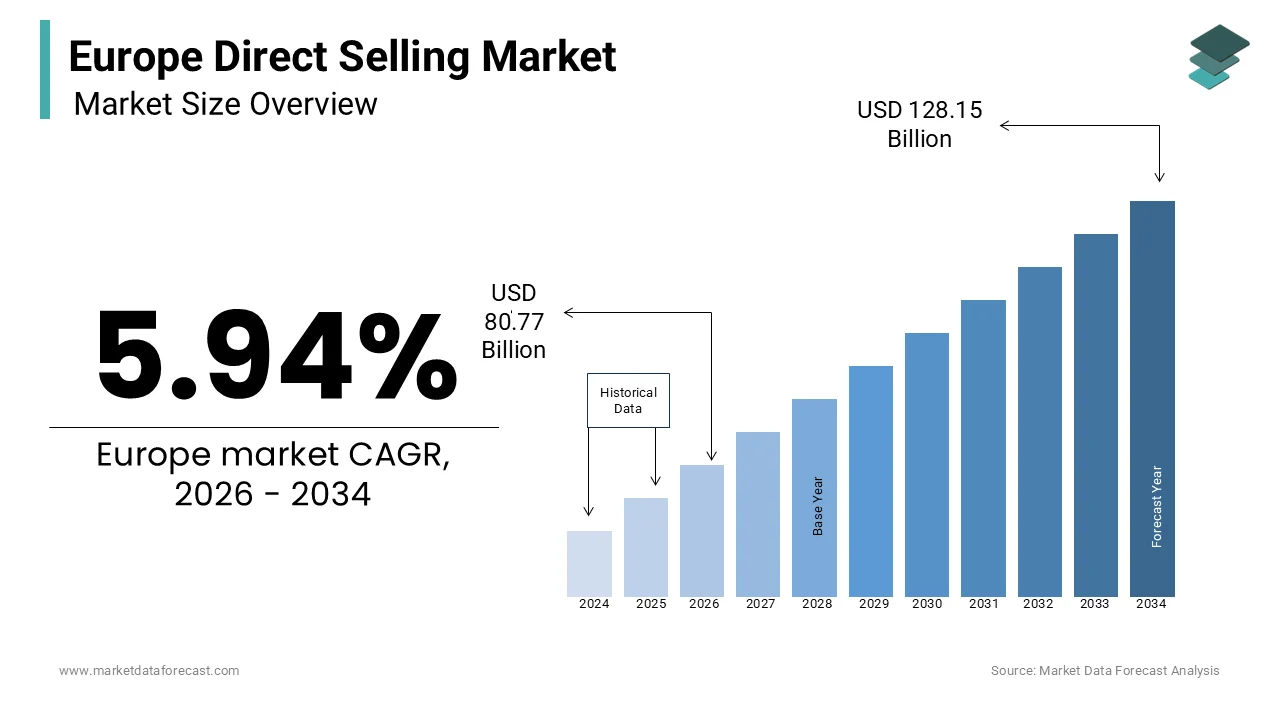
- Market Valuation: Valued at USD 76.24 billion (2025), rising to USD 80.77 billion (2026), and projected to reach USD 128.15 billion by 2034, registering a CAGR of 5.94% (2026–2034).
- Primary Growth Drivers: Acceleration of social commerce, digital transformation, and hybrid online-offline selling models. Key structural and labor benchmarks include over 5.2 million individuals registered as direct sellers across the European Union in 2023, ~18% of self-employed individuals in Southern Europe identifying direct selling as their primary income source, and the UK's internet penetration standing at ~97.8% in 2025.
Key Market Segment Metrics (2026–2034)
| Category | Leading Segment (2025 Position) | Fastest-Growing Segment |
|---|---|---|
| By Product Category | Cosmetics & personal care (led with a 49.5% market share in 2025; e.g., representing 61% of sales volume in Italy) | Health & wellness (projected to register the fastest CAGR of 9.02%) |
| By Sales & Distribution Model | Person-to-person direct selling and independent representative networks | Hybrid social commerce, live commerce, and multi-platform digital channels |
| By End User / Consumer Base | Direct-to-consumer retail buyers and household purchasers | Digital-first millennial and Gen-Z consumer demographics |
| By Country / Region | Germany (dominated with a 20.8% share in 2025, supported by ~908,000 active representatives, followed by France, Italy with over 250,000 sellers, and Spain with >262,000 professionals) | High digital-adoption European markets expanding social selling frameworks |
Major Market Players & Market Structure
Market Structure: Highly competitive European direct selling and multilevel marketing marketplace featuring global cosmetics, wellness, and household goods corporations competing intensely on digital transformation, advanced representative training programs, regulatory compliance, corporate sustainability, social commerce adoption, AI-driven product recommendations, and personalized customer engagement strategies.
Key Companies: Amway Enterprises Pvt. Ltd., Avon Products Inc., Herbalife Nutrition Ltd., Natura & Co., Thermomix (Vorwerk), Nu Skin Enterprises, Tupperware Brands Corporation, Oriflame Cosmetics AG, Belcorp Corporation, Mary Kay Inc., and Cutco Corporation.
Europe Direct Selling Market Size
The Europe direct selling market size was valued at USD 76.24 billion in 2025 and is anticipated to reach a valuation of USD 80.77 billion in 2026 and USD 128.15 billion by 2034, growing at a CAGR of 5.94% from 2026 to 2034.
Direct selling refers to the distribution of consumer goods and services through person-to-person interactions outside fixed retail premises and is typically facilitated by independent representatives who engage customers via home demonstrations, online platforms, or social networks. This channel emphasizes relationship-based commerce, product education, and experiential marketing that are commonly spanning categories such as beauty and personal care, wellness supplements, home care, and premium lifestyle products. Unlike e-commerce or traditional retail, direct selling in Europe operates within a tightly regulated consumer protection framework that mandates transparency in income claims, product labeling, and contractual terms. More than 5.2 million individuals were registered as direct sellers across the European Union in 2023, with significant concentrations in Germany, France, and Italy. The model thrives on social trust and localized engagement, particularly in regions where digital commerce penetration remains moderate or where consumers value tactile product experiences. Approximately 18% of self-employed individuals in Southern Europe identified direct selling as their primary income source, which reflects its socio-economic relevance beyond mere retail mechanics.
MARKET DRIVERS
Rising Demand for Personalized Wellness and Beauty Solutions
The growing Consumer preference for tailored health and beauty regimens has significantly amplified direct selling activity across Europe, where consultants offer customized product recommendations based on individual skin types, dietary needs, or lifestyle goals, which is one of the key factors driving the European direct selling market growth. According to the reports of the European Consumer Organisation, women aged 25 to 45 in France and Spain preferred receiving beauty advice through in-person consultations rather than algorithm-driven online suggestions in 2025. This trend aligns with the broader shift toward preventive health. Direct selling companies leverage this demand by training representatives in basic wellness coaching, enabling them to position products as part of holistic routines. The interpersonal nature of this channel allows for real-time feedback, product sampling, and trust-building elements difficult to replicate in an impersonal retail environments, and thus reinforces sustained consumer engagement and repeat purchases.
Expansion of Digital Social Selling Platforms
The integration of digital tools into traditional direct selling models has revitalized the sector by enabling representatives to reach broader audiences while maintaining relational authenticity, which is further boosting the regional market expansion. Social media platforms such as Instagram and WhatsApp are now central to consultant outreach. Live commerce, which means real-time video demonstrations followed by instant checkout, has gained traction. These digital extensions reduce geographic barriers and lower entry costs for new sellers, especially among younger demographics. According to the Digital Economy and Society Index, a significant population of Europe aged 16 to 34 regularly discovers products through social influencers. This hybrid offline-online approach enhances scalability without sacrificing the personalized interaction that defines the channel’s core value proposition.
MARKET RESTRAINTS
Stringent Regulatory Scrutiny on Income Representations
European authorities impose rigorous controls on how direct selling companies present earning potential to recruits, which significantly constrains recruitment messaging and growth strategies and hampers the direct selling market growth in Europe. The European Commission’s 2023 guidance on unfair commercial practices explicitly prohibits generalized income claims without disclosed median earnings and attrition rates. In practice, this means companies must provide verified data showing that many sellers earn modest or no income, which is a requirement that dampens enthusiasm among potential recruits. For instance, the Competition and Markets Authority in the UK mandated that direct selling firms publish annual income-disclosure statements, which reveal that a majority of active sellers earned less than a basic threshold. Similar rules exist in Germany under the Act Against Unfair Competition, where misleading earnings promises can trigger significant fines. These regulations are reducing the motivational appeal of joining networks, particularly among younger populations seeking side income. Consequently, companies face a delicate balance between compliance and recruitment vitality that often results in slower network expansion and higher churn among new representatives.
Persistent Stigma and Misclassification as Pyramid Schemes
Despite legal distinctions, direct selling in Europe continues to suffer from public misperception as a pyramid scheme, which is undermining trust and recruitment effectiveness and hindering the market growth in Europe. According to respondents who participated in a survey, a substantial portion of respondents in Southern and Eastern Europe believed many direct-selling companies primarily profit from recruitment rather than product sales. This skepticism is exacerbated by high-profile enforcement actions, such as a ruling in France that fined a wellness network for operating an illegal multi-level structure. Media coverage often conflates legitimate direct selling with fraudulent schemes, which further entrenches negative stereotypes. As a result, potential sellers, particularly professionals and educated wome,n hesitate to associate with the model due to reputational risk. The European Confederation of Direct Selling Associations has invested in public awareness campaigns, but cultural resistance remains strong in countries like Greece and Portugal, where informal commerce is historically viewed with suspicion. This perception gap limits talent inflow and constrains the channel’s ability to modernize its image as a legitimate entrepreneurial pathway.
MARKET OPPORTUNITIES
Growing Appeal of Sustainable and Ethically Sourced Products
Direct selling networks are uniquely positioned to capitalize on Europe’s rising demand for environmentally responsible and transparently sourced goods by emphasizing traceability, refill systems, andcruelty-freee certifications through personal storytelling, which is expected to be a significant opportunity for the regional market growth. Many EU consumers now consider sustainability an important factor in their beauty and home-care purchasing decisions. Direct sellers leverage this by hosting in-home demonstrations that showcase biodegradable packaging, carbon-neutral logistics, or fair-trade ingredient sourcing narratives that resonate more authentically in face-to-face settings than on e-commerce product pages. Companies like Yves Rocher and Forever Living have integrated eco-credentials into their representative training that enable consultants to position products as part of a conscious lifestyle. In some markets, such as Sweden, environmental values are increasingly cited by direct selling customers as a key reason for choosing the channel over supermarkets. As the EU’s Green Claims Directive tightens marketing standards from 2026 onward, direct sellers who embed verifiable sustainability into their product education will gain a competitive edge through trust-based advocacy.
Integration with Local Community and Social Impact Initiatives
Direct selling is increasingly aligning with community-based economic models that emphasize local empowerment, female entrepreneurship, and social inclusion, which is likely to offer growth opportunities for the market participants in the Europe direct selling market. Many direct sellers in the EU are women, particularly those operating in rural or economically disadvantaged regions where formal employment opportunities are limited. Companies are responding by partnering with local NGOs and municipal programs to offer skills training and micro-entrepreneurship support. For example, one major beauty company partnered with the Spanish Red Cross to train women in digital literacy and financial management alongside product sales. Similarly, another leading firm’s collaboration with vocational schools in Romania has integrated direct selling modules into youth employment curricula. These initiatives not only enhance brand reputation but also create resilient local networks that drive long-term customer loyalty. As the European Commission prioritizes inclusive growth through its Social Economy Action Plan, the grassroots of the direct selling structure offers a scalable model for decentralized economic participation that aligns with broader regional development goals.
MARKET CHALLENGES
High Attrition Rates Among Independent Representatives
Despite robust recruitment efforts, the Europe direct selling market contends with persistently high dropout rates among new representatives, which is one of the biggest challenges to the growth of the European market. Many individuals who join direct-selling companies in the EU discontinue within the first six months, as attrition stems from unrealistic income expectations, insufficient training, and the demanding nature of self-managed sales without guaranteed earnings. In some markets, the rate of continuation after one year is even lower, with time constraints and low initial sales cited as primary reasons. The lack of social-security benefits further discourages sustained participation, particularly among older demographics. While companies have introduced gamified onboarding and mentorship programmes, these often fail to address structural issues such as market saturation in urban areas or limited digital proficiency among older recruits. Without systemic improvements in retention support and realistic career-pathing, the model risks becoming a transient side-hustle rather than a viable entrepreneurial avenue, ultimately weakening its commercial foundation.
Fragmented National Regulations Multi-Level Compensation Structures
The absence of a harmonized EU framework for multi-level marketing compensation creates operational complexity and legal uncertainty for pan-European direct selling companies, which further challenges the expansion of the European direct selling market. While countries like Germany and the Netherlands permit multi-tier commission structures under strict product-sales thresholds, others, such as Belgium and Austria, impose near-prohibitive restrictions that effectively ban recruitment-based incentives. According to a 2025 study by the European Parliament Committee on Internal Market and Consumer Protection, divergent national interpretations of the Unfair Commercial Practices Directive lead to inconsistent enforcement across EU member states. For instance, a wellness brand operating in both France and Hungary must configure entirely different compensation plans to comply with local jurisprudence on “primary focus on product sales.” This fragmentation increases compliance costs, delays market entry, and discourages cross-border team building. As the EU moves toward greater digital single-market integration, the lack of regulatory convergence in direct selling remains a critical barrier to scaling operations efficiently across the region, which is ultimately stifling innovation and market fluidity.
REPORT COVERAGE
| REPORT METRIC | DETAILS |
| Market Size Available | 2025 to 2034 |
| Base Year | 2025 |
| Forecast Period | 2026 to 2034 |
| CAGR | 5.94% |
| Segments Covered | By Product, and Country |
| Various Analyses Covered | Regional and Country-Level Analysis, Segment-Level Analysis, DROC, PESTLE Analysis, Porter’s Five Forces Analysis, Competitive Landscape, Analyst Overview of Investment Opportunities |
| Regions Covered | Germany, the UK, France, Spain, Russia, Sweden, Denmark, Italy, Switzerland, the Netherlands, and the Rest of Europe. |
| Market Leaders Profiled | Amway Enterprises Pvt. Ltd., Herbalife Nutrition Ltd., Natura & Co., Thermomix (Vorwerk), Nu Skin Enterprises, Tupperware Brands Corporation, Oriflame Cosmetics AG, Belcorp Corporation, Mary Kay Inc., Cutco Corporation |
SEGMENTAL ANALYSIS
By Product Insights
The cosmetics & personal care segment held the leading share of 49.5% of the European market in 2025, owing to the deeply rooted cultural preferences for beauty rituals, strong brand loyalty, and the experiential nature of product trials that align perfectly with direct selling’s consultative model. Many women aged 30 to 55 in France and Italy regularly engage with beauty consultants for personalized skincare advice. The tactile and sensory aspects of cosmetics, such as texture, fragrance, and immediate skin response, are difficult to convey through e-commerce, and giving in-person demonstrations is distinct advantage. Major brands like Oriflame and Avon have institutionalized this approach by training representatives in skin-typing and regimen design, which is transforming transactions into advisory relationships. Furthermore, the EU’s Cosmetic Products Notification Portal has recorded a large volume of new cosmetic formulations introduced via direct channels, which reflects continuous innovation. This fusion of personalization, trust, and product experience is primarily driving the domination of the cosmetics and personal care segment in the European direct selling market.
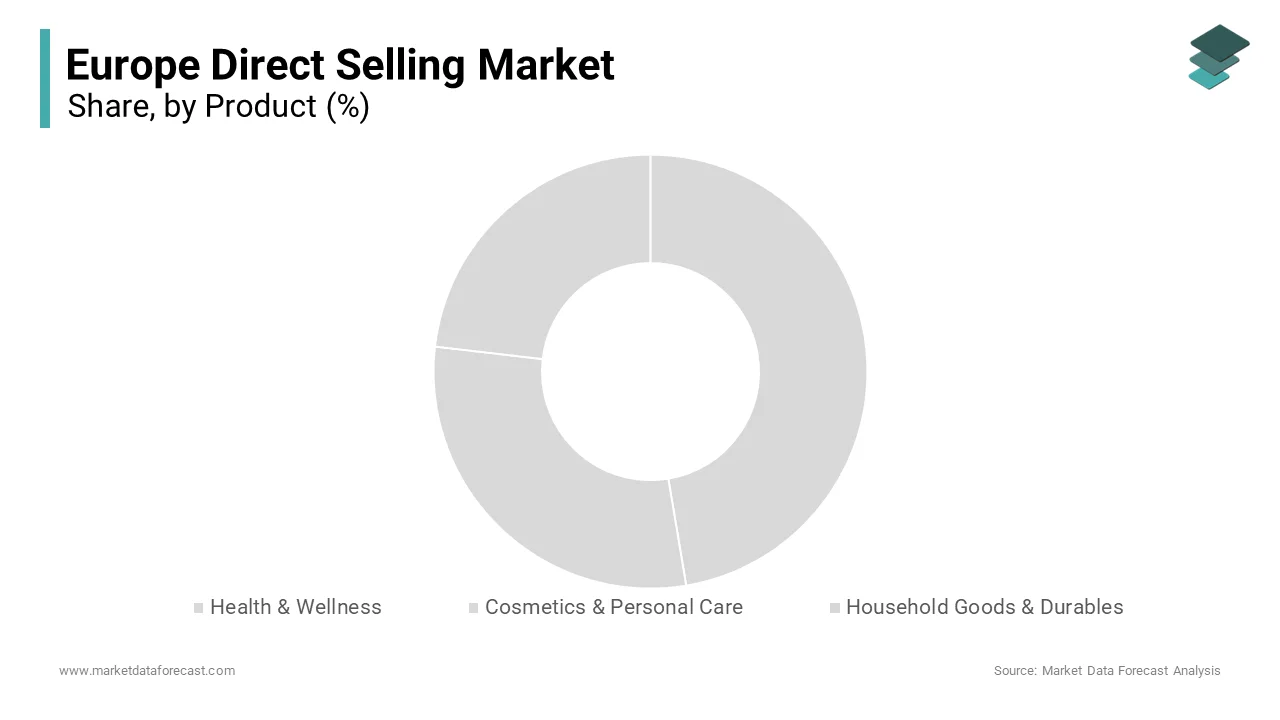
The health and wellness segment is estimated to exhibit ate fastest CAGR of 9.02% over the forecast period, owing to the rising consumer focus on preventive health, aging populations, and regulatory acceptance of evidence-based supplements. According to a 2022 survey by Ipsos European Public Affairs, over half of European consumers reported having taken dietary supplements or vitamins in the past twelve months. Direct selling thrives in this space because consultants provide contextual education by explaining ingredient synergies, dosage timing, and lifestyle integration that generic retail cannot replicate. Companies like Herbalife and Forever Living have adapted by certifying representatives in basic nutrition science and aligning product claims with EFSA-authorised health statements. Additionally, regulatory changes permit clearer communication of the benefits of vitamins D and B12, which are widely sold through direct networks. As chronic disease prevention becomes a public-health priority, the health and wellness segment in the European market is likely to grow at a rapid pace.
COUNTRY ANALYSIS
Germany Direct Selling Market Analysis
Germany stood as the top performer in 2025 in the European direct selling market with 20.8% of the market share. The dominating role of Germany in the European market is primarily attributed to the mature consumer base of Germany that values product quality, scientific validation, and face-to-face consultation, particularly in wellness and premium cosmetics. According to a 2025 industry study by the Bundesverband Direktvertrieb Deutschland e.V. (BDD), approximately 908,000 representatives were active in the German direct-selling sector. Regulatory clarity under the German Act Against Unfair Competition (UWG) provides a stable operating environment, while strong data-privacy laws have encouraged companies to adopt secure digital tools for order management without compromising personal interaction. The aging population of Germany is further fuelling demand for wellness-related sales channels, which is further contributing to the domination of Germany in the European direct selling market, and this trend is likely to continue throughout the forecast period.
France Direct Selling Market Analysis
France is considered another major market for direct selling in Europe and accounted for the second-largest share of the European market in 2025. France’s deep cultural affinity for beauty and personal care creates fertile ground for direct selling, especially in rural and peri-urban areas where access to premium beauty counters is limited is primarily boosting the direct selling market in France. Brands such as Yves Rocher maintain multi-generational loyalty through eco-conscious formulations and in-home consultations. The French government’s Social and Solidarity Economy Law recognized direct selling as a legitimate form of micro-entrepreneurship to enable sellers to access simplified social contribution schemes. Additionally, consumer surveys show that a significant portion of French skincare buyers prefer personal advice over algorithm-driven suggestions. The blend of cultural tradition, policy support, and digital adaptation ensures France remains a core market for relationship-based retail.
Italy Direct Selling Market Analysis
Italy is anticipated to account for a promising share of the European direct selling market over the forecast period. The strong familial and community networks that facilitate word-of-mouth promotion and trust-based transactions are driving the direct selling market in Italy. According to Eurostat’s data for December 2025, Italy’s youth unemployment rate (ages 15–24) stood at approximately 20.3 percent. The sector is particularly vibrant in Southern Italy, where this elevated youth unemployment underscores the appeal of flexible income streams through beauty and wellness networks. Over 250,000 active sellers operate nationwide, with cosmetics accounting for 61% of sales volume. Italian consumers place a high value on product origin and natural ingredients, a preference leveraged by local and international brands through storytelling around Mediterranean botanicals. The Ministry of Economic Development’s 2025 initiative to support female micro-entrepreneurs included direct selling in its funding eligibility criteria, which further legitimizes the model. This socio-economic context, which combines cultural trust, regional disparity, and policy recognition, sustains Italy’s robust direct selling presence.
United Kingdom Direct Selling Market Analysis
The United Kingdom is projected to do well in the European direct selling market during the forecast period. Despite Brexit, the UK maintains a dynamic direct-selling culture driven by digital fluency and demand for flexible work. With the internet penetration rate of the UK standing at around 97.8% of the population at the start of 2025, the digital infrastructure supports consultants’ use of social media and messaging tools. Direct selling benefits from this connectivity, as consultants can easily manage client relationships via platforms such as Instagram and WhatsApp. The wellness segment has surged post-pandemic, with increasing numbers of British adults purchasing supplements through consultant networks. Regulatory oversight by the Competition and Markets Authority ensures income transparency, which has improved public trust. Additionally, the UK’s strong broadband coverage and high household internet access enable seamless hybrid selling. This fusion of digital agility, health consciousness, and regulatory clarity allows the UK to retain strong market relevance despite economic headwinds.
Spain Direct Selling Market Analysis
Spain is predicted to hold a considerable share of the European direct selling market over the forecast period, owing to the high engagement among women in semi-urban and rural communities, where direct selling offers both social connection and supplementary income. Over 262,000 professionals were engaged in the direct-selling sector in Spain, with women comprising a large majority of distributors. The Spanish government’s 2023-2027 Social Economy Strategy formally recognized the social economy to enhance institutional visibility for business models, including direct selling. Consumer behaviour also shows that relationships matter strongly in purchasing decisions in Spain. Economic pressure, including elevated unemployment in early 2025, has further driven interest in low-entry-cost entrepreneurial models. This alignment of social dynamics, policy support, and economic necessities is driving the direct selling market growth in Spain.
COMPETITIVE LANDSCAPE
The Europe direct selling market features competition centered on brand trust, product differentiation, and representative experience rather than price. Global players like Avon and Herbalife coexist with regional specialists such as Oriflame and Yves Rocher, each leveraging cultural affinity and localized product development. The absence of significant new entrants reflects high regulatory and reputational barriers, yet competition remains dynamic through digital innovation and service enhancement. Companies compete to offer the most compelling combination of flexible entrepreneurship, meaningful income potential and purpose-driven products. Regulatory scrutiny on income claims and product safety ensures only compliant and transparent operators thrive. Moreover, the rise of social commerce has blurred lines between direct selling and influencer marketing, intensifying pressure to deliver authentic engagement. Success increasingly depends on integrating digital convenience with the irreplaceable human element of oadvice-baseded selling, fostering a competitive landscape defined by integrity, innovation,n and community.
KEY MARKET PLAYERS
A few of the market players in the Europe direct selling market include
- Amway Enterprises Pvt. Ltd.
- Avon Products Inc
- Herbalife Nutrition Ltd.
- Natura & Co.
- Thermomix (Vorwerk)
- Nu Skin Enterprises
- Tupperware Brands Corporation
- Oriflame Cosmetics AG
- Belcorp Corporation
- Mary Kay Inc.
- Cutco Corporation
Top Players In The Market
- Avon maintains a deeply entrenched presence in the Europe direct selling market through its legacy of empowering women entrepreneurs and offering accessible beauty solutions. The company operates extensive representative networks across the UK, France, Italy, and Eastern Europe, supported by localized product portfolios that reflect regional skincare and fragrance preferences. In recent years, Avon has modernized its model by integrating digital tools such as virtual try-on features and mobile ordering apps to enhance consultant productivity. It also launched sustainability-focused initiatives, including recyclable packagin,g carbon-neutral delivery routes in Germany and Spain. These efforts align with evolving European consumer values while preserving the interpersonal trust that defines its century-old selling tradition.
- Oriflame is a Europe native direct selling leader with strong operational roots in Sweden and expansive reach across Central and Eastern Europe. The company differentiates itself through natural-inspired formulations, Nordic design aesthetic, and a robust digital platform that enables representatives to manage customer relationships and host virtual beauty sessions. In 20,23, Oriflame enhanced its consultant training curriculum with modules on skin science and ethical sourcing to meet rising consumer demand for transparency. It also partnered with local NGOs in Poland and Romania to support female entrepreneurship through microgrants and digital literacy workshops. These initiatives reinforce its regional identity while strengthening long-term representative engagement and brand loyalty.
- Herbalife Nutrition plays a pivotal role in the Europe direct selling market by focusing on science-backed wellness and nutrition products distributed through a network of independent distributors. The company has tailored its offerings to align with European dietary guidelines and regulatory standards for health claims, particularly in Germany, the Netherlands, and Spain. Recently, Herbalife launched certified nutrition coach programs in collaboration with national fitness associations to elevate the credibility of its representatives. It also introduced localized wellness challenges and community events to foster peer support and product adherence. These actions position Herbalife not merely as a product seller but as a holistic wellness partner within Europe’s evolving health-conscious consumer landscape.
Top Strategies Used By The Key Market Participants
Key players in the Europe direct selling market emphasize digital transformation, representative empowerment, and regulatory compliance to sustain growth. Companies are investing in mobile-first platforms that integrate social commerce, live demonstrations, and AI-driven product recommendations while preserving human interaction. Extensive training programs on nutrition science, skincare expertise, and ethical selling practices enhance consultant credibility and customer trust. Sustainability is another strategic pillar with brands adopting refillable packaging, biodegradable formulations, and carbon-neutral logistics to align with EU Green Deal principles. Additionally, firms actively engage with national direct selling associations to shape fair regulatory frameworks and combat misperceptions about the business model. These strategies collectively reinforce legitimacy, scalability, and consumer relevance in a highly scrutinized retail environment.
RECENT MARKET NEWS
- In March 2025 v on Products Inc. launched a digital upskilling program for its representatives across France and Italy in partnership with local vocational training agencies to enhance e-commerce and social media selling capabilities, strengthening the Europe direct selling market presence.
- In May 2025, IFLAME Cosmetics introduced a certified Nordic sustainability label for its entire skincare range,spanningn Sweden,e n Denm, Norway, ,and Finland, ensuring full traceability of ingredients and reinforcing the Europe direct selling market commitment to environmental transparency.
- In February, 2025, Herbalife Nutrition rolled out pan-European nutrition coach certification in collaboration with national fitness federations in Germany, and the Netherlands to elevate scientific credibility and strengthen the Europe direct selling market professional standards.
- In June 2025, Avon ProProductsimplementedaa a carbon-neutralast-milele delivery system for all direct orders in the UK and Ireland, using electric vehicle fleets and offsepartnershipsip,s, enhancing the Europe direct selling market sustainability initiatives.
- In April 2025 Oriflame Cosmetics expanded its virtual beauty advisor platform to include real-time skin analysis via smartphone cameras in Poland and Romania, enabling personalized consultations and strengthening the Europe direct-selling market's digital engagement.
MARKET SEGMENTATION
This research report on the Europe direct selling market is segmented and sub-segmented into the following categories.
By Product
- Health & Wellness
- Cosmetics & Personal Care
- Household Goods & Durables
- Others
By Country
- UK
- France
- Spain
- Germany
- Italy
- Russia
- Sweden
- Denmark
- Switzerland
- Netherlands
- Turkey
- Czech Republic
- Rest of Europe