Europe Dishwasher Market Size, Share, Trends & Growth Forecast Report – Segmented By Product Type (Built-in, Free-standing), Design, Distribution Channel, and Country (UK, France, Spain, Germany, Italy, Russia, Sweden, Denmark, Switzerland, Netherlands, Turkey, Czech Republic & Rest of Europe), Industry Analysis From 2026 to 2034
Market Size, 2025
$2.71 BnMarket Estimate, 2026
$2.87 BnMarket Forecast, 2034
$4.51 BnCAGR, 2026–2034
5.81%Europe Dishwasher Market Report Summary
The Europe dishwasher market was valued at USD 2.71 billion in 2025 and is estimated to reach USD 2.87 billion in 2026, with projections indicating growth to USD 4.51 billion by 2034, expanding at a CAGR of 5.81% during the forecast period. Market growth is driven by increasing urbanization, rising disposable incomes, and growing consumer preference for time-saving and energy-efficient home appliances. The shift toward modular kitchens, higher adoption of built-in appliances, and stringent energy and water efficiency regulations across Europe are further supporting market expansion.
Key Market Trends
-
Rising adoption of built-in dishwashers aligned with modern kitchen layouts and space optimization needs.
-
Increasing demand for energy-efficient and water-saving models in response to environmental regulations and sustainability goals.
-
Growing preference for smart dishwashers with IoT-enabled features, advanced wash programs, and noise reduction technologies.
-
Strong influence of specialty appliance stores offering expert guidance, demonstrations, and premium brand assortments.
-
Continuous product innovation focused on compact designs, hygiene-focused wash cycles, and premium finishes.
Segmental Insights
- Based on product type, the built-in dishwasher segment dominated the Europe dishwasher market by accounting for 66.5% of the regional market share in 2025. The segment’s dominance is attributed to the rising popularity of integrated kitchen designs and increasing demand for aesthetically seamless appliances.
- Based on design, the standard tub design segment led the market by holding 70.3% of the Europe dishwasher market share in 2025. This leadership is driven by the balance of capacity, cost-effectiveness, and compatibility with a wide range of household needs.
- Based on distribution channel, specialty stores emerged as the leading segment, capturing 40.8% of the regional market share in 2025. The prominence of this segment stems from personalized customer service, professional installation support, and availability of premium and technologically advanced models.
Regional Insights
- The Europe dishwasher market is experiencing steady growth across key countries, supported by high household appliance penetration and strong consumer awareness of convenience-driven technologies.
- Germany was the largest national market in Europe in 2025, accounting for 22.8% of the regional market share.
Competitive Landscape
The Europe dishwasher market is moderately competitive, characterized by the presence of established global and regional appliance manufacturers. Leading players are focusing on technological innovation, energy-efficient product lines, and smart appliance integration to strengthen market positioning. Strategic investments in R&D, expansion of specialty retail partnerships, and sustainability-focused product development are shaping competitive dynamics. Prominent companies operating in the Europe dishwasher market include Electrolux AB, LG Electronics Inc., Whirlpool Corporation, Robert Bosch GmbH, Aga Rangemaster Group, Samsung Group, Asko Appliances AB, Miele, Fagor Electrodomésticos, and Haier Group Corporation.
Europe Dishwasher Market Size
The Europe dishwasher market size was valued at USD 2.71 billion in 2025 and is projected to reach USD 4.51 billion by 2034 from USD 2.87 billion in 2026, growing at a CAGR of 5.81%.
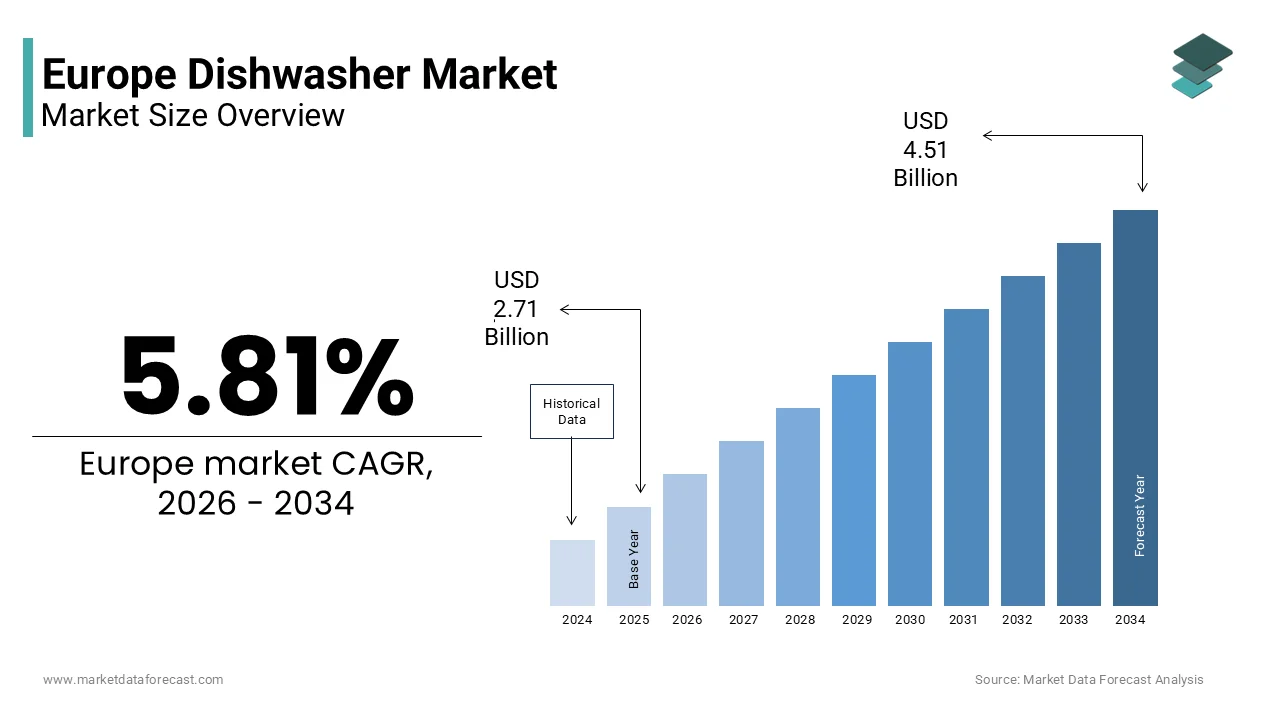
Dishwasher appliances are gaining increasing popularity across the European region and these range from fully integrated built-in models to compact countertop units and are increasingly tailored to meet EU sustainability mandates and evolving consumer lifestyles. As per Eurostat, dishwasher ownership exceeds 70% in highpenetration countries such as Germany, Sweden, and Finland, while remaining below 25% in Romania and Bulgaria. This stark regional divergence reflects differences in urban infrastructure, income levels, and housing age. According to the European Environment Agency, modern dishwashers now account for only about 7% of indoor household water usage due to stricter efficiency standards under the EU Energy Labeling Regulation. Furthermore, according to Eurofound, 78% of Europeans live in urban or suburban settings where spaceefficient kitchen layouts favor integrated appliance solutions. These contextual dynamics form the operational and behavioral foundation of today’s European dishwasher landscape.
MARKET DRIVERS
Rising Penetration of EnergyEfficient Appliances Drives Market Expansion
Europe’s regulatory architecture has become a primary catalyst for dishwasher adoption, particularly through the enforcement of stringent eco-design and labeling standards, which is majorly driving the growth of the European dishwasher market. The revised EU Energy Label, fully implemented in 2021, introduced a simplified AtoG rating scale and lowered maximum allowable energy and water use thresholds. According to the European Commission, Class A dishwashers must now consume no more than 0.65 kWh per cycle and use under 9.5 liters of water, which is representing a 30 to 40% improvement over models sold prior to 2019. Consumer response has been swift and decisive. As per GfK’s 2024 European Major Domestic Appliance Tracker, more than 82% of new dishwashers sold in Germany, France, and the Netherlands carried an A or B rating in 2023. This shift is reinforced by financial incentives; the International Energy Agency reports that appliancerelated electricity consumption in EU households fell by 11% between 2015 and 2023, with dishwashers playing a measurable role due to adaptive load sensing and shortened ecocycles. As utility costs rise and environmental awareness deepens, energy efficiency has transitioned from a compliance requirement to a core purchase driver, which is accelerating replacement demand even outside traditional lifecycle windows.
Urban Housing Trends Favor Integrated and SpaceOptimized Dishwasher Adoption
The architectural evolution of European housing has fundamentally reshaped kitchen design norms and appliance expectations, which is another major factor propelling the European dishwasher market growth. According to the data of Eurostat, average new apartment sizes in cities such as Paris, Berlin, and Amsterdam have declined by 12% since 2010, with many units now under 65 square meters. In this context, builtin dishwashers have become standard features rather than optional upgrades. According to the European Construction Institute’s 2024 Housing Design Survey, 68% of new residential developments across the EU27 now include integrated dishwashers as baseline specifications. Simultaneously, emerging housing models such as coliving and microapartments have fuelled demand for slimline 45centimeter models. According to Euromonitor International, these compact variants now represent nearly 30% of dishwasher sales in Western Europe. Unlike freestanding alternatives, integrated units preserve counter space and align with minimalist interior aesthetics preferred by younger demographics. This spatial imperative has elevated the dishwasher from a convenience item to a functional necessity in modern urban living, creating sustained pull from both developers and end users.
MARKET RESTRAINTS
Persistent Low Adoption in Eastern and Southern Europe Constrains Market Growth
Despite robust penetration in Northern and Western Europe, the dishwasher market faces structural limitations in Southern and Eastern regions due to infrastructural, economic, and cultural barriers. Eurostat’s 2023 Household Budget Survey indicates that dishwasher ownership remains below 30% in Greece, Romania, and Bulgaria, with rural rates often under 15%. A critical constraint is outdated plumbing infrastructure; the European Investment Bank’s Housing Conditions Report estimates that more than 40% of dwellings in Southeastern Europe lack dual water inlets required for standard dishwasher installation. Additionally, manual dishwashing remains culturally ingrained, reinforced by limited disposable income. The European Central Bank notes that average annual household spending on major appliances in Romania and Bulgaria is less than 180 euros, which is less than half the figure in Germany. Compounding this, OECD data shows that more than 60% of young adults in Southern Europe live in rental housing, where landlords rarely include dishwashers as standard fixtures. Without coordinated policy support such as renovation subsidies or landlord mandates, this regional disparity will persist, capping continentwide market potential and fragmenting consumer behavior across economic and geographic lines.
Economic Volatility and Consumer Spending Retrenchment Limit Replacement Cycles
Macroeconomic headwinds have significantly dampened discretionary appliance purchases across Europe, directly impacting dishwasher sales velocity, which is further hindering the dishwasher market growth in Europe. According to the European Commission’s Consumer Survey, historically low confidence levels in 2023, driven by inflation, rising interest rates, and labor market uncertainty. This caution has extended appliance lifespans; as per GfK’s Home Appliance Monitor, the average dishwasher replacement cycle in Western Europe lengthened from 11.2 years in 2019 to 13.7 years in 2024. Unlike essential electronics, dishwashers are often deferred when existing units remain functional. As per the European Central Bank, real disposable income per capita in the euro area declined by 2.1% between 2022 and 2023, which is the first twoyear contraction since 2012. In this climate, even midtier models priced between 400- and 700-euros face resistance, as households prioritize essentials such as food and energy. Compounding the issue, Eurostat notes an 8.4% yearonyear decline in new housing completions across the EU27 in 2023, reducing firstinstallation demand. Until income stability returns and housing activity rebounds, the market will remain constrained by delayed replacements and reduced newbuild integration, despite strong technological and regulatory tailwinds.
MARKET OPPORTUNITIES
Integration of Smart Connectivity Features Opens New Product Differentiation Avenues
The rapid expansion of smart home ecosystems across Europe offers a highvalue opportunity for the European dishwasher market. As per Berg Insight’s European Smart Home Market Monitor, 58 million EU households were connected in 2024, with smart kitchen adoption growing at 14% annually. Leading brands such as Bosch and Miele have capitalized on this trend by embedding WiFi, remote diagnostics, and AIdriven cycle optimization into their premium lines. According to Statista’s 2024 Appliance Brand Tracker, smart models now account for more than 40% of premium dishwasher sales in Germany and Austria. Crucially, functionality aligns with shifting consumer expectations. According to a 2023 YouGov survey across five major EU markets, 61% of adults aged 25 to 44 consider smart features decisive when replacing kitchen appliances. Voice assistant compatibility further enhances convenience for timeconstrained households. With 5G coverage now reaching 85% of EU urban populations, per the European Electronic Communications Authority, latency issues that once hindered realtime control are largely resolved. This enables advanced capabilities such as predictive maintenance alerts and automatic detergent reordering, transforming the dishwasher from a passive appliance into an intelligent node within the connected home.
Circular Economy Mandates Spur Demand for Modular and Repairable Designs
The European Union’s accelerated transition toward a circular economy is creating strategic openings for the European dishwasher market. Under the European Commission’s Sustainable Products Initiative, all new dishwashers sold in the EU from 2025 must feature modular construction, readily available spare parts for at least ten years, and standardized component interfaces. This regulatory shift incentivizes brands to design for longevity rather than obsolescence. Electrolux and Whirlpool have already introduced models with snapfit panels and toolfree rack systems that reduce repair times by up to 50%, according to service metrics shared with the European Consumer Organisation. Currently, while 73% of dishwasher materials are technically recoverable, actual recycling rates hover near 55% due to glued assemblies and mixed polymers, as noted by the European Environment Agency. New design protocols aim to push recyclability above 85% by 2030. Consumer sentiment supports this pivot. As per a 2024 Eurobarometer survey, 68% of EU citizens are willing to pay a 10 to 15% premium for easily repairable appliances. Coupled with national righttorepair laws in France and the Netherlands, this convergence of policy, technology, and consumer values positions repairability as a key axis of future competitiveness.
MARKET CHALLENGES
Supply Chain Fragmentation Increases Cost and Delivery Volatility
The dishwasher manufacturing ecosystem in Europe remains highly vulnerable to global supply chain disruptions due to its reliance on imported critical components, which is challenging the growth of the European dishwasher market. As per the European Association of Electrical and Electronic Equipment Manufacturers, more than 60% of appliancegrade stainless steel and 45% of microcontrollers used in EUassembled dishwashers originate from Asia, primarily China and Vietnam. This dependency exposes the sector to geopolitical friction, shipping delays, and input cost fluctuations. The European Central Bank’s Industrial Supply Chain Report documented an average component delivery delay increase of 22 days in 2023 compared to prepandemic levels. Additionally, the EU’s Carbon Border Adjustment Mechanism imposes tariffs on embedded emissions in imported steel and aluminum. ArcelorMittal estimates this has raised raw material costs for appliance manufacturers by 8 to 12%. Midtier brands, lacking the scale to absorb these shocks, often respond by rationalizing product lines or delaying launches. Until supply chains are diversified through nearshoring or strategic stockpiling, cost instability and inventory shortages will continue to undermine pricing predictability and market responsiveness across the dishwasher sector.
Ambiguity in Water Hardness Standards Complicates Product Performance Consistency
A persistent yet under addressed challenge in the European dishwasher market is the lack of harmonized water quality standards across member states, which directly impacts cleaning efficacy and appliance durability. The European Environment Agency documents extreme variation in water hardness, with calcium carbonate concentrations ranging from under 50 mg/L in Nordic countries to more than 400 mg/L in parts of Spain, Italy, and Hungary. This disparity forces manufacturers to engineer regionspecific adaptations such as enhanced resinbased water softeners and antilimescale coatings increasing complexity and cost. However, consumer awareness remains low. A 2023 study by the European Consumer Centre Network found that only 28% of dishwasher owners in highhardness areas regularly use regenerating salt or adjust cycle settings, leading to accelerated limescale buildup and reduced lifespan. Electrolux reported a 17% yearonyear increase in service calls related to limescale damage in Southern Europe between 2021 and 2023. Meanwhile, detergent formulations are rarely optimized for local conditions; the European Detergent Association acknowledges that fewer than onethird of leading brands offer regionspecific variants. Without EUlevel water quality mapping or mandatory appliance calibration protocols, performance inconsistency will persist, eroding brand reliability and increasing aftersales burdens.
REPORT COVERAGE
| REPORT METRIC | DETAILS |
| Market Size Available | 2025 to 2034 |
| Base Year | 2025 |
| Forecast Period | 2026 to 2034 |
| CAGR | 5.81% |
| Segments Covered | By Product Type, Design, Distribution Channel, and Region |
| Various Analyses Covered | Global, Regional, & Country Level Analysis; Segment-Level Analysis; DROC, PESTLE Analysis; Porter’s Five Forces Analysis; Competitive Landscape; Analyst Overview of Investment Opportunities |
| Regions Covered | UK, France, Spain, Germany, Italy, Russia, Sweden, Denmark, Switzerland, Netherlands, Turkey, and the Czech Republic |
| Market Leaders Profiled | Electrolux AB, LG Electronics Inc., Whirlpool Corporation, Robert Bosch GmbH, Aga Rangemaster Group, Samsung Group, Asko Appliances AB, Miele, Fagor Electrodomésticos, and Haier Group Corporation |
SEGMENTAL ANALYSIS
By Product Type Insights
The builtin dishwasher segment led the market by commanding for 66.5% of the regional market share in 2025. The dominance of built-in segment is driven by the architectural and lifestyle shifts across urban Europe. Builtin dishwashers have become synonymous with contemporary European kitchen aesthetics and functionality. As per the European Construction Institute’s 2024 Residential FitOut Survey, 74% of newly constructed apartments in Germany, France, and the Netherlands include fully integrated dishwashers as standard kitchen fittings. This trend is driven by developer preferences for seamless cabinetry and minimalist layouts that conceal appliances. Unlike freestanding units, which disrupt visual continuity and consume floor space, builtin models align with space optimization imperatives—especially in urban dwellings where average kitchen areas have shrunk to under 8 square meters, according to Eurostat’s 2023 Housing Microdata. Homebuyers increasingly view builtin dishwashers not as optional luxuries but as baseline expectations in new properties. This normalization has cemented the segment’s market leadership and reduced the appeal of freestanding alternatives outside rental or temporary housing contexts.
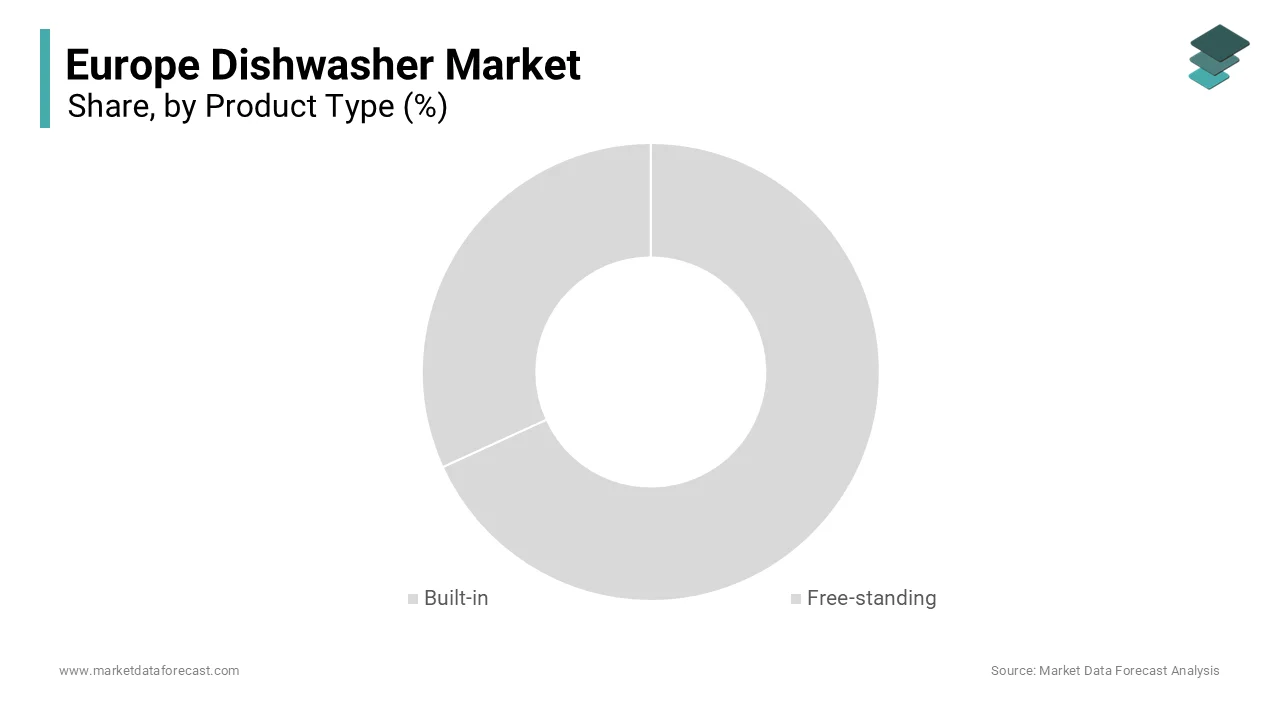
While builtin units lead in volume, the freestanding dishwasher segment is projected to grow at a CAGR of 5.05% over the forecast period. Freestanding dishwashers are experiencing renewed traction in Southern and Eastern Europe, where rental occupancy exceeds 50% in urban centers. According to the OECD data, more than 62% of adults under 35 in cities such as Madrid, Rome, and Warsaw live in nonowned accommodations where builtin appliances are rarely installed. Freestanding units offer portability, allowing tenants to move the appliance between residences without costly reinstallation. This flexibility is especially valued in gigeconomydriven demographics with higher residential mobility. As per a 2024 YouGov Mobility and Housing Survey, 41% of renters in Europe consider portability a decisive factor when purchasing major kitchen appliances. This behavioral shift is transforming freestanding dishwashers from budget options into strategic lifestyle tools.
By Design Insights
The standard tub design segment led the market by holding 70.3% of the regional market share in 2025. This configuration remains the default for most residential installations due to legacy infrastructure and spatial constraints. Standard tub dishwashers are engineered to fit within the 82centimeter height clearance typical of European base cabinets, which is a dimension standardized across EU housing since the 1980s. As per the European Construction Institute, more than 85% of renovation projects in Western Europe retain existing cabinetry during kitchen upgrades to control costs. Installing a tall tub model would require cabinet reconfiguration, an expense 68% of homeowners avoid, according to a 2023 Eurobarometer Renovation Survey. This structural inertia ensures continued dominance of the standard tub segment, especially in countries such as France and Italy where housing stock averages more than 40 years old, per Eurostat. Manufacturers reinforce this compatibility by offering standard tub units with enhanced internal racks that simulate tall tub capacity without altering external dimensions.
The tall tub dishwasher segment is the fastest growing design category in Europe and is estimated to witness a CAGR of 6.33% over the forecast period. Tall tub models, which offer 14 to 16 place settings compared to 12 in standard tubs, are gaining traction among families and multigenerational households. Eurostat’s 2024 Household Composition Data shows that 31% of German and Swedish households now include three or more adults, often due to aging in place or cohabitation trends. These households generate more dishes per cycle and prioritize fullload efficiency. Bosch’s internal sales data indicates that tall tub models accounted for 44% of dishwasher sales in households with four or more residents in 2024. This functional advantage is amplified by EU energy labeling, which rewards fewer cycles through higher efficiency ratings for larger loads.
By Distribution Channel Insights
The specialty stores segment dominated the market by accounting for 40.8% of the regional market share in 2025. Despite digital growth, European consumers remain highly tactile when purchasing highinvolvement appliances. A 2024 European Consumer Organisation survey found that 67% of dishwasher buyers visited a physical store to compare noise levels, door mechanisms, and interior layouts before purchasing. Specialty stores provide handson access to working units and trained staff who explain differences in energy ratings, water consumption, and installation requirements. This guidance is especially valued in markets such as Germany and Italy, where appliance lifespans exceed 12 years, making purchase decisions highly consequential. As per GfK data, consultationdriven sales in specialty stores achieve 23% higher customer satisfaction rates than online transactions, reinforcing their centrality in the purchase journey.
The online stores segment is the fastest growing distribution channel and is estimated to grow at a CAGR of 8.12% over the forecast period. Ecommerce players have overcome traditional barriers through advanced logistics networks. Amazon and AO.com now offer nextday dishwasher delivery with full installation in 18 EU countries, covering 74% of the urban population, according to the European Logistics Association’s 2024 Performance Index. This reliability has eroded the perceived risk of online appliance purchases. A 2024 Kantar ECommerce Trust Survey found that 58% of consumers aged 25 to 40 now consider online retailers as trustworthy as physical stores for major appliances—a 22point increase since 2020. Transparent pricing, algorithmdriven recommendations, and flexible return policies further enhance appeal, particularly in pricesensitive markets such as Spain and Poland.
REGIONAL ANALYSIS
Germany Dishwasher Market Analysis
Germany held as the largest national market for dishwashers in Europe by accounting for 22.8% of regional market share in 2025. The dominance of Germany in the European dishwasher market is attributed to a confluence of high household income, mature housing infrastructure, and stringent environmental regulations. As per the Federal Statistical Office, more than 78% of German households own a dishwasher, reflecting decades of cultural normalization. The Energiewende policy framework has further entrenched energyefficient appliance adoption, with over 85% of new dishwashers carrying an A energy rating, according to the German Environment Agency. Urban renovation programs such as the KfW Efficiency House initiative subsidize kitchen modernization including dishwasher upgrades driving replacement demand even in nonfailure scenarios. Additionally, Germany’s engineeringoriented consumer base values quiet operation and durability, with average appliance lifespans exceeding 13 years, per the German Appliance Manufacturers Association. This combination of policy, consumer behavior, and infrastructure ensures Germany’s continued dominance.
France Dishwasher Market Analysis
France was the second leading regional segment in the Europe dishwasher market in 2025. The growth of France in the European market is driven by strong new construction activity and urban kitchen modernization trends. According to France’s National Institute of Statistics and Economic Studies, more than 62% of households owned a dishwasher in 2024, with penetration rising fastest in cities such as Lyon and Toulouse, where new apartment completions grew by 6.3% yearonyear. The French government’s MaPrimeRénov scheme, which provides subsidies for energyefficient home upgrades, has included dishwashers since 2023, further stimulating demand. A 2024 IFOP consumer survey found that 54% of French buyers prioritize water consumption when selecting a dishwasher, aligning with national water conservation goals. Moreover, French developers increasingly integrate builtin dishwashers as standard in social and private housing alike—a practice reinforced by the RE2020 environmental regulation mandating resourceefficient fixtures in all new buildings. This policydriven normalization is closing the gap with Northern European adoption rates.
Italy Dishwasher Market Analysis
Italy is anticipated to command for a notable share of the European dishwasher market over the forecast period, with growth increasingly fueled by postpandemic housing investments and regional policy incentives. As per ISTAT, dishwasher ownership reached 58% in 2024, up from 49% in 2019, reflecting a cultural shift away from traditional hand washing. This transition is most pronounced in Northern Italy, where per capita income exceeds the EU average and new housing incorporates integrated appliances as standard. The Italian Ministry of Ecological Transition’s Bonus Elettrodomestici program, which offers 20% rebates on Class A appliances, has directly boosted dishwasher sales, with more than 1.2 million units claimed under the scheme between 2022 and 2024. Additionally, Italian manufacturers such as Smeg and Indesit leverage domestic design heritage to position dishwashers as aesthetic as well as functional elements, enhancing appeal among styleconscious consumers. These combined forces are transforming Italy from a moderate adoption market into a highgrowth engine.
United Kingdom Dishwasher Market Analysis
The United Kingdom is predicted to register a prominent CAGR in the Europe dishwasher market during the forecast period with demand shaped by urban density, housing turnover, and evolving sustainability norms. According to the Office for National Statistics, 52% of UK households owned a dishwasher in 2024, with London and the Southeast exceeding 65% due to compact apartment living where space saving and water efficiency are critical. The UK’s postBrexit Appliance Standards Regulation, which mirrors EU ecodesign rules, has maintained pressure for highefficiency models, with 79% of new units achieving toptier water and energy ratings, as per the Department for Energy Security and Net Zero. Additionally, the rise of buildtorent developments has institutionalized dishwasher inclusion; Savills reports that 81% of new rental apartments completed in 2024 featured builtin dishwashers to attract professional tenants. This developerdriven adoption, combined with strong ecommerce penetration ensures steady market expansion despite economic volatility.
Spain Dishwasher Market Analysis
Spain is anticipated to account for a noteworthy share of the Europe dishwasher market during the forecast period and is experiencing the fastest per capita growth among the top five countries, driven by housing recovery and rising middleclass aspirations. According to Spain’s National Statistics Institute, dishwasher ownership climbed to 47% in 2024, up from 36% in 2019, reflecting renewed confidence in durable goods spending. The government’s Plan Renhata renovation subsidy, which provides up to 6,000 euros for energyefficient home upgrades, has significantly boosted kitchen modernization, with dishwashers among the most claimed items, per the Ministry for Ecological Transition. Urban centers such as Madrid and Barcelona are seeing rapid adoption in new microapartments, where developers position builtin dishwashers as essential to modern living. Furthermore, Spanish consumers are increasingly influenced by Northern European norms, with 58% of buyers under 40 citing water savings as a key purchase factor, according to a 2024 Kantar Spain Home Appliance Report. This convergence of policy, aspiration, and lifestyle change is propelling Spain into a highgrowth trajectory.
COMPETITIVE LANDSCAPE
The Europe dishwasher market features intense competition characterized by a mix of global conglomerates and regional specialists vying for consumer preference through innovation sustainability and service excellence. Leading brands differentiate themselves via advanced features such as smart connectivity water softening systems and ultra quiet operation while adhering to stringent EU environmental standards. Price competition remains moderate as the market gravitates toward value-based purchasing where efficiency performance and longevity outweigh initial cost. New entrants face high barriers due to regulatory complexity established distribution networks and consumer brand loyalty. Competition is further intensified by the convergence of home appliance and smart home ecosystems prompting incumbents to forge partnerships with technology firms. Despite market maturity players continue to invest in R and D to address unmet needs in water conservation space optimization and circular design thus sustaining dynamic rivalry across segments and geographies.
KEY MARKET PLAYERS
Some of the notable key players in the Europe dishwasher market are
- Electrolux AB
- LG Electronics Inc.
- Whirlpool Corporation
- Robert Bosch GmbH
- Aga Rangemaster Group
- Samsung Group
- Asko Appliances AB
- Miele
- Fagor Electrodomésticos
- Haier Group Corporation
Top Players in the Market
- Bosch is a leading innovator in the Europe dishwasher market with a strong legacy in engineering energy efficient and quiet operating appliances. The company integrates advanced technologies such as Home Connect for remote control and AI based wash cycle optimization. Bosch has reinforced its position through strategic investments in sustainable manufacturing and R and D focused on water reduction and modular design. In recent years the company launched its EcoSilence Drive series across major European markets emphasizing durability and low maintenance. Bosch also aligns its product portfolio with EU ecodesign standards ensuring compliance while enhancing consumer value through long term performance and reduced utility costs.
- Miele holds a premium position in the Europe dishwasher market distinguished by its emphasis on longevity precision engineering and superior cleaning performance. The company designs dishwashers with expected lifespans of up to 20 years significantly exceeding industry norms. Miele has strengthened its market presence by expanding its connected appliance ecosystem and enhancing after sales service networks across Western and Northern Europe. Recent initiatives include the launch of the Miele SmartLine series featuring automatic detergent dosing and real time energy monitoring. The brand also invests heavily in consumer education to highlight total cost of ownership advantages reinforcing loyalty among high income and sustainability conscious households.
- Electrolux plays a pivotal role in the Europe dishwasher market by offering a broad portfolio spanning value conscious to premium segments. The company leverages its deep distribution footprint and localized product development to address diverse regional needs from compact urban models in Sweden to high-capacity units in Germany. Electrolux has intensified its focus on circular economy principles introducing dishwashers with snap fit components and ten-year spare parts availability. The brand recently rolled out its Care+ service platform offering proactive maintenance alerts and recycling support. These actions align with EU sustainability mandates while enhancing customer retention and brand differentiation in a competitive landscape.
Top Strategies Used by the Key Market Participants
Key players in the Europe dishwasher market employ product differentiation through smart connectivity integration to enhance user convenience and justify premium pricing. They align closely with EU eco-design and energy labeling regulations to ensure compliance and leverage sustainability as a marketing advantage. Companies invest in modular and repairable designs to meet emerging right to repair legislation and consumer demand for durability. Geographic customization of product features such as water hardness adaptation and compact sizes addresses regional infrastructure and housing variations. Strategic expansion of online and omnichannel distribution networks captures digitally active consumers while maintaining service quality through bundled installation and after sales support.
MARKET SEGMENTATION
This research report on the European dishwasher market has been segmented and sub-segmented based on categories.
By Product Type
- Built-in
- Free-standing
By Design
- Standard Tub
- Tall Tub
By Application
- Residential
- Commercial
By Distribution Channel
- Specialty Stores
- Online Stores
- Brand Stores
- Others
By Country
- UK
- France
- Spain
- Germany
- Italy
- Russia
- Sweden
- Denmark
- Switzerland
- Netherlands
- Turkey
- Czech Republic
- Rest of Europe
Frequently Asked Questions
1.What is a dishwasher and how does it work?
A dishwasher is an automated kitchen appliance that cleans dishes using pressurized hot water, detergents, and drying systems to remove food residues and bacteria.
2.What is driving the growth of the Europe dishwasher market?
Market growth is driven by rising urbanization, increasing disposable income, growing adoption of modular kitchens, and demand for time-saving home appliances.
3.Which countries dominate the Europe dishwasher market?
Germany, the UK, France, and Italy dominate the market due to high household penetration, strong appliance manufacturing bases, and consumer preference for energy-efficient products.
4.What types of dishwashers are available in the European market?
The market includes built-in dishwashers, freestanding dishwashers, compact countertop models, and drawer-type dishwashers.
5.Which distribution channels are most prominent in Europe?
Offline retail stores dominate sales, while online channels are growing rapidly due to convenience, competitive pricing, and wider product availability.
6.How do energy efficiency regulations affect the Europe dishwasher market?
Strict EU energy labeling and eco-design regulations encourage manufacturers to develop water- and energy-efficient dishwasher models.
7.What role does smart technology play in modern dishwashers?
Smart dishwashers offer features such as Wi-Fi connectivity, remote monitoring, app-based control, and optimized wash cycles for improved efficiency.
8.What are the most preferred dishwasher capacities in Europe?
Standard-size dishwashers with 12–15 place settings are most preferred, especially among medium to large households.
9.What are the key challenges in the Europe dishwasher market?
High upfront costs, limited adoption in smaller households, and water supply concerns in certain regions are key challenges.
10. What is the future outlook for the Europe dishwasher market?
The market is expected to grow steadily, supported by smart appliance adoption, sustainability initiatives, and rising demand for premium kitchen solutions.
Related Reports
Access the study in MULTIPLE FORMATS
Purchase options starting from
$ 2000
Didn’t find what you’re looking for?
TALK TO OUR ANALYST TEAM
Need something within your budget?
NO WORRIES! WE GOT YOU COVERED!
Call us on: +1 888 702 9696 (U.S Toll Free)
Write to us: sales@marketdataforecast.com