- Product Description Description
- Table of Contents TOC
- List of Table & Figure LOT
- Get Free Sample PDF Sample PDF
Europe Distributed Antenna Systems Market Report Summary
The Europe distributed antenna systems (DAS) market was valued at USD 2.71 billion in 2024, is anticipated to reach USD 3.18 billion in 2025, and is projected to reach USD 11.31 billion by 2033, growing at a CAGR of 17.55% during the forecast period from 2025 to 2033. The growth of the European distributed antenna systems market is driven by the increasing demand for seamless mobile connectivity, expanding 5G network deployments, and the rising adoption of smart buildings and IoT technologies. Additionally, the growing number of large commercial complexes, transportation hubs, and public venues is further boosting the installation of indoor distributed antenna systems to enhance signal strength and data coverage.
Key Market Trends
- Rising deployment of 5G-enabled distributed antenna systems to improve in-building connectivity.
- Increasing adoption of neutral host DAS models to reduce infrastructure costs for telecom operators.
- Growing focus on public safety communication networks in airports, stadiums, and metro stations.
- Integration of DAS with small cell and Wi-Fi networks for optimized coverage and capacity.
- Expansion of private LTE and enterprise 5G networks across corporate and industrial environments.
Segmental Insights
- Based on coverage, the indoor distributed antenna systems segment dominated the European distributed antenna systems market in 2024, accounting for a substantial share. This segment’s growth is attributed to the increasing need for strong in-building network coverage in offices, hospitals, shopping malls, and universities, driven by the rising use of high-speed mobile data and smart devices.
- Based on the ownership model, the carrier-owned distributed antenna systems segment led the European distributed antenna systems market, capturing 65.6% share in 2024. This dominance is due to the extensive investments made by telecom service providers in network infrastructure to ensure optimal performance, particularly in high-traffic and densely populated urban areas.
Regional Insights
The European distributed antenna systems market demonstrates strong regional growth, fueled by advancements in communication technologies and increasing connectivity demands.
- Germany was the top performer in the Europe distributed antenna systems market, capturing 23.6% share in 2024, driven by rapid 5G rollout, large commercial infrastructure, and strong investments in smart city development.
- The United Kingdom continues to lead in DAS adoption across airports, corporate buildings, and healthcare facilities, driven by increasing mobile data traffic and digital transformation initiatives.
- France is witnessing notable growth with major telecom operators expanding indoor coverage solutions to meet the needs of public and private enterprises.
- Italy and Spain are showing promising growth due to the modernization of communication networks and the increasing adoption of next-generation connectivity solutions.
- Nordic countries are emerging as early adopters of advanced indoor connectivity systems, leveraging DAS for industrial automation and 5G enterprise networks.
Competitive Landscape
The European distributed antenna systems market is moderately consolidated, with key players focusing on technological innovation, strategic partnerships, and 5G infrastructure integration. Leading companies are investing in multi-operator, multi-technology DAS solutions to enhance signal performance and reduce operational costs. Major players in the European distributed antenna systems market include CommScope Holding Co. Inc., Corning Incorporated, Comba Telecom Systems Holdings Ltd., SOLiD Technologies, American Tower Corporation, Boingo Wireless Inc., Dali Wireless, JMA Wireless, HUBER+SUHNER AG, and Zinwave Europe Limited.
Europe Distributed Antenna Systems Market Size
The Europe distributed antenna systems market size was valued at USD 2.71 billion in 2024 and is anticipated to reach USD 3.18 billion in 2025 from USD 11.31 billion by 2033, growing at a CAGR of 17.55% during the forecast period from 2025 to 2033.
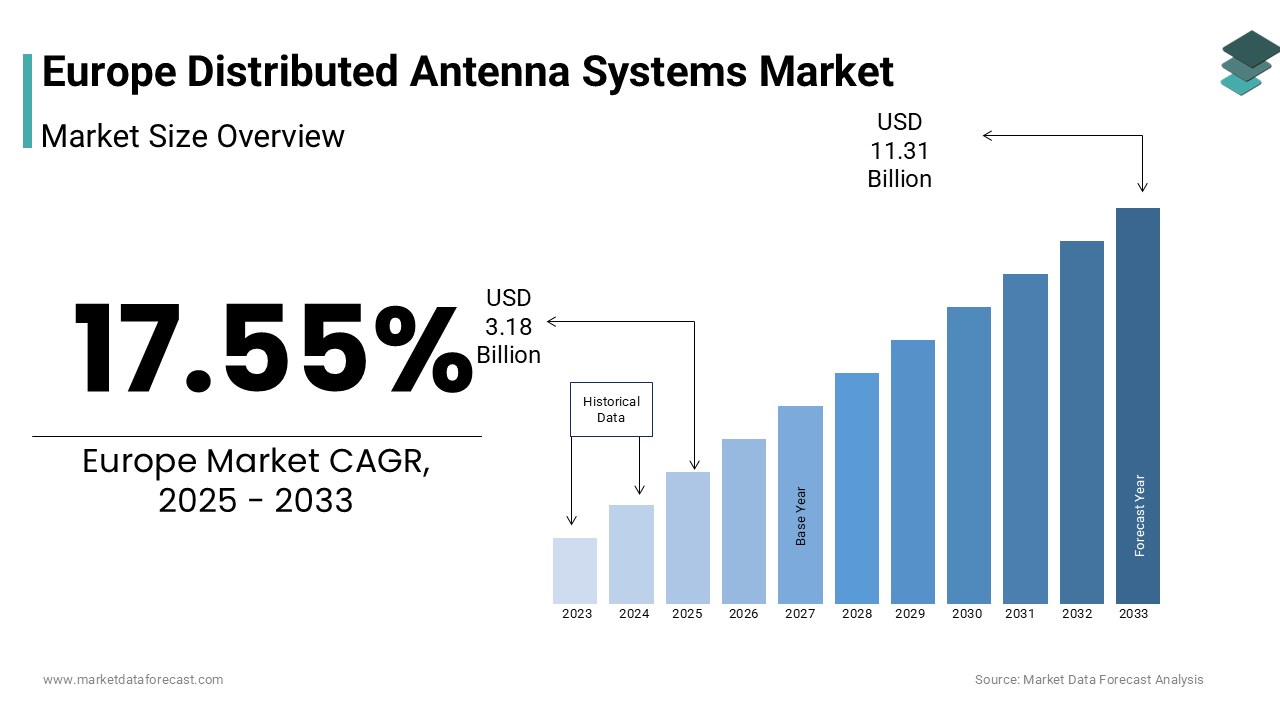
A distributed antenna system (DAS) is a network of antennas that amplifies and distributes a wireless signal to provide better cellular and Wi-Fi coverage in large or complex buildings where signals from external towers are weak or blocked. These systems, ranging from passive coaxial setups to active digital fiber based architectures, are critical in ensuring seamless connectivity in subterranean transport hubs high rise commercial complexes hospitals and large public venues. The market’s evolution is tightly interwoven with Europe’s urban density regulatory mandates and digital inclusion goals. According to Eurostat, over 75% of the European Union’s population resided in urban areas as of 2021, many of which feature historic buildings with thick masonry that obstruct radio frequency signals. Concurrently, the European Electronic Communications Code (EECC) required EU countries to implement public warning systems by mid-2022. This confluence of demographic pressure regulatory enforcement and technological transition defines the operational imperatives of the Europe distributed antenna systems market.
MARKET DRIVERS
Mandated In Building Public Safety Communication Requirements
Regulatory mandates for reliable emergency radio coverage in large buildings constitute a major booster for the growth of the Europe distributed antenna systems market. The EECC mandates the use of public warning systems (like cell broadcast) to alert citizens via mobile networks during emergencies. Requirements for indoor radio coverage for first responders are set at the national or local level, often referencing international building and fire safety codes. In Germany, the Technical Relief Agency (THW) provides civil protection and disaster management services, primarily with volunteers. It does not enforce DIN SPEC 14675, which is a German standard for fire alarm systems. These legally binding requirements compel building owners to invest in passive or active DAS solutions not as optional upgrades but as non negotiable safety infrastructure, and thereby anchoring sustained market demand irrespective of commercial telecom cycles.
Accelerated 5G Network Densification in Urban Centers
The rollout of 5G networks is intensifying, which in turn drives the expansion of the Europe distributed antenna systems market. The need for distributed antenna systems is due to the inherent propagation limitations of high frequency spectrum bands. 5G’s use of mid band 3.5 gigahertz and future millimeter wave frequencies suffers from significantly reduced wall penetration and higher path loss compared to legacy 4G signals. According to the European Conference of Postal and Telecommunications Administrations 5G signals at 3.5 gigahertz experience up to twenty decibels more attenuation when passing through concrete and glass than 800 megahertz 4G signals. This physical constraint renders macro towers insufficient for indoor coverage in dense urban environments. Major operators have responded by mandating DAS integration in all new commercial developments in cities like Berlin Paris and London. The expansion of 5G standalone networks and increasing urban data consumption are making DAS adoption a technical necessity for building next-generation connectivity.
MARKET RESTRAINTS
Stringent Historic Preservation and Aesthetic Regulations
Stringent urban planning and heritage conservation laws limit visible infrastructure modifications in historic districts, which restricts the growth of the Europe distributed antenna systems market. Many European cities including Rome Prague and Edinburgh contain vast zones designated as UNESCO World Heritage Sites or nationally protected areas where external antenna mounting window penetration and rooftop alterations require special permits or are outright prohibited. These constraints force DAS designers to rely on costly and technically complex solutions such as leaky feeder cables or concealed radiators which increase project timelines and reduce signal efficiency. The preservation imperative will continue to hinder the timely and cost-effective deployment of essential digital infrastructure until streamlined approval pathways are established.
High Initial Capital Expenditure and Complex Multi Operator Coordination
The substantial upfront investment required for neutral host distributed antenna systems is an obstruction to the expansion of the Europe distributed antenna systems market. Deploying a carrier grade active DAS in a large commercial building typically costs between several hundred thousand and one million euros or more, depending on the building's size and required technology. This capital intensity is compounded by the complexity of coordinating multiple mobile network operators who must agree on technical specifications power sharing and revenue allocation. In countries like Spain and Belgium fragmented operator landscapes with four or more national carriers further exacerbate negotiation deadlocks. Apart from these, the absence of standardized cost sharing models means building owners often bear disproportionate financial risk. The market's scalability is constrained by economic and coordination friction, a problem that will persist until financing mechanisms and interoperability frameworks mature.
MARKET OPPORTUNITIES
Integration of DAS with Smart Building and IoT Ecosystems
The convergence of in-building wireless infrastructure with smart building management and Internet of Things platforms opens new opportunities for the growth of the Europe distributed antenna systems market. Modern DAS architectures increasingly support not only cellular and public safety bands but also low power wide area networks such as NB IoT and LTE-M enabling seamless connectivity for sensors actuators and monitoring devices. These systems enable real time monitoring of energy usage occupancy patterns and environmental conditions while ensuring first responder access. Building owners benefit from operational efficiencies with a single cabling backbone supporting both human connectivity and machine communication. DAS providers are positioned to become essential enablers of sustainable intelligent infrastructure as a result of the EU’s Energy Performance of Buildings Directive, which mandates net-zero ready standards by 2030.
Deployment in Transportation Infrastructure Under EU Digital Corridors Initiative
The expansion of distributed antenna systems within Europe’s transportation networks presents a high growth opportunity for the Europe distributed antenna system market. It is driven by the European Union’s Digital Transport Corridors policy. This initiative mandates continuous 5G and GSM R coverage across all major rail highways and tunnels to support connected and autonomous mobility as well as passenger connectivity. According to sources, the European Union is pursuing the modernization and interoperability of its rail network, including communications systems. Similarly, as per EU directives, road tunnels within the Trans-European Transport Network (TEN-T) must meet minimum safety standards that include support for emergency and commercial mobile services. National rail operators such as SNCF Deutsche Bahn and Trenitalia have launched tenders for leaky feeder based DAS installations in underground stations and tunnels. This coordinated public investment creates a pipeline of large scale projects that demand robust scalable and multi band DAS solutions thereby transforming transportation arteries into strategic growth vectors for the market.
MARKET CHALLENGES
Fragmented National Spectrum Allocation and Licensing Frameworks
The lack of harmonized spectrum allocation for in building wireless services across member states slows down the growth of the Europe distributed antenna systems market. While the 3.5 gigahertz band is widely used for 5G the specific channel plans power limits and licensing conditions for indoor deployment vary significantly between countries. The fragmentation forces manufacturers to maintain multiple product variants increasing costs and complicating inventory management. Moreover some countries such as Austria restrict third parties from operating DAS on certain public safety frequencies while others like the Netherlands allow shared access. The European Commission's failure to achieve greater spectrum harmonization will perpetuate a regulatory patchwork, which in turn will hinder economies of scale and delay cross-border project execution.
Skilled Labor Shortage for DAS Design and Installation
The growing shortage of engineers and technicians qualified to design install and commission complex in building wireless networks continues to be a challenge for the expansion of the Europe distributed antenna systems market. The technical demands of modern active DAS requiring expertise in RF engineering fiber optics IP networking and multi operator integration—exceed the capabilities of traditional low voltage contractors. The gap is most acute in Central and Eastern Europe where vocational training programs have not kept pace with 5G infrastructure demands. Training initiatives by companies remain limited in scale and geographic reach. The shortage of skilled workers could delay public safety upgrades and drive up labor costs, which limits the market's ability to respond quickly.
REPORT COVERAGE
| REPORT METRIC | DETAILS |
| Market Size Available | 2024 to 2033 |
| Base Year | 2024 |
| Forecast Period | 2025 to 2033 |
| Segments Covered | By Coverage, Ownership and Region. |
| Various Analyses Covered | Global, Regional, & Country Level Analysis; Segment-Level Analysis, Drivers, Restraints, Opportunities, Challenges, PESTLE Analysis, Porter’s Five Forces Analysis, Competitive Landscape, Analyst Overview of Investment Opportunities |
| Regions Covered | UK, France, Spain, Germany, Italy, Russia, Sweden, Denmark, Switzerland, Netherlands, Turkey, Czech Republic, Rest of Europe |
| Key Market Players | CommScope Holding Co Inc, Corning Incorporated, Comba Telecom Systems Holdings Ltd, SOLiD Technologies, American Tower Corporation, Boingo Wireless Inc, Dali Wireless, JMA Wireless, HUBER+SUHNER AG, and Zinwave Europe Limited. |
SEGMENTAL ANALYSIS
By Coverage Insights
The indoor distributed antenna systems segment dominated the Europe distributed antenna systems market and accounted for substantial share in 2024. The physical limitations of 5G and 4G signals in penetrating dense building materials combined with stringent regulatory mandates for indoor public safety coverage propels the domination of the indoor distributed antenna systems segment. Urban environments across Europe feature high concentrations of concrete steel and energy efficient glass that attenuate radio frequencies. Consequently, a portion of mobile data traffic originates indoors yet macro networks fail to deliver consistent signal quality in basements elevators and interior zones. This dual pressure of technical necessity and legal obligation makes indoor DAS not a luxury but a foundational requirement for modern infrastructure across hospitals airports shopping centers and high-rise offices throughout the continent.
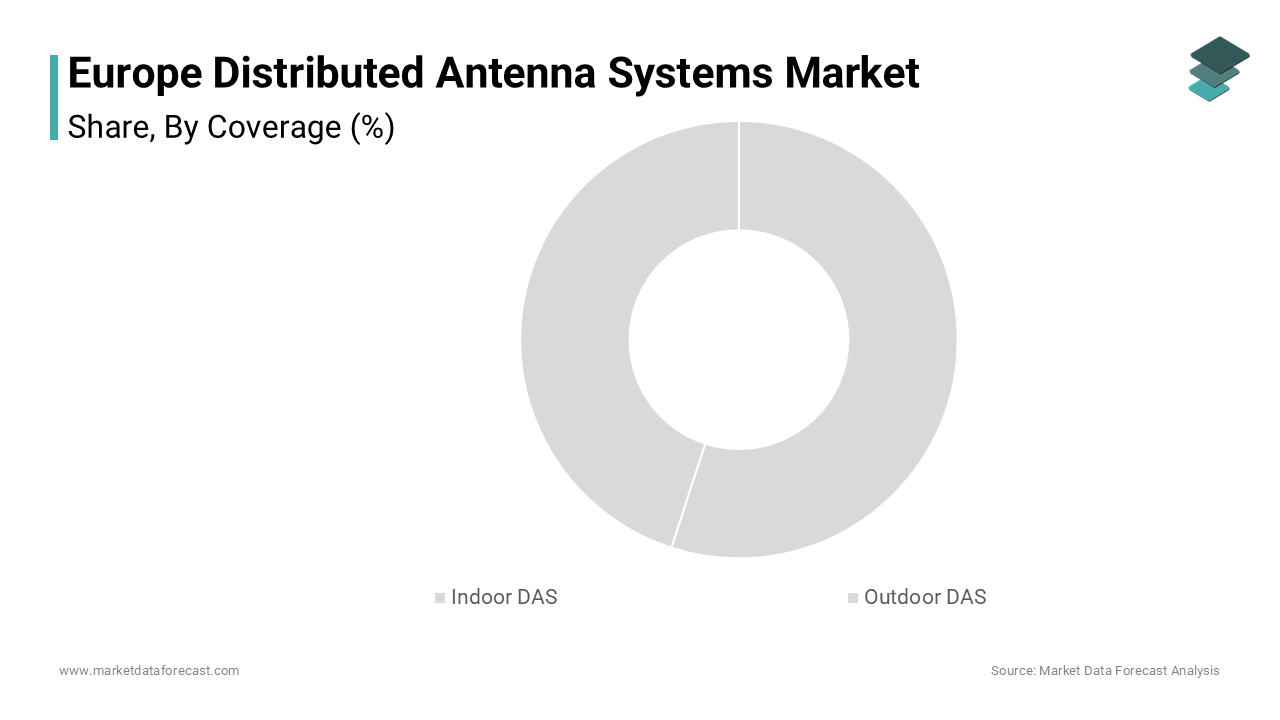
The outdoor distributed antenna systems segment is on the rise and is expected to be the fastest growing segment in the global market by witnessing a CAGR of 12.4% from 2025 to 2033. The rapid expansion of the outdoor distributed antenna systems segment is fueled by the European Union’s Digital Transport Corridors initiative which mandates uninterrupted 5G and GSM R coverage across all major rail lines highways and tunnels to support connected mobility and passenger connectivity. National rail operators such as SNCF and Deutsche Bahn have launched large scale tenders for outdoor DAS deployment in alpine tunnels and urban underground stations. The expansion of autonomous vehicles and cross-border freight digitalization is transforming outdoor Distributed Antenna Systems (DAS) from a niche application into a critical component of national infrastructure.
By Ownership Model Insights
The carrier owned distributed antenna systems segment led the Europe distributed antenna system market by capturing 65.6% share in 2024. The growth of the carrier owned distributed antenna systems segment is because mobile network operators retain direct control over network performance spectrum utilization and customer experience in high value venues such as stadiums airports and flagship retail stores. Operators like Vodafone Deutsche Telekom and Orange prioritize carrier owned DAS in locations where subscriber density and data consumption justify dedicated investment. Regulatory frameworks in countries like Germany and the United Kingdom also allow operators to claim accelerated depreciation on in building infrastructure reducing capital burden. This performance advantage combined with direct monetization of premium connectivity ensures that mobile operators continue to dominate DAS ownership in strategic commercial and public safety deployments.
The neutral host distributed antenna systems segment is expected to exhibit a noteworthy CAGR of 14.7% during the forecast period owing to commercial property owners seeking to provide seamless multi operator coverage without negotiating separate agreements with each mobile carrier. Large venues such as shopping malls convention centers and hospital complexes benefit from a single infrastructure that supports all national operators reducing installation complexity and long term maintenance costs. Regulatory support further accelerates adoption. Companies have secured long term contracts to operate neutral host networks in major airports including Heathrow and Charles de Gaulle. The high capital and operational expenditures associated with individual 5G deployments are mitigated by a shared model, which delivers superior efficiency and makes it the optimal approach for sustainable in-building wireless solutions.
REGIONAL ANALYSIS
Germany Distributed Antenna Systems Market Analysis
Germany was the top performer in the Europe distributed antenna systems market and captured 23.6% share in 2024. The prominence of Germany is primarily driven by its advanced 5G rollout stringent public safety mandates and dense urban infrastructure requiring robust in building coverage. Deutsche Telekom and Vodafone have invested heavily in both carrier owned and neutral host systems across airports hospitals and transport hubs including Berlin Brandenburg and Frankfurt Main stations. Industrial complexes in the Ruhr Valley also drive demand as factories adopt private 5G networks for automation requiring integrated DAS for worker communication. Germany’s combination of regulatory rigor industrial digitization and operator investment ensures its position as the most mature and active DAS market in Europe.
United Kingdom Distributed Antenna Systems Market Analysis
The United Kingdom followed closely in the Europe distributed antenna system market. The market in the United kingdom is propelled by London’s status as a global financial and transport hub where uninterrupted connectivity is critical in skyscrapers underground stations and major airports. Heathrow Gatwick and Crossrail stations have deployed advanced neutral host DAS systems supporting all four national operators. Commercial real estate developers such as British Land and Canary Wharf Group include DAS as standard in new office specifications. In the UK, a perfect storm of aging infrastructure, high urban density, and strict regulatory enforcement fuels the strong demand for DAS solutions that serve both indoor and transport needs.
France Distributed Antenna Systems Market Analysis
France witnessed steadily growth in the Europe DAS market due to national security policies and large scale infrastructure modernization. Paris Charles de Gaulle and Lyon Saint Exupéry airports have implemented multi operator neutral host systems managed by BAI Communications. The government also allocates funding for in building wireless as part of broader digital inclusion goals. Historic preservation laws in cities like Bordeaux and Strasbourg complicate deployments yet drive innovation in concealed antenna designs. France’s blend of security imperatives transport investment and urban density sustains consistent DAS deployment momentum across public and private sectors.
Italy Distributed Antenna Systems Market Analysis
Italy expanded gradually in the Europe distributed antenna system market, with urgent retrofitting needs in historic urban centers and major transport corridors. Rome Milan and Naples feature dense building stock with thick masonry that severely attenuates 5G signals prompting regulatory action. The Civil Protection Department mandates emergency radio coverage in all hospitals and stadiums following the 2022 stadium safety directive. Companies like INWIT have emerged as neutral host providers installing shared systems in shopping malls and metro stations across major cities. Despite bureaucratic delays and heritage constraints Italy’s combination of regulatory pressure urban congestion and EU funding ensures steady growth in both indoor and transport DAS segments.
Spain Distributed Antenna Systems Market Analysis
Spain is predicted to grow in the Europe distributed antenna systems market from 2025 to 2033 owing to tourism infrastructure modernization and high-speed rail development. Major airports including Madrid Barajas and Barcelona El Prat have deployed neutral host DAS to support millions of international travelers requiring seamless connectivity. The government’s Spain Digital 2025 strategy includes specific provisions for in building 5G coverage in public hospitals and universities. Coastal cities like Valencia and Malaga are upgrading convention centers and cruise terminals with DAS to enhance visitor experience. Significant EU cohesion funds, coupled with increasing demand for data, are driving steady growth in Spain's DAS market within the transport, commercial, and public safety domains.
COMPETITIVE LANDSCAPE
The Europe distributed antenna systems market features a competitive landscape defined by the interplay between global technology vendors specialized neutral host operators and national telecom incumbents. Unlike commoditized hardware markets DAS competition hinges on engineering expertise regulatory compliance and long term operational partnerships rather than price alone. Global players like CommScope and Corning offer end to end hardware and software solutions but face stiff competition from regional specialists such as Cellnex and BAI Communications who control critical venue access through infrastructure concessions. Mobile operators also exert influence by choosing between carrier owned deployments for strategic sites or neutral host models for cost efficiency. The market is further shaped by fragmented national regulations public safety mandates and historic building constraints that demand localized adaptation. As 5G densification accelerates competition is shifting toward integrated offerings that combine DAS with edge services smart building management and transport digitization. Success requires not only technical excellence but also deep institutional relationships and regulatory fluency across Europe’s diverse national ecosystems.
KEY MARKET PLAYERS
A few of the major companies in the europe distributed antenna systems market include
- CommScope Holding Co Inc
- Corning Incorporated
- Comba Telecom Systems Holdings Ltd
- SOLiD Technologies
- American Tower Corporatio
- Boingo Wireless Inc.
- Dali Wireless
- JMA Wireless
- HUBER+SUHNER AG
- Zinwave Europe Limited
Top Players in the Market
CommScope is a leading global provider of distributed antenna systems with deep integration across Europe’s telecom and public safety infrastructure. The company supplies both passive and active DAS solutions to major mobile operators transport authorities and venue owners throughout the continent. CommScope has strengthened its European position by aligning its ION DAS platform with EU regulatory standards for multi operator support and emergency communications. Recent initiatives include partnerships with national rail operators to deploy fiber based DAS in alpine tunnels and collaboration with smart building developers to integrate DAS with IoT management systems. Its RUCKUS Networks division also offers hybrid solutions that combine DAS with Wi Fi 6 for unified indoor connectivity.
Cellnex Telecom has emerged as Europe’s foremost neutral host infrastructure operator specializing in shared DAS deployments across transport and urban venues. Headquartered in Spain the company owns and operates in building wireless networks in over one hundred major locations including airports stadiums and metro systems across twelve European countries. Cellnex has significantly expanded its DAS footprint through strategic acquisitions of tower and venue infrastructure assets in Italy France and the United Kingdom. Mobile operators can achieve accelerated 5G indoor coverage with less effort by utilizing Cellnex's single-infrastructure, long-term lease agreements. Its asset light operational model and strong relationships with public authorities position it as a pivotal enabler of shared wireless infrastructure across the region.
BAI Communications is a key player in the Europe distributed antenna systems market with a specialized focus on transportation infrastructure. The company designs builds and operates neutral host DAS networks in some of the continent’s most complex environments including the London Underground Crossrail and major airports such as Heathrow and Charles de Gaulle. BAI leverages its experience in public safety radio integration to deliver systems that simultaneously support commercial 4G 5G and emergency TETRA or LTE bands. Recent actions include the deployment of Europe’s first multi operator 5G SA ready DAS in a metro tunnel and the adoption of software defined radio technology to future proof infrastructure against spectrum changes. Through long term concessions with transport authorities BAI ensures sustainable revenue while meeting stringent EU mandates for continuous connectivity in critical mobility corridors. Its domain expertise in underground and high density environments makes it a trusted partner for large scale public infrastructure projects.
Top Strategies Used by the Key Market Participants
Key players in the Europe distributed antenna systems market prioritize neutral host deployment models to enable multi operator support and reduce infrastructure duplication in large venues. They form strategic partnerships with national rail operators airports and commercial real estate developers to secure long term site access and revenue stability. Companies invest in software defined and fiber based active DAS platforms that support future 5G standalone and public safety network evolutions. They ensure compliance with country specific emergency communication mandates by integrating TETRA and LTE based public safety bands into every system design. Firms localize engineering and installation teams to navigate historic preservation laws and urban planning regulations across diverse European cities. They bundle DAS with edge computing and IoT connectivity to position wireless infrastructure as part of broader smart building solutions. Continuous engagement with national regulators ensures alignment with evolving spectrum allocation and safety certification requirements across the region.
MARKET SEGMENTATION
This research report on the Europe distributed antenna systems market has been segmented based on the following categories.
By Coverage
- Indoor DAS
- Outdoor DAS
By Ownership Model
- Carrier Ownership
- Neutral-Host Ownership
- Enterprise Ownership
By Country
- UK
- France
- Spain
- Germany
- Italy
- Russia
- Sweden
- Denmark
- Switzerland
- Netherlands
- Turkey
- Czech Republic
- Rest of Europe