- Product Description Description
- Table of Contents TOC
- List of Table & Figure LOT
- Get Free Sample PDF Sample PDF
Market Size, 2025
$3.06 BnMarket Estimate, 2026
$3.51 BnMarket Forecast, 2034
$10.52 BnCAGR, 2026–2034
14.71%Executive Summary: Europe District Cooling Market
- Market Scope: Regional market analysis for district cooling systems in Europe, covering technological breakdowns (electric, absorption, free cooling), end-use applications, regional and country dynamics, and key industry players.
- Market Valuation: Valued at USD 3.06 billion in 2025, estimated at USD 3.51 billion in 2026, and projected to reach USD 10.52 billion by 2034, growing at a robust CAGR of 14.71% from 2026 to 2034.
- Primary Growth Drivers: Escalating urban cooling energy demands, increased infrastructure spending, rising internal heat loads in building designs (such as glass exteriors in commercial complexes), and superior cost-efficiency compared to scattered individual appliances. Key restraints include initial capital intensity, historical preference for conventional power sources, and slow market penetration due to past financial recessions.
Key Market Segment Metrics (2026–2034)
| Category | Segments Covered / Breakdown | Strategic Overview |
|---|---|---|
| By Technology | Electric Chillers, Absorption Cooling, Free Cooling | Absorption cooling captures the majority market share, heavily supported by the efficient utilization of waste energy. |
| By Application | Residential, Commercial, Institutional | Commercial complexes, hotels, and airports drive high cooling demand due to modern architecture (glass exteriors), while residential setups largely function as autonomous single-building solutions. |
| Regional / Country Analysis | Germany, Italy, France, United Kingdom, Nordic Regions (Sweden) | Nordic regions (notably Sweden) lead in technology development and maturity, while 65% of the wider European cooling market is concentrated in top populated countries (Germany, France, UK, Italy, and Spain). |
Major Market Players & Market Structure
Market Structure: Emerging urban utility and specialized energy infrastructure market where corporate and political commitment plays a decisive role in pipeline expansion and large-scale plant deployment.
Key Companies: ENGIE, Veolia, Danfoss, Fortum, Vattenfall, Siemens, Alfa Laval, Cetetherm, Ramboll Group, Göteborg Energi, Helen Oy, Wien Energie, LOGSTOR Denmark Holding, Daikin Industries, and E.ON.
Europe District Cooling Market Size
The Europe district cooling market size was valued at USD 3.06 billion in 2025 and is projected to reach USD 10.52 billion by 2034 from USD 3.51 billion in 2026, growing at a CAGR of 14.71%.
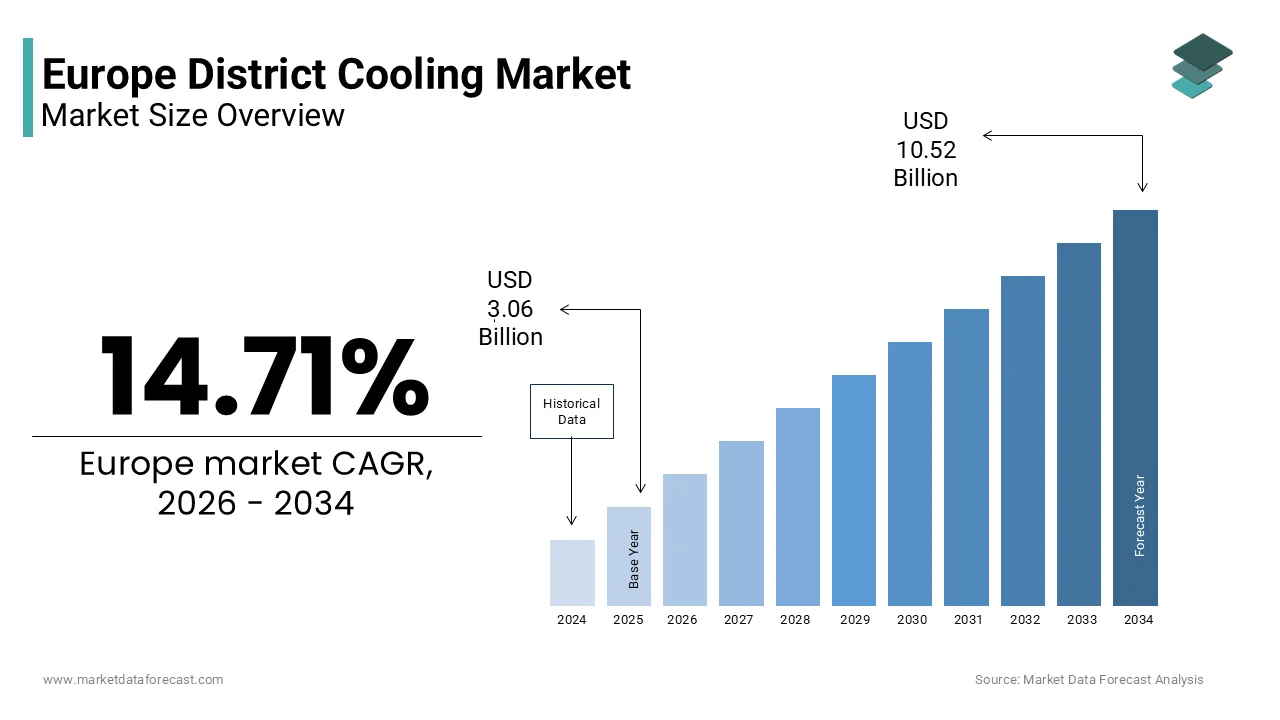
District cooling comprises centralized systems that distribute chilled water through underground networks to provide air conditioning for multiple buildings simultaneously. As per Eurostat, cooling demand in European buildings is projected to triple by 2050 due to rising average temperatures and increased urbanization, creating an urgent need for energy-efficient thermal management solutions. According to the International Energy Agency, district cooling systems can reduce electricity consumption for air conditioning by up to 40% compared to individual units by leveraging economies of scale and waste heat recovery. This market is characterized by its integration with renewable energy sources, such as seawater, lake water, and industrial waste heat, which aligns with the European Green Deal objectives. Regulatory frameworks in countries like France and Sweden mandate low-carbon heating and cooling solutions for new urban developments. The sector benefits from established infrastructure in Northern Europe while expanding rapidly in Southern regions facing extreme heat events. These structural advantages distinguish the Europe District Cooling Market from decentralized alternatives by offering superior sustainability metrics and operational efficiency for dense urban environments.
MARKET DRIVERS
Stringent Environmental Regulations Mandating Low-Carbon Solutions
Strict legislative frameworks directly accelerate the adoption of district cooling as a compliant alternative to conventional air conditioning, which is a key factor boosting the Europe district cooling market expansion. According to the European Commission Energy Efficiency Directive, member states are required to increase the share of renewable energy in heating and cooling by 1.1% annually, forcing municipalities to prioritize low-carbon infrastructure projects. As per the United Nations Environment Programme, district cooling systems emit 50% less carbon dioxide than traditional electric chillers when powered by renewable or waste energy sources, making them essential for meeting national climate targets. This regulatory pressure translates into robust demand from city planners and developers who face penalties for non-compliance with building energy performance standards. The statistical correlation between carbon pricing mechanisms and infrastructure investment shows that regions with higher carbon taxes experience a 25% faster uptake of district cooling networks. Consequently, the legal imperative for decarbonization acts as a powerful catalyst that embeds district cooling into mainstream urban planning rather than keeping it as a niche option for specific large-scale projects.
Rising Urban Density Increasing Efficiency of Centralized Systems
High population concentration in metropolitan areas enhances the economic viability of shared cooling infrastructure, which is another major market driver. According to Eurostat, over 75% of the European population lives in urban areas where space constraints limit the installation of individual rooftop chillers and condensers. As per the European Environment Agency, dense urban clusters reduce the distribution loss of chilled water to less than 10%, making central plants significantly more efficient than dispersed units. This spatial dynamic allows operators to utilize large-scale technologies, such as absorption chillers and thermal storage tanks, that are impractical for single buildings. Statistical evidence indicates that the cost per kilowatt of cooling capacity decreases by 30% in high-density zones due to shared infrastructure and reduced maintenance requirements. Therefore, the physical reality of urban sprawl functions as a demand-side driver that favors centralized solutions over fragmented individual systems, ensuring long-term operational savings for property owners and municipalities alike.
MARKET RESTRAINTS
High Initial Capital Expenditure Deterring Private Investment
Substantial upfront costs for infrastructure development create significant financial barriers for the Europe district cooling market. According to the European Bank for Reconstruction and Development, the initial investment for district cooling networks ranges from 1,000 to 2,000 euros per connected kilowatt, which is substantially higher than installing individual split units. As per the International District Energy Association, payback periods for these systems often exceed 10 years depending on usage patterns and energy prices, making them unattractive to private developers focused on short-term returns. This financial hurdle is exacerbated by the need for extensive civil works, including trenching and pipe lying in existing urban fabrics, which disrupts traffic and increases project complexity. Statistical data reveals that 40% of proposed district cooling projects in Southern Europe were abandoned due to the inability to secure long-term financing or guarantees from anchor tenants. Consequently, the capital-intensive nature of the technology acts as a persistent restraint that limits market expansion to publicly funded initiatives or large master-planned developments with guaranteed occupancy.
Complexity of Retrofitting Existing Urban Infrastructure
Integrating new cooling networks into established cities poses severe technical and logistical restraints for the Europe district cooling market. According to the Union of the Electricity Industry, digging permits in historic European city centers can take up to 18 months to approve due to archaeological preservation laws and utility congestion. As per the European Construction Industry Federation, the presence of existing underground assets, such as gas, water, and electrical lines, increases installation costs by 25% and raises the risk of service disruptions during construction. This logistical friction discourages municipal authorities from initiating projects in densely populated older districts where the need for cooling is often highest. Statistical analysis shows that retrofit projects have a 30% higher failure rate than Greenfield installations due to unforeseen subsurface obstacles and community opposition to noise and disruption. Therefore, the physical and bureaucratic complexity of urban renewal functions as a formidable barrier that confines district cooling primarily to new developments and limits its potential to decarbonize the existing building stock.
MARKET OPPORTUNITIES
Integration with Renewable Energy Sources Enhancing Sustainability Credentials
Coupling district cooling with natural cold sources creates unique value propositions for the Europe district cooling market. According to the European Commission Horizon Europe program, funding for projects utilizing seawater, lake water, and geothermal energy for cooling increased by 20% in 2023, reflecting strong policy support for nature-based solutions. As per the International Renewable Energy Agency, using free cold sources can reduce operational energy consumption by up to 90% compared to mechanical chilling, providing a compelling economic argument for coastal and lakeside cities. This technological synergy allows operators to market their services as virtually carbon neutral, attracting premium commercial tenants with strict environmental, social, and governance mandates. Statistical evidence indicates that districts powered by renewable cold sources achieve 15% higher occupancy rates due to their superior sustainability ratings. Thus, the availability of natural thermal resources transforms district cooling from a utility service into a strategic asset that enhances property values and aligns with broader climate resilience goals.
Expansion into Data Center Cooling Applications Creating New Demand Vectors
The rapid growth of digital infrastructure opens lucrative avenues for the Europe district cooling market. According to the European Data Centre Association, energy consumption by data centers in Europe is expected to double by 2030, driven by artificial intelligence and cloud computing demands requiring massive cooling capacities. As per the Uptime Institute, liquid cooling solutions integrated with district networks can improve power usage effectiveness by 20% compared to air-cooled systems, making them increasingly attractive for hyperscale facilities. This trend encourages collaboration between utility providers and tech giants to develop dedicated cooling loops that utilize waste heat for nearby residential districts, creating circular energy ecosystems. Statistical data reveals that data center-related cooling contracts now account for 10% of new district cooling connections in major hubs like Frankfurt and Dublin. Consequently, the digital economy functions as a powerful growth driver that provides stable baseload demand and justifies the expansion of network capacity beyond traditional commercial and residential sectors.
MARKET CHALLENGES
Lack of Standardized Regulatory Frameworks Across Member States
Inconsistent national policies create uncertainty for cross-border investors and technology providers, which is a significant challenge for the Europe district cooling market. According to the European Court of Auditors, only 12 out of 27 EU member states have specific regulations governing the planning and operation of district cooling networks, leading to fragmented market conditions. As per the European District Heating and Cooling Association, the absence of harmonized technical standards for pipe materials and safety protocols increases compliance costs by 15% for multinational operators seeking to expand across borders. This regulatory heterogeneity complicates financing structures and risk assessments as investors must navigate diverse legal landscapes for each project. Statistical analysis shows that projects in countries with clear regulatory frameworks attract 3 times more foreign direct investment than those in ambiguous jurisdictions. Therefore, the lack of legislative uniformity acts as a critical challenge that stifles market integration and prevents the emergence of pan-European players capable of driving innovation and economies of scale.
Public Perception and Awareness Gaps Regarding Benefits
Limited understanding of district cooling advantages hinders community acceptance and political support and further challenging the regional market expansion. According to a survey by the European Climate Foundation, 60% of citizens in non-adopting regions are unaware of the environmental and economic benefits of centralized cooling systems compared to individual air conditioners. As per the Local Government Association, misinformation about potential noise pollution and visual intrusion from infrastructure leads to local opposition that delays or cancels projects in democratic planning processes. This knowledge gap requires extensive public engagement campaigns that are costly and time-consuming for developers and municipalities. Statistical evidence indicates that projects with proactive community education programs face 40% fewer objections during permitting phases, highlighting the importance of social license to operate. Consequently, the challenge of educating stakeholders remains a persistent obstacle that slows down project timelines and increases soft costs, necessitating strategic communication efforts to build trust and demonstrate tangible local benefits.
REPORT COVERAGE
| REPORT METRIC | DETAILS |
| Market Size Available | 2025 to 2034 |
| Base Year | 2025 |
| Forecast Period | 2026 to 2034 |
| CAGR | 14.71% |
| Segments Covered | By Technology, Application, and Region |
| Various Analyses Covered | Global, Regional, & Country Level Analysis; Segment-Level Analysis; DROC, PESTLE Analysis; Porter’s Five Forces Analysis; Competitive Landscape; Analyst Overview of Investment Opportunities |
| Regions Covered | UK, France, Spain, Germany, Italy, Russia, Sweden, Denmark, Switzerland, Netherlands, Turkey, and the Czech Republic |
| Market Leaders Profiled | ENGIE, Veolia, Danfoss, Fortum, Vattenfall, Siemens, Alfa Laval, Cetetherm, Ramboll Group, Göteborg Energi, Helen Oy, Wien Energie, LOGSTOR Denmark Holding, Daikin Industries, and E.ON. |
SEGMENTAL ANALYSIS
By Technology Insights
The electric chillers segment dominated the market by holding the major share of the Europe district cooling market in 2025 due to their proven reliability and seamless integration with existing electrical infrastructure across European urban centers. According to the International Energy Agency, electric compression chillers account for approximately 65% of installed district cooling capacity in Europe because they offer high coefficient of performance values ranging from 4.0 to 6.0 under optimal operating conditions. As per Eurostat, the widespread availability of stable electricity grids in Western and Northern Europe supports the continuous operation of these energy-intensive systems without the need for complex fuel supply chains. This technological maturity reduces operational risks for utility providers who prioritize consistent service delivery over experimental technologies. The statistical correlation between grid stability and chiller adoption shows that regions with less than 1% annual power outage rates prefer electric solutions for their predictability and ease of maintenance. Consequently, the established engineering standards and robust support ecosystems secure the dominance of electric chillers as the default choice for large-scale commercial and institutional cooling applications where uptime is critical.
On the other end, the free cooling segment represents the fastest-growing segment and is predicted to witness a CAGR of 10.5% over the forecast period owing to the abundance of natural cold sources in Northern and Coastal Europe. According to the European Commission Joint Research Centre, utilizing seawater, lake water, or ambient air for free cooling can reduce electricity consumption by up to 90% compared to mechanical chilling, making it highly attractive for meeting strict carbon reduction targets. As per the Swedish Energy Agency, cities like Stockholm and Helsinki have expanded their free cooling networks by 15% annually since 2020, leveraging deep-water intakes that maintain temperatures below 10 degrees Celsius year-round. This environmental advantage aligns perfectly with the European Green Deal objectives, which prioritize nature-based solutions for urban infrastructure. Statistical evidence indicates that free cooling systems achieve payback periods of less than 7 years in coastal regions due to minimal operational energy costs, despite higher initial infrastructure investments. Therefore, the convergence of geographic suitability and regulatory pressure propels free cooling into a high-growth trajectory that challenges traditional mechanical methods in suitable locations.
By Application Insights
The commercial segment held the dominant share of the Europe district cooling market in 2025 as office towers, shopping malls, and data centers generate concentrated cooling loads that justify network connections. According to the European Property Federation, commercial buildings in major European cities consume 40% more energy for cooling than residential structures due to high internal heat gains from equipment, lighting, and occupancy. As per the Union of the Electricity Industry, district cooling contracts with commercial clients typically involve long-term agreements exceeding 15 years, providing revenue stability for operators and ensuring high utilization rates of central plants. This economic model favors dense business districts where multiple large consumers can be served by a single pipeline network, maximizing infrastructure efficiency. The statistical relationship between floor space density and connection rates shows that commercial zones with over 5,000 square meters per hectare are 3 times more likely to adopt district cooling than low-density areas. Consequently, the intense thermal demand and financial viability of commercial clusters solidify this sector as the primary driver of district cooling expansion across European metropolitan hubs.
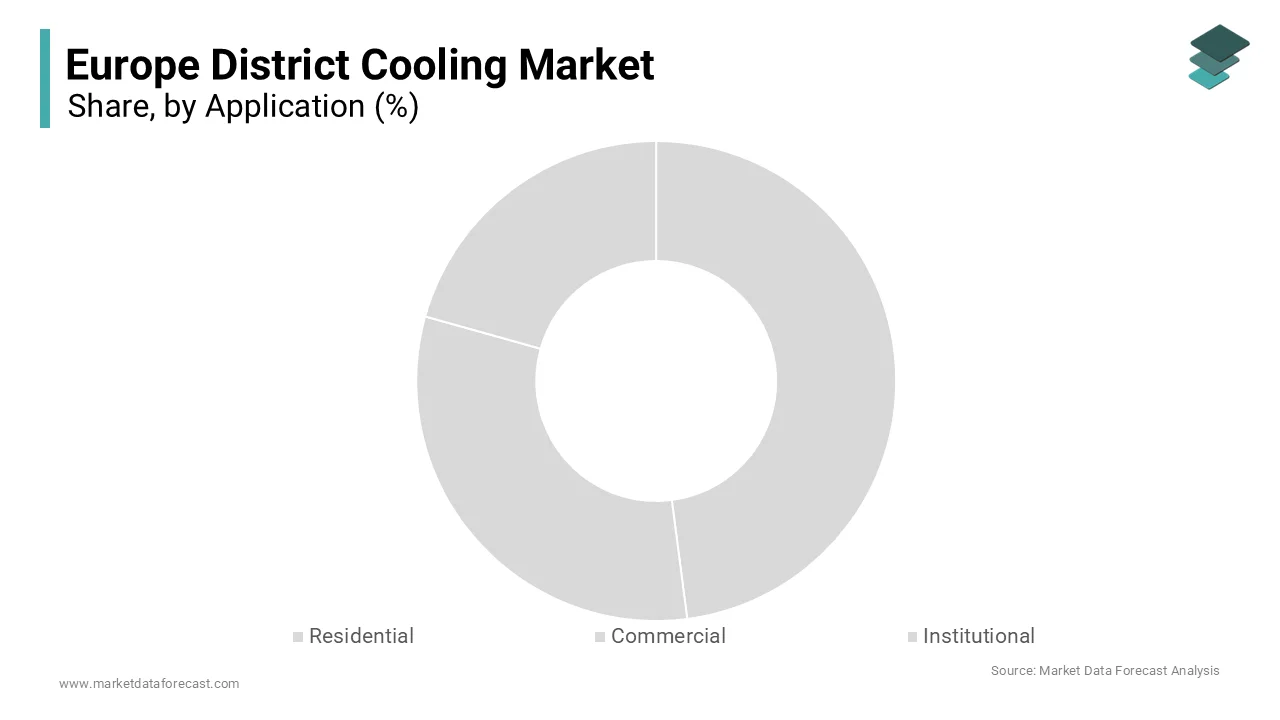
However, the residential segment is the fastest-growing application and is estimated to witness a CAGR of 9.5% during the forecast period as new housing developments integrate centralized cooling as a standard amenity. According to Eurostat, over 2 million new residential units were constructed in the European Union in 2023, with a significant portion located in urban areas where space constraints prevent individual air conditioning installations. As per the European Construction Industry Federation, modern apartment complexes increasingly feature pre-installed cooling interfaces connected to district networks to meet rising consumer expectations for thermal comfort during increasingly frequent heatwaves. This trend is supported by municipal policies that mandate sustainable cooling solutions for large residential projects to comply with local climate action plans. For instance, residential connections in new developments in France and Spain grew by 20% year-on-year, reflecting a shift from optional luxury to essential infrastructure. Thus, the combination of urban densification and changing lifestyle standards drives rapid adoption of district cooling in the housing sector, creating a substantial new revenue stream for utility providers.
REGIONAL ANALYSIS
Sweden Market Analysis
Sweden had the major share of the Europe district cooling market in 2025 and is expected to maintain its position as a highly mature and stable market leader over the next few years due to its continuous expansion of sustainable urban infrastructure and extensive use of natural cold sources. According to the Swedish Energy Agency, district cooling supplies approximately 15% of the total cooling demand in Stockholm and Gothenburg, which leverage seawater and bedrock storage systems that operate with minimal environmental impact. As per the International District Energy Association, Sweden has over 100 active district cooling networks that utilize waste heat from industrial processes and data centers to drive absorption chillers, creating circular energy loops. This advanced ecosystem is supported by strong government incentives for energy efficiency and carbon neutrality, which encourage continuous network expansion. For instance, renewable energy usage and cooling adoption shows that Swedish systems achieve 80% renewable input, significantly higher than the European average. Consequently, Sweden's combination of technical expertise, favorable geography, and policy support ensures its continued leadership in the regional district cooling landscape, serving as a model for other nations.
France Market Analysis
France is anticipated to register accelerated market growth over the coming years driven by strict environmental regulations and large-scale urban renewal initiatives in Paris and Lyon. According to the French Ministry of Ecological Transition, the Climate and Resilience Law requires new commercial buildings over 1,000 square meters to connect to existing renewable heating and cooling networks where available, forcing developers to prioritize district solutions. As per the Paris City Council, the Climespace network in the capital serves over 70 major landmarks, including the Louvre and Pompidou Center, reducing local electricity peak demand by 25% during summer months. This regulatory push is complemented by public investment in expanding pipeline infrastructure to cover more arrondissements and suburban areas. For instance, district cooling capacity in France increased by 12% in 2023, reflecting aggressive implementation of national climate goals. Therefore, France's ability to enforce compliance through legislation while investing in public infrastructure creates a dynamic and rapidly expanding market for district cooling services.
Spain Market Analysis
Spain is projected to experience strong upward growth trajectories over the next few years as rising temperatures and tourism-driven construction increase demand for efficient cooling solutions in coastal cities. According to the Spanish Association of Air Conditioning and Refrigeration, cooling demand in tourist hubs like Barcelona and Valencia has risen by 30% over the past decade, necessitating scalable infrastructure beyond individual split units. As per the Institute for Energy Diversification and Saving, several pilot projects utilizing seawater cooling have been launched in Mediterranean ports, demonstrating the technical feasibility and economic benefits of free cooling in warm climates. This adaptation strategy is crucial for maintaining competitiveness in the tourism sector where guest comfort is paramount. For instance, hotel chains in Spain are increasingly signing long-term contracts with district cooling providers to stabilize operational costs and meet sustainability certification requirements. Consequently, Spain's urgent need to adapt to climate change while supporting its vital tourism industry drives rapid adoption of district cooling technologies in key economic zones.
Germany Market Analysis
Germany is poised to display consistent and resilient market expansion over the next few years by leveraging its extensive industrial base and advanced combined heat and power integration strategies. According to the German Energy Agency, over 40% of district cooling production in cities like Berlin and Munich utilizes waste heat from industrial facilities and power generation through absorption chillers, enhancing overall system efficiency. As per the Federal Ministry for Economic Affairs and Climate Action, national strategies promote sector coupling, which encourages the use of excess thermal energy for cooling purposes, reducing primary energy consumption by up to 35%. This industrial synergy allows Germany to offer cost-competitive cooling services while lowering carbon emissions from manufacturing sectors. Statistical analysis shows that industrial-linked cooling networks in Germany have 20% lower operational costs than standalone electric plants due to free or low-cost heat inputs. Therefore, Germany's focus on industrial symbiosis and energy efficiency creates a unique and resilient district cooling model that balances economic and environmental objectives.
United Kingdom Market Analysis
The United Kingdom is expected to witness targeted high-value market expansion over the next few years driven by hyper-scale data center developments and major urban regeneration projects in London and Manchester. According to the UK Data Centre Association, hyperscale facilities in Slough and London increasingly connect to district cooling networks to manage massive heat loads more efficiently than standalone systems, improving power usage effectiveness by 15%. As per the Greater London Authority, new developments in King’s Cross and Canary Wharf incorporate shared cooling infrastructure to reduce street-level heat island effects and improve air quality. This targeted approach focuses on high-value areas where density and thermal intensity justify the investment. For instance, data center-related cooling contracts now account for 25% of new connections in London, highlighting the shifting demand profile. Consequently, the UK market evolves through strategic partnerships with digital infrastructure providers and urban planners, creating specialized high-efficiency networks rather than broad municipal coverage.
COMPETITIVE LANDSCAPE
The Europe district cooling market features a fragmented competitive landscape characterized by a mix of large utility companies specialized technology providers and municipal operators. Major players compete primarily on energy efficiency sustainability credentials and service reliability rather than price alone due to the long term nature of infrastructure contracts. The market sees intense rivalry in innovation as companies strive to integrate renewable cold sources and digital management systems to reduce operational costs and carbon footprints. Barriers to entry remain high due to significant capital requirements for pipeline construction and central plant installation as well as complex regulatory approvals for urban excavation. Established firms leverage their existing customer bases and technical expertise to secure exclusive rights in specific districts or new developments. However smaller niche players gain traction by offering specialized technologies or flexible service models for smaller communities. Competitive dynamics are further influenced by national energy policies and local climate action plans which dictate investment priorities. Companies increasingly differentiate themselves through transparent sustainability reporting and community engagement programs. This environment fosters continuous improvement in technological integration and operational efficiency across the sector.
Key Market Players
Some of the key players in the Europe district cooling market are
- ENGIE
- Veolia
- Danfoss
- Fortum
- Vattenfall
- Siemens
- Alfa Laval
- Cetetherm
- Ramboll Group
- Göteborg Energi
- Helen Oy
- Wien Energie
- LOGSTOR Denmark Holding
- Daikin Industries
- E.ON
Top Players in the Market
- Engie operates as a global leader in low carbon energy services with a significant footprint in the European district cooling sector. The company focuses on integrating renewable energy sources such as seawater and geothermal heat into its cooling networks to reduce carbon emissions significantly. Engie recently expanded its Climespace network in Paris by connecting new cultural landmarks and commercial buildings to enhance urban energy efficiency. Their strategic investments in smart grid technologies allow for real time optimization of chilled water distribution and demand response capabilities. The company actively collaborates with municipal authorities to develop master plans for sustainable urban cooling infrastructure. These efforts position Engie as a key innovator in the transition toward net zero cities. By leveraging its extensive technical expertise and financial strength Engie strengthens its competitive edge in delivering reliable and eco friendly cooling solutions across major European metropolitan areas.
- Fortum maintains a strong presence in Northern Europe particularly in Sweden and Finland where it operates some of the most efficient district cooling systems globally. The company emphasizes circular economy principles by utilizing waste heat from data centers and industrial facilities to drive absorption chillers for cooling production. Fortum recently launched innovative projects in Helsinki that integrate deep sea water cooling with thermal storage to maximize energy savings and grid stability. Their commitment to sustainability involves reducing primary energy consumption through advanced heat recovery techniques and digital monitoring platforms. The company engages in long term partnerships with technology firms to secure stable waste heat supplies for its networks. These initiatives reinforce Fortum reputation for operational excellence and environmental stewardship. By focusing on resource efficiency and technological integration Fortum continues to lead the development of smart and sustainable cooling infrastructure in the Nordic region.
- Danfoss serves as a critical technology provider in the Europe District Cooling Market by supplying high efficiency components and control systems. The company focuses on enhancing system performance through advanced variable speed drives heat exchangers and intelligent valve solutions that optimize energy usage. Danfoss recently introduced new digital tools for network balancing and leak detection which help operators reduce maintenance costs and improve service reliability. Their strategic collaborations with engineering firms ensure that best practices in hydraulic design and thermal management are implemented across new and existing projects. The company prioritizes research and development to create compact and modular equipment suitable for dense urban environments. These actions strengthen Danfoss position as an essential enabler of efficient district cooling operations. By providing cutting edge hardware and software solutions Danfoss supports the industry in achieving higher efficiency standards and meeting stringent regulatory requirements.
Top Strategies Used by Key Market Participants
Key players in the Europe District Cooling Market employ integration strategies to combine cooling with heating and power generation for maximum efficiency. Companies invest heavily in renewable energy sourcing such as seawater geothermal and waste heat to lower operational costs and meet carbon reduction targets. Digital transformation forms another core strategy as operators implement smart metering and predictive analytics to optimize network performance and reduce energy waste. Strategic partnerships with municipalities and large commercial tenants ensure long term contract stability and facilitate infrastructure expansion in dense urban areas. Expansion into niche segments like data center cooling provides new revenue streams and utilizes excess capacity during off peak hours. Sustainability reporting and certification are prioritized to align with corporate social responsibility goals and attract environmentally conscious investors. These multifaceted strategies enable participants to maintain competitive advantages and respond effectively to evolving regulatory frameworks and climate challenges in the dynamic European market landscape.
MARKET SEGMENTATION
This research report on the Europe district cooling market has been segmented and sub-segmented based on the following categories.
By Technology
- Electric chillers
- Absorption Cooling
- Free cooling
By Application
- Residential
- Commercial
- Institutional
By Country
- UK
- France
- Spain
- Germany
- Italy
- Russia
- Sweden
- Denmark
- Switzerland
- Netherlands
- Turkey
- Czech Republic
- Rest of Europe