- Product Description Description
- Table of Contents TOC
- List of Table & Figure LOT
- Get Free Sample PDF Sample PDF
Market Size, 2025
$579 MnMarket Estimate, 2026
$601 MnMarket Forecast, 2034
$811 MnCAGR, 2026–2034
3.82%Europe Docks Market Size
The Europe docks market size was valued at USD 579.32 million in 2025 and is projected to reach USD 811.80 million by 2034 from USD 601.45 million in 2026, growing at a CAGR of 3.82%.

The docks are the infrastructure and operational ecosystem supporting maritime cargo handling across commercial seaports within the European Union and associated coastal nations. Docks in this context refer to engineered waterfront structures facilitating vessel berthing, loading and unloading of goods, and intermodal connectivity to inland transport networks.
MARKET DRIVERS
Expansion of Offshore Wind Energy Infrastructure Drives Dock Modernization
The rapid deployment of offshore wind farms across Northern and Western Europe has intensified demand for specialized dock infrastructure capable of supporting turbine assembly, transport, and maintenance operations is propelling the growth of the European docks market. European Union member states aim to install 300 gigawatts of offshore wind capacity by 2050, as per a recent study. Similarly, the United Kingdom’s Humber region has allocated 180 million pounds through the Humber Local Enterprise Partnership to enhance dockside facilities for renewable energy logistics. These developments require docks to meet stringent load-bearing and spatial specifications often exceeding those of conventional container terminals. Consequently, port authorities across the North Sea and Baltic Sea are repurposing underutilized dock zones into renewable energy hubs, creating a sustained demand stream for dock engineering and retrofitting services that directly stimulate the European docks market.
Growth in Short Sea Shipping Reinforces Dock Utilization
The short sea shipping has emerged as a pivotal alternative to road freight within Europe, driven by congestion, decarbonization mandates, and supply chain resilience objectives, which is leveraging the growth of the European docks market. The short sea shipping through its Motorways of the Sea program, which aims to shift 30% of road freight over 300 kilometers to other modes by 2030. In 202,3, short sea shipping accounted for 43 % of total EU maritime freight measured in tonne kilometers. This modal shift increases vessel calls at smaller, medium-sized ports, requiring upgraded dock infrastructure to handle higher throughput and diverse cargo types, including roll-on roll-off and project cargo. Similarly, Italy’s Adriatic ports such as Ravenna and Ancona have expanded dockside rail links and storage yards to accommodate growing intra-Mediterranean trade flows. These adaptations necessitate structural reinforcement of existing docks, installation of modern fendering systems, and enhanced cargo handling interfaces, all of which contribute to sustained investment in the European docks market beyond traditional deep-sea container operations.
MARKET RESTRAINTS
Stringent Environmental Regulations Impose Cost and Design Constraints
The European environmental legislation, particularly the EU Green Deal and the Fit for 55 package, imposes rigorous emissions and ecological standards that significantly complicate dock development and renovation is hampering the growth of the European docks market. The requirement for zero-emission port operations by 2050, as mandated by the European Maritime Safety Agency, compels dock operators to integrate renewable energy systems, shore power connections, and sediment management protocols into every infrastructure project. Compliance often entails extensive environmental impact assessments that delay project timelines by 18 to 36 months, according to the survey. This limitation forces port authorities to pursue costly engineering alternatives such as floating docks or land reclamation with ecological compensation measures. For instance, the Port of Valencia suspended a 200 million euro dock extension in 2023 due to concerns over seagrass meadow disruption identified during a mandatory ecological audit conducted under EU biodiversity guidelines. These regulatory hurdles not only inflate capital expenditures but also deter private investment in dock modernization, particularly among smaller regional ports lacking dedicated environmental compliance teams, thereby acting as a structural restraint on market expansion.
Aging Dock Infrastructure Requires Capital-Intensive Rehabilitation
The mid twentieth century, with over 40% of quay walls in Western European ports exceeding their 50-year design life, is also expected to degrade the growth of Europe's docks market. Structural fatigue, corrosion, and inadequate load capacity render many docks unsuitable for contemporary vessel sizes and cargo handling technologies. However, public funding remains constrained as port authorities compete with other transport sectors for limited cohesion policy budgets. Furthermore, the technical complexity of underwater repairs and the necessity to maintain operational continuity during rehabilitation increase project costs by 25 to 40%. These financial and logistical burdens disproportionately affect smaller ports, which lack economies of scale and access to green bonds or private equity, thereby limiting their ability to participate in market growth and reinforcing infrastructure obsolescence as a persistent restraint.
MARKET OPPORTUNITIES
Digital Twin Integration Offers Precision Planning for Dock Upgrades
The adoption of digital twin technology by optimizing dock design maintenance and operational efficiency across European ports is set to pose new opportunities growth of the European docks market. Digital twins enable real-time simulation of structural loads, vessel interaction, and environmental stress, allowing engineers to model retrofit scenarios without physical disruption. Early adopters such as the Port of Hamburg have reduced dock renovation planning time by 35 % and cut cost overruns by 22 % through virtual prototyping. Furthermore, digital twins facilitate predictive maintenance by integrating sensor data from strain gauges, tide monitors, and corrosion detectors, thereby extending asset life and minimizing unplanned downtime. This integration of regulatory alignment, technological maturity, and funding support creates a scalable opportunity for engineering firms and software providers to deliver integrated dock solutions that enhance resilience and reduce lifecycle costs across the European docks market.
Circular Economy Principles Enable Sustainable Dock Construction
The innovation in dock construction materials and methods by promoting the reuse of marine dredged sediments, recycled concrete, and low-carbon steel is also expected to fuel the growth of the European docks market in the coming years. Ports are increasingly required to achieve at least 70 % reuse of excavation and demolition waste by 2030 as stipulated in the EU Construction and Demolition Waste Management Protocol. This directive has spurred pilot projects such as the Port of Ghent’s use of recycled concrete aggregates in quay wall reconstruction, which reduced embodied carbon by 38 % compared to virgin materials. Similarly, the Port of Barcelona partnered with the Catalan Institute for Water Research to stabilize dredged sediments into geotechnical fill for dock expansion, eliminating 120000 cubic meters of landfill disposal in 2023.
MARKET CHALLENGES
Labor Shortages in Marine Civil Engineering Delay Project Execution
The skilled labor in marine civil engineering disciplines is impeding the timely execution of dock construction and rehabilitation projects is boosting the growth of the European docks market. This gap stems from an aging workforce with 42 % of current professionals aged over 50 according to the Labor Force Survey, and insufficient vocational training pipelines in coastal regions. Consequently, major dock projects face extended timelines and cost escalations. These delays not only disrupt cargo operations but also jeopardize eligibility for EU infrastructure grants that require strict adherence to delivery schedules.
Geopolitical Instability Disrupts Supply Chains for Critical Dock Materials
The ongoing geopolitical tensions, particularly in Eastern Europe and the Red Sea corridor, have severely disrupted the supply of essential construction materials required for dock projects, including specialty steel, marine-grade concrete, and cathodic protection systems. This factor is anticipated to limit the growth of the European docks market. As per a 28% increase in lead times for imported steel sheet piles in 2025 compared to 202,1 due to export restrictions and rerouted logistics. Additionally, the conflict in Ukraine has curtailed access to 35 % of Europe’s pre-war supply of ferroalloys used in corrosion-resistant steel. These disruptions inflate project costs and introduce procurement uncertainty. Moreover, insurance premiums for maritime construction projects have risen by 22 % since 2022, according to Lloyd’s of London, reflecting heightened risk perceptions.
REPORT COVERAGE
| REPORT METRIC | DETAILS |
| Market Size Available | 2025 to 2034 |
| Base Year | 2025 |
| Forecast Period | 2026 to 2034 |
| CAGR | 3.82% |
| Segments Covered | By Material, Product Type, Application, End Use, Dock Accessories, and Region |
| Various Analyses Covered | Global, Regional & Country Level Analysis, Segment-Level Analysis, DROC, PESTLE Analysis, Porter’s Five Forces Analysis, Competitive Landscape, Analyst Overview on Investment Opportunities |
| Regions Covered | UK, France, Spain, Germany, Italy, Russia, Sweden, Denmark, Switzerland, Netherlands, Turkey, Czech Republic, Rest of Europe |
| Market Leaders Profiled | Candock Miami, Ronáutica Marinas, Sunstreams Boat Lifts, ShoreMaster, EZ Dock, Walcon Marine, Jet Dock Systems, Meeco Sullivan, Ingemar, Transpac Marinas, PMS Dockmarine, MariCorp U.S., AccuDock, Bellingham Marine, Versadock (Marine IP Ltd), Carolina Docks, Connect A Dock, HydroHoist, Tommy Docks, Snap Dock, Damen Shipyards, Cellofoam, and others. |
SEGMENTAL ANALYSIS
By Material Insights
The concrete segment held 38.2% of the European docks market share in 2025, with the concrete’s durability, resistance to marine borers, and minimal maintenance requirements, especially in commercial and industrial marine infrastructure. Concrete is widely used in fixed dock structures across major European ports such as Rotterdam and Hamburg, where longevity and load-bearing capacity are critical. The European Green Deal’s emphasis on sustainable construction has led to innovations in low-carbon concrete formulations, which further support its adoption. The material’s fire resistance and stability in varying tidal conditions also make it a preferred choice for public and institutional dock projects across coastal regions in Southern and Western Europe.
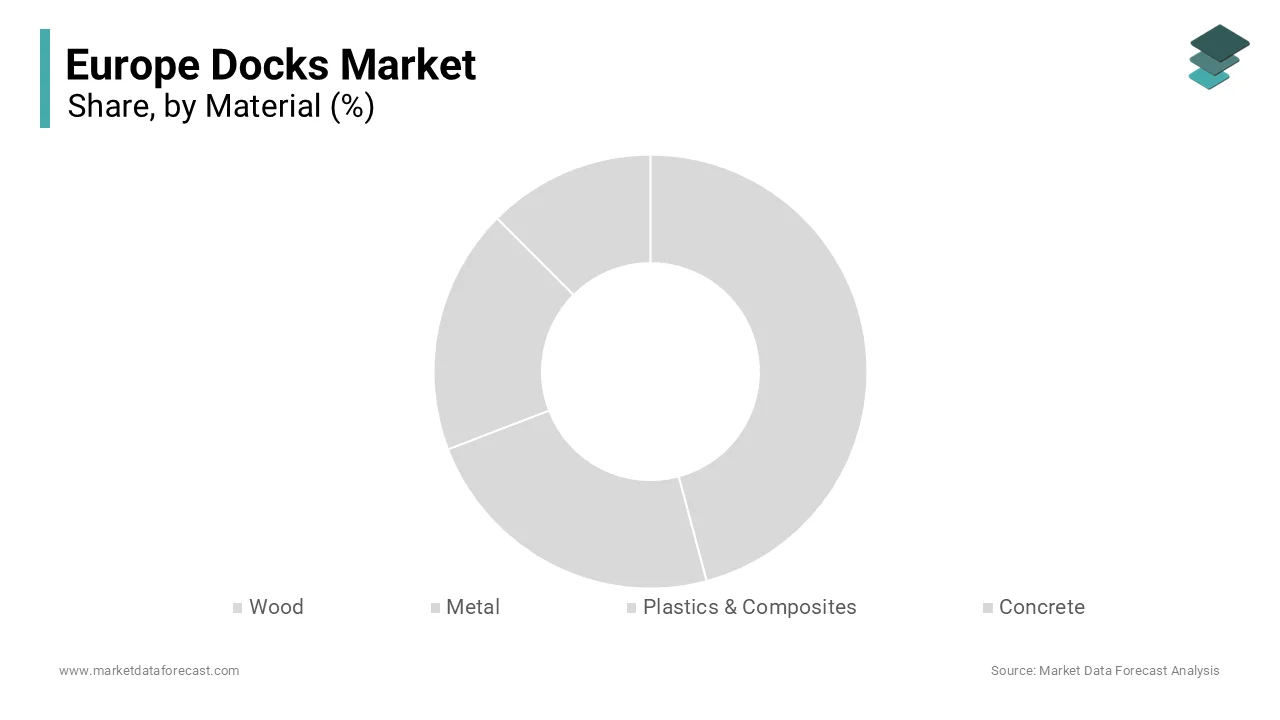
The Plastics and Composites segment is growing rapidly with a CAGR of 6.8 % from 2026 to 2034, with the rising demand for eco-friendly low maintenance, low-maintenance, and corrosion-resistant dock solutions. Composite materials made from recycled plastics and fiberglass are increasingly replacing traditional wood in residential and recreational docks, particularly in Scandinavia and the British Isles. According to a survey, over 4.5 million tonnes of plastic waste were collected in the EU in 202,3, and the use of recycled content in marine construction aligns with circular economy goals.
By Product Type Insights
The fixed docks segment held a significant share of the European docks market in 2025. Fixed docks are preferred in deep water ports and industrial harbors where structural stability and high load capacity are essential. Major European ports, including Antwerp and Felixstow, rely on fixed concrete and steel dock systems to support container handling and cargo logistics. Additionally, fixed docks offer easier integration with rail and road transport networks, which is critical for multimodal logistics hubs. The stability of fixed docks also makes them suitable for heavy machinery and cranes used in shipbuilding and offshore energy sectors, particularly in Germany and Italy, where maritime industrial activity remains robust.
The floating docks segment is expected to register the fastest CAGR of 7.2% from 2026 to 2034, with the rising recreational boating tourism and climate-induced sea level fluctuations. The recreational boating contributes over 30 billion euros annually to the EU economy and supports more than 350000 jobs. Floating docks adapt seamlessly to changing water levels, making them ideal for lakes, rivers, and coastal areas in countries like Sweden and France. Moreover, modular floating systems made from high-density polyethylene are easy to install, relocate, nd expand, which appeals to private marina operators.
By End Use Insights
The commercial segment was the largest by occupying 45.3% of the European docks market share in 2025, with the continent’s extensive maritime trade network and thriving tourism sector. Europe hosts ten of the world’s top 50 container ports, and commercial marinas in coastal cities like Barcelona, Nice, and Dubrovnik serve millions of tourists annually. Commercial docks also support ferry services, which transport over 400 million passengers yearly across the Baltic and Mediterranean SeaPublic-privateate partnerships have further accelerated commercial dock development, with countries like Spain and Greece investing in smart marina infrastructure to boost nautical tourism.
The residential segment is likely to grow with an expected CAGR of 6.5% throughout the forecast period, with the rising waterfront property ownership and lifestyle preferences among high-income households in Northern and Western Europe. The trend is mirrored in the United Kingdom, where over 1.2 million active boaters, many of whom own homes near lakes or coastal areas. Urban planning policies in countries like the Netherlands and Denmark now encourage mixed-use waterfront developments that include residential docks as part of sustainable community design. Additionally, the availability of prefabricated and customizable dock systems has lowered installation costs and time, making private docks more accessible to affluent homeowners seeking convenience and leisure amenities.
By Dock Accessories Insights
The cleats segment accounted in holding a significant share of 18.3% in 2025. Cleats are essential for securing vessels of all sizes and are standard components in both commercial and residential docks across Europe. Their universal utility, high durability, and compatibility with diverse mooring lines make them indispensable in marine infrastructure. The European Committee for Standardization has established EN 13175 specifications for marine cleats, ensuring load resistance and corrosion protection, which drives consistent procurement across EU member states. Ports such as Marseille and Genoa require cleats on every berth as part of safety compliance protocols.
The Kayak Racks segment is likely to pose a significant CAGR of 9.1% from 2026 to 2034, with the explosive popularity of kayaking and stand-up paddleboarding as recreational activities across Europe. Countries like Norway and Finland have integrated kayak access points into national water trail systems, encouraging local governments and private dock owners to install dedicated racks. Urban waterways in cities such as Amsterdam and Copenhagen now feature public kayak docks equipped with secure storage solutions. Additionally, eco-tourism operators in the Adriatic and Aegean Seas offer guided kayak tours, which require robust storage for equipment.
REGIONAL ANALYSIS
Germany Market Analysis
Germany was the largest contributor in the European docks market with an estimated 19.3% share in 2025, with its strategic location on the North and Baltic Seas and its role as Europe’s largest exporter of goods. The federal government’s Maritime Agenda 2026 allocates 1.2 billion euros to port modernization with a focus on digitalization and climate resilience. Industrial dock infrastructure supports offshore wind energy logistics with over 25000 people employed in the maritime renewable sector. Additionally, Germany’s inland waterway network spanning 7300 kilometers requires extensive docking facilities for barge transport, which further bolsters market activity.
United Kingdom Market Analysis
United Kingdom was ranked second by holding 16.2% of the share in 2025, with its extensive coastline and strong maritime heritage. Recreational boating is a major contributor, with the Royal Yachting Association estimating 1.3 million boat owners, many of whom require private or club-based docking. Post Brexit, the UK has prioritized port autonomy and infrastructure upgrades, with 800 million pounds committed under the National Infrastructure Strategy. Coastal regeneration projects in cities like Liverpool and Plymouth include new public docks to support tourism and fisheries.
France Market Analysis
France's dock market growth is escalating with its dual Atlantic and Mediterranean coastlines. According to France Stratégie, a government think tank, French ports handled 370 million tonnes of goods in 2023, with Marseille Fos serving as the largest port in the Mediterranean. The country’s Blue Economy strategy aims to double maritime sector revenue by 2030, with docks playing a central role in aquaculture, offshore energy, and cruise tourism. Public investment in green ports includes solar-powered lighting and electric boat charging stations integrated into dock structures. Regional authorities in Brittany and Provence also subsidize private dock installations to support local fishing communities and coastal livelihoods.
Italy Market Analysis
Italy's dock market growth is likely to be driven by its 7600-kilometer coastline and vibrant nautical tourism industry. The Port System Authorities have launched the Ports 4.0 initiative to digitize docking operations and improve energy efficiency across 55 port districts. Industrial docks in Genoa and Trieste support automotive and machinery exports, which account for 12 % of Italy’s total merchandise trade. Additionally, the government’s National Recovery and Resilience Plan allocates 2.3 billion euros to maritime infrastructure, including floating docks for small-scale fisheries in Sicily and Sardinia. Rising demand for luxury yacht berths in the Amalfi Coast and Portofino also drives premium dock construction.
Spain Market Analysis
Spain's dock market growth is driven by its position as a top global cruise destination. The country operates 46 commercial ports and more than 1500 recreational marinas primarily along the Costa del Sol and Balearic Islands. Investment in smart marinas under the Spain Digital 2026 plan includes IIoT-enabled dock monitoring systems for real-time occupancy and maintenance alerts. Additionally, rising domestic interest in water sports has spurred residential dock development in inland reservoirs and along the Ebro River basin.
COMPETITIVE LANDSCAPE
KEY MARKET PLAYERS
Some of the notable key players in the European docks market are
- Candock Miami
- Ronáutica Marinas
- Sunstreams Boat Lifts
- ShoreMaster
- EZ Dock
- Walcon Marine
- Jet Dock Systems
- Meeco Sullivan
- Ingemar
- Transpac Marinas
- PMS Dockmarine
- MariCorp U.S.
- AccuDock
- Bellingham Marine
- Versadock (Marine IP Ltd)
- Carolina Docks
- Connect A Dock
- HydroHoist
- Tommy Docks
- Snap Dock
- Damen Shipyards
- Cellofoam
TOP STRATEGIES USED BY THE KEY MARKET PLAYERS
Key players in the European docks market prioritize product innovation through sustainable materials and smart technologies to meet stringent environmental regulations. Companies invest heavily in research and development to create modular and adaptable dock systems that address sea level rise and coastal erosion. Strategic partnerships with local marina operators and government bodies facilitate entry into new regional markets and ensure compliance with maritime safety standards. Expansion of distribution networks and localized manufacturing reduces lead times and enhances customer service. Additionally, firms increasingly integrate digital solutions such as IoT-enabled monitoring and mobile-controlled lighting to differentiate offerings and capture premium segments in the recreational and residential sectors.
COMPETITION OVERVIEW
The European docks market features a moderately fragmented competitive landscape with a mix of global innovators and regional specialists. Established players leverage technological expertise and sustainability credentials to secure contracts in high-value commercial and luxury residential segments. At the same time, local manufacturers compete on cost and customization, particularly in Eastern and Southern Europe, where budget constraints influence procurement decisions. Regulatory alignment with EU directives on marine protection and circular economy principles has become a critical differentiator. Competition is further intensified by cross-border collaborations and public tenders for port modernization funded under the Connecting Europe Facility.
TOP PLAYERS IN THE MARKET
- Bellingham Marine is a leading global provider of floating dock systems with a strong presence across Europe. The company specializes in designing and manufacturing eco-friendly modular docks using advanced composite materials. In recent years, a rs B Llinghamam Marine has expanded its operations in Southern Europe by partnering with local marina developers in Spain and Italy to deliver sustainable docking solutions. These initiatives align with European Union environmental directives and reinforce its commitment to innovation in marine infrastructure.
- Marinetek is a Finnish company renowned for high-quality floating docks and mooring systems used in both residential and commercial applications. The company has significantly contributed to the modernization of marinas in Scandinavia and the Baltic region. This digital enhancement supports predictive maintenance and improves safety. Marinetek also collaborates with European port authorities to pilot climate-resilient docking technologies that adapt to rising sea levels and extreme weather events.
- Wahoo Docks is a prominent player known for its customizable aluminum and composite dock systems serving recreational and private markets across Western Europe. The company has intensified its focus on user-centric design by launching modular kits that allow homeowners to assemble docks with minimal tools. It also introduced a line of solar-powered dock lighting and charging stations catering to the growing demand for off-grid marine amenities among eco-conscious consumers in Germany and France.
MARKET SEGMENTATION
This research report on the European docks market has been segmented and sub-segmented based on categories.
By Material
- Wood
- Metal
- Plastics & Composites
- Concrete
By Product Type
- Floating
- Fixed
By Application
- Freshwater
- Saltwater
By End Use
- Residential
- Commercial
- Industrial
- Institutional
By Dock Accessories
- Ladders
- Bumpers
- Cleats
- Carts
- Benches/Seats
- Fish Cleaning Station
- Kayak Rack
- Trash Cans
- Lighting
- Handrails
- Other Accessories
By Country
- UK
- France
- Spain
- Germany
- Italy
- Russia
- Sweden
- Denmark
- Switzerland
- Netherlands
- Turkey
- Czech Republic
- Rest of Europe