- Product Description Description
- Table of Contents TOC
- List of Table & Figure LOT
- Get Free Sample PDF Sample PDF
Market Size, 2025
$6.51 BnMarket Estimate, 2026
$6.62 BnMarket Forecast, 2034
$7.61 BnCAGR, 2026–2034
1.68%Europe DRAM Market Report Summary
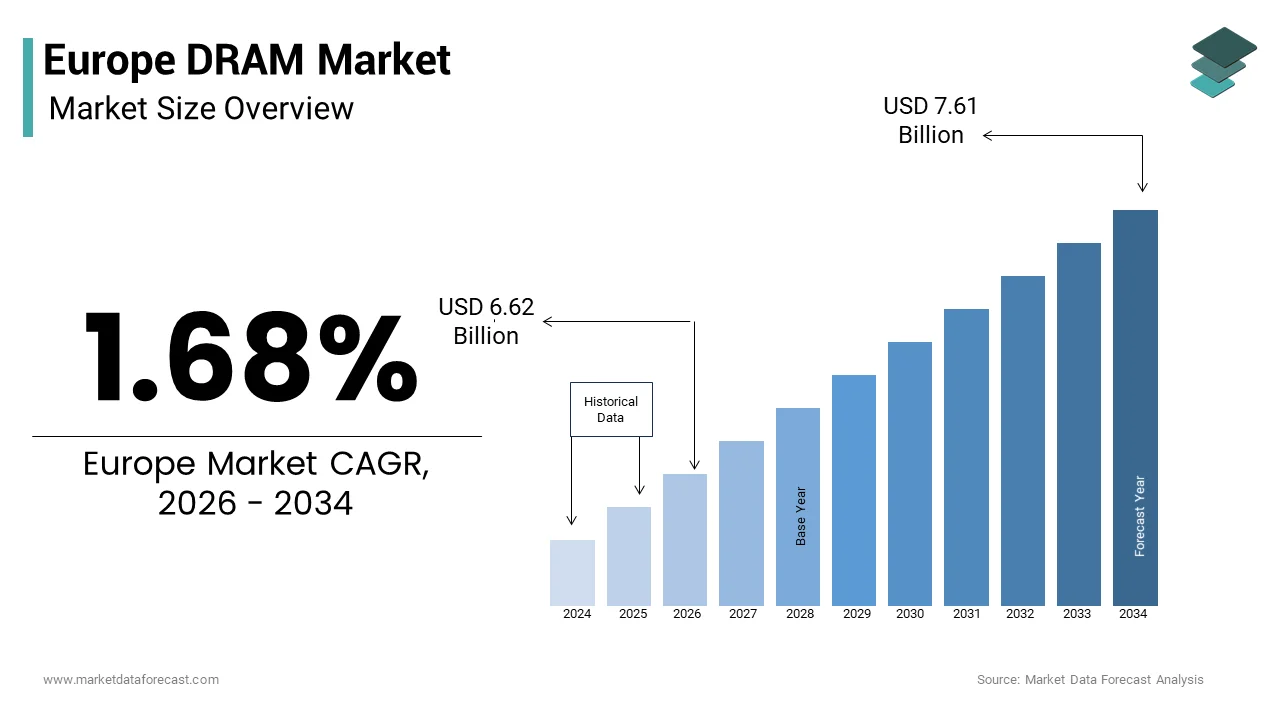
The Europe DRAM market was valued at USD 6.51 billion in 2025, is estimated to reach USD 6.62 billion in 2026, and is projected to reach USD 7.61 billion by 2034, growing at a CAGR of 1.68% during the forecast period from 2026 to 2034. The growth of the Europe DRAM market is driven by steady demand from consumer electronics, increasing data center expansion, and rising adoption of memory-intensive applications across industries. The growing need for efficient computing, cloud services, and digital transformation initiatives is further supporting the demand for DRAM solutions across Europe.
Key Market Trends
- Growing demand for memory solutions driven by increasing adoption of cloud computing and data center infrastructure.
- Rising usage of DRAM in PCs, laptops, and enterprise systems to support high-performance computing requirements.
- Gradual transition toward advanced memory architectures to enhance speed and energy efficiency.
Increasing integration of DRAM in industrial automation and smart manufacturing applications. - Stable demand from automotive and embedded systems supporting long-term market growth.
Segmental Insights
- Based on architecture, the DDR4 segment dominated the Europe DRAM market by holding a share of 52.7% in 2025. The segment’s leadership is attributed to its widespread adoption across consumer and enterprise applications due to its balance of performance, cost efficiency, and reliability.
- Based on application, the PCs and laptops segment accounted for 38.3% of the Europe DRAM market share in 2025. The segment’s dominance is driven by continuous demand for personal computing devices and enterprise IT infrastructure upgrades.
Regional Insights
The Europe DRAM market demonstrates steady growth across key countries.
- Germany led the market by accounting for 26.6% of the share in 2025, supported by its strong industrial base and technological adoption.
- The United Kingdom followed with 17.4% of the market share, driven by digital transformation and IT infrastructure investments.
- France is witnessing growth due to its strong aerospace and defense sector and expanding public sector digitalization.
- Italy is experiencing steady growth supported by its manufacturing strength and increasing focus on automation.
- The Netherlands is expected to expand due to its strategic position as a logistics and data center hub in Europe.
Competitive Landscape
The Europe DRAM market is moderately competitive, with key players focusing on product innovation, capacity expansion, and technological advancements to maintain their market position. Companies are investing in next-generation memory technologies and strengthening supply chains to meet evolving demand across industries. Prominent players in the Europe DRAM market include SK Hynix Inc., Micron Technology Inc., Nanya Technology Corporation, Winbond Electronics Corporation, Samsung Electronics Co. Ltd., Transcend Information, Kingston Technology, Infineon Technologies, ATP Electronics, and Elpida Memory Inc.
Europe DRAM Market Size
The Europe DRAM market size was valued at USD 6.51 billion in 2025 and is anticipated to reach USD 6.62 billion in 2026 to reach USD 7.61 billion by 2034, growing at a CAGR of 1.68% during the forecast period from 2026 to 2034.
Current Introduction to the Europe DRAM Market
DRAM stands for Dynamic Random Access Memory. It is a type of volatile semiconductor memory that serves as the main memory (RAM) in most modern computers, smartphones, and tablets. Unlike regions dominated by semiconductor fabrication, Europe's landscape is uniquely defined by its robust downstream demand in automotive, industrial automation, and high-performance computing sectors, coupled with a strategic push toward technological sovereignty under the European Chips Act. The region serves as a critical consumption hub where memory density and reliability are paramount for safety-critical applications. According to Eurostat, the number of information and communication technology specialists in the European Union is on a steady upward trajectory, reflecting the massive demand for digital expertise to support expanding data centers and enterprise hardware. Furthermore, the European Commission’s Digital Decade programme establishes a clear path for the majority of EU businesses to integrate advanced technologies like cloud computing and big data by the end of the decade. This transition necessitates large-scale upgrades to server infrastructure, driving the adoption of high-performance memory modules and next-generation storage solutions. Reports from SolarPower Europe confirm that the EU is consistently breaking records for new solar installations. This rapid growth in solar energy capacity requires the deployment of increasingly sophisticated power management systems that rely on durable and high-capacity memory chips for optimal performance. This convergence of digital transformation mandates, automotive electrification, and the drive for industrial AI positions Europe as a pivotal market for specialized, high-reliability DRAM solutions rather than just commodity volume.
MARKET DRIVERS
Surge in Artificial Intelligence and High-Performance Computing Infrastructure
The rapid deployment of generative AI models and exascale supercomputing initiatives drives exponential demand for high-bandwidth and high-density DRAM modules.
The aggressive expansion of AI infrastructure and high-performance computing is contributing to the growth of the Europe DRAM market. These facilities are required to train large language models and process complex scientific simulations. These applications demand memory subsystems with unprecedented bandwidth and capacity, specifically driving the adoption of High Bandwidth Memory and next-generation DDR5 modules that can handle massive datasets without bottlenecks. According to the European Commission, the EU is significantly increasing funding for AI Gigafactories and supercomputing clusters. These facilities are designed to train complex models and require massive arrays of advanced memory to support high-performance processing. The EuroHPC Joint Undertaking is actively deploying exascale-class supercomputers across Europe. These systems provide the necessary computational power for research in climate science and healthcare, relying on high-speed memory to handle vast data throughput. Furthermore, the automotive sector's shift toward autonomous driving requires onboard computers with significant DRAM capacity to process sensor data in real time. This structural shift toward data-intensive workloads ensures a sustained and growing requirement for high-performance DRAM as the foundational enabler of intelligent computation across the continent.
Accelerated Electrification and Digitalization of the Automotive Sector
The transition to electric vehicles and software-defined architectures creates a critical need for automotive-grade DRAM with enhanced durability and temperature resistance.
The profound transformation of the region’s automotive industry further boosts the expansion of the Europe DRAM market. This shift to electric vehicles and advanced driver assistance systems has drastically increased the bill of materials for memory components. Modern electric vehicles function as data centers on wheels, requiring vast amounts of DRAM for infotainment systems, digital cockpits, and neural network processing units that manage battery optimization and autonomous navigation. Data from ACEA shows that battery electric and hybrid-electric vehicles are capturing an increasing share of the European market, necessitating more complex electronic architectures compared to traditional combustion engines. Groups like the IEA highlights that modern electric vehicles contain a much higher value of semiconductor and memory components, which are critical for battery management, safety sensors, and infotainment systems. The German Association of the Automotive Industry (VDA) highlights that high-level automated driving features are a major focus for future vehicle development, requiring specialized, high-reliability memory components designed to function in the extreme environments of automotive operation. This dual pressure from electrification and automation ensures that the automotive segment remains a robust and specialized demand center for automotive-grade DRAM in the European market.
MARKET RESTRAINTS
Lack of Domestic Front-End Manufacturing Capacity
The absence of large-scale front-end fabrication facilities for memory chips within Europe creates strategic dependency and supply chain vulnerabilities.
The near-total lack of domestic front-end manufacturing capacity for memory semiconductors is a significant restraint to the European DRAM market. As a result, the region relies almost exclusively on imports from Asia and the United States for its supply needs. While Europe possesses strong capabilities in chip design, equipment manufacturing, and packaging, it currently hosts no major commercial fabrication plants dedicated to producing DRAM wafers, leaving the supply chain exposed to geopolitical tensions and global logistics disruptions. According to the European Semiconductor Industry Association (ESIA), the European Union currently accounts for a small fraction of global semiconductor manufacturing, with the region lacking any significant large-scale fabrication facilities for advanced memory modules. This geographic disconnect creates vulnerabilities, as evidenced by recent global shortages that delayed the delivery of critical components to European automotive and industrial manufacturers. The European Commission identifies a critical dependency on external suppliers for memory technologies, which remains a primary focus of the European Chips Act as it seeks to reduce vulnerabilities in the digital supply chain. Although the act aims to boost local production, the construction of memory fabs requires years of lead time and billions in capital expenditure. Constrained by external supply, the market awaits the arrival of domestic capabilities. Consequently, European system integrators struggle to secure guaranteed volumes and favorable pricing.
Stringent Environmental Regulations and Energy Consumption Constraints
Rigorous European Union directives on energy efficiency and electronic waste increase operational costs and complicate product lifecycle management.
The increasingly stringent regulatory framework governing energy consumption and electronic waste negatively impacts the expansion of the Europe DRAM market. This framework imposes additional compliance burdens on DRAM manufacturers and downstream users. The Ecodesign for Sustainable Products Regulation (ESPR) establishes new benchmarks for the environmental performance of electronic goods, compelling the industry to adopt energy-efficient memory architectures to comply with upcoming market entry requirements. In addition, the International Energy Agency (IEA) indicate that data centres are becoming a major consumer of electricity in the EU. This growth is prompting regulators to implement stricter Power Usage Effectiveness (PUE) reporting and performance standards to manage the impact of AI-driven computing on the power grid. The European Environment Agency (EEA) notes that new circularity and recycling mandates will require significant operational adjustments from electronic component assemblers, potentially impacting the financial margins of smaller enterprises as they upgrade their recovery processes. Furthermore, the restriction of hazardous substances and the requirement for higher recyclability rates complicate the material sourcing and disposal processes for memory modules containing rare earth elements and precious metals. The combination of high operational expenditures and the capital burden of sustainability transitions creates a difficult environment for maintaining profitability, potentially discouraging new investments or driving production capacity to regions with lower costs and less restrictive regulatory frameworks.
MARKET OPPORTUNITIES
Expansion of Sovereign Cloud and Edge Computing Initiatives
The development of independent European cloud platforms and edge networks offers a transformative opportunity to localize demand and reduce reliance on non-European hyperscalers.
Building sovereign cloud infrastructure and edge computing networks provides a paramount opportunity for the Europe DRAM market. These networks would operate independently of U.S. and Asian hyperscalers, creating a localized demand stream for high-performance memory. The European Union is actively fostering the creation of homegrown cloud ecosystems, such as Gaia-X, to ensure data sovereignty and provide secure environments for public sector and industrial data, which will necessitate the deployment of vast amounts of server-grade DRAM. According to the European Commission, several member states have announced plans to invest billions in constructing AI factories and sovereign cloud data centers dedicated to training large-scale models for public sector use cases. These dedicated facilities will require thousands of servers equipped with high-density DDR5 and LPDDR5 modules, all of which mandate advanced memory for optimal performance, creating a guaranteed and localized demand stream. Research indicates that the demand for sovereign cloud services is growing at twice the rate of general public cloud adoption, driven by regulatory compliance and security concerns. As these sovereign clouds come online, they will act as anchor tenants for DRAM suppliers, encouraging them to establish stronger logistical and technical support networks within the region. This shift towards digital autonomy not only secures supply but also stimulates innovation in memory-optimized architectures tailored specifically for European regulatory and industrial needs.
Integration of Advanced Memory in Industrial IoT and Automation
The proliferation of Industry 4.0 and smart factory technologies presents a lucrative avenue for deploying ruggedized, low-latency DRAM in embedded systems.
The rapid evolution towards fully automated smart factories and the IoT offers a substantial prospect for the DRAM market. This shift drives demand for specialized, ruggedized memory modules capable of withstanding harsh industrial environments. As European manufacturers adopt cyber-physical systems and real-time analytics to optimize production, the need for memory that offers low latency, high endurance, and resistance to vibration and temperature extremes becomes critical. The European Commission's Digital Europe Programme has further accelerated this trend by funding projects that integrate artificial intelligence and IoT technologies into small and medium-sized enterprises, driving demand for edge computing devices equipped with industrial-grade DRAM. The demand for high-reliability and ruggedized DRAM is expanding as industries digitalize to maintain global competitiveness. Consequently, the industrial sector has solidified its position as a key growth vertical, extending well beyond traditional consumer electronics.
MARKET CHALLENGES
Geopolitical Fragmentation and Supply Chain Volatility
Escalating geopolitical tensions and shifting trade policies create an environment of uncertainty that disrupts long-term supply planning and technology access.
The increasing volatility caused by geopolitical fragmentation and the imposition of stringent export controls on advanced semiconductor technologies by global powers is a major challenge confronting the Europe DRAM market. The trade restrictions enacted by the United States and countermeasures by other regions regarding high-end chips and memory technologies create a complex web of compliance requirements that can abruptly alter supply chains and limit access to cutting-edge nodes. According to sources, the European Union finds itself caught between competing technological spheres, forcing companies to navigate conflicting regulations that may restrict the sale or purchase of DRAM components containing specific intellectual property or manufacturing equipment. The uncertainty makes it difficult for European system integrators to commit to long-term roadmaps or secure multi-year supply contracts, as the availability of specific DRAM generations could be jeopardized by sudden policy shifts. Furthermore, the risk of being excluded from certain global technology ecosystems threatens to isolate European innovators, potentially slowing down the pace of adoption and forcing costly redesigns of products to comply with varying national security mandates.
Acute Shortage of Specialized Semiconductor Engineering Talent
The critical deficit of engineers skilled in memory architecture and system integration hampers the effective deployment and optimization of advanced DRAM systems.
A lack of specialized engineering talent impedes the expansion of the Europe DRAM market. This shortage creates a bottleneck in designing and integrating advanced memory systems. The complexity of modern DRAM, which involves intricate knowledge of signal integrity, power management, and thermal dynamics, requires a highly skilled workforce that is currently in short supply across the continent. Universities and technical institutes often lag behind the rapid pace of technological advancement, failing to produce graduates with hands-on experience in the latest memory interfaces and interconnect technologies. The talent barrier delays the time to market for new products and limits the ability of European firms to fully leverage the performance benefits of advanced DRAM. The region must make a concerted effort to upskill its workforce and attract global talent. Without this, it risks falling behind in the efficient deployment of critical technologies, stifling market growth and innovation.
REPORT COVERAGE
| REPORT METRIC | DETAILS |
| Market Size Available | 2025 to 2034 |
| Base Year | 2025 |
| Forecast Period | 2026 to 2034 |
| CAGR | 1.68% |
| Segments Covered | By Architecture, Application By Country |
| Various Analyses Covered | Global, Regional & Country Level Analysis, Segment-Level Analysis, DROC, PESTLE Analysis, Porter’s Five Forces Analysis, Competitive Landscape, Analyst Overview on Investment Opportunities |
| Regions Covered | UK, France, Spain, Germany, Italy, Russia, Sweden, Denmark, Switzerland, Netherlands, Turkey, the Czech Republic, and the Rest of Europe |
| Market Leaders Profiled | SK Hynix Inc., Micron Technology Inc., Nanya Technology Corporation, Winbond Electronics Corporation, Samsung Electronics Co. Ltd, Transcend Information, Kingston Technology, Infineon Technologies, ATP Electronics, Elpida Memory Inc. |
SEGMENTAL ANALYSIS
By Architecture Insights
The DDR4 architecture segment was the largest segment in the Europe DRAM market and captured a share of 52.7% share in 2025. This supremacy of the segment is attributed to its entrenched presence in the existing installed base of enterprise servers, industrial machinery, and mid-range consumer electronics, where the cost-performance balance remains optimal for current workloads. The primary driver for the dominance of DDR4 is the massive existing deployment of this architecture across European data centers, manufacturing plants, and legacy IT infrastructure, which creates a sustained demand for replacements and upgrades rather than immediate migration. Many European enterprises, particularly small and medium-sized businesses, operate server fleets and industrial control systems that were standardized on DDR4 during the last decade, and the high cost of replacing entire infrastructures delays the shift to newer standards. The industrial sector, a cornerstone of the European economy, relies heavily on ruggedized DDR4 modules for automation controllers and robotics that have long certification cycles, making rapid technology turnover impractical. In addition, the inertia provided by the vast installed base ensures that DDR4 remains the workhorse of the European memory market, securing its majority share despite the emergence of newer technologies. A further key factor sustaining the market share of DDR4 is its superior cost efficiency compared to the premium pricing of DDR5, making it the preferred choice for budget-conscious consumer devices and cost-sensitive industrial applications. As DDR5 production yields improve, prices are falling, yet DDR4 modules still offer a significantly lower price per gigabyte, which is crucial for manufacturers of mid-range laptops, desktops, and embedded systems operating on thin margins. Furthermore, in the industrial IoT sector, where thousands of sensors and edge devices are deployed, the cumulative cost savings of using DDR4 over DDR5 can be substantial, influencing bill of materials decisions heavily. This economic advantage ensures that DDR4 retains its dominance in volume segments, balancing performance needs with fiscal realities across diverse European industries.
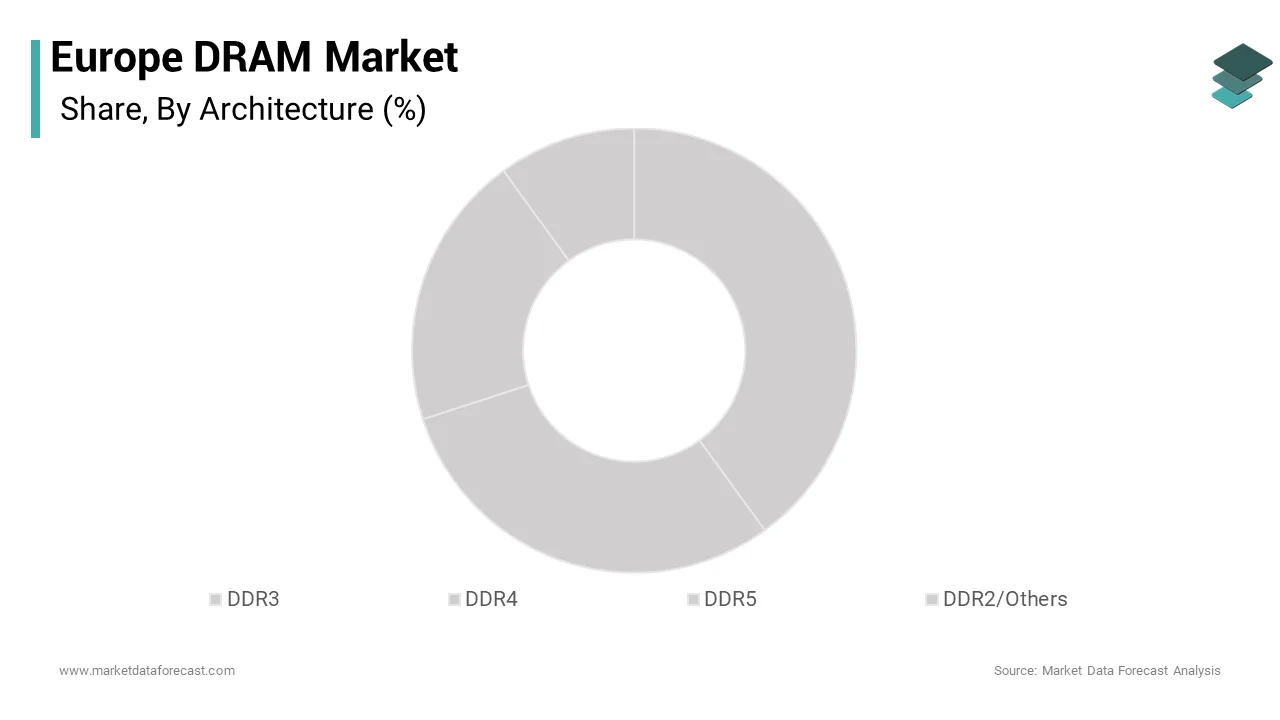
The DDR5 segment is on the rise and is expected to be the fastest growing segment in the market by witnessing a CAGR of 28.5% from 2026 to 2034 due to the mandatory adoption of DDR5 in next-generation high-performance computing platforms, the rollout of AI-driven servers, and the increasing bandwidth requirements of modern software applications. The main accelerator for the rapid expansion of DDR5 is its status as the exclusive memory standard for the latest generations of server processors and high-performance computing nodes deployed across Europe's expanding data center landscape. Major cloud providers and enterprise IT departments are upgrading their infrastructure to support artificial intelligence workloads and big data analytics, which require the doubled bandwidth and improved power efficiency that only DDR5 can provide. The inability of older architectures to keep pace with the data hunger of modern AI accelerators forces a rapid refresh cycle in the server market. As European organizations race to build sovereign AI capabilities, the demand for DDR5 modules is surging, driving its growth rate well above any other memory architecture in the region. Also supporting this segment is the escalating performance requirements of the gaming industry and professional content creation sectors in Europe, where high frame rates and rapid asset loading are non-negotiable. The release of next-generation gaming consoles and high-end graphics cards has pushed PC enthusiasts and professionals to adopt platforms capable of handling 4K and 8K video editing, 3D rendering, and immersive virtual reality experiences, all of which benefit immensely from DDR5's higher transfer speeds. Professional creatives in fields like architecture and media production also require the low latency and high bandwidth of DDR5 to streamline workflows in software like Adobe Creative Cloud and Autodesk Maya. This consumer and professional pull for top-tier performance ensures that DDR5 adoption will accelerate rapidly, outpacing the transition rates of previous generational shifts.
By Application Insights
The PCs and Laptops application segment dominated the Europe DRAM market and held a 38.3% share in 2025. This dominance of the segment is supported by the ubiquitous presence of personal computing devices in both professional and educational settings, coupled with the ongoing refresh cycles driven by remote work trends and hardware obsolescence. The preeminence of the PCs and Laptops segment is fundamentally driven by the permanent shift towards hybrid work models and digital education across Europe, which has solidified the laptop as the primary tool for productivity and learning. The need for reliable, high-performance computing devices for remote collaboration, video conferencing, and cloud-based applications has led to consistent procurement of new laptops by both corporations and educational institutions. Furthermore, government initiatives like the Digital Education Action Plan have spurred the distribution of millions of laptops to students, each requiring substantial DRAM capacity for smooth operation. This structural reliance on personal computing ensures that the PC and laptop sector remains the largest consumer of DRAM modules, driving steady volume demand across the continent. Further boosting this segment is the increasing complexity of operating systems and application software, which mandates higher DRAM capacities to maintain acceptable performance levels. Modern versions of Windows, macOS, and Linux, along with resource-intensive suites like Microsoft 365 and creative tools, consume significantly more memory than their predecessors, forcing users to upgrade their hardware to avoid sluggishness. Additionally, the rise of web-based applications that run entirely in the browser further strains memory resources, making higher capacity modules essential for a smooth user experience. This software-driven pressure ensures that even as unit sales fluctuate, the total volume of DRAM consumed per device continues to rise, securing the segment's leading position in the market.
The Automotive application segment is expected to exhibit a noteworthy CAGR of 16.8% over the forecast period owing to the electrification of vehicle fleets, the integration of advanced driver assistance systems, and the transformation of cars into software-defined platforms requiring massive data processing capabilities. The main engine for the rapid expansion of the automotive segment is the widespread deployment of Advanced Driver Assistance Systems (ADAS) and the gradual introduction of autonomous driving features, which generate terabytes of sensor data requiring real-time processing and temporary storage. Modern vehicles equipped with lidar, radar, and high-resolution cameras rely on high-bandwidth DRAM to fuse sensor inputs and make split-second safety decisions, creating a surge in memory content per vehicle. As vehicles move towards Level 3 and Level 4 autonomy, the requirement for redundant, high-reliability DRAM capable of operating in extreme temperatures will intensify, driving exceptional growth rates in this application vertical. Also helping this segment is the radical transformation of the vehicle interior into a digital cockpit featuring multiple high-resolution displays, voice assistants, and connected entertainment systems. Modern cars now function as mobile entertainment hubs, incorporating large touchscreens, augmented reality head-up displays, and seamless smartphone integration, all of which demand significant DRAM capacity to render graphics and manage multimedia streams smoothly. The shift towards software-defined vehicles also means that memory requirements will continue to grow over the vehicle's lifespan via over-the-air updates, further cementing the automotive sector as the fastest-growing application for DRAM in Europe.
COUNTRY LEVEL ANALYSIS
Germany DRAM Market Analysis
Germany led the Europe DRAM market and occupied a 26.6% share in 2025. This position of the German market is driven by its status as Europe's largest economy, hosting a dense concentration of automotive manufacturers, industrial automation giants, and a robust IT sector that drives immense demand for high-reliability memory solutions. Germany's dominance is also propelled by its world-leading automotive industry, which is undergoing a massive transformation towards electrification and autonomous driving, thereby becoming the single largest consumer of automotive-grade DRAM in the region. Companies like Volkswagen, BMW, and Mercedes-Benz are integrating increasingly complex electronic architectures into their vehicles, requiring vast amounts of high-performance memory for ADAS and digital cockpits. Furthermore, Germany's strong industrial base, characterized by Industry 4.0 initiatives, relies heavily on embedded systems and robotics that utilize ruggedized DRAM for real-time control and data processing. The presence of major research institutes and a thriving startup ecosystem focused on AI and high-performance computing further amplifies domestic consumption. This combination of automotive leadership, industrial depth, and technological innovation ensures Germany remains the primary engine of the European DRAM market.
United Kingdom DRAM Market Analysis
The United Kingdom was the next prominent country in the regional market and captured a 17.4% share in 2025. This expansion of the UK market is fuelled by its world-class financial services sector, a vibrant technology and gaming industry, and significant investments in artificial intelligence and cloud infrastructure. The UK's strong market standing is largely attributable to its role as a global hub for finance and professional services, where high-frequency trading platforms and massive data centers require ultra-low latency and high-capacity DRAM modules to process transactions and manage vast datasets. The country is also home to a thriving gaming and creative industries sector, which drives demand for high-performance GPUs and workstations equipped with the latest DDR5 memory for rendering and development. Furthermore, the government's push for digital sovereignty and the establishment of sovereign cloud capabilities are accelerating the procurement of enterprise-grade memory solutions. This blend of financial power, creative excellence, and strategic AI investment positions the UK as a critical and dynamic market for DRAM in Europe.
France DRAM Market Analysis
strong aerospace and defense sector, and extensive public sector digitalization programs. In addition, France's market strength is underpinned by its strategic commitment to digital sovereignty, exemplified by the development of the Gaia-X cloud infrastructure and national AI strategies that necessitate the deployment of thousands of servers equipped with high-density DRAM. The country's powerful aerospace and defense industry, led by giants like Airbus and Thales, utilizes specialized, radiation-hardened, and high-reliability DRAM for avionics, satellite systems, and secure communication networks, creating a niche but high-value demand stream. Additionally, the French government's extensive digitization of public services and healthcare systems drives steady procurement of IT hardware for hospitals, schools, and administrative bodies. This convergence of state-led digital ambition, high-tech industrial needs, and public sector modernization ensures France remains a pivotal market for DRAM technologies in Western Europe.
Italy DRAM Market Analysis
Italy grew steadily in the Europe DRAM market owing to its robust manufacturing sector, a growing focus on industrial automation, and a resilient consumer electronics market driven by design and lifestyle trends. Besides, Italy's significant market presence is driven by its renowned manufacturing base, particularly in the northern regions, where small and medium-sized enterprises are increasingly adopting Industry 4.0 technologies to enhance productivity and global competitiveness. This shift involves the widespread deployment of smart machines, robotic arms, and automated production lines that rely on embedded DRAM for precise control and data logging. The country also boasts a strong consumer electronics market, with Italian consumers showing a keen interest in high-end laptops, gaming PCs, and smart home devices that incorporate the latest DRAM standards. Furthermore, the automotive sector, with brands like Ferrari and Lamborghini, contributes to the demand for high-performance memory in luxury and supercar electronics. This fusion of industrial modernization, consumer appetite for technology, and automotive excellence keeps Italy as a key growth market for DRAM in Southern Europe.
Netherlands DRAM Market Analysis
The Netherlands is anticipated to expand in the Europe DRAM market during the forecast period due to its role as a major logistics and data center hub for Europe, hosting critical internet exchange points and serving as a gateway for semiconductor distribution. Also, the Netherlands' market trajectory is uniquely defined by its status as the digital gateway to Europe, hosting a disproportionately large number of hyperscale data centers in cities like Amsterdam and Groningen due to excellent connectivity and favorable business conditions. These facilities serve as critical nodes for global cloud providers, driving immense demand for server-grade DRAM to support content delivery, cloud computing, and colocation services. The country is also home to ASML, the world's leading supplier of lithography equipment, which fosters a high-tech ecosystem that consumes specialized DRAM for R&D and manufacturing control systems. Additionally, the Port of Rotterdam's ongoing digitalization and automation efforts create further demand for industrial memory solutions. This unique combination of being a physical hub for data storage and a center for semiconductor technology ensures the Netherlands maintains a strong and influential position in the European DRAM market.
COMPETITIVE LANDSCAPE
The competition in the Europe DRAM market is characterized by intense rivalry among a select group of global multinational corporations that dominate the landscape due to extremely high barriers to entry and proprietary manufacturing technologies. Established players leverage their extensive fabrication networks and decades of expertise to secure long term supply agreements with major European automotive and industrial manufacturers. The market is highly consolidated with few competitors possessing the necessary resources to conduct costly research and development cycles required for next generation memory nodes. Innovation focuses heavily on increasing data transfer speeds reducing power consumption and improving thermal performance to meet the rigorous demands of artificial intelligence and electric vehicle workloads. Companies differentiate themselves through comprehensive technical support offerings including co design services and localized engineering teams that ensure optimal integration for European clients. Strategic alliances between memory makers and processor designers are critical for validating new standards and accelerating time to market. The competitive dynamic is further shaped by the urgent need for supply chain resilience which drives customers to multi source strategies while demanding guaranteed volumes. This environment fosters continuous technological advancement while limiting the ability of new entrants to gain significant footholds without massive capital investment or breakthrough intellectual property.
KEY MARKET PLAYERS
A few of the market players that are in the Europe DRAM market are
- SK Hynix Inc.
- Micron Technology Inc.
- Nanya Technology Corporation
- Winbond Electronics Corporation
- Samsung Electronics Co. Ltd
- Transcend Information
- Kingston Technology
- Infineon Technologies
- ATP Electronics
- Elpida Memory Inc.
Top Players In The Market
- Samsung Electronics Co Ltd stands as a global titan in semiconductor manufacturing with a profound impact on the Europe DRAM landscape through its comprehensive portfolio of memory solutions. The company contributes significantly to the global market by setting industry standards for density, speed, and energy efficiency in DDR5 and LPDDR5 modules used across diverse sectors. Recently Samsung has strengthened its position by collaborating with major European automotive manufacturers to supply high reliability DRAM specifically designed for electric vehicles and autonomous driving systems. The firm actively invests in research partnerships with European universities to develop next generation low power memory technologies that align with strict EU sustainability regulations. These strategic initiatives ensure their technology remains at the forefront of innovation while addressing the critical demand for advanced storage solutions throughout the continent.
- SK Hynix Inc operates as a leading innovator in memory semiconductors with a dominant presence in the European market particularly within high performance computing and artificial intelligence applications. The company contributes globally by pioneering High Bandwidth Memory technologies that are essential for training large language models and running complex simulations. Their recent actions to solidify market presence include securing long term supply agreements with key European cloud providers and data center operators to support the rollout of sovereign AI infrastructure. SK Hynix has also invested heavily in expanding its technical support centers in Germany and France to assist local original equipment manufacturers with integration challenges. The firm frequently engages in joint development projects with European industrial firms to create ruggedized DRAM modules capable of withstanding extreme temperatures. By focusing on technological leadership and customer proximity SK Hynix enhances reliability for mission critical applications. These efforts demonstrate their commitment to driving advancement and maintaining supremacy in the competitive European memory arena.
- Micron Technology Inc is a specialized memory and storage solutions provider that has established itself as a key player in the European market through its focus on automotive and industrial grade DRAM products. The company makes a substantial global contribution by delivering scalable memory portfolios that support diverse workloads from edge computing to enterprise servers. Their recent strategy to strengthen their European position involves launching new automotive qualified DRAM lines tailored for software defined vehicles and advanced driver assistance systems which are booming in the region. Micron has also expanded its collaboration network with European research institutions to foster innovation in sustainable memory manufacturing and recycling processes. The firm continues to invest in advanced packaging facilities to ensure a resilient supply chain for its European customers amidst global volatility. By maintaining a dedicated focus on quality certification and long term lifecycle support Micron addresses the evolving needs of safety critical industries. Their persistent innovation in memory density and durability ensures they remain a vital partner for sectors seeking reliable and future proof storage solutions.
Top Strategies Used By Key Market Participants
Key players in the Europe DRAM market predominantly employ strategic localization and product specialization to secure supply chains and meet escalating regional demand for high reliability memory. Companies frequently invest billions in establishing technical support centers and design win teams within the European Union to provide rapid assistance to automotive and industrial clients. Another major strategy involves forming deep collaborative partnerships with original equipment manufacturers to co develop customized DRAM solutions that address specific application requirements like extreme temperature tolerance and long term availability. Market participants also focus heavily on expanding their production capacities for next generation DDR5 and High Bandwidth Memory to support the burgeoning artificial intelligence and cloud computing sectors. Investment in research and development remains a cornerstone strategy as firms strive to achieve breakthroughs in power efficiency and data transfer speeds. Additionally, companies pursue targeted acquisitions of niche technology startups to rapidly incorporate novel memory architectures or sustainability features into their existing platforms. These combined approaches allow industry leaders to navigate complex regulatory environments while maintaining a competitive edge in this rapidly evolving technological sector.
MARKET SEGMENTATION
This research report on the Europe DRAM market is segmented and sub-segmented into the following categories.
By Architecture
- DDR3
- DDR4
- DDR5
- DDR2/Others
By Application
- Smartphones/Tablets
- PCs/Laptops
- Data Centers
- Graphics
- Consumer Products
- Automotive
- Other Applications
By Country
- UK
- France
- Spain
- Germany
- Italy
- Russia
- Sweden
- Denmark
- Switzerland
- Netherlands
- Turkey
- Czech Republic