Europe Drippers Market Size, Share, Trends & Growth Forecast Report By Product Type, By Flow Rate, By End User, and By Country (Spain, Italy, France, Germany, United Kingdom & Rest of Europe) – Industry Analysis and Forecast, 2026 to 2034
Market Size, 2025
$1.03 BnMarket Estimate, 2026
$1.12 BnMarket Forecast, 2034
$2.27 BnCAGR, 2026–2034
9.22%Europe Drippers Market Report Summary
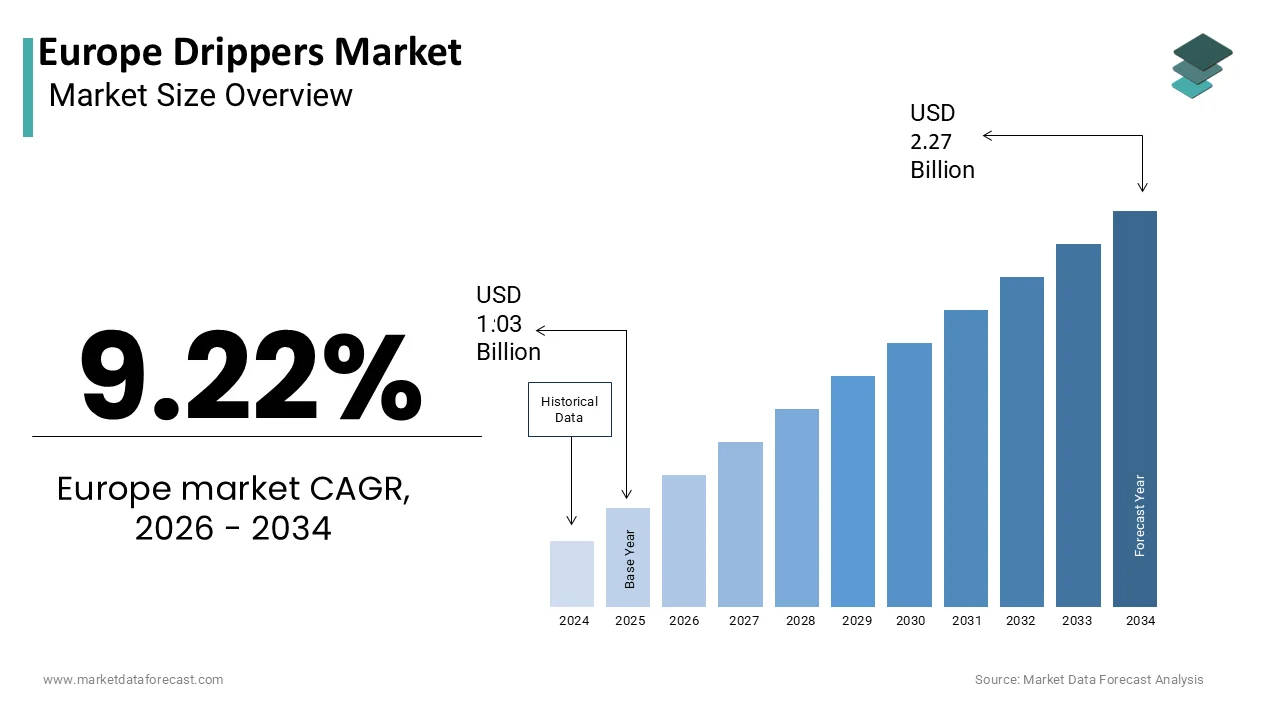
The Europe Drippers Market was valued at USD 1.03 billion in 2025 and is projected to reach USD 2.27 billion by 2034, growing from USD 1.12 billion in 2026 at a CAGR of 9.22% during the forecast period. Growth is driven by increasing drought conditions, stringent water conservation regulations, rising adoption of precision irrigation, and growing demand for sustainable farming practices. High installation costs and technical complexity remain major restraints.
Key Market Trends
- Increasing integration of drippers with IoT-based smart irrigation and precision farming systems.
- Growing adoption of automated irrigation using soil moisture sensors and weather monitoring technologies.
- Rising demand for drip irrigation in specialty crops, vineyards, greenhouses, and organic farming.
- Expansion of fertigation systems for efficient water and nutrient management.
- Growing focus on recyclable and environmentally sustainable drip irrigation components.
Segmental Insights
- Based on product type, inline drippers held the largest market share in 2025, driven by cost efficiency, uniform water distribution, and widespread adoption across large-scale farming operations.
- Based on flow rate, up to 2 liters per hour dominated the market in 2025 due to superior water-use efficiency and suitability for vegetables, fruits, and water-sensitive crops.
- Online drippers are the fastest-growing product segment, driven by increasing adoption in orchards, vineyards, greenhouses, and other high-value specialty crop applications.
Regional Insights
- Spain led the market in 2025, supported by severe water scarcity, extensive adoption of precision irrigation, government subsidies, and large-scale horticultural production.
- Italy holds a significant share, driven by vineyards, olive cultivation, organic farming, and strong government support for sustainable irrigation.
- France is a prominent market, supported by increasing precision agriculture adoption, smart irrigation integration, and environmental sustainability initiatives.
- Germany contributes notably through advanced precision farming technologies, greenhouse cultivation, and smart irrigation innovation.
- Small and medium-sized farms represent the fastest-growing end-user segment, driven by government subsidies, Common Agricultural Policy (CAP) support, and increasing adoption of water-efficient irrigation systems.
Competitive Landscape
The market is highly competitive, with global irrigation companies and regional manufacturers competing through product innovation, smart irrigation technologies, sustainability initiatives, and strong after-sales support. Companies are investing in IoT-enabled irrigation systems, clog-resistant emitters, digital farm management platforms, recyclable materials, and strategic partnerships to strengthen their market position while supporting Europe's transition toward sustainable agriculture.Prominent players in the market include Netafim, Rivulis Irrigation, and Jain Irrigation Systems.
Europe Drippers Market Size
The Europe Drippers Market is projected to grow from USD 1.03 billion in 2025 to USD 1.12 billion in 2026 and reach USD 2.27 billion by 2034, registering a CAGR of 9.22% during the forecast period from 2026 to 2034.
Drippers encompass a sophisticated array of precision irrigation components designed to deliver water directly to plant root zones with minimal waste. These systems are integral to modern agricultural practices across the continent, addressing the need for sustainable water management in farming operations. According to the European Environment Agency, agricultural activities account for 40% of total water use in the European Union. This substantial consumption underscores the urgency for efficient delivery mechanisms that reduce overall abstraction while maintaining crop yields. As per the European Environment Agency, water scarcity conditions affected 29% of the European Union territory during at least one season in 2023. Such environmental pressures have catalyzed a shift toward advanced irrigation technologies that optimize resource utilization. According to the European Environment Agency, the agricultural sector has seen a 27% decrease in water use since 1990, reflecting ongoing efforts to enhance efficiency through technological adoption. Drippers serve as the fundamental hardware enabling this transition by ensuring targeted hydration that minimizes evaporation and runoff. The integration of these components into broader smart farming ecosystems allows for real-time monitoring and automated control, further enhancing their effectiveness. As climate variability intensifies, the reliance on precise water application methods becomes increasingly vital for food security and environmental sustainability across European nations.
MARKET DRIVERS
Escalating Frequency of Extreme Drought Events Driving Adoption
The increasing prevalence of severe drought conditions across Europe is one of the major factors propelling the European drippers market expansion. According to the European Commission, approximately 34% of Europe experienced extreme agricultural drought in the summer of 2025, creating urgent demand for water conservation technologies among farmers. As per the European Environment Agency, drought conditions impacted large swathes of European Union territory throughout 2024, which indicates the persistent nature of this climatic challenge. These recurring dry spells force agricultural stakeholders to prioritize irrigation methods that maximize every drop of available water. Traditional flood or sprinkler systems suffer from high evaporation losses, whereas drippers deliver moisture directly to root zones with efficiency rates exceeding 90%. As per the European Commission, severe drought affected central, northern, and Eastern Europe along with the Mediterranean region in mid-202,,5 and this is exacerbating stress on water resources. Farmers facing such conditions recognize that switching to drip irrigation can reduce water consumption by up to 60% compared to conventional methods. This substantial savings potential makes drippers an essential investment for maintaining productivity during prolonged dry periods. The economic implications of crop failure due to water stress further incentivize the transition to precision irrigation. As drought frequency and intensity continue to rise, the agricultural sector views dripper technology not merely as an enhancement but as a necessary adaptation strategy for long-term viability.
Stringent Regulatory Frameworks Promoting Water Efficiency
European regulatory bodies have implemented rigorous policies aimed at reducing agricultural water consumption, thereby driving the mandatory or strongly encouraged adoption of efficient irrigation technologies like drippers, and this is further boosting the European market growth. According to the European Environment Agency, diffuse pollution pressures from agriculture affect 32% of ground waters and 29% of surface waters, which is prompting stricter controls on water usage and runoff. As per the European Environment Agency, water stress affects 30% of European Union territory and 34% of the population on average, leading policymakers to enforce measures that promote sustainable abstraction practices. These regulations often tie financial subsidies and agricultural grants to the adoption of water-saving technologies, making dripper systems financially attractive for farmers. The Common Agricultural Policy increasingly emphasizes environmental conditionality, requiring beneficiaries to demonstrate improved resource efficiency. According to the European Environment Agency, agricultural water use has decreased by 27% since 1990, a trend supported by policy interventions that favor precision irrigation adoption. Nations such as Spain and Italy, which face acute water stress, have introduced national laws limiting irrigation volumes, effectively mandating the use of high-efficiency systems. Compliance with these legal frameworks necessitates the installation of monitored drip lines that provide verifiable data on water usage. The regulatory push extends beyond mere volume restrictions to include quality; high-efficiency drippers help minimize fertilizer leaching into groundwater. This dual benefit of compliance and environmental protection ensures that dripper adoption remains aligned with legislative expectations across the region.
MARKET RESTRAINTS
High Initial Capital Investment Impeding Widespread Deployment
The substantial upfront cost associated with installing drip irrigation infrastructure is hampering the drippers market growth in Europe. A complete dripper system includes pumps, filters, pressure regulators, control valves, and the drip lines themselves, which results in initial expenditures that can range from 1500 to 3000 euros per hectare depending on complexity. For farmers operating on thin margins, this capital outlay poses a considerable financial risk, particularly when rthemselvesn on invresultstake several growing seasons to materialize. For instance, the demand for agricultural irrigation machinery is growing rapidly in Europe, and this indicates a sizable but potentially constrained spending capacity among agricultural operators. Many traditional farmers lack access to affordable credit facilities specifically tailored for irrigation modernization, further complicating the procurement process. The cost burden is exacerbated by the need for regular maintenance and replacement of emitters, which can clog or degrade over time. Smaller holdings often cannot achieve the economies of scale that larger agribusinesses enjoy, which is making the per-unit cost of installation disproportionately higher. Additionally, the integration of smart sensors and automated controllers adds another layer of expense that may be prohibitive for budget-conscious operators. While government subsidies per unit, the application processes are often complex and time-consuming, delaying implementation. This financial hurdle prevents many potential adopters from transitioning to drip systems, and budget-conscious operators from realizing the long-term benefits. Consequently, market penetration remains uneven, with wealthier areas adopting faster than economically strained areas.
Technical Complexity and Maintenance Requirements Limiting Accessibility
The operational intricacy of long-term irrigation systems is further impeding regional market expansion. Dripper systems require precise calibration of pressure levels, flow rates, and filtration standards to function effectively, which is demanding a level of expertise that many traditional agricultural workers do not possess. Clogging of emitters due to sediment, algae, or mineral deposits is a frequent issue that requires regular flushing and chemical treatment, adding demands burden. According to the Food and Agriculture Organization of the United Nations, behavioural factors and perceived complexity significantly influence farmers' intention to implement these technologies. The need for constant monitoring to detect leaks or blockages means that farmers must dedicate additional time to system management, which can be scarce during peak harvesting periods. Furthermore, the integration of digital controls and IoT sensors introduces cybersecurity concerns and software learning curves that older demographics may find daunting. The lack of localized technical support services in rural areas compounds these difficulties, leaving farmers without immediate assistance when systems fail. Training programs are often insufficient or inaccessible, resulting in improper installation that leads to suboptimal performance and frustration. This technical barrier discourages adoption among those who fear system failure could result in crop loss. The perception that drip systems are fragile or high maintenance persists despite advancements in durability. Without adequate support infrastructure, the potential benefits of drippers remain unrealized for a significant portion of the agricultural community.
MARKET OPPORTUNITIES
Integration with Smart Farming Technologies Creating New Avenues
The convergence of drip irrigation systems with advanced smart farming technologies opens substantial opportunities for the European drippers market. For instance, the demand for precision farming is growing at a promising CAGR, and this indicates strong momentum in digital agricultural adoption. Drippers equipped with soil moisture sensors and weather stations enable automated watering schedules that respond to real-time environmental conditions dynamically. This integration reduces manual intervention and optimizes water usage with unprecedented accuracy. Smart controllers can analyze historical data to predict irrigation needs, preventing both under- and overwatering. As per Market Data Forecast, the Europe Smart Irrigation Market was valued at 554.51 million USD in 2025, which is reflecting the growing demand for connected irrigation solutions. Farmers can monitor system performance remotely via mobile applications, allowing for immediate response to anomalies such as leaks or pump failures. This connectivity facilitates predictive maintenance, extending the lifespan of equipment and reducing downtime. The ability to generate detailed reports on water consumption aids in compliance with regulatory requirements and sustainability certifications. Moreover, integration with farm management software enables holistic planning that aligns irrigation with fertilization and pest control activities. As 5G networks expand across rural Europe, the latency and reliability of these connected systems will improve, further enhancing their appeal. This technological synergy positions drippers as central components of the digital farm ecosystem, attracting tech-savvy younger farmers and large agribusinesses seeking operational excellence.
Expansion into High Value Specialty Crop Cultivation
The growing cultivation of high-value specialty crops such as berries, vineyards, and organic vegetables is a lucrative opportunity for the drippers market in Europe. These crops require precise water management to ensure optimal quality, flavor, and yield, making high-value irrigation the preferred method for many producers. The sensitivity of fruits like strawberries and blueberries to water stress necessitates consistent moisture levels that only drippers can reliably provide. Vineyards across France, Italy, and Spain increasingly adopt deficit irrigation strategies using drippers to enhance grape quality for premium wine production. Organic farming regulations often restrict the use of certain chemicals, making the reduced leaching associated with drip systems particularly advantageous for maintaining soil health. The demand for locally grown, high-quality produce drives farmers to invest in technologies that maximize output per hectare. Drippers allow for fertigation, the simultaneous application of water and nutrients, which is crucial for intensive specialty crop production. High quality ensures that plants receive exact nutrient ratios at critical growth stages, improving both yield and marketability. As consumer preferences shift toward sustainably produced foods, certification bodies recognize drip irrigation as a best practice for resource conservation. The higher profit margins associated with specialty crops justify the initial investment in drip infrastructure, accelerating adoption in these segments. Furthermore, greenhouse cultivation of herbs and vegetables relies heavily on drip systems to maintain controlled environments. This segment continues to expand as urban farming and vertical agriculture gain traction, creating new demand channels for compact and efficient dripper solutions.
MARKET CHALLENGES
Supply Chain Disruptions Affecting Component Availability
Persistent supply chain vulnerabilities pose a significant challenge to the consistent availability and pricing of dripper components across Europe. The manufacturing of drip lines, emitters, and connectors relies on global supplies of polymers, metals, and electronic components, all of which have faced intermittent shortages in recent years. Geopolitical tensions and trade restrictions can disrupt the flow of raw materials, leading to production delays and increased costs for manufacturers. The dependence on imports for certain specialized parts exposes the European market to external shocks that are beyond local control. Logistics bottlenecks at major ports and transportation networks further complicate the timely delivery of irrigation equipment to end users. These disruptions force farmers to postpone installation projects or settle for suboptimal alternatives, hindering market growth. The volatility in plastic resin prices, a key input for drip lines, directly impacts the affordability of price-sensitive systems for price-sensitive buyers. Manufacturers struggle to maintain stable inventory levels, leading to fluctuating lead times that frustrate distributors and contractors. The lack of diversified sourcing options for critical components exacerbates these risks, leaving the supply chain fragile. Additionally, the transition to sustainable materials requires retooling and qualification processes that can temporarily reduce output. These structural weaknesses in the supply network create uncertainty for long-term stakeholders planning long-term irrigation upgrades. Addressing these vulnerabilities requires strategic stockpiling and regionalization of production, but such measures involve significant capital investment. Until supply chains stabilize, the market faces headwinds that limit its ability to meet surging demand efficiently.
Lack of Standardization Across Regional Systems
The absence of uniform technical standards for drip irrigation components across different European countries creates compatibility issues and increases complexity for users, which is further challenging the expansion of the European drippers market. Various manufacturers produce emitters, connectors, and tubing with differing specifications, making it difficult to mix and match parts from different suppliers. This fragmentation forces farmers to commit to single vendor ecosystems, reducing competition and limiting flexibility in system design. The lack of interoperability and third-party integration of sensors and controllers stifles innovation in smart irrigation solutions. Regional differences in water quality and pressure requirements further complicate the development of universal standards, as systems must be customized for local conditions. Farmers moving between regions or expanding operations face challenges in replicating successful setups due to these inconsistencies. The absence of standardized testing protocols for emitter performance makes it difficult for buyers to compare products objectively. This ambiguity can lead to poor purchasing decisions and subsequent system failures. Industry bodies have attempted to establish guidelines, but widespread adoption remains elusive due to competitive interests among manufacturers. The resulting confusion slows down the decision-making process for potential adopters who seek reliable and proven solutions. Harmonizing standards would facilitate easier maintenance, reduce spare parts inventory costs, and encourage broader market participation. Until such alignment occurs, the market remains fragmented, with each region developing its own informal norms that hinder cross-border trade and collaboration.
REPORT COVERAGE
| REPORT METRIC | DETAILS |
| Market Size Available | 2025 to 2034 |
| Base Year | 2025 |
| Forecast Period | 2026 to 2034 |
| Segments Covered | By Product Type, Flow Rate,End User and Region. |
| Various Analyses Covered | Global, Regional and Country-Level Analysis, Segment-Level Analysis, Drivers, Restraints, Opportunities, Challenges; PESTLE Analysis; Porter’s Five Forces Analysis, Competitive Landscape, Analyst Overview of Investment Opportunities |
| Countries Covered | Spain,ItalyFranceGermanyUnited KingdomRest of Europe |
| Market Leaders Profiled | Netafim Ltd. (Orbia), Jain Irrigation Systems Limited, Rivulis Irrigation Ltd., The Toro Company, Rain Bird Corporation, Hunter Industries, Inc., Antelco Pty Ltd., Metzer Group, Elgo Irrigation Ltd., Irritec S.p.A., Azud Group, EPC Industries Limited. |
SEGMENTAL ANALYSIS
By Product Type Insights
The inline drippers segment accounted for the highest share of the European market in 2025 due to their inherent cost efficiency and seamless integration into large-scale agricultural operations. These components are manufactured directly into the drip line during the extrusion process, which significantly reduces material usage and labor costs associated with assembly. This manufacturing advantage translates to lower per-unit prices, making inline systems the preferred choice for extensive row crop cultivation such as maize, potatoes, and vegetables that cover vast hectares across the European plains. The economic pressure on farmers to minimize operating per-unit expenditures drives the preference for these integrated solutions over more expensive alternatives. According to the European Commission, the adoption of cost-effective irrigation technologies has increased by 15% among large-scale arable farmers in the last five years as they seek to maintain profitability amidst fluctuating commodity prices. Inline drippers also offer uniform water distribution over long distances, which is critical for maintaining consistent crop growth in large fields. The simplicity of installation allows for rapid deployment using standard machinery, reducing downtime during planting seasons. Furthermore, the reduced risk of theft or damage compared to external emitters adds to their appeal in open field environments. The scalability of inline systems ensures that they can be easily expanded or modified to fit changing field layouts, providing long-term flexibility for agribusinesses. This combination of affordability, ease of use, and reliability solidifies the position of inline drippers as the leading product type in the European market.
On the other hand, the online drippers segment is experiencing the fastest growth in the Europe drippers market and is predicted to grow at a promising CAGR in the European market over the forecast period owing to their exceptional flexibility and suitability for high-value specialty crops. Unlike inline systems, online drippers are installed externally onto the drip line, allowing for precise placement of water delivery points according to the specific root zones of individual plants. This adaptability is high-value for orchards, vineyards, and greenhouse operations where plant spacing varies, and precise hydration is essential for quality improvement. According to Eurostat, the Europe specialty crop sector, including berries and stone fruits, has seen a 12% increase in area under cultivation in recent years, which is fuelling demand for customizable irrigation solutions. Online drippers enable farmers to adjust emitter density and flow rates easily, optimizing water use for different growth stages and plant types. This precision supports higher yields and better fruit quality, which commands premium prices in the market. The ability to replace individual emitters without replacing entire lines also appeals to growers who prioritize long-term system management. As European consumers increasingly demand high-quality, locally grown produce, farmers are investing in technologies that enhance crop characteristics. The modular nature of online systems allows for incremental upgrades and expansions, making them ideal for small- to medium-sized farms that may not have the capital for large-scale inline installations. This versatility positions online drippers as the preferred choice for intensive and diverse agricultural practices.
By Flow Rate Insights
The small- to medium-sized up to 2 liters per hour dominated the market, accounting for the leading share of the European market in 2025 due to their optimal balance between water delivery and conservation for most crops. This low flow rate is ideal for maintaining consistent soil moisture without causing runoff or deep percolation, which is critical in regions facing water scarcity. Most vegetable and fruit crops require steady, low-volume hydration that matches their transpiration rates, making this range the standard for efficient irrigation. The European Union’s emphasis on sustainable water use has driven the adoption of low-flow emitters that minimize waste while maximizing crop uptake. According to the European Environment Agency, data indicates that irrigation systems operating below 2 liters per hour can achieve water use efficiencies of over 90%, significantly higher than traditional methods. This efficiency aligns with regulatory goals and farmer objectives to reduce abstraction volumes. The water-sensitive cultivation of water-sensitive crops such as strawberries, lettuce, and tomatoes across Europe further reinforces the dominance of this segment. These are grown under precise, low-volume irrigation that prevents disease and promotes healthy root development. The technical maturity of emitters in this range ensures reliable performance and uniform distribution, building trust among users. As water resources become increasingly constrained, the preference for low flow technologies continues to grow, securing the leading position of this segment in the market.
On the other side, the greater than 4 liters per hour segment is expected to exhibit the fastest CAGR in the European market over the forecast period owing to the increasing adoption in arid regions and areas with sandy soils across Southern Europe. In regions like Spain and Greece, where evaporation rates are high and soil water-holding capacity is low, higher flow rates are necessary to ensure adequate wetting patterns and root zone coverage. Sandy soils require faster water application to prevent excessive infiltration beyond the root zone before lateral water-holding. This technical requirement has led to a surge in demand for high flow emitters in these specific agro-ecological zones. According to the Intergovernmental Panel on Climate Change, climate change projections indicate a 15% increase in aridity in Mediterranean regions by 2050, prompting farmers to adapt their irrigation strategies. Agroecological drippers allow for shorter irrigation cycles, reducing exposure to wind and heat losses. The expansion of intensive agriculture in these regions, particularly for citrus and olive production, further fuels the need for robust, high-volume irrigation solutions. Farmers are recognizing that standard low flow emitters may not provide sufficient hydration in extreme conditions, leading to a shift toward higher capacity options. This adaptation to local environmental changes drives the rapid growth of the more than 4 L H segment.
By End User Insights
The large corporate farms segment had the largest share of the European market in 2025. The dominance of this segment in the European market is mainly driven by their ability to leverage economies of scale and access substantial capital for infrastructure investment. These entities manage vast land areas that require standardized, efficient irrigation solutions to maintain productivity and stability. The high initial cost of drip irrigation systems is more easily absorbed by large operations, which can spread expenses over larger output volumes. Corporate farms often have dedicated agronomy teams and financial resources to plan and execute large-scale irrigation projects, ensuring optimal system design and implementation. According to the European Commission, data shows that farms larger than 100 hectares account for 60% of total drip irrigation installations in Europe, reflecting a large-scale dominant role in technology adoption. The professional management structure of these farms facilitates the integration of advanced technologies such as automated controls and remote monitoring, enhancing system performance. Their purchasing power allows them to negotiate better prices with suppliers and secure favorable financing terms. The focus on long-term sustainability and compliance with environmental regulations also drives corporate farms to invest in efficient irrigation technologies. This strategic approach ensures that they remain competitive and resilient in the face of long-term constraints and market volatility.
However, the small and medium-sized farms segment is predicted to record the fastest CAGR in the European market over the forecast period owing to the generous government subsidies and support programs aimed at modernizing European agriculture. Policies under the Common Agricultural Policy provide financial incentives for smallholders to invest in water-saving technologies, reducing the barrier to entry. These grants often cover a significant portion of installation costs, making drip irrigation financially viable for smaller operations. The European Commission has allocated billions of euros to rural development programs that prioritize sustainable farming practices, directly benefiting small-scale farmers. According to the European Commission, participation in these schemes has increased by 25% among small holdings in recent years, indicating strong uptake of supported technologies. Local agricultural extensions also provide technical assistance and training, helping small farmers overcome knowledge gaps and implement systems correctly. The democratization of technology through financial support enables smaller entities to compete with larger farms in terms of efficiency and quality. This inclusive approach fosters broader adoption of drip irrigation across diverse farm sizes.
COUNTRY LEVEL ANALYSIS
Spain Drippers Market Analysis
Spain led the market with the largest share of the European market in 2025 and is expected to maintain its market dominance in the coming years due to its commitment to advanced water management strategies and its extensive experience with arid conditions. According to the Food and Agriculture Organization of the United Nations, the country faces severe water scarcity, with agriculture consuming approximately 75% to 80% of available water resources, necessitating efficient irrigation technologies. Spanish farmers have pioneered the use of drip irrigation in large-scale horticulture and orchard production, particularly in regions like Andalusia and Murcia. The government supports modernization through national plans that subsidize efficient irrigation systems, driving widespread adoption. Spain accounts for a significant share of European drip irrigation installations, reflecting its advanced agricultural practices. The focus on high-value exports such as fruits and vegetables further incentivizes investment in precision irrigation to maintain quality and yield. The presence of major irrigation equipment manufacturers in Spain also fosters local innovation and market growth. The country’s proactive approach to water conservation sets a benchmark for other European nations facing similar challenges.
Italy Drippers Market Analysis
Italy is likely to see steady growth over the next few years as it further aligns with sustainable farming directives. Italy occupies a key position in the Europe drippers market characterized by its diverse agricultural landscape and strong tradition of quality produce. The country’s extensive vineyard and olive grove sectors rely heavily on drip irrigation to enhance product quality and conserve water in Mediterranean climates. According to the European Environment Agency, Italian farmers are increasingly adopting precision irrigation to meet stringent environmental regulations and consumer demands for sustainable practices. The government provides incentives for modernizing irrigation infrastructure, supporting the transition to efficient systems. Italy’s focus on organic farming and protected designation of origin products drives the need for precise water management that drip systems provide. The integration of traditional farming knowledge with modern technology creates a unique market dynamic. The presence of specialized irrighigh-valueanies catering to high value crops supports market growth. Italy’s commitment to preserving its agricultural heritage while embracing sustainability ensures continued demand for advanced dripper technologies.
France Drippers Market Analysis
France is projected to see continued investment in precision systems as national environmental standards tighten and maintains a strong position in the Europe drippers market driven by its large agricultural sector and emphasis on environmental sustainability. According to the European Commission, the country has implemented strict regulations on water usage and pesticide application, encouraging the adoption of efficient irrigation methods. French farmers are increasingly integrating drip irrigation with smart farming technologies to optimize resource use and improve crop yields. The government supports research and development in precision agriculture, fostering innovation in irrigation solutions. France’s diverse crop portfolio, including wine grapes, fruits, and vegetables, benefits from the flexibility and efficiency of drip systems. The focus on reducing environmental impact aligns with national sustainability goals, driving market growth. The presence of leading agricultural cooperatives facilitates collective investment in modern irrigation infrastructure. France’s balanced approach to productivity and environmental stewardship supports steady adoption of dripper technologies.
Germany Drippers Market Analysis
Germany is expected to experience significant technological advancements and increased adoption of digital irrigation tools in the coming years and holds a significant position in the Europe drippers market characterized by its advanced technological integration and focus on precision agriculture. Although water scarcity is less severe than in Southern Europe, German farmers adopt drip irrigation for high-value crops and greenhouse production to maximize efficiency. According to the Federal Ministry of Food and Agriculture, the country’s strong engineering sector drives innovation in smart irrigation systems that integrate with digital farm management platforms. German regulations emphasize resource efficiency and environmental protection, encouraging the use of precise irrigation methods. The adoption of drip systems in organic farming and urban agriculture projects is growing rapidly. Germany’s focus on sustainability and technological leadership supports the development of advanced dripper solutions. The presence of major agricultural technology companies fosters local market growth. Germany’s commitment to innovation ensures its continued relevance in the European irrigation landscape.
United Kingdom Drippers Market Analysis
The United Kingdom is poised for consistent market expansion as farmers adapt to changing climate conditions over the next few years and occupies a notable position in the Europe drippers market, driven by its focus on sustainable agriculture and climate resilience. According to the Department for Environment, Food and Rural Affairs, changing weather patterns and increased rainfall variability have highlighted the need for efficient water management in UK farming. Farmers are using high-value irrigation for high-value crops such as soft fruits and vegetables to ensure consistent yields. Government initiatives promoting sustainable farming practices support the adoption of water-saving technologies. The UK’s strong research sector contributes to the development of innovative irrigation solutions tailored to local conditions. The growth of vertical farming and controlled environment agriculture in urban areas drives demand for compact and efficient drip systems. The emphasis on reducing environmental impact aligns with national net zero goals. The UK’s adaptive approach to climate change ensures continued interest in precision irrigation technologies.
COMPETITIVE LANDSCAPE
The competition in the Europe drippers market is characterized by a mix of established global leaders and specialized regional manufacturers who strive to differentiate through technology and service quality. Market participants face intense pressure to innovate continuously as farmers demand higher efficiency and smarter solutions to cope with climate variability and regulatory constraints. The presence of numerous local distributors creates a fragmented downstream landscape where brand loyalty and technical support play crucial roles in purchasing decisions. Companies compete not only on product performance but also on the ability to provide integrated systems that include sensors, controllers, and software platforms. Price sensitivity remains a factor, particularly among small-scale farmers, prompting manufacturers to offer tiered product ranges. Regulatory compliance regarding material safety and water efficiency standards acts as a barrier to entry for new players while favoring incumbents with robust small-scale processes. The shift toward sustainable agriculture drives competition in eco-friendly product development. Collaborative efforts with research institutions help firms stay ahead in technological advancements. Overall,l the market rewards companies that can deliver reliable, le customizable, and digitally enabled irrigation solutions while maintaining strong after-sales support networks across diverse European regions.
KEY MARKET PLAYERS
Some of the companies that are playing a dominating role in the Europe Drippers Market include
- Netafim Ltd. (Orbia)
- Jain Irrigation Systems Limited
- Rivulis Irrigation Ltd.
- The Toro Company
- Rain Bird Corporation
- Hunter Industries, Inc.
- Antelco Pty Ltd.
- Metzer Group
- Elgo Irrigation Ltd.
- Irritec S.p.A.
- Azud Group
- EPC Industries Limited
TOP LEADING PLAYERS IN THE MARKET
- Netafim stands as a pioneering force in the European irrigation landscape with a strong commitment to sustainable agriculture and water efficiency. The company provides advanced drip irrigation solutions tailored to diverse European climatic conditions and crop requirements. Netafim actively collaborates with local farmers and agricultural institutions to promote precision farming practices that optimize resource use. Recent initiatives include the expansion of its digital farming platforms, which integrate real-time data analytics with irrigation control systems. This technological integration allows European growers to monitor soil moisture and plant health remotely, enhancing decision-making capabilities. The company also focuses on developing real-time-friendly materials for drip lines to reduce environmental impact. By offering comprehensive training programs and technical support, Netafim strengthens its,relationshdecision-makingers. Its continuous investment in research and development ensures that products meet the evolving needs of modern European agriculture while maintaining high standards of durability and performance.
- Rivulis Irrigation has established a robust presence in Europe by delivering innovative and reliable drip irrigation technologies designed for maximum efficiency. The company emphasizes modular system designs that allow for easy customization and scalability across various farm sizes. Rivulis actively engages in partnerships with local distributors and agronomists to ensure proper system implementation and maintenance. Recent efforts include the launch of new pressure-compensating emitters that perform consistently under varying hydraulic conditions common in European terrains. The company also prioritizes sustainability by introducing recyclable components and reducing plastic usage in manufacpressure-compensatingulis supports farmers through detailed agronomic guidance, helping them achieve optimal yields while conserving water. Its focus on user-friendly installation procedures reduces labor costs and encourages adoption among small and medium-sized holdings. By maintaining a strong service network, R ivulis ensures timely support and spare parts availability, reinforcing trust among user-friendly agricultural stakeholders.
- Jain Irrigation Systems contributes significantly to the medium-sized market by offering cost-effective and durable drip irrigation solutions suitable for a wide range of crops. The company leverages its global manufacturing expertise to provide high-quality products that meet stringent European standards. Jain Irrigation focuses on expanding its distribution network across key agricultural regions in Europe to improve accessibility for farmers. Recent actions include the introduction of smart irrigation controllers that integrate with existing drip systems to automate watering schedules based on weather data. The company also invests in educational workshops to raise awareness about the benefits of precision irrigation among traditional farmers. Jain Irrigation emphasizes product reliability and ease of maintenance, which are critical factors for long-term user satisfaction. By aligning its offerings with regional regulatory requirements and sustainability goals, the company strengthens its competitive position. Its commitment to innovation and customer support drives continued growth and long-term acceptance in the diverse European agricultural sector.
TOP STRATEGIES USED BY KEY MARKET PARTICIPANTS
Key players in the Europe drippers market primarily focus on product innovation and technological integration to maintain competitive advantage. Companies invest heavily in research and development to create emitters with superior clogging resistance and uniform water distribution capabilities. Strategic partnerships with local distributors and agricultural cooperatives enable broader market reach and enhanced customer support. Manufacturers increasingly emphasize sustainability by developing biodegradable or recyclable drip line materials to align with European environmental regulations. Digital transformation is another major strategy, with firms integrating IoT sensors and cloud-based platforms for remote monitoring and automated control. Providing comprehensive training and technical assistance helps overcome adoption barriers among traditional farmers. Competitive pricing strategies and flexible financing are employed to attract small and medium-sized farms. Companies also engage in mergers and acquisitions to expand their product portfolios and geographic presence. These multifaceted approaches ensure that market participants address diverse customer needs while adhering tomedium-sizedity and sustainability standards prevalent in the European agricultural sector.
MARKET SEGMENTATION
This research report on the europe drippers market is segmented and sub-segmented into the following categories.
By Product Type
- Inline Drippers
- Online Drafter-sales
By Flow Rate
- Up to 2 Liters per Hour
- 2–4 Liters per Hour
- Greater than 4 Liters per Hour
By End User
- Large Corporate Farms
- Small and Medium-Sized Farms
By Country
- Spain
- Italy
- France
- Germany
- United Kingdom
- Rest of Europe
Frequently Asked Questions
1. What is driving growth in the Europe drippers market?
Growth is driven by drought conditions, stricter water conservation rules, rising precision irrigation adoption, and demand for sustainable farming practices
2. Why are drippers important for European agriculture?
Drippers help farmers apply water more efficiently, reduce water losses, and support sustainable agriculture in water-stressed regions.
3. Which technologies are being integrated with drippers?
Drippers are increasingly being combined with IoT-based smart irrigation, soil moisture sensors, weather monitoring, and digital farm management tools.
4. Which crops and farming applications are driving demand?
Demand is rising in specialty crops, vineyards, greenhouses, orchards, and organic farming because these applications need precise water delivery.
5. Which countries are key markets in Europe?
Spain, Italy, France, and Germany are major markets, supported by water scarcity, specialty crop farming, precision agriculture, and smart irrigation adoption.
Related Reports
Access the study in MULTIPLE FORMATS
Purchase options starting from
$ 2000
Didn’t find what you’re looking for?
TALK TO OUR ANALYST TEAM
Need something within your budget?
NO WORRIES! WE GOT YOU COVERED!
Call us on: +1 888 702 9696 (U.S Toll Free)
Write to us: sales@marketdataforecast.com