- Product Description Description
- Table of Contents TOC
- List of Table & Figure LOT
- Get Free Sample PDF Sample PDF
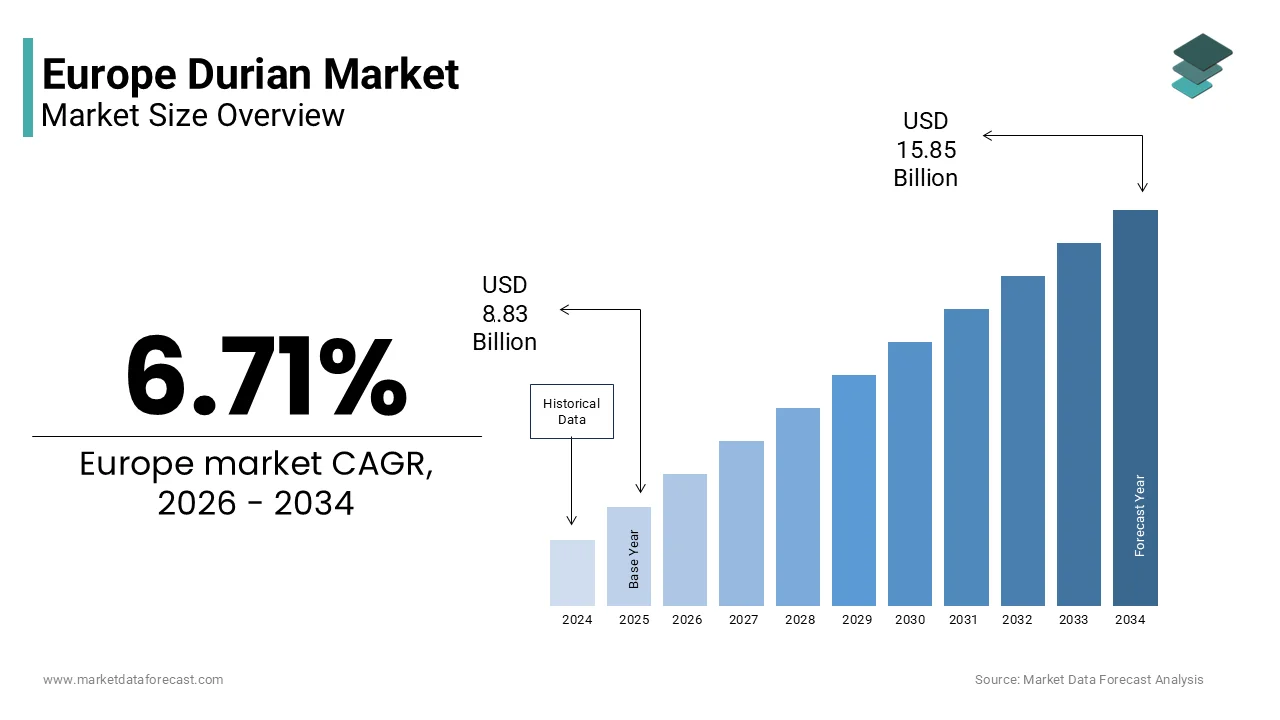
Market Size, 2025
$8.83 BnMarket Estimate, 2026
$9.42 BnMarket Forecast, 2034
$15.85 BnCAGR, 2026–2034
6.71%Europe Durian Market Report Summary
The Europe durian market was valued at USD 8.83 billion in 2025 and is estimated to reach USD 9.42 billion in 2026, and is projected to reach USD 15.85 billion by 2034, growing at a CAGR of 6.71% during the forecast period. The growth of the Europe durian market is driven by increasing consumer interest in exotic fruits, rising multicultural population, and expanding availability of imported tropical products across the region. The growing popularity of Asian cuisine, along with increasing demand for unique flavors in desserts and processed foods, is further supporting market growth. In addition, the expansion of cold chain logistics and online grocery platforms is improving accessibility and distribution of durian products across Europe.
Key Market Trends
- Increasing demand for exotic and tropical fruits driven by changing consumer preferences and rising cultural diversity across Europe.
- Growing popularity of Asian cuisines and specialty desserts boosting the consumption of durian based products.
- Expansion of frozen and processed durian products improving shelf life and market accessibility.
- Rising penetration of online grocery platforms and specialty stores supporting the availability of imported fruits.
- Advancements in cold chain logistics enhancing the quality and distribution of perishable tropical fruits like durian.
Segmental Insights
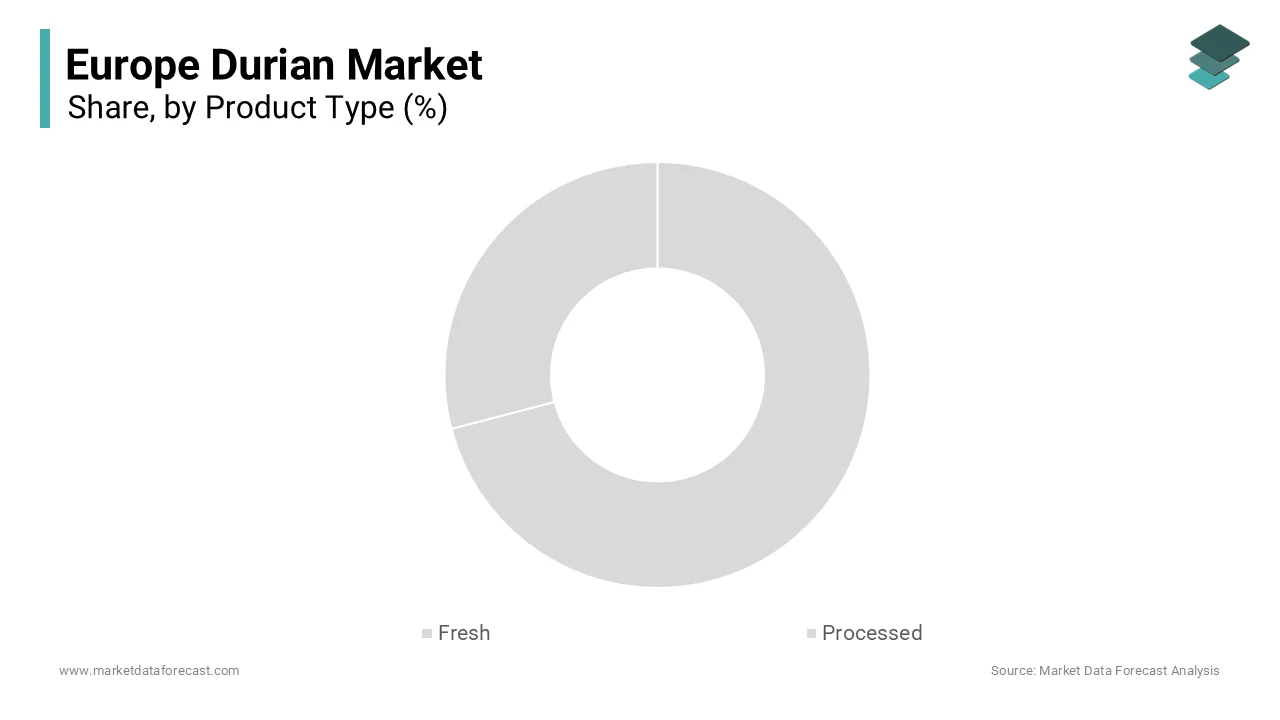
- Based on product type, the fresh durian segment accounted for 58.1% of the Europe durian market share in 2025. The dominance of this segment is attributed to strong consumer preference for authentic taste, natural texture, and premium quality associated with fresh durian fruit.
- Based on processing technology, the raw processing segment held 65.2% of the Europe durian market share in 2025. The segment’s leadership is driven by minimal processing requirements and increasing demand for natural and unprocessed fruit products.
- Based on end use, the desserts and ice creams segment captured 42.9% of the Europe durian market share in 2025. The widespread use of durian in desserts, ice creams, and confectionery products is contributing significantly to segment growth.
Regional Insights
- The Europe durian market is witnessing notable growth across several countries supported by increasing demand for exotic food products and expanding import channels.
- The United Kingdom emerged as the leading contributor to the Europe durian market, accounting for 26.5% of the regional market share in 2025. The country’s diverse population, strong presence of Asian communities, and growing demand for international cuisines are driving the consumption of durian products.
- Other European countries are also experiencing rising demand for durian driven by evolving consumer tastes, increased exposure to global cuisines, and expanding specialty food retail networks.
Competitive Landscape
The Europe durian market is characterized by the presence of several importers, distributors, and specialty food suppliers focusing on expanding product availability and maintaining quality standards. Companies are investing in efficient supply chain management, cold storage infrastructure, and partnerships with Southeast Asian producers to ensure consistent supply. Product diversification, including frozen, pulp, and processed durian products, is helping market players cater to a wider consumer base. Key companies operating in the Europe durian market include Fresh Box Sp. z o.o., NOW21, VINAHUGO Co. Ltd, VIET D.E.L.T.A Industrial Co. Ltd, 99 Gold Data Processing Trading Company Limited, TRL South East Asia Sdn Bhd, Top Fruits Sdn Bhd, and Evergreen Frozen and Dried Fruit Sdn Bhd.
Europe Durian Market Size
The Europe durian market size was valued at USD 8.83 billion in 2025 and is projected to reach USD 15.85 billion by 2034 from USD 9.42 billion in 2026, growing at a CAGR of 6.71%.
Durian is known as the "King of Fruits". It is a tropical commodity native to Southeast Asia that has transitioned from an exotic niche product to a growing segment within the European specialty fruit sector. The region relies entirely on air and sea freight imports primarily from Thailand, Malaysia, and increasingly Vietnam, as domestic cultivation is impossible due to climatic constraints. According to Eurostat, the European Union remains a major global destination for tropical fruits, with import volumes continuing to rise to meet year-round demand. Within this category, niche products like durian are seeing increased interest, primarily supported by the region's diverse diaspora communities and a growing appetite for unique culinary ingredients. The European Food Safety Authority regulates durian under strict phytosanitary protocols to prevent the entry of pests, while also monitoring for potential allergens given its potent aromatic profile. Market analysis indicates that younger urban demographics in Europe are increasingly prioritizing "food exploration" and are more willing to try exotic flavors than previous generations. According to multiple studies, this shift toward novel food experiences is creating a specialized but steady growth path for unconventional tropical fruits in high-end and ethnic retail sectors. The market is characterized by a sharp divide between traditional whole fruit sales in ethnic enclaves and the emerging premium segment of frozen pulp and durian-infused confectionery in mainstream gourmet stores. Regulatory frameworks regarding odor control in public transport and retail spaces also uniquely influence the logistics and display methods for this polarizing fruit.
MARKET DRIVERS
Expanding Asian Diaspora and Cultural Culinary Integration
The significant growth and economic empowerment of the Asian diaspora continues to drive the growth of the Europe durian market. This serves as the foundational consumer base driving consistent demand. According to Eurostat, the population of Asian-born residents in the European Union has grown steadily over the last decade. Substantial communities in countries such as France, Germany, and the Netherlands are driving a consistent demand for authentic regional ingredients, significantly influencing the local food landscape.This demographic shift has transformed durian from a rare curiosity into a staple comfort food for millions who seek authentic tastes of home. Observations of the ethnic retail sector show that sales of Southeast Asian specialty foods are on an upward trajectory. Ingredients like durian have transitioned from niche items to sought-after seasonal products, particularly during major cultural and festive celebrations across the continent. The establishment of specialized Asian hypermarkets and grocery chains across major European cities has further normalized the purchase of durian, making it accessible beyond niche corners shops. Furthermore, second and third generation immigrants are increasingly introducing durian to their non-Asian peers through social gatherings and digital content, acting as cultural ambassadors. This deep rooted cultural connection ensures a stable baseline demand that insulates the market from fleeting food trends, providing a reliable revenue stream for importers and distributors who cater to this loyal and growing customer segment.
Rising Popularity of Exotic Flavors in Gourmet Confectionery
The surging interest from the European gourmet food and beverage sector is accelerating the expansion of the European durian market. This market is increasingly incorporating durian pulp and flavorings into high-end desserts, ice creams, and pastries. The European food industry is seeing a marked increase in the launch of new products featuring exotic tropical flavors. This trend reflects a broader consumer desire for novel and intense sensory experiences, as manufacturers look beyond traditional fruit profiles to differentiate their premium offerings. Durian's unique custard like texture and complex flavor profile, often described as a blend of almond, caramel, and savory notes, appeals to adventurous foodies and professional chefs seeking differentiation. Research indicates that premium brands are increasingly experimenting with bold, international flavors. Limited-edition releases featuring durian have seen positive reception in cosmopolitan hubs, where diverse populations and "foodie" cultures are most concentrated. The fruit's versatility allows it to be used in both sweet and savory applications, from mooncakes and mousse to curry pastes and chips. Social media platforms amplify this trend, as the visual distinctiveness and controversial nature of durian generate significant online engagement and free marketing. European consumers are increasingly prioritizing experiential dining and artisanal ingredients. As a result, the integration of durian into the mainstream culinary landscape will sustain robust demand for processed and frozen formats.
MARKET RESTRAINTS
Potent Odor and Public Perception Barriers
The fruit's infamous pungent odor acts as a barrier to the European durian market. This creates significant logistical hurdles and limits its acceptance among the broader European population. The strong smell, often compared to rotting onions or turpentine by detractors, has led to explicit bans on carrying durian in hotels, on public transportation, and in certain retail environments across several European cities. According to reports on urban mobility and transit etiquette, there is an increasing awareness of sensory sensitivities in shared spaces. This has led to localized regulations and "unspoken" social norms in European public transport and shared housing that can inadvertently limit the visibility and consumption of highly aromatic foods like durian. This sensory barrier creates a psychological hurdle for first time buyers who fear the social embarrassment associated with the smell or the difficulty of disposing of the rind. Research into European "food curiosity" indicates that a significant portion of non-Asian consumers remains hesitant to purchase fresh durian. According to sources, the primary deterrent is the concern over the fruit's potent and lingering aroma in residential environments and personal vehicles.Retailers often relegate durian to isolated sections or require vacuum sealed packaging to mitigate complaints, which increases operational costs and reduces impulse visibility. The polarization of opinion means that while enthusiasts are loyal, the mass market remains elusive, constraining volume growth. Until effective odor neutralization technologies or widespread education demystifies the scent, this sensory characteristic will remain a formidable brake on market expansion.
High Logistics Costs and Perishability Constraints
The exorbitant cost and complexity of logistics required to transport fresh durian from Southeast Asia to Europe inhibit the expansion of the European durian market. Furthermore, this must be done while maintaining optimal ripeness and quality. Durian is highly perishable with a narrow window of peak edibility, necessitating expensive air freight for fresh whole fruit to prevent spoilage during the long transit. International air transport authorities confirms that the cost of air freight for perishable tropical fruits has seen sharp fluctuations recently. Rising fuel costs and global capacity constraints have substantially increased the financial burden on importers, impacting the retail price of air-flown exotic produce in Europe.This volatility directly impacts retail pricing, making fresh durian a luxury item inaccessible to average consumers. Furthermore, the strict phytosanitary regulations imposed by the European Union require rigorous inspection and certification processes that can delay shipments and increase the risk of rejection at borders. These structural inefficiencies force retailers to maintain high markups to cover risks, limiting the addressable market to affluent demographics. The reliance on distant supply chains also makes the market vulnerable to geopolitical disruptions and climate events in producing regions, creating supply instability that hampers long term planning.
MARKET OPPORTUNITIES
Expansion of Frozen and Value Added Product Formats
Aggressive development and commercialization of frozen durian pulp and value-added derivatives pave the way for the growth of the European durian market. This approach overcomes the logistical limitations of fresh fruit. Freezing technology effectively locks in the flavor and texture of durian at peak ripeness while neutralizing the potent odor and extending shelf life to over 12 months. Processed formats such as durian chips, freeze dried cubes, and ready to use pastry fillings allow manufacturers to tap into the snacking and baking sectors without the waste associated with fresh fruit. These formats also enable distribution through standard cold chains rather than expensive air freight, significantly reducing landed costs and retail prices. By shifting the focus from whole fresh fruit to versatile processed ingredients, suppliers can penetrate mainstream supermarkets and food service channels that were previously inaccessible. This strategic pivot towards value addition unlocks significant volume growth potential and democratizes access to the "King of Fruits" for a wider European audience.
Cultivation Initiatives in Southern European Microclimates
The exploration of durian cultivation in specific microclimates within Southern Europe provides a substantial long-term opportunity for the Europe durian market. This approach could reduce import dependency and lower costs. Advancements in agricultural technology and the selection of hardier varieties have sparked pilot projects in Spain, Italy, and Greece. Although traditionally a tropical crop, these Mediterranean regions have mild enough winter temperatures to support its growth. Successful trials in Sicily and Andalusia have demonstrated the feasibility of producing small batches of high quality durian locally, which appeals to the "locavore" movement and reduces the carbon footprint associated with long distance transport. Although commercial scale production remains years away, the potential to establish a European supply chain could revolutionize the market dynamics by ensuring fresher product availability and mitigating currency and freight risks. Early movers who invest in agronomic research and pilot plantations stand to capture a first mover advantage in a potentially disruptive local supply sector.
MARKET CHALLENGES
Stringent Phytosanitary Regulations and Import Compliance
Rigorous and ever-evolving phytosanitary regulations govern the import of fresh tropical fruits from non-EU countries. This creates a serious challenge for the European durian market. The European Union maintains strict maximum residue limits for pesticides and zero tolerance for specific quarantine pests, requiring exporters to implement costly treatment protocols such as vapor heat treatment or irradiation. The complexity of navigating these regulations varies by country of origin, with some nations facing temporary bans due to pest outbreaks, creating supply volatility. Small and medium sized importers often lack the resources to manage these complex compliance requirements, leading to market consolidation where only large players can operate effectively. Furthermore, the lack of harmonization in interpretation of rules across different member state ports can lead to inconsistent enforcement, adding uncertainty to supply chains. Regulatory friction will remain a persistent barrier to market fluidity and cost competitiveness. This will continue until trade agreements streamline processes or local production becomes viable.
Consumer Education Gaps and Preparation Complexity
Many consumers lack the knowledge necessary to select, open, and consume durian, which is also a hindrance to the European durian market. Consequently, this creates a high barrier to entry for inexperienced buyers. Unlike many other fruits, durian requires specific techniques to identify ripeness and safely extract the flesh due to its hard, spiky shell and potent aroma. According to sources, a notable share of non Asian consumers express anxiety about purchasing durian because they do not know how to handle it or fear buying an unripe or overripe fruit. This uncertainty leads to low trial rates and negative experiences if the first attempt results in a poor quality product, reinforcing negative stereotypes. The absence of standardized grading systems in European retail further complicates the decision making process for shoppers. Retailers report that without in store demonstrations or clear instructional labeling, sales of whole durian remain stagnant outside of ethnic communities. Digital content helps but cannot fully replace the tactile guidance needed for such a unique fruit. Additionally, the disposal of the large, spiky rind poses a practical challenge for urban households with limited waste management options. Coordinated industry efforts to educate consumers and simplify the user experience through pre-prepared formats are necessary. Without them, the complexity of engagement will continue to limit the market's expansion into the mainstream.
REPORT COVERAGE
| REPORT METRIC | DETAILS |
| Market Size Available | 2025 to 2034 |
| Base Year | 2025 |
| Forecast Period | 2026 to 2034 |
| CAGR | 6.71% |
| Segments Covered | By Product Type, Processing Technology, End Use, and Region |
| Various Analyses Covered | Global, Regional, & Country Level Analysis; Segment-Level Analysis; DROC, PESTLE Analysis; Porter’s Five Forces Analysis; Competitive Landscape; Analyst Overview of Investment Opportunities |
| Regions Covered | UK, France, Spain, Germany, Italy, Russia, Sweden, Denmark, Switzerland, Netherlands, Turkey, and the Czech Republic |
| Market Leaders Profiled | Fresh Box Sp. z o.o., NOW21, VINAHUGO Co. Ltd, VIET D.E.L.T.A Industrial Co. Ltd, 99 Gold Data Processing Trading Company Limited, TRL South East Asia Sdn Bhd, Top Fruits Sdn Bhd, and Evergreen Frozen and Dried Fruit Sdn Bhd |
SEGMENTAL ANALYSIS
By Product Type Insights
The fresh durian segment was the largest segment in the Europe durian market and occupied a 58.1% share in 2025. This prominence of the segment is driven by the cultural preference of the core consumer base, primarily the Asian diaspora, who prioritize the authentic sensory experience of consuming the fruit at peak ripeness. This segment's dominance is backed by the perception that fresh durian offers superior flavor complexity and texture compared to preserved alternatives. One key reason driving the fresh segment is the unwavering demand from Asian communities across Europe for the unadulterated taste and aroma that only fresh fruit can provide. Consumers in these demographics often view processed forms as inferior substitutes suitable only when fresh options are unavailable. The ritual of selecting, opening, and sharing a fresh durian is also a significant social activity that reinforces community bonds, making the whole fruit essential for cultural preservation. Retailers catering to these communities invest heavily in air freight logistics to ensure the arrival of fresh stock, knowing that this segment drives the majority of their revenue. This deep cultural attachment ensures that fresh durian remains the benchmark against which all other forms are measured, sustaining its market leadership. In addition, this segment is supported by the positioning of fresh durian as a luxury gift item and status symbol within both Asian and increasingly affluent non Asian circles in Europe. The visual impact of presenting a whole, spiky durian carries a prestige that packaged pulp or chips cannot replicate, making it a preferred choice for corporate gifting and special occasions. The scarcity of high quality fresh durian due to logistical constraints further enhances its exclusivity, driving up desirability. Supermarkets and specialty stores often display fresh durian in prominent, climate controlled sections to highlight its premium nature, attracting impulse buyers seeking a unique treat. This association with luxury and exclusivity creates a resilient demand curve that is less sensitive to price fluctuations, securing the dominant market share of the fresh segment.
The processed durian segment is predicted to witness the highest CAGR of 14.2% during the forecast period. This segment is experiencing rapid expansion due to its ability to overcome the logistical and sensory barriers associated with fresh fruit, thereby unlocking access to the mainstream European consumer. The segment is further boosted by its effectiveness in neutralizing the potent odor of durian and extending shelf life, which facilitates distribution through standard retail channels. The cost efficiency allows retailers to stock durian in mainstream supermarkets without fear of customer complaints regarding smell, significantly expanding availability. The removal of the odor barrier also encourages trial among curious non Asian consumers who were previously hesitant to bring fresh durian into their homes or vehicles. Furthermore, processed formats like freeze dried chips and canned pulp offer consistent quality and portion control, appealing to busy urban lifestyles. By solving the fundamental logistical and sensory challenges of the fresh fruit, processed durian is rapidly penetrating markets that were previously inaccessible, driving exceptional growth rates. A further key driver is the increasing adoption of processed durian ingredients by the European food service and manufacturing sectors for use in desserts, beverages, and baked goods. The standardized texture and flavor profile of processed durian allow for precise formulation in ice creams, mooncakes, and pastries, ensuring uniform product quality across multiple locations. Processed formats also enable the creation of innovative products like durian flavored soft drinks and snack bars that would be impossible to produce with fresh fruit due to stability issues. The ability to incorporate durian into a wide range of industrial applications without the complexities of fresh supply chains makes processed forms indispensable for manufacturers. This expanding utility in the B2B sector is fueling substantial volume growth, positioning processed durian as the most dynamic segment in the market.
By Processing Technology Insights
The raw processing technology segment led the Europe durian market and captured a 65.2% share in 2025. This leading position of the segment is supported by its ability to preserve the near fresh characteristics of the fruit while offering the logistical benefits of preservation. The main cause behind the raw segment leadership is the superior capability of freezing and chilling technologies to lock in the authentic flavor, aroma, and creamy texture of durian at its peak ripeness. Consumers and food manufacturers alike prioritize this fidelity to the fresh experience, making raw frozen durian the preferred input for high end desserts and direct consumption. The absence of heat treatment prevents the development of cooked flavors that can alter the delicate balance of sweet and savory notes characteristic of premium varieties. Additionally, the visual appeal of the bright yellow flesh is better maintained in raw frozen states compared to thermally processed versions which may darken. This commitment to quality and authenticity ensures that raw processing remains the gold standard for preserving durian, sustaining its dominant market share across both retail and food service channels. A major factor that aids this segment is the versatility of raw frozen durian which serves as a foundational ingredient for a wide array of downstream applications in the European food industry. The flexibility allows manufacturers to adjust usage rates based on demand without being constrained by the short shelf life of fresh fruit. The ability to store large quantities of raw frozen durian also provides a buffer against seasonal supply fluctuations and price volatility in the fresh market. Furthermore, the format supports portion control and reduced waste, as users can thaw only the amount needed for specific batches. This operational efficiency and adaptability make raw processing the most practical and widely adopted technology for integrating durian into the European food supply chain, reinforcing its leading position.
The dried processing technology segment is estimated to register the fastest CAGR of 16.5% over the forecast period due to the explosion of the healthy snacking sector and the unique advantages of dehydration in creating novel product formats. The principal driver for the surge in dried durian adoption is the aligning of this format with the robust European trend toward healthy, portable, and convenient snacking options. Dried durian, particularly freeze dried varieties, retains significant levels of fiber, vitamins, and minerals while offering a crunchy texture that appeals to modern palates. The lightweight and non perishable nature of dried durian makes it ideal for on the go consumption, fitting seamlessly into lunchboxes, gym bags, and travel kits. Unlike fresh or frozen forms, dried durian requires no refrigeration or preparation, removing barriers to immediate consumption. The novelty of the flavor combined with the health halo of freeze drying technology attracts adventurous eaters and health conscious individuals alike. As the snacking culture in Europe continues to evolve toward functional and exotic options, the demand for dried durian is set to accelerate dramatically. One more point that adds strength is the exceptional shelf stability and logistical efficiency offered by dehydration technologies. The extended shelf life minimizes waste for retailers and allows for broader distribution into convenience stores, vending machines, and online subscription boxes where refrigeration is not available. The reduction in packaging weight and volume also lowers the carbon footprint of distribution, appealing to environmentally conscious consumers and retailers. Furthermore, the intense concentration of flavor in dried durian allows for smaller serving sizes, which can help manage portion control and calorie intake perceptions. These logistical and economic advantages make dried durian an attractive proposition for both suppliers and retailers, driving rapid expansion into new retail environments and consumer occasions.
By End Use Insights
The desserts and ice creams segment dominated the Europe durian market and accounted for a 42.9% share in 2025. The primary driver behind the dominance of the desserts and ice creams segment is the inherent physical property of durian flesh, which closely mimics the texture of premium ice cream and custard, making it an ideal natural ingredient. This position of the segment shows the perfect marriage between durian's natural custard like texture and the European tradition of high quality frozen desserts and artisanal sweets. The creamy consistency of durian blends seamlessly into ice cream bases, mousses, and gelatos, enhancing mouthfeel and delivering a distinct flavor profile that stands out in a crowded market. The natural sweetness and fat content of durian reduce the need for added sugars and fats in formulations, aligning with clean label trends. Furthermore, the visual appeal of durian specks in white ice cream creates an attractive product that drives impulse purchases. This synergistic relationship between the fruit's natural attributes and the requirements of the dessert industry ensures that this segment remains the largest consumer of durian products across Europe. This segment is also shaped by the deep integration of durian into traditional Asian confections that have gained widespread popularity across Europe. These products rely heavily on durian paste or pulp as the central filling, creating a consistent and high volume demand channel. The fusion of Western pastry techniques with traditional durian fillings has also created a new category of hybrid desserts that appeal to broader audiences. Bakeries and patisseries are increasingly experimenting with durian croissants, tarts, and eclairs, further diversifying the application scope. The strong emotional connection consumers have with these traditional treats ensures steady demand regardless of economic fluctuations. This blend of cultural heritage and culinary innovation cements the desserts and ice creams segment as the leading end use category for durian in the European market.
The snacks segment is anticipated to witness the fastest CAGR of 18.3% between 2026 and 2034. This accelerated expansion is propelled by the transformation of durian from a niche fruit into a mainstream snacking ingredient, driven by product innovation and changing consumer habits. The foremost factor fuelling the growth of the snacks segment is the rapid innovation in novelty snack formats that leverage the unique flavor of durian to capture consumer attention in a saturated market. Products like vacuum fried durian chips offer a crunchy texture and concentrated flavor that appeals to adventurous eaters looking for new sensory experiences. Social media plays a crucial role in this growth, as the visual distinctiveness and controversial nature of durian snacks generate significant online buzz and user generated content. Manufacturers are also introducing single serve packs and multiplex flavor boxes that lower the barrier to entry for first time buyers. The ability to combine durian with other popular snack bases like taro, sweet potato, or coconut creates complex flavor profiles that resonate with diverse palates. This wave of product innovation and the allure of the exotic are driving unprecedented growth in the durian snack category. Along with this, the segment is driven by the strategic positioning of durian based snacks as healthier alternatives to conventional processed snacks, aligning with the rising health and wellness trends in Europe. Freeze dried durian pieces and baked durian chips are marketed as guilt free treats that provide energy and nutrients without artificial additives or excessive sugar. The perception of durian as a "superfruit" in some circles further enhances its appeal to health conscious demographics. Retailers are responding by placing durian snacks in the "better for you" aisles alongside dried mangoes and banana chips, increasing visibility to target audiences. The combination of indulgence and perceived health benefits creates a compelling value proposition that drives adoption among families and fitness enthusiasts. As the demand for nutritious yet tasty snacks continues to rise, the durian snack segment is poised for sustained rapid expansion.
REGIONAL ANALYSIS
United Kingdom Durian Market Analysis
The United Kingdom outperformed other countries in the Europe durian market and captured a 26.5% share in 2025 because of its large and diverse Asian diaspora, particularly of Malaysian, Singaporean, and Thai origin. The British market has a highly developed retail infrastructure that supports both fresh and processed durian imports. A key driving factor is the presence of established Asian supermarket chains in London, Manchester, and Birmingham that serve as primary distribution hubs for fresh durian airlifted directly from Southeast Asia. Additionally, the UK's cosmopolitan food scene has embraced durian in high end restaurants and dessert bars, normalizing its consumption among non Asian locals. The country's status as a global financial hub also facilitates trade logistics, ensuring efficient customs clearance for perishable goods. Furthermore, the strong e commerce sector in the UK enables specialized online retailers to deliver fresh and frozen durian directly to consumers nationwide, expanding reach beyond physical store locations. This combination of demographic strength, retail sophistication, and logistical efficiency secures the UK's top position in the regional market.
France Durian Market Analysis
France followed closely behind in the Europe durian market and occupied a 19.8% share in 2025. The growth of the French market is supported by its strong historical ties to Southeast Asia and a sophisticated palate for exotic gourmet foods. The French market is unique due to the influence of its former colonies and a large Vietnamese community that has integrated durian into the local culinary landscape. A primary driver is the thriving restaurant and patisserie sector in Paris and other major cities, where chefs creatively incorporate durian into French style desserts and fusion cuisine. The French consumer's appreciation for high quality and artisanal products aligns well with premium durian varieties, supporting higher price points. Additionally, the presence of large Asian communities in districts like the 13th arrondissement of Paris creates concentrated demand centers that sustain specialized import businesses. The country's robust tourism industry also exposes millions of visitors to French Asian fusion cuisine, fostering curiosity and trial among international and domestic consumers. The cultural acceptance of strong flavors in French gastronomy reduces the stigma associated with durian's odor compared to other European nations. This fusion of cultural heritage, culinary innovation, and consumer openness sustains France's prominent market position.
Germany Durian Market Analysis
Germany is also a major player in the Europe durian market owing to its large Vietnamese and Thai communities and a growing interest in exotic foods among the general population. The German market is characterized by a strong preference for quality and sustainability, influencing the types of durian products that succeed. One of the main market drivers is the extensive network of Asian wholesale markets and cash and carry stores that supply both independent retailers and the food service industry. Furthermore, the German retail sector, known for its efficiency, has begun stocking frozen durian pulp and chips in major supermarket chains, making the fruit more accessible to the mainstream. The country's central location in Europe also makes it a logistical hub for distributing durian to neighboring countries. The rising trend of veganism in Germany has also sparked interest in durian as a plant based ingredient for dairy alternatives and rich desserts. Additionally, strict food safety standards in Germany ensure that only high quality imported durian reaches the shelves, building consumer trust. This combination of demographic growth, retail expansion, and logistical advantage secures Germany's strong standing in the regional market.
Netherlands Durian Market Analysis
The Netherlands is moving ahead steadfastly in the Europe durian market due to its status as a major European logistics gateway and a home to a diverse multicultural population. Although smaller in population compared to the UK or France, the Netherlands punches above its weight due to the Port of Rotterdam, which serves as a critical entry point for sea freight shipments of frozen and processed durian. A key contributor to the growth is the country's role as a distribution hub where durian is imported, stored, and re exported to other European nations, amplifying its market activity metrics. The Dutch retail landscape is highly innovative, with supermarkets frequently launching limited edition exotic fruit ranges that include durian products. The high level of English proficiency and international orientation of the Dutch population also facilitates the adoption of global food trends. Additionally, the presence of numerous Asian restaurants and food festivals in cities like Amsterdam and The Hague keeps durian visible and relevant in the public consciousness. The efficient cold chain infrastructure in the Netherlands ensures minimal post harvest loss, maintaining product quality. This blend of logistical prowess, cultural diversity, and retail innovation ensures the Netherlands' prominent role in the European durian value chain.
Italy Durian Market Analysis
Italy is predicted to expand notably in the Europe durian market during the forecast period owing to a growing appreciation for exotic ingredients among its food loving population and a rising Asian immigrant community. The Italian market is evolving as consumers begin to view durian as a novel ingredient for experimental gastronomy rather than just an ethnic specialty. A major driving force is the dynamic food service sector, where innovative chefs in Milan, Rome, and Florence are incorporating durian into contemporary Italian desserts and savory dishes, generating media attention and consumer curiosity. The strong tradition of gelato in Italy has also provided a perfect vehicle for durian introduction, with many artisanal gelaterias now offering durian flavors during the summer season. The Italian consumer's willingness to explore new tastes, combined with a deep respect for high quality ingredients, supports the premiumization of durian products. Additionally, the expansion of ethnic grocery stores in urban areas has improved physical access to fresh and frozen durian. The intersection of culinary tradition and modern experimentation creates a fertile ground for market growth. This convergence of gastronomic creativity, demographic shifts, and retail expansion sustains Italy's position as a key growth market in Southern Europe.
COMPETITIVE LANDSCAPE
The competition in the Europe durian market is characterized by intense rivalry among specialized Asian exporters global food conglomerates and niche importers who vie for dominance through supply reliability and product quality. Major players leverage their extensive networks in Southeast Asia to secure exclusive access to premium varieties like Musang King which commands high prices and loyal followings. The market sees frequent innovation in packaging and processing technologies as companies strive to overcome the sensory barriers of odor and perishability that hinder mass adoption. Regulatory compliance regarding phytosanitary standards acts as a significant differentiator favoring established entities with resources to manage rigorous inspection protocols. Price volatility in fresh fruit markets leads to strategic hedging and long term contracts to protect margins against harvest fluctuations. Private label offerings from major retailers add pressure on branded suppliers to justify premium pricing through superior taste or unique texture attributes. Mergers and acquisitions are common tactics used to consolidate supply chains and gain access to new processing capabilities or distribution channels. This dynamic environment forces continuous adaptation and strategic investment to maintain relevance and profitability in a highly discerning European marketplace where authenticity and convenience are paramount.
KEY MARKET PLAYERS
Some of the notable key players in the Europe durian market are
- Fresh Box Sp. z o.o.
- NOW21
- VINAHUGO Co. Ltd
- VIET D.E.L.T.A Industrial Co. Ltd
- 99 Gold Data Processing Trading Company Limited
- TRL South East Asia Sdn Bhd
- Top Fruits Sdn Bhd
- Evergreen Frozen and Dried Fruit Sdn Bhd
Top Players in the Market
- Olam Food Ingredients operates as a global leader in agricultural supply chains with a significant and growing footprint in the Europe durian market. The company contributes to the global sector by managing end to end sourcing from Southeast Asian farms to European distribution centers ensuring consistent quality. Recently Olam strengthened its position by investing in specialized freezing facilities designed to preserve the unique texture and aroma of premium durian varieties during long transit times. They have also expanded their portfolio of frozen durian pulp to meet the rising demand from European ice cream manufacturers and bakeries. Their focus on sustainable farming practices and direct farmer partnerships ensures a reliable supply of high grade fruit while adhering to strict European safety standards. This strategic emphasis on supply chain integrity and product innovation solidifies their role as a preferred partner for major food service clients across the continent.
- Thai Union Group PCL stands as a prominent global seafood and food producer that has diversified into the Europe durian market through its extensive frozen fruit divisions. The company leverages its robust cold chain logistics to export high quality frozen whole durian and pulp from Thailand to key European hubs. Recent actions to strengthen their market position include launching new premium brands specifically targeted at European gourmet retailers and Asian specialty stores. They have also invested in advanced packaging technologies that neutralize odor while maintaining freshness addressing a primary barrier to mainstream adoption. Their ability to scale production and ensure year round availability makes them a critical supplier for large supermarket chains and food processors. The group commitment to food safety certifications aligns perfectly with stringent European regulations enhancing consumer trust. This dedication to quality control and market specific product development ensures their continued influence and growth within the competitive European durian landscape.
- Charoen Pokphand Foods Public Company Limited functions as a major agribusiness conglomerate with a substantial presence in the Europe durian market via its integrated fruit export operations. The company supplies both fresh and processed durian products leveraging its vast network of orchards in Thailand and Vietnam. Their global contribution includes pioneering traceability systems that allow European buyers to verify the origin and ripeness of every shipment. To strengthen their European position CP Foods recently formed strategic alliances with local distributors to expand reach into secondary cities beyond major capitals. They have also introduced value added durian snacks and ready to eat formats tailored to European snacking habits. Their investment in rapid air freight corridors ensures that fresh premium varieties reach shelves within days of harvest. They combine agricultural expertise with sophisticated logistics and customer-centric innovation. This allows them to effectively meet the diverse needs of modern European retailers and food service operators throughout the region.
Top Strategies Used by Key Market Participants
Key players in the Europe durian market primarily focus on cold chain optimization and odor control technologies to maintain competitiveness. Companies actively invest in advanced freezing and vacuum sealing methods to preserve flavor while eliminating the pungent smell that limits retail acceptance. Product diversification drives growth as manufacturers develop snacks desserts and beverage ingredients to appeal to broader non Asian demographics. Strategic partnerships with local distributors enable market leaders to navigate complex regulatory environments and secure shelf space in mainstream supermarkets. Sustainability initiatives including ethical sourcing and carbon neutral logistics resonate with European values and strengthen brand reputation. Direct sourcing from certified farms ensures consistent quality and reduces supply chain risks associated with seasonal fluctuations. Digital marketing campaigns educate consumers on preparation and usage to overcome cultural barriers and drive trial. These combined approaches enable market participants to expand the addressable market while capturing emerging opportunities in the exotic fruit sector.
MARKET SEGMENTATION
This research report on the European durian market has been segmented and sub-segmented based on categories.
By Product Type
- Fresh
- Processed
By Processing Technology
- Raw
- Dried
- Canned
By End Use
- Desserts and Ice creams
- Soft Drinks
- Bakery
- Confectionery
- Snacks
- Powder Premixes
- Others
By Country
- UK
- France
- Spain
- Germany
- Italy
- Russia
- Sweden
- Denmark
- Switzerland
- Netherlands
- Turkey
- Czech Republic
- Rest of Europe