- Product Description Description
- Table of Contents TOC
- List of Table & Figure LOT
- Get Free Sample PDF Sample PDF
Market Size, 2025
$16.69 BnMarket Estimate, 2026
$18.75 BnMarket Forecast, 2034
$47.56 BnCAGR, 2026–2034
12.34%Executive Summary: European E-Bike Market
- Market Scope: Comprehensive evaluation of the European electric bicycle industry spanning propulsion models, battery chemistries, motor configurations, speed classes, application segments, end uses, designs, and country markets.
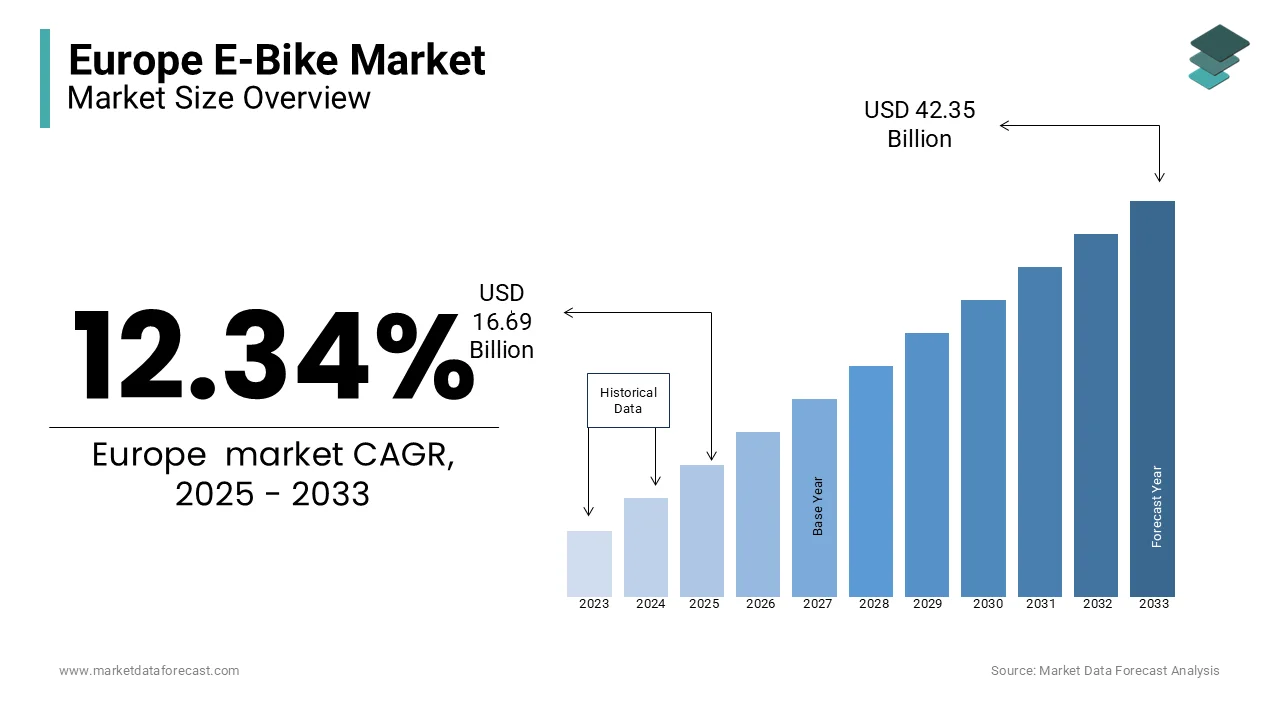
- Market Valuation: Valued at USD 16.69 billion in 2025, estimated at USD 18.75 billion in 2026, and projected to reach USD 47.56 billion by 2034, growing at a robust CAGR of 12.34% from 2026 to 2034.
- Primary Growth Drivers: High urban traffic congestion, an aging demographic seeking active and accessible mobility, and municipal pushes toward zero-emission transportation.
Key Market Segment Metrics (2026–2034)
| Category | Leading Segment (Base Position) | Fastest-Growing / High-Growth Segment |
|---|---|---|
| By Propulsion Type | Pedal-Assist (dominant share, legally classified as standard bicycles under EU regulations with motor cut-off at 25 km/h) | Speed Pedelecs (projected at an 18.7% CAGR, accelerating peri-urban commutes and commercial deliveries) |
| By Battery Type | Lithium-Ion Batteries (the primary power source capturing major share due to high energy density and falling manufacturing costs) | Solid-State Batteries (projected at a rapid 34.1% CAGR, eliminating fire risks and offering up to 200-kilometer ranges) |
| By Application | City / Urban E-Bikes (accounted for major regional share, ideal for short daily trips under 10 kilometers) | Cargo & Utility E-Bikes (projected at an impressive 22.3% CAGR, driven by last-mile delivery bans and family logistics) |
| By Country / Region | Germany (market leader capturing 26.5% share in 2024, backed by strong purchasing power, advanced infrastructure, and domestic brands) | France & Italy (high-growth markets driven by national purchase subsidies, e-bike tourism, and urban mobility packages) |
Major Market Players & Industry Landscape
Market Structure: Highly competitive ecosystem featuring global component suppliers, established European brand houses, and scalable manufacturers competing on proprietary drive software, battery safety compliance, and B2B fleet contracts.
Key Companies: Bosch eBike Systems, Giant Manufacturing Co. Ltd., Accell Group N.V. (Haibike, Winora), Merida Industry Co., Ltd., Yamaha Motor Corporation, BH Bikes, Pedego Electric Bikes, and Moustache Bikes.
 Download Free Sample Report
Europe E-Bike Market Size
The European e-bike market size was valued at USD 16.69 billion in 2025 and is anticipated to reach USD 18.75 billion in 2026, from USD 47.56 billion by 2034, growing at a CAGR of 12.34% during the forecast from 2026 to 2034.
The e-bikes are the design, manufacturing, distribution, and use of pedal-assisted electric bicycles that comply with EU regulatory definitions, specifically those with motor assistance limited to 25 kilometers per hour and a maximum continuous rated power of 250 watts. Over 74% of the EU population resides in urban areas, where congestion, air quality, and last-mile connectivity shape transport choices.
MARKET DRIVERS
Urban Congestion and Limited Parking Drive E-Bike Adoption
The persistent traffic congestion and scarce urban parking in European cities have made e-bikes a pragmatic alternative for daily mobility, which is accelerating the growth of the European e-bike market. According to a recent study, the average car commuter in cities like Paris, Rome, and Brussels spends 98 hours annually in traffic delays. Simultaneously, on street parking occupancy exceeds 90 % in central districts as reported by the International Parking Institute Europe. In Amsterdam, 62% of residents under 45 now use e-bikes as their primary weekday transport, according to the City of Amsterdam’s 2024 Mobility Monitor.
Aging Population Seeks Accessible Active Mobility Solutions
Europe’s demographic shift toward an older population has elevated demand for mobility aids that combine physical activity with motorized support, which is significantly boosting the growth of the European market. 1 in 3 Europeans will be aged 60 or older by 2030, as pea a survey. Many in this cohort seek to remain independent yet face limitations in walking distance or hill navigation. In France, over 48 % of e-bike buyers in 2023 were aged 55 or above. National health systems recognize this benefit, with Germany’s statutory health insurance now partially reimbursing e-bike purchases for patients with cardiovascular or metabolic conditions under its Prevention Act.
MARKET RESTRAINTS
Inconsistent Charging Infrastructure Limits Long Distance Use
The absence of standardized and widely available e-bike charging points across European cities and rural corridors restricts usage beyond short urban trips,s restraining the growth of the European e-bike market. Only 12% of EU municipalities provide public e-bike charging stations, with most concentrated in Germany. A 2024 survey found that 67% of potential bike users in Southern and Eastern Europe cited battery range anxiety as a primary barrier, especially on hilly or intercity routes. While most e-bikes offer 70 to 100 kilometers per charge, cold weather and cargo load can reduce this by 30 to 40 % according to the Technical University of Munich.
Regulatory Fragmentation Across Member States Creates Compliance Burden
The e-bike classification speed limits and road access vary significantly, creating confusion and compliance risks for manufacturers and users, which is hampering the growth of the European e-bike market. These inconsistencies complicate cross-border product design and marketing. Moreover, speed pedelecs classified as mopeds in Germany require registration insurance and helmets, but are treated as bicycles in Sweden. This regulatory patchwork increases costs for brands and deters consumers from purchasing higher-performance models, fearing legal non-compliance.
MARKET OPPORTUNITIES
Integration with Micromobility as a Service Platforms Expands Access
The rise of Mobility as a Service ecosystems is unlocking new e-bike adoption through subscription and shared models that reduce upfront costs and maintenance burdens, which showcases new opportunities for the growth of the European e-bike market. Cities like Helsinki and Lisbon have integrated e-bikes into unified apps that combine public transit, bike share, and ride-hailing under single payment systems. In 2024, the BIKE4ALL project will allocate 6.3 million euros to develop interoperable e-bike sharing networks across 12 countries using standardized battery and docking protocols. Companies like Swapfiets and Zegoo offer all-inclusive monthly subscriptions covering repairs, insurance, and battery replacement, attracting over 500000 users in urban Europe.
Development of Swappable and Modular Battery Systems Enhances Convenience
The innovations in battery design are addressing range and charging limitations through swappable and modular architectures that decouple energy from the frame, which is another attribute to enhance the growth of the European e-bike market. Startups like Cake and Cowboy now offer e-bikes with removable lithium-ion packs that can be charged indoors or exchanged at retail partner locations. According to the survey, modular batteries reduce user charging time by 75 % and extend overall battery life through balanced cell usage. The European Battery Alliance has prioritized standardization of e-bike battery form factors to enable cross-brand compatibility with pilot programs in Belgium and Austria. This shift not only improves user experience but also facilitates second-life applications where retired packs power streetlights or home storage, enhancing circularity and reducing waste.
MARKET CHALLENGES
Battery Fires and Safety Incidents Erode Consumer Confidence
Incidents involving lithium-ion battery thermal runaway have triggered safety concerns that threaten e-bike market growth. Over 1200 e-bike-related fire or explosion notifications were recorded in 2023, a 38 % increase from 2022. Many involved non-compliant third-party batteries or improper indoor charging. The seized counterfeit e-bike batteries lacked basic protection circuits against overcharging or short circuits. In response, cities like Paris and Barcelona banned e-bike storage in residential buildings following fatal fires in 2023. These measures, while necessary, deter adoption among apartment dwellers who constitute 65% of urban populations.
Skilled Technician Shortage Impedes After-Sales Service Quality
The trained e-bike mechanics are undermining service reliability and user satisfaction across Europe, which is a challenging factor for the growth of the European e-bike market. In 2024, a survey found that 72% of independent bike shops reported wait times exceeding three weeks for complex repairs involving motors or battery diagnostics. The European Commission’s Pact for Skills has allocated 18 million euros to expand e-mobility training programs, yet rollout remains slow in Southern and Eastern Europe. This service gap increases the total cost of ownership through prolonged downtime and drives users toward disposable low-end models, exacerbating e-waste and reducing brand loyalty in a market where reliability is paramount.
REPORT COVERAGE
| REPORT METRIC | DETAILS |
| Market Size Available | 2025 to 2034 |
| Base Year | 2025 |
| Forecast Period | 2026 to 2034 |
| CAGR | 12.34% |
| Segments Covered | By Propulsion, Battery, Motor, Drive, Speed Class, Application, End-Use, Design, and Region. |
| Various Analyses Covered | Global, Regional & Country Level Analysis, Segment-Level Analysis, DROC, PESTLE Analysis, Porter’s Five Forces Analysis, Competitive Landscape, Analyst Overview of Investment Opportunities |
| Regions Covered | UK, France, Spain, Germany, Italy, Russia, Sweden, Denmark, Switzerland, Netherlands, Turkey, Czech Republic, and the Rest of Europe |
| Market Leaders Profiled | Giant Manufacturing Co. Ltd., Merida Industry Co. Ltd., Leader 96, BH Bikes, Pedego Electric Bikes, Yamaha Motor Co., Accell Group N.V., Energica Motor Co., Mahindra & Mahindra Ltd., Robert Bosch GmbH, and Others. |
SEGMENTAL ANALYSIS
By Propulsion Insights
The pedal-assisted e-bikes segment was the largest by occupying a significant share of the European e-bikes market in 2024, with its alignment with EU regulatory definitions, favorable treatment under traffic laws, and broad accessibility across age groups. Pedal-assisted e-bikes are limited to 250 watts and 25 kilometers per hour motor cut-off, which are legally classified as bicycles under EU Directive 2002/24/EC. This status exempts riders from mandatory insurance registration, helmets, ts, or driver’s licenses required for higher speed categories. This regulatory parity enables seamless integration into existing cycling infrastructure and public transport systems, such as bike carrying on trains and buses. European cities have invested decades in building protected bike lanes, traffic calming zones, and bike parking facilities designed for conventional cycling speeds. Pedal-assisted e-bikes operate within this ecosystem without requiring redesign. Additionally, public bike share systems like Vélib in Paris and Donkey Republic in Berlin exclusively deploy pedal-assisted models to ensure user safety and fleet uniformity.
The speed pedelecs segment is likely to grow with an anticipated CAGR of 18.7 % during the forecast period. Speed pedelecs reduce travel time by 40 to 50 % compared to standard e-bikes, making 30 to40-kilometerr commutes feasible within one hour. Municipalities like Utrecht now provide dedicated high-speed cycle corridors connecting suburbs to rail hubs, further enabling adoption. This functional advantage transforms speed pedelecs into viable car alternatives for peri-urban populations.
Courier companies and field service providers increasingly deploy speed pedelecs for time-sensitive urban deliveries. Similarly, telecom technicians in Sweden use speed pedelecs to carry tools across large service territories, reducing van dependency.
By Application Insights
The City and urban e-bike segment accounted for h2.3% of the European e-bike market share in 2024. Over 70 % of daily trips in European cities are under 10 kilometers, as reported, making them ideal for e-bike substitution. Urban e-bikes feature integrated lights, fenders, racks, and step-through frames optimized for frequent stops, errands, and public transport interchanges. Municipal policies reinforce this. Berlin’s 2023 Mobility Law mandates that all new residential buildings include secure-bike parking, accelerating household adoption. Urban e-bikes are designed for multimodal use with lightweight frames and folding variants compatible with trains, buses, and trams. Additionally, cities like Lisbon and Helsinki integrate e-bikes into Mobility as a Service apps, allowing seamless transfers between metro and bike share.
The Cargo and utility e-bike segment is likely to grow with a significant CAGR of 22.3% from 2025 to 2033. Cities across Europe are implementing zero-emission last-mile delivery zones. London’s Ultra Low Emission Zone and Paris’s 2024 ban on light commercial vehicles in the city center have forced logistics firms to adopt cargo e-bikes. Companies like Amazon and La Poste now operate fleets exceeding 5000 cargo e-bikes in major cities. Families are increasingly using cargo e-bikes for school runs and grocery shopping to avoid car dependency. Models with dual child seats, weather canopies, and 200-kilogram payloads offer practicality rivaling small cars.
By Battery Insights
The lithium-ion battery power segment was the largest shareholder of thEuropeanpe e-bike market in 2024. Lithium-ion cells deliver 150 to 250 watt hours per kilogram compared to 30 to 50 for lead acid, enabling ranges of 80 to 120 kilometers on a 500-watt-hour pack. This efficiency allows manufacturers to integrate batteries into downtubes or rear racks without compromising handling. According to the survey, 92 % of urban e-bike users consider range the top purchase factor. The average price of lithium-ion battery packs fell by 89 % between 2010 and 2023. Furthermore, the EU Battery Regulation mandates carbon footprint declarations and recycled content thresholds; lithium-ion producers are better positioned to meet these requirements than lead acid manufacturers. Companies like Northvolt and ACC are scaling European production with 30 % lower emissions than Asian counterparts, as verified by the Joint Research Centre. The solid-state batteries segment is expected to grow with a significant CAGR of 34.1% from 2025 to 2033. Solid-state batteries replace flammable liquid electrolytes with ceramic or polymer solids, eliminating fire hazards that plague conventional lithium-ion packs. In 2024, BMW and Prologium launched a pilot fleet of e-bikes with solid-state cells demonstrating zero thermal events under extreme stress tests as confirmed by TÜV Rheinland. Solid-state prototypes achieve 400 to 500 watt-hours per kilogram, enabling 200-kilometer ranges in compact formats.
COUNTRY ANALYSIS
Germany E-bikes Market Analysis
Germany was the largest contributor European-bikes market by capturing 26.5% of the share in 024, with the strong purchasing power, extensive cycling infrastructure, and proactive policy support. The government’s 2023 EE-MobilityBonus provides up to 500 euros for e-bike purchases linked to car scrappage schemes. Additionally, Germany hosts major manufacturers like Bosch and Riese Müller, whose drive systems and frames set global benchmarks. The nationwide ADFC cycling network, with over 200000 kilometers of signposted routes, further enables long-distance e-bike tourism, reinforcing cultural adoption across urban and rural demographics.
France E-bikes Market Analysis
France's e-bike market held 14.3% of the share in 2024, with urban mobility reforms and national subsidies. The government’s 2024 Sustainable Mobility Package increased the e-bike purchase rebate to 400 euros for low-income households and 2000 euros for cargo models. French manufacturers like Moustache and Angell emphasize lightweight frames and smart connectivity, appealing to e-savvy urbanites. Additionally, the nationwide Véligo bike share system integrates e-bikes across 20 cities, fostering trial and familiarity.
Itlay E-bikes Market Analysis
Italy's E-bikes market growth is fueled by hilly terrain tourism and aging demographics. The government’s Ecobonus scheme provides a 30 % tax credit up to 1000 euros for e-bike purchases, which contributed to a 27 % sales increase in 2024. Italian manufacturers like Atala and Torpado specialize in mid-drive motors optimized for mountainous regions. Additionally, e-bike tourism has surged with over 200 certified routes across Tuscany and the Dolomites, attracting international visitors. This blend of topography policy and experiential travel sustains steady demand across leisure and daily mobility segments.
COMPETITIVE LANDSCAPE
European bimarket features intense rivalry among global component suppliers, European brand houses, and Asian OEMs, each competing through technology design and service ecosystems. Premium players like Bosch and Shimano dominate the mid-drive segment through proprietary motor software and extensive dealer networks, while integrated manufacturers such as Giant and Accell leverage brand heritage and localized product development. Chinese entrants challenge on price but struggle with service infrastructure and regulatory compliance. Competition is increasingly defined by software capabilities, including connectivity, predictive maintenance, and theft protection. Regulatory pressures around battery safety and recyclability raise entry barriers, favoring established players with compliance resources. Urban logistics demand is creating a parallel B2B battleground where durability,y payl,o and uptime outweigh aesthetics.
KEY MARKET PLAYERS
A few of the market players in the global E-bike market include
- Giant Manufacturing Co. Ltd
- Derby Cycle
- Bosch eBike Systems
- Easy Motion
- Accell Group N.V.
- Yamaha Motor Corporation
- Merida Industry Co., Ltd.
- Moustache Bikes
- NYCeWheels
Top Players In The Market
- Bosch eBike Systems GmbH is a leading provider of drive units and battery systems for e-bikes across Europe and globally. The company supplies its high-performance mid-drive motors and PowerTube batteries to over 80 bicycle brands, including Trek, Specialized, and Riese Mü,ller. These innovations reinforceosch’s role as the technological backbone of the premium bike segment and enhance its influence on global e-bike design and user experience standards.
- Giant Manufacturing Co Ltd exerts significant influence in thEuropeanpe e-bike market through its e-bike integrated production and diverse brand portfolio, including Liv and Momentum. The company operates a dedicated e-bike assembly plant in the Netherlands serving the European region,n with models tailored to urban trekking and cargo applications. These actions strengthen Giant’s position as a scalable and responsive global player capable of aligning product development with regional mobility policies and consumer preferences.
- Accell GrGroup plays a pivotal role in the European e-bike market as a portfolio company owning iconic European brands such as Haibike, Lapierre, Ghost, and Winora. The group focuses on localized design engineering and distribution across key markets including Germany France a,, France, n Franced the Netherlands. In early 2024, Accell launched its Unifie,,d Platform Strategy, standardizing frame architecture an end software across brands to accelerate innovation and reduce time to market. It also invested in a circular economy initiative offering battery take-back and frame refurbishment services across 15 countries. These moves enhance operational efficiency and sustainability positioning Accell as a steward of responsible e-bike consumption in Europe and beyond.
Top Strategies Used By the Key Market Participants
Key players in the European e-bike market invest heavily in proprietary drive system technology to differentiate performance and user experience. They pursue vertical integration by controlling battery, motor, and software development to ensure seamless interoperability. Strategic partnerships with municipalities and logistics firms secure B2B contracts for shared and cargo fleets. Companies expand certified service networks to address after-sales gaps and build after-sales support. Additionally, they align product portfolios with EU sustainability mandates through modular designbattery recycling program, and bonn footprint transparency to meet evolving regulatory and consumer expectations.
MARKET SEGMENTATION
This research report on the European e-bike market is segmented and sub-segmented into the following categories.
By Propulsion Type
- Pedal Assist
- Throttle
- Speed Pedelec
By Battery Type
- Lithium-ion Battery
- Lead-acid Battery
- Nickel Metal Hydride Battery
- Others
By Motor Type
- Hub Motor
- Mid Drive Motor
By Drive Type
- Chain Drive
- Belt Drive
By Speed Class
- Class I (Pedal Assist up to 20 mph / 32 km/h)
- Class II (Throttle up to 20 mph / 32 km/h)
- Class III (Pedal Assist up to 28 mph / 45 km/h)
By Application
- City/Urban
- Mountain/Trekking
- Cargo/Utility
- Recreational
By End Use
- Personal
- Commercial
By Design
- Foldable
- Non-foldable
By Region
- UK
- Russia
- Germany
- Italy
- France
- Spain
- Sweden
- Denmark
- Poland
- Switzerland
- Netherlands
- Rest of Europe