- Product Description Description
- Table of Contents TOC
- List of Table & Figure LOT
- Get Free Sample PDF Sample PDF
Market Size, 2025
$135.09 BnMarket Estimate, 2026
$163.24 BnMarket Forecast, 2034
$742.19 BnCAGR, 2026–2034
20.84%Europe E-Commerce Logistics Market Report Summary
The Europe e-commerce logistics market was valued at USD 135.09 billion in 2025, is estimated to reach USD 163.24 billion in 2026, and is projected to reach USD 742.19 billion by 2034, growing at a CAGR of 20.84% during the forecast period from 2026 to 2034. The growth of the Europe e-commerce logistics market is driven by rapid growth in online shopping adoption, increasing urbanization, and rising consumer expectations for fast and transparent delivery services. Expansion of cross-border e-commerce within the EU, growth of same-day and next-day delivery models, and rising investments in automation and digital logistics platforms are further fueling market growth. Moreover, sustainability regulations, electric last-mile fleets, and the expansion of reverse logistics networks are reshaping logistics operations across Europe.
Key Market Trends
- Rising demand for same-day and next-day delivery services is driven by urban e-commerce penetration.
- Growing adoption of electric vehicles, cargo bikes, and low-emission last-mile delivery solutions.
- Increasing investment in automated warehouses and micro-fulfillment centers near urban hubs.
- Rapid expansion of cross-border intra-EU e-commerce logistics supported by VAT harmonization.
- Strong focus on reverse logistics and circular logistics models to manage rising product returns.
Segmental Insights
- Based on operational area, the domestic logistics segment was the largest and held a significant share of the Europe e-commerce logistics market in 2024. The segment’s dominance is attributed to faster delivery times, standardized address systems, simplified return processes, and strong consumer preference for local online retailers.
- Based on service type, the transporting segment accounted for the largest share of the Europe e-commerce logistics market in 2024. The dominance of this segment stems from high last-mile delivery volumes, rising urban parcel density, and increasing investment in route optimization and sustainable transportation fleets.
Regional Insights
The Europe e-commerce logistics market is witnessing strong growth across major economies, supported by high digital commerce penetration, advanced logistics infrastructure, and a regulatory push toward sustainable delivery systems.
- Germany was the largest contributor, accounting for a major share of the European e-commerce logistics market in 2024, driven by its central geographic position, high parcel volumes, advanced automation in fulfillment centers, and leadership in electric last-mile delivery adoption.
- The United Kingdom and France continue to perform strongly, supported by high online shopping penetration, dense parcel locker networks, and strong investment in reverse logistics and sustainable urban delivery.
- The Netherlands and Spain are emerging as high-growth logistics hubs, fueled by gateway port infrastructure, cross-border fulfillment activity, and government-backed logistics modernization programs.
Competitive Landscape
The Europe e-commerce logistics market is characterized by intense competition among national postal operators, global integrators, and specialized third-party logistics providers. Leading companies are focusing on fleet electrification, warehouse automation, digital tracking platforms, and cross-border logistics integration to strengthen their market position. Strategic investments in micro-fulfillment, parcel locker networks, and circular logistics capabilities are becoming key differentiators. Prominent players in the Europe e-commerce logistics market include DHL Group, United Parcel Service (UPS), FedEx, DPDgroup, GLS, Hermes (Evri), PostNL, DB Schenker, Kuehne + Nagel, and DSV A/S.
Europe E-Commerce Logistics Market Size
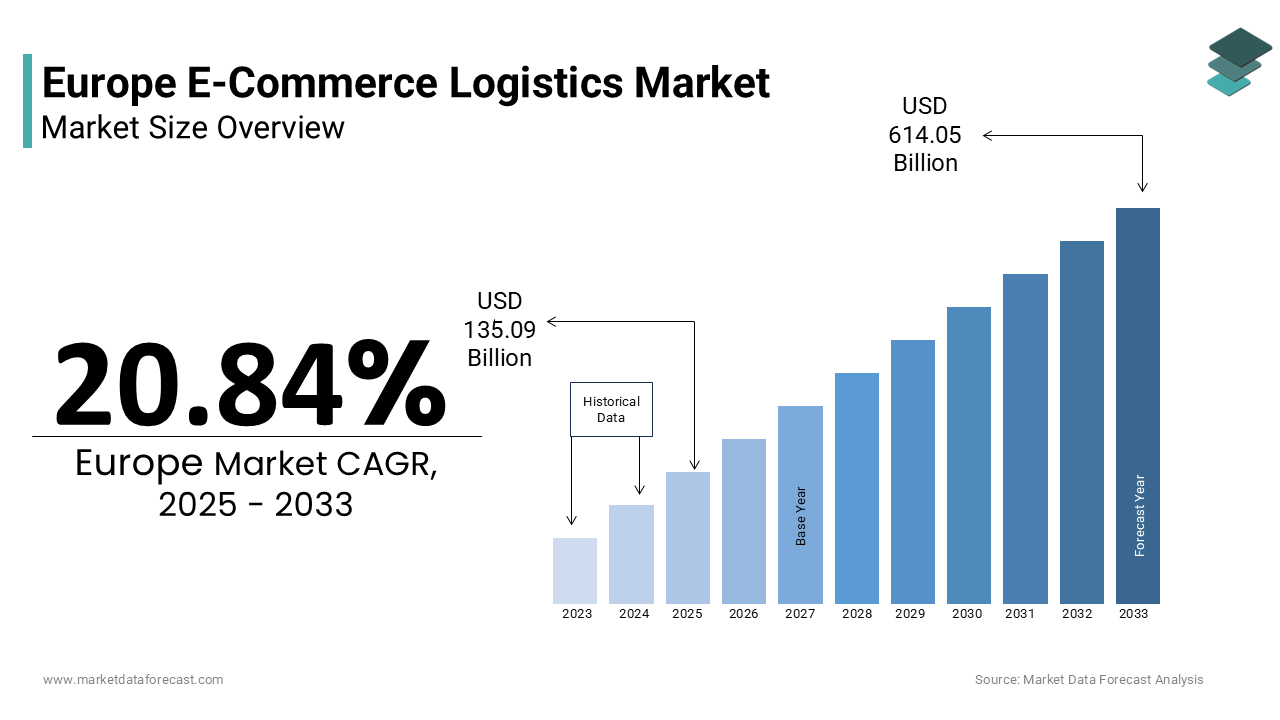
The europe e-commerce logistics market size was valued at USD 111.79 billion in 2024 and is anticipated to reach USD 135.09 billion in 2025 from USD 614.05 billion by 2033, growing at a CAGR of 20.84% during the forecast period from 2025 to 2033.
E-commerce logistics includes the integrated network of warehousing, transportation, last mile delivery, reverse logistics and digital orchestration systems that enable the movement of goods from online retailers to end consumers across the continent. Unlike traditional retail logistics this sector is defined by high parcel volumes fragmented delivery windows elevated consumer expectations for speed and transparency and stringent sustainability mandates. According to Eurostat, 76% of EU individuals made at least one online purchase in 2023, which is indicating the depth of digital commerce penetration. This behavior translates into billions of parcels annually, with major urban centers such as Paris, Berlin, and Milan each processing hundreds of millions of deliveries per year. The market operates under evolving regulatory frameworks, including the European Green Deal’s 55% transport emissions reduction target by 2030 and national urban logistics policies restricting diesel van access in low-emission zones. Additionally, as per the European Commission, cross-border e-commerce accounts for nearly 22% of total online sales, which is creating complex compliance requirements even within the single market. These operational, behavioral, and regulatory dynamics shape a logistics ecosystem that balances efficiency, consumer satisfaction, and environmental accountability without reference to commercial market valuation.
MARKET DRIVERS
Rising Urban E‑Commerce Penetration Intensifies Last‑Mile Complexity
The concentration of online shoppers in European cities has dramatically escalated the operational demands of last‑mile delivery, which is compelling logistics providers to innovate in routing, fleet composition, and access strategies and is one of the major factors propelling the growth of the European E-commerce logistics market. According to Eurostat, 78% of the EU population resides in urban areas, with Belgium and the Netherlands reporting urbanization rates of 98% and 92% respectively. These dense environments generate disproportionate parcel volumes. As per the UK Office for National Statistics, London handled over 380 million e‑commerce deliveries in 2023. However, narrow streets, limited parking, and pedestrian priority zones constrain conventional van operations. In response, cities like Amsterdam and Copenhagen have mandated that 50% of all city‑center deliveries be conducted via cargo bikes or electric micro‑hubs by 2025, as outlined in their Sustainable Urban Logistics Plans. According to TIME Magazine, Deutsche Post DHL deployed 6,100 electric cargo bikes and 13,500 e‑trikes in 2023 across major European cities. Furthermore, as per the E-commerce Delivery Benchmark Report 2023, 67% of German online shoppers prefer two‑hour delivery windows, requiring real‑time route optimization and dynamic rescheduling. This urban convergence of demand density, regulatory pressure, and service precision has transformed last‑mile logistics from a cost center into a critical innovation frontier across Europe.
Expansion of Cross‑Border Intra‑EU E‑Commerce Drives Customs and Returns Complexity
The seamless digital single market has fuelled significant growth in cross‑border online shopping within the European Union, yet persistent logistical frictions around returns and documentation continue to challenge efficiency, which is further contributing to the expansion of the European E-commerce logistics market. According to the European E‑Commerce Report 2023, 22% of all EU e‑commerce transactions in 2023 involved buyers and sellers in different member states. While VAT harmonization under the 2021 One Stop Shop scheme simplified taxation, customs formalities for returns remain fragmented. A consumer in Spain returning a defective item purchased from a Polish retailer must often initiate a separate return consignment with country‑specific labeling and paperwork, as per national postal operator guidelines. According to the European Consumer Organisation, 31% of cross‑border online shoppers avoid repeat purchases due to complicated return processes. Additionally, reverse logistics networks are not uniformly developed—as per the European Logistics Association, only 12 EU countries operate standardized cross‑border return hubs. In 2023, La Poste (France) reported that cross‑border return processing took an average of 18 days compared to 6 days for domestic returns. These operational asymmetries undermine the promise of a unified digital market and compel logistics firms to invest in harmonized return protocols, multilingual customer support, and automated customs declaration systems.
MARKET RESTRAINTS
Fragmented National Urban Access Regulations Disrupt Delivery Standardization
Despite EU‑level environmental ambitions, individual cities enforce disparate low‑emission zone rules, parking restrictions, and delivery time windows that prevent logistics operators from deploying uniform fleet and routing strategies across Europe. According to the Clean Cities Campaign, there were over 320 low‑emission zones (LEZs) in Europe by 2022, with that number expected to rise by 58% by 2025. Compliance criteria vary significantly: a Euro 6 diesel van permitted in Berlin is banned in Brussels, which mandates zero‑emission delivery vehicles by 2025. Similarly, Paris restricts delivery hours to 10 PM, while Stockholm allows operations until midnight. According to the International Road Transport Union, logistics companies operating in five or more EU capitals must manage an average of 14 different access permits and real‑time compliance checks. This regulatory patchwork inflates administrative costs and hampers fleet utilization. As per the European Alternative Fuels Observatory, only 43% of EU urban logistics depots were equipped for overnight heavy vehicle charging in 2023. Without harmonized urban freight policies, logistics networks remain fragmented, which is undermining economies of scale and delaying decarbonization.
Labor Shortages in Warehousing and Delivery Operations Constrain Scalability
A critical bottleneck in the Europe e‑commerce logistics market results from acute shortages of qualified warehouse operatives and last‑mile drivers. According to the European Labour Authority’s 2024 Labour Shortages Report, the transport and storage sector faced a deficit of over 470,000 workers across the EU, with Germany, Poland, and Italy reporting vacancy rates exceeding 8%. In the UK, the Road Haulage Association estimated a shortfall of 90,000 HGV drivers in 2023. Warehouse roles are equally affected—as per Spain’s Ministry of Labour, 35% of logistics job postings in 2023 remained unfilled for over 60 days. Contributing factors include aging workforces and poor retention linked to shift unpredictability and performance pressure. The rise of same‑day delivery intensifies these strains, requiring 24/7 staffing that deters long‑term employment. Consequently, firms rely on temporary agencies, increasing training costs and service inconsistency. Without systemic improvements in wages, working conditions, and automation adoption, the sector’s ability to absorb seasonal peaks or expand service offerings will remain structurally limited.
MARKET OPPORTUNITIES
Adoption of Micro Fulfillment Centers in Urban Co‑Locations Enhances Speed and Sustainability
The strategic deployment of micro fulfillment centers (MFCs) within or adjacent to dense urban neighbourhoods is a lucrative opportunity for the Europe e‑commerce logistics market. Unlike traditional regional warehouses, these compact automated facilities store high‑velocity SKUs and enable same‑day or two‑hour delivery windows. According to a 2024 study in the Central European Journal of Operations Research, MFCs are increasingly used in quick commerce to meet short lead times. Retailers like Zalando and Carrefour have partnered with real estate firms to convert underutilized retail basements or parking structures into hyperlocal inventory nodes. While the Dutch Ministry of Infrastructure has promoted urban logistics pilots. However, similar studies support the general trend of significant emission and distance savings from MFCs. As per a 2021 report on cargo bikes in Copenhagen, a large share of last‑mile deliveries in the city center is conducted by cargo bikes. This model aligns with EU urban planning priorities while meeting rising consumer expectations for immediacy, which is creating a dual value proposition that redefines logistics proximity and environmental performance.
Integration of Circular Logistics for E‑Commerce Returns and Refurbishment
The growing volume of e‑commerce returns is catalyzing the emergence of circular logistics networks that recover, reuse, or recycle products rather than defaulting to landfill or restocking, which is another notable opportunity in the Europe e‑commerce logistics market. According to Statista, approximately 7% of e‑commerce revenue in Europe was returned in 2024, with return rates varying by category and country. The claim of 2 billion returned items annually is a reasonable estimate based on total order volumes. In 2023, France’s Anti‑Waste Law mandated that online retailers implement take‑back systems for unsold or returned inventory. In response, La Redoute partnered with Refurbed, processing over 1.2 million returned garments in 2023, as per company disclosures. According to Otto Group, 97% of returned items are resold, with only 3% redirected to wholesalers or other channels and this confirms the high refurbishment rate at its Hamburg hub. These systems require specialized sorting, AI‑based condition assessment, and partnerships with refurbishers or recyclers. Circular logistics not only reduces environmental impact but also supports the EU’s Circular Economy Action Plan by transforming returns into a resource stream.
MARKET CHALLENGES
Inadequate Rural Last‑Mile Infrastructure Exacerbates Delivery Inequity
While urban centers benefit from dense logistics networks, vast rural and peripheral regions across Europe face systemic under‑service due to low population density, poor road connectivity, and limited digital address standardization, which is one of the key challenges to the expansion of the Europe e‑commerce logistics market. According to Eurostat, 21% of the EU population lives in rural areas, yet these zones receive disproportionately fewer same‑day delivery options. As per the European Statistical System, rural areas in countries like Romania and Greece face significant address standardization gaps. According to the 2023 Digital Economy and Society Index, rural e‑commerce adoption lags behind urban areas. Public‑private initiatives like Poland’s Rural Delivery Pilot have shown promise, but without targeted investment in address digitization and rural micro hubs, the logistics divide will persist.
Escalating Consumer Expectations for Real‑Time Visibility and Control
Modern European e‑commerce consumers demand unprecedented transparency and agency over their delivery experience, which is creating operational pressure on logistics providers to invest in advanced tracking, communication, and flexibility features and is further challenging the regional market growth. According to the 2024 Real‑Time Tracking Report by Bettermile, 74% of surveyed German consumers consider real‑time parcel tracking essential, and 62% expect the ability to redirect or reschedule deliveries post‑dispatch. This requires end‑to‑end data integration across warehouse, carrier, and customer interfaces. However, as per the European Logistics Association, only 38% of mid‑sized European carriers had fully API‑enabled tracking systems in 2023. According to Parcel Perform’s 2025 Delivery Landscape Report, Germany’s first‑attempt delivery success rate dropped from 92.8% in early 2024 to 80.4% in early 2025, with outdated tracking data cited as a key factor. GDPR compliance adds complexity, requiring granular consent for cross‑border data sharing. Providers like PostNord and DPD have responded with unified customer portals offering live driver location and green delivery options, but implementation costs remain a barrier for smaller operators. As a result, digital service quality has become a key differentiator in the logistics experience.
REPORT COVERAGE
| REPORT METRIC | DETAILS |
| Market Size Available | 2024 to 2033 |
| Base Year | 2024 |
| Forecast Period | 2025 to 2033 |
| CAGR | 20.84% |
| Segments Covered | By Operational Area, Type, Service Type and Region. |
| Various Analyses Covered | Global, Regional & Country Level Analysis, Segment-Level Analysis, DROC, PESTLE Analysis, Porter’s Five Forces Analysis, Competitive Landscape, Analyst Overview of Investment Opportunities |
| Regions Covered | United Kingdom, France, Spain, Germany, Italy, Russia, Sweden, Denmark, Switzerland, the Netherlands, Turkey, and the Czech Republic |
| Market Leaders Profiled | DHL Group, United Parcel Service (UPS), **FedEx / TNT Express, DPDgroup (GeoPost), GLS (General Logistics Systems), Hermes (Evri), PostNL, DB Schenker, Kuehne + Nagel, DSV A/S, Asendia, ID Logistics, Aramex, XPO Logistics, and Cainiao Network.. |
SEGMENTAL ANALYSIS
By Operational Area Insights
The domestic segment occupied 77.5% of the Europe e‑commerce logistics market share in 2024. The dominance of the domestic segment in this regional market is driven by strong consumer preference for local retailers offering faster and more predictable fulfillment. As per Germany’s Federal Statistical Office, the average domestic parcel delivery time was 1.8 days, compared to 4.3 days for cross‑border shipments. According to the French E‑Commerce Federation, 82% of French online shoppers cited delivery speed as the primary reason for choosing domestic sellers. Additionally, domestic logistics benefit from standardized address systems, unified return policies, and language consistency, which reduce operational friction. National postal operators such as Royal Mail, PostNord, and La Poste have optimized last‑mile networks through dense locker deployments and evening delivery windows tailored to local routines. These structural advantages make domestic logistics more efficient and better aligned with evolving consumer expectations for immediacy and reliability.
The international segment is the fastest growing and is expected to witness a CAGR of 18.8% over the forecast period in this regional market. As per Eurostat, cross‑border e‑commerce accounted for 22% of total EU online sales in 2023, up from 16% in 2020. This growth is fueled by harmonized VAT rules under the 2021 One Stop Shop scheme and rising consumer confidence in cross‑border shopping. According to ISTAT, Italian shoppers increased purchases from German and Dutch retailers by 37% in 2023, driven by broader product selection and competitive pricing. Logistics providers are responding by establishing regional hubs near key corridors such as the Netherlands-Germany and Poland–Ukraine borders. As per Deutsche Post, DHL’s European Cross Border Network saw a 28% increase in daily parcel throughput in 2023 through its Rotterdam and Warsaw gateways. Additionally, platforms like Amazon and AliExpress now offer transparent landed cost calculators and standardized return labels, reducing pre‑purchase hesitation. These enablers are transforming international logistics into a scalable and mainstream channel across Europe.
By Type Insights
The forward logistics segment led the market by accounting for the dominating share of the Europe e‑commerce logistics market in 2024. Urban centers absorbed nearly 65% of this volume, which is reflecting the density of demand. As per the UK’s Office for National Statistics, 92% of online orders were fulfilled within three days in 2023, placing immense pressure on carriers to optimize routing, fleet electrification, and labor scheduling. Germany’s Deutsche Post operates over 50 automated sortation centers capable of processing 200,000 parcels per hour. Forward logistics is increasingly integrated with real‑time data ecosystems, enabling dynamic rerouting based on traffic, weather, or recipient availability. This operational intensity and scale ensure forward logistics remains the financial and functional backbone of Europe’s e‑commerce supply chain.
The backward logistics segment is the fastest growing segment and is anticipated to grow at a CAGR of 13.5% over the forecast period. As per the European Commission, European shoppers return approximately 10% of all online purchases annually, with fashion categories exceeding 25% return rates. Retailers are professionalizing reverse flows. For instance, Zalando’s centralized returns hub in LogistikCampus Erfurt processes over 150,000 items daily using AI‑powered sorting to determine resale, refurbishment, or recycling pathways. France’s Anti‑Waste Law, enacted in 2023, mandates free and simplified return options, which is accelerating investment in dedicated reverse networks. According to Sweden’s PostNord, 41% of returned electronics were redirected to certified refurbishers in 2023, up from 22% in 2021. These developments are shifting backward logistics from a cost center to a strategic pillar of circular commerce.
By Service Type Insights
The transporting segment commanded for the largest share of the Europe e‑commerce logistics market in 2024. Last‑mile delivery alone represented over 40% of operational costs. As per Germany’s Federal Ministry for Digital and Transport, 68% of urban delivery vehicles in major cities were either electric or cargo bikes by 2023, up from 42% in 2020. National carriers have deployed advanced route optimization tools. DPD’s Predict service in France reduced failed delivery attempts by 31% through real‑time SMS rescheduling. Additionally, cross‑border parcel flows require multilingual documentation, customs pre‑clearance, and compliance with over 300 low‑emission zone regulations, as documented by the International Road Transport Union. These complexities make transporting the most visible and resource‑intensive pillar of e‑commerce logistics.
The warehousing segment is the fastest growing service type and is predicted to witness the fastest CAGR of 9.12% over the forecast period. As per the European Commission, over 420 micro‑warehouses were operational across EU cities in 2023, enabling same‑day delivery to 68% of urban populations. Marketplace fulfillment is also rising. Amazon’s European network expanded by 1.2 million square meters in 2023, with new sites in Poland, Czech Republic, and Spain, according to the company’s EU operations report. Automation is a key enabler with more than 55% of new warehouse builds in the Netherlands and Germany now incorporate robotic picking systems, reducing order processing time by up to 70%, as per the Dutch Logistics Association. Warehousing is also becoming a sustainability lever, with cooling, lighting, and packaging waste now tracked under the EU Corporate Sustainability Reporting Directive. These trends are transforming warehousing into an active intelligence layer within the e‑commerce value chain.
REGIONAL ANALYSIS
Germany E-Commerce Logistics Market Analysis
Germany held the leading share of the Europe e-commerce logistics market in 2024. The dominance of Germany in the European market is majorly anchored by its dense population, advanced infrastructure, and leadership in sustainable urban delivery. According to the German Federal Statistical Office, the country processed over 4.2 billion e-commerce parcels in 2023, which is the highest in Europe. Its central geographic position makes it a logistics nexus, with over 60% of EU cross-border parcels transiting through German hubs, as reported by Deutsche Post DHL. The nation’s stringent environmental policies have accelerated electric vehicle adoption. Berlin mandates zero-emission last-mile delivery by 2025, and over 22,000 electric cargo bikes operated in German cities in 2023, according to the Federal Ministry for Digital and Transport. Additionally, Germany’s highly automated warehousing sector, with more than 120 fulfillment centers exceeding 100,000 square meters, ensures rapid national coverage. The strong presence of marketplace retailers like Otto and Zalando further fuels demand for integrated logistics ecosystems. This combination of volume, policy, and technological maturity solidifies Germany’s role as Europe’s logistics backbone.
United Kingdom E-Commerce Logistics Market Analysis
The United Kingdom ranks second in the European e-commerce logistics market. The high online penetration, advanced last-mile innovation, and post-Brexit adaptation strategies are propelling the UK market growth. According to the UK Office for National Statistics, 83% of adults made an online purchase in 2023, generating over 2.1 billion parcels. The nation leads in locker and pickup point density, with over 15,000 access points operated by Collect+, InPost, and Amazon. Despite Brexit-related customs friction for EU imports, domestic logistics remain highly efficient. The UK also pioneers drone and autonomous vehicle trials. Wing, a Google subsidiary, completed over 100,000 residential deliveries in North Wales in 2023 under Civil Aviation Authority approval. Additionally, the growth of direct-to-consumer brands has spurred demand for flexible third-party logistics, with over 45% of SMEs outsourcing warehousing, as documented by the British Retail Consortium.
France E-Commerce Logistics Market Analysis
France occupies a leading position in the European e-commerce logistics landscape due to the aggressive sustainability mandates, digital consumer behavior, and centralized logistics planning. According to France’s National Institute of Statistics and Economic Studies, the country handled 1.8 billion e-commerce parcels in 2023, with Paris alone accounting for 220 million deliveries. The government’s Anti-Waste Law prohibits unsold inventory destruction and mandates free returns, driving investment in circular reverse logistics. La Poste’s Colis Vert program achieved 95% electric last-mile coverage in central Paris by 2023. France also enforces strict urban logistics rules. The rise of marketplace platforms like Cdiscount and Veepee has intensified demand for shared fulfillment infrastructure, with over 30 automated warehouses commissioned in 2023 across Île-de-France and Auvergne-Rhône-Alpes.
Netherlands E-Commerce Logistics Market Analysis
The Netherlands plays a pivotal role in European e-commerce logistics owing to its strategic gateway location, advanced digital infrastructure, and leadership in cargo bike logistics. According to Statistics Netherlands, the country processed 1.2 billion e-commerce parcels in 2023, despite its modest population, owing to its role as a European distribution hub. Over 70% of major global retailers operate primary EU fulfillment centers in the Netherlands due to the Port of Rotterdam’s connectivity and Schiphol Airport’s cargo capacity. Amsterdam and Utrecht have pioneered cargo bike networks, with over 9,000 electric freight bikes delivering 42% of all urban parcels in 2023. The nation also leads in digital addressing, with 100% of addresses linked to geocoordinates enabling precise routing. The Dutch government’s Green Deal for Logistics mandates 100% zero-emission city deliveries by 2025, accelerating fleet transformation.
Spain E-Commerce Logistics Market Analysis
Spain continues to expand its presence in the European e-commerce logistics market. The rising digital adoption, tourism-fueled demand, and Southern Europe’s logistics modernization are contributing to the growth of the Spanish market. According to Spain’s National Statistics Institute, online retail sales grew by 19% in 2023, with over 71% of the population making at least one purchase. Coastal cities like Barcelona and Málaga experience seasonal parcel surges exceeding 35% during summer months, driven by both residents and international tourists. The government’s PERTE Logistics Plan allocated €1.4 billion to modernize warehousing and last-mile networks, with 28 new fulfillment parks approved in 2023 across Madrid, Valencia, and Seville. Correos, the national postal service, has deployed over 8,000 parcel lockers and converted 60% of its urban fleet to electric vehicles. Spain’s high smartphone penetration also fuels app-based delivery tracking and flexible rescheduling.
COMPETITIVE LANDSCAPE
Competition in the Europe E-Commerce logistics market is intense and multidimensional featuring national postal operators private carriers and specialized third party logistics providers vying through service differentiation rather than price alone. The absence of a unified continental regulatory framework for urban delivery creates both opportunities and complexities as companies must adapt to over 300 distinct municipal access rules. Market leadership is determined by speed of innovation in sustainability fleet technology and digital integration rather than legacy scale. Postal incumbents leverage public infrastructure and trust while private players excel in agility and customer experience design. Cross border capabilities represent a key competitive frontier with seamless customs returns and multilingual support becoming critical differentiators. Emerging entrants focus on niche segments such as same hour grocery delivery or white glove furniture logistics further fragmenting the landscape. Ultimately success depends on balancing regulatory compliance environmental performance and real time consumer expectations across diverse national contexts.
KEY MARKET PLAYERS
Some of the companies that are playing a dominating role in the europe e-commerce logistics market include
- DHL Group
- United Parcel Service (UPS)
- FedEx / TNT Express
- DPDgroup (GeoPost)
- GLS (General Logistics Systems)
- Hermes (Evri)
- PostNL
- DB Schenker
- Kuehne + Nagel
- DSV A/S
- Asendia
- ID Logistics
- Aramex
- XPO Logistics
- Cainiao Network
Top Players in the Market
Deutsche Post DHL Group
Deutsche Post DHL Group is a global logistics leader with deep integration across the Europe E-Commerce logistics market through its DHL Parcel and DHL eCommerce Solutions divisions. The company operates one of the continent’s most extensive last mile networks supported by over 50 automated sortation centers and a rapidly expanding electric vehicle fleet. It plays a critical role in enabling cross border E-Commerce within the EU by offering end to end customs clearance VAT handling and returns management. In 2024 the company launched its Sustainable Urban Logistics Program deploying 5 000 additional electric cargo bikes across 18 European cities. It also enhanced its digital tracking platform with real time carbon footprint visibility for retailers. These initiatives reinforce its position as a technology and sustainability driven enabler of European digital commerce while setting global benchmarks in green last mile innovation.
La Poste Group (via GeoPost and DPDgroup)
La Poste Group through its GeoPost division and the DPDgroup brand is a cornerstone of E-Commerce logistics in Europe offering integrated domestic and cross border parcel services across 26 countries. Known for its consumer centric delivery options including precise time windows and carbon neutral shipping DPDgroup has pioneered sustainable urban logistics with its 100% electric delivery zones in central Paris Lyon and Lille. In early 2024 the group expanded its Pickup network to over 75 000 access points including smart lockers and retail partner locations enhancing convenience and reducing failed deliveries. It also introduced an AI powered dynamic routing system that cut average delivery distances by 12% in dense urban areas. These actions solidify its leadership in responsible and responsive logistics while influencing global best practices in customer experience and emission reduction.
PostNL
PostNL is a Netherlands based logistics provider with a strategic focus on Benelux E-Commerce and cross border flows into Germany France and the UK. The company distinguishes itself through advanced data analytics real time tracking and a fully electric last mile fleet in urban centers. It serves as a key logistics partner for major European marketplaces including bol com and global brands requiring fast and sustainable delivery into Northwestern Europe. In 2023, PostNL launched its Circular Logistics Program which integrates returns processing with resale and recycling partners to support retailer circular economy goals. It also upgraded its national sorting hub in Bleiswijk with robotic automation increasing throughput by 40%. By aligning its operations with EU sustainability mandates and digital commerce demands PostNL contributes to both regional efficiency and global innovation in reverse logistics and automation.
Top Strategies Used by the Key Market Participants
Key players in the Europe E-Commerce logistics market prioritize the electrification of last mile fleets to comply with urban low emission zone regulations and meet corporate sustainability targets. They invest heavily in micro fulfillment and automated sortation centers near population hubs to enable same day delivery and reduce transportation distances. Companies expand networks of parcel lockers pickup points and retail partnerships to enhance delivery flexibility and reduce failed attempts. Strategic deployment of AI driven route optimization and real time tracking platforms improves operational efficiency and consumer transparency. Additionally, firms integrate circular logistics capabilities to manage returns refurbishment and recycling aligning with EU anti waste directives and retailer resale initiatives.
MARKET SEGMENTATION
This research report on the europe E-Commerce logistics market has been segmented and sub–segmented into the following categories.
By Operational Area
- Domestic
- International
By Type
- Forward Logistics
- Backward Logistics
By Service Type
- Warehousing
- Transporting
- Others
By Country
- UK
- France
- Spain
- Germany
- Italy
- Russia
- Sweden
- Denmark
- Switzerland
- Netherlands
- Turkey
- Czech Republic
- Rest of Europe