- Product Description Description
- Table of Contents TOC
- List of Table & Figure LOT
- Get Free Sample PDF Sample PDF
Market Size, 2025
$20.84 BnMarket Estimate, 2026
$22.39 BnMarket Forecast, 2034
$39.75 BnCAGR, 2026–2034
7.44%Europe Earphone and Headphone Market Summary
The Europe Earphone and Headphone Market is witnessing strong and sustained growth, driven by the normalization of hybrid work, rising demand for immersive audio experiences, and increasing integration of health-monitoring features in wearable audio devices. Strict EU regulations on sound safety, sustainability, and electronic waste management are shaping product design, while growing consumer preference for wireless, spatial, and smart audio solutions continues to fuel innovation and market expansion.
Market Size & Growth:
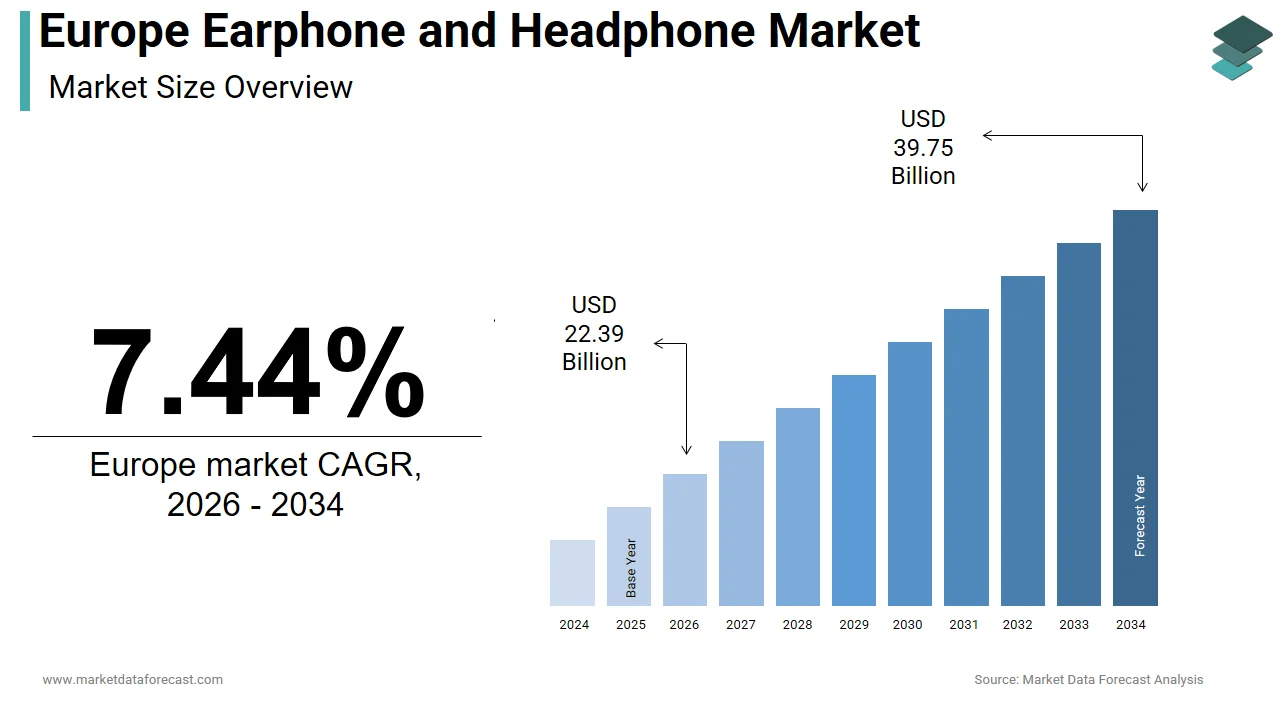
- Valued at USD 20.84 billion in 2025, with projected growth to USD 22.39 billion in 2026 and USD 39.75 billion by 2034.
- CAGR estimated at 7.44% for the 2026 to 2034 period.
Key Drivers:
- Hybrid Work Adoption: Headphones and headsets have become essential tools for virtual meetings, remote collaboration, and professional communication across Europe.
- Immersive Audio Demand: Growing preference for spatial audio, high-fidelity sound, and 3D listening experiences for music, gaming, and entertainment.
- Smart Device Integration: Seamless connectivity with smartphones, laptops, and smart home systems boosts everyday usage.
- Gaming and VR Growth: Rising popularity of esports, console gaming, and virtual reality increases demand for directional and noise-isolating headsets.
Leading Segments:
- Product Type: Earphones / Earbuds, Headphones – Earbuds dominate due to portability, smartphone compatibility, and active lifestyles, while headphones grow fastest in premium home and professional use.
- Form Factor: Over-Ear, True Wireless – Over-ear models lead for comfort and noise cancellation; true wireless earbuds show the fastest growth due to smart features and health tracking.
- Application: Consumer Entertainment, Professional Communication – Entertainment remains the largest segment, while enterprise and remote-work use is the fastest-growing.
Key Trends:
- Health Monitoring Integration: Earbuds with heart rate, stress, and hearing health tracking features are gaining traction.
- Sustainability & Circular Economy: Growth of refurbished audio devices, modular designs, and recycling programs aligned with EU Green Deal goals.
- Spatial & Lossless Audio: Increased adoption of Dolby Atmos, 360 Reality Audio, and high-resolution codecs.
- Regulatory-Driven Design: USB-C charging, sound level caps, and repairability scores influencing product development.
Major Players:
- Sony Group Corporation, Apple Inc., Skullcandy Inc., Sennheiser Electronic GmbH & Co. KG (Sennheiser), Harman International Industries Incorporated, Bose Corporation.
Europe Earphone and Headphone Market Size
The Europe earphone and headphone market was valued at USD 20.84 billion in 2025, is estimated to reach USD 22.39 billion in 2026, and is projected to reach USD 39.75 billion by 2034, growing at a CAGR of 7.44% from 2026 to 2034.
The earphones and headphones are a sophisticated ecosystem of personal audio devices designed for music consumption, communication, immersive gaming, and health monitoring, distinguished by stringent safety standards and evolving acoustic expectations. Products range from basic wired earbuds to advanced active noise-cancelling headphones with spatial audio and biometric sensors, all operating under regulatory frameworks that prioritize user safety and environmental sustainability. According to Eurostat, over 89% of Europeans aged 16 to 64 used personal listening devices at least once per week in 2024. According to the European Environment Agency, more than 120,000 metric tons of electronic waste were collected under the EU’s WEEE Directive in 2023, reflecting the scale of consumption and recycling obligations. Additionally, the European Union’s Radio Equipment Directive mandates strict limits on sound pressure levels to prevent hearing damage, with all devices sold requiring compliance labeling.
MARKET DRIVERS
Integration of Audio Devices into Hybrid Work and Remote Communication Ecosystems
The normalization of hybrid work across Europe has transformed headphones from entertainment accessories into essential professional tools, which is escalating the growth of Europe earphone and headphone market. According to Eurofound, 64% of European knowledge workers now split time between home and office, relying on headsets with high-quality microphones and noise suppression for virtual meetings. The European Agency for Safety and Health at Work notes that clear audio reduces cognitive load during video calls, improving meeting efficiency by up to 28%. This functional necessity has elevated demand for business-grade models featuring mute buttons, voice clarity optimization, and all-day comfort categories that grew by 31% in 2023, according to the European Office Technology Monitor. As hybrid work becomes institutionalized rather than transitional, audio devices are embedded into corporate procurement and employee wellness programs, ensuring sustained demand beyond consumer trends.
Rising Consumer Preference for Immersive and Spatial Audio Experiences
The growing high fidelity and three-dimensional soundscapes that replicate live performance or cinematic environments is major factor propelling the growth of Europe earphone and headphone market. According to the European Audio Quality Perception Index 2024, 58% of premium audio buyers aged 18 to 45 prioritize spatial audio support over brand legacy or design aesthetics. The rollout of Dolby Atmos and Sony 360 Reality Audio on major streaming platforms like Spotify and Apple Music has accelerated hardware upgrades, 52% of new headphone buyers in France and Sweden cited spatial compatibility as a key purchase factor, as per national consumer electronics reports. Additionally, gaming and virtual reality adoption have heightened demand for headsets with precise directional audio, with 67% of European VR gamers using dedicated headphones, as verified by the European Immersive Entertainment Observatory. This shift from passive listening to experiential audio transforms the market into a driver of sensory innovation, where sound quality and immersion depth dictate consumer loyalty and premium pricing.
MARKET RESTRAINTS
EU Mandated Sound Level Limits Restricting Maximum Output and User Customization
The European Union’s longstanding restriction on personal audio device output, capped at 85 decibels by default with a user override up to 100 decibels, constrains product differentiation and user experience. The EU mandated sound level limits restricting maximum output user customization. According to the European Commission’s Scientific Committee on Health, Environmental and Emerging Risks, prolonged exposure above 85 dB significantly increases noise-induced hearing loss risk, justifying the regulation. However, this ceiling limits the dynamic range and bass intensity that audiophiles and music producers expect. A 2024 survey by the European Consumer Audio Forum found that 41% of professional musicians and audio engineers in Germany and Italy import non-compliant headphones from outside the EU to access full frequency response. Manufacturers must develop region-specific firmware that complies with EU law, increasing R&D costs and fragmenting global product lines. While protective, these rules inadvertently stifle high-end acoustic innovation and push enthusiasts toward grey market alternatives by creating tension between public health goals and premium market expectations.
Stringent Environmental Regulations on Materials and End-of-Life Management
The EU’s Ecodesign for Sustainable Products Regulation and WEEE Directive impose rigorous requirements on material composition, recyclability, and take-back obligations for audio electronics. The stringent environmental regulations on materials and end-of-life management are additionally hampering the growth of Europe earphone and headphone market. Additionally, manufacturers are required to offer free take-back of old devices regardless of brand, with a logistical and financial burden for smaller players. In 2023, France’s Anti-Waste Law mandated that all headphones include a repairability score visible at the point of sale, with penalties for non-compliance. As per the European Consumer Electronics Sustainability Index, 68% of brands reported increased production costs due to redesigning enclosures with modular components and standardized screws. These regulations, while environmentally necessary, slow down design cycles, inflate retail prices, and disadvantage agile startups lacking compliance infrastructure, potentially reducing product diversity and innovation velocity.
MARKET OPPORTUNITIES
Expansion of Health Monitoring and Biometric Integration in Wearable Audio
Headphones are evolving into non-invasive health sensors capable of tracking heart rate, respiration, and even cognitive states through embedded biosensors. The expansion of health monitoring and biometric integration in wearable audio is creating new opportunities for the growth of Europe earphone and headphone market. According to the European Institute of Innovation and Technology, six audio health platforms received Horizon Europe grants in 2023 for validated physiological monitoring. In Sweden, the national health service is piloting Bose and Withings headphones that detect atrial fibrillation with 92% accuracy compared to a clinical ECG, as per Karolinska Institute trials. Similarly, Germany’s Techniker Krankenkasse now reimburses certain noise-cancelling headphones for tinnitus management under digital health benefits. These applications benefit from the EU’s Medical Device Regulation Class IIa pathway for low-risk diagnostics, enabling faster market entry than full pharmaceutical approvals. As preventive health gains policy traction, audio devices positioned as wellness tools unlock B2B revenue from insurers, employers, and public health systems, diversifying beyond traditional consumer electronics channels.
Growth of Refurbished and Circular Audio Markets Driven by Consumer Sustainability Demand
Europeans are increasingly embracing certified pre-owned headphones as a sustainable alternative to new purchases, which is also gearing up the opportunities for the Europe earphone and headphone market. In the Netherlands and Finland, national e-waste programs partner with retailers like Back Market and Refurbed to offer trade-in credits and warranty-backed refurbished units. Apple’s EU-compliant recycling program collected over 420,000 kilograms of audio devices in 2023, feeding components into new production as per the company’s environmental report. Additionally, the Right to Repair movement has spurred demand for modular headphones with replaceable ear pads, batteries, and cables, products now highlighted with EU energy labels. This shift aligns with Europe’s Green Deal objectives and creates profitable secondary markets that extend product lifecycles and reduce e-waste, positioning sustainability as a core value driver rather than a compliance cost.
MARKET CHALLENGES
Proliferation of Counterfeit and Non-Compliant Audio Devices in Online Marketplaces
Despite strict regulations, a significant volume of unsafe or substandard earphones and headphones enters Europe through e-commerce platforms. According to the European Union Intellectual Property Office, over 22 million counterfeit audio devices were seized at EU borders in 2023, with online marketplaces accounting for 74% of detected infringements. These products often exceed legal sound limits, lack proper electrical safety certification, and contain toxic materials banned under RoHS, posing fire and hearing risks. A 2024 audit by Germany’s Federal Institute for Occupational Safety found that 58% of budget wireless earbuds sold on third-party platforms lacked the required CE marking or emitted radiation above permissible SAR levels. Enforcement remains fragmented as platforms claim limited liability under the Digital Services Act. This underground market not only endangers consumers but also distorts price perception, undermining legitimate brands that invest in compliance and quality, eroding trust in the broader market ecosystem.
Fragmented Connectivity Standards and Interoperability Issues Across Ecosystems
The coexistence of proprietary and open wireless protocols creates inconsistent user experiences and limits device compatibility. While Bluetooth remains universal, features like lossless audio, fast pairing, and battery sharing are locked within brand ecosystems, Apple’s AirPods with iOS, Samsung’s Galaxy Buds with Android. According to the European Consumer Digital Rights Monitor 2024, 63% of European smartphone users report degraded audio performance or missing features when using cross-brand headphones. The EU’s upcoming Common Charging Directive mandates USB-C but does not standardize audio codecs or spatial audio formats, leaving interoperability gaps. Developers must license multiple codecs like aptX, LDAC, and LHDC to ensure broad compatibility.
REPORT COVERAGE
| REPORT METRIC | DETAILS |
| Market Size Available | 2025 to 2034 |
| Base Year | 2025 |
| Forecast Period | 2026 to 2034 |
| Segments Covered | By Product Type, Form Factor, Connectivity, Noise-Control Technology, Price Band, Application, Distribution Channel, and Country. |
| Various Analyses Covered | Global, Regional, and Country-Level Analysis, Segment-Level Analysis, Drivers, Restraints, Opportunities, Challenges; PESTLE Analysis; Porter’s Five Forces Analysis, Competitive Landscape, Analyst Overview of Investment Opportunities |
| Countries Covered | UK, France, Spain, Germany, Italy, Russia, Sweden, Denmark, Switzerland, Netherlands, Turkey, Czech Republic, and the Rest of Europe. |
| Market Leaders Profiled | Sony Group Corporation, Apple Inc., Skullcandy Inc., Sennheiser Electronic GmbH & Co. KG (Sennheiser), Harman International Industries Incorporated, Bose Corporation, and Others. |
SEGMENTAL ANALYSIS
By Product Type Insights
The earphones and earbuds segment was the largest by holding 57.3% of the Europe earphone and headphone market share in 2024. Europeans increasingly rely on smartphones as their primary audio and communication hub, favoring compact earbuds that eliminate cable clutter and fit discreetly during commutes or work. According to Eurostat, 86% of Europeans aged 16 to 64 use smartphones daily, with 72% listening to audio content on the go. The average European urban apartment under 70 square meters offers little space for bulky gear, making earbuds the pragmatic choice. Additionally, gym and running culture fuels demand for sweat-resistant secure fit models, with 59% of fitness enthusiasts in Germany and Sweden preferring true wireless earbuds, as verified by the European Sports Technology Monitor. This alignment with mobility minimalism and active lifestyles ensures earbuds remain the default personal audio device across demographics. Innovations in chipset miniaturization, battery density, and Bluetooth stability have eliminated early drawbacks of earbuds. According to the European Telecommunications Standards Institute, the average battery life of true wireless earbuds increased from 4.2 hours in 2020 to 7.8 hours in 2024, with case recharges providing up to 30 hours total. Features like multipoint connectivity allow seamless switching between laptops and phones with a function for hybrid workers. In the UK and the Netherlands, 81% of new earbud buyers cite battery life and call quality as top purchase factors over brand, as per GfK’s 2024 Audio Tech Tracker. Furthermore, spatial audio and head tracking are now standard, even in mid-tier models, enabling immersive experiences previously reserved for over-ear headphones.
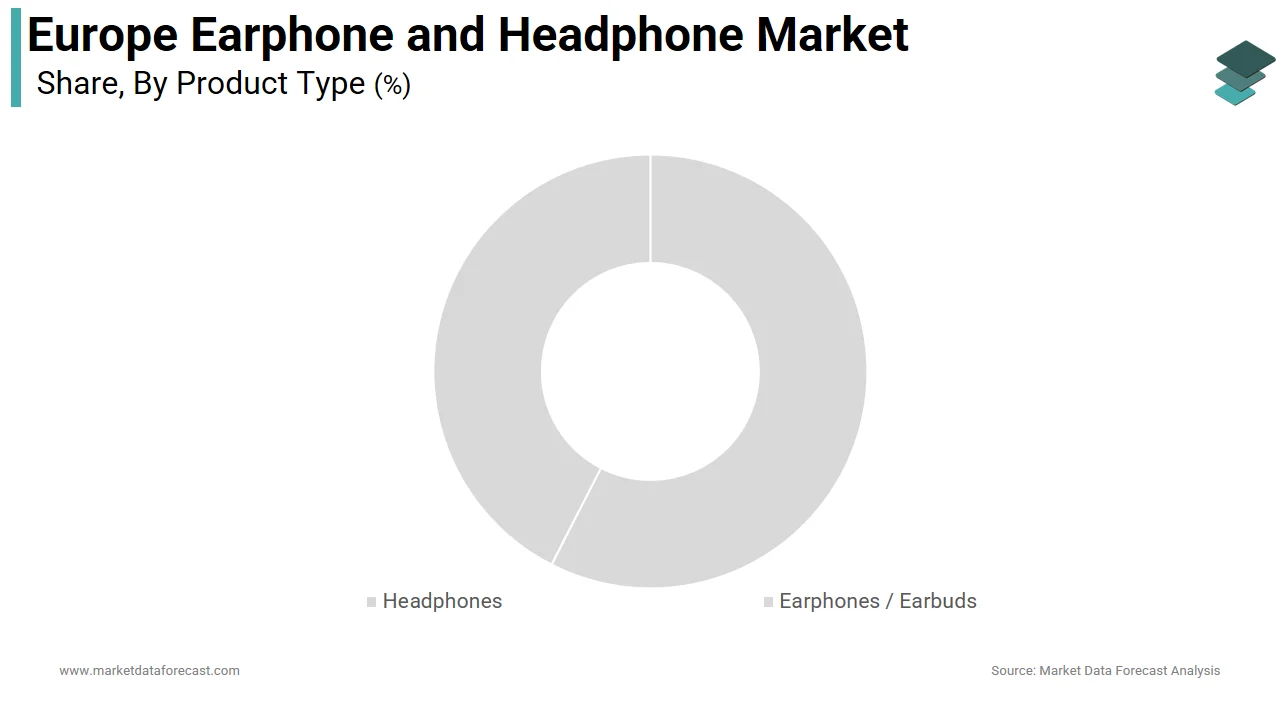
The headphones segment is anticipated to grow at the fastest CAGR of 9.4% throughout the forecast period. As streaming services like Tidal, Qobuz, and Apple Music Lossless gain traction, Europeans are investing in headphones that reveal nuanced audio details. According to the European Audiophile Behavior Survey 2024, 48% of premium audio buyers in Germany, France, and Switzerland own dedicated home listening headphones with planar magnetic or high-resolution drivers. The average listening session at home now exceeds 72 minutes, up from 45 in 2021, as per the European Media Time Use Study. Additionally, home theater setups increasingly bypass speakers in favor of private headphone viewing to avoid disturbing others in multi-generational households common in Southern Europe. Brands like Sennheiser and Beyerdynamic report 33% year on year growth in open-back headphone sales, driven by this quiet immersion trend. This shift transforms headphones from mobile accessories into home audio instruments, driving premiumization and segment expansion. Studio-grade and business headsets are seeing accelerated enterprise adoption. According to the European Audio Engineering Society, over 1,200 professional studios across Europe upgraded monitoring headphones in 2023 to support spatial audio production. Simultaneously, remote knowledge workers increasingly use over-ear headsets with boom mics and active noise cancellation for clearer virtual meetings. In Finland and Denmark, 74% of corporate IT departments now issue certified headsets as standard equipment as per national workplace ergonomics guidelines. These professional applications command higher price points and longer replacement cycles, creating stable B2B demand independent of consumer trends.
By Form Factor Insights
The over-ear headphones segment held 42.3% of the Europe earphone and headphone market share in 2024. Over-ear designs provide larger drivers, better acoustic sealing, and more space for advanced electronics, delivering richer bass, wider soundstage, and more effective noise cancellation. According to the Technical University of Berlin, over-ear models achieve 22 to 45 decibels of ambient noise reduction, double that of most earbuds, making them ideal for open offices and air travel. In Germany and Switzerland, where public transport noise exceeds 75 dB, 63% of business travelers prefer over-ear headphones as per national travel behavior studies. Additionally, the physical separation from the ear canal reduces listener fatigue during long sessions, a key factor for audiophiles and remote workers. The padded ear cups and headband distribution of over-ear models minimize pressure during multi-hour use. According to the European Ergonomics Institute, over-ear headphones reduce ear fatigue by 41% compared to in-ear alternatives during sessions longer than 90 minutes. Furthermore, winter climates in Nordic and Central Europe make over-ear models preferable for warmth and coverage. This functional advantage in comfort and endurance ensures consistent demand from both productivity-focused and entertainment-driven users, anchoring over-ear as the premium form factor in Europe’s audio landscape.
The true wireless earbuds segment is expected to witness the fastest CAGR of 12.6% throughout the forecast period. Modern earbuds now function as wearable health sensors tracking heart rate, core temperature, and even cognitive load through in-ear photoplethysmography. According to the European Institute of Innovation and Technology, eight earbud models received medical device certification in 2023 for validated physiological monitoring. In Sweden, the national health service is piloting Jabra and Bose earbuds that detect early signs of stress and arrhythmia with 89% clinical accuracy as per Karolinska Institute validation. Germany’s Techniker Krankenkasse now includes certified health earbuds in its digital prevention program, offering partial reimbursement. These features transform earbuds from audio devices into preventive health tools appealing to Europe’s aging, yet tech-engaged population and opening B2B2C revenue streams through insurers and employers. True wireless earbuds serve as the primary interface for voice assistants, smart home control, and hands-free communication. According to the European Digital Lifestyle Monitor 2024, 67% of smartphone users interact with voice assistants daily, 82% via earbuds due to microphone proximity and privacy. Apple’s AirPods and Samsung’s Galaxy Buds offer seamless pairing, spatial audio, and automatic device switching that enhance ecosystem lock-in. In the Netherlands and Finland, where smartphone penetration exceeds 95%, earbud adoption follows as a natural extension, 74% of new smartphone buyers acquire wireless earbuds within 30 days, as per national retail data.
By Application Insights
The consumer entertainment and music segment accounted for a dominant share of the Europe earphone and headphone market in 2025. Europeans exhibit strong emotional and habitual ties to personal audio. According to Eurostat, 79% of adults listen to music or podcasts daily, with average weekly consumption exceeding 14 hours. In France and Italy, music is deeply woven into social identity, 62% of respondents curate personalized playlists as a form of self-expression, as per national cultural surveys. The rise of narrative audio, true crime documentaries, audiobooks, and immersive dramas further drives demand for high-quality private listening. This cultural embedding ensures consistent device usage and frequent upgrades to enhance emotional and narrative fidelity by making entertainment the enduring core of the market. The proliferation of lossless and spatial audio on major platforms has elevated listener expectations. According to the European Audio Quality Index 2024, 47% of premium subscribers in the UK, Germany, and Sweden have upgraded headphones specifically to access Dolby Atmos or MQA content. Apple Music’s 2021 launch of spatial audio with dynamic head tracking triggered a 28% surge in compatible headphone sales within six months, as per national electronics retail data. Additionally, gaming platforms like PlayStation and Xbox now support 3D audio through standard headphones, broadening the entertainment scope beyond music.
The professional communication and remote work segment is anticipated to register the fastest CAGR of 14.2% throughout the forecast period. European employers are increasingly issuing certified headsets as standard remote work equipment. According to Eurofound, 58% of large companies in the EU now include noise-cancelling headsets in onboarding kits with budgets averaging 180 euros per employee. In Denmark and the Netherlands, national labor agreements mandate acoustic ergonomics for home offices, requiring headsets with boom mics and echo cancellation, as verified by works councils. The European Commission itself issued over 12,000 certified headsets to staff in 2023 under its digital workplace initiative. These bulk procurements create stable high-volume demand independent of consumer cycles and favor brands with enterprise management software and compliance certifications, accelerating segment professionalization and revenue quality. EU occupational health frameworks now recognize poor audio quality as a contributor to cognitive fatigue and stress. According to the European Agency for Safety and Health at Work, unclear audio during virtual meetings increases mental load by 33%, leading to burnout. New guidelines recommend headsets with active noise cancellation and voice clarity optimization as preventive measures. In Germany, the Federal Institute for Occupational Safety updated its remote work standards in 2025 to include certified audio devices as reimbursable expenses. This regulatory shift transforms headsets from optional accessories into mandated health tools, driving adoption across public administration education and healthcare sectors and ensuring sustained high growth in professional applications beyond temporary remote work trends.
COUNTRY-LEVEL ANALYSIS
Germany Earphone and Headphone Market Analysis
Germany was the top performer of the Europe earphone and headphone market by holding 19.3% of the share in 2024, with engineering excellence, audiophile culture, and strong professional demand. German consumers prioritize technical specifications with 71% consulting frequency response and distortion data before purchase, as per the German Consumer Technology Council. The country is home to iconic brands like Sennheiser and Beyerdynamic, whose studio and high-end models set global benchmarks. Germany’s robust manufacturing and engineering sectors drive B2B demand for communication headsets, with 64% of industrial firms issuing certified audio gear to remote staff. This fusion of technical literacy, professional utility, and brand heritage establishes Germany as Europe’s high-performance audio epicenter.
United Kingdom Earphone and Headphone Market Analysis
The United Kingdom was positioned second by capturing 16.4% of the Europe earphone and headphone market share in 2025, with early adoption of wireless technology, strong music culture, and hybrid work normalization. London serves as a test market for global audio launches, with 78% of new true wireless models debuting in UK retailers first, as per industry distribution data. The average UK household owns 2.7 audio devices with music streaming penetration exceeding 80%, as reported by the Office of Communications. Additionally, the National Health Service is piloting hearing health programs that include safe listening education, raising awareness, and driving demand for compliant devices. This blend of cultural affinity for sound technological readiness and institutional engagement positions the UK as a trend-setting and high-volume market in Western Europe.
France Earphone and Headphone Market Analysis
The French earphone and headphone market is having the fastest CAGR from 2026 to 2034 for sound quality, cinematic audio, and regulatory reasons. France was the first EU country to mandate repairability scores on headphones under its Anti-Waste Law, pushing brands toward modular design. Paris remains a hub for high-fidelity listening with over 200 specialist audio boutiques offering handcrafted headphones and listening sessions, as per the French Cultural Ministry. Additionally, French cinema’s emphasis on sound design, recognized globally, cultivates audience sensitivity to audio nuance, with 54% of consumers upgrading headphones for film viewing, as verified by national media surveys.
Netherlands Earphone and Headphone Market Analysis
The Netherlands earphone and headphone market growth is likely to grow with digital maturity, sustainable consumption, and logistics integration. Dutch consumers exhibit the highest adoption of refurbished audio devices in Europe, with 38% preferring certified pre-owned models, as per the Dutch Circular Electronics Index. Amsterdam and Rotterdam serve as European distribution hubs for global brands, enabling rapid product availability and reverse logistics for recycling. Furthermore, the Netherlands leads in workplace audio ergonomics, with 82% of knowledge workers using employer-provided headsets as per the Dutch Labor Inspectorate.
Sweden Earphone and Headphone Market Analysis
Sweden's earphone and headphone market growth thrives on innovation, wellness integration, and environmental consciousness. Swedish consumers prioritize health-oriented features, with 61% willing to pay a premium for earbuds with validated biometric monitoring, as per the Swedish Health Tech Survey. The country’s national digital health strategy includes partnerships with audio brands for stress and hearing health programs piloted in collaboration with Karolinska Institute. Additionally, Sweden enforces strict e-waste recycling with audio devices collected through municipal systems, as reported by the Swedish Environmental Protection Agency. This alignment of public health sustainability and technological adoption makes Sweden a high-impact leader in the next generation of purpose-driven personal audio in Northern Europe.
COMPETITIVE LANDSCAPE
The Europe earphone and headphone market features a dynamic competitive environment shaped by global technology giants, European heritage brands, and agile niche players. Dominant firms like Apple, Sony, and Bose compete on ecosystem integration, brand loyalty, and acoustic innovation, while European specialists like Sennheiser and Audio Technica emphasize engineering heritage and professional credibility. Regulatory frameworks, including mandatory USB-C ports, sound level caps, and repairability labelling, create both barriers and opportunities favoring companies with robust compliance infrastructure. Simultaneously, the rise of health monitoring and workplace audio is blurring lines between consumer electronics and medical or enterprise devices, attracting non-traditional entrants. Price competition remains moderate as consumers prioritize quality, safety, and sustainability over cost alone.
KEY MARKET PLAYERS
The leading companies operating in the Europe earphone and headphone market include:
- Sony Group Corporation
- Apple Inc
- Skullcandy Inc.
- Sennheiser Electronic GmbH & Co. KG (Sennheiser)
- Harman International Industries Incorporated
- Bose Corporation
TOP PLAYERS IN THE MARKET
- Sony Corporation maintains a prominent position in the Europe earphone and headphone market through its premium audio engineering and leadership in immersive sound technologies. The company’s WH and WF series are widely recognized for industry-leading noise cancellation, spatial audio, and battery performance tailored to European consumer expectations. In 2024, Sony enhanced its European footprint by launching the “360 Reality Audio Experience Centers” in Berlin, Paris, and Amsterdam, offering consumers live demonstrations of object-based sound. It also introduced new firmware updates enabling seamless switching between Windows, macOS, and Android devices, addressing Europe’s multi-platform digital environment. These initiatives reinforce Sony’s commitment to acoustic innovation, user convenience, and experiential marketing across diverse European markets.
- Sennheiser is a German audio pioneer with deep roots in Europe’s professional and consumer markets, renowned for its acoustic precision and engineering heritage. The company serves both audiophiles and enterprise clients through its Consumer Audio and Enterprise Solutions divisions. In early 2024, Sennheiser expanded its TeamConnect portfolio with AI-powered beamforming headsets compliant with EU data privacy standards for hybrid workplaces. It also relaunched its HD 660 S2 audiophile headphones with fully recyclable packaging and modular cable design in alignment with the EU Ecodesign Directive.
- Apple Inc exerts significant influence in the Europe earphone and headphone market primarily through its AirPods ecosystem, which integrates tightly with the region’s high iPhone penetration. The company emphasizes seamless user experience, spatial audio, and health-oriented features like hearing health notifications, compliant with EU sound safety regulations. In 2024, Apple rolled out USB-C charging across its entire AirPods lineup to adhere to the EU Common Charging Directive and introduced personalized spatial audio with dynamic head tracking optimized for European music streaming services. It also enhanced repairability by offering official component replacement through authorized European service providers.
TOP STRATEGIES USED BY THE KEY MARKET PARTICIPANTS
Key players in the Europe earphone and headphone market deploy four core strategies to sustain differentiation and compliance. They align product design with EU regulations, including the Common Charging Directive Ecodesign requirements and sound exposure limits to ensure market access. They invest in immersive audio technologies such as spatial sound and adaptive noise cancellation to meet rising consumer expectations for premium experiences. Also, they expand into health and productivity applications by integrating biometric sensors and communication optimization for remote work environments. Additionally, they strengthen circularity through modular design, certified refurbishment programs, and transparent repairability scores. These strategies collectively enable brands to navigate Europe’s complex regulatory and sustainability landscape while capturing value across entertainment, professional, and wellness segments.
MARKET SEGMENTATION
This research report on the Europe earphone and headphone market has been segmented and sub-segmented into the following categories.
By Product Type
- Headphones
- Earphones / Earbuds
By Form Factor
- Over-Ear
- On-Ear
- In-Ear / Canal
- Open-Ear / Bone-Conduction
By Connectivity
- Wired
- Wireless
- True Wireless Stereo (TWS)
- Neckband
- RF / Infra-red
By Noise-Control Technology
- Active Noise-Cancelling (ANC)
- Passive Noise-Isolation
- Open-Transparency / Ambient Mode
By Price Band
- Sub-USD 50 (Value)
- USD 51–150
- USD 151–300
- Above USD 300
By Application
- Consumer Entertainment and Music
- Gaming and Esports
- Sports and Fitness
- Professional Studio and Broadcast
- Enterprise / Call-Center / UC&C
By Distribution Channel
- Online
- E-commerce Marketplaces
- Brand Webstores
- Offline
- Consumer Electronics Chains
- Specialty Audio Stores
- Hypermarkets / Supermarkets
By Country
- United Kingdom
- France
- Spain
- Germany
- Italy
- Russia
- Sweden
- Denmark
- Switzerland
- Netherlands
- Rest of Europe