- Product Description Description
- Table of Contents TOC
- List of Table & Figure LOT
- Get Free Sample PDF Sample PDF
Europe Edge Computing Market Size
The europe edge computing market size was valued at USD 2.67 billion in 2024 and is anticipated to reach USD 3.63 billion in 2025 from USD 41.93 billion by 2033, growing at a CAGR of 35.78% during the forecast period from 2025 to 2033.
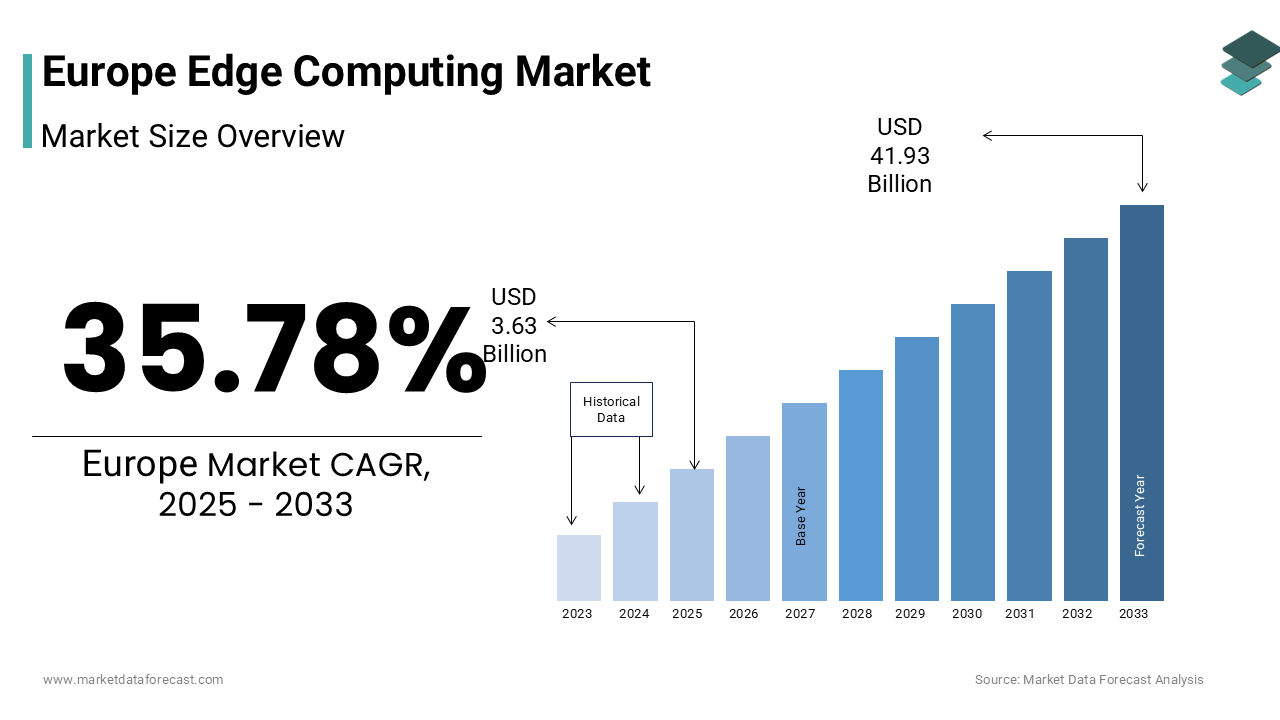
Edge computing refers to a distributed computing paradigm that processes data near its source, such as industrial machines, connected vehicles, or smart city sensors, rather than relying solely on centralized cloud data centers. This architecture minimizes latency, enhances data privacy, and supports real time decision making critical for applications in manufacturing, healthcare, energy, and transportation. The European edge computing landscape is shaped by stringent data sovereignty requirements under the General Data Protection Regulation and the EU Data Act, which mandate that sensitive operational data remain within national or regional boundaries. According to sources, a substantial and growing number of industrial enterprises in the EU are prioritizing data management strategies, including localization and on-premise/edge infrastructure, driven by data governance, latency, and operational requirements. As per research, a significant and increasing number of large manufacturing firms across major EU economies, such as Germany, France, and Italy, are investing in and piloting advanced digital technologies, including edge computing and predictive maintenance solutions, to enhance operational efficiency. Europe is witnessing a pivotal move beyond generic cloud services, with edge computing being rapidly integrated into private 5G networks and Industrial IoT platforms to establish robust, sovereign, and highly responsive digital infrastructure that addresses specific regional needs.
MARKET DRIVERS
Mandates for Data Sovereignty and Regulatory Compliance
European data governance frameworks are a primary growth driver of the Europe edge computing market. This compels organizations to process sensitive information locally to comply with legal and ethical standards. Moreover, France’s Military Programming Law restricts defense related sensor data from leaving sovereign territory, accelerating edge AI adoption in surveillance and logistics. These regulatory imperatives transform edge computing from an operational choice into a compliance necessity, particularly in sectors handling personally identifiable or strategically sensitive information. As per research, a portion of surveyed public sector entities now include edge processing clauses in their digital procurement tenders, which supports its role as a foundational element of Europe’s data sovereignty strategy.
Proliferation of Industrial IoT and Smart Manufacturing Initiatives
The integration of edge computing with industrial Internet of Things systems is accelerating the expansion of the Europe edge computing market. This proliferation is driven by the need for real time analytics and autonomous process control. According to research, European industrial digitalization programs are increasingly focusing on smart factory development, with numerous pilot projects deploying edge computing to support high-speed automation and precision manufacturing tasks. As per sources, automotive production facilities across Central Europe are adopting edge-enabled computer vision systems for real-time defect detection, leading to significant improvements in quality control and material efficiency. Apart from these, energy efficiency regulations are pushing factories toward edge based predictive maintenance. Edge computing acts as a key enabler for European manufacturers who seek to balance the demands of global competition with stringent sustainability mandates through the use of intelligent, efficient production systems.
MARKET RESTRAINTS
Fragmented National Cybersecurity and Certification Frameworks
Inconsistent national cybersecurity requirements that complicate cross border deployment and certification restrict the growth of the Europe edge computing market. While the EU’s Cyber Resilience Act establishes baseline security standards for digital products, individual member states maintain supplementary mandates that affect edge hardware and software validation. For instance, Sweden’s Civil Contingencies Agency requires all edge devices in critical infrastructure to undergo national penetration testing, whereas Italy’s National Cybersecurity Agency mandates proprietary encryption modules for public sector edge deployments. The fragmentation increases compliance costs and deters small and medium enterprises from adopting standardized edge platforms. Moreover, the absence of a harmonized EU wide edge security certification, akin to the Common Criteria for IT products, leaves vendors navigating a patchwork of technical specifications. The current inconsistency in regulations poses a continuous barrier to achieving a unified market and fostering widespread innovation adoption.
High Capital Expenditure and Skilled Labor Shortages
Economic and human capital constraints limit scalability, particularly among mid-sized enterprises, which constrain the expansion of the Europe edge computing market. Unlike cloud services with pay as you go models, edge solutions require upfront investment in on site servers, networking gear, and integration services. High initial capital investment continues to be a barrier for small and medium-sized manufacturers seeking to adopt edge computing technologies, which limits broader deployment across the industrial base. Compounding this challenge is a severe shortage of professionals skilled in edge architecture, AI model deployment, and industrial networking. Accessible financing and robust vocational training in distributed computing are prerequisites for European firms to fully leverage edge technologies, despite their obvious operational benefits.
MARKET OPPORTUNITIES
Integration with 5G Private Networks in Critical Infrastructure
The convergence of edge computing and 5G private networks offers an opportunity across Europe’s energy, transportation, and utilities sectors, which drives the growth of the Europe edge computing market. This enables ultra-reliable low-latency communication for mission-critical operations. National grid operators in France and Spain are deploying edge nodes co located with 5G base stations to monitor transformer health and reroute power during outages within milliseconds. Multiple private 5G networks were operational in EU industrial sites, with a share integrated with edge analytics platforms, as per studies. This synergy between sovereign connectivity and localized intelligence positions edge computing as a cornerstone of Europe’s next generation critical infrastructure.
Expansion of AI at the Edge in Healthcare Diagnostics
Real time AI in European healthcare diagnostics gives fresh prospects for the expansion of the Europe edge computing market. Hospitals in the Netherlands and Finland are deploying edge devices that analyze medical imaging, such as chest X rays or retinal scans, on site, delivering preliminary results in under 15 seconds without transmitting sensitive data to external clouds. Regulatory alignment further supports adoption. The Medical Device Regulation now includes specific conformity pathways for AI software running on edge hardware, provided data remains within the clinical environment. This fusion of medical ethics, regulatory clarity, and computational innovation establishes healthcare as a high impact domain for edge computing in Europe.
MARKET CHALLENGES
Interoperability Gaps Across Legacy Industrial Systems
Scaling edge computing in the region’s industrial base remains a challenge for the Europe edge computing market. This is because of the incompatibility between modern edge platforms and decades old operational technology systems. Many manufacturing plants, particularly in Southern and Eastern Europe, still rely on machinery using proprietary protocols like Modbus RTU or Profibus that lack native support for IP based edge integration. According to research, a share of industrial sites surveyed required custom middleware or protocol gateways to connect legacy assets to edge analytics layers, which increases project complexity and failure risk. These retrofits often introduce latency bottlenecks and security vulnerabilities. Moreover, the absence of universal semantic models for industrial data, despite initiatives like Asset Administration Shell under the Industrial Digital Twin framework, hinders scalable AI training across multi vendor environments. The complete industrial potential of edge computing will remain limited until legacy integration challenges are resolved in a standardized and cost-effective manner.
Energy Consumption and Sustainability Compliance Pressures
A growing scrutiny over their environmental footprint, particularly as the EU tightens energy efficiency standards for digital infrastructure, negatively impacts the Europe Edge computing market. Unlike centralized data centers that benefit from economies of scale in cooling and renewable energy procurement, distributed edge nodes, often housed in unoptimized enclosures at remote sites, consume power less efficiently. This poses a challenge for always on industrial edge systems that cannot tolerate downtime. Apart from these, the Corporate Sustainability Reporting Directive mandates that large enterprises account for Scope 3 emissions from digital infrastructure, prompting reevaluation of edge rollout plans. Balancing real time computing needs with Europe’s climate neutrality goals thus represents a critical operational and strategic dilemma for edge adopters.
REPORT COVERAGE
| REPORT METRIC | DETAILS |
| Market Size Available | 2024 to 2033 |
| Base Year | 2024 |
| Forecast Period | 2025 to 2033 |
| Segments Covered | By Component Enterprise Type, Application, Industry, and Region. |
| Various Analyses Covered | Global, Regional & Country Level Analysis, Segment-Level Analysis, DROC, PESTLE Analysis, Porter’s Five Forces Analysis, Competitive Landscape, Analyst Overview of Investment Opportunities |
| Regions Covered | UK, France, Spain, Germany, Italy, Russia, Sweden, Denmark, Switzerland, the Netherlands, Turkey, the Czech Republic, and the Rest of Europe |
| Market Leaders Profiled | Siemens AG, Amazon Web Services, Inc. (AWS), Microsoft Corporation, Atos SE, Cisco Systems, Inc., Aricent, Inc., General Electric Company (GE), Hewlett Packard Enterprise Development LP (HPE), Honeywell International Inc., IBM Corporation, Intel Corporation, Rockwell Automation, Inc., SAP SE, ADLINK Technology Inc., Dell Technologies, and EdgeConnex Inc. |
SEGMENTAL ANALYSIS
By Component Insights
The hardware segment dominated the Europe edge computing market by accounting for 42.7% share in 2024. The dominance of the hardware segment is primarily driven by the foundational need for physical infrastructure, such as edge servers, gateways, sensors, and ruggedized computing units, to enable localized data processing across industrial, transport, and energy environments. The deployment of private 5G networks in manufacturing facilities has intensified demand for integrated edge hardware. Apart from these, EU cybersecurity mandates require on premise hardware with secure boot and hardware root of trust capabilities, which drives adoption of certified edge appliances. The automotive sector is a major contributor. Furthermore, public funding under the EU’s Important Project of Common European Interest on Next Generation Cloud Infrastructure has subsidized hardware procurement. These regulatory, industrial, and policy forces collectively anchor hardware as the bedrock of Europe’s edge computing ecosystem.
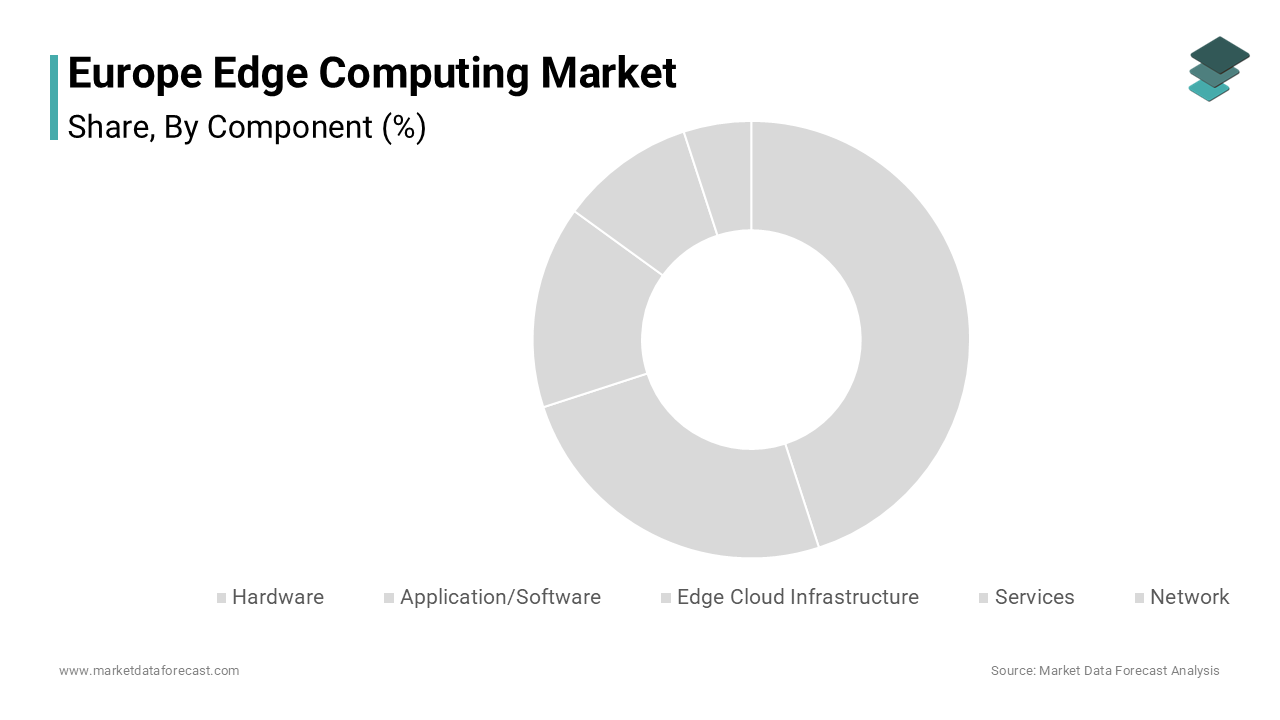
The application and software segment is on the rise and is expected to be the fastest growing segment in the global market by witnessing a CAGR of 28.6% from 2025 to 2033 due to the rising demand for AI enabled edge analytics, real time decision engines, and containerized microservices that operate independently of cloud connectivity. Industrial firms are increasingly adopting software platforms that deploy machine learning models directly on edge devices for anomaly detection and process optimization. According to research, many German manufacturing plants using edge computing run proprietary or third party AI software stacks for predictive quality assurance. Regulatory developments also support growth. Apart from these, open source initiatives have reduced vendor lock in and accelerated software prototyping. This convergence of algorithmic innovation, regulatory alignment, and accessible development tools positions software as the most dynamic layer in Europe’s edge stack.
By Enterprise Type Insights
The large enterprises segment held the majority share of the Europe edge computing market in 2024. The supremacy of the large enterprises segment is because of extensive capital resources, complex operational footprints, and regulatory obligations that necessitate localized data processing. Multinational manufacturers, energy utilities, and transport operators deploy edge infrastructure across dozens of sites to meet real time control and data sovereignty requirements. Large firms also benefit from direct partnerships with hyperscalers and telecom providers. Furthermore, compliance with the EU Corporate Sustainability Reporting Directive compels large entities to implement granular operational monitoring, which edge systems uniquely enable. These structural, financial, and regulatory advantages ensure large enterprises remain the primary drivers of edge adoption across the continent.
The small and medium enterprises segment is expected to exhibit a noteworthy CAGR of 31.2% during the forecast period owing to the emergence of affordable, modular edge solutions and targeted public support programs. The EU’s Digital Europe Programme has allocated funds to subsidize edge adoption among SMEs through Digital Innovation Hubs. These hubs provide plug and play edge kits, combining hardware, pre trained AI models, and cybersecurity configurations, which makes deployment feasible for businesses with limited IT staff. In the agri food sector, Italian and Spanish SMEs are using edge enabled vision systems to automate sorting of produce, reducing labor costs. Apart from these, cloud providers now offer “edge as a service” models with monthly subscriptions, eliminating upfront capital barriers.
By Application Insights
The IoT applications segment led the Europe edge computing market by accounting for 36.2% share in 2024. The prominence of the IoT applications segment is primarily propelled by the sheer scale of connected device deployments across smart manufacturing, utilities, and urban infrastructure, all of which generate data streams too voluminous or time sensitive for cloud only processing. Industrial IoT alone accounts for billions of connected sensors in the EU, with edge nodes filtering and analyzing data locally to reduce bandwidth costs and latency. The EU’s Cyber Resilience Act further mandates that IoT devices in critical sectors incorporate on device security updates, which edge platforms facilitate through localized firmware management. Moreover, the rollout of NB IoT and LTE-M networks across Europe has enabled low power wide area connectivity that pairs naturally with edge analytics for remote assets. This symbiotic relationship between edge and IoT ensures continued dominance in both public and private sector digital transformation.
The robotics and automation segment is predicted to witness the highest CAGR of 33.8% from 2025 to 2033. Factors such as the integration of edge AI into collaborative robots, autonomous mobile robots, and machine vision systems that require millisecond level decision making boost the expansion of the robotics and automation segment. The EU’s Chips Act has further accelerated adoption by funding domestic development of AI accelerators optimized for robotic edge workloads. Additionally, safety regulations under the Machinery Regulation require autonomous systems to maintain operational continuity during cloud outages, mandating on device intelligence. In logistics, companies deploy edge powered autonomous forklifts in distribution centers that dynamically reroute based on human presence detected via local sensor fusion. These technological, regulatory, and industrial forces position robotics as the vanguard of intelligent automation in Europe.
REGIONAL ANALYSIS
Germany Edge Computing Market Analysis
Germany was the top performer in the Europe edge computing market and accounted for 26.8% share in 2024. The domination of Germany is attributed to its world class industrial base, where Industry 4.0 initiatives have driven widespread adoption of edge enabled manufacturing systems. A share of Germany’s top 500 industrial firms operate edge computing infrastructure for real time production analytics. The automotive sector is a key driver. National policy further accelerates deployment. Apart from these, Germany hosts Europe’s largest concentration of private 5G networks most integrated with edge platforms. Strong collaboration between Fraunhofer institutes and industry ensures continuous innovation in edge AI for predictive maintenance and energy optimization. These industrial, regulatory, and research synergies solidify Germany’s position as Europe’s edge computing powerhouse.
France Edge Computing Market Analysis
France was the second largest player in the Europe edge computing market. Its strategic focus on digital sovereignty and critical infrastructure modernization drives the demand for Edge computing in France. In the nuclear sector, EDF uses edge systems to monitor reactor integrity in real time, processing sensor data on site to comply with military grade data localization laws. Additionally, France is a pioneer in smart city edge applications. The national AI strategy also funds edge native AI research at institutions like INRIA, which fosters a robust startup ecosystem. These top down policy interventions and sector specific use cases ensure France’s sustained leadership in sovereign edge computing.
The United Kingdom Edge Computing Market Analysis
The United Kingdom remains a key player in the Europe edge computing market. Despite Brexit, the UK remains a hub for edge innovation, particularly in healthcare, fintech, and offshore energy. In the North Sea, BP and Shell use edge platforms on oil rigs to monitor equipment health under harsh conditions where satellite latency is prohibitive. The UK’s National Cyber Security Centre mandates that critical national infrastructure adopt on premise processing for operational technology, directly driving edge adoption. Hence, the UK maintains a dynamic and application driven edge ecosystem.
Netherlands Edge Computing Market Analysis
The Netherlands expanded gradually in the Europe edge computing market, with its role as a digital logistics and data hub. Edge computing enables real time operations at the Port of Rotterdam, the largest in Europe. The port uses edge nodes to coordinate autonomous cranes, truck routing, and customs inspections, processing significant terabytes of sensor data daily on site. The Netherlands is also a leader in agri tech edge applications. Furthermore, the country hosts major data centers from Equinix and Digital Realty that offer edge colocation services for pan European enterprises. This blend of logistics excellence, agricultural innovation, and digital infrastructure cements the Netherlands as a strategic node in Europe’s edge landscape.
Sweden Edge Computing Market Analysis
Sweden is anticipated to grow in the Europe edge computing market from 2025 to 2033 due to its focus on sustainable and secure edge deployments aligned with national climate and defense priorities. In mining, LKAB uses edge enabled autonomous haulers in underground iron ore operations where connectivity is unreliable, ensuring continuous productivity. Sweden’s stringent data protection laws, among the strictest in the EU, mandate that public sector edge systems undergo national security certification, driving demand for locally developed solutions. Apart from these, the Swedish Energy Agency funds edge based microgrid controllers that balance renewable generation and storage in remote communities.
COMPETITIVE LANDSCAPE
The Europe edge computing market features a multifaceted competitive landscape shaped by industrial technology providers, telecom operators, cloud vendors, and specialized startups. Competition is not solely based on technology but heavily influenced by regulatory compliance, data sovereignty credentials, and sector specific expertise. Large industrial firms like Siemens and Schneider Electric dominate manufacturing applications through deep operational technology integration, while telecom giants such as Ericsson and Nokia leverage 5G infrastructure to offer network edge services. European cloud providers like OVHcloud and Deutsche Telekom differentiate through sovereign infrastructure and GDPR aligned data handling. Meanwhile, agile startups focus on niche verticals such as edge AI for agriculture or healthcare diagnostics. The absence of a dominant global hyperscaler in the European edge space, due to data localization pressures, has created room for regional players to thrive. However, interoperability gaps, cybersecurity fragmentation, and high integration costs continue to challenge scalability. Overall, the market rewards companies that combine technical robustness with regulatory trust and vertical domain knowledge.
KEY MARKET PLAYERS
A few of the major companies in the europe edge computing market include
- Siemens AG
- Amazon Web Services, Inc. (AWS)
- Microsoft Corporation
- Atos SE
- Cisco Systems, Inc.
- Aricent, Inc.
- General Electric Company (GE)
- Hewlett Packard Enterprise Development LP (HPE)
- Honeywell International Inc.
- IBM Corporation
- Intel Corporation
- Rockwell Automation, Inc.
- SAP SE
- ADLINK Technology Inc.
- Dell Technologies
- EdgeConnex Inc.
Top Players in the Europe Edge Computing Market
Siemens AG
Siemens AG is a global industrial technology leader with deep integration in the Europe edge computing market through its Industrial Edge portfolio. The company provides hardware and software solutions that enable real time data processing in manufacturing, energy, and infrastructure sectors across the continent. Siemens has strengthened its position by expanding its Industrial Edge Management System to support third party applications and AI models, fostering an open ecosystem for developers. Its active role in GAIA X and Plattform Industrie 4.0 ensures alignment with EU data sovereignty and interoperability standards, reinforcing trust among industrial customers seeking secure, localized computing infrastructure.
Ericsson AB
Ericsson AB plays a pivotal role in the Europe edge computing market by integrating edge capabilities into its 5G network infrastructure. The company’s Edge Gravity platform enables telecom operators and enterprises to deploy low latency applications at the network edge, particularly in smart factories, ports, and urban mobility systems. Ericsson has reinforced its European footprint through strategic partnerships with Orange, Deutsche Telekom, and Telia to co develop private 5G edge solutions.
OVHcloud SA
OVHcloud SA is a leading European cloud provider that has strategically expanded into edge computing to support data localization and low latency requirements across the EU. The company offers sovereign edge infrastructure through its “Edge Sites” program, deploying micro data centers in proximity to industrial and urban hubs in France, Germany, and Poland. OVHcloud has strengthened its market position by launching edge native Kubernetes services that allow seamless deployment of containerized applications without cloud dependency.
Top Strategies Used by the Key Market Participants
Key players in the Europe edge computing market pursue strategies centered on regulatory alignment, ecosystem collaboration, and vertical integration. They prioritize compliance with EU data sovereignty frameworks such as the Data Act and Cyber Resilience Act by designing localized and auditable edge architectures. Companies actively co develop solutions with telecom operators, industrial OEMs, and public sector entities to embed edge capabilities into sector specific workflows. Investment in open source platforms and interoperable standards, such as those promoted by GAIA X and EdgeX Foundry, reduces vendor lock in and accelerates adoption. Additionally, firms are establishing sovereign edge infrastructure within national borders to address security and latency requirements in defense, healthcare, and critical infrastructure. Strategic acquisitions of AI and IoT startups further enhance their software capabilities, enabling end to end edge to cloud value chains tailored to European operational and ethical expectations.
MARKET SEGMENTATION
This research report on the Europe Edge Computing Market has been segmented based on the following categories.
By Component
- Hardware
- Application/Software
- Edge Cloud Infrastructure
- Services
- Network
By Enterprise Type
- Small & Medium-sized Enterprises (SMEs)
- Large Enterprises
By Application
- IoT Applications
- Robotics & Automation
- Predictive Maintenance
- Remote Monitoring
- Smart Cities
- Others (Video Analytics, Smart Homes)
By Industry
- Manufacturing
- Oil & Gas
- BFSI
- Healthcare
- Retail
- IT & Telecom
- Automotive
- Others
By Country
- UK
- France
- Spain
- Germany
- Italy
- Russia
- Sweden
- Denmark
- Switzerland
- Netherlands
- Turkey
- Czech Republic
- Rest of Europe