- Product Description Description
- Table of Contents TOC
- List of Table & Figure LOT
- Get Free Sample PDF Sample PDF
Market Size, 2025
$0.95 BnMarket Estimate, 2026
$1.01 BnMarket Forecast, 2034
$1.63 BnCAGR, 2026–2034
6.18%Europe Elastomeric Couplings Market Size, Trends, and Forecast (2026–2034)
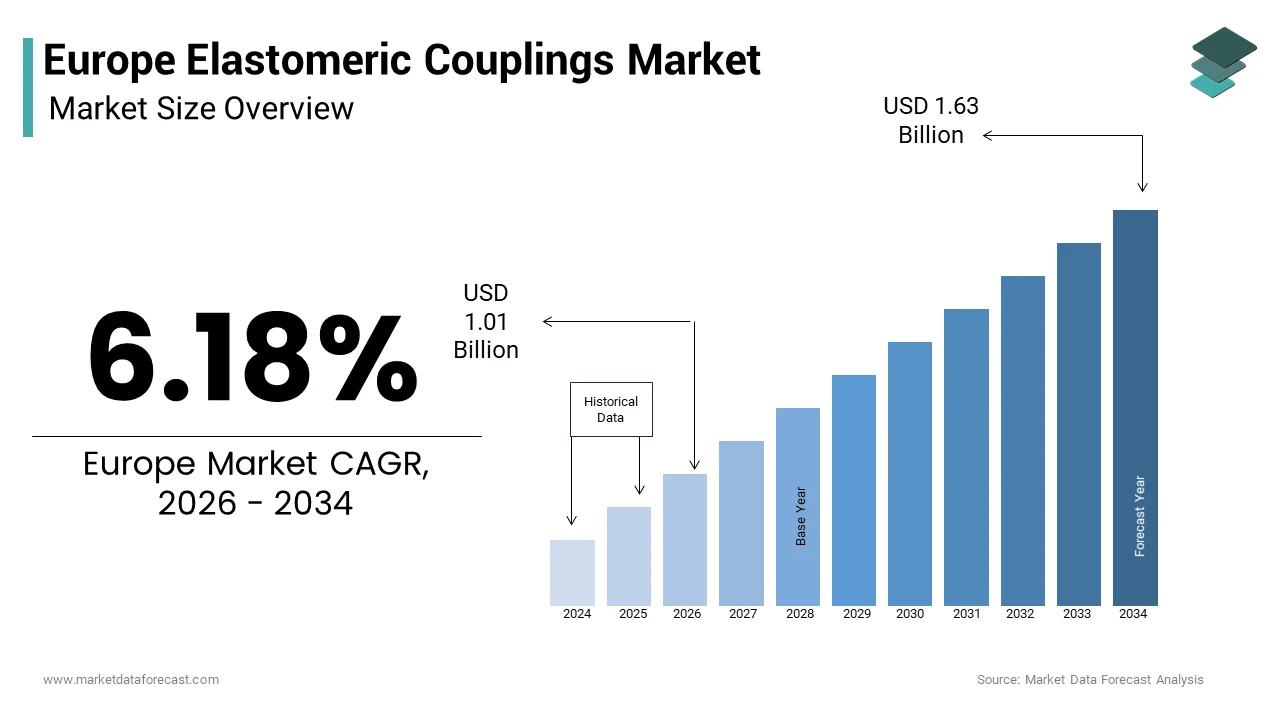
The Europe elastomeric couplings market size was valued at USD 0.95 billion in 2025, stands at USD 1.01 billion in 2026, and is anticipated to reach USD 1.63 billion by 2034, expanding at a compound annual growth rate (CAGR) of 6.18% during the forecast period from 2026 to 2034. Growth is primarily propelled by strict European energy efficiency mandates (such as the EU Ecodesign Directive), expanding offshore wind and renewable energy infrastructure, and rising automation demands across advanced manufacturing sectors.
Key Executive Metrics (At-a-Glance)
- 2025 Base Valuation: USD 0.95 Billion
- 2026 Current Valuation: USD 1.01 Billion
- 2034 Forecast Valuation: USD 1.63 Billion
- Forecast Period: 2026–2034
- Compound Annual Growth Rate (CAGR): 6.18%
- Dominant Product Segment: Jaw-Type Coupling (36.1% share in 2025)
- Fastest-Growing Product Segment: Tire-Type Coupling (7.1% CAGR)
- Dominant Application Segment: Pumps (33.5% share in 2025)
- Fastest-Growing Application Segment: Conveyors (6.9% CAGR)
- Leading End-User Sector: Automotive (38.2% share in 2025)
- Leading Country Market: Germany (28.3% share in 2025)
Core Market Drivers
- Energy Efficiency Regulations: Enforcement of rigorous standards like the EU Ecodesign Directive targeting motor-driven system losses.
- Renewable Infrastructure: Proliferation of offshore wind farms requiring high-reliability drivetrain components resistant to saline corrosion and thermal cycling.
Primary Market Restraints & Challenges
- Environmental Vulnerability: Degradation of basic polymer elements under continuous thermal, UV, and ozone exposure.
- Regulatory Complexity: Strict chemical regulations (REACH compliance) and supply chain fragmentation resulting from regional regulatory divergence.
Europe Elastomeric Couplings Market Segmentation Breakdown
| Segment Category | Leading / Dominant Sub-Segment | Fastest-Growing / Key Highlight |
|---|---|---|
| By Product | Jaw-Type Coupling (36.1% share) | Tire-Type Coupling (7.1% CAGR) |
| By Application | Pumps (33.5% share) | Conveyors (6.9% CAGR) |
| By End-User | Automotive (38.2% share) | Machine Tools (7.3% CAGR) |
| By Country | Germany (28.3% share) | Sweden (Sustainable Innovation Hub) |
Major Industry Players Profiled
Key market participants driving technology and expansion across Europe include Siemens AG, System Components Inc., R+W Antriebselemente GmbH, Astro-Tex Co., Inc., Regal Beloit Corporation, ABB Motors, Mechanical Inc., Flender AG, Ringfeder, John Crane, and Altra Industrial Motion Corp.
 Download Free Sample Report
Europe Elastomeric Couplings Market Size
The Europe elastomeric couplings market size was valued at USD 0.95 billion in 2025 and is anticipated to reach USD 1.01 billion in 2026 to reach USD 1.63 billion by 2034, growing at a CAGR of 6.18% from 2026 to 2034.
An elastomeric coupling is a type of flexible mechanical device used to connect two rotating shafts, such as a motor and a pump, to transmit power while accommodating misalignment and dampening vibrations. These couplings utilize flexible polymer elements, typically composed of rubber, polyurethane, or advanced thermoplastic elastomers, that provide resilience under dynamic operational conditions prevalent in precision machinery. Their deployment is critical in safeguarding drivetrain integrity in sectors such as manufacturing automation, renewable energy, rail transport, and process engineering. Industry reliability studies indicate that misalignment and imbalance are root causes for approximately 50% of rotating machinery failures, prompting a shift toward laser alignment systems and precision flexible couplings to dampen vibration and extend component life. While the European Environment Agency focuses on broad industrial decarbonization, technical studies show that correcting shaft misalignment can reduce energy consumption in motor-driven systems by 2% to 10%, making precision alignment a key factor in meeting corporate energy efficiency goals. Besides, the Machinery Directive (2006/42/EC), harmonized under CEN standards, strictly mandates the use of fixed guards or protective devices around rotating transmission parts to prevent operator injury, rather than prescribing specific coupling internal mechanisms for machine reliability. In Germany’s automotive sector, standard industrial robots prioritize high-stiffness precision gearing for accuracy, while the emerging segment of collaborative robots (cobots) increasingly integrates torque sensors and compliant actuators to ensure safe interaction with human workers. Digitalized factories and clean energy infrastructure are on the rise across Europe’s industrial landscape. In this environment, elastomeric couplings have evolved from passive connectors into integral components of system efficiency, longevity, and operational safety.
MARKET DRIVERS
Stringent Energy Efficiency Regulations Driving Adoption in Motor-Driven Systems
The enforcement of rigorous energy efficiency standards within motor-driven equipment is a principal driver shaping the growth of the Europe elastomeric couplings market. This is particularly driven by the EU’s Ecodesign Directive 2019/1781. The legislation mandates minimum efficiency levels for electric motors, pumps, fans, and compressors. Electric motors are the largest consumers of power in European factories, making them the most important target for energy-saving upgrades. Elastomeric couplings contribute significantly to compliance by reducing parasitic losses caused by vibration, misalignment, and torsional oscillations, which can degrade system efficiency. In Denmark’s pharmaceutical manufacturing sector, where precision and sterility are paramount, companies like Novo Nordisk have implemented low-backlash jaw-type couplings to minimize micro-vibrations in filling lines, thereby enhancing product consistency and reducing energy waste. Furthermore, German government programs are encouraging businesses to look at every part of their power-delivery systems to find ways to use less electricity. Using more durable rubber materials in water pumps helps protect the internal parts from wearing out too quickly. Europe has recently accelerated its energy-saving goals, pushing industries to find even more creative ways to cut down on waste.
Expansion of Offshore Wind Energy Infrastructure Requiring High-Reliability Drivetrain Components
The rapid expansion of offshore wind capacity across Northern Europe further propels the expansion of the Europe elastomeric couplings market. In these systems, elastomeric couplings play a vital role in pitch and yaw control, generator linkages, and auxiliary drives. European nations are aiming to multiply their offshore wind power capacity nearly twenty-fold by mid-century to meet climate neutrality goals. Each multi-megawatt turbine incorporates multiple elastomeric couplings designed to withstand saline corrosion, thermal cycling, and constant mechanical fatigue. Grid operators focus on the stability of the electrical connection to shore, while the mechanical design of the turbines remains the responsibility of the manufacturer. Certification bodies emphasize that protecting gearboxes from sudden torque spikes is critical for extending the operational life of wind turbines. In Scotland’s Hywind floating wind project, operated by Equinor, specially formulated EPDM-based couplings resistant to UV degradation and marine biofouling have demonstrated zero performance decline after five years of continuous operation. The industry is moving toward using data analysis to predict when parts will break, allowing repairs to be scheduled during calm weather to minimize lost power generation. Offshore repairs are logistically complex and costly. Consequently, the reliability offered by advanced elastomeric solutions makes them indispensable in next-generation wind farms stretching from the Baltic to the Celtic Seas.
MARKET RESTRAINTS
Limited Service Life of Elastomers Under Continuous Thermal and Ozone Exposure
The inherent vulnerability of polymer materials to environmental degradation is one significant restraint affecting the growth of the Europe elastomeric couplings market. This is particularly true when they are subjected to prolonged heat, ozone, and ultraviolet radiation. Engineers are increasingly moving away from basic rubber materials in outdoor machinery because exposure to common air pollutants causes the material to become brittle and fail prematurely. Extreme summer heat in Mediterranean regions is forcing energy companies to choose specialized materials that can withstand high temperatures without losing their flexibility. Similarly, in urban rail networks like Paris’s Métro Line 14, elevated tunnel temperatures caused by braking systems and poor ventilation accelerate aging in couplings used in traction motor drives. Unexpected mechanical failures in public transit systems are a major driver of repair expenses, leading operators to seek more reliable part designs. Even advanced materials like ethylene propylene diene monomer (EPDM) exhibit reduced tensile strength after extended exposure to industrial pollutants common in port cities such as Antwerp and Hamburg. The European Chemicals Agency (ECHA) further restricts certain plasticizers under REACH regulations, limiting formulation options and complicating supply chain logistics for manufacturers. These factors collectively diminish the long-term viability of elastomeric solutions in high-stress environments, compelling operators to adopt more frequent inspection schedules or switch to metallic alternatives despite higher initial costs and inferior vibration absorption.
High Precision Requirements in Advanced Automation Limiting Conventional Designs
The increasing precision demands in the region’s high-tech manufacturing sectors also hampers the expansion of the Europe elastomeric couplings market. In these sectors, traditional elastomeric couplings struggle to meet micron-level alignment and zero-backlash requirements. Industries such as semiconductor fabrication, medical device assembly, and aerospace component machining necessitate rotational accuracy within ±0.02 degrees, a threshold often unattainable with standard rubber-based joints due to inherent creep and hysteresis. Robot manufacturers are looking for stiffer materials to ensure that their machines can move at high speeds without vibrating or losing their place. In lithography machines produced by ASML in the Netherlands, even minimal angular deviation caused by coupling deformation can result in wafer misalignment, leading to multimillion-euro production losses. Metalworking tools used in the most advanced factories require connectors that have virtually zero "wiggle room" to ensure the finished parts are perfectly smooth. Besides, the rise of direct-drive motors eliminates the need for intermediate couplings altogether, further eroding the application base for elastomeric variants. Large-scale battery factories are choosing rugged, high-precision metal parts for their robots to handle the intense heat and constant motion of the assembly line. Consequently, despite their advantages in cost and noise reduction, conventional elastomeric couplings face exclusion from cutting-edge automation platforms where mechanical fidelity outweighs flexibility.
MARKET OPPORTUNITIES
Integration of Condition-Monitoring Technologies into Smart Coupling Systems
Embedding sensor technology within elastomeric couplings to enable real-time health diagnostics and predictive maintenance across Industry 4.0-enabled facilities provides major growth opportunities for the Europe elastomeric couplings market. Industrial leaders across Northern and Central Europe are increasingly looking to add sensors to their mechanical parts to catch problems before they stop production. Companies such as Mayr Antriebstechnik and KTR Systems have developed prototype couplings equipped with MEMS accelerometers and strain gauges capable of detecting imbalance, misalignment, and early-stage elastomer fatigue. : Advanced factories are using artificial intelligence to listen to the "heartbeat" of their machines, allowing them to predict when a part might break weeks in advance. The International Electrotechnical Commission has standardized communication protocols such as IO-Link and OPC UA, enabling seamless integration of sensor-equipped couplings into existing SCADA and MES infrastructures. Car manufacturers are switching from fixed repair schedules to "as-needed" servicing to keep their assembly lines moving without unnecessary stops. Furthermore, the European Union’s Horizon Europe program is funding research into self-powered sensors using piezoelectric elements embedded in coupling hubs, eliminating the need for external batteries. The growing number of robots in European factories is creating a massive market for smart parts that can report their own health data.
Development of Recyclable and Bio-Based Elastomer Formulations for Circular Economy Compliance
The development of sustainable, recyclable, and bio-derived polymer materials aligned with the EU’s Circular Economy Action Plan also offers significant potential for the expansion of the Europe elastomeric couplings market. The European Union is introducing new design rules that will eventually require most mass-produced plastic items to be built for easy recycling or multiple uses. Because traditional industrial rubber is difficult to melt down and reuse, a large portion of it is currently burned for energy instead of being turned into new products. However, breakthroughs in thermoplastic polyurethanes (TPU) now allow for full mechanical recyclability without compromising damping performance. Covestro AG successfully tested a fully recyclable TPU coupling in collaboration with Bosch Rexroth, demonstrating retained functionality after three reprocessing cycles. Additionally, companies are experimenting with desert shrubs as a new source of rubber to reduce the environmental impact of traditional tree-based harvesting. The European Commission’s Green Public Procurement criteria now favor suppliers offering end-of-life take-back programs, prompting firms like Ringfeder and Rothe Erde to introduce modular coupling designs with separable metal and elastomer components. Although many of Europe's largest companies are promising to reach zero emissions, only a small group currently has a detailed plan that covers their entire business.
MARKET CHALLENGES
Intensifying Material Innovation Pressures Amid Regulatory and Performance Demands
The mounting pressure to develop materials that simultaneously meet escalating performance thresholds and stringent environmental regulations is a primary challenge confronting the Europe elastomeric couplings market. The European Chemicals Agency (ECHA) has restricted numerous substances under REACH, including several phthalate plasticizers traditionally used to enhance rubber flexibility, forcing manufacturers to reformulate without compromising durability. According to the German Rubber Institute, finding alternatives that maintain elongation at break above 300% while resisting oils and ozone remains a persistent R&D hurdle. The railway industry sets extremely high durability bars for all parts to ensure they can survive decades of constant use in freezing and sweltering weather. Moreover, the push for lightweighting in electric mobility has intensified demand for couplings with lower rotational inertia, yet reducing mass often compromises damping capacity. Engineers are finding that the sudden, powerful bursts of energy from electric car motors can put unexpected pressure on the flexible parts connecting the motor to the wheels. Simultaneously, customers expect longer service intervals. French industrial giant Alstom mandates minimum five-year maintenance-free operation in its tramway propulsion systems. Balancing these competing demands, performance, weight, temperature resilience, recyclability, and cost, requires unprecedented collaboration between material scientists, OEMs, and certification bodies, making innovation cycles longer and riskier.
Fragmented Supply Chain Dynamics Due to Regional Regulatory Divergence
The fragmentation of the supply chain also hinders the expansion of the Europe elastomeric couplings market. This is caused by differing national interpretations of EU-wide directives, particularly in safety, material traceability, and recycling obligations. While the EU promotes harmonization, member states apply varying enforcement rigor, complicating compliance for multinational coupling producers. Rail operators are moving toward a single, unified European fire safety standard (EN 45545) to replace the conflicting national rules that previously complicated train manufacturing. Automotive suppliers are warning that divergent regulations between the EU and other markets are adding significant administrative time to the launch of new vehicle components. Additionally, customs delays following Brexit have disrupted just-in-time deliveries between UK-based distributors and mainland European clients, as per Logistics UK’s 2023 industry review. In Eastern Europe, inconsistent adoption of digital product passports under the Digital Product Passport initiative hampers tracking of recycled content claims, undermining transparency goals. Standardization bodies are working to digitize testing protocols to ensure that a product tested in one country gets the exact same result as one tested in another. These inconsistencies elevate operational complexity, increase compliance costs, and weaken supply chain agility, posing a systemic barrier to scaling sustainable and technologically advanced elastomeric coupling solutions uniformly across the continent.
REPORT COVERAGE
| REPORT METRIC | DETAILS |
| Market Size Available | 2025 to 2034 |
| Base Year | 2025 |
| Forecast Period | 2026 to 2034 |
| CAGR | 6.18% |
| Segments Covered | By Product, Application, End-User, and Country |
| Various Analyses Covered | Global, Regional, and Country Level Analysis, Segment-Level Analysis; DROC, PESTLE Analysis; Porter’s Five Forces Analysis; Competitive Landscape; Analyst Overview of Investment Opportunities. |
| Regions Covered | UK, France, Spain, Germany, Italy, Russia, Sweden, Denmark, Switzerland, Netherlands, Turkey, Czech Republic, and the Rest of Europe |
| Market Leaders Profiled | Siemens AG, System Components Inc., R+W Antriebselemente GmbH, Astro-Tex Co., Inc., Regal Beloit Corporation, ABB Motors, Mechanical Inc... ., Flender AG, Ringfeder, John Crane, Altra Industrial Motion Corp. |
SEGMENTAL ANALYSIS
By Product Insights
The jaw-type coupling segment dominated the European elastomeric couplings market and accounted for a 36.1% share in 2025. The dominance of the segment is driven by its adaptability, ease of maintenance, and compatibility with a broad spectrum of industrial machinery across decentralized manufacturing units. Among these, a key factor driving its widespread adoption is its modular architecture, which allows for rapid replacement of elastomer "spiders" without realigning connected shafts, a feature critical in minimizing production downtime. High-value manufacturing sectors are facing escalating financial risks from technical failures, driving a massive investment in parts that can be replaced instantly. Industrial standards ensure that mechanical connectors can handle slight shifts in machine alignment to prevent parts from snapping under pressure. Machinery makers in Italy’s food valley are choosing mechanical parts that can be easily cleaned and do not conduct electricity to keep production lines safe and sterile. Furthermore, the European Committee for Standardization mandates fail-safe operation in safety-critical applications; jaw couplings inherently meet this requirement as they maintain torque transmission even after elastomer fracture. Factories are upgrading their old motor systems with more precise components to save energy and reduce the vibrations that cause machines to wear out.
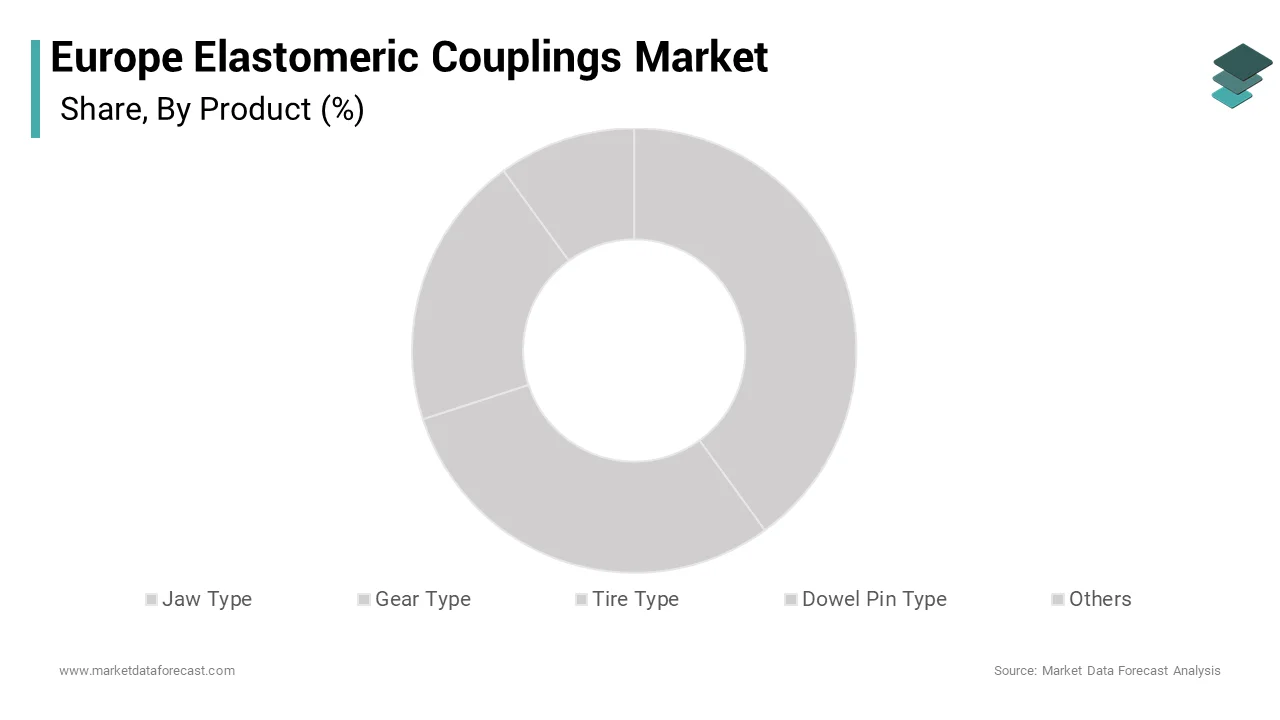
The tire-type elastomeric coupling segment is likely to experience the fastest CAGR of 7.1% from 2026 to 2034 due to increasing deployment in high-torque, shock-load-prone applications within renewable energy and heavy transport infrastructure. One of the primary drivers is its exceptional torsional flexibility and damping capacity, making it indispensable in wind turbine yaw and pitch drive systems. Wind farm operators are prioritizing mechanical connectors that can dampen the constant shaking of the turbine to protect the expensive gearboxes from wearing out. These couplings can absorb transient torques exceeding four times nominal load, a capability essential during sudden wind gusts or emergency feathering maneuvers. Mining companies in Northern Europe are choosing flexible connectors for their massive conveyor belts to handle the heavy, uneven loads of iron ore without breaking the drive systems. Another significant factor is their lightweight construction. A standard 60-inch tire coupling weighs less than an equivalent gear coupling, contributing to improved fuel efficiency in mobile platforms such as locomotives and mining trucks. The Fraunhofer Institute for Structural Durability and System Reliability reports that reducing rotational mass in drivelines enhances dynamic response and lowers energy consumption in variable-speed systems. Additionally, advancements in radial-reinforced synthetic rubber formulations, such as chloroprene and EPDM, are extending service life under UV and saline exposure, enabling broader use in coastal and Arctic environments. With major infrastructure programs like Germany’s Energiewende accelerating wind farm installations, tire-type couplings are poised for sustained outperformance.
By Application Insights
The pumps application segment held the majority share of 33.5% of the European elastomeric couplings market in 2025. The supremacy of the segment is attributed to the ubiquity of pumping systems across municipal water supply, wastewater treatment, chemical processing, and district heating networks. Every centrifugal or positive displacement pump requires a flexible interface between motor and impeller shaft to manage misalignment and vibration, both of which accelerate bearing degradation. Massive networks of water facilities across the continent rely on a huge number of pumps to keep clean water flowing and waste moving. Water companies in Denmark are upgrading their equipment to ensure their pumps last longer and break down less often. A significant portion of the electricity used to move liquids is lost because of old or poorly adjusted connections between motors and pumps. Elastomeric variants mitigate these losses by maintaining consistent alignment despite thermal expansion or foundation settling. Moreover, regulatory mandates such as the EU Ecodesign Directive 2019/1781 require minimum efficiency levels for pump packages, prompting upgrades to optimized coupling solutions. Facilities that turn seawater into drinking water must use specialized, rust-proof connectors to survive the salty air. The market for industrial pumps is expected to stay strong as European factories and utilities continue to modernize their liquid-handling systems.
The conveyors application segment is on the rise and is expected to be the fastest growing segment in the market by witnessing a CAGR of 6.9% during the forecast period owing to automation expansion in logistics, e-commerce fulfillment, and smart factory deployments. Modern material handling systems in distribution centers, automotive plants, and airport baggage handling rely on continuous, low-vibration operation, conditions where elastomeric couplings excel. Private sector reports indicate double-digit growth in the European warehouse automation market, driven by labor shortages and e-commerce demand. Major e-commerce hubs are deploying thousands of mobile robots to work alongside miles of traditional conveyors, creating hybrid automated environments. Logistics companies are prioritizing low-maintenance drivetrain components to minimize the high cost of downtime in 24/7 distribution centers. Another driver is the rise of underground urban logistics tunnels in cities like Paris and Helsinki, where noise and vibration control are paramount. Industrial safety institutes are increasingly focusing on reducing noise pollution in factories to protect worker health, often recommending softer materials for moving parts. Additionally, the European Federation of Materials Handling (FEM) specifies maximum permissible vibration levels in automated guided vehicle (AGV) transfer lines, favoring flexible coupling solutions. Cross-border online shopping continues to drive steady increases in package volumes across Europe, though official EU strategy focuses more on regulatory harmonization than volume targets.
By End-User Insights
The automotive segment was the largest segment in the European elastomeric couplings market and occupied a 38.2% share in 2025 because of the sector’s extensive use of automated production lines, robotic cells, and precision assembly equipment, all reliant on reliable power transmission components. Car manufacturers operate thousands of servo-driven robots per plant, each incorporating multiple elastomeric couplings in joint actuators, conveyor feeds, and welding arms. The automotive industry remains the primary driver of robot adoption in Europe, utilizing dense networks of automated arms to handle complex assembly tasks. Manufacturers of electric vehicles are choosing high-precision mechanical connectors to ensure that heavy battery components are placed with perfect accuracy every time. The German Mechanical Engineering Industry Association (VDMA) emphasizes that micro-misalignment in robotic joints exceeding 0.1 mm can result in defective welds or component misplacement, necessitating high-precision flexible joints. Additionally, the shift toward electric mobility has increased demand for couplings in e-axle test rigs, dynamometers, and battery cooling pumps, where vibration isolation protects sensitive electronics. The European Battery Alliance reports that approximately 35 to 50 major battery gigafactories are under development or operation across the continent, all requiring advanced material handling and testing infrastructure. Automakers are investing heavily in digital twin technologies and predictive maintenance. Consequently, the need for durable, serviceable couplings capable of integrating into smart diagnostics further solidifies the automotive sector’s preeminent position in shaping elastomeric coupling demand.
The machine tools segment is expected to exhibit a noteworthy CAGR of 7.3% between 2026 and 2034. The rapid expansion of the segment is fuelled by rising investment in high-precision machining for aerospace, medical devices, and electric mobility components. Modern CNC machines, including five-axis milling centers and grinding systems, demand couplings that deliver zero backlash, high torsional stiffness, and micron-level repeatability, qualities increasingly met by advanced elastomeric designs using polyurethane and Hytrel inserts. European machine tool builders are seeing a cooling in demand as global economic uncertainty causes manufacturers to delay buying new equipment. To achieve microscopic accuracy, machine builders are replacing flexible rubber connectors with rigid metal components that do not twist or bounce under load. Researchers are focusing on stabilizing the cutting tools and workpieces themselves to prevent the microscopic vibrations that ruin the finish of high-tech parts. Another factor is the integration of Industry 4.0 diagnostics. Machine tool builders such as DMG MORI are embedding condition-monitoring sensors into coupling hubs to detect imbalance and predict wear. Additionally, the EU’s Critical Raw Materials Act mandates localized production of rare-earth magnets and high-strength alloys, spurring new machining facilities dedicated to processing these materials. Eastern Europe continues to attract manufacturing investment, but growth is driven by individual factory expansions rather than a centralized program of building dozens of new specialized parks.
COUNTRY-LEVEL ANALYSIS
Germany Elastomeric Couplings Market Analysis
Germany led the European elastomeric couplings market and accounted for a 28.3% share in 2025. The dominance of the German market is driven by its status as the continent’s engineering and industrial automation hub. The country hosts a dense network of mechanical engineering firms, automotive OEMs, and precision machinery manufacturers, all intensive users of high-performance couplings. Germany remains the powerhouse of European machine manufacturing, contributing a substantial portion of the continent's total industrial sales. Companies such as Mayr Antriebstechnik, Ringfeder, and KTR Systems are global leaders in coupling innovation, supplying to industries ranging from robotics to rail transport. German factories are rapidly digitising their operations, with more than half of all businesses now using advanced smart technologies to run their production lines. Additionally, Germany’s Energiewende policy has spurred offshore wind installations in the North Sea, with Siemens Gamesa deploying thousands of elastomeric joints in turbine yaw systems. The German government is pushing for a massive upgrade of industrial equipment to meet strict new climate goals and reduce national energy use. Germany has deep-rooted expertise in materials science and quality manufacturing. As a result, it remains the technological epicenter of the European elastomeric couplings landscape.
Italy Elastomeric Couplings Market Analysis
Italy followed closely in the European elastomeric couplings market and captured a 17.4% share in 2025. The expansion of the Italian market is attributed to its world-leading position in specialized industrial machinery production. The country is renowned for manufacturing high-precision equipment in packaging, textile, ceramic, and food processing sectors, all of which integrate elastomeric couplings for smooth, low-noise operation. Italy continues to be a global leader in high-end machinery, with nearly half of its production sold to its European neighbours. A massive concentration of specialized machine builders in Northern Italy drives the demand for the flexible connectors used in modern packaging systems. Italian-made machines are the standard for drink-bottling factories across Europe, relying on numerous flexible parts to keep production moving smoothly. Moreover, stringent hygiene standards under EU Regulation 1935/2004 necessitate non-corrosive, easy-to-clean coupling housings made from stainless steel and FDA-compliant elastomers. The University of Bologna’s Department of Industrial Engineering confirms that vibration reduction in bottling lines improves fill accuracy. Italy’s National Recovery and Resilience Plan is supporting ongoing investments in automation and green manufacturing. Consequently, the domestic demand for advanced coupling technologies is expanding, reinforcing the nation’s strategic role in the European supply chain.
France Elastomeric Couplings Market Analysis
France maintains a noteworthy position in the European elastomeric couplings market due to robust investments in nuclear energy maintenance, railway modernization, and sustainable industrial transformation. The country operates numerous nuclear reactors, the second-largest fleet globally after the U.S., each relying on hundreds of pumps and cooling fans equipped with fail-safe elastomeric couplings. The French nuclear industry is moving toward even stricter standardisation as it prepares to build a new generation of reactors to meet national climate goals. Railway operators are increasingly retrofitting older engines with digital tracking and more efficient parts to extend their working life and reduce energy waste. Public transit agencies are adopting quieter track and wheel components to make train travel more acceptable to people living near busy rail corridors. Additionally, France’s push for circular economy compliance has accelerated R&D into recyclable polyurethane couplings, with pilot programs underway at Altra Industrial Motion’s Lyon facility. France is leading Europe in "polluter pays" laws that reward companies for using recycled materials and punish those that create excessive waste. Thousands of French factories are being modernised with smarter, greener parts to meet the country's ambitious target of cutting carbon emissions by 41 million tonnes by 2030.
United Kingdom Elastomeric Couplings Market Analysis
The United Kingdom grew steadily in the European elastomeric couplings market by sustaining strong demand despite post-Brexit trade adjustments, particularly in offshore energy, water management, and advanced manufacturing. Although no longer part of the EU single market, the UK remains deeply integrated into European supply chains through mutual recognition of technical standards such as BS EN ISO. The UK is rapidly expanding its sea-based wind power to meet ambitious national energy targets, maintaining its position as one of the world's top producers. London's new "super sewer" is using advanced, rust-proof hardware to ensure its critical pumps can operate deep underground for decades without failing. Water companies are choosing flexible connectors for their pumps to help the machinery survive the grit and sand often found in wastewater. Additionally, automotive factories in the British heartland are adopting more precise mechanical joints to ensure their robots can assemble complex electric car batteries with extreme reliability. Despite customs delays and regulatory divergence concerns, the UK’s commitment to net-zero targets and industrial renewal ensures continued relevance in the regional coupling ecosystem.
Sweden Elastomeric Couplings Market Analysis
Sweden is expected to be the most lucrative region in the European elastomeric couplings market over the forecast period owing to its leadership in sustainable industrial innovation and electrification of heavy transport. The country is at the forefront of fossil-free steel production, with HYBRIT’s hydrogen-based steel plant in Kiruna requiring advanced coupling solutions resistant to extreme thermal cycling and dust exposure. Manufacturers of fossil-free steel are prioritizing heavy-duty mechanical parts that can absorb the intense shaking of massive machinery to prevent expensive production stops. Sweden's deepest mines rely on miles of heavy-duty belts to haul millions of tonnes of iron ore from deep underground to the surface every year. Mining companies are seeing fewer breakdowns as they replace old diesel engines with high-tech electric systems that are easier to monitor and maintain. Additionally, Volvo Group’s transition to electric trucks has increased demand for couplings in e-axle dynamometers and test benches, where precise torque control is essential. Sweden is channelling billions of euros into electrical power projects to help its biggest industries stop using coal and oil by the end of the decade. Sweden exemplifies how environmental ambition and engineering excellence converge to shape next-generation coupling requirements. This approach places a strong emphasis on circularity and digitalization.
COMPETITIVE LANDSCAPE
The competitive landscape of the Europe elastomeric couplings market is defined by technological sophistication, engineering credibility, and alignment with evolving industrial paradigms. Dominance is not determined by scale alone but by the ability to deliver precision, reliability, and innovation in tandem with regulatory and environmental expectations. While multinational corporations lead through brand strength and R&D investment, niche specialists thrive by addressing highly specific needs in aerospace, medical devices, or green energy infrastructure. Differentiation increasingly hinges on material science advancements, design intelligence, and the capacity to integrate mechanical performance with digital diagnostics. Price competition remains subdued, as customers prioritize longevity, compliance, and system efficiency over initial cost. The rise of sustainability mandates and circular economy principles further reshapes competition, compelling manufacturers to innovate in recyclable materials and modular designs. Geopolitical shifts, including supply chain localization and decarbonization pressures, are prompting companies to strengthen regional manufacturing and after-sales networks. As industries transition toward electrification, automation, and predictive maintenance, the role of elastomeric couplings evolves from mechanical connectors to strategic enablers of operational resilience. This transformation intensifies rivalry, favoring those who anticipate change, invest in future-ready technologies, and position themselves as integral contributors to next-generation industrial systems.
KEY MARKET PLAYERS
A few of the market players in the Europe elastomeric couplings market include
- Siemens AG
- System Components Inc.
- R+W Antriebselemente GmbH
- Astro-Tex Co., Inc
- Regal Beloit Corporation
- ABB Motors
- Mechanical Inc
- Flender AG
- Ringfeder
- John Crane
- Altra Industrial Motion Corp.
Top Players In the Market
- Mayr Antriebstechnik stands as a cornerstone of innovation in precision drive technology, headquartered in Germany and renowned for its engineering excellence in motion control solutions. The company specializes in high-performance elastomeric couplings designed for applications demanding zero backlash, thermal stability, and exceptional dynamic balance. Its product portfolio integrates advanced materials and modular designs tailored for robotics, packaging machinery, and semiconductor manufacturing, sectors where mechanical precision directly impacts output quality. Mayr’s commitment to R&D has positioned it as a pioneer in developing couplings compatible with Industry 4.0 systems, enabling seamless integration into smart factory environments. With a strong presence across European industrial hubs, the company supports OEMs and end-users through technical consultation, customization, and lifecycle management, reinforcing its reputation as a trusted partner in critical drivetrain applications.
- KTR Systems is a leading German manufacturer celebrated for its comprehensive range of flexible couplings, including advanced elastomeric variants used in energy, rail, and process industries. The company excels in delivering robust, maintenance-optimized solutions that combine torsional damping with high misalignment tolerance, making them ideal for harsh operational environments. KTR's expertise lies in balancing performance, durability, and ease of installation, ensuring minimal downtime during component replacement. Its coupling designs are widely adopted in wind turbines, pumps, and conveyor systems across Europe, where reliability under continuous load is paramount. By maintaining close collaboration with engineering firms and certification bodies, KTR ensures compliance with stringent safety and efficiency standards. The company’s focus on system-level thinking, rather than isolated component supply, enables it to offer holistic power transmission solutions, strengthening its influence in both retrofit and greenfield industrial projects.
- Ringfeder is a distinguished name in mechanical power transmission, recognized for its durable and technically sophisticated elastomeric coupling systems serving heavy industry and transportation sectors. Based in Germany, the company produces engineered solutions that prioritize shock absorption, vibration isolation, and long service life in demanding applications such as mining, steel production, and marine propulsion. Ringfeder couplings are known for their structural integrity and adaptability to extreme torque fluctuations, making them essential in large-scale industrial drivetrains. The company emphasizes fail-safe design principles, ensuring operational continuity even under partial component degradation. With deep integration into European infrastructure projects and renewable energy installations, Ringfeder combines traditional engineering rigor with modern material science to deliver reliable, code-compliant products. Its dedication to quality, technical support, and application-specific engineering has solidified its status as a preferred supplier among industrial operators and OEMs across the continent.
Top Strategies Used By Key Market Participants
- A primary strategy employed by leading players is product differentiation through material and functional innovation , focusing on developing elastomers with enhanced resistance to heat, ozone, and dynamic fatigue while improving damping characteristics. Companies are advancing beyond standard rubber compounds to proprietary formulations that extend service life and enable operation in extreme environments, setting new benchmarks in performance and reliability.
- Another pivotal approach is the integration of digital capabilities into mechanical components , transforming passive couplings into intelligent nodes within connected industrial ecosystems. Firms are embedding sensors and compatibility with industrial communication protocols to facilitate real-time condition monitoring, predictive maintenance, and data-driven asset management, aligning with the broader shift toward smart manufacturing.
- A third strategic lever is deepening collaboration with OEMs and engineering consultants to co-develop application-specific coupling solutions. By engaging early in the design phase of machinery and plants, manufacturers ensure optimal integration, enhance customer loyalty, and secure long-term supply agreements, positioning themselves as indispensable partners rather than mere component vendors.
MARKET SEGMENTATION
This research report on the Europe elastomeric couplings market has been segmented and sub-segmented based on the following categories.
By Product Type
- Jaw Type
- Gear Type
- Tire Type
- Dowel Pin Type
- Others
By Application
- Pumps
- Fans/Blowers
- Compressors
- Mixers
- Conveyors
- Others
By End-User
- Automotive Industry
- Heavy Machinery
- Machine Tools
By Country
- UK
- France
- Spain
- Germany
- Italy
- Russia
- Sweden
- Denmark
- Switzerland
- Netherlands
- Turkey
- Czech Republic
- Rest of Europe