- Product Description Description
- Table of Contents TOC
- List of Table & Figure LOT
- Get Free Sample PDF Sample PDF
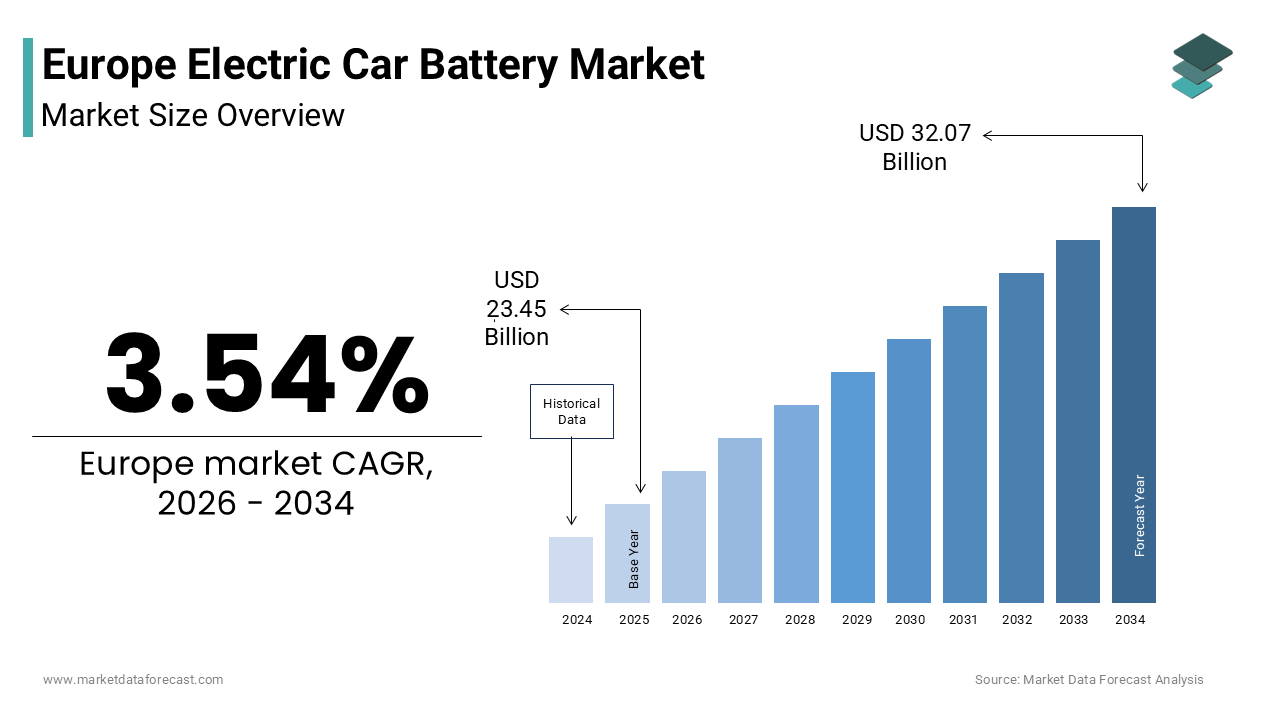
Market Size, 2025
$23.45 BnMarket Estimate, 2026
$24.28 BnMarket Forecast, 2034
$32.07 BnCAGR, 2026–2034
3.54%Europe Electric Car Battery Market Report Summary
The Europe electric car battery market was valued at USD 23.45 Bn in 2025, is estimated to reach USD 24.28 Bn in 2026, and is projected to reach USD 32.07 Bn by 2034, growing at a CAGR of 3.54% during the forecast period from 2026 to 2034. The growth of the Europe electric car battery market is driven by stringent emission regulations, increasing adoption of electric vehicles, and rising investments in domestic battery manufacturing. Expanding gigafactory construction, advancements in lithium-ion and next-generation battery technologies, and growing government initiatives promoting sustainable mobility are further accelerating market growth. Moreover, increasing focus on battery recycling, circular economy initiatives, and strengthening regional supply chains are supporting the expansion of the Europe electric car battery market.
Key Market Trends
-
Rising investments in gigafactory construction to strengthen Europe's domestic battery manufacturing capabilities.
-
Increasing adoption of lithium-ion batteries owing to their superior energy density, performance, and cost efficiency.
-
Growing research and commercialization of solid-state and next-generation battery technologies.
-
Rising emphasis on battery recycling, circular economy initiatives, and sustainable raw material sourcing.
-
Increasing strategic partnerships between automakers and battery manufacturers to secure long-term battery supply.
Segmental Insights
- Based on battery type, the lithium-ion segment dominated the Europe electric car battery market in 2025. The dominance of the segment is attributed to its superior energy density, longer cycle life, higher power output, declining production costs, established manufacturing ecosystem, and widespread adoption across battery electric vehicles. Continuous advancements in lithium-ion chemistry and recycling technologies further support its market leadership.
- The others segment is projected to witness the fastest CAGR of 28.5% during the forecast period owing to increasing investments in solid-state, sodium-ion, and other next-generation battery technologies, growing research and development activities, rising government funding for battery innovation, and increasing demand for safer and more energy-efficient battery solutions.
- Based on vehicle type, the battery electric vehicles (BEVs) segment dominated the Europe electric car battery market and accounted for 65.5% of the market share in 2025. The growth of the segment is driven by stringent emission regulations, increasing consumer preference for zero-emission vehicles, expanding charging infrastructure, government purchase incentives, and growing production of fully electric passenger vehicles across Europe.
- The plug-in hybrid electric vehicles (PHEVs) segment is anticipated to register the fastest CAGR of 12.4% during the forecast period due to increasing consumer preference for transitional electrification technologies, improving battery capacities, expanding model availability, supportive tax incentives in selected markets, and growing demand for vehicles offering both electric and conventional driving capabilities.
Regional Insights
- Germany dominated the Europe electric car battery market and accounted for 28.6% of the regional market share in 2025. The country's leadership is driven by its strong automotive manufacturing base, extensive investments in battery gigafactories, presence of major automotive OEMs, advanced charging infrastructure, and government initiatives promoting battery production and electric mobility.
- France held 16.2% of the Europe electric car battery market share in 2025 owing to strong government incentives, expanding domestic battery manufacturing, increasing electric vehicle adoption, growing investments in battery recycling, and continuous support for sustainable transportation initiatives.
- The United Kingdom continues to maintain a significant position in the Europe electric car battery market due to ambitious electrification targets, increasing investments in battery manufacturing facilities, growing electric vehicle registrations, expanding charging infrastructure, and strong support for battery technology innovation.
- Italy is witnessing steady growth owing to increasing electric vehicle adoption, government incentives, expanding battery recycling initiatives, growing investments by automotive manufacturers, and rising development of charging infrastructure.
- Sweden is projected to witness notable growth during the forecast period due to the presence of Northvolt, increasing investments in sustainable battery manufacturing, strong electric vehicle penetration, government support for green technologies, and continuous innovation in battery production and recycling.
Competitive Landscape
The Europe electric car battery market is highly competitive and characterized by the presence of global battery manufacturers, emerging European battery producers, and automotive joint ventures competing through technological innovation, manufacturing expansion, and sustainable production practices. Leading companies are focusing on expanding gigafactory capacities, developing next-generation battery chemistries, strengthening raw material sourcing strategies, investing in battery recycling technologies, and establishing long-term partnerships with automotive manufacturers. Continuous investments in research and development, localized manufacturing, and circular economy initiatives continue to strengthen competitive positioning across the Europe electric car battery market. The prominent players operating in the Europe electric car battery market include Contemporary Amperex Technology Co. Limited (CATL), LG Energy Solution Ltd., Samsung SDI Co., Ltd., Panasonic Corporation, BYD Company Limited, SK On Co., Ltd., Tesla Inc., Saft Groupe S.A., Northvolt AB, and Automotive Cells Company (ACC).
 Download Free Sample Report
Europe Electric Car Battery Market Size
The Europe electric car battery market size was valued at USD 23.45 billion in 2025 and is anticipated to reach USD 24.28 billion in 2026 from USD 32.07 billion by 2034, growing at a CAGR of 3.54% during the forecast period from 2026 to 2034.
An electric car battery, often called a traction battery pack, is a large, rechargeable energy storage system that provides the electricity needed to drive the vehicle's motor. This market serves as the foundational component of the continent's transition toward sustainable mobility acting as the primary determinant of vehicle range performance and cost. The market is characterized by a complex supply chain involving raw material extraction cell production module assembly and end of life recycling. According to the European Environment Agency, transport (including international bunkers) accounts for approximately 29% (specifically 28.9% in 2022) of total greenhouse gas emissions in the European Union, necessitating a rapid shift to zero-emission technologies. As per Eurostat, the share of new passenger cars with electric powertrains (Battery Electric and Plug-in Hybrid) reached 21.7% in 2023 (up from 21.6% in 2022), with battery-only electric cars accounting for 14.6 percent, indicating a substantial adoption rate that directly drives battery demand. Regulatory frameworks such as the EU Battery Regulation mandate strict sustainability due diligence and carbon footprint declarations reshaping production standards. The region is witnessing a surge in gigafactory construction aimed at reducing dependency on Asian suppliers. Energy density improvements and charging infrastructure expansion are critical factors influencing consumer acceptance. The market dynamics are further shaped by geopolitical tensions affecting raw material availability and the strategic imperative for technological sovereignty. Understanding this landscape requires analyzing the interplay between legislative mandates industrial capacity building and the evolving chemistry of battery cells to meet diverse automotive requirements.
MARKET DRIVERS
Stringent Regulatory Mandates and Carbon Neutrality Goals
The implementation of stringent regulatory mandates and ambitious carbon neutrality goals is the main driver of the European EV battery market. The European Union has established a comprehensive legal framework to accelerate the phase out of internal combustion engines and promote electric mobility. The Fit for 55 package aims to reduce net greenhouse gas emissions by at least 55% by 2030 compared to 1990 levels. According to the European Commission the regulation setting CO2 emission performance standards for new passenger cars effectively mandates a 100% reduction in emissions by 2035 which translates to a ban on the sale of new petrol and diesel cars. This legislative certainty forces original equipment manufacturers to electrify their fleets thereby creating sustained demand for high capacity batteries. According to the International Energy Agency, strong policy incentives across Europe have effectively accelerated the transition to electric mobility, resulting in electric models capturing a substantial portion of the new car landscape. The EU Battery Regulation further strengthens this driver by requiring batteries to have a digital passport ensuring transparency in sourcing and recycling. These regulations create a favorable environment for investment in local battery production facilities. Automakers are compelled to secure long term supply contracts with battery manufacturers to comply with these rules. The regulatory push not only stimulates demand but also encourages innovation in sustainable battery chemistries and manufacturing processes. This top down approach ensures that the market grows in alignment with broader environmental objectives.
Rising Consumer Adoption and Expanding Model Availability
The rising consumer adoption of EVs driven by an expanding array of available models and improved performance metrics is also contributing to the expansion of the Europe electric car battery market. Automakers have significantly diversified their electric vehicle portfolios offering options across various segments from compact city cars to luxury SUVs. This variety addresses different consumer needs and budgets making electric mobility more accessible. According to the European Automobile Manufacturers Association the number of fully electric battery electric vehicle models available in the European market exceeded 100 in 2023 providing consumers with greater choice. As per J.D. Power consumer interest in electric vehicles in Europe has grown substantially with range anxiety decreasing due to advancements in battery technology. Modern lithium ion batteries now offer ranges exceeding 400 kilometers on a single charge which alleviates concerns about daily usability. The total cost of ownership for electric vehicles is becoming increasingly competitive with internal combustion engine vehicles due to lower maintenance and fuel costs. Government incentives such as purchase subsidies and tax exemptions further enhance affordability. The improvement in public charging infrastructure also supports consumer confidence. As more consumers switch to electric vehicles the demand for replacement batteries and new installations rises. This bottom up demand complements regulatory drivers ensuring robust market growth. The positive feedback loop between model availability consumer acceptance and infrastructure development sustains the momentum of the electric car battery market.
MARKET RESTRAINTS
Supply Chain Vulnerabilities and Raw Material Dependency
Heavy dependence on imported raw materials and supply chain vulnerabilities continue to constrain growth in the Europe electric car battery market. The production of lithium ion batteries requires critical raw materials such as lithium cobalt nickel and graphite the majority of which are sourced from outside Europe. According to the European Commission, the European Union relies almost exclusively on international partners for its supply of essential battery minerals, with a small number of countries controlling the vast majority of extraction and refining capacity. As per the Joint Research Centre this high level of import dependency exposes the market to geopolitical risks trade disruptions and price volatility. Recent global events have highlighted the fragility of these supply chains leading to fluctuations in battery costs. The concentration of refining and processing capabilities in Asia further exacerbates this vulnerability. European manufacturers struggle to secure stable and cost effective supplies of these essential inputs. The lack of domestic mining and processing infrastructure means that any disruption in international trade can severely impact production schedules. Additionally the ethical and environmental concerns associated with mining practices in some source countries pose reputational risks. Companies must navigate complex compliance requirements to ensure responsible sourcing. These supply chain constraints limit the ability of European manufacturers to scale up production rapidly and maintain competitive pricing. Addressing this restraint requires significant investment in domestic extraction and recycling capabilities which are still in early stages of development.
High Production Costs and Capital Intensity
High production costs and the capital intensive nature of battery manufacturing are among the major restraints on the Europe electric car battery market. Establishing gigafactories requires billions of euros in investment for machinery infrastructure and research and development. According to sources, establishing large-scale battery manufacturing facilities in Europe is more capital-intensive than in Asian markets, driven by a combination of rigorous environmental standards and higher overhead for labor and power. As indicated by Eurostat and regional market observers, the cost of powering battery production facilities in Europe has settled at a level significantly higher than that of global competitors, placing continued pressure on the operational margins of the local chemical and energy sectors. The high cost of electricity is particularly impactful as battery manufacturing is an energy intensive process. These factors result in higher per unit production costs compared to competitors in regions with cheaper energy and labor. The financial burden limits the number of players who can enter the market and slows down the expansion of existing facilities. Furthermore the rapid pace of technological change requires continuous reinvestment to keep up with advancements in battery chemistry and manufacturing techniques. This creates a barrier to entry for smaller companies and consolidates the market among a few large players. The high initial investment also increases the financial risk for manufacturers especially if demand forecasts are not met. These economic challenges restrain the speed at which Europe can achieve self sufficiency in battery production and compete globally on price.
MARKET OPPORTUNITIES
Advancements in Solid State and Next Generation Batteries
The development and commercialization of solid-state and next-generation battery technologies provide a significant opportunity for the European electric car battery market. Solid state batteries offer higher energy density improved safety and faster charging times compared to conventional lithium ion batteries. According to the Fraunhofer Institute several European research institutions and companies are on the way in solid state battery development. Although the European Patent Office indicates that global patent filings for solid-state batteries are dominated by Asian manufacturers, European innovation remains highly active in specialized chemistry and fundamental research. Major automakers and battery manufacturers in Europe are investing heavily in pilot lines and demonstration projects to bring these technologies to market. The potential for solid state batteries to double the range of electric vehicles while reducing charging time to minutes is a game changer for consumer adoption. Governments are supporting these efforts through funding programs such as the Important Projects of Common European Interest which provides billions of euros for battery innovation. Successful commercialization of solid state batteries would allow European manufacturers to differentiate their products and capture premium market segments. This technological leap could also reduce reliance on scarce materials like cobalt. The opportunity to lead in next generation battery technology positions Europe as a global innovator rather than just a consumer. This strategic advantage can attract further investment and partnerships strengthening the overall market ecosystem.
Expansion of Battery Recycling and Circular Economy Initiatives
The expansion of battery recycling and circular economy initiatives offers a possibility to enhance sustainability and secure raw material supplies in the Europe electric car battery market. As the first generation of electric vehicles reaches end of life the volume of used batteries available for recycling is increasing. According to the European Environment Agency effective recycling can recover up to 80% of critical raw materials such as lithium cobalt and nickel from spent batteries. As per the EU Battery Regulation new mandates require minimum levels of recycled content in new batteries creating a guaranteed market for recycled materials. Several companies in Europe are establishing large scale recycling facilities to process black mass and recover valuable metals. This reduces dependency on virgin raw material imports and mitigates supply chain risks. The circular economy approach also lowers the environmental footprint of battery production by reducing the need for mining. Innovations in hydrometallurgical and direct recycling processes are improving recovery rates and reducing costs. Partnerships between automakers battery manufacturers and recyclers are forming closed loop systems. This integration ensures a steady supply of secondary raw materials which can be used to produce new batteries. The growth of the recycling sector creates new business opportunities and jobs. By embracing circularity the market can achieve greater resource independence and align with sustainability goals.
MARKET CHALLENGES
Integration of Complex Supply Chains and Logistics
Integration of complex supply chains and logistics is slowing down the growth of the Europe electric car battery market. The battery value chain spans multiple continents involving the extraction of raw materials refining cell manufacturing and final assembly. Coordinating these disparate elements requires sophisticated logistics and real time data sharing. According to the World Bank, the vast differences in infrastructure quality and administrative efficiency between nations involved in battery production create substantial challenges for the timely movement of raw materials and finished goods. As noted by the European Logistics Association, the absence of unified digital communication standards and shared operational protocols continues to complicate the seamless transfer of industrial components across borders. The transportation of lithium ion batteries is subject to strict safety regulations due to their classification as dangerous goods. This complicates shipping and increases costs. Any disruption in one part of the chain such as a port closure or political instability can have cascading effects on production. The Just in Time manufacturing model used by automakers is particularly vulnerable to these disruptions. Building resilience requires diversifying suppliers and holding larger inventories which increases costs. The complexity is further exacerbated by the need to track the carbon footprint and ethical sourcing of materials throughout the chain. Implementing blockchain and other digital tools for traceability is challenging and expensive. These logistical hurdles make it difficult to optimize costs and ensure timely delivery. Overcoming these challenges requires extensive collaboration and investment in digital infrastructure.
Technological Obsolescence and Rapid Innovation Cycles
The rapid pace of technological innovation in battery chemistry and design poses a challenge of obsolescence for the Europe electric car battery market. Battery technology is evolving quickly with new formulations offering better performance and lower costs. According to research, the speed of innovation in battery design is accelerating, which places significant pressure on investors to ensure their manufacturing facilities can be rapidly upgraded to remain competitive. The International Council on Clean Transportation highlights that the ongoing evolution of battery chemistries—moving toward more cost-effective and energy-dense formulations demands that production sites maintain high levels of adaptability in their equipment and processes. This creates uncertainty for investors and manufacturers who must decide which technologies to back. Retooling factories for new chemistries is costly and time consuming. There is a risk that large investments in current lithium ion production facilities may lose value if superior technologies emerge sooner than expected. Additionally the lack of standardization in cell formats and packaging complicates the transition to new technologies. Automakers may hesitate to commit to long term supply contracts if they anticipate significant changes in battery specifications. This dynamic creates a volatile environment where companies must balance the need for scale with the flexibility to innovate. Managing this risk requires agile manufacturing strategies and continuous research and development. Failure to keep pace with technological advancements can lead to loss of competitiveness and market shar
REPORT COVERAGE
| REPORT METRIC | DETAILS |
| Market Size Available | 2025 to 2034 |
| Base Year | 2025 |
| Forecast Period | 2026 to 2034 |
| CAGR | 3.54% |
| Segments Covered | By Battery Type, Vehicle Type and Region. |
| Various Analyses Covered | Global, Regional & Country Level Analysis, Segment-Level Analysis, DROC, PESTLE Analysis, Porter’s Five Forces Analysis, Competitive Landscape, Analyst Overview of Investment Opportunities |
| Country Covered | UK, France, Spain, Germany, Italy, Russia, Sweden, Denmark, Switzerland, the Netherlands, Turkey, the Czech Republic, and the Rest of Europe.. |
| Market Leaders Profiled | Contemporary Amperex Technology Co. Limited (CATL), LG Energy Solution Ltd., Samsung SDI Co., Ltd., Panasonic Corporation, BYD Company Limited, SK On Co., Ltd., Tesla Inc., Saft Groupe S.A., Northvolt AB, and Automotive Cells Company (ACC) |
SEGMENTAL ANALYSIS
By Battery Type Insights
The Lithium-ion segment dominated the Europe electric car battery market and accounted for a substantial share in 2025. This dominance of the segment is attributed to the superior energy density power output and cycle life that lithium-ion chemistry offers compared to alternative technologies. These characteristics are essential for meeting the range and performance expectations of modern electric vehicle consumers. According to the International Energy Agency lithium-ion batteries account for nearly all newly installed capacity in electric vehicles globally due to their ability to store more energy per unit of weight. As per studies, the average certified range of new battery electric vehicles in Europe has expanded, a progression enabled primarily by advancements in lithium-ion cell technology. The scalability of lithium-ion manufacturing allows for cost reductions through economies of scale which is critical for making electric vehicles price competitive. Furthermore the extensive supply chain infrastructure for lithium-ion components including cathodes anodes and electrolytes is already well established in Europe and Asia. Continuous improvements in lithium-ion chemistries such as nickel manganese cobalt and lithium iron phosphate have enhanced safety and reduced reliance on scarce materials. The maturity of recycling processes for lithium-ion batteries also supports their sustainability profile. These technical and economic advantages ensure that lithium-ion remains the undisputed standard for electric mobility in the foreseeable future.
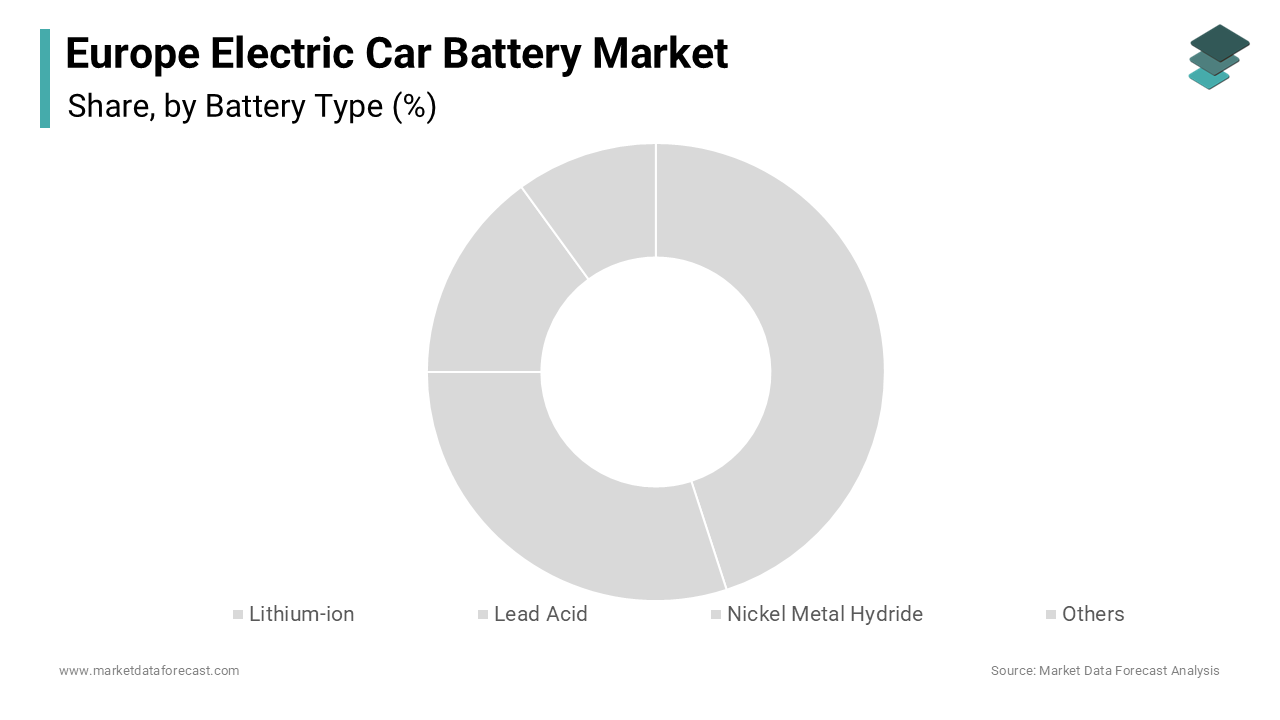
The others segment is estimated to register the fastest CAGR of 28.5% during the forecast period owing to intense research and development efforts aimed at overcoming the limitations of conventional lithium-ion batteries such as safety risks and resource scarcity. Solid state batteries in particular offer the potential for significantly higher energy density and non flammable electrolytes which address key consumer concerns. According to the Fraunhofer Institute, European research initiatives have advanced solid-state technology, with pilot production lines now operational and focusing on commercial maturation. As per the European Patent Office, Japan is the global leader in patent filings for solid-state battery technologies, while Europe maintains a significant role in the innovation landscape. Sodium ion batteries are gaining traction as a cost effective alternative that does not rely on lithium or cobalt making them attractive for entry level vehicles. The European Union’s Important Projects of Common European Interest initiative provides substantial funding for these next generation technologies. Automakers are forming strategic partnerships with startups and research institutions to secure early access to these innovations. The promise of faster charging times and longer lifespans drives investment in these alternatives. Although currently in early stages the potential for breakthrough performance makes this segment the fastest growing area in the market.
By Vehicle Type Insights
In 2025, the battery electric vehicles segment was the largest segment in the Europe electric car battery market and captured a 65.5% share because of the complete reliance on large capacity battery packs for propulsion. Unlike hybrid vehicles which use smaller batteries BEVs require high energy storage systems to achieve acceptable driving ranges making them the primary driver of battery demand. According to Eurostat, sales of pure electric cars in the European Union surpassed 1.5 million units in 2023 representing a significant portion of total car sales. As per sources, the average battery size in BEVs has grown to over 60 kilowatt hours to meet consumer expectations for long distance travel. Regulatory pressures such as the EU’s ban on new internal combustion engine cars by 2035 are accelerating the shift towards fully electric models. Major automakers are prioritizing BEV platforms which allow for optimized battery integration and improved vehicle efficiency. The expansion of fast charging infrastructure across Europe further supports BEV adoption by reducing range anxiety. Government incentives often favor zero emission vehicles providing additional financial motivation for consumers to choose BEVs over hybrids. The total cost of ownership for BEVs is becoming increasingly attractive due to lower maintenance and energy costs. These factors collectively ensure that BEVs remain the dominant vehicle type driving battery consumption in the European market.
The plug-in hybrid electric vehicles segment is anticipated to witness the fastest CAGR of 12.4% between 2026 and 2034 due to its role as a transitional technology for consumers hesitant to switch fully to electric power. PHEVs offer the flexibility of electric driving for short commutes and gasoline power for long trips addressing range anxiety effectively. According to the European Automobile Manufacturers Association (ACEA), PHEV registrations declined in 2023, primarily driven by the reduction of purchase incentives in key markets rather than infrastructure constraints. As per major fleet mobility reports (e.g., Arval Mobility Observatory), many corporate fleets are increasingly shifting directly to BEVs to meet emission targets, as real-world data has challenged the viability of PHEVs for meeting strict sustainability goals. Recent improvements in PHEV battery capacities allowing for electric only ranges of 50 to 80 kilometers have made them more viable for daily use. Tax benefits in several European countries continue to support PHEV purchases although some governments are tightening criteria to encourage full electrification. The availability of diverse PHEV models across various segments from compact cars to SUVs enhances consumer choice. For many buyers PHEVs serve as a stepping stone towards full electrification familiarizing them with charging habits and electric driving dynamics. This transitional demand ensures steady growth for PHEV batteries even as the market shifts towards BEVs. The segment’s resilience is supported by its ability to bridge the gap between traditional and fully electric mobility.
REGIONAL ANALYSIS
Germany Electric Car Battery Market Analysis
Germany led the Europe electric car battery market and held a 28.6% share in 2025. Its robust automotive industry and aggressive electrification strategies are contributing to the leading position of the German market. The country is home to major original equipment manufacturers such as Volkswagen BMW and Mercedes Benz who are heavily investing in electric vehicle production and battery supply chains. The presence of leading chemical companies like BASF facilitates the local production of battery materials enhancing supply chain security. Germany’s extensive charging infrastructure network supports widespread EV adoption. The country’s industrial policy focuses on maintaining technological leadership in battery cell production to reduce dependency on Asian suppliers. Collaborative projects between academia and industry drive innovation in battery chemistry and recycling. These structural advantages maintain Germany’s leadership position in the European market.
France Electric Car Battery Market Analysis
France followed closely behind in the Europe electric car battery market and accounted for a share of 16.2% in 2025. This growth of the French market is driven by strong government support for electric mobility and a growing domestic battery manufacturing base. The French government has implemented substantial purchase incentives and tax benefits to encourage EV adoption among consumers and businesses. The country’s nuclear energy portfolio provides low carbon electricity which aligns with the sustainability goals of electric mobility. Renault and Stellantis have committed to electrifying their fleets with significant production volumes planned in French facilities. The development of a circular economy for batteries is also a priority with initiatives to enhance recycling capabilities. France’s strategic focus on sovereignty in critical technologies supports the growth of the local battery ecosystem. These factors sustain France’s prominent position in the regional market.
United Kingdom Electric Car Battery Market Analysis
The United Kingdom continues to be a significant player in the European market owing to its ambitious climate targets and strong consumer demand for electric vehicles. Also, the UK government has set a deadline of 2030 for ending the sale of new petrol and diesel cars creating urgency for electrification. According to studies, electric vehicle registrations in the UK have grown consistently reaching record levels in recent years. Major investments in battery manufacturing facilities such as the Britishvolt project although facing challenges highlight the country’s intent to build local capacity. Nissan’s plant in Sunderland continues to produce electric vehicles and batteries contributing to the supply chain. The UK’s financial sector supports green investments facilitating funding for battery startups and technology developers. Post Brexit regulations are being aligned to support domestic industry growth. These dynamics ensure that the UK remains a key market for electric car batteries in Europe.
Italy Electric Car Battery Market Analysis
Italy expanded steadily in the Europe electric car battery market due to its automotive heritage and increasing focus on sustainable mobility. The Italian government has introduced incentives for electric vehicle purchases and charging infrastructure development to accelerate adoption. Stellantis has significant production facilities in Italy and is investing in electric vehicle platforms and battery technologies. The country is also exploring opportunities in battery recycling and second life applications to support circular economy goals. Regional initiatives are promoting the installation of charging stations in historic cities adapting infrastructure to unique urban landscapes. The presence of specialized engineering firms supports innovation in battery integration and management systems. These efforts contribute to Italy’s stable and growing position in the European market.
Sweden Electric Car Battery Market Analysis
Sweden is predicted to grow notably in the Europe electric car battery market from 2026 to 2034 owing to its high electric vehicle penetration rate and leadership in sustainable battery production. The country is home to Northvolt one of Europe’s largest battery manufacturers which supplies cells to major automakers. Volvo Cars and Polestar are headquartered in Sweden and are committed to full electrification driving local demand for batteries. The government supports research and development in battery technology through grants and partnerships with universities. Sweden’s focus on ethical sourcing and transparent supply chains enhances the reputation of its battery products. The well developed charging infrastructure supports widespread EV usage across the country. These factors establish Sweden as a key innovator and producer in the European electric car battery market.
COMPETITIVE LANDSCAPE
The competition in the Europe electric car battery market is intense characterized by the entry of established Asian giants and the rise of domestic startups aiming for technological sovereignty. Major players compete on cost efficiency production scale technological innovation and sustainability credentials. The push for local manufacturing under the EU Battery Regulation drives investments in gigafactories across the continent. Companies differentiate themselves through proprietary battery chemistries such as solid state or sodium ion which offer superior performance. Supply chain security is a critical competitive factor with firms securing long term contracts for lithium nickel and cobalt. Partnerships with automotive original equipment manufacturers are essential for securing off-take agreements and ensuring market access. Price competition remains fierce as manufacturers strive to lower costs through economies of scale and process improvements. Regulatory compliance regarding carbon footprint and recycling adds complexity to operations. Innovation in recycling technologies creates new competitive advantages. The market rewards those who can balance scale with sustainability and technological leadership. Collaboration between industry governments and research institutions is vital for maintaining competitiveness against global rivals.
KEY MARKET PLAYERS
Some of the companies that are playing a dominating role in the Europe electric car battery market include
- Contemporary Amperex Technology Co. Limited (CATL)
- LG Energy Solution Ltd.
- Samsung SDI Co., Ltd.
- Panasonic Corporation
- BYD Company Limited
- SK On Co., Ltd.
- Tesla Inc.
- Saft Groupe S.A.
- Northvolt AB
- Automotive Cells Company (ACC)
Top Players in the Market
Northvolt AB
Northvolt AB is a Swedish battery manufacturer that has emerged as a key player in the Europe electric car battery market by focusing on sustainable and locally produced energy storage solutions. The company contributes to the global market by establishing a fully integrated supply chain within Europe reducing dependency on Asian imports. Recent actions include the expansion of its Northvolt Ett gigafactory in Skellefteå and the initiation of construction for Northvolt Drei in Germany. These facilities aim to produce high quality lithium ion batteries with a minimal carbon footprint. Northvolt actively partners with major automakers such as Volkswagen and BMW to secure long term supply agreements. The company also invests heavily in recycling technologies through its Revolt program to recover valuable materials from spent batteries. These strategic initiatives strengthen its position as a leading provider of green battery solutions in the European region.
Contemporary Amperex Technology Co Limited
Contemporary Amperex Technology Co Limited known as CATL is a global leader in battery technology with a significant and growing presence in the Europe electric car battery market. The company supplies advanced lithium ion batteries to numerous European automakers including Tesla Mercedes Benz and BMW. Recent actions to strengthen its market position include the construction of a major manufacturing plant in Erfurt Germany which began production to serve local customers. CATL continues to innovate with new battery chemistries such as sodium ion and condensed matter batteries offering higher energy density and safety. The company collaborates with European suppliers to localize its supply chain and reduce logistics costs. By establishing local production capabilities CATL ensures reliable delivery and compliance with European regulations. Its technological leadership and scale enable it to maintain a competitive edge in the rapidly evolving European battery landscape.
LG Energy Solution Ltd
LG Energy Solution Ltd is a South Korean battery manufacturer that plays a crucial role in the Europe electric car battery market through its extensive production facilities and partnerships. The company operates a large scale factory in Wrocław Poland which serves as a primary supply hub for European electric vehicle manufacturers. Recent actions include expanding its production capacity in Poland and planning additional facilities in Hungary to meet rising demand. LG Energy Solution focuses on developing next generation battery technologies including solid state and high nickel cathode cells. The company has secured contracts with major European automakers such as Renault and Stellantis ensuring steady demand for its products. It also emphasizes sustainability by implementing renewable energy sources in its manufacturing processes. These efforts enhance its reputation and competitiveness in the European market while supporting the continent's transition to electric mobility.
Top Strategies Used by the Key Market Participants
Key players in the Europe electric car battery market prioritize vertical integration to secure raw material supplies and control production costs. Companies invest heavily in building local gigafactories to reduce dependency on imports and comply with regional content requirements. Strategic partnerships with automakers ensure long term demand and facilitate joint development of customized battery solutions. Manufacturers focus on research and development to innovate in battery chemistry improving energy density safety and charging speed. Sustainability is a core strategy with firms implementing recycling programs and using renewable energy in production. Diversifying supply chains mitigates geopolitical risks and enhances resilience. Digitalization of manufacturing processes improves efficiency and quality control. These strategies enable companies to navigate regulatory challenges and maintain competitiveness in a dynamic market environment.
MARKET SEGMENTATION
This research report on the Europe electric car battery market has been segmented and sub-segmented based on the following categories.
By Battery Type
- Lithium-ion
- Lead Acid
- Nickel Metal Hydride
- Others
By Vehicle Type
- Battery Electric Vehicles (BEVs)
- Plug-in Hybrid Electric Vehicles (PHEVs)
- Hybrid Electric Vehicles (HEVs)
By Country
- UK
- France
- Spain
- Germany
- Italy
- Russia
- Sweden
- Denmark
- Switzerland
- Netherlands
- Turkey
- Czech Republic
- Rest of Europe