Europe Electric Cargo Bikes Market Size, Share, Trends & Growth Forecast Research Report, Segmented By Product, Battery, End-User, and Country (UK, France, Spain, Germany, Italy, Russia, Sweden, Denmark, Switzerland, Netherlands, Turkey, Czech Republic and Rest of Europe), Industry Analysis From (2026 to 2034)
Market Size, 2025
$0.70Market Estimate, 2026
$0.86 BnMarket Forecast, 2034
$3.59 BnCAGR, 2026–2034
22.30%Europe Electric Cargo Bikes Market Report Summary
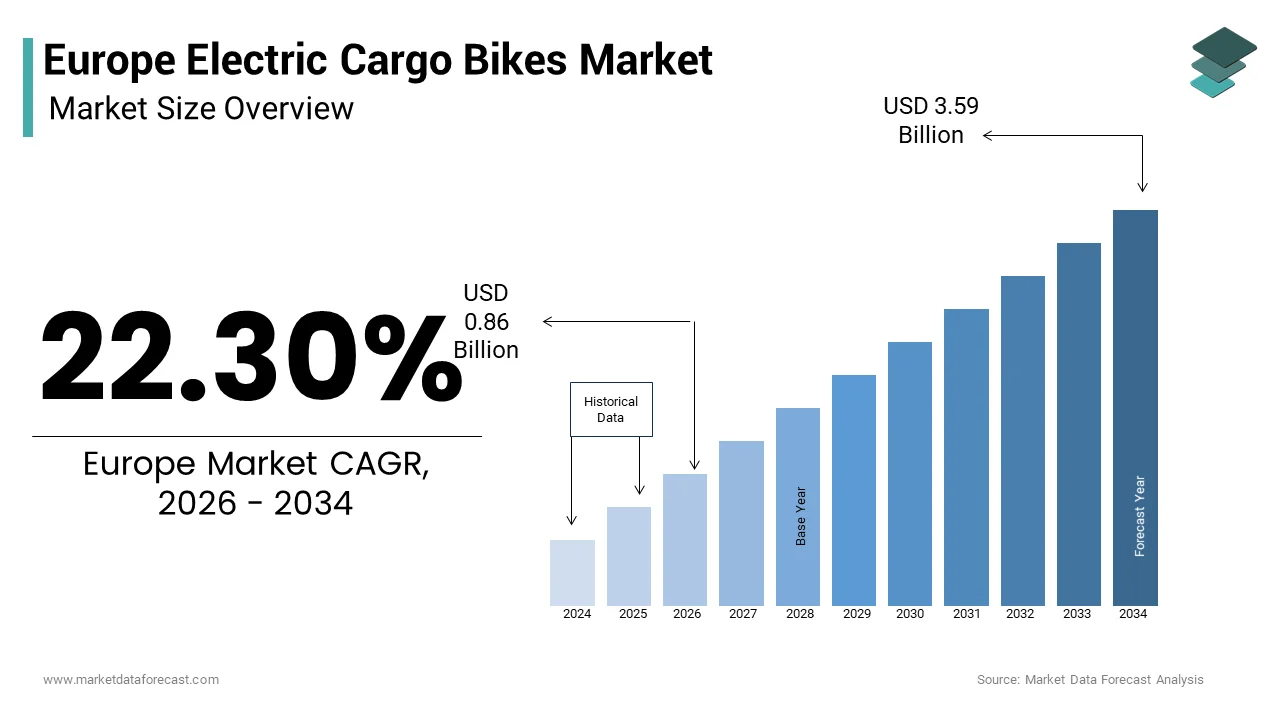
The European electric cargo bikes market was valued at USD 0.70 billion in 2025, is estimated to reach USD 0.86 billion in 2026, and is projected to grow significantly to USD 3.59 billion by 2034, expanding at a remarkable CAGR of 22.30% during the forecast period from 2026 to 2034.
The rapid growth of the European electric cargo bikes market is driven by rising e-commerce activity, increasing last-mile delivery demand, and strong government support for zero-emission urban mobility solutions. Growing concerns over traffic congestion, carbon emissions, and fuel costs are accelerating the adoption of electric cargo bikes across commercial and municipal sectors. Additionally, expanding cycling infrastructure, urban sustainability initiatives, and corporate ESG commitments are further strengthening market momentum across Europe.
Key Market Trends
- Strong shift toward sustainable last-mile delivery solutions in urban logistics.
- Increasing adoption of electric two-wheel cargo bikes for flexibility and cost efficiency.
- Dominance of lithium-ion battery technology due to higher energy density and longer lifecycle.
- Growth of fleet-based subscription and leasing models for commercial operators.
- Rising investments in cycling infrastructure and low-emission urban zones.
Segmental Insights
- Based on product type, the two-wheeler electric cargo bikes segment led the European electric cargo bikes market by accounting for 61.6% of the total market share in 2025. The dominance is attributed to their maneuverability, lower cost, and suitability for dense urban environments.
- Based on battery type, the lithium-ion batteries segment dominated the market with a substantial 90.2% share in 2025. Lithium-ion batteries are preferred due to their lightweight structure, high efficiency, longer range, and faster charging capabilities.
- Based on end user, the courier and parcel service providers segment commanded the largest share of 44.5% in 2025. The surge in e-commerce deliveries and demand for efficient last-mile logistics solutions are major factors driving this segment’s leadership.
Regional Insights
The European electric cargo bikes market is expanding rapidly across major economies supported by urban mobility reforms and sustainability goals.
- Germany emerged as the leading market, capturing 25.1% of total market share in 2025, driven by strong logistics infrastructure and government incentives for electric mobility.
- France holds a promising share supported by green transport policies and growing delivery fleets.
- The Netherlands is expected to exhibit a healthy CAGR, driven by its advanced cycling infrastructure and high bicycle adoption rates. Denmark is projected to occupy a notable share due to its strong cycling culture and urban sustainability initiatives.
- The United Kingdom is anticipated to register steady growth driven by urban delivery expansion and emission reduction targets.
Competitive Landscape
The European electric cargo bikes market is highly dynamic and innovation-driven, characterized by the presence of specialized cargo bike manufacturers and mobility solution providers. Companies are focusing on lightweight frame design, battery efficiency, fleet management integration, and modular cargo systems to enhance commercial viability. Strategic partnerships with logistics providers and the expansion of subscription-based models are strengthening competitive positioning.
Prominent players in the European electric cargo bikes market include:
Smart Urban Mobility B.V., Cervelo, Rad Power Bikes, Yuba Bicycles LLC, Riese & Müller, Butchers & Bicycles, Cero Bikes, Douze Cycles, Urban Arrow, Tern Bicycles, Carla Cargo, and Rad Power Bikes.
Europe Electric Cargo Bikes Market Size
The Europe electric cargo bikes market size was valued at USD 0.70 billion in 2025 and is anticipated to reach USD 0.86 billion in 2026 to USD 3.59 billion by 2034, growing at a CAGR of 22.30% during the forecast period from 2026 to 2034.
Electric cargo bikes are pedal assisted or throttle operated two or three wheeled vehicles designed to carry significant payloads over urban distances using integrated electric drivetrains and specialized load platforms or enclosed boxes. These vehicles serve as sustainable last mile delivery solutions for logistics providers retailers and municipal services while also functioning as car replacements for families and small businesses. Europe’s adoption is driven by dense urban planning strict low emission zone policies and a cultural shift toward active mobility. As per Eurostat, many cities across the EU now enforce low emission zones that restrict or ban internal combustion engine vehicles under Euro 6 standards creating regulatory space for zero tailpipe alternatives. According to the European Cyclists’ Federation, electric cargo bikes are increasingly in active use across the EU with urban delivery fleets representing a significant share of new registrations. National policies further accelerate uptake. France’s Sustainable Mobility Bonus provides up to 2500 euros for commercial cargo bike purchases while Germany’s Climate Protection Program includes tax exemptions for businesses replacing vans with e cargo bikes. This confluence of urban policy infrastructure investment and behavioral change defines Europe as the global epicenter of electric cargo bike innovation and deployment.
MARKET DRIVERS
Expansion of Urban Low Emission Zones and Zero Emission Delivery Mandates
The proliferation of low emission zones and zero emission urban logistics mandates across European cities is primarily driving the growth of the European electric cargo bikes market. According to the European Environment Agency, there are currently more than 320 low emission zones in Europe, progressively restricting access for diesel and gasoline vehicles based on Euro emission standards. Major metropolitan areas have gone further. Paris prohibits all non‑electric delivery vehicles under 3.5 tons from entering the city center by 2024Euronews, while Brussels enforces a zero-emission last‑mile delivery requirement for parcels by 2025. As per the European Commission’s Urban Mobility Framework, European cities are planning to expand zero emission delivery zones significantly by 2030Mobility and Transport. These policies directly incentivize logistics firms to transition from vans to electric cargo bikes, which face no access restrictions and benefit from dedicated loading zones. DHL Express reported in 2024 that its European Packstation network now uses over 2,400 electric cargo bikes for final delivery, with plans to double the fleet by 2026. Similarly, Amazon’s Delivery Service Partners operate electric cargo bikes across Berlin, Madrid, and MilanAmazon.com, Inc. - Press Room. These regulatory imperative transforms cargo bikes from niche alternatives into operational necessities for urban logistics compliance.
Corporate and Municipal Fleet Electrification Commitments
Businesses and public sector entities across Europe are actively replacing light commercial vehicles with electric cargo bikes as part of binding sustainability and fleet electrification strategies, which is further boosting the European electric cargo bikes market expansion. As per the European Commission’s Green Public Procurement criteria, all municipal vehicle purchases must prioritize zero emission options where feasible, and cargo bikes are increasingly specified for postal, sanitation, and social services. La Poste in France operates a large fleet of electric cargo bikes, handling the majority of urban mail delivery in cities like Lyon and Bordeauxipc.be. On the corporate side, IKEA offers home delivery via e‑cargo bikes in several European cities, including Amsterdam, Copenhagen, and Vienna. According to the European Cyclists’ Federation, many municipalities now include cargo bikes in official fleet plans, with some achieving full zero emission municipal logistics in their historic centersECF. Additionally, the EU’s Corporate Sustainability Reporting Directive requires large companies to disclose Scope 3 emissions, driving firms like DPD and UPS to adopt cargo bikes to reduce last‑mile carbon footprints. With each e‑cargo bike replacing 10,000 to 15,000 kilometers of van travel annually, these commitments translate into structural and scalable demand.
MARKET RESTRAINTS
Limited Range and Payload Capacity for High Volume Logistics Operations
Electric cargo bikes face inherent operational constraints that restrict their viability in high‑volume or long‑distance urban logistics networks, which is a significant restraint to the growth of the European electric cargo bikes market. According to the German Aerospace Center’s urban mobility study, payload capacity is generally sufficient for small parcel delivery but inadequate for bulk transport. A DHL internal assessment revealed that e‑cargo bikes achieve only 55% to 60% of the daily delivery throughput of small electric vans in certain citiesblog.gettransport.com. Furthermore, battery charging infrastructure remains underdeveloped, as per the European Clean Logistics Partnership. While ideal for dense city centers, these limitations confine cargo bikes to niche roles and delay full replacement of motorized fleets in mixed urban and suburban environments.
High Upfront Cost and Fragmented Subsidy Landscapes Across Member States
Despite declining battery prices, electric cargo bikes remain significantly more expensive than conventional bicycles, and often cost more than entry‑level electric scooters or mopeds, which is creating affordability barriers for small businesses and individual users and further hampering the regional market growth. A commercial‑grade e‑cargo bike typically costs between 4,000 and 8,000 euros, comparable to a used delivery van, without including maintenance or insurance. Although national subsidies exist, they are highly inconsistent. France offers up to 2,500 euros through its Sustainable Mobility Bonus, while Germany provides 2,000 euros but only for businesses replacing combustion vehicles. In contrast, countries like Spain and Italy offer no nationwide cargo bike incentives, as per the European Commission’s Clean Mobility Funding Tracker. According to the European Bicycle Manufacturers Association, many small retailers cite cost as the primary barrier to adoption. Without harmonized EU‑level financial support or leasing models, cargo bikes will struggle to achieve mass penetration beyond well‑funded pilot cities and corporate sustainability programs.
MARKET OPPORTUNITIES
Integration into Micro Mobility Hubs and Shared Urban Logistics Networks
The development of integrated micro mobility and urban logistics hubs offers a promising opportunity for the European electric cargo bikes market. Cities like Berlin, Copenhagen, and Rotterdam are piloting urban consolidation centers where long‑haul freight is transferred to e‑cargo bikes for final delivery within low emission zones. According to the City of Amsterdam, the “City Hub” network launched in 2024 provides strategically located depots offering shared cargo bike fleets, charging stations, and digital logistics coordination for local businesses. Similarly, the EU‑funded LOGiCITY project connected multiple European cities through a common platform enabling SMEs to book cargo bike delivery slots on demand. As per the European Investment Bank, significant funding has been allocated to support such infrastructure recognizing that shared models reduce individual ownership costs. Furthermore, integration with digital freight platforms like Bringme and Packfleet allows retailers to outsource last‑mile delivery without fleet investment. These ecosystem approaches transform cargo bikes from standalone vehicles into nodes in a coordinated zero emission urban logistics fabric, amplifying their utility and economic viability.
Adoption in Public Services and Social Mobility Programs
Municipalities across Europe are increasingly deploying electric cargo bikes for public service delivery and social inclusion initiatives creating stable institutional demand beyond commercial logistics, which is another major opportunity in the regional market. Postal services lead this trend. La Poste in France and PostNL in the Netherlands use cargo bikes not only for mail but also for prescription delivery, library book loans, and elderly meal services. According to the City of Vienna, the “CareBike” program launched in 2024 equips social workers with temperature‑controlled cargo bikes to deliver medicine and groceries to homebound seniors. Similarly, Copenhagen’s “Bike Ambulance” initiative uses cargo bikes for non‑emergency patient transport between clinics and homes. As per the European Social Fund, several programs have been funded since 2022 targeting rural and underserved communities where public transport is limited. These applications demonstrate cargo bikes as tools of social equity and public service innovation. With the EU’s Cohesion Policy prioritizing sustainable local services, this segment offers reliable non‑commercial demand that strengthens market resilience and broadens societal impact.
MARKET CHALLENGES
Inadequate Cycling Infrastructure and Safety Concerns in Mixed Traffic
Despite policy support, many European cities lack dedicated and protected cycling infrastructure capable of safely accommodating large and heavily loaded electric cargo bikes, which is a key challenge to the expansion of the European electric cargo bikes market. As per the European Cyclists’ Federation, only a minority of EU urban areas have continuous physically separated bike lanes wide enough for cargo bikes. In cities like Rome, Athens, and Warsaw, cargo bike riders must navigate narrow streets, cobblestones, and high volumes of car and delivery van traffic, increasing collision risks. According to the European Transport Safety Council, injuries involving e‑cargo bikes have been rising, primarily due to conflicts with turning trucks and illegally parked vehicles blocking bike lanes. Additionally, cargo bikes’ low speed—typically capped at 25 kilometers per hour under EU type approval—creates dangerous speed differentials on shared paths with faster e‑scooters and mopeds. Without targeted infrastructure investments including widened lanes, protected intersections, and cargo bike priority zones, adoption will remain limited to confident riders and low traffic zones. Safety perceptions directly influence business and public sector procurement decisions, making infrastructure a critical enabler of market scalability.
Battery Standardization and End of Life Recycling Gaps
The European electric cargo bike market faces growing sustainability and operational challenges due to the absence of standardized battery formats and underdeveloped recycling infrastructure for lithium‑ion cells. As per the European Battery Alliance, multiple battery chemistries, mounting systems, and voltage configurations are used across major brands, preventing interoperability and complicating fleet maintenance. When batteries degrade, users face replacement costs with limited second‑life options. More critically, according to the European Environment Agency, only a minority of e‑bike batteries in the EU are formally collected for recycling due to fragmented take‑back schemes and low consumer awareness. Unlike electric vehicles which fall under the EU Battery Regulation’s strict collection targets, e‑cargo bike batteries often slip through regulatory gaps as “light means of transport.” This undermines circular economy goals and risks environmental contamination. Until harmonized battery standards and mandatory producer responsibility schemes are implemented, the long‑term sustainability and total cost of ownership of electric cargo bikes will remain compromised.
REPORT COVERAGE
| REPORT METRIC | DETAILS |
| Market Size Available | 2025 to 2034 |
| Base Year | 2025 |
| Forecast Period | 2026 to 2034 |
| CAGR | 22.30% |
| Segments Covered | By Product, Battery, End-User, and Region. |
| Various Analyses Covered | Global, Regional, an, Country-Level Analysis, Segment-Level Analysis; DROC, PESTLE Analysis; Porter’s Five Forces Analysis; Competitive Landscape; Analyst Overview of Investment Opportunities |
| Regions Covered | UK, France, Spain, Germany, Italy, Russia, Sweden, Denmark, Switzerland, Netherlands, Turkey, the Czech Republic, and the Rest of Europe |
| Market Leaders Profiled | Smart Urban Mobility B.V., Cervelo, Rad Power Bikes, Yuba Bicycles LLC, Riese & Müller, Butchers & Bicycles, Cero Bikes, Douze Cycles, Urban Arrow, Tern Bicycles, Carla Cargo, Rad Power Bikes |
SEGMENTAL ANALYSIS
By Product Insights
The two-wheeler electric cargo bikes segment led the market by holding 61.6% of the European market share in 2025. The dominance of two-wheeler segment in the European market is attributed to their superior manoeuvrability lower weight and compatibility with existing urban cycling infrastructure. Unlike three or four wheelers which often exceed one meter in width two wheelers easily navigate narrow bike lanes historic city centers and dense pedestrian zones common across European cities. Their lighter frame reduces energy consumption enabling longer range per charge which is critical for high frequency delivery routes. Major logistics operators favor this format. DHL’s Cubicycle and Amazon’s eBike fleets in Berlin and Paris are exclusively two wheeled due to their ability to access tight alleyways and multi-story buildings. Additionally, two wheelers benefit from EU type approval under the L1e-A category which simplifies registration and avoids the stricter safety requirements imposed on three wheelers classified as L2e vehicles. As per the German Federal Motor Transport Authority two wheelers are the majority of commercially registered electric cargo bikes in 2024.
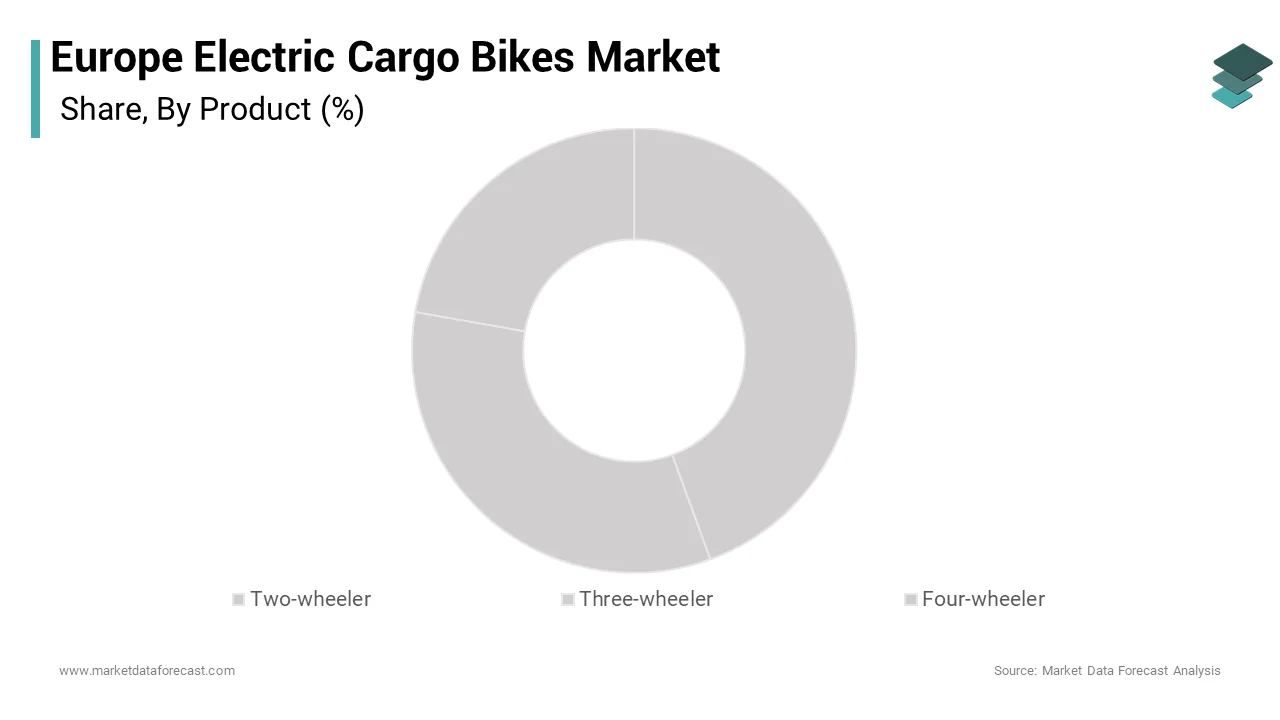
The three-wheeler segment is the fastest growing product type in the Europe market and is projected to expand at a CAGR of 20.2% over the forecast period owing to the growing demand for higher payload stability and all-weather usability in commercial and municipal applications. Three wheelers feature enclosed front or rear cargo boxes that protect goods from rain and theft. The EU’s Urban Mobility Framework now recognizes three wheelers as light electric utility vehicles enabling access to bus lanes and dedicated loading zones previously restricted to vans.
By Battery Insights
The lithium-ion batteries segment dominated the market by holding 90.2% of the regional market share in 2025. This overwhelming share is due to their high energy density lightweight design and declining cost per kilowatt hour which are essential for cargo bikes requiring extended range under heavy loads. Furthermore, EU type approval regulations effectively discourage lead acid batteries due to weight and performance limitations. With over a million electric cargo bikes in operation across Europe virtually all new models from major brands like Riese & Müller Urban Arrow and Tern use lithium-ion systems solidifying their technical and regulatory dominance.
The lithium-ion segment remains not only dominant but also the fastest growing battery segment in the Europe electric cargo bikes market. This growth is fueled by advancements in solid state and lithium iron phosphate chemistries that enhance safety lifespan and cold weather performance. Additionally, the EU’s new Battery Regulation mandates material recovery by 2030 accelerating investment in closed loop recycling. Fleet operators are also adopting swappable battery systems where lithium packs are exchanged quickly eliminating charging downtime.
By End-User Insights
The courier and parcel service providers segment commanded for the largest share of 44.5% of the European market in 2025. The leading position of courier and parcel service providers segment in the regional market is attributed to the urgent need for zero emission last mile solutions in cities enforcing strict delivery restrictions. DHL Express Amazon and La Poste are among the major operators deploying large fleets of electric cargo bikes across European cities. As per Eurostat, courier demand will remain the primary engine of cargo bike adoption driven by regulatory compliance operational efficiency and corporate sustainability targets.
The waste municipal services segment is the fastest growing end user segment in the Europe electric cargo bikes market and is anticipated to register a CAGR of 22.8% over the forecast period. This surge is driven by cities implementing car free zones and zero emission sanitation policies in historic and residential districts where traditional garbage trucks cannot operate. The EU’s Circular Economy Action Plan now funds municipal pilot projects that replace diesel sweepers and compactors with human scaled electric collection systems. With many European cities committing to zero emission municipal fleets by 2030 waste services are rapidly transforming into a strategic application for electric cargo bikes.
COUNTRY ANALYSIS
Germany Electric Cargo Bikes Market Analysis
Germany led the market by capturing 25.1% of the European market share in 2025. The dominance of Germany in the European market is driven by the aggressive urban logistics decarbonization policies and strong corporate adoption. Berlin Hamburg and Munich have implemented zero emission delivery zones where electric cargo bikes serve DHL Amazon and local retailers. Germany’s Climate Protection Program offers subsidies for businesses replacing combustion vans with e cargo bikes. As per the Fraunhofer Institute German courier firms using cargo bikes have documented significant reductions in last mile emissions. Additionally, Germany hosts leading manufacturers like Riese & Müller whose high-performance models are exported across Europe. With many German cities investing in protected cargo bike lanes and dedicated loading zones the country combines policy infrastructure and industry to sustain its market leadership.
France Electric Cargo Bikes Market Analysis
France occupied a promising share of the European electric cargo bikes market in 2025. The growth of France in the European market can be attributed to the La Poste’s unparalleled fleet which handles the majority of urban mail delivery in cities like Lyon Bordeaux and Marseille. France’s Sustainable Mobility Bonus provides financial support for commercial and public sector cargo bike purchases accelerating adoption beyond postal services. Municipalities like Paris and Strasbourg use cargo trikes for waste collection library book loans and school meal distribution. As per the French Environment and Energy Management Agency these deployments have reduced municipal vehicle kilometers annually. With national mandates requiring a large share of urban public service trips to be zero emission by 2026 and strong integration into the “15 Minute City” urban model France remains the public sector vanguard of cargo bike implementation.
Netherlands Electric Cargo Bikes Market Analysis
The Netherlands is estimated to showcase a healthy CAGR in the European electric cargo bikes market over the forecast period. The country’s strength lies in its deep cycling culture and world class infrastructure where thousands of kilometers of dedicated bike paths include widened lanes and cargo bike priority signals in cities like Amsterdam Utrecht and Rotterdam. Many electric cargo bikes are in use reflecting social acceptance beyond commercial logistics. Companies like Urban Arrow and Babboe headquartered in the Netherlands drive design innovation with models tailored for school runs and grocery shopping. Municipalities offer free cargo bike trials and family leasing schemes reducing ownership barriers. As per the Dutch Central Bureau of Statistics urban households with children show higher cargo bike ownership compared to the EU average. This cultural embeddedness supported by infrastructure and industry makes the Netherlands the most mature and diversified cargo bike market in Europe.
Denmark Electric Cargo Bikes Market Analysis
Denmark is estimated to occupy a notable share of the European electric cargo bikes market over the forecast period. The country excels in deploying electric cargo bikes for public health and municipal services in dense urban environments. Copenhagen’s “CareBike” program equips social workers with temperature-controlled trikes to deliver medicine meals and home care supplies to elderly residents annually reducing car dependency in narrow historic districts. The city also operates cargo bikes for organic waste collection achieving reliable route completion year-round. Denmark’s national e bike subsidy covers a portion of cargo bike costs encouraging both personal and institutional adoption. The Technical University of Denmark leads R and D in cold weather battery performance ensuring reliability in Nordic climates. With much of Copenhagen’s city center designated car free and a national target of 50% bike commuting by 2030 Denmark demonstrates how cargo bikes can serve as essential public service tools in sustainable urban ecosystems.
United Kingdom Electric Cargo Bikes Market Analysis
The United Kingdom is expected to exhibit a steady CAGR in the European electric cargo bikes market during the forecast period. Despite Brexit the UK maintains strong momentum in urban logistics applications with London Oxford and Bristol implementing ultra-low emission zones that incentivize cargo bike adoption. Royal Mail operates electric cargo bikes for urban mail delivery while DPD and Evri use them for same day parcel services in congestion charge zones. The UK’s Plug in Grant for commercial e bikes offers financial support accelerating fleet transitions. As per Transport for London cargo bike delivery in the central zone has increased significantly reducing van traffic monthly. Although personal adoption lags behind continental Europe due to less cycling infrastructure UK cities are rapidly building protected lanes and cargo bike parking. With e commerce growth and congestion pricing expanding to Manchester and Birmingham the UK’s market is poised for accelerated growth focused on commercial last mile efficiency and urban air quality compliance.
COMPETITIVE LANDSCAPE
The Europe electric cargo bikes market features a dynamic mix of specialized manufacturers niche innovators and emerging commercial solution providers. Competition is driven by vehicle design payload capacity battery integration and suitability for specific urban use cases rather than price alone. Incumbents like Riese & Müller and Urban Arrow leverage strong brand reputation engineering quality and deep relationships with municipal and logistics clients to maintain leadership. New entrants differentiate through folding mechanisms compactness or digital features appealing to personal and micro business segments. The market remains fragmented with no single dominant player as regional preferences infrastructure and policy shape demand. However, rising commercial adoption is raising performance and durability expectations creating a shift toward professional grade specifications. Barriers to entry include certification compliance service network development and access to premium components like Bosch or Shimano drive systems. Overall, the competitive landscape rewards companies that combine robust hardware with ecosystem integration and urban operational insight.
KEY MARKET PLAYERS
A few of the market that are dominating the Europe electric cargo market
- Smart Urban Mobility B.V.
- Cervelo
- Rad Power Bikes
- Yuba Bicycles LLC
- Riese & Müller
- Butchers & Bicycles
- Cero Bikes
- Douze Cycles
- Urban Arrow
- Tern Bicycles
- Carla Cargo
- Rad Power Bikes
Top Players In The Market
- Riese & Müller is a German manufacturer renowned for high performance premium electric cargo bikes with a strong presence across Europe and global export markets. The company offers a diverse portfolio including two-wheeler and three-wheeler models such as the Load and Multitinker series designed for commercial logistics and family use. In 2024 Riese & Müller launched an upgraded Load75 with dual battery capacity exceeding 1400 watt hours and integrated telematics for fleet management. The company also partnered with DHL and Deutsche Post to customize cargo configurations for urban parcel delivery in Germany and France. By combining German engineering durability and modular design Riese & Müller has positioned itself as the preferred supplier for professional users demanding reliability and serviceability in intensive urban operations.
- Urban Arrow is a Netherlands based innovator specializing in lightweight yet robust electric cargo bikes widely adopted by European municipalities and delivery services. Known for its signature thermoplastic cargo boxes and ergonomic design the company’s Family and Shorty models serve both personal and commercial segments. In 2023 Urban Arrow introduced a commercial fleet platform with swappable batteries and GPS tracking now used by PostNL and Picnic in the Netherlands and Belgium. The firm also collaborated with the City of Amsterdam to develop a waste collection trike integrated into the city’s circular economy program. Through user centered design and deep integration with urban logistics ecosystems Urban Arrow has become a benchmark for functional and scalable cargo bike solutions across Northern Europe.
- Tern is a Taiwan headquartered but Europe active brand that has gained significant traction with its compact folding electric cargo bikes tailored for dense urban environments. The company’s GSD and Quick Haul models combine car replacement utility with apartment friendly storage making them popular among families and small businesses in cities like Berlin Copenhagen and London. In 2024 Tern launched a commercial delivery variant with modular cargo racks compatible with standard parcel containers and integrated with Bringme’s last mile logistics platform. The firm also expanded its service network across 18 EU countries offering business leasing and maintenance packages. By focusing on space efficiency multifunctionality and urban liveability Tern addresses the unique constraints of European city dwellers and micro businesses driving adoption beyond traditional cargo bike users.
Top Strategies Used by the Key Market Participants
Key players in the Europe electric cargo bikes market are developing modular and customizable cargo platforms to serve diverse commercial and personal use cases. Companies are integrating telematics GPS tracking and fleet management software to support logistics operators and municipal services. Strategic partnerships with courier firms postal services and city governments enable co designed solutions and pilot deployments that validate real world performance. Investment in swappable battery systems and cold weather battery technology enhances operational uptime and year-round reliability. Additionally, manufacturers are expanding service networks and leasing models to lower ownership barriers and ensure long term customer support. These strategies collectively address functionality durability and total cost of ownership in a market demanding professional grade utility from human scaled vehicles.
MARKET SEGMENTATION
This research report on the Europe electric cargo bikes market is segmented and sub-segmented into the following categories.
By Product
- Two-wheeler
- Three-wheeler
- Four-wheeler
By Battery
- Lithium-ion
- Lead-based
- Nickel-based
By End-User
- Courier and Parcel Service Providers
- Service Delivery
- Personal Use
- Large Retail Suppliers
- Waste Municipal Services
- Others
By Country
- UK
- France
- Spain
- Germany
- Italy
- Russia
- Sweden
- Denmark
- Switzerland
- Netherlands
- Turkey
- Czech Republic
- Rest of Europe
Frequently Asked Questions
What is the Europe electric cargo bikes market?
It refers to the regional industry for battery-assisted cargo bicycles designed to transport goods and passengers sustainably in urban environments.
What drives growth in the Europe electric cargo bikes market?
Rising e-commerce deliveries, urban congestion, environmental policies, and demand for zero-emission mobility drive market growth.
How do electric cargo bikes differ from traditional cargo bikes?
Electric cargo bikes incorporate an electric motor and battery to assist pedaling, enabling easier transport of heavier loads over longer distances.
Which sectors use electric cargo bikes most?
Last-mile delivery, logistics, retail, food & beverage delivery, and municipal services are major users.
Are electric cargo bikes eco-friendly?
Yes, they produce zero direct emissions, reduce traffic congestion, and help lower urban carbon footprints.
What types of electric cargo bikes exist?
Long-john cargo bikes, box bikes, mid-tail cargo bikes, and two- or three-wheeled utility models are common.
How does battery range impact cargo bike performance?
Longer battery range allows greater distance between charges, enhancing delivery efficiency and route flexibility.
What role do city regulations play in the market?
Urban low-emission zones, cycling infrastructure investment, and cargo bike incentives shape adoption and use cases.
Do businesses prefer rental or ownership of electric cargo bikes?
Many businesses choose rental or fleet-as-a-service models to reduce capital expenditures and improve scalability.
What challenges does the Europe electric cargo bikes market face?
High purchase costs, battery performance limitations, and infrastructure gaps are primary market challenges.
Access the study in MULTIPLE FORMATS
Purchase options starting from
$ 2000
Didn’t find what you’re looking for?
TALK TO OUR ANALYST TEAM
Need something within your budget?
NO WORRIES! WE GOT YOU COVERED!
Call us on: +1 888 702 9696 (U.S Toll Free)
Write to us: sales@marketdataforecast.com