- Product Description Description
- Table of Contents TOC
- List of Table & Figure LOT
- Get Free Sample PDF Sample PDF
Market Size, 2025
$51.6 BnMarket Estimate, 2026
$61.8 BnMarket Forecast, 2034
$261.5 BnCAGR, 2026–2034
19.74%Executive Summary: Europe Electric Motorcycles Market
- Market Scope: Comprehensive European electric motorcycles market analysis covering vehicle range categories, battery technologies, voltage architectures, regional leadership frameworks, and adoption metrics.
- Market Valuation: Valued at USD 51.69 billion (2025), estimated at USD 61.89 billion (2026), and projected to reach USD 261.54 billion by 2034, registering a robust CAGR of 19.74% (2026–2034).
- Primary Growth Drivers: Low-emission zones, stricter Euro 5+ standards, rising fuel costs, battery advancements, and charging infrastructure expansion. Key market metrics include nearly 40 million motorcycles and mopeds in circulation across the EU, 58% of surveyed electric motorcycle buyers in Germany, Italy, and the Netherlands citing low-emission-zone access as their primary motivation, and 28 European cities launching electric motorcycle-sharing fleets in 2025 averaging 300 units per city.
Key Market Segment Metrics (2026–2034)
| Category | Leading Segment (2025 Position) | Fastest-Growing Segment |
|---|---|---|
| By Vehicle Range | 75–100-Mile Segment (dominated with a 58.4% market share in 2025) | Above-100-Mile Segment (projected to register the fastest CAGR of 24.6%) |
| By Battery Type | Lithium-ion Batteries (held the leading battery-type share in 2025) | Lithium-ion Batteries / Advanced Solid-State Solutions (forecast to grow at a 21.3% CAGR) |
| By Voltage Architecture | Above-60-Volt Segment (was the largest voltage category in 2025) | Above-60-Volt Segment (projected to register a strong 23.1% CAGR) |
| By Region / Country | Germany (led the European market with a 22.4% share in 2025, followed by France) | Southern and Western European urban markets expanding fast-charging infrastructure |
Major Market Players & Market Structure
Market Structure: Highly competitive European market landscape featuring established two-wheeler manufacturers and specialized electric vehicle innovators competing intensely on longer-range models, lithium-ion technology, high-voltage architectures, fast charging, battery swapping, and connected mobility.
Key Companies: GOVECS AG, Gogoro Inc., TORROT ELECTRIC EUROPA S.A., Kwang Yang Motor Co. Ltd., unu GmbH, BMW AG, Niu Technologies, Askoll EVA SpA, Zero Motorcycles Inc., Lightning Motors Corp., Alta Motors, and Scutum Logistic S.L.
Europe Electric Motorcycles Market Size
The Europe electric motorcycles market size was valued at USD 51.69 billion in 2025 and is projected to reach USD 261.54 billion by 2034 from USD 61.89 billion in 2026, growing at a CAGR of 19.74%.
Electric motorcycles refer to the battery-powered two- and three-wheeled motor vehicles with motor outputs typically exceeding 4 kilowatts, designed for urban commuting, intercity travel, and recreational riding. Unlike electric scooters, which dominate last-mile logistics, this segment emphasises performance range and rider experience while aligning with the continent’s decarbonization mandates. According to industry data (e.g., ACEM), the number of motorcycles and mopeds in circulation across the EU has been steadily increasing, reaching nearly 40 million vehicles in recent years. The European Commission’s Phase II Euro 5+ emissions standards, effective from January 2025, have increased compliance costs for manufacturers, particularly impacting the viability and pricing of some small-displacement and entry-level engines due to stricter durability and diagnostic requirements. Apart from these, an increasing number of European cities with populations above 200,000 are implementing or expanding low-emission zones (LEZs) to improve air quality, typically restricting the most polluting internal combustion vehicles, while offering unrestricted or preferential access to zero and low-emission vehicles, including electric motorcycles. These urban policies, combined with rising fuel prices and advances in lithium-iron-phosphate battery safety, are driving a structural shift toward electric propulsion in the two-wheeler segment.
MARKET DRIVERS
Expansion of Low Emission Zones Across Major European Cities
Urban regulatory frameworks are proving to be one of the key drivers for the growth of the European electric motorcycle market. Cities across the European Union are increasingly implementing low-emission zones that restrict or penalise internal combustion engine vehicles. According to sources, a number of these urban areas enforce zero-emission requirements for two-wheeled vehicles during specific periods or in areas such as historic districts. Some cities are implementing stricter regulations, with certain types of internal combustion engine two-wheelers facing outright bans and others subject to weekday congestion charges. Similarly, Urban emission zones are expanding in scope and geographic coverage, applying daily charges to motorcycles that do not comply with standards. These policies directly incentivise riders to switch to zero tailpipe alternatives. A 2025 survey by the European Two-Wheeler Manufacturers Association found that 58 per centcentnew electric motorcycle buyers in Germany,,ny Italy, and the Netherlands cited low emission zone access as their primary motivation. Access to low-emission zones is a significant factor motivating consumers in several European countries to purchase new electric motorcycles. This regulatory tailwind is not transient but structural.
Advancements in Battery Technology and Charging Infrastructure
Improvements in battery energy density and the rollout of motorcycle-specific charging networks are boosting the expansion of the European electric motorcycle market. Modern electric motorcycles now commonly feature lithium iron phosphate or silicon anode cells offering real-world ranges exceeding notable kilometres on a single charge. As per sources, the average energy consumption of mid-size electric motorcycles in Europe has shown a decreasing trend.. Concurrently, dedicated charging infrastructure is expanding, with the number of fast charging points optimised for two-wheelers installed across Germany, France, and the Netherlands having increased, according to research. Companies have introduced motorcycle parking bays with Type 2 and CCS connectors at highway rest stops, enabling intercity travel. Furthermore, the adoption of swappable battery systems by brands allows users to recharge quickly at urban kiosks. These synergistic advances in energy storage and refuelling convenience are transforming electric motorcycles from niche urban vehicles into viable mainstream transportation options.
MARKET RESTRAINTS
High Upfront Purchase Cost Relative to Conventional Motorcycles
The initial acquisition cost of electric motorcycles remains a barrier to the European electric motorcycle market. On average, electric motorcycles generally have a higher initial retail price than equivalent internal combustion models due to higher production costs, with price parity expected for some segments around 2026 for cars, according to sources. The premium is a result of higher upfront costs, a significant portion of which is the battery pack, a major cost driver for all electric vehicles. Cost-aware consumers, particularly in Southern and Eastern Europe, are put off by the initial price tag, notwithstanding the fact that the whole-life cost is typically less over five years due to savings on fuel and maintenance. Government purchase subsidies for electric two-wheelers vary significantly across Europe, with countries like Spain offering regional incentives, while national-level subsidies in Germany for private buyers have been discontinued. Furthermore, financing options for electric two-wheelers are limited. "Market penetration beyond early adopters and fleet operators will remain limited until battery pack costs drop significantly per kWh or leasing models become widely adopted.
Limited High Speed and Long-Distance Performance Capabilities
Performance limitations hinder their appeal among touring and sport riding enthusiasts and restrict the growth of the European electric motorcycle market. Most mass-market electric vehicle models have a limited top speed due to technical and safety considerations. According to sources, the vast majority of electric motorcycles registered in the EU are classified in lower power categories, with a small percentage capable of higher speeds. This contrasts sharply with internal combustion motorcycles. Besides, the lack of rapid charging compatibility on highways remains a critical gap, while internal combustion motorcycles are more likely to achieve higher speeds compared to electric models. As per sources, intercity travel on an electric motorcycle generally requires a significantly longer charging duration compared to the time needed to refuel a gasoline-powered motorcycle for the same distance. These functional constraints relegate electric motorcycles primarily to urban and suburban use, limiting their market to commuters rather than recreational riders. The performance difference will remain an issue until manufacturers create liquid-cooled high-voltage architectures and standardise their approach to automotive charging.
MARKET OPPORTUNITIES
Growing Integration with Urban Mobility as a Service Platforms
The convergence of electric motorcycles with shared mobility and subscription-based models provides a key opportunity for the growth of the European electric motorcycle market. Unlike car-based ride-hailing hailing electric two-wheelers offer superior traffic navigation and parking efficiency, making them ideal for on-demand urban transport. As per the European Shared Mobility Association, in 2025, 28 cities, including Madrid, Lisbon, and Vienna, launched electric motorcycle sharing fleets with an average of 300 units per city. Companies reported an increase in user minutes per vehicle compared to electric scooters due to greater range and weather protection. Moreover, subscription services are gaining traction. This model lowers ownership barriers while generating recurring revenue for OEMs. The growing urban focus on shifting away from private vehicles towards sustainable micro-mobility solutions positions electric motorcycles to secure a premium market share in this evolving landscape.
Rising Demand for Sustainable Recreational and Adventure Riding
A cultural shift toward eco-conscious leisure activities is opening fresh prospects for the expansion of the European electric motorcycle market. Traditionally dominated by high-displacement gasoline bikes, this segment is witnessing growing interest in silent zerozero-emissionn alternatives that minimise environmental impact in sensitive natural areas. National parks encourage or mandate electric two-wheelers on designated trails to reduce noise and air pollution. According to research, a portion of riders expressed willingness to switch to electric for off-road or alpine touring if range exceeded notable kilometres. Manufacturers are responding with purpose-built models. These developments signal that electric propulsion is no longer confined to utilitarian roles but is gaining legitimacy in performance-oriented recreational contexts.
MARKET CHALLENGES
Inconsistent Cross-Border Charging Standards and Interoperability
The absence of a unified charging protocol creates significant friction for riders engaging in cross-border travel, which ultimately challenges the growth of the European electric motorcycle market. While the EU mandated the adoption of the Type 2 connector for four-wheel electric vehicles in 2023, no equivalent standard exists for two-wheelers, leading to a fragmented landscape of proprietary and incompatible charging solutions. Riders travelling from France to Italy, for instance, often encounter CCS Combo 1 ports designed for cars with no motorcycle parking or adapter support. This forces users to carry multiple cables or rely on slow household sockets, extending journey times. The lack of roaming agreements among charging networks further complicates access. The absence of a universal European motorcycle charging standard currently hinders long-distance adoption and discourages tourist riders.
Shortage of Skilled Technicians for High Voltage System Maintenance
The specialised nature of electric motorcycle powertrains has exposed a serious gap in after-sales service capacity in the region, which holds back the expansion of the European electric motorcycle market. Unlike conventional motorcycles, which rely on mechanical expertise, electric models demand certified training in high voltage diagnostics,ics, battery management and software updates. According to sources, only a portion of authorised service centres in the EU possessed technicians qualified to work on vehicles. This shortage is most acute in Eastern Europe. Manufacturers are attempting to address this by launching OEM-certified training academies in Germany and Spain, but scaling remains slow. Mainstream buyers will lack confidence in reliability and resale value until the service infrastructure adequately supports the rapid sales growth.
REPORT COVERAGE
| REPORT METRIC | DETAILS |
| Market Size Available | 2025 to 2034 |
| Base Year | 2025 |
| Forecast Period | 2026 to 2034 |
| CAGR | 19.74% |
| Segments Covered | By Vehicle Range, Battery Type, Voltage Type, and Region |
| Various Analyses Covered | Global, Regional, & Country Level Analysis; Segment-Level Analysis; DROC, PESTLE Analysis; Porter’s Five Forces Analysis; Competitive Landscape; Analyst Overview of Investment Opportunities |
| Regions Covered | UK, France, Spain, Germany, Italy, Russia, Sweden, Denmark, Switzerland, Netherlands, Turkey, and the Czech Republic |
| Market Leaders Profiled | GOVECS AG, Gogoro Inc., TORROT ELECTRIC EUROPA S.A., Kwang Yang Motor Co. Ltd., unu GmbH, BMW AG, Niu Technologies, Askoll EVA SpA, Zero Motorcycles Inc., Lightning Motors Corp., Alta Motors, and Scutum Logistic S.L. |
SEGMENTAL ANALYSIS
By Vehicle Range Insights
The 75 to 100-mile range segment dominated the European electric motorcycle market and accounted for a 58.4% share in 2025. The dominance of the 75 to 100-mile range segment is a result of its precise alignment with the average daily commuting distance in urban and suburban Europe. Most riders use electric motorcycles primarily for city navigation and occasional weekend excursions. Fleet operators also favour this range for last-mile delivery and ride sharing as it enables two full work shifts on a single charge. Furthermore, charging infrastructure in cities supports nightly depot charging, making range anxiety negligible for this use case. The balance of affordability, performance, and practicality ensures this segment remains the mainstream choice across Western and Central Europe.
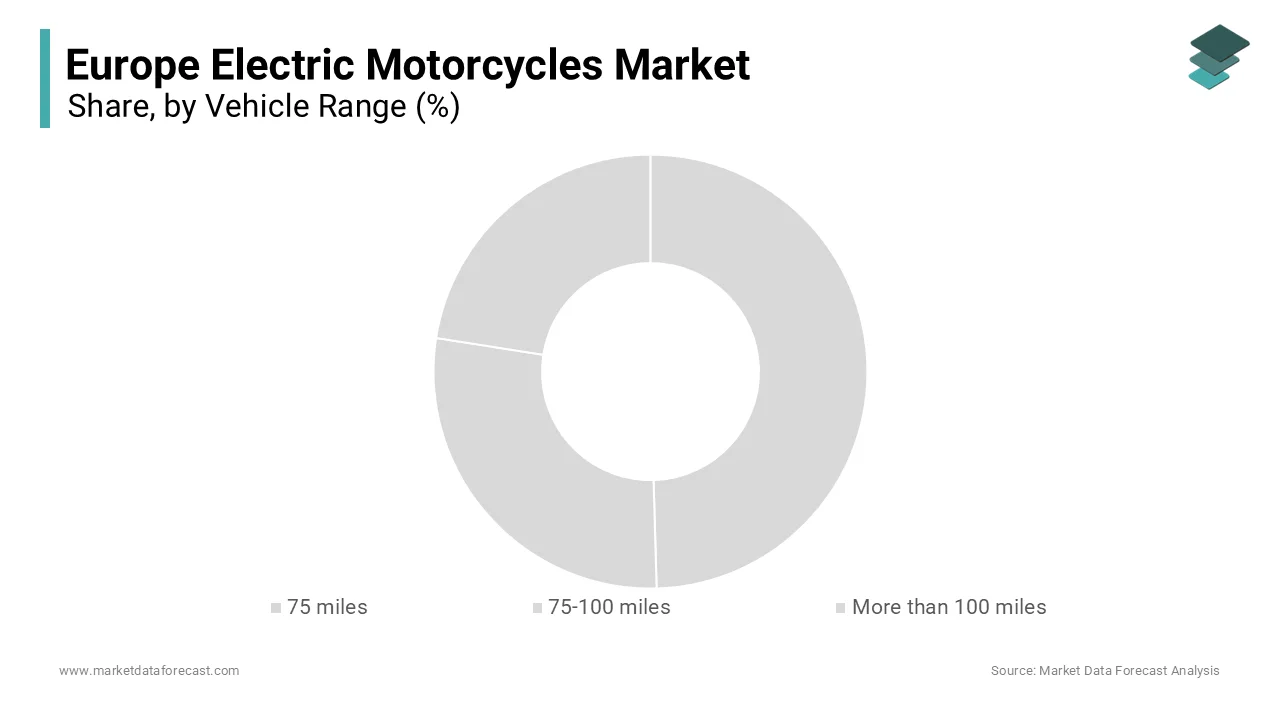
The above 100 miles range segment is predicted to witness the highest CAGR of 24.6% from 2026 to 2034 due to rapid advancements in battery energy density and the rising demand for intercity and recreational riding. Advancements in battery technology, specifically the use of silicon anode-enhanced lithium-ion cells, are increasing the real-world range of electric motorcycles. Concurrently, infrastructure improvements, such as the mandatory establishment of fast charging networks along major highways in regions like the European Union, are facilitating longer journeys for riders of electric two-wheelers. Furthermore, adventure and touring enthusiasts, who previously dismissed electric options, are now adopting them for alpine and coastal routes where silent operation enhances nature immersion. As battery costs decline and liquid-cooled powertrains improve thermal management, this segment is transitioning from niche to mainstream among performance-oriented consumers.
By Battery Type Insights
The lithium-ion batteries segment held the leading share of the European electric motorcycle market in 2025. The growth of the lithium-ion batteries segment is attributed to their superior energy density, lightweight design, and declining costs compared to legacy chemistries. Modern lithium-ion battery chemistries, such as lithium iron phosphate (LFP) and nickel manganese cobalt (NMC), offer significantly higher energy density compared to lead-acid batteries, allowing for greater practical range in electric vehicles without excessive weight penalties. Electric motorcycles utilising lithium-ion battery technology are generally lighter than equivalent models powered by lead-acid batteries. Regulatory alignment also favours this chemistry. Major manufacturers use lithium-ion due to performance and safety certifications. This technological and regulatory synergy ensures lithium-ion remains the default choice across all vehicle classes.
The lithium-ion is also the fastest-growing segment in the European electric motorcycle market with a CAGR of 21.3% from 2026 to 2034, owing to innovations in solid-state lithium iron phosphate variants that enhance safety and longevity. According to research, European institutions are providing substantial financial support to expand domestic lithium-ion battery manufacturing capabilities, which aims to decrease the region's dependence on imported Asian battery cells for light electric vehicles. Forthcoming European safety regulations will mandate sophisticated battery management systems with continuous thermal monitoring, a requirement that aligns well with existing lithium-ion battery architecture and further emphasises safety standards. Urban delivery fleets are accelerating adoption. The EU's forthcoming Battery Passport system will improve recycling, which further cements the dominance of lithium-ion batteries across all performance tiers by boosting their lifecycle sustainability.
By Voltage Type Insights
The above 60 Volt segment was the largest in the European electric motorcycle market and captured a substantial share in 2025. High-voltage architectures are essential for delivering the power, torque, and thermal efficiency required in performance and mid to large displacement electric motorcycles. Higher voltage systems (specifically in the 72V to 200V range) are increasingly used to achieve the motor outputs necessary for vehicles to meet the EU's performance classification thresholds for highway use. Electric motorcycles designed for high performance, such as rapid acceleration and sustained high-speed operation, typically utilise system voltages of 120V or higher. This efficiency translates to extended range and smaller conductor sizes, which reduce weight and cost over the vehicle lifecycle. Furthermore, high-voltage platforms are required to support fast charging. This technical necessity ensures the above 60 Volt segment remains dominant among serious riders and fleet operators.
The above 60 Volt segment is also anticipated to witness the fastest CAGR of 23.1% during the forecast period. The rapid growth of the above 60 Volt segment is propelled by the convergence of performance expectations, regulatory requirements, and charging ecosystem development. The EU's Regulation (EU) No 168/2013, already in force, classifies vehicles like speed pedelecs (max 45 km/h) as category L1e-B mopeds, which are subject to type-approval requirements, unlike standard e-bikes (max 25 km/h, 250 W). The ongoing discussions in the industry involve adapting regulations to accommodate growing interest in light electric vehicles (LEVs) that might exceed current low power limits (e.g., above 250W or 4kW) for utility purposes like cargo bikes, which currently face difficulties with the existing type-approval framework. Manufacturers are responding with modular architectures. The rising European demand for highway-capable options shows this voltage tier's reach will broaden across the commuter sport and adventure segments.
REGIONAL ANALYSIS
Germany Market Analysis
Germany led the European electric motorcycle market and held a 22.4% share in 2025. The domination of the German market is primarily driven by a combination of strong industrial policy, consumer aware, ness, and infrastructure readiness. Manufacturers like BMW Motorrad continue to innovate with models such as the CE 04 and the urban-focused CE 02, which offer integrated connectivity features and ranges suitable for city commuting (the CE 02 offers a range of approximately 90 km). Charging infrastructure is expanding, with major networks like Ionity and EnBW increasing the number of fast chargers across the country, though these are primarily aimed at electric cars. Furthermore, the dense network of TÜV-certified workshops ensures reliable after-sales service, which builds consumer confidence. These structural advantages position Germany as the innovation and adoption epicentre for electric motorcycles in Europe.
France Market Analysis
France followed closely in the European electric motorcycle market and accounted for 16.8% in 2025. Paris is moving toward restricting the use of non-electric two-wheelers in its city centre. There has been a significant increase in the adoption of electric motorcycles in the Île-de-France region in recent years. France is offering financial incentives to encourage the purchase of zero-emission two-wheelers and the scrapping of older, gasoline-powered models. Urban delivery fleets have been early adopters, with La Poste and Deliveroo converting over 3500 scooters and motorcycles to electric. The French government is investing heavily in the research and development of electric two-wheeler technology as part of a national investment plan. Brands have launched France-specific models with integrated anti-theft and battery swap features. This blend of urban policy, fleet adoption, and public investment sustains France’s dominance in sustainable two-wheeler mobility.
United Kingdom Market Analysis
The United Kingdom is also a major player in the European electric motorcycle market. The UK’s strong motorsport heritage has also caused performance-oriented innovation, with firms like Saietta and Arc Vector developing high-torque electric powertrains tested at Silverstone. Furthermore, the UK’s extensive rural road network is attracting adventure riders to new models that offer off-road capability and notable mileage range. Post-Brexit regulatory flexibility has allowed faster type approval for novel battery architectures, further stimulating market dynamism.
Italy Market Analysis
Italy experienced steady growth in the European electric motorcycle market due to its iconic motorcycling culture and dense historic centres, where noise and emissions restrictions favour electric propulsion. Cities ban gasoline-powered two-wheelers from restricted traffic zones during daytime hours, accelerating fleet electrification among couriers and food delivery services. Domestic brands like Tacita and Energica leverage racing heritage to develop high-performance electric models with premium Italian design. The national recovery plan allocated funds to expand two-wheeler charging infrastructure, focusing on tourism corridors. This fusion of cultural identity, regulatory pressure, and innovation ensures Italy remains a key growth market.
Spain Market Analysis
Spain is likely to expand in the European electric motorcycle market from 2026 to 2034, owing to favourable climate,,e extensiurbanisationion and strong tourism demand for sustainable mobility. Barcelona and Madrid have implemented low-emission zones that grant electric motorcycles free parking and access to bus lanes, providing tangible daily benefits. Apart from these, Spain’s abundant solar resources enable low-cost renewable charging. Companies are scaling domestic production of swappable battery motorcycles, which appeal to urban users lacking private parking. These geographic, economic, and policy factors position Spain high-potential market for continued expansion.
COMPETITIVE LANDSCAPE
KEY MARKET PLAYERS
Some of the notable key players in the European electric motorcycle market are
- GOVECS AG
- Gogoro Inc.
- TORROT ELECTRIC EUROPA S.A.
- Kwang Yang Motor Co., Ltd.
- unu GmbH
- BMW AG
- Niu Technologies
- Askoll EVA SpA
- Zero Motorcycles Inc.
- Lightning Motors Corp.
- Alta Motors
- Scutum Logistic S.L.
TOP STRATEGIES USED BY THE KEY MARKET PLAYERS
Key players in the European electric motorcycle market prioritise performance-oriented product development to appeal beyond urban commuters to sport and adventure riders. They invest in high-voltage architectures and fast charging compatibility to enable intercity travel and reduce range anxiety. Strategic partnerships with pan-European charging networks ensure seamless refuelling access. Companies also expand certified service networks and offer over-the-air software updates to enhance the ownership experience. Besides, they collaborate with urban delivery and shared mobility operators to scale fleet adoption while leveraging government incentives and low-emission zone policies to drive consumer demand across major metropolitan areas.
COMPETITION OVERVIEW
Competition in the European electric motorcycle market is intensifying as established OEMs, traditional motorcycle brands, and agile startups vie for dominance in a rapidly evolving mobility landscape. The rivalry is not solely based on price but on range charging speed,d, software integration and brand ethos. Premium players like Energica and LiveWire focus on performance and DC fast charging to capture enthusiasts, while BMW and Zero balance urban practicality with digital features. Chinese brands such as Niu and NIU Technologies enter through the lightweight segment, offering affordable swappable battery models for last-mile delivery. Regulatory advantages in low-emission zones create fertile ground for early adoption, yet differentiation hinges on after-sales support and charging interoperability. With the EU tightening CO2 norms and cities expanding zero-emission markets, it is becoming a strategic battleground where technological agility, brand trust, and ecosystem integration determine long-term success.
TOP PLAYERS IN THE MARKET
- Energica Motor Company is an Italian manufacturer renowned for its high-performance electric motorcycles that combine racing heritage with advanced battery technology. The company supplies its Ego and EsseEsse9 models across Europe and has pioneered the use of DC fast charging in the two-wheeler segment with compatibility up to 22 kW. The initiatives support Energica’s positioning as a premium performance brand while expanding its appeal beyond urban commuters to touring and recreational riders across the continent.
- Zero Motorcycles is a global leader in electric two-wheelers with a strong footprint in Europe through its S, D, S and DSR models. The company is known for its proprietary ZF battery architecture and high torque permanent magnet motors that deliver sporbike-level performance. Furthermore, Zero collaborated with European fleet operators to develop customised delivery variants with modular battery systems, enhancing its presence in commercial urban logistics.
- BMW Motorrad leverages its century-old engineering legacy to drive electric mobility in Europe through its CE 02 and CE 04 urban electric motorcycles. These models emphasise connectivity, minimalist design, and seamless integration into smart city ecosystems. The company’s extensive dealer network and certified technician training programs ensure high service accessibility, which builds consumer confidence. BMW’s strategic focus on urban sustainability and digital rider experience positions it as a key enabler of mainstream electric motorcycle adoption in Europe.
MARKET SEGMENTATION
This research report on the European electric motorcycle market has been segmented and sub-segmented based on categories.
By Vehicle Range
- 75 miles
- 75-100 miles
- More than 100 miles
By Battery Type
- Lead Acid
- Lithium-Ion (Li-ion)
- Nickel-Metal Hydride (NiMH)
By Voltage Type
- Below 24 Volt
- 24-48 Volt
- 48-60 Volt
- Above 60 Volt
By Country
- UK
- France
- Spain
- Germany
- Italy
- Russia
- Sweden
- Denmark
- Switzerland
- Netherlands
- Turkey
- Czech Republic
- Rest of Europe