- Product Description Description
- Table of Contents TOC
- List of Table & Figure LOT
- Get Free Sample PDF Sample PDF
Market Size, 2025
$0.93 BnMarket Estimate, 2026
$0.96 BnMarket Forecast, 2034
$1.27 BnCAGR, 2026–2034
3.52%Executive Summary: Europe Electrical Bushing Market
- Market Scope: Comprehensive European electrical bushing market analysis covering insulation types, application sectors, national leadership shares, renewable infrastructure drivers, and raw-material cost benchmarks.
- Market Valuation: Valued at USD 0.93 billion (2025), rising to USD 0.96 billion (2026), and reaching USD 1.27 billion by 2034, registering a CAGR of 3.52% (2026–2034).
- Primary Growth Drivers & Pressures: Growth is fueled by renewable energy grid expansions and aging transmission assets (such as the UK’s high-voltage transmission assets averaging ~36 years in age), supported by Europe connecting 3.8 GW of new offshore wind capacity in 2023 and the EU-27 installing ~269 GW of solar PV capacity. Conversely, raw-material pressures persist, with industrial-mineral prices rising 22% between 2021 and 2023 and epoxy resin prices surging 37% in 2022.
Key Market Segment Metrics (2026–2034)
| Category | Leading Segment (2025 Position) | Fastest-Growing Segment |
|---|---|---|
| By Insulation / Type | Oil-impregnated paper / OIP bushings (held the largest market share in 2025) | Resin-impregnated paper / RIP bushings (projected to grow at a 7.12% CAGR) |
| By Application | Power transformers (dominated in 2025, with every transformer requiring standard high- and low-voltage bushings) | Switchgears (fastest-growing application at an 8.04% CAGR, with medium-voltage switchgear demand growing at ~7% CAGR) |
| By Voltage Class | High-voltage and extra-high-voltage transmission bushings | Medium-voltage distribution and renewable substation bushings |
| By Country / Region | Germany (led the European market in 2025, followed by France and the UK) | High-growth European energy markets modernizing aging grid infrastructure |
Major Market Players & Market Structure
Market Structure: Highly competitive European electrical component manufacturing landscape featuring global power technology leaders and specialized bushing producers competing intensely on smart bushings, online condition monitoring, dry-type insulation solutions, localized manufacturing, predictive maintenance capabilities, digital twins, and environmentally compliant materials.
Key Companies: General Electric Company, ABB, Hitachi Energy, Siemens, Eaton, Gipro, Nexans, CG Power and Industrial Solutions, Chin Sun, Poinsa, and Georg Jordan.
Europe Electrical Bushing Market Size
The Europe electrical bushing market size was valued at USD 0.93 billion in 2025 and is anticipated to reach a valuation of USD 0.96 billion in 2026 and USD 1.27 billion by 2034, growing at a CAGR of 3.52%, from 2026 to 2034.

An electrical bushing functions as an insulated conduit that enables high or medium voltage conductors to pass safely through grounded metallic enclosures, such as transformer tanks, circuit breakers, or building walls without electrical leakage or flashover. Bushings are essential components in transmission substations, distribution networks, industrial plants, and electrified transport systems. Unlike commoditised electrical hardware, bushings must meet precise technical specifications under the European norm EN 50180 and international standard IEC 60137, which is addressing material composition, dielectric performance, ageing behaviour and environmental resilience. Many European transmission and distribution systems were built decades ago and are now approaching their design lifespan, which is creating a sustained requirement for replacement of bushings with modern, condition-monitored and environmentally compliant solutions. This combination of high technical specificity, regulatory oversight and infrastructure dependency shapes the European electrical-bushing market in the current decade.
MARKET DRIVERS
Grid Modernization Mandates Drive Replacement Demand
The coordinated push of Europe to modernize its electricity transmission and distribution networks is primarily driving the growth of the European electrical brushing market. Regulatory imperatives under the European Commission’s Clean Energy Package compel national transmission system operators to replace obsolete equipment with digitally enabled, high reliability alternatives. Unlike commoditised electrical hardware, bushings must meet precise technical specifications under standards such as EN 50180 and IEC 60137, which covers material composition, dielectric performance and environmental resilience. A significant portion of Europe’s high-voltage transmission and substation infrastructure was commissioned decades ago, many still operating with old oil-impregnated paper bushings that pose leakage, fire and environmental risks. According to the national transmission and grid expansion programmes in countries such as Germany and France, bushing replacement and modernisation of substations with dry-type or composite bushings, and integration of sensors for predictive maintenance, such as real-time monitoring of partial discharge and thermal stress. With regulatory standards tightening and non-compliance increasingly penalised, utilities face steady multi-year demand for technically advanced bushings tailored to European grid architecture and safety expectations.
Integration of Renewable Energy Assets Elevates Bushing Utilization
The aggressive deployment of Europe of renewable generation infrastructure directly amplifies demand for specialized electrical bushings, which is further boosting the electrical brushing market growth in Europe. Offshore wind is a cornerstone of Europe’s decarbonization strategy and requires robust high voltage bushings in offshore platform substations and onshore converter stations to manage power evacuation under saline and high humidity conditions. The European renewable-generation boom is creating a major hardware opportunity for transmission-equipment suppliers. For example, according to WindEurope, 3.8 GW of new offshore wind capacity was connected in Europe in 2023, which is a rise in large transformer- and reactor-loaded infrastructure. Meanwhile, SolarPower Europe states that the EU-27 had approximately 269 GW of installed solar PV capacity by the end of 2023 with many missions utilising pad-mounted transformers and medium-voltage bushings for utility-scale grid interconnection. These renewable assets often face rapidly changing load profiles and intermittency that accelerate insulation ageing and fuel the need for bushings with advanced partial-discharge resistance and hydrophobic surface properties. Large infrastructure initiatives, such as offshore wind hubs and major grid-connection expansions further promote the long-term demand pipeline. With regulatory and system-performance pressures rising, the bushing-market is expected to play an integral role in Europe’s clean-energy backbone.
MARKET RESTRAINTS
Raw Material Price Volatility Constrains Manufacturing Stability
The persistent pressure from volatile input costs for critical raw materials, including porcelain clays, epoxy resins, and high purity conductive metals is primarily hampering the electrical brushing market growth in Europe. The European Commission’s Raw Materials Information System documented a 22% increase in industrial-mineral prices, such as feldspar and kaolin between 2021 and 2023 due to the supply-chain bottlenecks and export restrictions from key mining nations. According to S&P Global Platts, petrochemical-derived epoxy resin, which is essential for modern dry-type bushings experienced a 37% price surge in 2022, which is linked to natural-gas shortages and refinery outages. European producers are lacking vertical integration into upstream material sourcing that cannot easily hedge against these fluctuations. This cost instability forces difficult trade-offs that absorb margin compression and raise prices in a competitive procurement environment, or substitute materials, which is potentially compromising dielectric performance. The EU’s Carbon Border Adjustment Mechanism further complicates import economics for raw materials with high embedded carbon, which is disproportionately affecting smaller manufacturers. Consequently, production planning becomes reactive rather than strategic, which is leading to extended lead times and inconsistent inventory availability. Without coordinated industry efforts to secure alternative feedstocks or develop circular-material-recovery systems, raw-material volatility will continue to undermine pricing predictability and innovation investment across the European bushing-supply chain and hinder the regional market growth.
Stringent Environmental and Fire Safety Regulations Limit Design Flexibility
The regulatory landscape of Europe increasingly restricts the use of traditional bushing technologies due to environmental and fire safety concerns, which is further restraining the growth of the European market. The Low Voltage Directive 2014/35/EU, together with national building-codes, sets out safety requirements for electrical equipment within certain voltage ranges (50-1000 V AC or 75-1500 V DC) and mandates conformity with harmonised standards. Many operators thus favour dry-type or composite bushings for new installations in densely populated settings. The RoHS Directive limits the use of certain hazardous substances (including some brominated flame-retardants) in electrical and electronic equipment, requiring polymer housings and insulating components to be reformulated if previously reliant on those substances. In rail and metro applications, the EN 45545‑2 fire-safety standard for materials used in vehicles and associated infrastructure further raises the bar for housing and insulation materials. These overlapping regulatory layers increase testing cycles, delay product launches and elevate R&D and certification budgets. Smaller European bushing manufacturers, less able to absorb testing and compliance cost burdens, face diminished competitiveness and utilities may see fewer suppliers. The cumulative effect is a market that places regulatory-compliance ahead of pure cost-efficiency, slowing technical iteration and optimisation of design for new applications.
MARKET OPPORTUNITIES
Retrofitting Legacy Substations with Smart Bushing Solutions
The digital transformation of substation fleet of Europe offers a high value opportunity through the deployment of smart bushings equipped with embedded sensors for real-time condition monitoring, which is a promising opportunity for the European market. Unlike passive legacy units, these advanced bushings provide continuous data on temperature, partial discharge activity and dielectric loss factor—enabling predictive maintenance and extending asset life. The European transmission-system operators, through ENTSO-E’s RDI roadmaps have prioritised digital retrofitting of substations over the 2025–2035 period to enhance asset-visibility and monitoring capability. Utilities in Germany and Sweden have begun adopting advanced monitoring of substation components, which suggest reductions in unplanned outages and maintenance costs when embedded sensors and condition-monitoring hardware are deployed. Initiatives at the EU level, including digital-twin and asset-digital-infrastructure strategies aim to bring real-time asset-visibility into critical grid infrastructure by around 2030. As manufacturers bring to market factory-integrated sensing modules in bushings and other substation equipment, those able to deliver reliable mechanical and insulation integrity plus digital data capability may secure premium positioning in utility tenders. In short, the alignment of regulatory digitisation, grid-asset modernisation and operational-efficiency imperatives is creating a niche for bushings moving beyond passive insulators toward active diagnostic platforms.
Expansion of Electrified Rail and Urban Transit Networks
The commitment of Europe to sustainable urban mobility is accelerating the deployment of electrified rail and metro systems, generating sustained demand for specialized medium voltage bushings, which is another major opportunity for the European market. According to the European Commission, as of 2022 the EU rail network spans about 202,000 km of lines, around 57% of which is electrified and ERA/ERTMS-led programmes aim to accelerate modernization through 2030. Urban metro expansions in Paris, Milan, Warsaw, and other major cities require compact, fire-resistant bushings for traction-power substations often located beneath streets or within buildings. These applications demand compliance with EN 50124 for railway insulation coordination and EN 45545 for fire safety standards that diverge significantly from conventional utility requirements. According to the International Association of Public Transport, urban rail ridership in Europe is projected to increase by 2030, which is requiring hundreds of new traction substations, each typically requiring multiple bushings per installation. The EU’s Sustainable and Smart Mobility Strategy further prioritises zero-emission public transport and the shift away from diesel toward electrification by overhead or third-rail systems. This policy tailwind ensures long-term procurement visibility for manufacturers offering halogen-free, vibration-resistant, and space-optimised bushing solutions tailored to the rail environment. With limited suppliers certified for railway applications, this segment represents a defensible and high-margin growth channel within the broader electrical-bushing market.
MARKET CHALLENGES
Supply Chain Fragmentation Impedes Just in Time Delivery
The pronounced supply chain fragmentation that is undermining delivery reliability and production agility is challenging the growth of the electrical brushing market in Europe. Unlike vertically integrated competitors in Asia, European producers typically source porcelain shells from ceramic specialists in Poland or Czechia, conductive cores from German metal fabricators, which is sealing compounds from Italian chemical firms, and sensors from Nordic electronics vendors. According to sources, lead times for custom high-voltage ceramic components have lengthened in recent years, particularly during peak demand and for project-specific configurations used in offshore wind or rail applications where bushings must meet tight dimensional tolerances and bespoke interface designs. Supply-chain complexity and the lack of large and centralised-manufacturing hubs for high-voltage components mean many manufacturers must rely on cross-border logistics, which increases exposure to regulatory, customs and shipping disruptions. Utilities operating just-in-time procurement models are encountering greater risk of delay or contract substitution by more reliable suppliers. Without coordinated industry efforts to develop regional manufacturing clusters or strategic inventory buffers, European bushing-manufacturers remain vulnerable to logistical disruptions that can erode customer trust and competitive positioning.
Technical Shortage in High Voltage Engineering Expertise
A deepening talent gap in high voltage engineering is further challenging the European market growth. According to Eurostat, the European Union employed more than 7 million scientists and engineers in 2022, which is a workforce that is unevenly distributed across technical disciplines and increasingly strained by demographic turnover. University programs in high-voltage technology have been scaled back due to declining enrollment and reduced research funding. This scarcity directly impacts bushing design validation, failure root-cause analysis, and field commissioning activities that demand nuanced understanding of material aging, creepage optimization, and corona-inception thresholds. Utilities increasingly outsource testing to external laboratories, which is adding delays across development cycles. The talent deficit also hampers adoption of next-generation technologies, such as nanodielectric composites or fiber-optic-embedded bushings, which require advanced simulation and validation competencies. Without a coordinated European electrotechnology skills alliance or industry-led apprenticeship programs, the bushing sector risks operational stagnation and compromised grid resilience at a time of escalating technical complexity.
REPORT COVERAGE
| REPORT METRIC | DETAILS |
| Market Size Available | 2025 to 2034 |
| Base Year | 2025 |
| Forecast Period | 2026 to 2034 |
| CAGR | 3.52% |
| Segments Covered | By Type, Application, By Country |
| Various Analyses Covered | Global, Regional & Country Level Analysis; Segment-Level Analysis, DROC, PESTLE Analysis, Porter’s Five Forces Analysis, Competitive Landscape, Analyst Overview of Investment Opportunities |
| Regions Covered | UK, France, Spain, Germany, Italy, Russia, Sweden, Denmark, Switzerland, Netherlands, Turkey, Czech Republic & Rest of Europe |
| Market Leaders Profiled | General Electric Company, ABB Ltd, Siemens AG, Eaton Corporation PLC, Gipro GmBH, Nexans SA, CG Power and Industrial Solutions Ltd, Chin Sun, Poinsa, Georg Jordan GmBH |
SEGMENTAL ANALYSIS
By Type Insights
The oil impregnated paper bushings segment commanded the most significant share of the European market in 2025 due to their entrenched presence in legacy high voltage infrastructure. A significant proportion of Europe’s operational transformers and circuit breakers were designed specifically for compatibility with oil impregnated paper insulation systems. The oil-impregnated paper (OIP) bushing technology remains widely deployed across many European high-voltage substations, which is creating a sustained demand for replacement or refurbishment projects that maintain consistent mechanical and electrical interfaces. Utilities often prioritise operational continuity over the adoption of newer insulation technologies, especially in critical transmission corridors where unplanned outages are heavily regulated and financially penalised. Established recycling and disposal protocols exist for mineral-oil/cellulose insulation systems, which may simplify end-of-life handling compared with newer composite-material bushings that lack fully mature recovery pathways. This combination of infrastructure inertia, interface standardisation needs and regulatory acceptance ensures that OIP bushings continue to dominate replacement volumes despite recognised environmental and performance drawbacks, which is one of the major factors propelling the expansion of the segment in the European market.
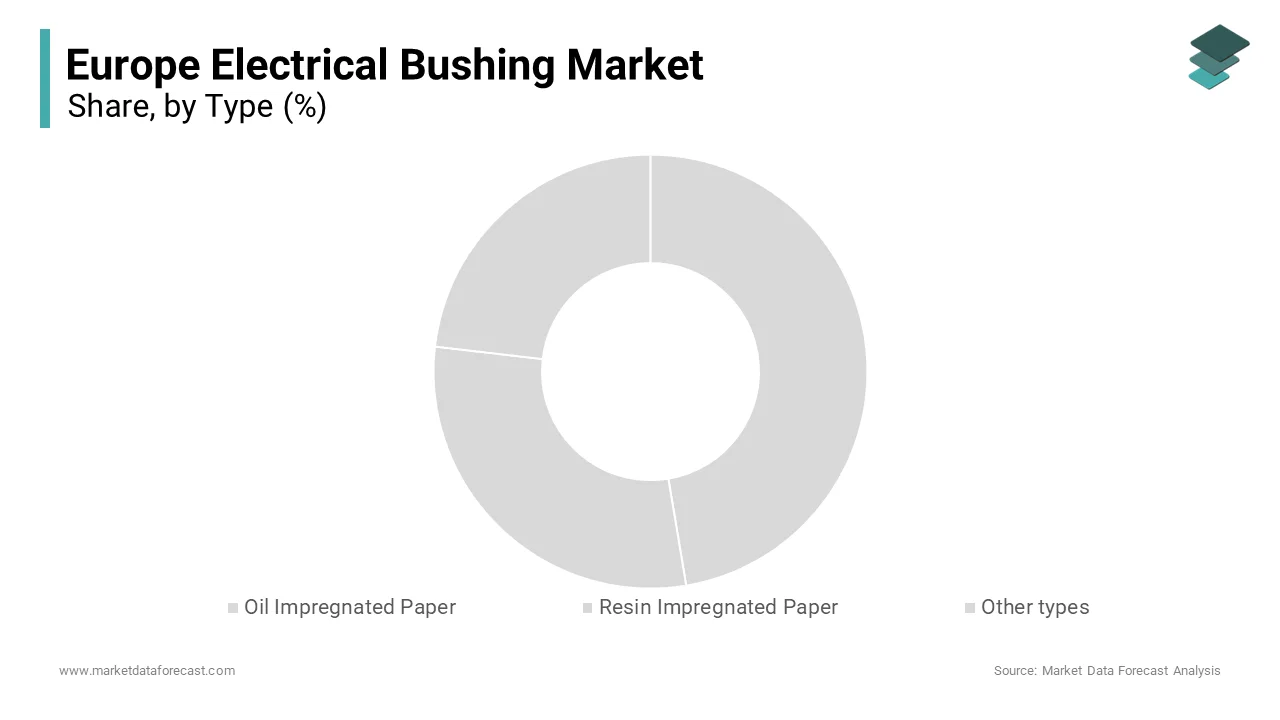
The resin impregnated paper bushings segment is expected to register a CAGR of 7.12% over the forecast period in the European electrical brushing market owing to their superior performance in compact and indoor installations where fire safety and maintenance constraints are paramount. Unlike oil filled alternatives, resin impregnated bushings are dry type, eliminating leakage risks and enabling safe deployment in densely populated urban substations and underground facilities. In many European metropolitan substation projects today, particularly for indoor or underground installations in cities like Paris, Berlin and Amsterdam operators increasingly favour insulation systems that are halogen-free and non-flammable. Resin-impregnated or composite designs are often specified over traditional oil-impregnated paper bushings for these urban or confined environments because they align more reliably with fire-safety and materials-compliance expectations. The standard EN 50181 sets interface and plug-in-type criteria for bushings above 1 kV up to 52 kV, helping establish a regulatory pathway for new designs. Meanwhile, new insulation material developments emphasise enhanced tracking resistance, flame retardance and durability in vibration and thermally-stressful settings. The convergence of urban-installation constraints, safety mandates, and the evolving insulation-materials ecosystems is reinforcing resin-impregnated or composite bushing designs as a growing segment within the broader European market and contributing to the growth of the resin impregnated paper bushings segment in the European market.
By Application Insights
The transformers segment occupied the largest share of the European market in 2025 due to their fundamental role in voltage transformation across transmission and distribution networks. Every power transformer whether in a utility substation, industrial facility, or renewable energy plant requires at least three high voltage bushings and three low voltage bushings to enable safe conductor penetration through its tank. The transmission and distribution networks of Europe continue to depend on a large installed base of substations and transformers, many of which are approaching end-of-life or require capacity and performance upgrades. Network-operators across Germany, France and Italy are actively planning refurbishment or replacement of aging transformer fleets and their associated switchgear, which drives steady demand for bushings. Meanwhile, the growth in renewable generation generates new step-up-transformer requirements at generation sites with each requiring high-reliability bushings designed for harsh environmental and dynamic-load conditions. According to the IEA’s “Renewables 2023” report, annual capacity additions surged globally in 2025, which is reflecting the scale of infrastructure growth that underpins ancillary-equipment demand. This structural dependence on transformers across voltage levels and asset-classes ensures that bushings remain a foundational component in the European grid-upgrading ecosystem and propel the dominance of the transformers segment in the European market.
The switchgears segment is emerging as the fastest growing application segment for electrical bushings in Europe and is anticipated to witness a CAGR of 8.04% over the forecast period. The continent’s aggressive push toward compact, gas insulated, and digitally enabled secondary substations is driving the growth of the switchgears segment in the European market. Modern gas insulated switchgear assemblies require specialized bushings that interface between internal conductors and external cable terminations while maintaining hermetic seals. In many urban distribution-substation projects across Europe, compact installation constraints are driving increased deployment of gas-insulated switchgear (GIS). For example, policy documents confirm that in densely populated areas and GIS is often preferred due to its smaller footprint compared with air-insulated alternatives. Utilities are also showing growing interest in switchgear solutions that support fire-resistant and non-polluting bushing materials when installed in transport-hub or underground locations. The demand for medium-voltage switchgears is forecast to grow at around a 7% CAGR, which is suggesting strong demand across urban infrastructure upgrades. As OEMs evolve their equipment road-maps, the relationship between switchgear design and bushing content is becoming more prominent, especially in configurations that embed condition-monitoring, meet higher voltage ratings or serve space-constrained substations. Altogether, this trend toward more modular, sensor-enabled, and space-efficient switchgear architectures helps reinforce demand for advanced bushings within urban-distribution applications.
COUNTRY ANALYSIS
Germany Electrical Bushing Market Analysis
Germany stood as the leading performer in the European market by holding the major share of the European market in 2025. The dominance of Germany in the European market is attributed to its role as the continent’s industrial and energy infrastructure hub. Germany’s Energiewende policy has driven major investments in grid modernisation, with the Bundesnetzagentur (Federal Network Agency) and the country’s transmission-system operators publishing grid-development plans that span hundreds of billions of euros through 2030 and beyond. For example, the grid-development plan “GDP 2037/2045” details on-shore and off-shore expansion and reinforcement measures. This modernisation includes refurbishment and upgrade of substations, which in turn increases demand for high-voltage and medium-voltage bushings. Germany hosts one of Europe’s densest high-voltage networks, with multiple operators and tens of thousands of kilometres of 220 kV and 380 kV lines. Utilities and grid-operators have noted that ageing asset-bases (including transformers, lines and switchgear) are a key driver of renewal cycles. In addition, Germany’s leadership in offshore wind and the integration of large-scale renewables necessitates specialised bushing solutions for offshore converter platforms, coastal connection points and high-voltage transmission corridors. Together, these structural, regulatory and renewable-energy drivers align to strengthen Germany’s position as a major European market for advanced bushing technologies.
France Electrical Bushing Market Analysis
France occupied the second largest position in the Europe electrical bushing market in 2025. The growth of French market is attributed to its centralized nuclear based grid and extensive rural electrification infrastructure. The French transmission system is operated by RTE and spans tens of thousands of kilometres of high- and medium-voltage lines and includes a large number of substations, many of which were commissioned decades ago. RTE’s multi-billion-euro grid modernisation programme focuses on upgrading ageing infrastructure, automating substation systems and replacing high-voltage equipment to improve resilience against extreme weather and climate impacts. A significant portion of bushings and switchgear in rural distribution networks are ageing and approaching end-of-life, creating a long-term replacement cycle that drives demand for modern bushing solutions. France’s ambitious offshore-wind deployment plans — such as its 18 GW target by 2035 — will also require new converter-station infrastructure and high-voltage component upgrades, including bushings tailored for coastal and offshore conditions. Combined, these infrastructure renewal, regulatory and renewables-driven factors support a strong outlook for the French bushing market.
United Kingdom Electrical Bushing Market Analysis
The United Kingdom held the third largest share of the European electrical bushing market in 2025. The aging grid infrastructure of the UK and ambitious offshore wind expansion are driving the UK market growth. The UK’s transmission system is ageing, with the weighted average age of high-voltage transmission assets in England and Wales estimated at around 36 years. With the government’s ambition to deliver 50 GW of offshore wind by 2030, new offshore substations and on-shore converter stations will be required processes that will demand many high-performance bushings. A national grid-reinforcement programme is underway, supported by multi-billion-pound funding commitments and transmission network upgrade plans. The UK’s Building Safety Act 2022 imposes enhanced safety requirements for higher-risk buildings and is accelerating design changes across infrastructure-connected facilities, which may indirectly influence equipment such as switchgear and bushings installed in urban settings. These structural, regulatory and renewables-driven factors combine to create a favourable demand outlook for advanced bushing technologies in the UK market.
COMPETITIVE LANDSCAPE
Competition in the Europe electrical bushing market is characterized by a blend of technological differentiation strategic localization and regulatory alignment among established global players. The market features limited but intense rivalry primarily among three to four multinational corporations that dominate high voltage segments through decades of grid integration experience. These companies compete not on price but on reliability certification compliance and digital service integration. Regional utilities favor suppliers with proven track records in harsh environments such as offshore wind or seismic zones creating high entry barriers for new entrants. Innovation cycles are driven by EU environmental mandates and grid modernization timelines rather than consumer demand. Smaller niche manufacturers focus on medium voltage or rail applications but lack the scale to influence broader market dynamics. As a result the competitive landscape remains stable yet highly technical with long term relationships and engineering expertise serving as critical success factors.
KEY MARKET PLAYERS
- General Electric Company
- ABB Ltd
- Hitachi Energy
- Siemens AG
- Eaton Corporation PLC
- Gipro GmBH
- Nexans SA
- CG Power and Industrial Solutions Ltd
- Chin Sun
- Poinsa
- Georg Jordan GmBH
Top Players In The Market
- Siemens Energy is a pivotal contributor to the Europe electrical bushing market through its high voltage product portfolio that integrates advanced insulation technologies and digital monitoring capabilities. The company supplies bushings for transformers and gas insulated switchgear across utility and industrial segments throughout Europe. In recent years Siemens Energy has intensified its focus on sustainability by developing oil free and biodegradable resin based bushing systems compliant with EU environmental directives. It has also launched condition monitoring solutions embedded directly into bushing flanges enabling real time assessment of dielectric health. These innovations align with Europe’s grid digitization and decarbonization mandates strengthening Siemens Energy’s technical leadership and project involvement in offshore wind interconnection and urban substation modernization programs across Germany France and the Nordic regions.
- Hitachi Energy maintains a strong presence in the Europe electrical bushing market by delivering technically differentiated products designed for extreme environments including offshore platforms and seismic zones. The company leverages its global R and D network to tailor bushing solutions that meet EN and IEC standards specific to European grid operators. Recently Hitachi Energy expanded its dry type bushing production capacity at its manufacturing facility in Sweden to address rising demand from rail and renewable sectors. It has also introduced bushings with integrated fiber optic sensors for partial discharge detection enhancing predictive maintenance capabilities for European utilities. Collaborations with transmission system operators in the UK and Spain on pilot deployments of smart bushings underscore its commitment to advancing grid reliability and solidifying its role in Europe’s energy transition infrastructure.
- ABB plays a significant role in the Europe electrical bushing market through its comprehensive range of medium and high voltage bushings designed for transformers switchgear and traction power systems. The company emphasizes compact and fire safe designs suitable for urban and underground substations a key requirement under evolving EU safety regulations. In 2025 ABB enhanced its European service footprint by establishing a dedicated bushing retrofit center in Italy focused on upgrading legacy oil impregnated units with modern resin alternatives. It also launched a digital twin enabled bushing testing protocol at its facility in Switzerland improving validation speed and accuracy for custom projects. These initiatives reinforce ABB’s alignment with Europe’s infrastructure modernization priorities and support its active participation in rail electrification and renewable integration initiatives across Southern and Central Europe.
Top Strategies Used By The Key Market Participants
Key players in the Europe electrical bushing market prioritize product innovation through the development of smart and environmentally compliant bushings that integrate real time monitoring capabilities. They invest heavily in localized manufacturing and retrofit service centers to ensure faster delivery and compliance with regional standards. Strategic partnerships with transmission system operators and renewable project developers enable early involvement in infrastructure planning. Companies also focus on material science advancements to replace oil and hazardous substances with biodegradable and fire resistant alternatives. Additionally they expand digital service offerings including predictive maintenance platforms and digital twin simulations to enhance asset lifecycle management and strengthen long term customer relationships across utility and industrial segments.
MARKET SEGMENTATION
This research report on the Europe electrical bushing market is segmented and sub-segmented into the following categories.
By Type
- Oil Impregnated Paper
- Resin Impregnated Paper
- Other types
By Application
- Transformers
- Switchgears
- Other Applications
By Country
- UK
- France
- Spain
- Germany
- Italy
- Russia
- Sweden
- Denmark
- Switzerland
- Netherlands
- Turkey
- Czech Republic
- Rest of Europe