- Product Description Description
- Table of Contents TOC
- List of Table & Figure LOT
- Get Free Sample PDF Sample PDF
Market Size, 2025
$3.42 BnMarket Estimate, 2026
$3.74 BnMarket Forecast, 2034
$7.57 BnCAGR, 2026–2034
9.23%Executive Summary: European Electronic Toll Collection (ETC) Market
- Market Scope: Comprehensive evaluation of the European Electronic Toll Collection (ETC) sector, covering system types, underlying technologies, end-user settings, and major country-level markets.
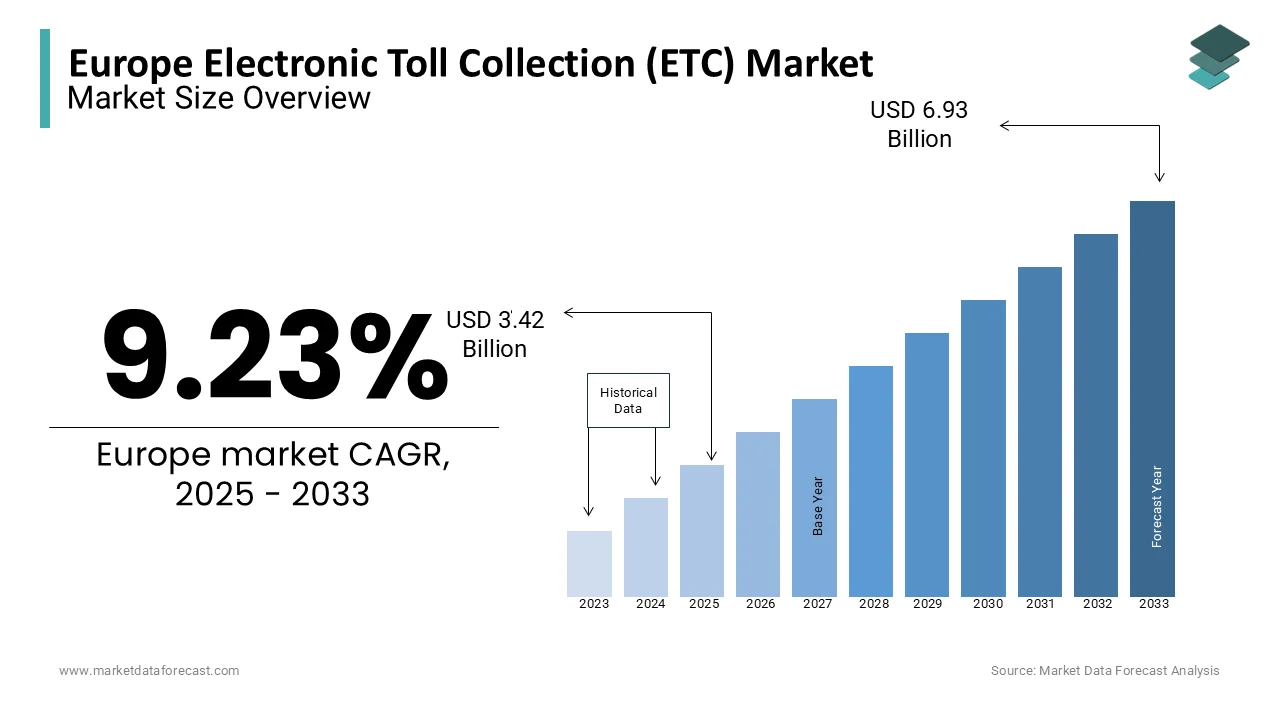
- Market Valuation: Valued at USD 3.42 billion in 2025, estimated at USD 3.74 billion in 2026, and projected to reach USD 7.57 billion by 2034, growing at a strong CAGR of 9.23% from 2026 to 2034.
- Primary Growth Drivers: Rapid urbanization, severe traffic congestion, government support for intelligent transportation systems, and the EU's push toward seamless cross-border interoperability via EETS.
Key Market Segment Metrics (2026–2034)
| Category | Leading Segment (Base Position) | Fastest-Growing / High-Growth Segment |
|---|---|---|
| By Type Insights | Automatic Vehicle Identification System (AVIS) (captured ~42.5% market share in 2025, core for contactless transactions and reducing toll plaza delays) | Violation Enforcement System (VES) (projected at a rapid 13.3% CAGR, driven by automated enforcement, safety cameras, and smart city rules) |
| By Technology Insights | Radio Frequency Identification (RFID) (dominated with ~41.4% share in 2025, praised for reliability, non-contact operation, and widespread deployment) | GNSS / GPS (projected at a 12.2% CAGR, accelerating the transition to open-road distance-based tolling and European Galileo integration) |
| By End-User Insights | Highways (led with ~55.8% market share, vital for long-distance transport networks, freight movement, and heavy-duty traffic flow) | Urban Areas (projected at a 10.8% CAGR, fueled by urban congestion charges, dynamic pricing, and smart city green initiatives) |
| By Country / Region | Germany (market leader holding 31.8% share in 2024, backed by robust infrastructure investments and satellite-based truck tolling) | France & Italy (high-growth hubs anchored by advanced national networks like Liber-T and Telepass, plus smart mobility initiatives) |
Major Market Players & Industry Landscape
Market Structure: Highly competitive ecosystem driven by key infrastructure technology providers specializing in satellite tracking, RFID toll systems, and automated enforcement architectures.
Key Companies: Kapsch TrafficCom, Q-Free ASA, Siemens Mobility, Toll Collect GmbH, Emovis, Egis Group, Neology, and Thales Group.
Europe Electronic Toll Collection (ETC) Market Size
The Europe's electronic toll collection market size was valued at USD 3.42 billion in 2025 and is anticipated to reach USD 3.74 billion in 2026 to reach USD 7.57 billion by 2034, growing at a CAGR of 9.23% from 2026 to 2034.
Electronic Toll Collection (ETC) is a critical component of the region’s intelligent transportation systems and is designed to streamline toll payment processes, reduce traffic congestion, and enhance overall road network efficiency. ETC systems utilize advanced technologies such as Radio Frequency Identification (RFID), Dedicated Short-Range Communication (DSRC), and Global Navigation Satellite Systems (GNSS) to enable seamless, cashless transactions for vehicles passing through toll plazas. These systems not only improve operational efficiency but also contribute to environmental sustainability by minimizing vehicle idle times and reducing carbon emissions.
The European ETC market has witnessed significant growth in recent years owing to increasing urbanization, rising vehicle ownership, and the need for efficient traffic management solutions. Countries such as France, Germany, and Italy have been at the forefront of this transformation, with well-established ETC networks like France’s Liber-T and Italy’s Telepass. Additionally, the European Union’s push for interoperability under the European Electronic Toll Service framework has further accelerated market expansion, which is enabling cross-border toll collection without the need for multiple devices. The integration of artificial intelligence and IoT-based solutions is expected to further revolutionize the sector, offering enhanced accuracy and user convenience. With these developments, the Europe ETC market is poised to play a pivotal role in shaping the future of transportation across the continent.
MARKET DRIVERS
Urbanization and Traffic Congestion
The rapid urbanization across Europe has led to increased traffic congestion, particularly in metropolitan areas, which is driving the demand for efficient toll collection systems and primarily contributing to the regional market growth. According to Eurostat, over 75% of the European Union’s population resides in urban areas, which is contributing to significant traffic bottlenecks. Electronic toll collection systems alleviate congestion by enabling seamless vehicle movement through toll plazas, reducing average wait times. For instance, Germany’s implementation of ETC on its autobahns has helped reduce traffic delays. These systems are essential for managing the growing volume of vehicles in urban centers, ensuring smoother traffic flow and reducing environmental impact.
Government Initiatives and Regulatory Support
Government policies and regulatory frameworks have been instrumental in propelling the adoption of electronic toll collection systems across Europe, which is further boosting the regional market expansion. The European Union’s European Electronic Toll Service (EETS) mandates interoperability, which is allowing vehicles to use a single device for toll payments across member states. According to the European Commission, this initiative has increased ETC adoption rates. Additionally, countries like France and Italy have implemented measures to encourage ETC usage, which is further boosting market penetration. The French Ministry of Ecological Transition reported increases in ETC device registrations following the introduction of such measures. These efforts underscore the critical role of government support in fostering market growth.
MARKET RESTRAINTS
High Initial Implementation Costs
The deployment of electronic toll collection systems requires substantial upfront investment in infrastructure, including gantries, sensors, and backend software, which can be a significant barrier for many regions and hinders the European ETC market growth. The average cost of implementing an ETC system on a major highway can be substantial, varying widely with scale and complexity. Smaller countries or regions with limited budgets often struggle to allocate funds for such projects. In some cases, high costs have delayed the adoption of ETC systems in certain areas. These financial constraints hinder widespread adoption, particularly in less economically developed regions.
Privacy and Data Security Concerns
The reliance on advanced technologies like RFID and GNSS in electronic toll collection systems raises concerns about data privacy and security, which is further hindering the electronic toll collection market growth in Europe. The European Data Protection Board has emphasized that the collection and storage of vehicle movement data pose risks of misuse or breaches. According to a survey conducted by the European Union Agency for Cybersecurity, a significant share of respondents expressed concerns about the potential misuse of their travel data. In Germany, the Federal Commissioner for Data Protection and Freedom of Information has flagged issues related to unauthorized access to toll data, further exacerbating public distrust. These concerns can deter users from adopting ETC systems, slowing market growth.
MARKET OPPORTUNITIES
Integration with Smart City Initiatives
The growing emphasis on smart city development across Europe presents a significant opportunity for the electronic toll collection market in Europe. Smart city projects aim to enhance urban living through technology-driven solutions, including intelligent transportation systems. Many EU cities are actively implementing smart city strategies, with transportation being a key focus area. ETC systems can integrate seamlessly with these initiatives, which provide real-time traffic data and enable dynamic toll pricing to manage congestion. For example, initiatives in the Netherlands have reported improvements in traffic flow in cities where ETC systems were integrated with smart city frameworks. This synergy positions ETC as a critical component of future urban mobility.
Adoption of Advanced Technologies
The incorporation of emerging technologies such as artificial intelligence, IoT, and blockchain into electronic toll collection systems offers immense growth potential. These technologies can enhance accuracy, security, and user experience. As per the European GNSS Agency, the use of AI in toll systems could reduce operational costs while improving transaction processing speeds. Additionally, blockchain technology can address data security concerns by providing tamper-proof transaction records. As per a pilot project in Austria that is supported by the Austrian Ministry for Climate Action, increased user trust was achieved when blockchain was integrated into toll systems. Such advancements are expected to drive market expansion and innovation.
MARKET CHALLENGES
Interoperability Issues Across Borders
Despite the European Electronic Toll Service (EETS) framework, achieving full interoperability across member states remains a significant challenge for the European electronic toll collection market. Differences in technology standards, pricing models, and regulatory requirements create complexities for seamless cross-border toll collection. Interoperability under the European Electronic Toll Service remains incomplete, leading to inefficiencies for international travelers. For instance, studies have found that cross-border trucking companies face delays due to incompatible toll systems. These interoperability gaps hinder the user experience and limit the effectiveness of ETC systems in promoting frictionless mobility across Europe.
Resistance to Adoption Among Users
Consumer reluctance to adopt electronic toll collection systems, particularly among older demographics, poses a challenge to market growth. Many individuals aged 50 and above in the EU are hesitant to use digital toll systems due to perceived complexity or lack of trust. For instance, a sizable share of non-users prefer traditional cash-based toll payments. This resistance is further compounded by concerns over hidden fees and technical glitches, as highlighted by the UK Department for Transport. Overcoming this resistance requires targeted awareness campaigns and user-friendly solutions to boost adoption rates.
REPORT COVERAGE
| REPORT METRIC | DETAILS |
| Market Size Available | 2025 to 2034 |
| Base Year | 2025 |
| Forecast Period | 2026 to 2034 |
| CAGR | 9.23% |
| Segments Covered | By Type, Technology, End-User, And Region. |
| Various Analyses Covered | Global, Regional, and Country Level Analysis, Segment-Level Analysis, DROC, PESTLE Analysis, Porter’s Five Forces Analysis, Competitive Landscape, Analyst Overview of Investment Opportunities |
| Regions Covered | UK, France, Spain, Germany, Italy, Russia, Sweden, Denmark, Switzerland, Netherlands, Turkey, Czech Republic & Rest of Europe |
| Market Leaders Profiled | Kapsch Traffic Com, Q-Free ASA, Siemens Mobility, Toll Collect GmbH, Emovis, Egis Group, Neology, Thales Group (France) |
SEGMENTAL ANALYSIS
By Type Insights
The automatic vehicle identification system (AVIS) segment accounted for 42.5% of the European electronic toll collection market in 2025. The dominance of the AVIS segment in the European market is driven by its critical role in electronic toll collection (ETC) and traffic management. ETC systems using technologies like RFID help reduce toll plaza congestion, significantly improving traffic flow. The importance of AVIS lies in its ability to enable seamless, contactless transactions, widely used across developed countries.
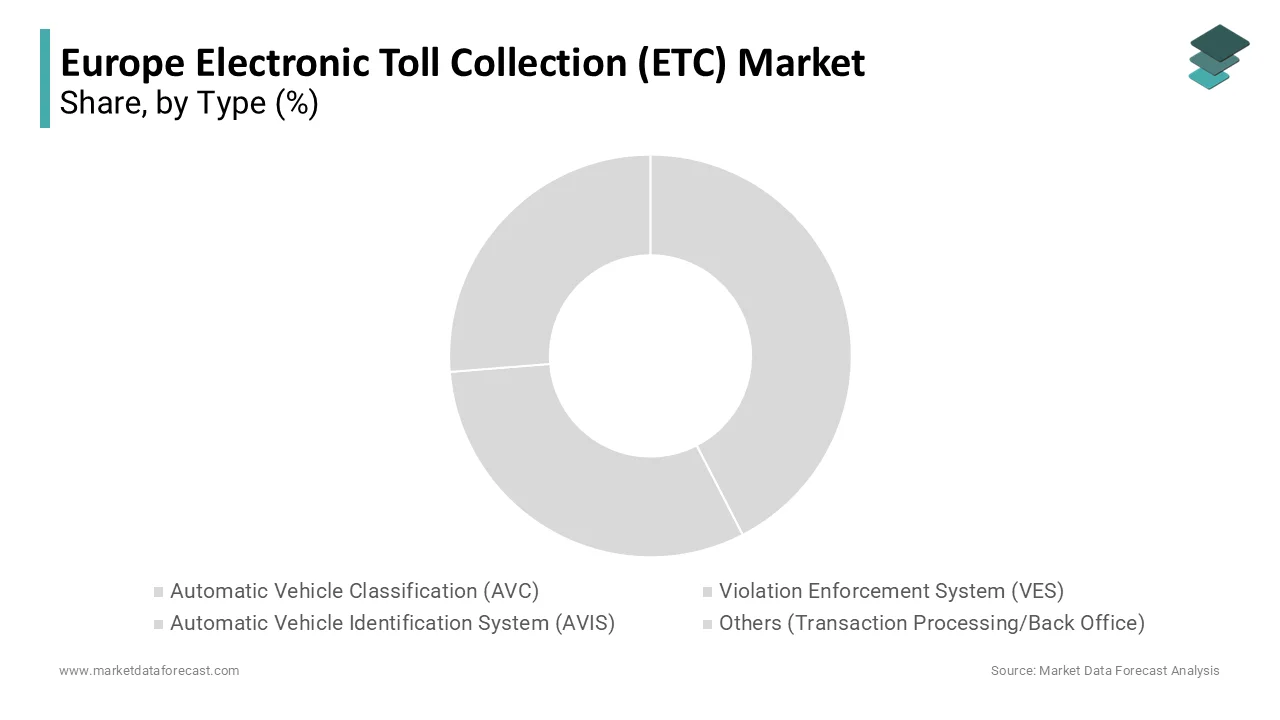
The violation enforcement system (VES) segment is the fastest-growing segment and is estimated to record a CAGR of 13.3% over the forecast period in the European market, owing to the increasing adoption of automated traffic enforcement solutions to enhance road safety and reduce violations. For instance, speed cameras, a key VES application, have been shown to reduce crashes by 15–20% in Europe. Similarly, studies in the U.S. have found that cities with red-light cameras experienced 21% fewer fatal red-light-running crashes at signalized intersections. The rising focus on smart city initiatives and stricter traffic regulations globally further accelerates VES adoption.
By Technology Insights
The RFID segment dominated the Electronic Toll Collection (ETC) market by holding 41.4% of the European market share in 2025. The growth of the RFID segment in the European market is primarily attributed to its reliability, non-contact operation, and widespread adoption in toll systems globally. RFID ensures seamless toll collection, reducing traffic congestion by enabling vehicles to pass through toll plazas at high speeds. For instance, the U.S. E-ZPass system, which uses RFID, processes over 3 billion transactions annually, highlighting its importance in modern transportation infrastructure. Governments favor RFID due to its cost-effectiveness and ability to integrate with existing systems, making it a cornerstone of ETC solutions.
The GNSS/GPS segment is predicted to grow at the fastest CAGR of 12.2% over the forecast period in the European market, owing to the shift toward open-road tolling and distance-based charging, eliminating the need for physical toll plazas. GNSS-based systems are gaining traction due to their scalability and ability to cover vast geographic areas. For example, the European Union’s Galileo GNSS system supports tolling across multiple countries, reducing infrastructure costs and improving efficiency. The increasing adoption of connected vehicles and smart transportation systems further accelerates this segment’s growth, which is making GNSS a critical technology for future tolling solutions.
By End-user Insights
The highways segment led the Electronic Toll Collection (ETC) market in Europe in 2024 by occupying a share of 55.8% of the regional market. The growth of the highways segment in this regional market can be credited to the critical role highways play in long-distance travel and freight movement. ETC systems on highways, such as RFID-based solutions, enable seamless toll collection, reducing congestion and travel time. For example, the U.S. E-ZPass system processes over 3 billion transactions annually, significantly improving traffic flow and fuel efficiency. Governments prioritize highway ETC systems to modernize infrastructure and support economic growth, which is making it the largest and most important segment in the ETC market.
The urban area segment is anticipated to grow at a CAGR of 10.8% over the forecast period in the European ETC market due to the rapid urbanization, increasing traffic congestion, and the need for sustainable transportation solutions. Urban ETC systems, such as London’s Congestion Charge Zone, use technologies like ANPR to manage traffic and reduce emissions, generating significant annual revenue. The adoption of GNSS-based systems for dynamic pricing and zone-based tolling further accelerates growth. Urban ETC systems are vital for smart city initiatives, which are making this segment crucial for future transportation planning and environmental sustainability.
REGIONAL ANALYSIS
Germnay Electronic Toll Collection (ETC) Market Analysis
Germany dominated the European electronic toll collection (ETC) market in 2024 by capturing 31.8% of the regional market share. The growth of Germany in this regional market is primarily attributed to the substantial government investments in road infrastructure that ensure efficient and widespread ETC system coverage. Its advanced tolling network, including satellite-based toll collection for trucks, has strengthened its dominance.

France Electronic Toll Collection (ETC) Market Analysis
France is another key player in the ETC market. The extensive highway network of France and the nd adoption of cutting-edge tolling technologies are contributing to the ETC market growth in France. The country has implemented interoperable tolling solutions that facilitate seamless transportation across major routes. The government's focus on reducing congestion and improving traffic flow has further accelerated the market's growth.
Italy Electronic Toll Collection (ETC) Market Analysis
Italy ranks among the top-performing countries in the European market due to its well-established tolling infrastructure and integration of electronic payment systems. The extensive use of RFID in France and GPS-based toll collection ensures minimal traffic disruptions. Italy's commitment to smart mobility solutions continues to drive its market share and growth in the ETC sector.
COMPETITIVE LANDSCAPE
KEY MARKET PLAYERS
A few of the market players in the Europe electronic toll collection (ETC) market include
- Kapsch Traffic Com
- Q-Free ASA
- Siemens Mobility
- Toll Collect GmbH
- Emovis
- Egis Group
- Neology
- Thales Group (France)
MARKET SEGMENTATION
This research report on the Europe electronic toll collection (ETC) is segmented and sub-segmented into the following categories.
By Type
- Automatic Vehicle Classification (AVC)
- Violation Enforcement System (VES)
- Automatic Vehicle Identification System (AVIS)
- Others (Transaction Processing/Back Office)
By Technology
- Radio Frequency Identification (RFID)
- Dedicated Short Range Communication (DSRC)
- Global Navigation Satellite System (GNSS)/GPS
- Video Analytics
- Cell Phone Tolling
- Others (Barcode-based ETC)
By End-user
- Highway
- Urban Area
By Country
- UK
- Russia
- Germany
- Italy
- France
- Spain
- Sweden
- Denmark
- Poland
- Switzerland
- Netherlands
- Rest of Europe