- Product Description Description
- Table of Contents TOC
- List of Table & Figure LOT
- Get Free Sample PDF Sample PDF
Europe Energy as a Service Market Size
The europe energy as a service market size was valued at USD 22.85 billion in 2024 and is anticipated to reach USD 25.69 billion in 2025 from USD 65.60 billion by 2033, growing at a CAGR of 12.43% during the forecast period from 2025 to 2033
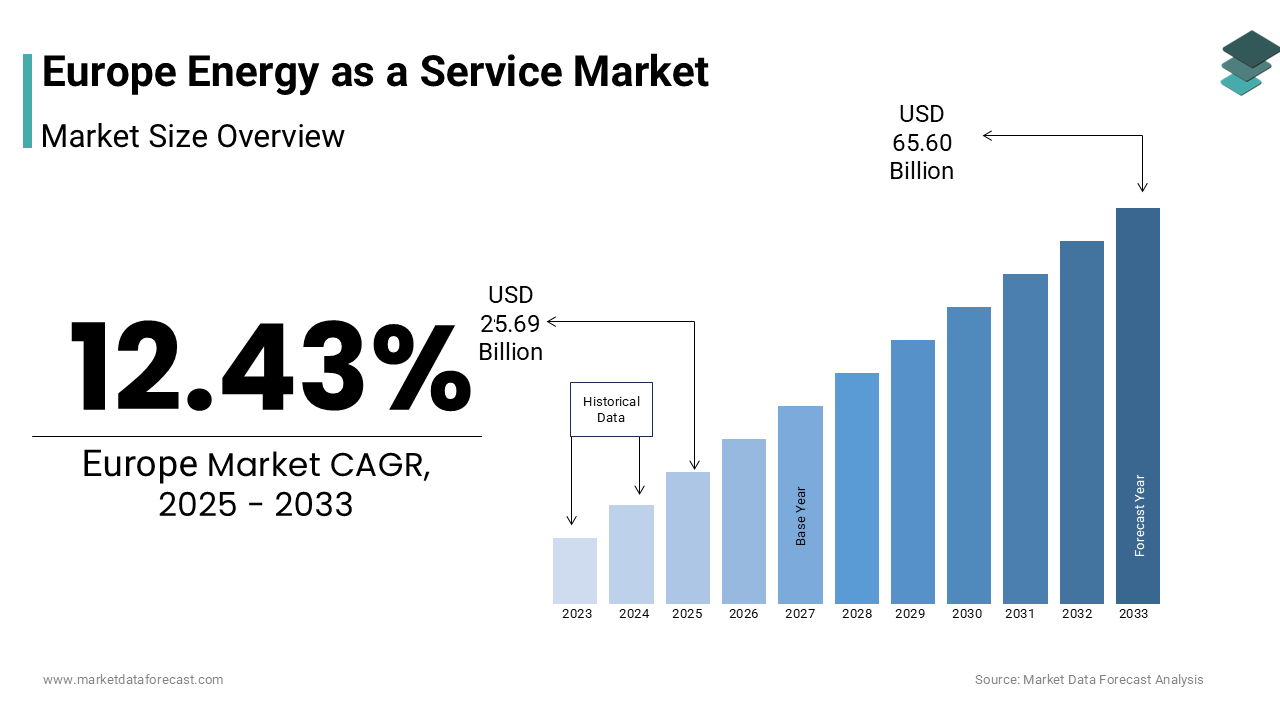
Energy as a Service (EaaS) is a business model where a service provider manages a customer's energy needs for a subscription or pay-per-use fee, instead of the customer owning the energy infrastructure. This model decouples capital expenditure from energy access enabling businesses public institutions and industrial facilities to achieve decarbonization and cost stability without upfront investment. The framework aligns with Europe’s policy trajectory notably the European Green Deal and the Net Zero Industry Act which prioritize operational flexibility over hardware ownership. According to sources, the majority of European non-residential buildings are over 25 years old and utilize energy systems that do not meet current efficiency standards. Apart from these, European businesses increasingly view volatile energy costs as a major operational risk, which leads to demand for fixed-price performance agreements. Regulatory innovation further enables this transition with regulations now require open access to real-time energy consumption data and standardized grid interconnection protocols. As a result, Energy as a Service is emerging not as a niche offering but as a structural response to Europe’s intertwined challenges of energy security industrial competitiveness and climate accountability.
MARKET DRIVERS
Corporate Decarbonization Commitments Under EU Sustainability Mandates
European corporations are accelerating adoption of EaaS to meet binding climate disclosures and science based decarbonization targets mandated under EU regulation, which drives the growth of the Europe energy as a service market. New rules, specifically the Corporate Sustainability Reporting Directive (CSRD), now require many large companies to report and verify their environmental impact each year, as well as share their plans for moving to cleaner energy. As per studies, the because of these regulations, businesses are increasingly using energy-as-a-service (EaaS) agreements to lower their indirect emissions from electricity use, which allows them to do so without having to spend their own capital upfront. For example, one major German car maker has committed to a long-term EaaS deal to receive a reliable supply of mostly renewable electricity from on-site solar panels and batteries at a set price for more than a decade. Similarly, the EU Taxonomy for Sustainable Activities creates financial incentives for investments aligned with climate objectives. Furthermore, New import fees from the Carbon Border Adjustment Mechanism (CBAM) are putting financial pressure on companies in industries that use a lot of energy, such as those making cement and steel. This confluence of compliance risk financing advantage and reputational necessity transforms EaaS from an operational choice into a strategic imperative for European industry.
Rising Energy Price Volatility and Grid Instability
Persistent instability in European wholesale energy sector has made fixed cost energy procurement through service models increasingly vital for budget predictability and operational continuity and thereby fuelling the expansion of the Europe energy as a service market. Following the 2022 energy crisis, wholesale spot prices in the EU for electricity peaked at historic highs, with average day-ahead prices across the EU reaching around 500 €/MWh in August 2022, according to an EU document. This uncertainty has eroded confidence in traditional utility contracts with high energy costs and market volatility in Europe are a significant concern for industrial energy managers, which impacts the competitiveness of European industries and leading businesses to implement various risk management strategies. Energy as a Service address this by bundling generation storage and grid services into long term fixed or capped rate agreements insulated from market swings. Besides, grid reliability is deteriorating as intermittent renewables grow. According to ENTSO-E, long-lasting frequency deviations (LLFDs) were a significant factor in 2023, which caused the Continental Europe synchronous area to not meet its frequency quality target that year. EaaS providers mitigate this by embedding battery storage and automated demand response into their offerings ensuring uninterrupted operations during grid stress events. Hospitals data centers and manufacturing plants particularly value this resilience. Thus, volatility and fragility in the legacy energy system are powerful catalysts for the service-based alternative.
MARKET RESTRAINTS
Fragmented Regulatory Frameworks Across Member States
The implementation of EaaS enabling policies remains highly inconsistent across national jurisdictions, which creates operational and financial uncertainty for providers and restricts the growth of the Europe energy as a service market. Key barriers include divergent rules on grid connection fees permissible contract structures and the treatment of third party ownership of generation assets. As per studies, several European Union countries have grid tariffs that disadvantage local, on-site energy production used in service agreements. For instance, some Spanish utility companies have implemented backdated fees for self-consumed solar power, which invalidates previously established price agreements. Similarly, Germany's specific exemption for renewable energy surcharges does not cover all types of customers who use direct power lines. According to sources, misaligned regulations cause significant project delays by adding nearly a year on average to the timeline for energy-as-a-service initiatives because of extra-legal reviews and permit adjustments. This fragmentation discourages cross border scaling and increases transaction costs disproportionately affecting smaller service providers who lack legal resources to navigate multiple distinct regulatory regimes. Progress in EaaS will be fragmented and dependent on specific opportunities until industry-wide standards are established.
Limited Access to Long Term Offtake Financing for SMEs
Small and medium-sized enterprises constitute most of European businesses yet face barriers in accessing EaaS due to perceived credit risk and lack of standardized financing instruments, which ultimately constrain the expansion of the Europe energy as a service market. Most EaaS contracts require ten to fifteen year terms to ensure return on infrastructure investment but banks remain hesitant to extend such durations to SMEs without collateral. Many small and medium-sized businesses in Europe face significant challenges in securing the standard credit ratings necessary to access traditional funding for energy projects. Consequently, providers often exclude SMEs or impose higher tariffs to offset risk limiting market inclusivity. Although the EU Innovation Fund supports clean energy projects it prioritizes large industrial emitters leaving retail hospitality and logistics SMEs underserved. National guarantee schemes exist but coverage is partial and application processes are cumbersome. According to a study, most small businesses interested in "Energy as a Service" (EaaS) arrangements are unable to proceed with agreements because they cannot satisfy the credit stipulations set by the service providers. This financing bottleneck prevents the diffusion of energy service models to the very segment that could benefit most from operational expenditure flexibility and decarbonization support stifling both economic and climate progress.
MARKET SEGMENTATION
Integration with Industrial Digital Twins and AI Driven Optimization
EaaS is evolving beyond hardware deployment into intelligent orchestration of energy flows through integration with industrial digital twins and AI based predictive analytics that is setting fresh opportunities for the growth of the Europe energy as a service market. Leading European manufacturers now embed real time energy performance data into their digital production models enabling dynamic alignment of energy use with operational schedules grid signals and carbon intensity forecasts. As per research, numerous industrial sites across Germany, Italy, and the Netherlands have implemented energy-as-a-service platforms connected to digital twins. These platforms aid companies in reducing energy costs by predicting load shifts and managing storage dispatch. For instance, a pharmaceutical plant in Switzerland uses AI to correlate energy pricing with production batch timing for operational optimization. This capability is enhanced by new EU regulations, which mandate machine-readable access to energy consumption data from industrial equipment. Providers are embedding these analytics into their EaaS offerings transforming them from static supply contracts into adaptive energy intelligence layers that continuously optimize for cost carbon and resilience. This convergence positions EaaS as a core component of Industry 5.0 where energy is not a utility but a responsive and intelligent production input.
Expansion into Public Sector Through Green Public Procurement
The European public sector shows a high potential growth for the Europe energy as a service market. This is driven by binding Green Public Procurement criteria and sustainability mandates for government operations. The European Union is actively working to significantly increase the number of public buildings covered by performance-based energy contracts, as part of a broader renovation push. In practice, this has catalyzed major EaaS deployments. Public entities are increasingly entering into innovative, long-term agreements with private energy service companies to achieve ambitious energy and emissions reduction targets. These agreements often involve the integration of various green technologies, such as solar power, energy storage solutions, and heat pumps. Across Europe, significant public funds are consistently spent on energy, emphasizing the substantial potential for savings and efficiency improvements that these new initiatives aim to capture. This policy driven channel offers scale predictability and effect that can de risk private sector adoption. EaaS thus transitions from commercial novelty to institutional standard through public dominance.
MARKET CHALLENGES
Complexity in Performance Verification and Contract Enforcement
The credibility of EaaS hinges on precise measurement verification and transparent performance accounting yet current metering and data protocols in the region lack standardization, which exerts negative impact on the expansion of the Europe energy as a service market. This creates disputes and eroding trust. Unlike commodity energy, where volume and price are clear, EaaS contracts guarantee outcomes such as “20 percent reduction in site energy intensity” or “95 percent renewable supply” which require granular sub metering data analytics and baseline adjustments for weather or production changes. As per studies, many EaaS contracts in Southern and Eastern Europe lack independent measurement and verification clauses due to limited access to calibrated sub meters and certified auditors. Even where data exists interpretations vary, grid carbon intensity factors differ by country and hour making renewable claims difficult to validate consistently. This ambiguity increases legal risk. EaaS will not achieve the transparency and comparability required for mass market confidence and investor investment until standardized verification becomes mandatory.
Workforce Shortage in Distributed Energy System Integration
A serious shortage of technicians engineers and project managers continues to be a challenge for the expansion of the Europe energy as a service market. This workforce needs to be skilled in integrating distributed energy resources across electrical thermal and digital domains. Unlike conventional energy projects which rely on centralized plant expertise EaaS requires multidisciplinary teams capable of installing solar inverters configuring battery management systems programming IoT sensors and interfacing with building automation, all while complying with country specific grid codes. Vocational programs remain siloed with electricians rarely trained in thermal storage and IT specialists unfamiliar with power quality standards. For example, in Poland and Greece, project delays several months due to lack of local installers certified for hybrid system commissioning, according to research. This bottleneck inflates labor costs and limits provider capacity to scale beyond pilot projects. The European Skills Agenda promotes upskilling initiatives, but the rollout is inconsistent, with nationally recognized EaaS integration certifications available in only a handful of member states. A lack of a cohesive workforce development strategy means the technical execution gap will be a barrier to the energy transition EaaS is meant to advance.
REPORT COVERAGE
| REPORT METRIC | DETAILS |
| Market Size Available | 2024 to 2033 |
| Base Year | 2024 |
| Forecast Period | 2025 to 2033 |
| Segments Covered | By Service Type, End-User, and Region. |
| Various Analyses Covered | Global, Regional & Country Level Analysis, Segment-Level Analysis; DROC, PESTLE Analysis, Porter's Five Forces Analysis, Competitive Landscape, Analyst Overview of Investment Opportunities |
| Regions Covered | UK, France, Spain, Germany, Italy, Russia, Sweden, Denmark, Switzerland, the Netherlands, Turkey, the Czech Republic, and the Rest of Europe |
| Market Leader Profiled | Schneider Electric, Siemens AG, Engie SA, Honeywell International Inc., Johnson Controls International plc, Veolia Environnement S.A., EDF Energy, Centrica plc, Enel X, and WGL Energy. |
SEGMENTAL ANALYSIS
By Service Type Insights
The supply services segment captured the majority share of 48.3% of the Europe Energy as a Service market in 2024. The expansion of the supply services segment is attributed to the foundational role of guaranteed clean energy delivery, typically through on site or off-site renewable generation bundled with fixed price contracts, which directly addresses corporate decarbonization mandates and energy cost volatility. Enterprises increasingly seek to replace variable utility bills with predictable operational expenditure while meeting Scope 2 emissions targets under the Corporate Sustainability Reporting Directive. Besides, the EU’s push for energy sovereignty post 2022 has elevated on site solar plus storage as a strategic asset. Utilities and independent providers like Ørsted and Engie have scaled standardized supply EaaS offerings across industrial parks and commercial real estate portfolios enabling rapid deployment. This segment’s dominance reflects the market’s current priority, which includes securing clean electrons at known costs in an era of geopolitical and regulatory uncertainty.
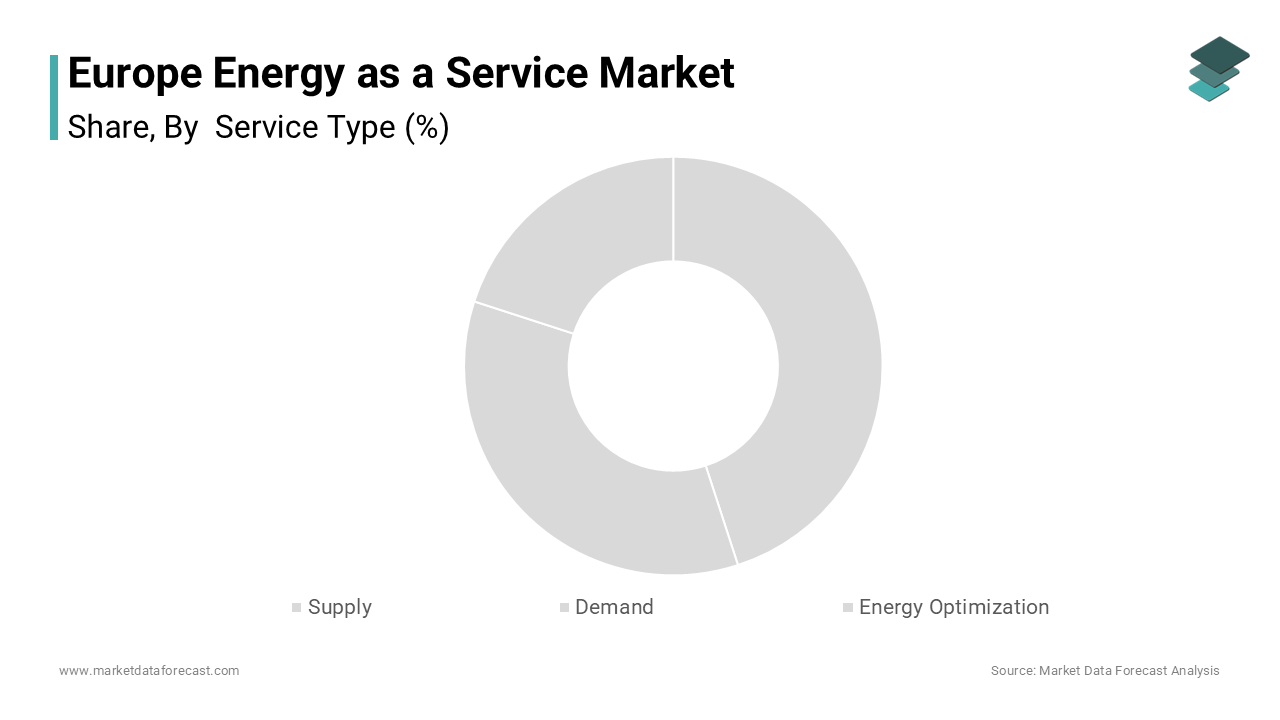
The energy optimization segment is likely to experience the fastest CAGR of 26.4% from 2025 to 2033. The swift growth of the energy optimization segment is driven by the convergence of AI powered analytics building automation and real time grid data enabling dynamic alignment of consumption with cost carbon and reliability signals. Unlike static supply contracts optimization continuously adjusts operations—such as shifting HVAC loads or modulating industrial processes—based on predictive algorithms. A key enabler is the EU Data Act which mandates machine readable access to energy consumption data from building management and industrial equipment facilitating seamless integration. Companies embed these capabilities into their EaaS contracts transforming them into adaptive intelligence layers. This shift from energy procurement to intelligent orchestration positions optimization as the frontier of value creation in the EaaS ecosystem.
By End-use Insights
The industrial end use segment remained prominent in the Europe Energy as a Service market by occupying a 62.7% share in 2024. The prominence of the industrial end use segment is propelled by the sector’s acute exposure to energy price volatility, carbon regulation, and operational continuity risks. Energy intensive industries such as chemicals steel and cement face dual pressure from the EU Emissions Trading System and the Carbon Border Adjustment Mechanism which threatens export competitiveness. EaaS offers a capital free pathway to decarbonize through integrated solutions like solar thermal for process heat battery storage for grid resilience and AI driven load management. As per research, many major EU steel producers have signed EaaS contracts covering at least one production site to secure fixed cost clean power and meet CBAM reporting requirements. Furthermore, industrial facilities often have available land and stable load profiles making them ideal for on-site renewable deployment. This combination of regulatory urgency asset suitability and financial de risk makes industrial sites the primary engine of EaaS growth in Europe.
The commercial end use segment is on the rise and is expected to be the fastest growing segment in the market by witnessing a CAGR of 22.1% from 2025 to 2033 owing to factors such as green building mandates tenant demand and corporate net zero commitments. Commercial real estate owners increasingly adopt EaaS to comply. Large retailers office operators and data center providers are particularly active. Some companies have rolled out EaaS across dozens of European stores using solar canopies and battery systems to ensure fixed operational costs and backup power. The segment’s growth is also fuelled by modular scalable solutions tailored to multi-tenant buildings where sub metering and individualized billing are now feasible through digital platforms. This regulatory and financial alignment positions commercial real estate as the next major frontier for EaaS beyond industrial heavyweights.
REGIONAL ANALYSIS
Germany Energy as a Service Market Analysis
Germany outperformed other regions in the Europe Energy as a Service market and accounted for a 25.1% share in 2024. Its industrial base’s urgent need for decarbonization and energy security has largely contributed to the strong demand for EaaS in the German market. The EU's Emissions Trading System and Carbon Border Adjustment Mechanism are putting considerable strain on Germany, Europe's biggest manufacturing powerhouse, because energy-intensive industries like chemicals and metals must contend with high production costs. Government allocates funds to support on site renewable energy projects structured as service contracts. Major players have pioneered large scale EaaS deployments including hydrogen ready combined heat and power systems. Apart from these, the Fraunhofer Institute’s certification framework for energy performance contracts provides technical credibility that reduces transaction risk. This ecosystem of regulatory clarity industrial urgency and engineering excellence solidifies Germany’s position as the continent’s EaaS innovation and adoption hub.
France Energy as a Service Market Analysis
France emerged as the second-largest player in the Europe Energy as a Service market and captured a 18.5% share in 2024. The growth of EaaS in France is fuelled by strong public sector dominance and nuclear renewable hybrid strategies. French government dedicates funds to energy performance contracts in public hospitals schools and military bases with all new public building tenders requiring EaaS compliance. Besides, France’s unique energy mix, 70 percent nuclear plus growing wind and solar, enables EaaS providers to offer low carbon baseload plus flexible renewables tailored to industrial needs. The country also benefits from state backed financing through Bpifrance which guarantees up to a notable share of EaaS project loans for SMEs reducing provider risk. This fusion of public mandate industrial engagement and financial innovation creates a scalable model increasingly emulated across Southern Europe.
United Kingdom Energy as a Service Market Analysis
The United Kingdom maintained a noteworthy position in the Europe energy as service market, with growth driven by corporate climate accountability and post Brexit energy sovereignty imperatives. The UK’s Contracts for Difference scheme has also been adapted to support private wire renewable projects under EaaS structures enabling fixed price clean power without subsidy dependency. Furthermore, the National Grid’s Dynamic Containment program incentivizes battery storage integration which EaaS providers bundle into commercial and industrial contracts. London’s status as a green finance center further amplifies adoption. This alignment of regulation finance and grid innovation sustains the UK’s command despite its non EU status.
Netherlands Energy as a Service Market Analysis
The Netherlands gradually expanded in the Europe Energy as a Service market due to its port industrial clusters and circular economy integration. The Port of Rotterdam, the largest in Europe, hosts many chemical and refining companies that face stringent EU and national decarbonization deadlines with EaaS emerging as the primary compliance vehicle. Companies have signed multi decade EaaS contracts covering gigawatt scale demand. Moreover, the Netherlands leads in cross sectoral energy sharing with EaaS platforms enabling waste heat exchange between neighboring facilities. The country’s advanced digital infrastructure with nationwide smart metering and open data protocols facilitates real time optimization. This focus on industrial symbiosis grid interactivity and regulatory stringency positions the Netherlands as a high impact niche leader in complex EaaS deployment.
Sweden Energy as a Service Market Analysis
Sweden is predicted to grow in the Europe Energy as a Service market from 2025 to 2033 due to its near carbon free grid ambitious industrial electrification and public procurement dominace. The government mandates that public sector energy purchases must be fossil free with EaaS as the preferred delivery model for hospitals universities and transport authorities. In the private sector companies like SSAB and Volvo use EaaS to power fossil free steel and vehicle production targeting global green premium markets. Apart from these, Sweden’s carbon tax makes operational energy efficiency non optional. This combination of clean grid policy pressure and export driven decarbonization creates a uniquely advanced and scalable EaaS environment that influences Nordic and Baltic adoption patterns.
COMPETETIVE LANDSCAPE
Competition in the Europe energy as a service market is shaped by a dynamic interplay between legacy utilities industrial technology firms and agile clean energy startups. Incumbents like ENGIE and E.ON leverage their grid relationships and balance sheet strength to offer large scale integrated solutions while technology providers such as Schneider Electric and Siemens differentiate through AI powered optimization and industrial domain expertise. New entrants focus on niche segments like SME decarbonization or public building retrofits often supported by EU innovation grants. The competitive edge increasingly lies not in asset ownership but in data intelligence contract structuring and risk management capabilities. Regulatory fragmentation across member states creates both barriers and opportunities favoring players with localized compliance expertise. As the market matures competition is shifting from product features to outcome reliability financing innovation and the ability to deliver verifiable carbon reduction within complex operational environments across Europe.
KEY MARKET PLAYERS
Some of the companies that are playing a dominating role in the Europe Energy as a Service Market include
- Schneider Electric
- Siemens AG
- Engie SA
- Honeywell International Inc.
- Johnson Controls International plc
- Veolia Environnement S.A.
- EDF Energy
- Centrica plc
- Enel X
- WGL Energy
Top Players in the Europe Energy as a Service Market
Schneider Electric SE
Schneider Electric SE is a global leader in energy management and automation with a strong foothold in the Europe Energy as a Service market. The company delivers integrated solutions combining solar storage microgrids and AI driven energy optimization under performance-based contracts for industrial and commercial clients. Schneider Electric has reinforced its European position by launching its EcoStruxure Resource Advisor platform which provides real time carbon and cost analytics aligned with EU sustainability reporting mandates. Recently the company partnered with major European real estate developers to embed EaaS into new commercial buildings ensuring compliance with the Energy Performance of Buildings Directive. Its global contribution lies in standardizing EaaS delivery frameworks that are now replicated in North America and Asia leveraging European regulatory experience as a blueprint for scalable decarbonization services.
ENGIE SA
ENGIE SA is a French multinational utility that has strategically pivoted from traditional power generation to becoming a leading Energy as a Service provider across Europe. The company offers end to end solutions including on site renewables battery storage and demand response tailored to industrial decarbonization and public sector mandates. ENGIE has strengthened its market relevance by integrating AI powered optimization software into its service contracts enabling dynamic alignment with grid signals and carbon pricing. Globally ENGIE exports its European EaaS models to Latin America and Southeast Asia positioning European regulatory and technical standards as a benchmark for emerging clean energy service markets.
Siemens AG
Siemens AG leverages its industrial automation heritage to deliver high precision Energy as a Service solutions focused on manufacturing and critical infrastructure in Europe. The company combines distributed energy resources with its proprietary digital twin and AI analytics to guarantee energy performance outcomes for factories hospitals and data centers. Siemens has recently enhanced its offering by certifying its EaaS platform under the EU Taxonomy for Sustainable Activities enabling clients to access green financing. It also established a joint venture with a major German steel producer to deploy hydrogen ready hybrid energy systems under a 15-year service agreement. Siemens contributes globally by embedding European-grade cybersecurity and grid code compliance into its EaaS architecture setting new benchmarks for industrial energy resilience and interoperability worldwide.
Top Strategies Used by the Key Market Participants
Key players in the Europe energy as a service market focus on regulatory alignment by designing contracts that comply with the Corporate Sustainability Reporting Directive Energy Performance of Buildings Directive and EU Taxonomy. They bundle hardware software and financing into integrated offerings to eliminate customer capital barriers. Strategic partnerships with banks public agencies and industrial associations enhance credibility and de risk deployment. Companies invest in AI driven optimization platforms that dynamically align energy use with cost carbon and grid reliability signals. Besides, they prioritize standardization of measurement verification and performance guarantees to build trust and enable scalability across diverse European jurisdictions.
MARKET SEGMENTATION
The research report on the europe energy as a service market has been segmented and sub-segmented based on categories.
By Service Type
- Supply
- Demand
- Energy Optimization
By End-use
- Commercial
- Industrial
By Country
- UK
- France
- Spain
- Germany
- Italy
- Russia
- Sweden
- Denmark
- Switzerland
- Netherlands
- Turkey
- Czech Republic
- Rest of Europe