- Product Description Description
- Table of Contents TOC
- List of Table & Figure LOT
- Get Free Sample PDF Sample PDF
Market Size, 2025
$33.43 BnMarket Estimate, 2026
$36.62 BnMarket Forecast, 2034
$75.91 BnCAGR, 2026–2034
9.54%Europe Energy Storage Systems Market Size, Growth, Trends & Forecast (2026–2034)
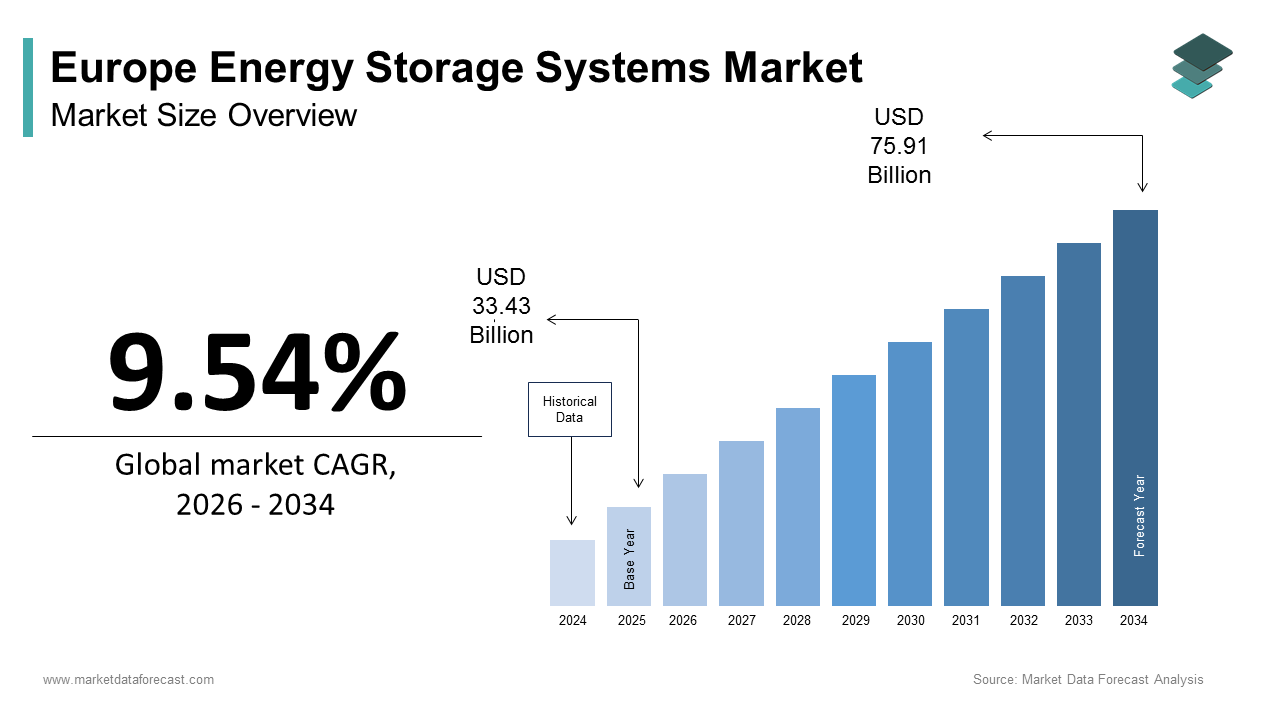
The Europe Energy Storage Systems Market size was calculated to be USD 33.43 billion in 2025, is estimated to reach USD 36.62 billion in 2026, and is projected to expand to USD 75.91 billion by 2034, registering a compound annual growth rate (CAGR) of 9.54% during the forecast period from 2026 to 2034. Driven by the accelerated deployment of variable renewable energy, strict EU battery regulations, grid flexibility policies, and rising prosumer residential demand, the market is transforming into a systemic pillar of Europe's decarbonization architecture.
Key Executive Metrics (At-a-Glance)
- 2025 Base Valuation: USD 33.43 Billion
- 2026 Current Valuation: USD 36.62 Billion
- 2034 Forecast Valuation: USD 75.91 Billion
- Compound Annual Growth Rate (CAGR): 9.54% (2026–2034)
- Leading Segment: Batteries (by technology) and Commercial & Industrial (by end user)
- Key Growth Hubs: Germany, Italy, United Kingdom, Spain, and France
Core Market Drivers
- Renewable Capacity Expansion: Rapid wind and solar additions creating supply volatility, negative pricing, and an urgent need for grid-balancing storage assets.
- Policy Mandates: Legislative frameworks and incentive programs driving both centralized grid-scale storage and decentralized prosumer adoption.
Primary Market Restraints & Challenges
- Permitting & Regulatory Bottlenecks: Fragmented national and subnational approval processes causing deployment delays and high compliance burdens.
- Supply Chain & Safety Pressures: Heavy reliance on imported raw materials for batteries and stricter fire safety code requirements across member states.
Market Segmentation: Largest and Fastest-Growing Segments
| Segment Category | Largest Segment | Fastest-Growing Segment |
|---|---|---|
| By Technology | Batteries (Leading share in 2025) | Thermal Energy Storage (CAGR of 12.3%) |
| By End User | Commercial & Industrial (58.1% share in 2025) | Residential (CAGR of 14.1%) |
| By Region | Germany, Italy & UK (Core installation hubs) | Southern & Eastern European Growth Markets |
Major Industry Players Profiled
Key market participants shaping the European energy storage systems landscape include LG Energy Solution, Siemens Energy, ABB Ltd, Schneider Electric, Tesla Inc., Saft Groupe S.A., VARTA AG, Fluence Energy, BYD Company Ltd., Samsung SDI, Eaton Corporation, Hitachi Energy, NEC Energy Solutions, Northvolt, and Wärtsilä.
Europe Energy Storage Systems Market Size
The Europe energy storage systems market size was calculated to be USD 33.43 billion in 2025 and is anticipated to be worth USD 75.91 billion by 2034, growing from USD 36.62 billion in 2026 at a CAGR of 9.54% during the forecast period.
An Energy Storage System (ESS) captures energy produced at one time and stores it for later use, balancing supply and demand to stabilize power grids, especially with intermittent renewables like solar and wind. These systems primarily include lithium-ion batteries, flow batteries, thermal storage, and emerging mechanical solutions such as compressed air and gravity-based storage. The market functions as a critical enabler of renewable energy integration, grid stability, and decarbonization objectives under the European Green Deal. According to EU environmental monitoring, non-combustible sources—including renewables and nuclear—made up the majority of the EU's electricity production in 2023, increasing the need for rapid deployment of flexible storage capacity to manage the variability of solar and wind energy. As per European authorities, the surge in variable renewable capacity additions to the EU grid between 2020 and 2023, driven by record wind and solar expansion, has outpaced traditional synchronous generation, resulting in higher system balancing needs. National regulatory frameworks such as Germany’s Renewable Energy Sources Act and Italy’s Decree on Energy Communities have further catalyzed distributed storage adoption. Unlike generic power equipment markets, energy storage in Europe is defined by stringent safety certification under the EU Battery Regulation, circular economy mandates, and real-time market participation rules governed by ENTSO-E, positioning it at the nexus of energy policy, digital control, and advanced electrochemistry.
MARKET DRIVERS
Accelerated Deployment of Variable Renewable Energy Sources
The rapid expansion of wind and solar power across the region has created an urgent operational need for energy storage to manage supply volatility and maintain grid reliability, which is among the key accelerators of the Europe energy storage systems market. Electricity generation from solar and wind sources within the European Union has experienced substantial growth in recent years. This increase in renewable output has occasionally resulted in market prices dropping below zero, requiring the curtailment of renewable electricity and highlighting a need for increased system flexibility. Energy storage systems mitigate these inefficiencies by absorbing excess generation during peak production and discharging during evening demand peaks. High levels of solar generation during daylight hours are encouraging the adoption of behind-the-meter battery storage in Spain. The significant contribution of wind energy to total electricity consumption in Denmark is influencing government requirements for energy storage in new offshore projects. These examples indicate a trend where high penetration of variable renewable energy is driving the integration of storage solutions to balance supply and demand. These dynamics transform storage from a discretionary asset into a systemic necessity, directly linking its deployment trajectory to renewable capacity additions mandated under national energy and climate plans.
Policy Mandates for Grid Flexibility and Self-Consumption
European regulatory frameworks are increasingly embedding energy storage as a non-negotiable component of clean energy transitions through binding targets and financial incentives, which in turn propel the expansion of the Europe energy storage systems market. Legislative updates within the region now encourage the integration of energy storage systems into electricity markets. Frameworks are shifting to permit aggregated, decentralized energy resources to participate in broader market activities. Regulations increasingly protect residential users from additional charges when installing solar and battery systems for personal use. Public funding initiatives are actively providing financial support for the adoption of residential battery technologies. Incentive programs have substantially accelerated the adoption rate of home energy storage retrofits in specific regions. These policies not only stimulate demand but also redefine consumer roles from passive ratepayers to active prosumers, creating a decentralized storage ecosystem that complements centralized grid-scale projects and enhances overall system resilience.
MARKET RESTRAINTS
Complex and Fragmented Regulatory Approval Processes
Inconsistent national and subnational permitting regimes delay project timelines and inflate costs, despite overarching EU directives, which hinders the growth of the Europe energy storage systems market. Securing grid connection approval for utility-scale battery projects in Southern Europe is often a lengthy process due to the need to align requirements across multiple stakeholders, including operators, environmental, and local authorities. In France, a significant portion of submitted storage interconnection requests have historically failed to receive final authorization within the standard regulatory timeframe. In Poland, zoning regulations often categorize large battery installations as industrial facilities, which necessitates comprehensive environmental impact assessments even for projects below certain size thresholds. This regulatory ambiguity discourages private investment, particularly in cross-border projects where harmonization is absent. The uneven adoption of the Net Zero Industry Act across Member States has left developers burdened by a "patchwork" of conflicting regional regulations. This lack of uniformity in technical and land-use standards creates significant administrative hurdles for cross-border clean-tech projects.
Supply Chain Vulnerabilities for Critical Battery Materials
Global disruptions in the supply of lithium, cobalt, and nickel, which are essential for current lithium-ion chemistries, are impeding the expansion of the European energy storage systems market. The European battery industry exhibits a high level of reliance on imported raw materials for electric vehicle manufacturing, with a substantial portion of global material refining concentrated in a single external market. Recent significant volatility in lithium pricing has caused instability in downstream battery pack production costs, directly impacting the expense of battery integration for European manufacturers. New regulatory frameworks focusing on environmental sustainability and material circularity are driving initiatives for increased battery recycling in Europe, although immediate widespread adoption faces operational, technical, and financial hurdles in material recovery. Current recycling capabilities for lithium and other battery metals remain relatively limited, with efforts to scale up facing challenges in achieving high-efficiency material extraction via conventional, industrial methods. The industry is shifting towards developing more robust local supply chains and advanced, localized recycling solutions to improve material security and comply with upcoming, more stringent environmental standards. Projects like Northvolt’s Revolt facility aim to close this loop, but scaling remains slow. European storage manufacturers will remain exposed to geopolitical risks and commodity price volatility until domestic refining and recycling capabilities mature.
MARKET OPPORTUNITIES
Integration of Storage into Renewable Energy Communities
The rise of citizen-led renewable energy communities provides a major opportunity for distributed energy storage across the region, which is anticipated to boost the growth of the Europe energy storage systems market. Enabled by the Renewable Energy Directive II, these cooperatives allow households, businesses, and municipalities to jointly produce, store, and share locally generated electricity. The number of registered energy communities across the European Union has grown, with a high concentration of these initiatives appearing in specific regions. Shared solar arrays combined with community-managed storage systems are contributing to decreased reliance on external energy imports during periods of lower solar generation. Revised regulatory frameworks in certain areas are facilitating the deployment of community-scale battery projects. Local municipal efforts are driving the adoption of energy initiatives, particularly in rural locations. These models not only enhance local energy sovereignty but also generate new revenue streams through peer-to-peer trading platforms compliant with the EU’s Digital Energy Interoperability framework. Europe will see faster deployment and more equitable energy transitions if storage is woven into the social and economic fabric of the continent, moving beyond a purely asset-based approach.
Repurposing of Electric Vehicle Battery Second Life Applications
The growing volume of retired electric vehicle batteries offers a cost-effective and sustainable pathway to expand stationary storage capacity across the region, which creates fresh prospects for the Europe energy storage systems market. Newer electric vehicles feature improved battery capacities compared to earlier models, just as a larger number of older, out-of-warranty cars hit the market. Companies like Renault and BMW have launched certified second-life programs where modules are re-engineered for backup power in telecom towers or frequency regulation in microgrids. The number of registered energy communities across the European Union has grown, with a high concentration of these initiatives appearing in specific regions. Shared solar arrays combined with community-managed storage systems are contributing to decreased reliance on external energy imports during periods of lower solar generation. Revised regulatory frameworks in certain areas are facilitating the deployment of community-scale battery projects. Local municipal efforts are driving the adoption of energy initiatives, particularly in rural locations.
MARKET CHALLENGES
Fire Safety Standards and Public Perception Risks
Safety concerns surrounding thermal runaway in lithium-ion battery installations pose a persistent challenge to public acceptance and regulatory approval of energy storage projects in the region, which challenges the growth of the Europe energy storage systems market. High-profile facility fires in the UK and Netherlands have triggered more stringent local ordinances and higher insurance costs, even though such incidents remain rare. Municipal guidelines are increasingly incorporating advanced fire suppression requirements for large-scale battery installations. Requirements for, and adoption of, active fire suppression technologies such as inert gas systems are becoming more common. Structural safety measures, including containment structures, are being implemented to manage potential hazards. The inclusion of enhanced safety systems contributes to a higher initial investment for energy storage projects. Moreover, the absence of a unified EU fire code for electrochemical storage forces developers to comply with divergent national standards, complicating pan-European rollout. Public skepticism is further amplified by limited awareness of modern battery management systems that continuously monitor cell voltage and temperature. The proliferation of advanced technologies in densely populated areas is restricted by public perception of risk, a hurdle that persists regardless of innovation, pending standardized safety protocols and open incident data.
Grid Access Limitations and Congestion Management
Physical and institutional constraints within the region’s aging transmission infrastructure limit the effective utilization of newly installed energy storage assets, and thereby slow down the expansion of the Europe energy storage systems market. Grid capacity constraints in certain European regions are resulting in delayed operational timelines for new energy storage installations. Local infrastructure limitations, particularly regarding transformer capacity, are creating bottlenecks for the integration of planned battery projects. Insufficient grid-supporting capabilities, such as reactive power, are causing limitations on the approval of new storage connections in specific areas. The expansion of storage infrastructure is encountering limitations due to congestion in local transmission and distribution networks. Unlike generators, storage systems often provide multiple services simultaneously, such as energy arbitrage, frequency response, and voltage control, which complicates grid operator scheduling and settlement protocols. Variations in telemetry interfaces across different systems can create challenges for achieving instantaneous grid dispatch. Efforts to establish unified models for distributing system operations face hurdles from older, existing IT infrastructure. The implementation of updated operational standards is often slowed by inconsistent approaches to data governance. Fragmented systems in the energy sector create operational barriers, delaying the adoption of real-time management. Consequently, even technically viable storage projects may deliver suboptimal returns if unable to access dynamic market signals or respond to grid needs with millisecond precision, undermining investor confidence in near term scalability.
REPORT COVERAGE
| REPORT METRIC | DETAILS |
| Market Size Available | 2025 to 2034 |
| Base Year | 2025 |
| Forecast Period | 2026 to 2034 |
| CAGR | 9.54% |
| Segments Covered | By Technology, End User And Region |
| Various Analyses Covered | Global, Regional & Country Level Analysis; Segment-Level Analysis; DROC, PESTLE Analysis; Porter’s Five Forces Analysis; Competitive Landscape; Analyst Overview of Investment Opportunities |
| Regions Covered | UK, France, Spain, Germany, Italy, Russia, Sweden, Denmark, Switzerland, Netherlands, Turkey, and the Czech Republic |
| Market Leaders Profiled | LG Energy Solution, Siemens Energy, ABB Ltd, Schneider Electric, Tesla Inc., Saft Groupe S.A., VARTA AG, Fluence Energy, BYD Company Ltd., Samsung SDI, Eaton Corporation, Hitachi Energy, NEC Energy Solutions |
SEGMENTAL ANALYSIS
By Technology Insights
The batteries segment led the Europe energy storage systems market by accounting for a substantial share in 2025. The dominance of the batteries segment is driven by the rapid deployment of lithium-ion battery systems across residential, commercial, and grid-scale applications due to their modularity, declining costs, and fast response times. According to research, Europe experienced a massive surge in battery storage installations in 2023, with a near-doubling of capacity, predominantly driven by Germany, Italy, and the United Kingdom. A further key driver is the integration of variable renewable energy, as batteries provide essential services such as frequency containment reserve and voltage support that legacy infrastructure cannot deliver. As indicated by ENTSO-E and market monitors, battery systems are becoming vital for grid security, increasingly taking on a substantial, growing share of rapid frequency restoration and grid stabilization tasks in continental Europe. Additionally, policy mechanisms like Germany’s KfW subsidy program and Italy’s Ecobonus have directly linked solar installations to battery incentives, accelerating behind-the-meter adoption. Unlike bulk storage technologies, batteries can be deployed in weeks rather than years, offering a scalable solution aligned with the EU’s urgent decarbonization timelines under the Fit for 55 package.
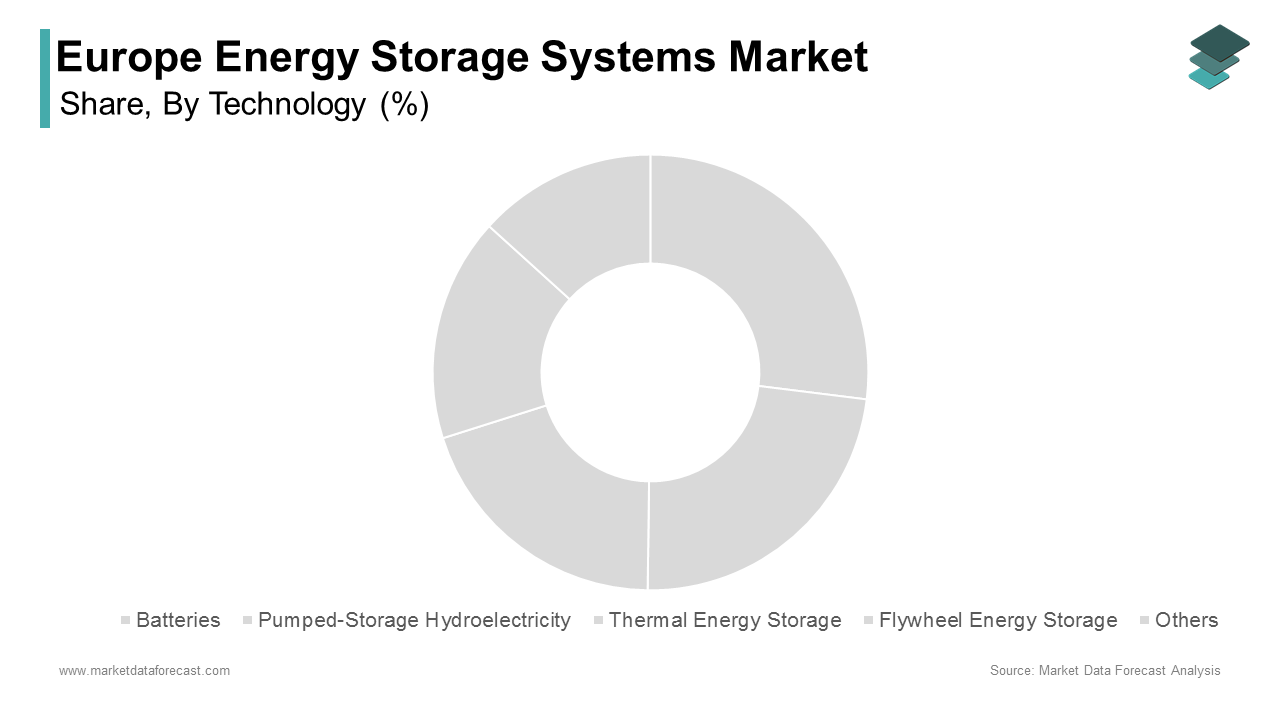
The thermal energy storage segment is likely to experience the fastest CAGR of 12.3% between 2026 and 2034 due to Europe’s industrial decarbonization agenda and the need to store excess renewable heat for use in high-temperature processes. TES systems using molten salts or phase change materials enable factories to shift electric boiler operation to off-peak hours when wind generation is abundant. Partnerships between energy providers and industrial operators are being established to deploy thermal storage technologies designed to deliver carbon-free steam for manufacturing processes. The implementation of these storage solutions is enabling a reduction in the daily reliance on fossil fuels like natural gas for industrial heat requirements. Initiatives in Europe are supporting the demonstration of thermal energy storage projects across various industrial sectors, including cement and food processing, to facilitate industrial heat recovery. The deployment of these technologies suggests a trend toward decarbonizing heavy industry through the adoption of alternative energy solutions. The EU’s Carbon Border Adjustment Mechanism further incentivizes such investments by penalizing emissions-intensive imports, making thermal storage a strategic asset for competitiveness and compliance.
By End User Insights
The commercial and industrial end-user segment held the largest share of 58.1% of the Europe energy storage systems market in 2025. The supremacy of the commercial and industrial end-user segment is attributed to the economic imperative for businesses to manage rising electricity costs, ensure operational continuity, and meet corporate sustainability targets. Rising industrial electricity costs in European markets have prompted businesses to implement energy storage systems to manage peak demand and reduce grid fees. Logistics companies are integrating battery storage at distribution centers to manage energy usage during high-demand periods. Furthermore, commercial sites are increasingly utilizing storage to facilitate demand response, while new sustainability reporting requirements are encouraging investments in on-site renewable energy and storage solutions. These combined financial regulatory and resilience factors make the C&I segment the cornerstone of Europe’s storage deployment strategy.
The residential end-user segment is on the rise and is expected to be the fastest-growing segment in the market by witnessing a CAGR of 14.1% from 2026 to 2034, owing to escalating household electricity prices, generous subsidy schemes, and the rise of prosumer culture across Western and Southern Europe. Rising residential electricity prices in Europe are increasing the financial attractiveness of self-generated power for homeowners. Government tax incentives have significantly accelerated the adoption of home battery storage systems in certain European countries. Targeted national funding initiatives for residential energy storage have driven a substantial increase in consumer demand. Policy support and high energy costs are creating a trend toward greater adoption of residential self-consumption technologies. Digital platforms now allow homeowners to participate in virtual power plants, aggregating rooftop solar and batteries to provide grid services. These dynamics transform residences from passive consumers into active grid assets, accelerating decentralized storage adoption at an unprecedented pace.
COMPETITION OVERVIEW
Competition in the Europe energy storage systems market is intensifying as global integrators, European battery startups, and traditional power equipment manufacturers vie for dominance in a policy-driven landscape. Incumbents like Wärtsilä and Fluence leverage decades of grid expertise and proven software platforms to secure large-scale tenders while newcomers such as Northvolt and Verkor differentiate through vertically integrated low-carbon cell production. The entry of Chinese manufacturers is tempered by the EU’s proposed Net Zero Industry Act, which prioritizes local content and traceability. Differentiation increasingly hinges on digital capabilities, circular design, and compliance with stringent safety and sustainability standards under the EU Battery Regulation. As markets mature from subsidy dependence to a merchant revenue model,s firms must demonstrate not only technical reliability but also financial ingenuity through bundled services and virtual power plant aggregation. This multi-dimensional contest favors agile players who can navigate regulatory complexity while delivering bankable performance across diverse applications.
KEY MARKET PLAYERS
A few market players in the Europe energy storage systems market include
- LG Energy Solution
- Siemens Energy
- ABB Ltd
- Schneider Electric
- Tesla Inc
- Saft Groupe S.A.
- VARTA AG
- Fluence Energy
- BYD Company Ltd
- Samsung SDI
- Eaton Corporation
- Hitachi Energy
- NEC Energy Solutions
Top Strategies Used by the Key Market Participants
Key players in the Europe energy storage systems market pursue vertical integration by controlling cell chemistry manufacturing and power conversion systems to ensure supply chain security and performance consistency. They invest heavily in digital intelligence platforms that enable participation in multiple revenue streams, including frequency regulation capacity markets and congestion management. Strategic partnerships with utilities and independent power producers facilitate co-development of hybrid renewable plus storage projects aligned with national decarbonization roadmaps. Companies actively engage in EU-funded innovation programs such as Horizon Europe to pilot next-generation technologies like solid-state and sodium-ion batteries. Additionally, they localize manufacturing and recycling operations to comply with the EU Battery Regulation’s carbon footprint and material recovery mandates, thereby reinforcing sustainability credentials and reducing import dependency.
Leading Players in the Europe Energy Storage Systems Market
- Fluence Energy is a leading global provider of energy storage solutions with deep operational roots in Europe through its joint heritage with Siemens and AES. The company delivers grid-scale and commercial battery systems integrated with AI-powered digital platforms like Fluence IQ for real-time optimization. It also partnered with E.ON to deploy modular storage units across German industrial parks, enabling dynamic load management. These initiatives reinforce Fluence’s role as both a technology integrator and grid services enabler, strengthening its footprint in Europe’s rapidly evolving flexibility markets.
- Northvolt is a Swedish battery manufacturer pioneering sustainable lithium-ion cell production for stationary storage and electric vehicles across Europe. The company supplies proprietary battery modules to utilities and independent power producers seeking low-carbon certified storage assets. It also launched the Altris sodium ion pilot line in collaboration with Swedish researchers to diversify beyond lithium chemistries. These moves position Northvolt at the intersection of circular manufacturing and strategic autonomy, aligning with EU Battery Regulation requirements and accelerating deployment of homegrown storage capacity.
- Wärtsilä is a Finnish technology group offering advanced energy storage and smart grid solutions tailored for high renewable penetration scenarios. Its Quantum product suite combines lithium-ion batteries withthe GEMS digital energy platform to deliver fast frequency response and black start capabilities. It also signed a long-term agreement with Iberdrola to co-develop hybrid solar plus storage plants in Spain and Portugal. These actions underscore Wärtsilä’s focus on system-level integration and cross-border grid resilience, enhancing its influence in Europe’s decarbonized power architecture.
MARKET SEGMENTATION
This research report on the Europe energy storage systems market has been segmented and sub-segmented based on technology, end user, and region.
By Technology
- Batteries
- Pumped-Storage Hydroelectricity
- Thermal Energy Storage
- Flywheel Energy Storage
- Others
By End User
- Residential
- Commercial & Industrial
By Region
- UK
- France
- Spain
- Germany
- Italy
- Russia
- Sweden
- Denmark
- Switzerland
- Netherlands
- Turkey
- Czech Republic
- Rest of Europe