- Product Description Description
- Table of Contents TOC
- List of Table & Figure LOT
- Get Free Sample PDF Sample PDF
Market Size, 2025
$636.69 BnMarket Estimate, 2026
$739.83 BnMarket Forecast, 2034
$2459.13 BnCAGR, 2026–2034
16.20%Europe Energy Transition Market Report Summary
The Europe energy transition market was valued at USD 636.69 billion in 2025, is estimated to reach USD 739.83 billion in 2026, and is projected to reach USD 2,459.13 billion by 2034, growing at a CAGR of 16.20% during the forecast period from 2026 to 2034. The growth of the Europe energy transition market is driven by ambitious decarbonization targets, increasing deployment of renewable energy, and rising investments in electrification and energy efficiency. Expanding adoption of clean energy technologies, modernization of electricity grids, and strong government support through the European Green Deal and Fit for 55 package are further fueling market growth. Moreover, increasing investments in green hydrogen, digital energy infrastructure, and smart energy management solutions are supporting the expansion of the Europe energy transition market.
Key Market Trends
-
Rising deployment of renewable energy projects to achieve Europe’s climate neutrality targets.
-
Increasing electrification of transportation, buildings, and industrial operations.
-
Growing investments in green hydrogen production and cross-border hydrogen corridors.
-
Rising adoption of digital energy management platforms and smart grid technologies.
-
Increasing modernization of power transmission and distribution infrastructure to integrate renewable energy sources.
Segmental Insights
- Based on type, the renewable energy segment held the largest share of the Europe energy transition market. The segment’s dominance is attributed to strong regulatory support, declining renewable energy technology costs, increasing wind and solar power installations, and ambitious European decarbonization policies that prioritize clean energy deployment.
- The electrification segment is projected to witness the fastest growth during the forecast period, registering a CAGR of 14.3%. The rapid growth of this segment is driven by increasing electric vehicle adoption, expanding charging infrastructure, rising deployment of heat pumps, industrial electrification initiatives, and supportive government policies promoting low-carbon energy systems.
- Based on sector, the power and utility segment accounted for 52.4% of the Europe energy transition market share in 2024. The dominance of this segment is driven by extensive investments in renewable electricity generation, grid modernization, energy storage integration, and the growing role of electricity as the backbone of Europe's decarbonization strategy. Meanwhile, the transportation segment is expected to register the fastest growth due to accelerating electric mobility adoption, stricter vehicle emission standards, and expanding public charging infrastructure.
Regional Insights
The Europe energy transition market is witnessing substantial growth across major countries, supported by ambitious climate policies, large-scale renewable energy investments, and increasing electrification initiatives.
- Germany was the largest contributor, accounting for 22.7% of the Europe energy transition market share in 2025, driven by its Energiewende policy, large-scale renewable energy deployment, industrial decarbonization initiatives, expanding offshore wind capacity, and significant investments in power grid modernization.
- France continues to perform strongly, supported by its low-carbon electricity generation mix, expanding renewable energy capacity, increasing heat pump adoption, and growing investments in green hydrogen infrastructure.
- The United Kingdom remains a key market owing to its leadership in offshore wind development, strong carbon capture and storage initiatives, expanding electric vehicle market, and legally binding net-zero commitments.
- Spain is emerging as a major growth market due to rapid solar photovoltaic deployment, expanding green hydrogen projects, favorable renewable energy policies, and increasing cross-border electricity interconnections.
- The Netherlands is also witnessing significant growth, driven by advanced offshore wind projects, smart energy infrastructure, circular economy initiatives, and growing integration of renewable electricity into the national energy system.
Competitive Landscape
The Europe energy transition market is characterized by the presence of leading utilities, renewable energy developers, industrial technology providers, and energy infrastructure companies competing through innovation, strategic partnerships, and integrated clean energy solutions. Leading companies are focusing on expanding renewable energy portfolios, modernizing power grids, investing in hydrogen infrastructure, deploying digital energy management technologies, and strengthening energy storage capabilities. Continuous investments in electrification, smart grids, offshore wind, and sustainable energy infrastructure are intensifying competition across the Europe energy transition market. Prominent players in the Europe energy transition market include Siemens AG, Ørsted A/S, Iberdrola S.A., Vestas Wind Systems A/S, Schneider Electric SE, Enel S.p.A., Shell plc, BP plc, TotalEnergies SE, E.ON SE, Engie SA, Fortum Oyj, Equinor ASA, and ABB Ltd.
Europe Energy Transition Market Size
The europe energy transition market size was valued at USD 636.69 billion in 2025 and is anticipated to reach USD 739.83 billion in 2026 from USD 2459.13 billion by 2034, growing at a CAGR of 16.20% during the forecast period from 2026 to 2034.
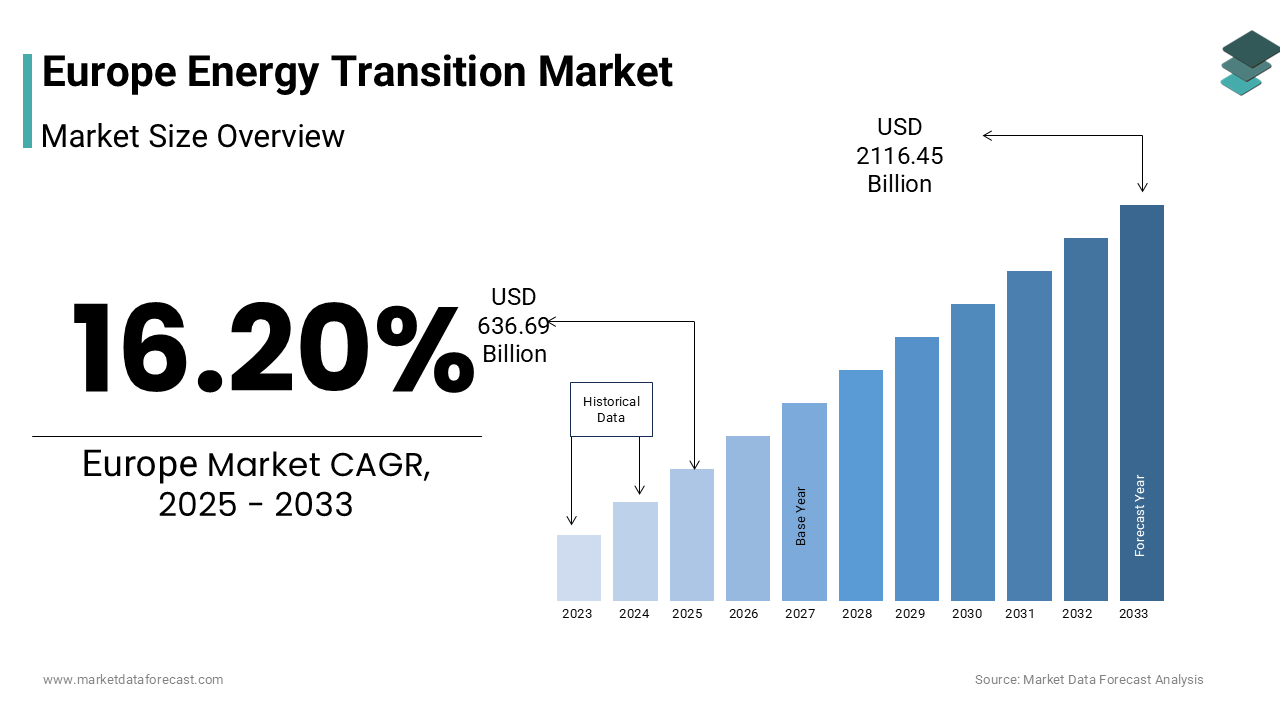
Energy transition refers to a systemic reconfiguration of the continent’s energy architecture, from fossil fuel dependency toward integrated, renewable-based, and digitally enabled low carbon systems. This transformation is not confined to power generation but encompasses cross sectoral electrification, industrial decarbonization, building retrofits, and mobility shifts, all anchored in the European Green Deal’s legally binding climate neutrality objective for 2050. As per Eurostat, renewable energy constituted 24.5% of the European Union’s gross final energy consumption in 2023, an increase of 1.4 percentage points from 2022. According to the IEA, Europe installed almost 80 gigawatts of renewable electricity capacity in 2023, driven by policy urgency and energy security imperatives following geopolitical disruptions. According to the European Environment Agency, buildings alone account for 40 percent of the EU’s total energy use and 36 percent of its CO2 emissions, emphasizing the multidimensional nature of the transition. This market is thus defined by technological innovation, regulatory harmonization, infrastructure modernization, and societal engagement, which forms a complex ecosystem where energy, industry, and policy converge to redefine Europe’s sustainable future.
MARKET DRIVERS
Accelerated Policy Integration Through the Fit for 55 Package
"The European Union’s Fit for 55 legislative framework functions as a foundational facilitator that fuels the growth of the Europe energy transition market. This is done by embedding legally enforceable decarbonization pathways across all major economic sectors. Central to this is the revised Renewable Energy Directive, which mandates that renewables supply at least 42.5 percent of the EU’s final energy consumption by 2030, with an aspirational target of 45 percent. According to analysis by the European Environment Agency (EEA) and other think tanks, achieving the 2030 target will require member states to more than double the average annual growth rate of renewables seen over the past decade. The directive is reinforced by the Carbon Border Adjustment Mechanism, which imposes carbon costs on imports of steel, cement, aluminum, and other goods, compelling global suppliers, and by extension, European industries, to accelerate electrification and clean production. The Effort Sharing Regulation further allocates differentiated national emission reduction targets for non ETS sectors such as transport and residential heating. These binding national trajectories necessitate large scale adoption of heat pumps, electric vehicles, and smart building technologies. This policy coherence generates investor certainty.
Industrial Electrification and Decarbonization Imperatives
The region’s industrial base is undergoing a structural shift toward electrification, driven by carbon pricing pressure and corporate sustainability mandates, and this shift propels the expansion of the Europe energy transition market. Europe’s emissions trading framework continues to exert strong economic pressure on carbon-intensive industries, accelerating the transition toward low-emission manufacturing technologies. As per sources, heavy industries across the region are increasingly investing in electrified and hydrogen-based production systems, with Sweden and Germany emerging as key hubs for renewable-powered steelmaking innovation. Full decarbonization of the steel sector will depend heavily on the availability of large-scale renewable electricity, which emphasizes the interdependence between industrial transformation and clean energy expansion.
MARKET RESTRAINTS
Grid Infrastructure Bottlenecks and Permitting Delays
Its transmission and distribution networks lag significantly, which creates a barrier to the Europe energy transition market. The primary cause is protracted permitting timelines. The European Commission’s Grid Action Plan reports that new high voltage transmission lines take an average of over four years to approve, with some projects in Southern Europe exceeding ten years. This delay stems from fragmented national regulations, local opposition, and poor coordination between energy and spatial planning authorities. As per sources, only few kilometers of new transmission lines were constructed across the EU in 2023, far below the required under the Fit for 55 scenario through 2030. The consequences are tangible. Europe's energy transition is at risk of becoming unreliable and inefficient unless it urgently reforms permitting processes and boosts grid investment.
Critical Mineral Supply Chain Vulnerabilities
The region’s clean energy ambitions are heavily dependent on imported critical raw materials, which exposes the transition to supply chain risks, and thereby restricts the expansion of the Europe energy transition market. According to sources, the EU imports a significant share of its lithium, magnesium, and nearly all its rare earth elements, with China dominating global processing capacity. As per studies, China accounts for a notable share of rare earth mining and refining, a near monopoly that became evident during China’s 2023 export restrictions on gallium and germanium, which disrupted European semiconductor and photovoltaic supply chains. The demand pressure is intensifying. Recycling remains minimal. Supply chain vulnerabilities pose a direct threat to transition timelines. Without diversified sourcing, robust domestic refining, and circular economy strategies, essential technology deployment will likely face significant delays.
MARKET OPPORTUNITIES
Cross Border Green Hydrogen Corridors as Systemic Enablers
Transnational green hydrogen infrastructure offers an opportunity for the Europe energy transition market. Unlike electricity, hydrogen enables long duration storage and interregional transport, allowing solar rich Iberia or wind abundant North Sea zones to supply industrial centers in Central Europe. Projects linking Portugal, Spain, France, and Germany, are advancing under the Important Projects of Common European Interest framework. Apart from these, “hydrogen valleys”, localized ecosystems integrating production, storage, and end use, are scaling in the Netherlands, Denmark, and Poland. These corridors transform Europe’s geographic diversity from a logistical challenge into a systemic advantage, enhancing energy security and economic efficiency across borders.
Digital Twin Integration for Grid Flexibility and Asset Optimization
The deployment of digital twins, dynamic, data-driven replicas of physical energy systems, presents a fresh prospect for the expansion of the European energy transition market. These virtual models integrate real time data from distributed generation, storage, EVs, and demand response to simulate grid behavior, enabling predictive control and optimization. According to research, digital twin technologies are increasingly being adopted across Europe’s energy sector to enhance forecasting accuracy for renewable generation, and thereby minimizing grid balancing costs and energy curtailment. Moreover, industrial facilities in countries such as Germany are using digital twins to optimize energy efficiency and reduce electricity consumption through predictive monitoring and intelligent load management.
MARKET OPPORTUNITIES
Workforce Skills Mismatch in Clean Energy Sectors
A widening gap between workforce skills and the technical demands of clean energy jobs poses a challenge to the Europe energy transition market. According to sources, the renewable energy sector alone will face a deficit of notable number of qualified workers by 2030, especially in grid modernization, hydrogen systems, and battery integration. Vocational training systems remain anchored in legacy technologies. The gap is acute in emerging fields. As per research, only a portion of HVAC technicians in Southern Europe hold certified heat pump installation credentials, despite surging demand. So, Europe risks project delays, suboptimal system performance, and increased costs, which ultimately weakens the human capital foundation of its decarbonization strategy.
Public Acceptance and Spatial Justice in Energy Infrastructure Siting
Local opposition to energy infrastructure impedes the expansion of the Europe energy transition market. This is fueled by concerns over landscape impact, health, and inequitable benefit distribution. According to research, public support for renewable energy remains high across Europe, though local acceptance of infrastructure projects often lags due to community-level concerns and visual or environmental impacts. As per sources, resistance is particularly evident in the case of large-scale solar farms and overhead transmission networks, where residents frequently express opposition to installations near residential or protected areas. Inclusive planning, transparent environmental reviews, and equitable benefit sharing are prerequisites for building the unified social license necessary for a cohesive and just energy transition; without them, public opposition will persist and cause fragmentation.
REPORT COVERAGE
| REPORT METRIC | DETAILS |
| Market Size Available | 2025 to 2034 |
| Base Year | 2025 |
| Forecast Period | 2026 to 2034 |
| Segments Covered | By Type, Sector, and Region. |
| Various Analyses Covered | Global, Regional & Country Level Analysis, Segment-Level Analysis, DROC, PESTLE Analysis, Porter’s Five Forces Analysis, Competitive Landscape, Analyst Overview of Investment Opportunities |
| Regions Covered | UK, France, Spain, Germany, Italy, Russia, Sweden, Denmark, Switzerland, the Netherlands, Turkey, the Czech Republic, and the Rest of Europe |
| Market Leaders Profiled | AG, Ørsted A/S, Iberdrola S.A., Vestas Wind Systems A/S, Schneider Electric SE, Enel S.p.A., Shell plc, BP plc, TotalEnergies SE, E.ON SE, Engie SA, Fortum Oyj, Equinor ASA, and ABB Ltd. |
SEGMENTAL ANALYSIS
By Type Insights
The dominance of the renewable energy segment is attributed to binding policy mandates, declining technology costs, and urgent energy security imperatives. According to research, the European Union’s updated renewable energy framework is driving member states to significantly expand their share of clean energy in total consumption, reinforcing long-term climate and energy transition goals. As per sources, wind and solar generation are contributing an increasing share of the region’s electricity mix, highlighting strong momentum in renewable deployment across multiple European markets. Offshore wind is equally pivotal. These converging forces, regulatory, economic, and strategic, strengthen renewables as the cornerstone of Europe’s decarbonization architecture.

The electrification segment is anticipated to witness the fastest CAGR of 14.3% from 2025 to 2033 due to cross sectoral shifts in transport, heating, and industrial processes. The primary catalyst is the rapid adoption of electric vehicles. According to sources, EVs represented a portion of new car registrations in the EU. This surge necessitates parallel growth in charging infrastructure. Europe added notable number of public charging points. In buildings, heat pumps are displacing gas boilers at an accelerating pace. Industrial electrification is also gaining traction. Supporting this growth is the EU’s Carbon Border Adjustment Mechanism, which incentivizes low carbon production, and the Net Zero Industry Act, which prioritizes clean tech manufacturing. Together, these dynamics position electrification as the most dynamic vector of systemic decarbonization.
By Sector Insights
The power and utility segment held the leading share of 52.4% of the European energy transition market in 2024. The growth of the power and utility segment is propelled by its foundational role in enabling decarbonization across all other sectors. Electricity is the primary carrier through which renewable energy, electrification, and digitalization converge, making grid modernization and generation transformation non negotiable. As per studies, the EU invested notable in transmission and distribution grid upgrades, the highest annual figure on record. Renewable integration is central to this investment. Regulatory frameworks further cement this dominance. Apart from these, the phase out of coal is accelerating. The sector’s centrality is amplified by its role in enabling green hydrogen production, which requires renewable electricity to qualify as “green” under EU taxonomy rules. Thus, the power and utility sector functions not as a standalone domain but as the enabling backbone of the entire transition ecosystem.
The transportation segment is likely to experience the fastest CAGR of 16.1% from 2025 to 2033 owing to stringent vehicle emission standards, urban air quality mandates, and multimodal electrification strategies. The EU’s 2035 ban on new internal combustion engine car sales has triggered unprecedented EV adoption. Beyond passenger vehicles, heavy duty electrification is advancing rapidly. Rail decarbonization is also accelerating. Maritime and aviation are not excluded. Public investment is substantial. These coordinated policy, technological, and financial levers position transportation as the most dynamic and rapidly transforming sector in the European energy transition landscape.
REGIONAL ANALYSIS
Germany Energy Transition Market Analysis
Germany led the Europe energy transition market by capturing 22.7% share in 2025. The domination of Germany is largely fuelled by its Energiewende policy framework and industrial decarbonization urgency. The country generated a portion of its electricity from renewables. Solar deployment surged, driven by streamlined permitting and citizen energy cooperatives. Offshore wind is equally strategic. Industrial transformation is critical. However, grid congestion remains a challenge. Despite this, Germany’s combination of policy ambition, manufacturing scale, and public investment ensures its continued leadership in shaping Europe’s clean energy trajectory.
France Energy Transition Market Analysis
France is the second-largest region in the European energy transition market and accounted for 14.2% share in 2025. Its low carbon nuclear base while aggressively expanding renewables drives the growth of this market in France. Nuclear provided a share of electricity, the national grid operator, offering grid stability as intermittent sources grow. The government plans to build new reactors while targeting notable gigawatts of solar and gigawatts of onshore wind by 2050. Heat pump adoption is accelerating. Green hydrogen is also prioritized. France has achieved large-scale infrastructure deployment and comparatively low household electricity prices through a unique model of centralized planning and state investment, a method not mirrored by its neighboring countries.
United Kingdom Energy Transition Market Analysis
The United Kingdom maintains a strong position in the European energy transition through its world leading offshore wind sector and net zero legal mandate. The country operated notable gigawatts of offshore wind capacity, the largest in Europe and second globally after China. Beyond generation, the UK is advancing carbon capture and storage. Electric vehicle uptake is robust. EVs comprised a share of new car sales. However, onshore wind faces planning restrictions, limiting diversification. Nevertheless, the UK’s combination of maritime geography, financial markets, and regulatory certainty sustains its role as a key transition innovator.
Spain Energy Transition Market Analysis
Spain is an emerging country in the Europe energy transition market due to high irradiation levels and streamlined permitting. It recorded one of the highest solar photovoltaic installation levels in Europe, positioning itself as a leading market for large-scale renewable energy deployment. As per sources, most new solar additions in Spain are utility-scale projects designed to support green hydrogen production and enable cross-border electricity trade through expanded interconnectors with neighboring countries such as France. Green hydrogen remains a central component of Spain’s decarbonization roadmap, with large-scale production facilities already operational and contributing to industrial emission reduction goals. This decentralized yet export oriented model positions Spain as a clean energy supplier to the wider European grid.
Netherlands Energy Transition Market Analysis
The Netherlands is likely to grow in the Europe energy transition market from 2025 to 2033. It leads Europe in renewable electricity generation, with wind and solar accounting for a substantial portion of its power mix and driving progress toward national decarbonization goals. The country’s offshore wind sector is expanding rapidly, supported by large-scale projects in the North Sea that contribute significantly to clean power generation capacity. The country also leads in circular economy integration. Supported by strong cross border interconnections and progressive local governance, the Netherlands exemplifies how small nations can drive systemic innovation in the European transition landscape.
COMPETITIVE LANDSCAPE
Competition in the Europe energy transition market is intense and multidimensional involving utilities technology providers industrial conglomerates and new energy startups. Established players leverage scale and grid access while newcomers compete through digital innovation and agile business models. The market is characterized by frequent mergers and acquisitions as companies seek to consolidate capabilities in areas like battery storage hydrogen and smart grid software. Regulatory alignment is a key battleground with firms investing heavily in compliance and policy influence to secure project approvals and subsidies. Cross border collaboration is increasingly vital as interconnectors and shared infrastructure projects demand coordination among national champions. Unlike traditional energy markets competition here is not solely price based but revolves around system integration expertise speed of deployment and sustainability credentials. This dynamic landscape fosters continuous innovation but also raises barriers to entry for smaller actors lacking capital or regulatory experience.
KEY MARKET PLAYERS
A few of the major companies in the europe energy transition market include
- Siemens AG
- Ørsted A/S
- Iberdrola S.A.
- Vestas Wind Systems A/S
- Schneider Electric SE
- Enel S.p.A.
- Shell plc
- BP plc
- TotalEnergies SE
- E.ON SE
- Engie SA
- Fortum Oyj
- Equinor ASA
- ABB Ltd.
Top Players in the Market
Siemens Energy
Siemens Energy is a pivotal contributor to the Europe energy transition through its leadership in grid technologies and renewable integration solutions. The company supplies high voltage transmission systems and grid automation platforms essential for managing variable renewable generation across the continent. It also launched a digital grid control center in Berlin to enhance real time monitoring of cross border power flows. These initiatives reinforce its role in enabling secure and flexible clean energy infrastructure across Europe and globally.
Ørsted
Ørsted has transformed from a fossil fuel based utility into a global offshore wind leader and remains central to Europe’s decarbonization. The company developed some of the continent’s first large scale offshore wind farms including Hornsea in the UK and Borkum Riffgrund in Germany. It also divested non core oil and gas assets to focus exclusively on renewables. Through technology innovation and early mover advantage Ørsted continues to shape global offshore wind standards and supply chains.
Iberdrola
Iberdrola drives the energy transition through massive investments in onshore and offshore wind solar and grid modernization across Europe and beyond. It also launched a green hydrogen valley in Puertollano Spain integrating solar electrolysis and industrial use. These actions underscore its integrated approach to clean energy generation infrastructure and industrial decarbonization.
Top Strategies Used by the Key Market Participants
Key players in the Europe energy transition market employ several core strategies to reinforce their positions. Strategic partnerships and joint ventures are common to share risk and accelerate project development particularly in offshore wind and hydrogen. Vertical integration is another critical approach with companies expanding from generation into storage grid services and end use applications like electric vehicle charging. Geographic diversification within Europe allows firms to leverage favorable regulatory environments in different countries. Technology innovation especially in digital grid management and electrolyzer efficiency provides competitive differentiation. Finally active engagement in policy advocacy ensures alignment with evolving EU regulations and access to public funding mechanisms under initiatives like REPowerEU and the Net Zero Industry Act.
MARKET SEGMENTATION
This research report on the Europe energy transition market has been segmented based on the following categories.
By Type
- Renewable Energy
- Electrification
- Energy Efficiency
- Others
By Sector
- Power & Utility
- Transportation
- Others
By Country
- UK
- France
- Spain
- Germany
- Italy
- Russia
- Sweden
- Denmark
- Switzerland
- Netherlands
- Turkey
- Czech Republic
- Rest of Europe