Europe Enterprise Search Market Size, Share, Trends & Growth Forecast Report – Segmented By Type (Local Search, Hosted Search, Search Appliance), Organization Size, End Use, and Country (UK, France, Spain, Germany, Italy, Russia, Sweden, Denmark, Switzerland, Netherlands, Turkey, Czech Republic & Rest of Europe), Industry Analysis From 2026 to 2034
Europe Enterprise Search Market Report Summary
The Europe enterprise search market was valued at USD 1.80 billion in 2025, increased to USD 1.95 billion in 2026, and is projected to reach USD 3.68 billion by 2034, growing at a CAGR of 8.26% during the forecast period. Market growth is driven by the rapid expansion of enterprise data volumes, rising adoption of cloud-based solutions, and increasing demand for faster, more accurate internal information retrieval. The growing integration of artificial intelligence, natural language processing (NLP), and machine learning in search platforms, along with the need for improved workplace productivity and compliance management, is further accelerating enterprise search adoption across Europe.
Key Market Trends
-
Increasing adoption of AI-powered and semantic enterprise search solutions to improve search relevance and user experience.
-
Strong shift toward cloud-hosted and SaaS-based enterprise search platforms due to scalability and lower infrastructure costs.
-
Rising demand for unified search solutions capable of indexing structured and unstructured enterprise data.
-
Growing focus on data security, governance, and regulatory compliance, particularly under GDPR frameworks.
-
Integration of enterprise search with collaboration tools, CRM, and ERP systems to enhance decision-making efficiency.
Segmental Insights
-
By type, the hosted search segment dominated the Europe enterprise search market by accounting for 55.9% of the market share in 2025, supported by ease of deployment, flexibility, and lower maintenance requirements.
-
By organization size, large enterprises held the leading position with 70.4% of the market share in 2025, driven by complex data ecosystems and higher investment capacity in advanced search technologies.
-
By end use, the BFSI segment accounted for 25.2% of the market share in 2025, owing to the sector’s need for rapid access to large volumes of sensitive data, regulatory documentation, and customer information.
Regional Insights
-
The European enterprise search market is experiencing strong growth as organizations prioritize digital transformation, knowledge management, and AI-driven automation.
-
Germany emerged as the leading country, capturing 23.2% of the European enterprise search market share in 2025, supported by its strong enterprise IT adoption, large industrial base, and increasing investments in data-driven technologies.
Competitive Landscape
The Europe enterprise search market is highly competitive, characterized by the presence of global technology leaders and specialized search solution providers. Key players are focusing on AI enhancements, cloud-native architectures, and seamless enterprise software integration to strengthen their offerings. Strategic partnerships, product innovation, and acquisitions remain key competitive strategies. Major companies operating in the Europe enterprise search market include Microsoft Corporation, IBM Corporation, Google LLC (Alphabet Inc.), Amazon Web Services, Inc., OpenText Corporation, Oracle Corporation, X1 Discovery, Inc., Attivio, Inc., SAP SE, and Dassault Systèmes SE.
Europe Enterprise Search Market Size
The Europe enterprise search market size was valued at USD 1.80 billion in 2025 and is projected to reach USD 3.68 billion by 2034 from USD 1.95 billion in 2026, growing at a CAGR of 8.26%.

Enterprise search includes software solutions designed to enable organisations to rapidly locate, retrieve, and contextualise structured and unstructured data residing across disparate internal systems such as document repositories, email servers, customer relationship management platforms, and enterprise resource planning databases. Unlike public web search, enterprise search operates within secure organisational boundaries, relying on advanced indexing, natural language processing, and semantic understanding to deliver precise, role-based results tailored to individual user intent. These systems are critical for knowledge workers who otherwise spend significant time navigating siloed information landscapes. For instance, knowledge employees in EU-headquartered firms often spend a significant portion of their weekly working hours searching for or recreating information that already exists within their organisations. This inefficiency is further exacerbated by the proliferation of cloud applications and hybrid work models, which fragment data across on-premisess and SaaS environments. The European enterprise search market is also shaped by stringent data governance norms under the General Data Protection Regulation, requiring solutions to embed fine grained access controls and audit capabilities. Consequently, the market is evolving beyond keyword matching toward AI powered cognitive search platforms that unify relevance, security, and contextual intelligence to support decision velocity in complex regulatory and operational environments.
MARKET DRIVERS
Proliferation of Data Silos Across Hybrid Work Environments Drives Search Necessity
The fragmentation of enterprise data across on-premise legacy systems and cloud-based Software as a Service application has intensified the need for unified search capabilities across European organizations, which is majorly driving the growth of the European enterprise search market. As per Eurostat’s 2024 Digital Economy and Society Index, a majority of large enterprises in the European Union now use multiple cloud platforms simultaneously such as Microsoft 365 Salesforce and SAP S/4HANA while maintaining critical data in on premise servers due to regulatory or operational constraints. This multi environment architecture creates significant information silos, which is hindering cross functional collaboration and real time decision making. As per Eurostat, in 2024 more than two thirds of EU enterprises provided employees with remote access to documents and business applications. Enterprise search systems address this by deploying connectors that index content from diverse sources into a single semantic layer enabling users to execute one query and receive consolidated results regardless of original location. Moreover, hybrid work remains the dominant telework model in Europe with around 44% of employees in teleworkable jobs working in hybrid arrangements in 2024. Without intelligent search employees resort to redundant requests or outdated data increasing operational risk. Thus, enterprise search is no longer a convenience but a critical enabler of productivity in Europe’s increasingly distributed and heterogeneous digital workplace.
Stringent EU Data Privacy Regulations Mandate Secure and Compliant Search Architectures
The European enterprise search market is uniquely shaped by the region’s rigorous data protection and sovereignty requirements which necessitate search solutions with embedded compliance capabilities. Under the General Data Protection Regulation any system that indexes or retrieves personal data must enforce role-based access controls data minimization and audit trails to prevent unauthorized exposure. According to DLA Piper’s 2025 GDPR fines and data breach survey, European regulators issued an aggregate total of EUR 1.2 billion in fines across 2024, which is indicating the growing enforcement pressure on corporations. This regulatory pressure compels European firms to adopt enterprise search platforms with dynamic access filtering that respects original permission settings from source systems such as SharePoint or SAP. Additionally, the EU’s Data Governance Act and upcoming Data Act emphasize data portability and user rights requiring search engines to support data subject access requests by quickly locating all instances of an individual’s data across the enterprise. Vendors must therefore integrate pseudonymization techniques and consent management hooks into their indexing pipelines. Unlike in less regulated regions where performance or user experience may dominate procurement criteria in Europe compliance is non-negotiable and often the primary selection factor. This legal imperative not only increases technical complexity but also drives demand for locally hosted or EU based cloud deployments to ensure data never leaves the European Economic Area during processing or storage.
MARKET OPPORTUNITIES
Integration of Generative AI Enables Contextual and Conversational Search Experiences
The emergence of generative artificial intelligence provides a transformative opportunity for the European enterprise search market. Unlike traditional keyword search which returns lists of documents generative AI powered enterprise search can synthesize information from multiple sources to directly answer natural language queries while citing sources and respecting access permissions. As per industry surveys in 2024, enterprises piloting AI enhanced search reported measurable reductions in time spent on internal research tasks and improvements in decision alignment. European firms are particularly receptive to this evolution because it aligns with the region’s emphasis on knowledge worker augmentation rather than automation. Moreover, the European Commission’s AI Act classifies enterprise search assistants as limited risk systems provided, they include transparency measures such as source attribution and human override creating a clear regulatory pathway for adoption. Companies in sectors like pharmaceuticals and financial services where precision and auditability are paramount are leading deployment. By transforming search from a mechanical lookup tool into an intelligent knowledge partner generative AI unlocks deeper insights faster onboarding and more resilient institutional memory across Europe’s complex multilingual and multi-jurisdictional business landscape.
Expansion of Industry Specific Search Solutions Tailored to European Regulatory and Operational Needs
A significant growth opportunity lies in the development of verticalized enterprise search platforms customized for Europe’s highly regulated and specialized industries such as healthcare finance and public administration. Generic search tools often fail to interpret domain specific terminology or comply with sectoral data handling rules which vary significantly across EU member states. For instance, in healthcare the need to index and retrieve patient records across national electronic health record systems while adhering to country specific consent models requires search engines with built in medical ontologies and dynamic anonymization. As per the European Health Data Space initiative launched in 2024, cross border clinical research will depend on secure federated search capabilities that can query data without centralizing it. Similarly European banks must comply with the European Banking Authority’s guidelines on data lineage which demand that every search result used in regulatory reporting be fully traceable to its source. Vendors like Germany’s IntraFind and Sweden’s Findwise have responded by embedding industry taxonomies GDPR compliant redaction engines and multilingual natural language understanding into their platforms. Public sector adoption is also accelerating, and the European Commission’s Interoperable Europe Act entered into force in 2025 mandating interoperability of public services across member statesinteroperable-europe.ec.europa.eu+1. This regulatory tailwind combined with domain complexity creates fertile ground for specialized search providers who can bridge technical functionality with sectoral compliance.
MARKET CHALLENGES
Legacy System Integration Complexity Impedes Deployment and Data Coverage
A persistent challenge confronting the Europe enterprise search market is the extensive reliance on legacy IT infrastructure which resists seamless integration with modern search platforms. Many European enterprises particularly in manufacturing utilities and public administration continue to operate critical business functions on decades old systems such as mainframes SAP ECC or custom COBOL applications that lack standard APIs or structured metadata. As per industry reports, a significant share of small and medium enterprises in Southern and Eastern Europe still uses unsupported or end of life software that cannot be easily indexed by contemporary search crawlers. Even in large corporations the cost and risk of replacing these systems are prohibitive forcing search vendors to develop custom connectors that are time intensive to build and maintain. This integration gap results in incomplete data coverage where a notable portion of mission critical information remains invisible to enterprise search. Moreover, legacy systems often store data in unstructured formats like scanned PDFs or fax images requiring additional optical character recognition and entity extraction layers before indexing. These complexities delay time to value increase total cost of ownership and deter organizations from initiating search projects altogether. Until legacy modernization accelerates or low code integration frameworks mature the promise of comprehensive enterprise search will remain partially unrealized across significant segments of the European economy.
Multilingual and Cross Border Data Harmonization Presents Semantic and Legal Hurdles
The linguistic and legal diversity of the European Union poses a formidable challenge for enterprise search systems attempting to deliver consistent relevance across national boundaries. With 24 official languages and numerous regional dialects a query entered in French may need to retrieve documents originally written in German Dutch or Polish while preserving meaning and context. As per the European Language Resource Coordination initiative, many commercial search platforms deployed in multinational EU firms still lack accurate cross lingual semantic matching beyond basic translation. This gap leads to missed information and biased results particularly in legal compliance or customer service scenarios where nuance matters. Compounding the issue is the lack of standardized data schemas across member states, as a customer record in Spain may classify data differently than one in Sweden making unified indexing difficult. Furthermore, the EU’s principle of data localization under national implementations of the GDPR restricts the centralization of certain data types prohibiting vendors from building pan European semantic models that require data pooling. According to the European Data Protection Supervisor’s 2024 guidance, federated search architectures that keep data at source are preferred but they sacrifice the deep learning benefits of centralized training. Consequently, vendors must invest heavily in language specific natural language processing models and country level compliance logic increasing development costs and fragmenting product roadmaps. This unique combination of linguistic plurality and regulatory fragmentation makes Europe one of the most technically demanding regions for enterprise search deployment.
REPORT COVERAGE
| REPORT METRIC | DETAILS |
| Market Size Available | 2025 to 2034 |
| Base Year | 2025 |
| Forecast Period | 2026 to 2034 |
| CAGR | 8.26% |
| Segments Covered | By Type, Organization Size, End Use, and Region |
| Various Analyses Covered | Global, Regional, & Country Level Analysis; Segment-Level Analysis; DROC, PESTLE Analysis; Porter’s Five Forces Analysis; Competitive Landscape; Analyst Overview of Investment Opportunities |
| Regions Covered | UK, France, Spain, Germany, Italy, Russia, Sweden, Denmark, Switzerland, Netherlands, Turkey, and the Czech Republic |
| Market Leaders Profiled | Microsoft Corporation, IBM Corporation, Google LLC (Alphabet Inc.), Amazon Web Services Inc., OpenText Corporation, Oracle Corporation, X1 Discovery Inc., Attivio Inc., SAP SE, and Dassault Systèmes SE |
SEGMENTAL ANALYSIS
By Type Insights
The hosted search segment dominated the market by accounting for 55.9% of the regional market share in 2025. The dominating position of hosted search segment in this regional market is attributed to the region’s rapid cloud adoption and demand for scalable, low maintenance solutions. European enterprises increasingly favor hosted models where the search infrastructure is managed by third party vendors in secure data centers because they eliminate the need for on premise hardware, reduce IT staffing burdens, and enable faster deployment. According to Eurostat’s 2024 Digital Economy and Society Index, a majority of large enterprises and nearly half of SMEs in the EU use at least one cloud-based enterprise application, creating natural alignment with hosted search services that integrate natively with platforms like Microsoft 365 and Salesforce. Moreover, hosted solutions offer built in compliance with the General Data Protection Regulation through features such as EU based data residency options and automated audit logging. As per industry surveys, many IT decision makers cite reduced operational complexity as the primary reason for choosing hosted over local deployments. Vendors like Elastic and Coveo have capitalized on this trend by offering multi-tenant architectures with granular access controls and automatic updates, ensuring continuous alignment with evolving security and linguistic requirements across diverse national markets.
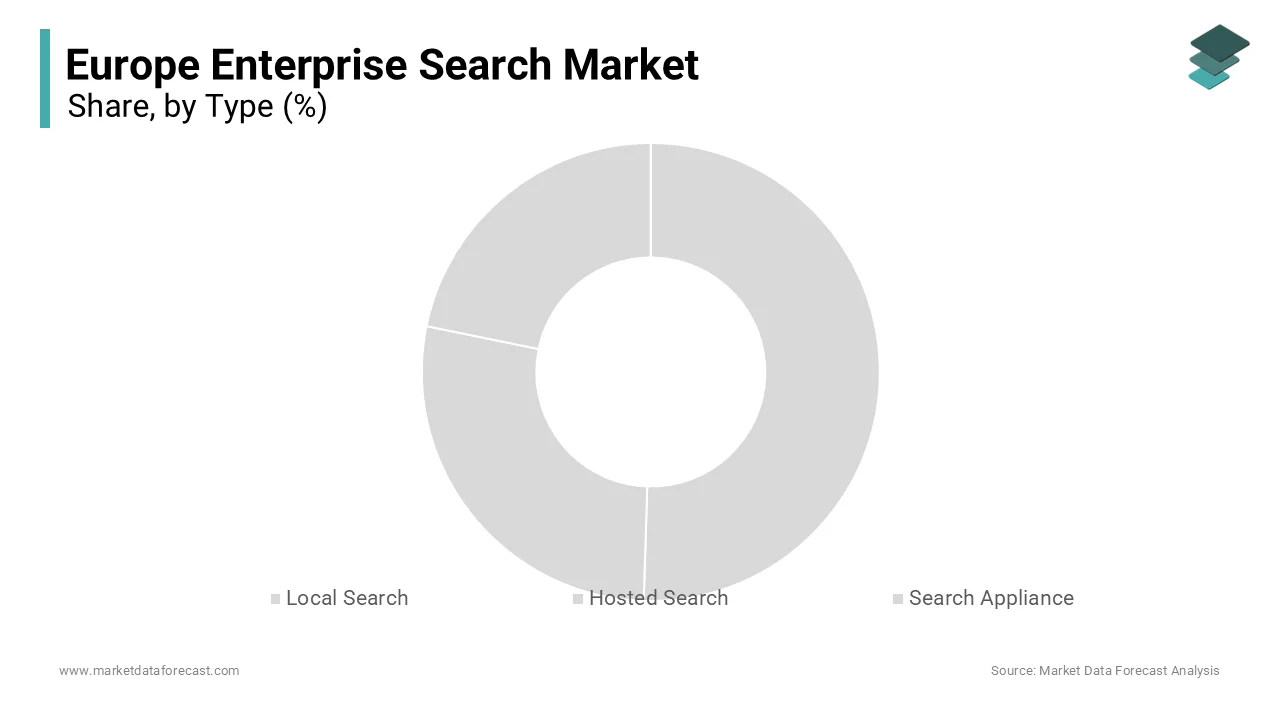
The local search segment is the fastest growing segment in the Europe enterprise search market and is estimated to witness a CAGR of 12.2% over the forecast period owing to the growing data sovereignty concerns, stringent regulatory mandates, and the need for ultra-low latency in mission critical environments. Unlike hosted models, local search installed and operated entirely within an organization’s private network ensures that sensitive data never leaves the premises, a non-negotiable requirement for defense agencies financial institutions and public sector bodies in countries like Germany and France. As per the European Data Protection Board’s guidance, national administrations must retain full control over citizen data processing, effectively mandating on premise search for government use cases. Additionally, industries such as pharmaceuticals and energy require real time search performance for operational safety. Advances in containerization and lightweight AI engines have also made local search more affordable and easier to maintain, enabling even mid-sized firms to adopt it without significant infrastructure overhaul. This convergence of regulatory, performance, and technological factors is driving a strategic resurgence of on-premise search in Europe’s most security conscious sectors.
By Organization Size Insights
The large size organizations segment led the market by holding 70.4% of the regional market share in 2025. The leading position of large size organizations segment in this regional market is attributed to their complex information ecosystems, substantial IT budgets, and regulatory obligations. These enterprises operate across dozens of departments and geographies, managing petabytes of data in systems ranging from legacy mainframes to modern SaaS platforms. According to Eurostat, most EU headquartered large firms employ more than 250 people and maintain multiple core enterprise applications, creating acute information fragmentation that necessitates robust search infrastructure. Furthermore, large corporations face disproportionate scrutiny under EU regulations such as the General Data Protection Regulation and the Digital Operational Resilience Act, which require auditable data access and rapid retrieval capabilities for compliance reporting. As per industry assessments, major banks have implemented enterprise search to fulfill regulatory data lineage requirements. Their capacity to invest in multiyear deployments, dedicated internal champions, and integration specialists further cements their dominance. Vendors tailor advanced features such as cross lingual semantic indexing and AI powered analytics specifically for this segment, reinforcing a cycle of innovation and adoption that smaller firms cannot yet match.
The small and medium sized organizations segment is the fastest growing segment in the Europe enterprise search market and is predicted to record a CAGR of 14.1% over the forecast period owing to the democratization of cloud-based search tools, rising cybersecurity threats, and EU policy initiatives aimed at digitalizing SMEs. Historically excluded due to cost and complexity, SMEs now benefit from subscription based hosted search platforms that require no upfront hardware and offer pre built connectors for common business applications like Microsoft 365 Zoho and Shopify. As per the European DIGITAL SME Alliance, many SMEs have adopted AI enabled productivity tools in recent years, with enterprise search ranking among the top categories. The EU’s Cyber Resilience Act has further heightened urgency, as SMEs must now demonstrate secure data handling to retain corporate clients and public contracts. Additionally, national digitalization grants such as Germany’s “Digital Now” program and France’s “France Relance” subsidize software costs for qualifying SMEs, lowering entry barriers. As these businesses scale, the need to institutionalize knowledge and reduce reliance on tribal expertise makes enterprise search not a luxury but a strategic necessity for competitiveness.
By End Use Insights
The BFSI segment accounted for 25.2% of the regional market share in 2025. The leading position of BFSI segment in this regional market is driven by stringent regulatory reporting obligations, fraud detection needs, and client service expectations. Financial institutions across the European Union must comply with a dense web of regulations including MiFID II GDPR and the European Banking Authority’s data governance standards, all of which mandate rapid retrieval of transaction records communications and client documentation. As per the European Central Bank, timely access to complete audit trails is critical for passing regulatory inspections. Enterprise search enables compliance officers to instantly locate all communications related to a specific trade or client across email CRM and chat logs while enforcing strict access controls. Additionally, customer service teams use semantic search to retrieve product details and policy terms in real time, reducing average handling time. The sector’s high IT investment capacity and zero tolerance for data exposure make it an early and consistent adopter of advanced search technologies that balance precision security and auditability.
The healthcare segment is a promising segment and is estimated to grow at a CAGR of 15.5% over the forecast period owing to the European Health Data Space initiative, national electronic health record rollouts, and the urgent need to unify fragmented clinical and administrative data. Across the EU, millions of health records remain siloed in hospital specific systems many of which use incompatible formats hindering cross facility care coordination. As per the European Observatory on Health Systems and Policies, clinicians in several EU countries report delays in patient treatment due to inability to access prior records from other providers. Enterprise search platforms address this by creating a unified index of radiology reports lab results discharge summaries and billing data while enforcing strict patient consent rules under GDPR. Furthermore, the EU’s push for AI in diagnostics requires rapid access to annotated historical cases, and search engines with medical ontologies can retrieve relevant imaging studies based on natural language descriptions. Hospitals in the Netherlands and Denmark are already piloting search powered virtual assistants that help doctors draft notes by pulling structured data from past visits. This convergence of policy urgency clinical need and AI readiness positions healthcare as Europe’s most dynamic frontier for enterprise search innovation.
REGIONAL ANALYSIS
Germany Enterprise Search Market Analysis
Germany held the leading place in the European enterprise search market in 2025 by capturing 23.2% of the regional market share. The dominance of Germany in the European market is attributed to its world class engineering sector, stringent data governance culture, and advanced digital infrastructure. German enterprises particularly in automotive manufacturing and financial services operate under some of the EU’s strictest data handling requirements including the Federal Data Protection Act which imposes additional constraints beyond GDPR. As per the German Federal Office for Information Security, many large corporations have adopted on premise or hybrid search systems to maintain full control over sensitive intellectual property. The country’s “Digital Sovereignty” strategy further prioritizes solutions that guarantee data residency and algorithmic transparency. Homegrown vendors like IntraFind and Empolis have gained pan European recognition by embedding German language natural language processing and industry specific taxonomies into their platforms. Additionally, Germany’s dual vocational education system produces a highly skilled IT workforce capable of managing complex search integrations. This blend of regulatory rigor, technical expertise, and industrial demand makes Germany not only the largest but also the most sophisticated market for enterprise search in Europe.
United Kingdom Enterprise Search Market Analysis
The United Kingdom captured a promising share of the European enterprise search market in 2025 due to its dense concentration of global financial and legal firms that demand high performance search for compliance and client service. London hosts hundreds of international banks and thousands of law firms where rapid document retrieval is a competitive necessity. As per the UK’s Financial Conduct Authority, firms that fail to produce requested communications within required timelines face significant penalties, driving aggressive search adoption. The post Brexit regulatory environment has also increased scrutiny on data provenance requiring UK enterprises to demonstrate full lineage for every decision. Unlike continental Europe where data localization dominates, UK firms favor cloud hosted search due to flexibility and integration with global collaboration tools. Vendors like Elastic and Microsoft have established dedicated UK data centers to address sovereignty concerns while delivering scalability. Moreover the UK’s National AI Strategy explicitly endorses cognitive search as a tool for public sector efficiency with pilot programs in HMRC and the NHS. This unique combination of legal urgency, cloud readiness, and policy support sustains the UK’s leadership despite its departure from EU institutional frameworks.
France Enterprise Search Market Analysis
France is likely to witness a healthy CAGR in the European enterprise search market during the forecast period with growth propelled by large scale government digitization mandates and strong national preference for data sovereignty. The French Digital Republic Act requires all public administrations to implement interoperable digital services by 2027, a goal that hinges on enterprise search to unify citizen records across ministries. As per the French Interministerial Digital Directorate, numerous national agencies are deploying semantic search platforms to enable cross departmental case management. In the private sector, French multinationals in energy, transport, and luxury goods prioritize on premise solutions to protect trade secrets. The country’s emphasis on linguistic integrity also drives demand for French first natural language processing engines that accurately interpret administrative jargon and regional dialects. State backed initiatives like the France 2030 investment plan allocate significant funding to AI sovereignty including support for domestic search vendors such as Akuity and Sinequa. This fusion of public sector ambition, industrial caution, and linguistic specificity positions France as a critical market for secure and linguistically precise enterprise search.
Netherlands Enterprise Search Market Analysis
The Netherlands is estimated to account for a notable share of the European enterprise search market during the forecast period owing to its role as Europe’s logistics gateway and a global hub for life sciences innovation. Dutch firms in port operations, pharmaceuticals, and agri tech manage vast real time data streams where delayed information access directly impacts safety and revenue. As per the Port of Rotterdam Authority, tens of thousands of shipping documents are processed daily requiring instant searchability for customs, hazardous material checks, and cargo tracking. In life sciences, companies like ASML and Philips rely on enterprise search to retrieve engineering specifications and clinical trial data across global R and D teams while complying with EU clinical data regulations. The Netherlands also ranks among the EU leaders in cloud readiness per the European Commission’s DESI index, enabling seamless adoption of hosted search with EU data residency guarantees. Furthermore, the Dutch government’s “NL AIC” AI coalition actively funds search related research in multilingual knowledge graphs. This ecosystem of operational urgency, regulatory compliance, and digital maturity makes the Netherlands a high value market for real time and multilingual enterprise search solutions.
Sweden Enterprise Search Market Analysis
Sweden is likely to contribute considerably to the European enterprise search market during the forecast period due to its early adoption of ethical AI principles and human centered digital workplace design. Swedish enterprises particularly in cleantech, public services, and gaming prioritize search solutions that enhance employee wellbeing, reduce cognitive load, and support sustainable operations. As per Statistics Sweden, a large share of knowledge workers in Stockholm based firms use AI powered tools daily with search ranking among the most valued for reducing preparation time. The country’s implementation of the EU AI Act emphasizes transparency and user control requiring search platforms to provide clear explanations for result rankings. Public sector agencies like the Swedish Social Insurance Agency have deployed local search to unify citizen cases across legacy systems improving service delivery while minimizing data duplication. Additionally Swedish firms favor vendors with strong environmental credentials, and surveys indicate that many IT buyers consider a vendor’s carbon footprint when selecting enterprise software. This values driven approach positions Sweden as a leader in responsible and usability focused enterprise search deployment across Northern Europe.
COMPETITIVE LANDSCAPE
The Europe enterprise search market features a competitive landscape shaped by the tension between global cloud providers and specialized European vendors. Multinational technology firms leverage scale ecosystem integration and brand recognition to dominate mass adoption particularly among commercial enterprises seeking quick deployment. In contrast regional players thrive in high compliance sectors such as government defense and finance where data sovereignty linguistic precision and regulatory alignment outweigh convenience. Competition is not solely on technical performance but on trust architecture with buyers evaluating where data is processed how algorithms are governed and whether solutions respect national legal nuances. The market is further segmented by deployment preference with Northern Europe embracing cloud hosted models while Southern and Eastern Europe favor on premise installations. Innovation is increasingly centered on responsible AI with vendors differentiating through explainable search results multilingual semantic accuracy and federated architectures that avoid data centralization. As the European Health Data Space and Interoperable Europe Act mandate unified information access across borders the ability to balance cross border functionality with local compliance will determine long term leadership in this strategically vital market.
KEY MARKET PLAYERS
Some of the notable key players in the Europe enterprise search market are
- Microsoft Corporation
- IBM Corporation
- Google LLC (Alphabet, Inc.)
- Amazon Web Services, Inc. (Amazon.com, Inc.)
- OpenText Corporation
- Oracle Corporation
- X1 Discovery, Inc.
- Attivio, Inc.
- SAP SE
- Dassault Systemes SE
Top Players in the Market
- Microsoft plays a pivotal role in the Europe enterprise search market through its Microsoft 365 ecosystem and Microsoft Search capabilities integrated across SharePoint Teams and Outlook. The company leverages its dominant cloud presence in the region to offer context aware search that respects organizational permissions and supports multilingual queries across 24 EU languages. Microsoft has deepened its compliance alignment by enabling GDPR ready data residency options in its European data centers located in Germany France and the Netherlands. In 2024 Microsoft enhanced its semantic search engine with generative AI features allowing users to ask natural language questions and receive synthesized answers with source citations. These updates are particularly valued by public sector and financial institutions seeking auditability and precision. Its tight integration with widely adopted productivity tools ensures seamless adoption without requiring separate infrastructure making it a foundational component of the European digital workplace.
- Elastic N.V. is a key innovator in the Europe enterprise search landscape through its Elastic Enterprise Search solution built on the open source Elasticsearch platform. The company caters to technically sophisticated organizations in finance manufacturing and public administration that require high performance customizable search across hybrid environments. Elastic’s architecture supports on premise hosted and cloud deployments with full control over data location addressing European concerns around sovereignty. In 2024 Elastic introduced advanced natural language processing models fine tuned for German French and Nordic languages significantly improving relevance for non English queries. The company also strengthened its compliance posture by certifying its European cloud offerings under ISO 27001 and EU GDPR standards. Its open architecture enables seamless integration with legacy systems and modern SaaS applications alike making it a preferred choice for enterprises undergoing complex digital transformations across the region.
- Sinequa S.A. is a France based leader specializing in AI powered enterprise search with deep roots in European public sector financial services and life sciences. The company’s platform emphasizes semantic understanding multilingual support and strict adherence to EU data governance principles including on premise deployment and algorithmic transparency. Sinequa has built strong relationships with European institutions such as the European Commission and national tax authorities by delivering search solutions that unify information across dozens of legacy systems while enforcing fine grained access controls. In 2024 Sinequa launched an enhanced generative AI layer that provides contextual answers without moving sensitive data outside the client’s infrastructure aligning with the EU AI Act’s requirements for limited risk systems. Its native support for French German and Dutch legal and administrative terminology gives it a distinct edge in public sector tenders. By combining linguistic precision with data sovereignty Sinequa has established itself as a trusted partner for high compliance enterprise search in Europe.
Top Strategies Used by the Key Market Participants
Key players in the Europe enterprise search market prioritize compliance by embedding GDPR aligned data residency access controls and audit capabilities directly into their architectures. They invest heavily in multilingual natural language processing to ensure accurate semantic understanding across Europe’s 24 official languages particularly for domain specific terminology in legal finance and healthcare. Vendors increasingly offer hybrid deployment models allowing organizations to choose between local hosted or cloud-based search based on sensitivity and performance needs. Strategic integration with widely used enterprise platforms such as Microsoft 365 SAP and Salesforce ensures seamless adoption and reduces implementation friction. Companies are also incorporating generative AI responsibly by providing source attributed answers and maintaining human oversight to meet EU AI Act transparency requirements. Additionally, they focus on industry specific solutions with pre built taxonomies connectors and compliance workflows tailored to European regulatory environments. Partnerships with local system integrators and participation in national digitalization programs further strengthen their foothold in public and critical infrastructure sectors.
MARKET SEGMENTATION
This research report on the European enterprise search market has been segmented and sub-segmented based on categories.
By Type
- Local Search
- Hosted Search
- Search Appliance
By Organization Size
- Large Size Organizations
- Small & Medium Sized Organizations
By End Use
- Retail & E-commerce
- BFSI
- Healthcare
- Media
- Government & Commercial Offices
- Manufacturing
- Others
By Country
- UK
- France
- Spain
- Germany
- Italy
- Russia
- Sweden
- Denmark
- Switzerland
- Netherlands
- Turkey
- Czech Republic
- Rest of Europe
Frequently Asked Questions
1.What is the Europe enterprise search market?
It refers to software that helps organizations find internal data across systems and repositories.
2.What drives growth in the European enterprise search market?
Big data growth, digital transformation, AI adoption, and need for better data access.
3.Which technologies are key in enterprise search?
AI, natural language processing, machine learning, and semantic search capabilities.
4.Who uses enterprise search solutions in Europe?
Enterprises across finance, healthcare, retail, government, and tech sectors.
5.What are common deployment models?
On-premises, cloud, and hybrid deployments depending on security and flexibility needs.
6.What benefits do enterprise search solutions offer?
Improved productivity, faster insights, unified data access, and better decision making.
7.What challenges affect the Europe enterprise search market?
Data silos, security concerns, integration complexity, and high implementation costs.
8. What is the future outlook for enterprise search in Europe?
Continued growth via AI integration, analytics convergence, and contextual search.
9. 9.Which countries lead enterprise search adoption in Europe?
UK, Germany, France, and the Nordics due to advanced digital initiatives.
10.How do compliance and data privacy shape the market?
GDPR and data protection rules drive secure search and access governance features.
Access the study in MULTIPLE FORMATS
Purchase options starting from
$ 2000
Didn’t find what you’re looking for?
TALK TO OUR ANALYST TEAM
Need something within your budget?
NO WORRIES! WE GOT YOU COVERED!
Call us on: +1 888 702 9696 (U.S Toll Free)
Write to us: sales@marketdataforecast.com