- Product Description Description
- Table of Contents TOC
- List of Table & Figure LOT
- Get Free Sample PDF Sample PDF
Market Size, 2025
$5.64 BnMarket Estimate, 2026
$5.91 BnMarket Forecast, 2034
$8.56 BnCAGR, 2026–2034
4.75%Europe Environmental Monitoring Market Report Summary
The Europe environmental monitoring market size was valued at USD 5.64 billion in 2025, is estimated to reach USD 5.91 billion in 2026, and is projected to reach USD 8.56 billion by 2034, growing at a CAGR of 4.75% during the forecast period from 2026 to 2034.
The market growth is driven by stringent environmental regulations, increasing pollution control measures, and rising demand for IoT-enabled monitoring solutions across Europe. Technological advancements in sensors, data analytics, and real-time monitoring systems are improving the accuracy and efficiency of air, water, and soil quality assessment. The region’s commitment to sustainability, smart city development, and industrial decarbonization initiatives continues to accelerate demand for advanced environmental monitoring technologies.
SEGMENTAL ANALYSIS
By Component Insights
The chemical detection segment led the Europe environmental monitoring market, accounting for a 38.5% share in 2025. The segment’s dominance is attributed to the growing need for chemical and toxic substance detection across air, water, and industrial emissions, ensuring compliance with the EU’s stringent pollution standards.
By Product Insights
The environmental monitoring sensors segment held the largest market share of 45.7% in 2025, driven by the rapid adoption of connected, low-power, and portable sensors for real-time environmental data collection. Expanding use in industrial facilities, municipal infrastructure, and smart cities further fuels this segment’s growth.
By Application Insights
The air pollution monitoring segment dominated the Europe environmental monitoring market with a 42.5% share in 2024. Increasing concerns over urban air quality, vehicular emissions, and industrial pollutants—supported by initiatives such as the EU Ambient Air Quality Directive—are strengthening this segment’s position.
COUNTRY ANALYSIS
Germany Market Analysis
Germany was the top performer in the Europe environmental monitoring market, capturing a 22.3% share in 2025. The country’s leadership stems from its strong industrial base, high environmental standards, and ongoing investments in digital air and water monitoring infrastructure.
France Market Analysis
France ranked second, holding a 16.7% share in 2025. National sustainability goals, strict emission control policies, and widespread deployment of advanced monitoring systems contribute to its market strength.
United Kingdom Market Analysis
The United Kingdom is witnessing steady growth in the Europe environmental monitoring market. Despite Brexit, the UK maintains close alignment with EU air and water quality standards under the Environment Act 2021, which sets legally binding targets for PM2.5 reduction and river health improvement.
COMPETITIVE LANDSCAPE
The Europe environmental monitoring market is moderately consolidated, with global and regional players focusing on technological innovation, cross-border collaborations, and real-time data intelligence. Companies are investing in AI-based analytics, IoT-driven sensor networks, and cloud-enabled environmental data platforms to enhance accuracy and compliance capabilities.
Prominent players in the Europe environmental monitoring market include:
BioMérieux (France), Honeywell International Inc. (U.S.), Merck KGaA (Germany), Siemens (Germany), Forbes Marshall (India), HORIBA (Japan), Agilent Technologies Inc. (U.S.), Thermo Fisher Scientific (U.S.), Shimadzu Corporation (Japan), PerkinElmer Inc. (U.S.), 3M (U.S.), Emerson Electric Co. (U.S.), Sensors Inc. (Canada), Danaher (U.S.), Spectris (U.K.), TE Connectivity (Switzerland), Teledyne Technologies Inc. (U.S.), RTX (U.S.), and ams-OSRAM AG (Austria).
Europe Environmental Monitoring Market Size
The Europe environmental monitoring market size was valued at USD 5.64 billion in 2025 and is anticipated to reach a valuation of USD 5.91 billion in 2026 and USD 8.56 billion by 2034, growing at a CAGR of 4.75% during the forecast period from 2026 to 2034.
Environmental monitoring refers to the deployment of sensors, instrumentation, data analytics, and software platforms to measure and manage air, water, soil, noise, and radiation parameters across industrial, municipal, and natural settings. Europe’s command in environmental governance is evident in its binding legal frameworks. A small number of key EU directives, such as the Industrial Emissions Directive (IED) and the Urban Wastewater Treatment Directive, mandate emission, and effluent monitoring across relevant sectors. The EU Emissions Trading System (EU ETS) requires approximately 10,000 to 11,000 power and manufacturing installations to monitor and report their greenhouse gas emissions annually. Under the main Industrial Emissions Directive (IED), permits for around 50,000-75,000 large industrial installations require monitoring and reporting of various pollutants to national authorities. Apart from these, The European Commission’s Zero Pollution Action Plan targets a 55% reduction in premature deaths caused by air pollution by 2030, compared to 2005 levels. Urbanization further intensifies monitoring needs. According to recent Eurostat data, approximately 72% of the EU population lives in urban areas. This convergence of compliance digitalization and public health priorities positions environmental monitoring as a vital infrastructure layer in Europe’s green transition.
MARKET DRIVERS
Stringent EU Environmental Regulations and Enforcement Mechanisms
The European Union’s comprehensive and enforceable environmental legislation is causing monitoring system adoption across industrial and municipal sectors, which drives the growth of the Europe environment monitoring market. Environmental regulations across the European Union are mandating more extensive and continuous emission monitoring requirements for a wide range of industrial and urban facilities. As per research, there is a strong and increasing trend towards connecting regulated facilities directly to national environmental registries, automating the submission of compliance data. Similarly, regulatory directives are expanding to mandate real-time monitoring of key pollutants and nutrient levels in wastewater treatment facilities across major population centers within the EU. The EU is demonstrating a clear trend of vigorous enforcement, with substantial financial penalties being imposed on member states for non-compliance with environmental directives. Environmental monitoring obligations are being extended beyond single facilities to encompass entire supply chains, which requires comprehensive verification of third-party environmental performance data. These regulatory layers create a non-discretionary demand base that sustains long term monitoring infrastructure deployment across power manufacturing and utilities.
Integration of Real Time Air Quality Monitoring in Urban Planning
European cities are embedding dense networks of air quality sensors into urban infrastructure to combat public health threats and meet WHO guideline targets, and this further propels the expansion of the Europe environment monitoring market. The World Health Organization's 2021 air quality update lowered the recommended annual mean for PM2.5 from 10 to 5 micrograms per cubic meter. According to a 2022 European Environment Agency (EEA) briefing, air quality data was collected from over 4,500 monitoring stations across 37 European countries in 2020/2021, and the EU is working to strengthen provisions on monitoring. Cities have deployed low-cost sensor grids on lampposts and public transport providing street level pollution maps updated after few minutes. The European Commission's Horizon Europe program allocated over €600 million in 2023 to support research and innovation under its five EU Missions, including the Climate-Neutral and Smart Cities Mission, which funds projects related to improving urban air quality. These systems inform dynamic traffic restrictions school alerts and green zone planning. Real-time monitoring has emerged as a core component of urban resilience and public health strategy in the EU, where a significant number of annual premature deaths are caused by air pollution-linked cardiovascular and respiratory diseases.
MARKET RESTRAINTS
High Initial Investment and Operational Complexity
Significant capital expenditure and technical expertise constrain adoption among small and medium enterprises and municipalities in Eastern Europe, which hampers the growth of the Europe environment monitoring market. Apart from these, ongoing maintenance requires certified technicians for quarterly calibrations and sensor replacements. Data management further complicates operations with the EU’s new digital reporting standards requiring secure cloud integration and audit trails that many legacy systems cannot support. Market penetration beyond large regulated facilities will remain limited by current financial and technical thresholds until modular, low-cost, and remotely managed solutions gain regulatory acceptance.
Data Fragmentation and Lack of Interoperability Standards
Data silos and incompatible formats hinder holistic environmental assessment and policy response, which obstructs the expansion of the Europe environmental monitoring market. National environmental agencies typically operate separate and diverse data platforms, which creates challenges for data consistency and sharing due to the lack of standardized formats and reporting frequencies, as per research. Industrial facilities often use proprietary software from different vendors making cross site benchmarking nearly impossible. Furthermore, adherence to common data exchange standards is low among environmental sensors, which emphasizes a broader issue of limited interoperability in environmental data collection and reporting across different regions and agencies. This fragmentation impedes the EU’s goal of a Digital Twin of the Earth under Destination Earth initiative which requires harmonized inputs. Furthermore the absence of universal metadata tagging complicates machine learning applications for pollution forecasting. The European Commission seeks to standardize spatial data, but few member states have fully implemented its environmental monitoring modules. Real-time environmental intelligence will stay fragmented and reactive, not predictive and integrated, until mandatory API standards and open data protocols are enforced.
MARKET OPPORTUNITIES
Expansion of Environmental Monitoring in Renewable Energy Infrastructure
The rapid deployment of wind solar and hydrogen facilities in the region is creating new opportunities for the Europe environmental monitoring market. This ensures ecological compatibility and regulatory compliance. There is a growing emphasis on continuously monitoring underwater noise from offshore wind farms in European waters to comply with environmental regulations designed to protect marine mammals. As per studies, A significant number of offshore wind projects are implementing various monitoring technologies, such as hydrophone arrays and sediment sensors, to track environmental impacts like acoustic disturbance and water turbidity. Similarly, large-scale solar parks require soil erosion and biodiversity monitoring to satisfy habitat protection clauses in permitting. The emerging hydrogen economy adds another layer. Green hydrogen electrolysis plants must monitor for trace ammonia and fluoride emissions. The expansion of clean energy in Europe is changing the niche monitoring sector from a mere compliance measure into an essential part of project design.
Adoption of AI and Predictive Analytics for Pollution Forecasting
Advanced data analytics and artificial intelligence are setting up fresh prospects for the expansion of Europe's environmental monitoring market. It is transforming environmental monitoring from reactive compliance to proactive risk mitigation across Europe. Machine learning models now ingest real time sensor data traffic patterns meteorology and satellite imagery to predict pollution hotspots up to several hours in advance. These systems not only optimize operational responses but also enable dynamic compliance, which allows facilities to adjust processes before exceedances occur. The combination of growing computational power and falling sensor costs is positioning AI environmental intelligence as a key strategic advantage for regulators and industry alike.
MARKET CHALLENGES
Cybersecurity Vulnerabilities in Connected Monitoring Systems
The digitalization of connected monitoring systems has introduced significant cybersecurity risks, such as sensor networks and cloud platforms becoming targets for data manipulation or operational disruption, which inhibits the growth of the Europe environmental monitoring market. A share of industrial continuous emission monitoring systems in Europe are internet connected, according to a study. Moreover, spoofing attacks on low cost air quality sensors caused false pollution alerts triggering unnecessary traffic restrictions. The lack of standardized security protocols for IoT environmental devices leaves systems vulnerable. The growing reliance on environmental data for legal enforcement and public health decisions means its integrity is crucial. Connected monitoring systems will remain vulnerable to cyberattacks until mandatory encryption authentication and intrusion detection are implemented as regulatory requirements.
Shortage of Skilled Personnel for Data Interpretation and System Maintenance
The region faces an important gap in trained professionals capable of operating, maintaining, and interpreting these complex systems, which slows down the expansion of the Europe environmental monitoring market. This shortage is most acute in Eastern Europe where aging workforces and migration have depleted technical capacity. As per research, many water utilities rely on external consultants for data validation due to in house skill gaps. Moreover, the shift toward AI driven analytics requires hybrid expertise in environmental science data science and instrumentation which few curricula currently provide. Europe's monitoring infrastructure faces the threat of underutilization or misinterpretation, thereby undermining its core mission, if a unified education and certification system is not established.
REPORT COVERAGE
| REPORT METRIC | DETAILS |
| Market Size Available | 2025 to 2034 |
| Base Year | 2025 |
| Forecast Period | 2026 to 2034 |
| CAGR | 4.75% |
| Segments Covered | By Component, Product, Sampling Method, Application, And Region |
| Various Analyses Covered | Global, Regional & Country Level Analysis, Segment-Level Analysis, DROC, PESTLE Analysis, Porter’s Five Forces Analysis, Competitive Landscape, Analyst Overview of Investment Opportunities |
| Regions Covered | UK, France, Spain, Germany, Italy, Russia, Sweden |
| Market Leaders Profiled | BioMérieux (France), Honeywell International Inc. (U.S.), Merck KGaA (Germany), Siemens (Germany), Forbes Marshall (India), HORIBA (Japan), Agilent Technologies Inc. (U.S.), Thermo Fisher Scientific (U.S.), Shimadzu Corporation (Japan), PerkinElmer Inc. (U.S.), 3M (U.S.), Emerson Electric Co. (U.S.), Sensors, Inc. (Canada), Danaher (U.S.), Spectris (U.K.), TE Connectivity (Switzerland), Teledyne Technologies Incorporated (U.S.), RTX (U.S.), ams-OSRAM AG (Austria) |
SEGMENTAL ANALYSIS
By Component Insights
The chemical detection segment led the Europe environmental monitoring market and accounted for a 38.5% share in 2025. The prominence of the chemical detection segment is attributed to the extensive regulatory mandates requiring continuous monitoring of gaseous and aqueous pollutants across industrial and municipal operations. European Union regulations require continuous monitoring and reporting of key pollutants from many industrial facilities. The EU also mandates stringent monitoring of urban wastewater with very low detection limits and has expanded requirements to include emerging contaminants, which leads to the adoption of specialized detection systems by water utilities. Advanced electrochemical and optical sensors from companies achieve parts per billion sensitivity with automatic calibration. This regulatory density ensures chemical detection remains the largest and most technically sophisticated component segment.
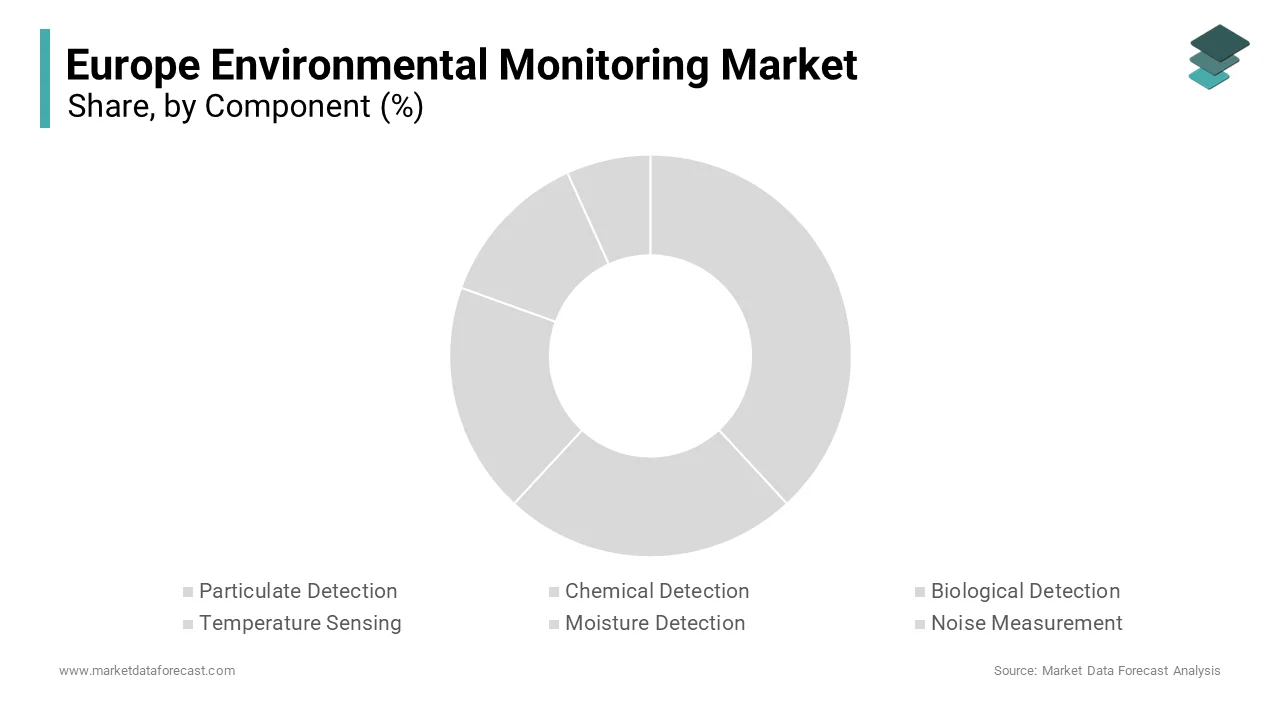
The biological detection segment is predicted to witness the highest CAGR of 15.8% from 2025 to 2033. The swift expansion of the biological detection segment is driven by heightened concerns over waterborne pathogens antibiotic resistant bacteria and bioaerosols in public spaces. There is an emerging regulatory shift within the European Union towards requiring continuous and rapid monitoring for key microbial contaminants in drinking water using advanced methods like molecular or immunoassay techniques. "Across Europe, including Germany, France, and the Netherlands, there is a growing trend and increased investment in the pilot testing and gradual deployment of automated rapid microbial monitoring systems, such as those using ATP bioluminescence and qPCR. The healthcare and food processing sectors are also adopting bioaerosol monitors following post pandemic hygiene protocols, hospitals use real time airborne pathogen sensors in ventilation systems. These public health imperatives are transforming biological detection from a niche application into a critical compliance layer.
By Product Insights
The environmental monitoring sensors segment held the leading share of 45.7% share of the Europe environment monitoring market in 2025. Their foundational role as the primary data capture layer across air water soil and noise applications has mainly contributed to the growth of the environmental monitoring sensors segment. Millions of fixed and mobile sensors are deployed across EU industrial sites urban centers and natural reserves according to research. Regulatory frameworks mandate continuous sensor-based measurement for pollutants and ozone with minimum data capture frequencies of one reading per hour. Technological advances have further driven adoption. Modern electrochemical metal oxide and NDIR sensors offer 5-to-10-year lifespans with self-diagnostics and digital outputs compliant with Modbus and MQTT protocols. Major manufacturers have localized production to meet EU cybersecurity and data sovereignty requirements. The modular nature of sensors also enables scalable deployment from single point checks to dense urban networks, which makes them the most versatile and widely procured product type in the monitoring ecosystem.
The environmental monitoring software segment is estimated to register the fastest CAGR of 18.2% during the forecast period owing to the shift from hardware centric monitoring to data driven environmental intelligence. The EU’s Corporate Sustainability Reporting Directive requires companies to collect validate and report environmental performance data from thousands of sources necessitating enterprise grade software platforms. Startups offer AI powered platforms that forecast pollution episodes and generate automated compliance reports for EEA submission. The evolution of monitoring from a compliance-focused task to a predictive science means software is now the core strategic command post for environmental management.
By Application Insights
The air pollution monitoring segment dominated the Europe environmental monitoring market and captured a 42.5% share in 2025. The supremacy of the air pollution monitoring segment is propelled by the severe public health burden of ambient air pollution which causes significant number of premature deaths annually in the EU. European Union air quality directives have established a widespread requirement for ambient air monitoring across large urban areas. Major European cities are increasingly combining extensive networks of official continuous monitoring stations with large-scale deployment of complementary low-cost sensor technology. The European Union is aligning its regulatory framework with more stringent international health guidelines for fine particulate matter (PM2.5), which is being adopted by a majority of its member states. Industrial sectors also contribute significantly. This dual pressure from public health mandates and industrial compliance ensures air monitoring remains the largest application segment.
The water pollution monitoring segment is anticipated to witness the fastest CAGR of 16.4% from 2025 to 2033 over the forecast period owing to the EU’s updated Drinking Water and Urban Wastewater Treatment Directives which mandate real time monitoring for emerging contaminants including microplastics pharmaceutical residues and per and polyfluoroalkyl substances. There is an increasing adoption of online analyzers in wastewater treatment plants across the EU, driven by the need to comply with stricter nitrogen and phosphorus discharge limits. EU regulations, such as the Zero Pollution Action Plan, are imposing more stringent requirements for monitoring a wide range of priority substances in surface waters, requiring highly sensitive detection methods. Countries have pioneered digital water quality networks using autonomous buoys and satellite data fusion to track pollution plumes in real time. Apart from these, drought conditions are a significant and widespread issue impacting a substantial portion of European river basins. These regulatory and climatic pressures are transforming water monitoring from episodic sampling to continuous digital surveillance.
COUNTRY ANALYSIS
Germany Environmental Monitoring Market Analysis
Germany was the top performer in the Europe environmental monitoring market and captured a 22.3% share in 2025. A combination of stringent enforcement, industrial density, and technological prowess is among the key reasons fuelling the demand of environmental monitoring in Germany. The country also operates the most extensive air quality network in Europe with official monitoring stations and low-cost sensors in urban areas. Germany’s Energiewende policy has further driven monitoring in renewable sectors. Offshore wind farms in the North Sea deploy underwater noise and turbidity sensors to comply with marine protection laws. Major sensor and software manufacturers operate R and D centers focused on next generation environmental IoT. This ecosystem of regulation innovation and industrial demand solidifies Germany’s position as Europe’s environmental monitoring epicenter.
France Environmental Monitoring Market Analysis
France was the next-biggest country in the European environment monitoring market and captured a 16.7% share in 2025. The nation’s growth is attributed to its aggressive urban air quality policies and nationwide water protection initiatives. Paris Lyon and Marseille have implemented low emission zones that rely on dense sensor grids to enforce traffic restrictions during pollution peaks. France also hosts Europe’s largest network of automated river monitoring stations. The government allocated funds to environmental digital twins including AI driven flood and drought prediction systems. This blend of public health urgency ecological stewardship and digital innovation sustains France’s robust monitoring infrastructure.
The United Kingdom Environmental Monitoring Market Analysis
The United Kingdom is moderately growing in the Europe environmental monitoring market. Despite Brexit the UK maintains alignment with EU air and water quality standards through its Environment Act 2021 which establishes legally binding targets for PM2.5 and river health. The UK’s extensive offshore oil and gas sector also drives demand for seabed and atmospheric monitoring. Post Brexit regulatory autonomy has enabled faster adoption of AI based forecasting tools and drone-based soil monitoring in agriculture. These factors ensure the UK remains a high intensity monitoring market with strong public and industrial demand.
Italy Environmental Monitoring Market Analysis
Italy is expected to be the most lucrative region in the European environmental monitoring market due to its vulnerability to Mediterranean pollution pressures and extensive industrial coastline. Italy also leads in noise pollution monitoring due to dense urban living. Rome and Naples operate permanent noise mapping systems integrated with traffic flow data. Apart from these, the country’s geothermal and cement industries are required to monitor hydrogen sulfide and particulate matter under stringent regional permits. This convergence of atmospheric water and noise challenges sustains Italy’s diversified and growing monitoring demand.
The Netherlands Environmental Monitoring Market Analysis
The Netherlands is anticipated to expand in the Europe environmental monitoring market from 2025 to 2033 owing to its pioneering water management systems and circular economy policies. The Delta Plan on Freshwater Supply mandates real time monitoring of salinity nutrients and pathogens in all major rivers and canals with automated stations feeding a national digital twin. Dutch wastewater utilities lead Europe in resource recovery. The country also operates Europe’s densest air quality network relative to land area. The Dutch government’s Climate Agreement requires all industrial sites to report greenhouse gas emissions hourly using certified monitors. This systemic integration of monitoring into water energy and climate policy makes the Netherlands a model of environmental data driven governance and a high value market for advanced monitoring solutions.
COMPETITIVE LANDSCAPE
Competition in the Europe environmental monitoring market is characterized by a blend of global technology leaders and specialized European firms vying for dominance in a highly regulated and fragmented landscape. The market is not driven by price but by regulatory certification data accuracy and integration capabilities with existing industrial and municipal infrastructure. Large players like Thermo Fisher and Siemens compete on end to end solutions combining hardware software and services while niche firms differentiate through domain expertise in water air or soil analytics. The enforcement of stringent EU directives creates a stable demand base yet raises barriers to entry due to complex type approval processes and cybersecurity requirements. Innovation is increasingly centered on AI driven analytics low maintenance sensors and interoperability with digital twins under the EU’s Destination Earth initiative. As monitoring shifts from compliance logging to predictive environmental intelligence the ability to deliver secure scalable and intelligent systems will determine long term competitive advantage.
KEY MARKET PLAYERS
A few of the market players in the Europe environmental monitoring market include
- BioMérieux (France)
- Honeywell International Inc. (U.S.)
- Merck KGaA (Germany)
- Siemens (Germany)
- Endress+Hauser Group
- Forbes Marshall (India)
- HORIBA (Japan)
- Agilent Technologies Inc. (U.S.)
- Thermo Fisher Scientific (U.S.)
- Shimadzu Corporation (Japan)
- PerkinElmer Inc. (U.S.)
- 3M (U.S.)
- Emerson Electric Co. (U.S.)
- Sensors, Inc. (Canada)
- Danaher (U.S.)
- Spectris (U.K.)
- TE Connectivity (Switzerland)
- Teledyne Technologies Incorporated (U.S.)
- RTX (U.S.)
- ams-OSRAM AG (Austria)
Top Players In The Market
- Thermo Fisher Scientific is a global leader in environmental monitoring instrumentation with a strong European footprint through its ambient air and water quality analyzers. The company supplies continuous emission monitoring systems to major industrial facilities across Germany France and the UK complying with EU Industrial Emissions Directive requirements. It also expanded its European service network to include rapid response centers ensuring 48 hour on site support for critical monitoring infrastructure. These initiatives reinforce its role as a trusted provider of high accuracy regulatory grade instrumentation while enhancing data integrity and operational uptime for European clients.
- Siemens AG leverages its industrial automation heritage to deliver integrated environmental monitoring solutions across power manufacturing and municipal sectors in Europe. The company’s Sitrans and Sentron product lines provide real time gas water and noise monitoring with seamless integration into existing process control systems. It also partnered with the German Federal Environment Agency to pilot a predictive air quality model in the Ruhr Valley using industrial emission and traffic data. These actions position Siemens at the intersection of operational technology and environmental governance enabling smarter regulatory compliance and resource management across the continent.
- Endress+Hauser is a European headquartered specialist in liquid and gas analysis instrumentation with deep expertise in water and emissions monitoring. The company serves municipal and industrial clients across the EU with certified analyzers for nutrients TOC heavy metals and greenhouse gases. It also launched Memosens digital sensor technology with cybersecurity features compliant with EU EN 303 645 standards. These developments strengthen its position as a provider of secure reliable and future ready monitoring solutions aligned with Europe’s evolving regulatory and digital requirements.
Top Strategies Used By The Key Market Participants
Key players in the Europe environmental monitoring market prioritize regulatory compliance by developing instrumentation certified under EU directives such as the Industrial Emissions Directive and Ambient Air Quality standards. They integrate sensors with cloud-based software platforms to enable real time data analytics automated reporting and predictive maintenance. Strategic expansion of service networks ensures rapid calibration and troubleshooting to maintain data continuity for regulated facilities. Companies also invest in cybersecurity hardened devices to protect environmental data integrity under evolving EU digital sovereignty rules. Apart from these, they collaborate with national agencies and research institutions to co-develop monitoring solutions for emerging contaminants like microplastics PFAS and bioaerosols enhancing technical leadership and market relevance.
MARKET SEGMENTATION
This research report on the Europe environmental monitoring market is segmented and sub-segmented into the following categories.
By Component
- Particulate Detection
- Chemical Detection
- Biological Detection
- Temperature Sensing
- Moisture Detection
- Noise Measurement
By Product Type
- Environmental Monitoring Sensors
- Environmental Monitors
- Environmental Monitoring Software
- Wearable Environmental Monitors
By Sampling Method
- Continuous Monitoring
- Active Monitoring
- Passive Monitoring
- Intermittent Monitoring
By Application
- Air Pollution Monitoring
- Water Pollution Monitoring
- Soil Pollution Monitoring
- Noise Pollution Monitoring
By Country
- United Kingdom
- France
- Spain
- Germany
- Italy
- Russia
- Sweden
- Denmark
- Switzerland
- Netherlands
- Rest of Europe