- Product Description Description
- Table of Contents TOC
- List of Table & Figure LOT
- Get Free Sample PDF Sample PDF
Market Size, 2025
$85.11 BnMarket Estimate, 2026
$91.15 BnMarket Forecast, 2034
$157.79 BnCAGR, 2026–2034
7.1%Executive Summary: Europe Express Delivery Market
- Market Scope: Comprehensive analysis of the European express delivery market spanning destination types, business models, industry end-users, and country-level performance.
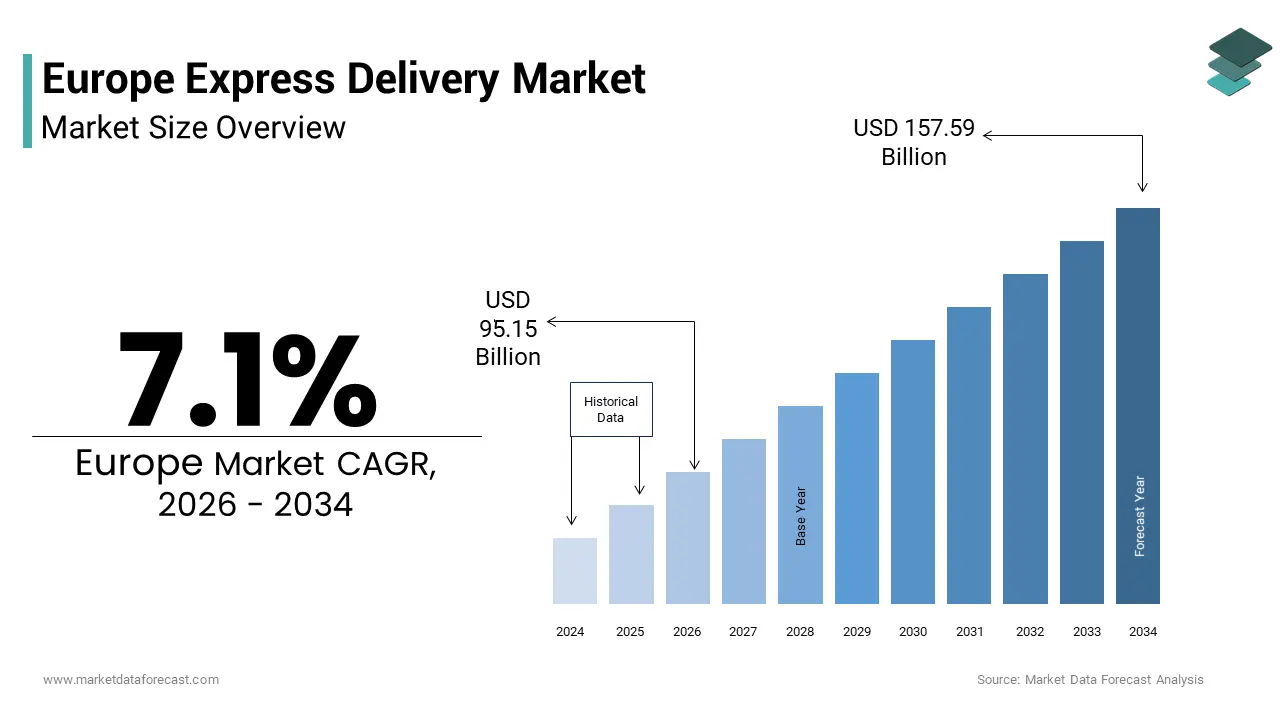
- Market Valuation: Valued at USD 85.11 billion in 2025, estimated at USD 91.15 billion in 2026, and projected to reach USD 157.79 billion by 2034, expanding at a solid CAGR of 7.1% from 2026 to 2034.
- Primary Growth Drivers: Continuous e-commerce penetration, shifting consumer expectations toward rapid fulfillment, and the deepening of cross-border intra-European trade.
Key Market Segment Metrics (2026–2034)
| Category | Leading Segment (Base Position) | Fastest-Growing / High-Growth Segment |
|---|---|---|
| By Destination | Domestic Express Delivery (accounted for a dominant share driven by localized e-commerce fulfillment and rapid turnaround demands) | International Express Delivery (estimated to grow at a robust CAGR of 11.3% backed by simplified IOSS tax compliance and cross-border trade) |
| By Business Type | B2C Express Delivery (largest market share fueled by online retail expansion and subscription-based delivery models) | B2C & Subscription Segments (witnessing a strong CAGR of 9.8% driven by social commerce and recurring delivery cadences) |
| By End-User | Retail & E-commerce (captured 58.3% of market share as the primary volume engine for online fashion, electronics, and home goods) | Pharmaceuticals (anticipated to register the fastest CAGR of 14.2% propelled by decentralized healthcare and cold-chain home delivery needs) |
| By Country / Region | Germany (top market performer capturing a 24.3% share due to its manufacturing power and central logistics nexus) | UK, France, Netherlands, & Italy (high-growth hubs leveraging advanced last-mile tech, green mandates, and multimodal trade gateways) |
Major Market Players & Industry Landscape
Market Structure: Highly competitive triadic framework balancing global network integrators, national postal operators scaling green last-mile fleets, and specialized vertical service providers.
Key Companies: Deutsche Post DHL Group, La Poste Geopost, United Parcel Service Inc., FedEx Corp., Royal Mail Parcel Force Worldwide, Schenker AG, DPDgroup, Aramex International LLC, BTA International BV, DPEX Europe, Manston Express Transport, and SDA Express Courier Spa.
Europe Express Delivery Market Size
The European express delivery market size was valued at USD 85.11 billion in 2025 and is anticipated to reach USD 91.15 billion in 2026 and USD 157.79 billion by 2034, growing at a CAGR of 7.1% during the forecast period from 2026 to 2034.
Current Intro Definition of the Europe Express Delivery Market
The express delivery is a time definite parcel and document transportation services offering guaranteed delivery within 24 to 72 hours across domestic and cross border routes. Unlike standard postal services, express delivery relies on integrated air and ground networks, advanced tracking systems, and dedicated sorting hubs to ensure speed and reliability for e-commerce businesses, enterprises, and high value consumer shipments. According to Eurostat, over 14.2 billion parcels were delivered in the European Union in 2025, with express services accounting for 38% of total volume driven by online retail growth. The European Commission’s Digital Economy and Society Index notes that 72% of EU citizens made at least one online purchase in 2025 by creating structural demand for rapid fulfillment. Regulatory frameworks such as the Urban Logistics Action Plan and the Alternative Fuels Infrastructure Regulation further shape operational models by promoting low emission vehicles and off hour deliveries in city centers.
MARKET DRIVERS
E-commerce Penetration Drives Structural Demand for Rapid Fulfillment
The sustained expansion of online retail has created an irreversible structural demand for express delivery services as consumers increasingly expect fast and flexible shipping options, which is greatly influencing the growth of Europe express delivery market. According to the European Commission’s Digital Economy and Society Index, 72% of EU citizens aged 16 to 74 purchased goods or services online in 2025, up from 55% in 2020. This shift is particularly pronounced among younger demographics, where a Eurostat reports that 89% of Europeans aged 18 to 34 now consider next day delivery a standard expectation rather than a premium feature. Major retailers like Zalando and ASOS have institutionalized same day and next day delivery in urban centers, forcing competitors to follow suit or lose market share. The European Retail Round Table confirms that 68% of fashion and electronics retailers now offer free express shipping as a baseline service. This consumer behavior transformation compels logistics providers to invest in micro fulfillment centers, automated sorting, and dynamic routing algorithms to meet escalating service level agreements without proportional cost increases.
Cross Border Trade Growth Amplifies International Express Volumes
The deepening of the EU single market and rising intra-European e-commerce have significantly increased cross border express delivery demand for business to consumer shipments. The cross border trade growth is also accelerating the growth of Europe express delivery market. As per the European Commission, intra-EU e-commerce sales reached 218 billion euros in 2025, representing 24% of total online retail with a figure projected to exceed 30% by 2030. Consumers routinely purchase from neighboring countries due to price differentials product availability or brand preference, necessitating reliable international express services. For instance, German shoppers frequently buy fashion from France and electronics from the Netherlands, while Southern Europeans order home goods from Germany. The EU’s VAT e commerce package implemented in 2021 simplified cross border taxation but increased customs data requirements, making integrated logistics providers essential for seamless clearance.
MARKET RESTRAINTS
Urban Congestion and Access Restrictions Impede Last Mile Efficiency
The dense historic city centers impose severe operational constraints on express delivery through low emission zones traffic congestion and limited loading infrastructure. According to the European Environment Agency, 235 European cities have implemented low emission zones that restrict access for diesel vans unless they meet Euro 6 standards or use alternative fuels. In Paris, the Crit’Air system bans non-compliant vehicles during weekdays, while London’s Ultra Low Emission Zone charges 12.50 pounds daily for older vans. These regulations force carriers to invest in electric or CNG fleets despite higher upfront costs and range limitations. Additionally, narrow streets and lack of designated loading bays cause average last mile delays of 18 minutes per stop, as per the European Urban Transport Observatory.
Labor Shortages in Driving and Sorting Roles Constrain Network Capacity
The express delivery sector faces acute workforce shortages in van driving and warehouse sorting roles, undermining service reliability and scalability is limiting the growth of Europe express delivery market. According to Eurostat, the vacancy rate for transport drivers reached 4.8% in 2025, where the highest since records began with Germany and Poland, reporting deficits of over 60000 drivers each. The European Logistics Association attributes this to aging workforces poor working conditions and competition from gig economy platforms offering more flexible hours. Sorting center vacancies are equally severe in the Netherlands PostNL reported 15% unfilled night shift positions in 2024 due to repetitive strain concerns and unsocial hours. These gaps lead to delayed dispatches missed delivery windows and increased reliance on costly temporary agencies. Without significant wage increases automation investment or migration policy reforms, network capacity will remain constrained just as demand peaks during holiday seasons by creating systemic fragility in Europe’s express logistics backbone.
MARKET OPPORTUNITIES
Integration of Micro Fulfillment Centers in Urban Areas Enhances Speed
The deployment of micro fulfillment centers within city limits presents a transformative opportunity to slash last mile delivery times and reduce emissions. These compact automated warehouses that often located in repurposed retail spaces or underground parking store high demand SKUs within 5 kilometers of end consumers. According to the European Urban Logistics Platform, over 120 such facilities became operational in 2025, across London Berlin and Paris by enabling same day or two hour delivery for select retailers. Zalando’s partnership with Urban Logistics Group in Berlin reduced average delivery distance by 78%, while cutting CO₂ emissions per parcel by 62% as verified by TÜV Rheinland.
Adoption of Electric Cargo Bikes and Vans Aligns with Green City Mandates
The transition to zero emission last mile fleets to comply with urban environmental regulations, while enhancing brand image is also to set up new opportunities for the growth of Europe express delivery market. According to the European Alternative Fuels Observatory, over 42000 electric cargo bikes and 18000 electric vans were deployed by express carriers in 2025, primarily in cities with strict low emission zones. Deutsche Post DHL’s StreetScooter fleet, now handles 70% of urban deliveries in German metropolitan areas, while La Poste’s subsidiary Geopost operates many electric vehicles, across France. The EU’s Alternative Fuels Infrastructure Regulation mandates charging points at major logistics hubs by 2026, accelerating adoption. These vehicles qualify for municipal incentives; Amsterdam offers free parking and loading permits for zero emission delivery operators. This convergence of regulatory compliance operational efficiency and public goodwill positions electrification as a cornerstone of future express delivery strategy.
MARKET CHALLENGES
Fragmented National Regulations Increase Cross Border Operational Complexity
The significant disparities in national rules governing parcel delivery create inefficiencies and compliance risks for pan European operators is one of the challenges for the growth of Europe express delivery market. Each member state maintains distinct requirements for customs documentation driver working hours vehicle dimensions and consumer return rights. According to the European Commission’s Internal Market Scoreboard Germany mandates real time parcel tracking disclosure, while Italy requires pre notification for all business deliveries. The European Court of Justice ruled in 2024 that such divergences violate the principle of free movement yet full alignment remains distant. During peak seasons these inconsistencies cause customs delays, parcels entering Spain from France face 12 to 36 hour holds due to differing electronic data formats. Until a unified EU parcel regulation emerges operators will struggle to achieve true network integration, undermining the promise of a seamless single market for express delivery.
Rising Consumer Expectations for Delivery Precision Strain Operational Models
The demand for hyper precise delivery windows, such as 30 minute slots or real time driver tracking imposes unsustainable pressure on express networks designed for broader time bands. The rising consumer expectations for delivery precision strain operational models is soelly to impact negatively on the growth of Europe express delivery market. According to the European Consumer Organisation, 68% of online shoppers now expect live GPS tracking and the ability to redirect parcels mid route, features that require continuous telematics and dynamic rerouting capabilities. Implementing these services across millions of daily deliveries demands massive investment in IoT sensors cloud computing and AI driven logistics platforms. This mismatch forces carriers to absorb costs or risk negative reviews and cart abandonment. During the 2024 holiday season Hermes reported a 22% increase in customer service inquiries related to delivery timing, overwhelming support systems. Without industry wide standards or consumer education on realistic expectations, the race toward perfect precision threatens profitability and service quality across the sector.
REPORT COVERAGE
| REPORT METRIC | DETAILS |
| Market Size Available | 2025 to 2034 |
| Base Year | 2025 |
| Forecast Period | 2026 to 2034 |
| CAGR | 7.1% |
| Segments Covered | By Destination, Business Type, End-User, and Region. |
| Various Analyses Covered | Global, Regional, and Country Level Analysis, Segment-Level Analysis, DROC, PESTLE Analysis, Porter’s Five Forces Analysis, Competitive Landscape, Analyst Overview of Investment Opportunities |
| Regions Covered | North America, Europe, APAC, Latin America, Middle East & Africa |
| Market Leaders Profiled | Aramex International LLC, BTA International BV, Deutsche Post DHL Group, DPDgroup, DPEX Europe, FedEx Corp., Manston Express Transport, Schenker AG, SDA Express Courier Spa, United Parcel Service Inc., and Others. |
SEGMENT ANALYSIS
By Destination Insights
The domestic express delivery segment was accounted in holding a dominant share of the Europe express delivery market in 2024 with the localization of e-commerce fulfillment and consumer demand for same day or next day delivery. According to the European Commission’s Digital Economy and Society Index, 72% of EU citizens made online purchases in 2025, with 64% expecting delivery within 48 hours with a standard only achievable through domestic networks. Retailers like Zalando ASOS and Otto have invested heavily in national fulfillment centers to meet these expectations, Zalando operates 12 automated warehouses, across Germany alone enabling 90% of domestic orders to ship same day. Additionally, national postal operators like La Poste and Deutsche Post leverage their universal service infrastructure to offer affordable express options that private carriers struggle to match on price. This structural alignment between consumer behavior retail strategy and logistics capability ensures domestic routes remain the volume backbone of the European express market.
The international express delivery segment is esteemed to grow at a CAGR of 11.3% during the forecast period. The European Union’s VAT e-commerce package implemented in July 2021 eliminated distance selling thresholds and introduced the Import One Stop Shop system, dramatically simplifying tax compliance for cross border sellers. According to the European Commission, over 180000 businesses registered for IOSS by end 2025 enabling seamless customs clearance for parcels under 150 euros. This reform reduced average customs processing time from 72 to 12 hours, as reported by the European Customs Union. Consumers now routinely purchase from neighboring countries Germans buy French cosmetics Italians order Dutch home goods by creating predictable international express flows. Carriers like DHL and UPS responded by establishing dedicated EU parcel hubs in Liege and Leipzig with automated IOSS validation by ensuring next day delivery across borders. This regulatory streamlining transforms international express from a complex exception into a scalable routine service. Emerging digitally native brands are designing their supply chains for pan European reach from inception rather than scaling country by country. Companies like Norway’s Oda grocery platform and Spain’s Wallapop marketplace operate centralized fulfillment centers serving multiple markets with express delivery as a core promise. According to the European Startup Observatory, over 420 direct to consumer brands launched cross border operations in 2025 using express networks to maintain brand consistency. These businesses rely on integrated logistics partners for real time tracking multilingual customer service and compliant returns handling across jurisdictions. This shift creates stable recurring international volumes that justify carrier investment in dedicated air and ground capacity between key economic zones like the Rhine Ruhr corridor and Iberian Peninsula.
By Business Insights
The business to consumer express delivery segment was the largest by holding a dominant share of the Europe express delivery market share in 2024 with the explosive growth of online retail and rising consumer expectations for rapid flexible delivery. According to Eurostat, 14.2 billion parcels were delivered in the EU in 2025 with B2C accounting for over 8.7 billion units. Fashion electronics and beauty categories drive the highest frequency with consumers ordering multiple times per month. Retailers respond by embedding express delivery into loyalty programs, where Amazon Prime and Zalando Plus offer unlimited one day shipping to retain high value customers. This volume intensity forces carriers to optimize last mile networks through micro hubs dynamic routing and alternative delivery points like parcel lockers. The emotional weight of consumer satisfaction, where a delayed parcel triggers negative reviews and cart abandonment makes B2C the most demanding yet dominant segment in the express ecosystem.
The B2C express delivery segment is esteemed to witness a CAGR of 9.8% throughout the period with the subscription models and social commerce integration. The proliferation of curated subscription services from meal kits to beauty boxes creates predictable weekly or monthly delivery cadences that stabilize carrier networks. According to the European Subscription Association, over 28 million Europeans subscribed to at least one recurring box service in 2025 generating 1.2 billion express parcels annually. Companies like HelloFresh and Birchbox rely on precise delivery windows to maintain freshness and customer retention, missed deliveries directly impact churn rates. Carriers respond with dedicated subscription lanes offering guaranteed morning slots and temperature-controlled options. In Germany, HelloFresh’s partnership with DHL ensures 98% on time delivery across 12 cities using predictive analytics to anticipate order spikes. This recurring revenue model provides carriers with volume certainty during off peak periods enhancing asset utilization and reducing reliance on volatile spot market demand. The rise of shoppable content on Instagram, TikTok, and Pinterest transforms social media into instant storefronts triggering immediate purchase and delivery expectations. According to the European Interactive Advertising Bureau, 42% of users aged 18 to 34 made a purchase directly through social platforms in 2025 often expecting delivery within 48 hours. Brands like Shein and Gymshark leverage influencer campaigns that link to one click checkout with express shipping pre-selected. This impulse driven model generates high frequency low value parcels that strain traditional networks yet command premium margins. Carriers adapt by partnering with social platforms on integrated logistics APIs enabling real time shipping quotes and carbon footprint displays at checkout.
By End User Insights
The retail and e-commerce segment was the largest by accounting for the 58.3% of the Europe express delivery market share in 2024 with the primary engine of parcel volume through online fashion electronics and home goods. According to the European Commission, intra EU e-commerce sales reached 218 billion euros in 2025 with fashion alone generating 3.2 billion parcels. The sector’s demand is characterized by high frequency seasonal peaks and stringent delivery promises that shape carrier network design. Retailers like Zalando ASOS and Otto operate proprietary logistics arms or exclusive partnerships to ensure control over customer experience. The European Retail Round Table notes that 82% of online retailers now offer free next day delivery as a standard feature driving continuous investment in urban fulfillment centers. Returns handling further amplifies volume; the European Consumer Organisation reports that few fashion parcels are returned requiring reverse logistics integration. This combination of forward and reverse flows makes retail and e commerce the undisputed core of the express delivery ecosystem.
The pharmaceuticals segment is expected to witness a fastest CAGR of 14.2% in next coming years.
Europe’s aging population and shift toward decentralized care models are driving demand for direct to patient delivery of prescription medications and chronic disease management supplies. According to the European Health Care Association, 68% of EU member states expanded home healthcare coverage in 2025 to reduce hospital congestion. This requires express carriers to maintain 2 to 8 degrees Celsius cold chain integrity for insulin biologics and vaccines across last mile routes. Companies like UPS Healthcare and DHL Life Sciences operate certified GDP compliant networks with real time temperature monitoring and electronic proof of delivery. In Germany, statutory health insurers now reimburse home delivery fees for patients with mobility limitations creating stable public sector demand. The European Medicines Agency’s 2024 guidelines on ambient excursions further tighten requirements pushing carriers to invest in phase change materials and IoT sensors. This mission critical nature ensures premium pricing and long term contracts insulated from e commerce volatility.
Country-Level Analysis
Germany Express Delivery Market Analysis
Germany was the top performer of the Europe express delivery market by occupying 24.3% of share in 2024 with its dual role as Europe’s manufacturing hub and leading e-commerce areas. Deutsche Post DHL leverages its universal postal network to offer affordable express options, while competing with Hermes and Amazon Logistics in urban centers. Germany’s dense autobahn network and central location make it a logistics nexus for cross border flows into Eastern and Southern Europe. The government’s Digital Strategy 2025 promotes smart logistics innovation including drone delivery trials in rural Bavaria. Strict packaging laws under the Circular Economy Act also drive investment in reusable container systems. This blend of industrial scale digital adoption and regulatory foresight sustains Germany’s leadership in both volume and innovation.
United Kingdom Express Delivery Market Analysis
The United Kingdom express delivery market held second position by holding 14.3% of share in 2024 with the high consumer expectations and sophisticated last mile infrastructure. UK e-commerce remains deeply integrated with EU supply chains with 28% of online purchases sourced from Europe as per the survey. Royal Mail Parcel Force and independent carriers like Evri handle many parcels annually with London alone. The Department for Transport’s Future of Freight program funds electric cargo bike trials in city centers aligning with net zero goals. Consumer demand for precise delivery windows pushes carriers to adopt AI driven route optimization. This mature yet dynamic environment makes the UK a testing ground for next generation express solutions.
France Express Delivery Market Analysis
France express delivery market growth is likely to grow with steady growth opportunities in next coming years with the proactive regulation and urban logistics innovation. The Anti-Waste Law for a Circular Economy mandates reusable packaging for express deliveries by 2027 accelerating adoption of returnable container systems by La Poste and Geopost. Paris’ low emission zone restricts diesel vans driving rapid electrification, where Geopost operates 12000 electric vehicles nationwide. France’s e commerce sales reached 68 billion euros in 2025 with strong cross border activity into Belgium and Spain. The government’s France Logistique 2030 plan allocates 2.1 billion euros to modernize freight infrastructure including urban consolidation centers. Cdiscount and Veepee lead in same day delivery from hyperlocal warehouses. This policy driven approach positions France as a laboratory for sustainable express delivery aligned with EU Green Deal objectives.
Netherlands Express Delivery Market Analysis
The Netherlands express delivery market growth is likely to grow with the logistics gateway leveraging Schiphol Airport and the Port of Rotterdam for global and intra EU flows. Major carriers operate European hubs in the Randstad region, where UPS’s facility in Eindhoven processes 180000 parcels daily. Dutch consumers exhibit high e commerce adoption with 82% making online purchases in 2025. The government’s Smart Logistics Action Plan promotes data sharing between carriers and municipalities to optimize delivery routes. Amsterdam’s cargo bike priority lanes and Rotterdam’s off hour delivery incentives reduce urban congestion. This strategic location combined with digital readiness makes the Netherlands indispensable to pan European express networks.
Italy Express Delivery Market Analysis
Italy express delivery market growth is likely to grow with the emergence as a dynamic southern market with strong cross border potential into the Balkans and North Africa. Milan and Rome serve as key hubs with Poste Italiane investing in automated sorting centers to handle rising B2C volume. Italian consumers increasingly purchase from German and French retailers creating consistent northbound flows. The government’s National Logistics Plan allocates 3.5 billion euros to upgrade southern infrastructure, including the Gioia Tauro port for Mediterranean distribution. Challenges remain in last mile efficiency due to historic city centers yet innovative solutions like Naples’ boat-based deliveries show local adaptation.
COMPETITIVE LANDSCAPE
Competition in the Europe express delivery market is characterized by a triad of capabilities: scale, sustainability, and specialization. Global integrators like DHL and UPS compete on network density technological sophistication and cross border reliability serving multinational corporations and high volume e commerce players. National postal operators such as La Poste Geopost and Royal Mail leverage universal service mandates to offer affordable domestic coverage while investing in green last mile solutions to meet urban regulatory demands. Meanwhile niche specialists focus on high value verticals like pharmaceuticals or same day grocery delivery where reliability commands premium pricing. Regulatory fragmentation across 27 member states adds complexity in customs procedures vehicle standards and labor laws. Success hinges on balancing pan European efficiency with local responsiveness while navigating the tension between consumer expectations for free fast delivery and the rising costs of sustainability and precision.
KEY MARKET PLAYERS
Some of the major key players involved in the European express delivery market.
- Aramex International LLC
- BTA International BV
- La Poste Geopost
- Royal Mail Parcel Force Worldwide
- Deutsche Post DHL Group
- DPDgroup
- DPEX Europe
- FedEx Corp
- Manston Express Transport
- Schenker AG
- SDA Express Courier Spa
- United Parcel Service Inc
Top Players In The Market
- Deutsche Post DHL Group is a global logistics leader with unparalleled dominance in the Europe express delivery market through its integrated network of air ground and last mile assets. The company operates over 2000 service points and 12 major hubs across the continent including the Leipzig Eurohub which processes 180000 parcels per hour. DHL Express offers guaranteed time definite delivery for both B2B and B2C segments with specialized services for pharmaceuticals electronics and high value goods. It expanded its GoGreen Plus program offering customers carbon neutral shipping with verified emission reductions through sustainable aviation fuel and electric last mile fleets. The group also invested in AI driven route optimization and predictive analytics to enhance on time performance during peak seasons. These initiatives reinforce DHL’s position as Europe’s most reliable and technologically advanced express carrier.
- La Poste Geopost is France’s national postal operator and a major European express delivery player known for its extensive urban network and commitment to sustainable logistics. Through its brands Chronopost and DPD it serves 230000 pickup points and operates over 12000 electric vehicles across Europe. Geopost emphasizes low emission urban delivery through cargo bikes micro hubs and off hour operations aligned with municipal green zone regulations. It launched Predictive Delivery a service using machine learning to forecast optimal delivery windows reducing failed attempts by 22%. The company also pioneered reusable packaging solutions under France’s Anti Waste Law achieving 15 million annual rotations of returnable containers. By combining public infrastructure with private innovation Geopost delivers speed reliability and environmental responsibility across Southern and Western Europe.
- Royal Mail Parcel Force Worldwide is a key UK based express delivery provider offering domestic and international time definite services with deep integration into British e commerce and retail supply chains. The company leverages Royal Mail’s universal service obligation network to reach every UK address while operating dedicated air and road freight corridors to Europe and beyond. Parcel Force specializes in high value electronics healthcare and automotive logistics with temperature controlled and secure handling options. It enhanced its Track and Trace platform with real time GPS and proof of delivery photo verification improving transparency for business clients. The firm also expanded its EV fleet to 5000 units supporting London’s Ultra Low Emission Zone compliance.
Top Strategies Used by the Key Market Participants
Key players in the Europe express delivery market invest heavily in electric and alternative fuel last mile fleets to comply with urban low emission zones and reduce carbon footprint. They deploy artificial intelligence and machine learning for dynamic route optimization demand forecasting and delivery window prediction to enhance efficiency and customer satisfaction. Companies establish micro fulfillment centers and urban consolidation hubs to shorten delivery distances and improve speed. Strategic partnerships with e commerce platforms and retailers enable seamless integration of shipping options at checkout. Additionally, firms develop specialized services for high value sectors like pharmaceuticals and electronics requiring temperature control security and chain of custody documentation to capture premium margins.
MARKET SEGMENTATION
This research report on the European express delivery market is segmented and sub-segmented into the following categories.
By Destination
- Domestic
- International
By Business Type
- B2B
- B2C
By End-User
- Automotive
- Retail and E-commerce
- Pharmaceuticals
- BFSI
- IT and Telecom
- Electronics
- Other
By Country
- UK
- Russia
- Germany
- Italy
- France
- Spain
- Sweden
- Denmark
- Poland
- Switzerland
- Netherlands
- Rest of Europe