- Product Description Description
- Table of Contents TOC
- List of Table & Figure LOT
- Get Free Sample PDF Sample PDF
Market Size, 2025
$58.56 BnMarket Estimate, 2026
$62.22 BnMarket Forecast, 2034
$97.18 BnCAGR, 2026–2034
6.23%Europe Eyeglass Market Report Summary
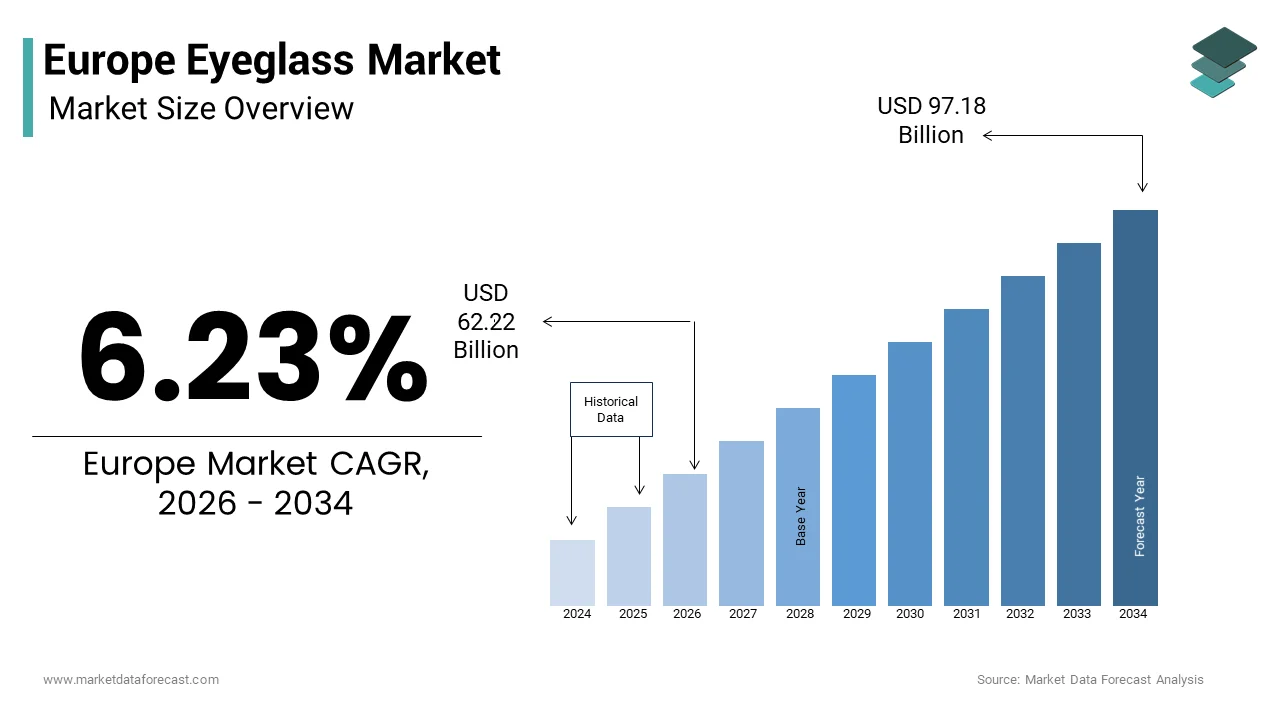
The Europe eyeglass market was valued at USD 58.56 billion in 2025, is estimated to reach USD 62.22 billion in 2026, and is projected to reach USD 97.18 billion by 2034, growing at a CAGR of 6.23% during the forecast period from 2026 to 2034. The growth of the Europe eyeglass market is driven by increasing vision impairment cases, rising awareness of eye health, and growing demand for stylish and functional eyewear. The convergence of healthcare needs with fashion trends, along with advancements in lens technology and expanding distribution channels, is further fueling market growth across Europe.
Key Market Trends
- Rising demand for fashionable and premium eyewear driven by increasing consumer focus on aesthetics and personal style.
- Growing adoption of advanced lens technologies such as anti-reflective, blue-light blocking, and photochromic lenses.
- Expansion of direct-to-consumer and online eyewear retail platforms enhancing accessibility and convenience.
- Increasing awareness of eye health and regular vision testing boosting demand for prescription eyewear.
Integration of smart eyewear and wearable technology creating new growth opportunities in the market.
Segmental Insights
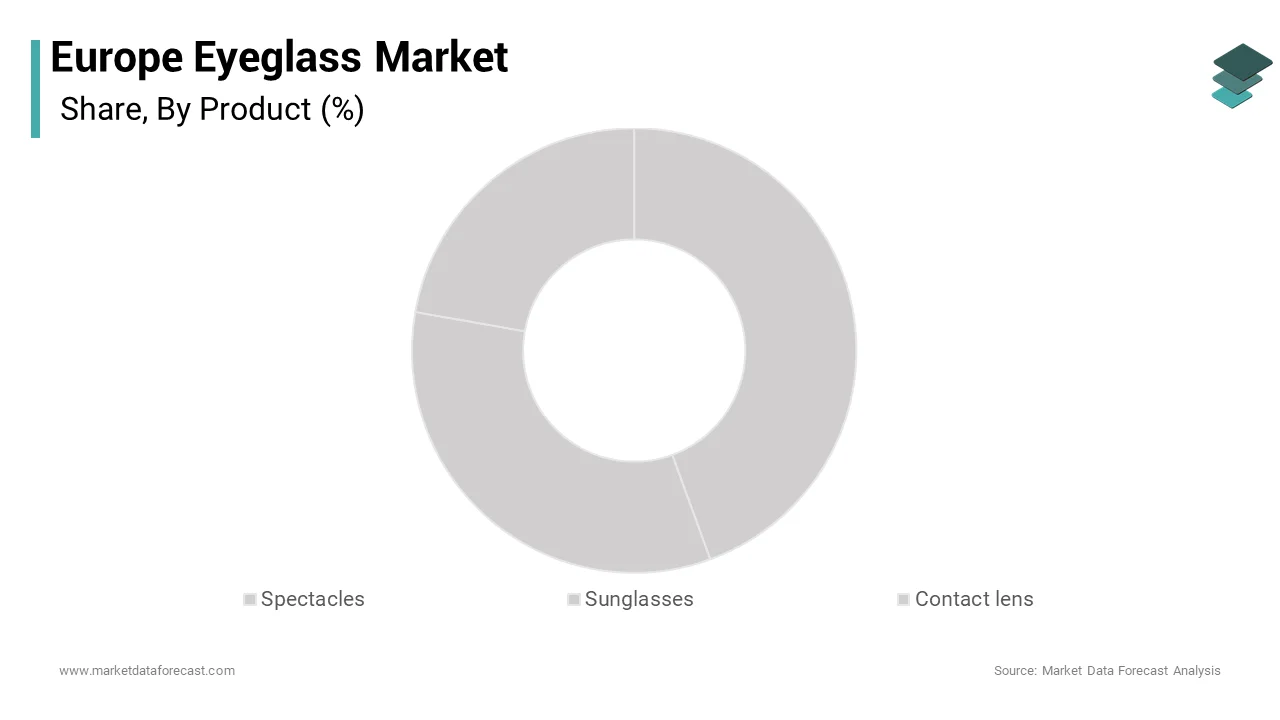
Based on product, the spectacles segment dominated the Europe eyeglass market in 2025. The segment’s leadership is attributed to the widespread need for vision correction and the increasing popularity of spectacles as both medical and fashion accessories.
Regional Insights
The Europe eyeglass market shows strong regional dynamics.
- Germany leading the market by accounting for 32.3% of the share in 2025, supported by its well-established optical industry and high consumer spending.
- France followed with 21.2% of the market share, driven by its unique reimbursement model and strong cultural emphasis on eyewear as a fashion accessory.
- The United Kingdom is witnessing steady growth due to the presence of large retail chains and a growing direct-to-consumer online sector.
- Italy benefits from strong domestic production and its position in the global luxury eyewear market.
- Spain is experiencing growth driven by economic recovery, a robust optical manufacturing base, and increasing health awareness.
Competitive Landscape
The Europe eyeglass market is highly competitive, with key players focusing on product innovation, brand positioning, and expansion of distribution networks. Companies are leveraging technological advancements, strategic partnerships, and digital platforms to strengthen their market presence and cater to evolving consumer preferences. Prominent players in the Europe eyeglass market include Bausch + Lomb, Alcon, Kering Eyewear, Johnson & Johnson Services, Inc., Carl Zeiss Meditec AG, The Cooper Companies, Inc., HOYA Corporation, EssilorLuxottica, Fielmann AG, and Safilo Group S.p.A.
Europe Eyeglass Market Size
The Europe eyeglass market size was valued at USD 58.56 billion in 2025 and is anticipated to reach USD 62.22 billion in 2026 to reach USD 97.18 billion by 2034, growing at a CAGR of 6.23% during the forecast period from 2026 to 2034.
The eyeglass is a healthcare necessity and fashion expression, driven by a demographic landscape characterized by an aging populace and increasing screen exposure. The prevalence of refractive errors such as myopia and presbyopia has reached critical levels, necessitating widespread adoption of vision correction solutions across the continent. According to the World Health Organization Regional Office for Europe, uncorrected refractive errors remain a leading cause of vision impairment, affecting millions of citizens and underscoring the vital role of accessible eyewear. The European Union enforces rigorous safety standards under the CE marking framework by ensuring that all optical products meet specific requirements for impact resistance and optical clarity. As per Eurostat data, individuals aged 65 and older now constitute over 21% of the total European population, a demographic shift that inherently increases the demand for reading glasses and multifocal lenses. Furthermore, the digital transformation of work and education has altered visual habits, with prolonged device usage contributing to digital eye strain among younger cohorts. National health systems in countries like Germany and France often provide subsidies or reimbursement for prescription eyewear, integrating these products into the broader public health infrastructure.
MARKET DRIVERS
Rising Prevalence of Myopia and Digital Eye Strain Among Youth
The escalating incidence of myopia and digital eye strain, particularly within the younger people is propelling the growth of Europe eyeglass market. Extended exposure to digital screens for education and entertainment has fundamentally altered visual development patterns, leading to earlier onset and faster progression of nearsightedness across the region. Educational institutions and health organizations have documented a sharp increase in complaints regarding headaches, blurred vision, and dry eyes among school-aged children, directly correlating with daily screen time exceeding 6 hours. The European Society of Ophthalmology emphasizes that early intervention with specialized lenses, such as those designed for myopia control, is becoming standard practice, driving demand for advanced optical technologies. Parents are increasingly investing in high quality frames and protective coatings like blue light filters to mitigate long term damage. Government initiatives in countries like France have mandated eye examinations for children at key developmental stages, ensuring higher detection rates and subsequent product uptake.
Demographic Aging and Increasing Incidence of Presbyopia
The structural shift towards an older population due to the universal onset of presbyopia and age related vision conditions is additionally fuelling the growth of Europe eyeglass market. As life expectancy increases, the proportion of citizens requiring vision correction for near tasks grows exponentially by creating a stable and recurring demand for multifocal and progressive lenses. According to Eurostat, the median age of the European Union population has risen to 44.6 years, indicating a significant expansion of the demographic most susceptible to presbyopia which typically begins after age 40. The International Agency for the Prevention of Blindness reports that cataracts and age related macular degeneration are prevalent among Europeans over 60, often necessitating specialized eyewear post surgery or for management. Older consumers tend to own multiple pairs of glasses for different activities, such as driving, reading, and computer use, thereby increasing the average unit sales per capita. National healthcare policies in nations like Germany and Sweden often cover part of the cost for prescription eyewear for seniors, reducing financial barriers and encouraging regular updates to prescriptions. Furthermore, the active lifestyle of modern retirees drives demand for lightweight, durable, and aesthetically pleasing frames that do not compromise on optical performance.
MARKET RESTRAINTS
High Cost of Advanced Lens Technologies and Limited Reimbursement
The substantial financial burden associated with advanced lens technologies and the variability in insurance reimbursement schemes is restricting the growth of Europe eyeglass market. Progressive lenses, photochromic options, and high index materials involve complex manufacturing processes that result in premium pricing, often placing them out of reach for budget conscious consumers. According to the European Consumer Organisation, out of pocket expenses for eyewear remain high in many member states where public health coverage is limited to basic frames and single vision lenses. In countries without comprehensive optical benefits, consumers may delay replacing broken glasses or updating prescriptions, leading to a suppression of voluntary demand. The economic downturns and inflationary pressures experienced across the Eurozone have further exacerbated this issue, forcing households to prioritize essential spending over optical upgrades. Data from national statistical offices indicates that discretionary spending on health-related accessories has contracted in several regions, with consumers opting for cheaper alternatives or online discounters that may compromise on quality. The lack of harmonization in reimbursement policies across the European Union creates market fragmentation, where consumers in one country enjoy subsidized access while neighbors face full retail prices.
Proliferation of Counterfeit Products and Unregulated Online Sales
The widespread availability of counterfeit eyewear and the rise of unregulated online sales channels pose a severe threat to the integrity and safety is additionally hampering the growth of Europe eyeglass market. Illicit operators frequently flood the market with substandard frames and lenses that fail to meet the stringent safety and optical accuracy standards mandated by European regulations. According to the European Union Intellectual Property Office, seizures of counterfeit optical goods at EU borders have increased significantly, with fake products often lacking proper UV protection or containing distorted lenses that can cause permanent eye damage. Consumers attracted by low prices on unofficial e commerce platforms often unknowingly purchase these hazardous items, undermining trust in legitimate brands and authorized retailers. The difficulty in verifying the authenticity and prescription accuracy of glasses sold through non certified online vendors complicates enforcement efforts and endangers public health. Industry associations warn that the optical parameters of counterfeit lenses often deviate beyond acceptable tolerances, leading to user discomfort and worsening vision problems. This erosion of consumer confidence can dampen overall market sentiment, as buyers become hesitant to invest in eyewear without physical verification. Furthermore, the loss of revenue for legitimate manufacturers due to intellectual property theft reduces funds available for research and development, stifling innovation within the sector and creating a challenging environment for compliant market participants.
MARKET OPPORTUNITIES
Integration of Smart Technology and Augmented Reality Features
The emergence of optical wearables with smart technology and augmented reality to redefine product utility and value propositions is creating new opportunities for the growth of Europe eyeglass market. Manufacturers are increasingly embedding micro displays, sensors, and connectivity modules into conventional frames to create smart glasses that offer navigation, real time translation, and health monitoring capabilities. According to the International Data Corporation, the wearable technology market in Europe is experiencing rapid expansion, with smart eyewear identified as a key growth category driven by enterprise adoption and consumer curiosity. Tech giants and traditional optical brands are collaborating to develop lightweight, stylish devices that seamlessly blend functionality with fashion, addressing previous concerns regarding bulkiness and aesthetics. The industrial sector in Germany and France is already utilizing AR enabled glasses for remote assistance and maintenance training, demonstrating clear return on investment and driving B2B demand. As battery technology improves and component miniaturization advances, the potential for mass market consumer adoption increases, opening new revenue streams beyond traditional vision correction. Healthcare applications are also emerging, with smart glasses capable of monitoring glucose levels or detecting early signs of eye diseases, aligning with the region's focus on preventive medicine. This technological evolution positions eyeglasses as essential digital interfaces, attracting a tech savvy demographic and revitalizing the market with high value innovative products.
Expansion of Sustainable and Eco Friendly Eyewear Collections
The growing consumer demand for sustainability and ethical production to differentiate through eco friendly materials and circular economy practices is additionally to promote new opportunities for the growth of Europe eyeglass market. European consumers are increasingly scrutinizing the environmental footprint of their purchases, favoring brands that utilize bio-based acetates, recycled metals, and plastic free packaging. According to the European Environment Agency, the fashion and accessory sector is under pressure to reduce waste and carbon emissions, prompting optical companies to innovate with materials derived from cotton seeds, wood pulp, and castor oil. Leading manufacturers are launching take back programs to recycle old frames and lenses, minimizing landfill contribution and fostering brand loyalty among environmentally conscious buyers. The European Green Deal provides a supportive regulatory framework that incentivizes sustainable manufacturing processes and transparent supply chain reporting. Data from consumer surveys indicates that over 60% of European shoppers are willing to pay a premium for products certified as sustainable or carbon neutral. Brands that successfully communicate their commitment to reducing plastic waste and supporting fair labor practices gain a competitive edge in a crowded marketplace. This shift towards green optics not only addresses regulatory compliance but also taps into a values driven market segment, driving growth through differentiation and aligning the industry with broader societal goals for environmental stewardship.
MARKET CHALLENGES
Complex Regulatory Compliance and Varying National Standards
Navigating the intricate web of regulatory compliance and varying national standards is one of the major challenges for the growth of Europe eyeglass market. While the CE marking provides a baseline for safety, individual member states often impose additional requirements regarding labeling, reimbursement eligibility, and professional dispensing qualifications. According to the European Commission, the fragmentation of medical device regulations, even under the new MDR framework, creates administrative burdens that delay product launches and increase operational costs for companies operating pan-regionally. Differences in how countries classify certain types of lenses or frames as medical devices versus fashion accessories lead to inconsistencies in market access and taxation. Optical professionals must adhere to strict continuing education and licensing requirements that vary significantly from one jurisdiction to another, complicating workforce mobility and service standardization. The need to maintain separate inventory and documentation for different markets strains supply chain efficiency and limits economies of scale. Small and medium sized enterprises often struggle to afford the legal and consultancy fees required to ensure full compliance, potentially forcing them out of the market or limiting their geographic reach.
Intense Price Competition and Margin Compression
The intense price competition and margin compression driven by the dominance of large vertical integrators and the influx of low cost online competitors is specifically to limit the growth of Europe eyeglass market. A handful of major conglomerates control significant portions of the supply chain from manufacturing to retail, allowing them to dictate pricing structures and squeeze margins for independent opticians and smaller brands. According to industry analysis, the consolidation of retail chains has led to aggressive promotional strategies and bundle offers that devalue premium products and condition consumers to expect lower prices. The rise of direct to consumer online retailers who bypass traditional overhead costs further exacerbates this pressure, forcing brick and mortar stores to slash prices to retain foot traffic. Economic uncertainty and inflation have made consumers more price sensitive, leading them to seek discounts or switch to private label options rather than purchasing branded frames. Data from financial reports of major optical retailers reveals shrinking profit margins in the core eyewear segment, compelling companies to cut costs in areas like customer service and staff training. This race to the bottom threatens the financial viability of independent practices that rely on professional expertise and personalized service as their value proposition.
REPORT COVERAGE
| REPORT METRIC | DETAILS |
| Market Size Available | 2025 to 2034 |
| Base Year | 2025 |
| Forecast Period | 2026 to 2034 |
| CAGR | 6.23% |
| Segments Covered | By Product, Distributional Channel, By Country |
| Various Analyses Covered | Global, Regional & Country Level Analysis, Segment-Level Analysis, DROC, PESTLE Analysis, Porter’s Five Forces Analysis, Competitive Landscape, Analyst Overview on Investment Opportunities |
| Regions Covered | UK, France, Spain, Germany, Italy, Russia, Sweden, Denmark, Switzerland, Netherlands, Turkey, the Czech Republic, and the Rest of Europe |
| Market Leaders Profiled | Bausch + Lomb (Canada), Alcon (Switzerland), Kering Eyewear , Johnson & Johnson Services, Inc. (U.S.), Carl Zeiss Meditec AG (Germany), The Cooper Companies, Inc. (U.S.), HOYA Corporation (Japan), EssilorLuxottica (U.S.), Fielmann AG (Germany), SAFILO GROUP S.P.A. (Italy) |
SEGMENTAL ANALYSIS
By Product Insights
The spectacles segment was the largest by holding a dominant share of the Europe eyeglass market in 2025 owing to the universal necessity of corrective eyewear for the aging population and the increasing prevalence of refractive errors across all age groups. Unlike contact lenses which require specific hygiene routines and adaptation, spectacles offer a non-invasive, low-maintenance solution that appeals to the broadest demographic spectrum. According to the World Health Organization Regional Office for Europe, uncorrected presbyopia affects over 100 million people in the region, creating a massive installed base that relies exclusively on spectacles for near vision correction. The first driving factor is the medical mandate for consistent wear; ophthalmologists frequently prescribe full-time use of glasses for conditions like astigmatism and high myopia, ensuring stable recurring revenue from lens replacements and frame upgrades. Data from the European Society of Ophthalmology indicates that adherence to spectacle wear is significantly higher than contact lens usage among patients over 50, who constitute the largest consumer block.
The contact lens segment is likely to register a fastest CAGR of 5.8% during the forecast period with the technological advancements in lens materials that enhance oxygen permeability and comfort, alongside a rising demand for cosmetic convenience among younger demographics and active older adults. The innovation in multifocal and toric designs that effectively address presbyopia and astigmatism, conditions previously difficult to manage with contacts is majorly escalating the growth of segment. As per the International Contact Lens Council, the adoption of daily disposable multifocal lenses has surged in Europe over the last three years, as these products eliminate the need for cleaning solutions and reduce infection risks. This is particularly appealing to the growing cohort of active seniors who wish to maintain sports and leisure activities without the hindrance of glasses.
By Distribution Channel Insights
The retail stores segment was the largest by holding a prominent share of the Europe eyeglass market in 2025 owing to the professional eye examinations, precise measurements, and personalized fitting services that cannot be fully replicated in other channels. The first driving factor is the regulatory and health requirement for valid prescriptions; in many European countries, a recent eye test from a certified professional is mandatory before purchasing prescription eyewear, naturally funneling consumers to physical clinics and stores. The complexity of frame selection and lens customization necessitates tactile interaction and expert advice. Consumers rely on opticians to adjust frame fit, measure pupillary distance accurately, and explain complex lens options like progressive additions or blue light filters. Data from the European Confederation of Optometry emphasizes that customer satisfaction and return rates are significantly better when purchases are made through professional retail channels due to the reduced risk of fitting errors. The trust established between patients and their local optician fosters long-term loyalty, ensuring repeat business for repairs, adjustments, and future replacements.
The online stores segment is swiftly emerging at a fastest CAGR of 9.2% in coming years with the increasing digital literacy of consumers, the proliferation of virtual try-on technologies, and the demand for competitive pricing and convenience. The first major driver is the advancement of augmented reality tools that allow shoppers to visualize frames on their faces with high accuracy, mitigating the traditional hesitation associated with buying eyewear online. As per a study, the adoption of virtual try-on features has increased conversion rates for online optical retailers by 35% in France and Germany, effectively bridging the gap between physical and digital shopping experiences. The cost advantage and extensive variety offered by e-commerce platforms, which appeal to price-sensitive consumers and those seeking niche designer brands not available locally. Additionally, the rise of direct-to-consumer brands offering high-quality prescription glasses at fraction of the retail price has disrupted traditional pricing models. The integration of tele-optometry services, where users can upload existing prescriptions or conduct remote eye tests, further streamlines the purchase journey. These technological and economic factors are reshaping consumer behavior, propelling the online channel to the forefront of market growth.
COUNTRY ANALYSIS
Germany Eyeglass Market Analysis
Germany was the top performer in the Europe eyeglass market by capturing 32.3% of share in 2025 with a high density of optical retail outlets and a strong culture of regular eye care. The country's market status is defined by its robust statutory health insurance system which provides subsidies for children and specific medical conditions, ensuring high penetration rates of corrective eyewear across all income levels. According to the Central Association of Opticians in Germany, the nation boasts over 11000 optical stores, resulting in one of the highest optician-to-population ratios globally. This extensive network facilitates easy access to eye examinations and premium products, driving consistent volume sales. The German consumer is highly quality-conscious, often opting for advanced lens technologies such as high-index progressives and photochromic coatings, which boosts the average transaction value. Data from the Federal Statistical Office reveals that expenditure on health-related optical products remains resilient even during economic downturns, reflecting the perceived necessity of vision correction.
France Eyeglass Market Analysis
France eyeglass market held second position with 21.2% of share in 2025 with its unique reimbursement model and a strong cultural emphasis on eyewear as a fashion accessory. As per the French National Health Insurance Fund, reforms in recent years have standardized reimbursement rates, leading to a surge in the uptake of mid-range and premium equipment as out-of-pocket expenses remain manageable for most citizens. French consumers are renowned for treating glasses as a key element of their personal style, often owning multiple pairs to match different outfits and occasions. Data from the Union of Optical Professions indicates that the average French person replaces their glasses every 2.5 years, a rate faster than the European average. The presence of global luxury conglomerates headquartered in France further drives the high-end segment, with designer frames commanding substantial market share. Additionally, government initiatives promoting regular eye checks for children and the elderly have expanded the customer base. The market is also seeing growth in contact lenses among the urban youth, though spectacles remain dominant.
United Kingdom Eyeglass Market Analysis
The United Kingdom eyeglass market growth is likely to grow at a mix of large national chains and a growing direct-to-consumer online sector. According to the Association of Optometrists, many eye tests are conducted annually in the UK by generating a steady stream of potential customers for private frame and lens sales. British consumers are increasingly price-aware and digitally engaged, driving the rapid expansion of online optical retailers who challenge traditional high street pricing models. Data from the Office for National Statistics shows a marked shift in purchasing behavior, with online sales of eyewear growing at double-digit rates as virtual try-on technology gains traction. The market is also notable for its strong demand for specialized lenses, including blue light filtering and occupational varifocals, driven by the high prevalence of screen time in the workforce. The regulatory environment ensures high standards of care, with strict rules on dispensing protecting consumer interests. Furthermore, the trend towards sustainable and ethically sourced frames is gaining momentum among younger buyers.
Italy Eyeglass Market Analysis
Italy eyeglass market growth is driven by the strong domestic production capacity that supplies both local needs and the global luxury market, fostering a culture that deeply appreciates craftsmanship and brand heritage. Italian consumers view eyeglasses as an essential fashion statement, often prioritizing brand prestige and aesthetic appeal alongside optical functionality. Data from ISTAT indicates that despite economic fluctuations, spending on luxury accessories including eyewear remains robust, driven by a loyal domestic customer base. The distribution network is dense with independent opticians who offer personalized service and curated collections of niche brands. Additionally, the aging population in Italy contributes to steady demand for progressive lenses and reading glasses, while the vibrant tourism sector boosts sales of prescription and plano sunglasses. The government's tax incentives for health expenses also support the affordability of corrective eyewear.
Spain Eyeglass Market Analysis
Spain eyeglass market growth is driven by a recovering economy, a strong optical manufacturing sector, and increasing health awareness among its population. According to the Spanish Optical Council, the market has seen consistent growth in the adoption of advanced lens treatments, such as anti-reflective and UV protection coatings, as consumers become more educated about eye health. The Spanish demographic is aging rapidly, with projections showing that nearly 30% of the population will be over 65 by 2050, creating a long-term demand pipeline for presbyopia correction. Data from the National Institute of Statistics highlights a rise in the number of optical centers per capita, improving accessibility in both urban and rural areas. The cultural inclination towards stylish yet functional eyewear supports a diverse product mix.
COMPETITIVE LANDSCAPE
The competition in the Europe eyeglass market is intense and characterized by the dominance of large conglomerates alongside a vibrant ecosystem of independent opticians and emerging direct-to-consumer brands. Major players leverage their extensive control over supply chains and iconic brand portfolios to maintain shelf space and influence consumer preferences across the region. The rivalry often centers on innovation in lens technology and frame design where companies strive to offer superior comfort and style to differentiate their products. Pricing strategies vary significantly with luxury brands commanding premium prices while mass market competitors engage in promotional activities to capture volume sales. Sustainability has emerged as a key battleground with firms competing to achieve the highest environmental standards and certifications to attract ethical consumers. The rise of online retail has disrupted traditional models forcing brick-and-mortar stores to enhance their service offerings and digital presence to retain customers. Regulatory compliance regarding medical device standards adds complexity requiring all participants to maintain rigorous quality control systems. New entrants focusing on niche markets or subscription models continue to challenge established norms driving overall market dynamism and forcing incumbents to adapt rapidly to changing consumer behaviors and technological advancements.
KEY MARKET PLAYERS
A few of the market players that are dominating the Europe eyeglass market are
- Bausch + Lomb (Canada)
- Alcon (Switzerland)
- Kering Eyewear
- Johnson & Johnson Services, Inc. (U.S.)
- Carl Zeiss Meditec AG (Germany)
- The Cooper Companies, Inc. (U.S.)
- HOYA Corporation (Japan)
- EssilorLuxottica (U.S.)
- Fielmann AG (Germany)
- SAFILO GROUP S.P.A. (Italy)
Top Players In The Market
- EssilorLuxottica stands as the undisputed global leader in the eyewear industry by merging optical lens expertise with premium frame manufacturing capabilities. The company contributes massively to the global market by supplying innovative lens technologies and iconic designer brands to consumers across every continent. Recent actions to strengthen their position include aggressive digital transformation initiatives that integrate online eye testing with physical retail networks to enhance customer convenience. They have expanded their portfolio of sustainable materials by launching frames made from bio-based acetates and recycled metals to align with European environmental goals. The firm actively invests in artificial intelligence tools for personalized frame recommendations and supply chain optimization. Their commitment to accessibility is evident through programs providing free glasses to underserved communities worldwide. By controlling the entire value chain from design to distribution they ensure superior quality control and rapid market response.
- Kering Eyewear operates as a prestigious player specializing in the design and distribution of luxury eyewear for some of the world's most famous fashion houses. Their contribution to the global market lies in redefining luxury optics through high craftsmanship and exclusive collaborations with top tier brands like Gucci and Saint Laurent. Recent actions to strengthen their position involve expanding direct-to-consumer channels and opening flagship boutiques in key European cities to offer immersive brand experiences. The company has launched ambitious sustainability targets aiming for carbon neutrality across its entire supply chain by prioritizing eco-friendly materials and ethical sourcing. They are leveraging advanced digital marketing strategies to engage younger demographics who value both style and corporate responsibility. Kering Eyewear also focuses on vertical integration to maintain strict quality standards and protect brand integrity. Their investment in circular economy initiatives includes take-back programs for old frames to reduce waste.
- Safilo Group serves as a major international manufacturer and distributor of ophthalmic and sunglasses frames with a strong heritage rooted in Italian design excellence. The company contributes significantly to the global market by licensing renowned fashion brands and developing its own proprietary labels that cater to diverse consumer segments. Recent actions to strengthen their position include streamlining operations to improve efficiency and focusing on core brands that drive profitability and growth. They have intensified their focus on digital commerce by enhancing online platforms and partnering with leading e-commerce retailers to reach wider audiences. Safilo is committed to sustainability through the introduction of collections featuring recycled plastics and biodegradable materials to meet evolving consumer demands. The group actively collaborates with opticians and healthcare professionals to promote eye health awareness and professional fitting services. Their strategy involves optimizing inventory management and reducing time to market for new collections.
Top Strategies Used By Key Market Participants
Key players in the Europe eyeglass market primarily employ vertical integration strategies to control the entire value chain from design and manufacturing to retail distribution. Companies heavily invest in research and development to create advanced lens technologies such as blue light filtering and progressive lenses that address specific visual needs. Sustainability has become a central strategic pillar with firms adopting eco-friendly materials and circular economy practices to appeal to environmentally conscious consumers. Digital transformation is another critical approach where brands utilize augmented reality for virtual try-ons and artificial intelligence for personalized shopping experiences. Strategic acquisitions of niche brands and online retailers allow major corporations to expand their portfolios and capture new demographic segments quickly. Enhancing direct-to-consumer channels through flagship stores and robust e-commerce platforms helps firms build stronger customer relationships and gather valuable data.
MARKET SEGMENTATION
This research report on the Europe eyeglass market is segmented and sub-segmented into the following categories.
By Product Type
- Spectacles
- Frames
- Lens
- Sunglasses
- Plano
- Prescription
- Contact lens
- Toric
- Multifocal
- Sphere
By Distribution Channel
- Retail Stores
- Online Stores
- Ophthalmic Clinics
By Country
- UK
- France
- Spain
- Germany
- Italy
- Russia
- Sweden
- Denmark
- Switzerland
- Netherlands
- Turkey
- Czech Republic