- Product Description Description
- Table of Contents TOC
- List of Table & Figure LOT
- Get Free Sample PDF Sample PDF
Market Size, 2025
$506.57 MnMarket Estimate, 2026
$576.89 MnMarket Forecast, 2034
$1631.62 MnCAGR, 2026–2034
13.88%Europe Facial Recognition Market Report Summary
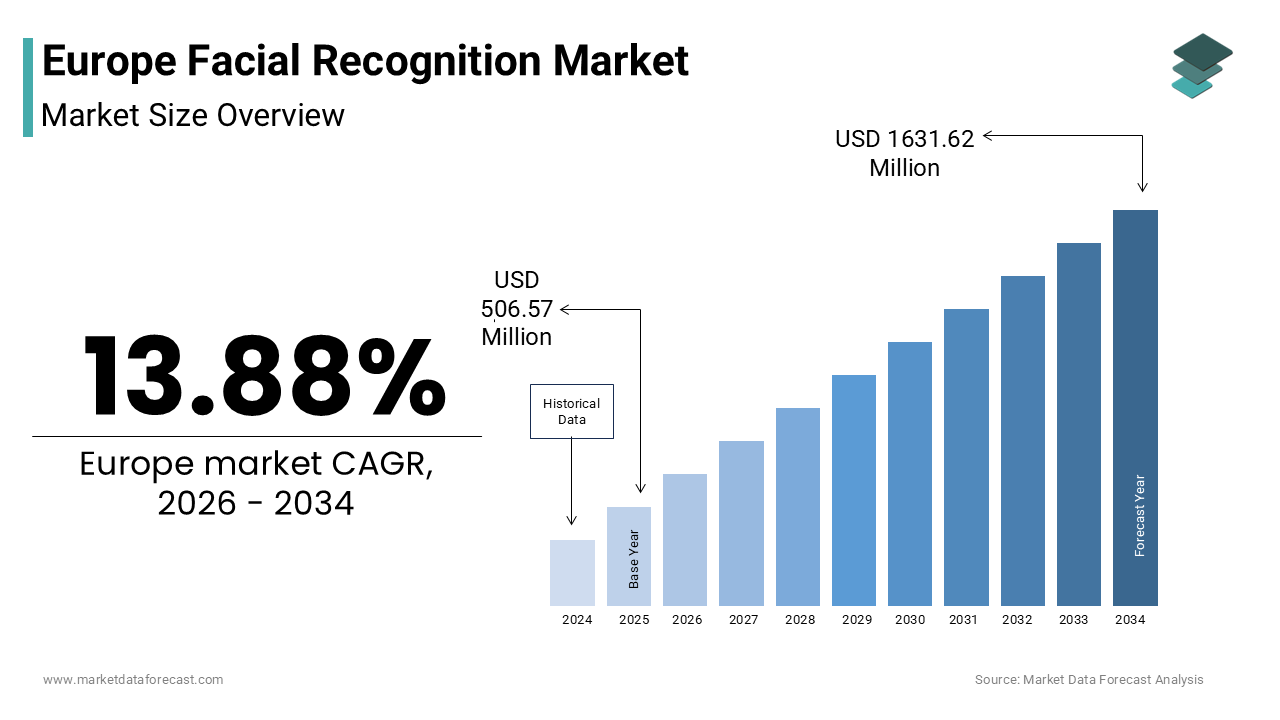
The Europe facial recognition market was valued at USD 506.57 million in 2025, is estimated to reach USD 576.89 million in 2026, and is projected to reach USD 1,631.62 million by 2034, growing at a CAGR of 13.88% during the forecast period from 2026 to 2034. The growth of the Europe facial recognition market is driven by the mandatory deployment of biometric systems in border control and travel security, the expansion of regulated digital identity frameworks, and the increasing adoption of facial authentication in banking and financial services. Growing use of facial recognition in controlled and legally sanctioned environments, such as access control, identity verification, and secure authentication, is further fueling market growth. Moreover, the integration of facial biometrics into the European Digital Identity Wallet and compliance-driven innovation under the GDPR and the EU Artificial Intelligence Act are shaping a highly regulated yet steadily expanding market landscape across Europe.
Key Market Trends
- Increasing deployment of facial recognition at EU external borders and automated eGate systems to enhance travel security and processing efficiency.
- Rising adoption of facial authentication in banking and financial services for strong customer authentication and remote onboarding.
- Growing focus on privacy-preserving and consent-based facial recognition systems aligned with GDPR and ethical AI principles.
- Expansion of on-device and on-premise facial recognition solutions to minimize biometric data storage and transmission risks.
- Emergence of facial recognition in regulated healthcare and workforce access management applications under strict data governance frameworks.
Segmental Insights
- Based on organization size, the large enterprises segment was the largest and held a significant share of the Europe facial recognition market in 2024. The segment’s dominance is attributed to the ability of large organizations to deploy high-assurance, compliant biometric systems in sectors such as border control, banking, transportation, and critical infrastructure, where identity verification is mandatory and subject to regulatory audits.
- Based on deployment mode, the on-premises segment occupied a prominent share of the Europe facial recognition market in 2024. This dominance stems from strict European data protection requirements, which mandate secure local storage and processing of biometric data in sensitive applications such as government services, healthcare, and financial institutions.
- Based on application, the access control segment was the largest, accounting for 41.2% of the Europe facial recognition market share in 2024. The growth of this segment is driven by the widespread adoption of facial recognition for secure entry management in government buildings, airports, data centers, and corporate campuses, where contactless and high-accuracy identity verification is required.
Regional Insights
The Europe facial recognition market is witnessing steady growth across major economies, supported by regulated biometric adoption, digital identity initiatives, and strong data protection frameworks.
- Germany was the largest contributor, accounting for 23.3% of the European facial recognition market share in 2024, driven by mandatory biometric deployment in federal buildings, airports, and critical infrastructure, along with strong investment in ethical and bias-mitigated AI systems.
- The United Kingdom continues to perform strongly, supported by controlled law enforcement use, widespread banking authentication adoption, and advanced biometric testing infrastructure.
- France is emerging as a key market, fueled by centralized digital identity programs, large-scale border control deployments, and strict national certification regimes governing biometric technologies.
- The Netherlands and Sweden are also witnessing notable growth, driven by fintech innovation, healthcare adoption, ethical AI research, and advanced digital government services, positioning them as leaders in responsible facial recognition deployment.
Competitive Landscape
The Europe facial recognition market is characterized by the dominance of established biometric technology providers with deep expertise in government identity, border management, and secure authentication systems. Leading companies are focusing on high-accuracy algorithms, advanced liveness detection, bias mitigation, and full regulatory compliance under GDPR and the EU AI Act. Vendors are prioritizing privacy-by-design architectures, on-device processing, and interoperability with EU digital identity frameworks. Strategic collaborations with government agencies, financial institutions, and infrastructure operators are strengthening market positioning. Prominent players in the Europe facial recognition market include NEC Corporation, Thales Group, Idemia, Cognitec Systems, Vision-Box, AnyVision, SenseTime, Herta Security, Ayonix, FacePhi, Veridas, and Aurora Computer Services.
Europe Facial Recognition Market Size
The Europe facial recognition market size was valued at USD 506.57 million in 2025 and is anticipated to reach USD 576.89 million in 2026 from USD 1631.62 million by 2034, growing at a CAGR of 13.88% during the forecast period from 2026 to 2034
Facial recognition technology to biometric systems that identify or verify individuals by analysing unique facial features from digital images or video streams using artificial intelligence and computer vision algorithms. Unlike generic surveillance tools these systems are increasingly deployed in controlled environments, such as border checkpoints access control in critical infrastructure and banking authentication, always under strict legal frameworks. Europe approaches facial recognition not as a blanket surveillance enabler but as a high-risk technology governed by the General Data Protection Regulation and the proposed Artificial Intelligence Act. Additionally, the European Commission’s Digital Identity Framework envisions facial verification as a core component of the European Digital Identity Wallet expected to be available to all EU citizens by 2026. These regulated deployments reflect Europe’s calibrated balance between security efficiency and fundamental rights, distinguishing its facial recognition landscape from more permissive global regimes.
MARKET DRIVERS
Mandatory Deployment in EU Border and Travel Security Systems
The systematic rollout of facial recognition at external Schengen borders, under EU regulatory mandates is propelling the growth of Europe facial recognition market. The Entry Exit System, which became operational in 2023 requires all third country nationals to be processed through automated border control gates using facial recognition to match live captures against visa and passport data. As per the European Border and Coast Guard Agency Frontex, over 180 million travellers passed through EU external borders in 2023 and nearly all major international airports including Paris Charles de Gaulle Frankfurt and Amsterdam Schiphol now operate biometric eGates with facial recognition as the sole identifier. The system replaces manual document checks with a contactless process that reduces processing time by up to 60% while improving document fraud detection. Furthermore, the EU’s Revised Customs Code requires biometric verification for trusted trader programmes enhancing supply chain security. This regulatory compulsion creates sustained demand for high accuracy low latency facial recognition systems that comply with the ISO IEC 39794 5 standard for facial image data interchange. Vendors must also ensure compliance with the European Biometrics Association’s ethical guidelines which prohibit mass surveillance or real time remote identification in public spaces focusing deployment strictly on one to one verification at controlled checkpoints.
Integration into Regulated Digital Identity and Financial Authentication Frameworks
The European Commission’s push for a unified digital identity infrastructure is accelerating the adoption of facial recognition in secure authentication for banking and public services. The integration into regulated digital identity and financial authentication frameworks is also accelerating the growth of Europe facial recognition market. The European Digital Identity Wallet initiative mandates that all EU member states offer citizens a mobile based digital ID by 2026, which uses facial biometrics for initial enrolment and subsequent logins. As per the European Banking Authority, over 78% of banks in the European Union now employ facial recognition as part of their strong customer authentication protocols in compliance with the Revised Payment Services Directive. These deployments are strictly limited to one-to-one verification and require explicit user consent for each transaction. In Germany, for example the Federal Financial Supervisory Authority approved facial recognition for remote account opening in 2023 provided the solution passed the iBeta PAD Level 1 liveness detection standard. Similarly, France’s ANSSI cybersecurity agency certified six facial recognition vendors in 2023 for use in national digital identity schemes. European facial recognition in finance and identity is constrained to on device or secure server based verification with stringent anti spoofing and data minimisation requirements by creating demand for privacy preserving algorithms that operate without storing raw biometric templates.
MARKET RESTRAINTS
Strict Prohibition of Real Time Remote Biometric Identification in Public Spaces
The European Union’s regulatory stance severely restricts the most controversial use case of facial recognition real time remote identification in publicly accessible spaces is restricting the growth of Europe facial recognition market. The strict prohibition of real time remote biometric identification in public spaces is hampering the growth of Europe facial recognition market. According to the European Parliament’s 2024 final text of the Artificial Intelligence Act such practices are banned for law enforcement except in narrowly defined post terrorist attack scenarios with judicial authorisation. This prohibition eliminates a major revenue stream available in other regions and forces vendors to pivot toward controlled environment applications. As per the European Data Protection Board, a 2023 enforcement sweep found that 11 out of 15 tested public space facial recognition trials in retail and transport hubs violated GDPR principles of necessity and proportionality leading to immediate shutdowns. The ban also discourages investment in mass recognition algorithms optimised for low resolution or non-cooperative subjects. Instead, developers must focus on high fidelity one to one verification under optimal lighting and pose conditions are limiting scalability and increasing per deployment costs. This legal ceiling fundamentally reshapes the market’s commercial logic compared to North America or Asia where public space monitoring remains an active segment.
Fragmented National Interpretations of Biometric Data Processing Rules
The EU regulations national data protection authorities apply divergent standards to facial recognition implementations creating compliance uncertainty. As per the European Data Protection Board, a 2023 comparative study revealed that Germany requires explicit written consent and independent algorithmic audits for any facial recognition use in workplaces whereas Spain permits implied consent in access control if alternative non biometric options exist. Similarly, France’s CNIL allows facial verification in banking apps only if liveness detection meets ANSSI’s April 2022 technical standard while the Netherlands’ Autoriteit Persoonsgegevens mandates on device processing with no cloud transmission. These discrepancies force vendors to maintain multiple compliance versions of the same software increasing development costs and delaying pan European rollouts. A facial recognition solution approved for use in Swedish schools was prohibited in Austria due to differing interpretations of children’s biometric data protections under Article 8 of the GDPR. This fragmentation undermines economies of scale and deters smaller European startups from entering the market due to legal overhead.
MARKET OPPORTUNITIES
Controlled Expansion in Healthcare Patient Identification and Access Management
Facial recognition is emerging as a secure and efficient solution for patient identification and controlled facility access in Europe’s healthcare sector thereby operating under strict data governance. Hospitals in Sweden, the Netherlands, and Finland have piloted facial verification systems to prevent medical identity fraud, which the European Health Insurance Card network estimates affects over 500,000 transactions annually. As per the European Centre for Disease Prevention and Control, accurate patient matching reduces duplicate records by up to 30% thereby improving treatment safety and interoperability of electronic health records. These deployments use on premise servers with encrypted facial templates that are never shared across institutions complying with the EU’s Health Data Governance Framework. In 2023, the Karolinska University Hospital in Stockholm implemented a facial recognition system to grant staff access to restricted laboratories housing high risk pathogens eliminating shared keycards that posed contamination and security risks. Similarly, the Dutch Ministry of Health certified a facial authentication platform for telemedicine platforms ensuring that only registered patients access sensitive consultations. These use cases demonstrate that when embedded within robust ethical and technical safeguards facial recognition can enhance both security and care quality in Europe’s highly regulated health ecosystem.
Adoption in Private Sector Workforce Management Under Ethical AI Pilots
The companies are cautiously integrating facial recognition into workforce systems through government sanctioned ethical AI pilots that prioritise transparency and employee rights, which is inclined to elevate the growth of the Europe facial recognition market. The European Commission’s AI Regulatory Sandbox has approved over 30 facial recognition trials in manufacturing logistics and energy sectors since 2022 where the technology is used for time attendance and restricted area access, not productivity monitoring. As per Germany’s Federal Ministry of Labour and Social Affairs, workers must receive clear notice and the right to opt out in all sandbox projects with biometric data stored locally and deleted after 72 hours. In Denmark, a leading wind turbine manufacturer reduced site entry time by 40% using facial recognition while maintaining full compliance with the Danish Data Protection Agency’s 2023 guidelines on workplace biometrics. Similarly, the French Labour Inspectorate permitted a facial access system at a Renault logistics hub provided it included a non-biometric fallback and quarterly bias audits. These controlled rollouts generate real world performance data while upholding the EU’s principle of human oversight, thereby creating a pathway for responsible commercial adoption that balances operational efficiency with fundamental rights.
MARKET CHALLENGES
Algorithmic Performance Disparities Across Demographic Groups
Facial recognition systems in Europe continue to exhibit accuracy gaps across gender age and ethnic subgroups raising fairness and legal compliance concerns. This is also prompting new opportunities for the growth of Europe facial recognition market. As per a 2024 evaluation by the European Union Agency for Fundamental Rights commercial algorithms tested on EU citizen datasets showed false non-match rates up to 4.2 times higher for women over 65 and 3.8 times higher for individuals of North African descent compared to young Caucasian males. These disparities violate the Artificial Intelligence Act’s requirement for high-risk systems to undergo bias mitigation and representative data testing. In Sweden, a 2023 pilot at Arlanda Airport was suspended after the system failed to verify 22% of female asylum seekers from sub-Saharan Africa.
Technical Vulnerabilities to Presentation and Adversarial Attacks
Despite regulatory safeguards, facial recognition systems remain susceptible to sophisticated spoofing and evasion techniques that compromise security in high stakes applications. As per the European Union Agency for Cybersecurity, synthetic media including deepfake videos and 3D printed masks successfully bypassed liveness detection in 4 out of 9 commercial systems tested in 2023. These vulnerabilities are particularly concerning in banking and border control, where identity fraud carries significant financial and security consequences. The EU’s Common Criteria certification scheme now requires Level 1 presentation attack detection as a minimum yet many legacy systems in transport and enterprise access control lack this capability. In 2023, French customs officials intercepted a case where a traveller used a high-resolution photograph on a smartphone to spoof an eGate system at Lyon Saint Exupéry Airport highlighting real world exploitability. Furthermore, adversarial patches subtle pixel level perturbations invisible to humans can cause misclassification with over 90% success rates in laboratory settings according to research from the Technical University of Munich.
REPORT COVERAGE
| REPORT METRIC | DETAILS |
| Market Size Available | 2025 to 2034 |
| Base Year | 2025 |
| Forecast Period | 2026 to 2034 |
| CAGR | 13.88% |
| Segments Covered | By Organization size, Deployment Mode, Offering, Technology, Application and Region |
| Various Analyses Covered | Regional & Country Level Analysis, Segment-Level Analysis, DROC, PESTLE Analysis, Porter’s Five Forces Analysis, Competitive Landscape, Analyst Overview on Investment Opportunities |
| Countries Covered | UK, France, Spain, Germany, Italy, Russia, Sweden, Denmark, Switzerland, the Netherlands, Turkey, the Czech Republic, and the Rest of Europe. |
| Market Leaders Profiled | NEC Corporation, Thales Group, Idemia, Cognitec Systems, Vision-Box, AnyVision, SenseTime, Herta Security, Ayonix, FacePhi, Veridas, and Aurora Computer Services. |
SEGMENTAL ANALYSIS
By Organization Size Insights
The large enterprises segment was accounted in holding a dominant share of the Europe facial recognition market in 2024 owing to the capacity to deploy high assurance systems in compliance with stringent regulatory and security requirements. These organisations operate in sectors such as banking border control energy and critical infrastructure where identity verification is non-negotiable and subject to audit under frameworks like the EU’s NIS2 Directive. As per the European Banking Federation over 85% of systemically important banks in the European Union have implemented facial recognition for remote onboarding and transaction authentication using certified liveness detection. Similarly, major airports under the oversight of the European Union Aviation Safety Agency have mandated biometric identity verification at boarding gates with facial recognition replacing manual passport checks at over 120 international airports by 2023. Large enterprises also benefit from dedicated legal and compliance teams capable of navigating the complex interplay between the General Data Protection Regulation the Artificial Intelligence Act and sector specific data protection rules.
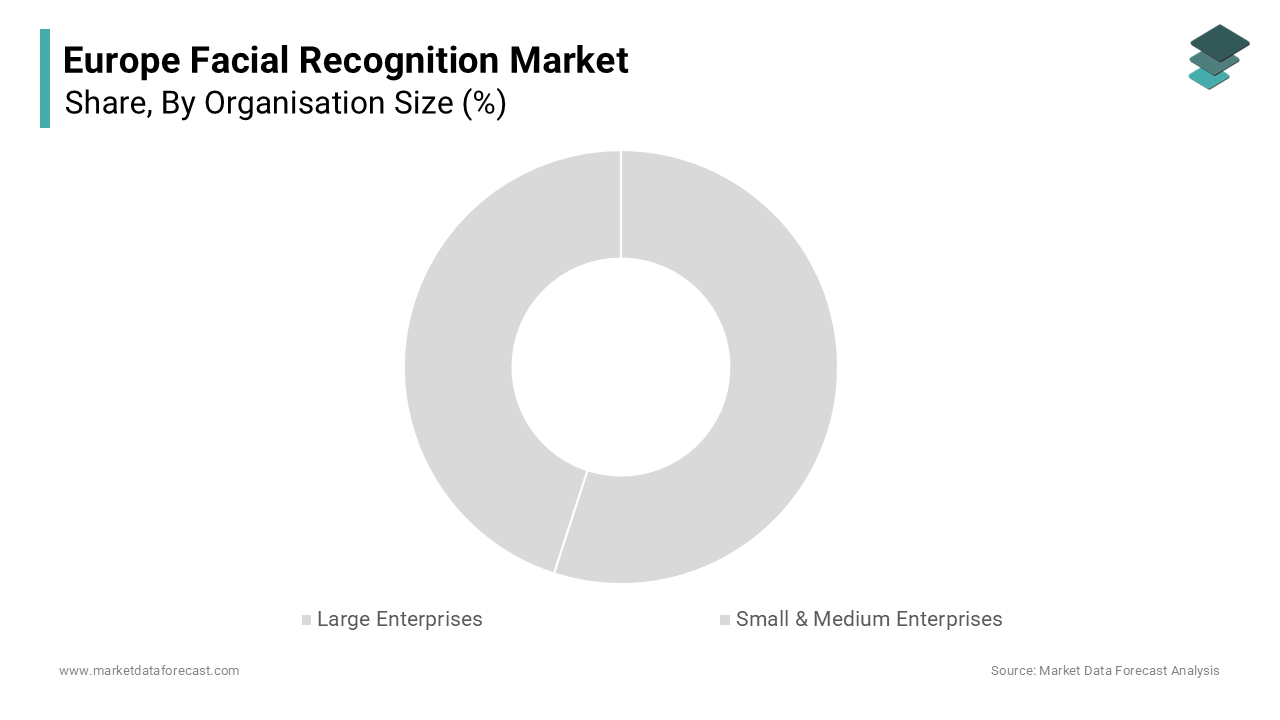
The Small and medium enterprises segment is likely to grow at a fastest CAGR of 18.7% from 2025 to 2033. The growth of the segment is driven by the availability of pre certified cloud based facial verification APIs that abstract regulatory complexity and reduce upfront costs. As per the European Commission’s 2023 SME Digitalisation Scoreboard, over 40% of European SMEs now use at least one regulated biometric authentication service for customer onboarding particularly in fintech e commerce and professional services. The European Digital Identity Wallet framework further enables SMEs to integrate facial recognition without managing biometric data directly instead relying on national trust schemes that handle verification via secure attribute exchange. In the Netherlands, for example over 12,000 small accounting and legal firms adopted facial authentication in 2023 to comply with anti-money laundering customer due diligence rules without building in house identity infrastructure. Similarly, Germany’s Federal Office for Information Security certified a suite of SME friendly facial recognition software development kits in early 2024 that include built in GDPR compliant consent flows and iBeta PAD Level 1 liveness. These enablers lower the barrier to entry while ensuring legal safety unlocking adoption across Europe’s 23 million SMEs.
By Deployment Mode Insights
The On premises deployment segment was the largest by accounting for a significant share of the Europe facial recognition market in 2024. European regulations including the General Data Protection Regulation classify facial templates as special category personal data requiring processing within secure controlled environments with minimal data retention. As per the European Data Protection Board’s 2023, guidance on biometrics organisations handling sensitive applications such as border control banking or healthcare must store facial templates on local servers or secure hardware security modules rather than in third party cloud environments. Germany’s Federal Office for Information Security explicitly prohibits cloud based facial recognition for infrastructure access unless end to end encryption and on device matching are guaranteed with a standard few public cloud providers meet. Consequently, airports banks and government agencies across France Italy and Sweden have opted for on premises solutions from vendors like Idemia and Gemalto that embed matching engines directly into access control hardware.
The cloud based facial recognition segment is expected to grow at a CAGR of 22.3% from 2026 to 2034 with the rise of regulated digital identity services and SME adoption of compliant authentication-as-a-service models. The European Commission’s Digital Identity Framework enables cloud deployment under strict conditions including data minimisation on device matching and use of qualified trust service providers. As per the European Union Agency for Cybersecurity, over 18 cloud based facial verification services received EU cybersecurity certification under the EN 303 645 standard in 2023 allowing them to be integrated into banking and telehealth platforms across member states. These services do not store facial images but instead generate ephemeral cryptographic tokens during verification, addressing core GDPR concerns. In France, the Banque de France approved three cloud facial recognition providers in 2024 for use in open banking applications provided they operate on sovereign cloud infrastructure like OVHcloud or Scaleway. Similarly, Sweden’s Posten BankID system migrated to a cloud hosted facial verification backend in 2023 using homomorphic encryption to process biometrics without decryption. These innovations demonstrate that cloud deployment is viable in Europe when embedded within robust legal and cryptographic safeguards.
By Application Insights
The access control segment was the largest by occupying 41.2% of the Europe facial recognition market share in 2024 owing to the Europe’s prioritisation of physical security in infrastructure government facilities and corporate campuses under the EU’s Directive on the Security of Network and Information Systems. As per the European Physical Security Association, over 60% of new access control installations in EU classified sites now include facial recognition as a primary or secondary factor replacing keycards and PINs. Germany’s Federal Ministry of the Interior mandated biometric access for all federal buildings by 2023 with facial recognition preferred due to its contactless nature and resistance to credential sharing. Similarly, France’s ANSSI certified 27 facial recognition access systems in 2023 for use in nuclear plants research laboratories and data centres. These deployments are typically on-premise use liveness detection and delete biometric data immediately after verification by making access control the most legally defensible and widely adopted use case across Europe.
The emotion recognition segment is projected to grow at CAGR of 26.4% concentrated in highly regulated research and user experience domains rather than public monitoring. As per the European Commission’s AI Regulatory Sandbox 14 emotion recognition pilots were approved in 2023 for use in healthcare automotive safety and human computer interaction, all requiring explicit informed consent and strict data anonymisation. In Sweden, Karolinska Institute researchers used emotion recognition to assess pain levels in non-verbal dementia patients achieving 88% correlation with clinical scales, according to a 2024 study published in The Lancet Digital Health. Similarly, Volkswagen’s R&D centre in Wolfsburg employs cabin mounted emotion recognition to evaluate driver fatigue during autonomous vehicle testing under supervision of Germany’s Federal Motor Transport Authority. These deployments avoid inferencing on protected characteristics and focus on transient affective states with immediate feedback loops.
REGIONAL ANALYSIS
Germany Facial Recognition Market Analysis
Germany was the top performer of the Europe facial recognition market by holding 23.3% of share in 2024 with its advanced industrial base stringent data protection culture in secure identity infrastructure. The country mandates biometric access control in all federal buildings and energy facilities under the Federal Office for Information Security’s 2023 technical directive. As per Germany’s Federal Criminal Police Office, over 95% of international airports including Frankfurt and Munich operate GDPR compliant facial recognition eGates integrated with the EU Entry Exit System. German financial institutions also pioneer regulated facial authentication with Deutsche Bank and Commerzbank deploying on premise verification for high-net worth client onboarding using systems certified by the Federal Office for Information Security. Furthermore, Germany’s Federal Ministry of Education and Research funds the “Trusted AI” initiative which develops bias resilient facial recognition models trained on diverse German demographic datasets.
United Kingdom Facial Recognition Market Analysis
The United Kingdom facial recognition market was positioned next with 17.8% of share in 2024 with its pragmatic regulatory approach in law enforcement biometrics. The UK’s Biometrics and Forensics Ethics Group oversees all public sector deployments ensuring compliance with human rights standards. As per the Home Office, over 70 police forces use facial recognition for retrospective suspect identification in controlled environments such as football stadiums and transport hubs with real time use restricted to terrorism investigations. The Metropolitan Police reported a 98.4% accuracy rate in its 2023 Notting Hill Carnival deployment using live facial recognition against a pre vetted watchlist. In the private sector the UK’s Financial Conduct Authority permits facial recognition for remote banking provided vendors pass iBeta PAD Level 2 certification with a standard met by 11 UK based firms in 2023. Additionally, the National Physical Laboratory operates Europe’s only ISO 17025 accredited biometric testing facility which validates algorithmic fairness and spoof resistance.
France Facial Recognition Market Analysis
France facial recognition market growth is likely to grow with its centralised digital identity strategy and aerospace security applications. The French National Commission on Informatics and Liberty CNIL maintains one of Europe’s strictest approval regimes for biometric systems requiring independent algorithmic audits and data protection impact assessments. As per the French Ministry of the Interior the Parafe automated border control system processed over 45 million travellers in 2023 using facial recognition with a false acceptance rate below 0.001%. France’s ANSSI cybersecurity agency certified 32 facial recognition solutions in 2023 for use in defence nuclear and banking sectors with mandatory on device matching and 256-bit encryption. Additionally, Airbus integrates facial recognition into cockpit access and maintenance log systems at its Toulouse facility to prevent unauthorised entry under EU Aviation Safety Agency rules. The country’s Digital Identity Wallet launched in 2023 enables citizens to authenticate to public services using facial verification processed on sovereign cloud infrastructure. These coordinated public private efforts make France a hub for high assurance biometric deployments.
Sweden Facial Recognition Market Analysis
Sweden facial recognition market growth is likely to grow with ethical AI research healthcare innovation and digital government services. The country prohibits real time public surveillance but permits facial recognition in controlled settings with explicit consent and data minimisation. As per Sweden’s Data Protection Authority, over 120 hospitals use facial verification for patient identification in electronic health records reducing duplicate entries by 28% according to the Swedish eHealth Agency. Stockholm Arlanda Airport operates one of Europe’s most advanced biometric corridors where facial recognition links check in security and boarding without storing images—complying with the Swedish Police Authority’s 2023 data retention limits. Furthermore, Sweden’s Innovation Agency Vinnova funds the “FairBiometrics” consortium which develops open source bias mitigation tools for facial recognition trained on Nordic demographic data.
Netherlands Facial Recognition Market Analysis
The Netherlands facial recognition market growth is likely to grow with its port security needs data protection leadership and fintech innovation. The Port of Rotterdam, where the largest in Europe uses facial recognition for authorised personnel access to sensitive cargo zones, under the Dutch National Cyber Security Centre’s 2023 maritime security directive. As per the Dutch Data Protection Authority, facial recognition in workplaces requires a works council approval and a non-biometric alternative with a rule that has shaped vendor design across Europe. Dutch banks including ING and ABN AMRO offer facial authentication for mobile banking using on device matching certified under the Dutch Central Bank’s 2023 fintech sandbox. Additionally, the Netherlands is home to leading biometric testing labs such as TNO, which validates algorithmic fairness against the Dutch population’s diverse ethnic composition, 23% of Amsterdam residents are non-EU born
COMPETITIVE LANDSCAPE
Competition in the Europe facial recognition market is defined by regulatory compliance technical precision and ethical accountability rather than scale or cost. Unlike other regions where mass surveillance drives adoption European vendors must navigate strict prohibitions on real time remote identification and mandatory safeguards for biometric data. This environment favours established players like Idemia NEC and Thales who combine decades of government identity experience with certified algorithms and local data processing capabilities. New entrants face high barriers including the need for national cybersecurity certifications independent bias audits and integration with EU frameworks like the Entry Exit System or Digital Identity Wallet. Competition intensifies around liveness detection accuracy data minimisation architecture and interoperability with legacy access control systems. Success depends on demonstrating not just performance but legal defensibility, making trust transparency and regulatory foresight the true differentiators in Europe’s constrained yet strategically vital facial recognition landscape.
KEY MARKET PLAYERS
Some of the companies that are playing a dominating role in the Europe facial recognition market include
- NEC Corporation
- Thales Group
- Idemia
- Cognitec Systems
- Vision-Box
- AnyVision
- SenseTime
- Herta Security
- Ayonix
- FacePhi
- Veridas
- Aurora Computer Services
Top Players in the Market
Idemia Group SAS
Idemia Group SAS is a leading European provider of facial recognition solutions with deep integration into government identity border control and financial authentication systems. The company supplies biometric eGates to over 80 international airports across Europe including Paris Charles de Gaulle and London Heathrow. Idemia’s MorphoFace technology is certified under EU standards for liveness detection and GDPR compliant data handling. In 2024, Idemia partnered with the European Border and Coast Guard Agency to enhance the Entry Exit System with contactless facial verification that processes travellers in under five seconds. It also launched a new on-premise facial recognition platform for banks that performs matching on secure hardware without cloud transmission. These initiatives reinforce Idemia’s role as a trusted enabler of secure and regulated biometric identification, across Europe.
NEC Corporation Europe GmbH
NEC Corporation Europe GmbH delivers high accuracy facial recognition systems tailored for European public safety transport and enterprise security applications. Its NeoFace engine is deployed in major European railway hubs airports and critical infrastructure sites with compliance to EN 303 645 and ISO IEC 24358 standards. NEC maintains a dedicated AI ethics board in Munich that oversees algorithmic fairness testing across demographic subgroups. NEC integrated its facial recognition engine into the German Federal Police’s retrospective suspect identification platform achieving a false match rate below one in ten million. The company also collaborated with Dutch healthcare providers to pilot patient identification systems that delete biometric templates after each session. These actions position NEC as a technology leader committed to ethical and compliant biometric deployment in Europe.
Thales Group
Thales Group plays a strategic role in the Europe facial recognition market through its biometric solutions for national identity documents border management and secure access control. The company’s facial recognition algorithms power the French and Italian national biometric passport systems and are embedded in EU approved eID cards. Thales operates a sovereign cloud biometric verification platform in France that supports the European Digital Identity Wallet initiative with on device matching and zero raw data storage. Thales received certification from Germany’s Federal Office for Information Security for its facial authentication SDK used by major European banks. It also launched a new generation of facial recognition terminals for airports featuring adaptive lighting and real time presentation attack detection. These developments underscore Thales’s commitment to secure interoperable and regulation aligned biometric infrastructure across Europe.
MARKET SEGMENTATION
This research report on the Europe facial recognition market has been segmented and sub-segmented based on following categories.
By Organization Size
- Large Enterprises
- Small & Medium Enterprises
By Deployment Mode
- On-premises
- Cloud
By Offering
- Software
- Hardware
- Services
By Technology
- 3D
- 2D
- Facial Analytics
By Application
- Access Control
- Attendance Tracking & Monitoring
- Security & Surveillance
- Emotion Recognition
- Others
By Vertical
- Government
- Media & Entertainment
- Education
- Healthcare & Lifesciences
- Automobile & Transportation
- Manufacturing
- Retail & eCommerce
- IT & Telecom
- Others
By Country
- UK
- France
- Spain
- Germany
- Italy
- Russia
- Sweden
- Denmark
- Switzerland
- Netherlands
- Turkey
- Czech Republic
- Rest of Europe