European Factory Automation Market Size, Share, Trends, & Growth Forecast Report By Product Type (Distributed Control Systems (DCS), Programmable Logic Controllers (PLC) Supervisory Control and Data Acquisition (SCADA), Manufacturing Execution Systems (MES), Product Lifecycle Management (PLM), Human Machine Interface (HMI), Enterprise Resource Planning (ERP)), Field Device Type, Deployment Model, End-User Industry and Country (UK, France, Spain, Germany, Italy, Russia, Sweden, Denmark, Switzerland, Netherlands, Turkey, Czech Republic and Rest of Europe), Industry Analysis From 2026 to 2034
Market Size, 2025
$64.10 BnMarket Estimate, 2026
$69.31 BnMarket Forecast, 2034
$129.53 BnCAGR, 2026–2034
8.13%Europe Factory Automation Market Report Summary
The Europe factory automation market was valued at USD 64.10 billion in 2025, is estimated to reach USD 69.31 billion in 2026, and is projected to reach USD 129.53 billion by 2034, growing at a CAGR of 8.13% during the forecast period from 2026 to 2034. The growth of the Europe factory automation market is driven by acute labor shortages, stringent environmental and safety regulations, Industry 4.0 initiatives, the reshoring of manufacturing operations, and rapid advancements in artificial intelligence-enabled manufacturing systems. Increasing deployment of industrial robots, smart control systems, and cyber-physical production technologies is transforming traditional factories into intelligent, data-driven production ecosystems. Moreover, the integration of predictive analytics, edge computing, and energy optimization technologies is further accelerating automation adoption across automotive, food & beverage, pharmaceuticals, and heavy industries in Europe.
Key Market Trends
- Rising adoption of AI-powered predictive maintenance and real-time quality inspection systems across manufacturing plants.
- Increasing deployment of collaborative robots (cobots) to address labor shortages and improve human-machine collaboration.
- Growing implementation of cloud-enabled and hybrid edge-cloud automation architectures for enhanced operational visibility.
- Expansion of reshored and nearshored manufacturing facilities with high automation intensity to strengthen supply chain resilience.
- Strong focus on energy-efficient and carbon-optimized production lines aligned with the European Green Deal and sustainability mandates.
Segmental Insights
Based on product type, the industrial control systems segment was the largest and held 42.2% of the Europe factory automation market share in 2024. The dominance of this segment is attributed to the widespread adoption of distributed control systems (DCS), programmable logic controllers (PLC), and supervisory control and data acquisition (SCADA) systems across automotive, chemical, and pharmaceutical industries to enable real-time monitoring and regulatory compliance.
Based on field device type, the industrial robots segment accounted for 38.2% of the Europe factory automation market share in 2024. The segment’s leadership is driven by high robot density in automotive and electronics manufacturing, ensuring precision, speed, and consistent quality in large-scale production environments.
Based on end-user industry, the automotive segment captured 28.3% of the Europe factory automation market share in 2024. The segment’s dominance stems from the extensive use of robotic welding, automated assembly lines, electric vehicle battery manufacturing automation, and stringent traceability requirements mandated under EU regulations.
Based on enterprise size, the large enterprises segment occupied a prominent share of the Europe factory automation market in 2024. The dominance of this segment is supported by strong capital availability, established Industry 4.0 roadmaps, and the ability to manage complex multi-site automation deployments.
Regional Insights
The Europe factory automation market is witnessing strong growth across major industrial economies, supported by advanced manufacturing ecosystems and proactive digital transformation strategies.
- Germany was the largest contributor, accounting for 27.3% of the Europe factory automation market share in 2024, driven by its strong automotive base, Industrie 4.0 initiatives, and high robot density across manufacturing facilities.
- Italy ranked second with a significant market share in 2024, supported by its dense network of specialized SMEs in machinery, packaging, ceramics, and food processing industries.
- France continues to demonstrate robust growth, fueled by aerospace automation, reindustrialization investments, and national digitization programs such as France 2030.
- The United Kingdom is emerging as a key market driven by pharmaceutical automation, aerospace precision engineering, and AI-enabled predictive maintenance adoption.
- The Netherlands is also strengthening its position, supported by semiconductor equipment manufacturing, smart port logistics automation, and strong digital infrastructure.
Competitive Landscape
The Europe factory automation market is characterized by the strong presence of global automation leaders and specialized industrial technology providers. Leading companies are focusing on interoperability through open communication standards, integration of AI-driven analytics, expansion of edge computing capabilities, and development of energy-efficient automation platforms aligned with EU sustainability targets. Strategic collaborations with national Industry 4.0 programs, research institutions, and vocational training centers are strengthening competitive positioning across the region. Prominent players in the Europe factory automation market include ABB, Siemens, Rockwell Automation, Schneider Electric, Mitsubishi Electric, Honeywell, Emerson Electric, Bosch Rexroth, FANUC, Yaskawa Electric, Omron, Keyence, Yokogawa Electric, and KUKA.
Europe Factory Automation Market Size
The europe factory automation market size was valued at USD 64.10 billion in 2025 and is anticipated to reach USD 69.31 billion in 2026 from USD 129.53 billion by 2034, growing at a CAGR of 8.13% during the forecast period from 2026 to 2034.
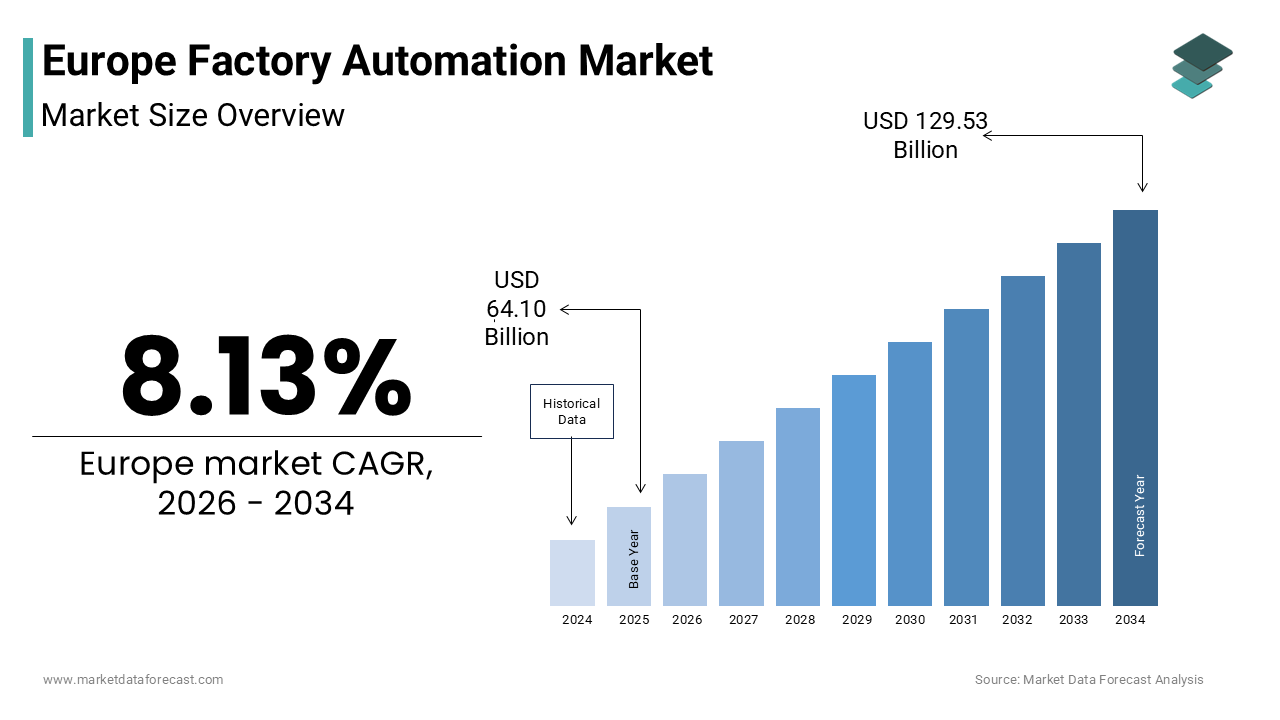
Factory automation represents the integration of advanced control systems, robotics, and digital technologies to optimize manufacturing processes across the continent. This ecosystem transcends mere mechanization by embedding intelligence into production lines to enhance flexibility and precision. According to the International Federation of Robotics, Europe is recognized as one of the largest robotic markets globally. Germany reflects its deep industrial heritage by accounting for a significant portion of installed industrial robots within Europe. As per Eurostat, the manufacturing sector plays a major role in contributing to the overall gross value added of the European Union economy, which provides a strong base for automation adoption. As per the European Commission, many large European manufacturers have implemented smart factory technologies as part of the industry 4.0 push. This transformation is not uniform and varies between Western and Eastern European nations depending on infrastructure maturity. The definition now encompasses cyber physical systems that enable real time data exchange between machines and human operators. Such connectivity aims to reduce downtime and improve resource efficiency while adhering to stringent environmental regulations prevalent across the union.
MARKET DRIVERS
Acute Labor Shortages Driving Operational Necessity
The persistent scarcity of skilled manufacturing workers is majorly propelling the growth of the European factory automation market. According to the European Centre for the Development of Vocational Training, demographic shifts have resulted in an aging workforce in countries such as Germany and Italy. This reality creates a critical gap as older workers retire without sufficient younger replacements entering the trade. As per the European Labour Authority, many vacancies remain unfilled across the industrial sector in the European Union, forcing companies to seek technological substitutes. Manufacturers increasingly deploy collaborative robots to handle repetitive tasks that humans find undesirable or physically demanding. According to the German Engineering Federation, a large proportion of mechanical engineering firms cite lack of qualified personnel as their biggest hurdle to growth. Consequently, investment in automated assembly lines has become a strategic imperative rather than a discretionary upgrade. Companies utilize these systems to maintain output levels despite shrinking labor pools. This trend accelerates the shift toward lights out manufacturing facilities where minimal human intervention is required. The urgency to sustain production capacity amidst declining available manpower ensures continued demand for sophisticated robotic solutions and automated guided vehicles across diverse industrial verticals.
Stringent Regulatory Frameworks Mandating Efficiency
Rigorous environmental and safety regulations imposed by the European Union compel manufacturers to adopt automated systems to ensure compliance and operational efficiency, which is further boosting the expansion of the European factory automation market. According to the European Environment Agency, the European Green Deal sets ambitious targets requiring significant reductions in greenhouse gas emissions by 2030 compared to 1990 levels. Achieving such reductions demands precise control over energy consumption and waste generation which manual processes often fail to deliver consistently. Automation technologies enable real time monitoring of resource usage allowing factories to optimize energy draw and minimize material scrap rates. As per the Confederation of European Paper Industries, automated mills achieve better energy efficiency than traditional setups. Furthermore, the Machinery Regulation updated recently enforces stricter safety standards that favor machines with built in sensors and emergency stop protocols. These regulatory pressures force industries ranging from automotive to pharmaceuticals to upgrade legacy equipment with smart controllers. Non-compliance risks severe financial penalties and reputational damage which acts as a powerful motivator for capital expenditure on automation. The drive to meet these legal obligations transforms automation from a competitive advantage into a mandatory requirement for market access. Manufacturers who delay this transition face existential threats due to inability to meet evolving statutory benchmarks regarding carbon footprints and worker safety protocols.
MARKET RESTRAINTS
High Initial Capital Investment Barriers
The substantial upfront financial commitment required for implementing advanced automation systems acts as a significant restraint for the European factory automation market growth. According to the Fraunhofer Institute for Manufacturing Engineering, deploying a fully integrated robotic cell often involves high costs when including software licensing, installation, and training expenses. Small businesses which constitute over 99% of all enterprises in the European Union frequently lack the liquidity to fund such massive capital outlays without jeopardizing daily operations. The return on investment period can stretch beyond three to five years depending on production volume and complexity which deters risk averse management teams. Financial institutions remain cautious about lending for unproven technologies leading to limited access to credit for automation projects. As per the European Investment Bank, only 15% of small manufacturing firms successfully secure dedicated funding for digital transformation initiatives. This financial bottleneck prevents widespread adoption particularly in Southern and Eastern European regions where profit margins are thinner. Companies often opt to extend the life of outdated machinery rather than risk bankruptcy on new installations. The high cost of proprietary software maintenance and specialized spare parts further exacerbates the total cost of ownership burden. Without accessible financing models or government subsidies tailored to smaller players, the pace of modernization remains uneven across the continental landscape.
Complex Integration with Legacy Infrastructure
Integrating modern automation solutions with existing legacy infrastructure presents a formidable technical challenge for the European factory automation market. According to the European Manufacturing Technology Association, a large proportion of installed industrial equipment in Europe predates the year 2000 and operates on closed proprietary systems. Retrofitting these assets requires custom engineering solutions that are time consuming and prone to unexpected failures during the transition phase. Engineers often struggle to bridge the gap between old programmable logic controllers and new cloud-based analytics platforms without causing production disruptions. Data interoperability issues arise when different vendors use incompatible data formats leading to siloed information flows that defeat the purpose of unified automation. As per the VDMA, integration complexities account for a significant portion of the total project timeline in digitalization efforts. This technical friction increases implementation risks and discourages manufacturers from pursuing comprehensive upgrades. The absence of universal standards for machine-to-machine communication further complicates the landscape forcing companies to rely on costly middleware. Until plug and play compatibility becomes standard across all equipment generations the friction of integration will continue to impede rapid scaling of automated ecosystems.
MARKET OPPORTUNITIES
Expansion of Reshoring Initiatives Boosting Local Demand
The growing trend of reshoring manufacturing activities back to Europe creates a fertile ground for the European factory automation market. Geopolitical tensions and supply chain disruptions experienced during recent global crises have prompted executives to relocate production closer to end markets. According to the European Commission, many multinational corporations plan to move part of their production capacity back to the continent within the next five years. To make this economically viable against low-cost Asian competitors these returning facilities must leverage high degrees of automation to maintain competitiveness. Automated lines allow reshored plants to operate with minimal staff while achieving output qualities that justify premium pricing strategies. Countries like Poland and Czechia are witnessing surges in foreign direct investment specifically targeted at building highly automated hubs for electronics and automotive components. As per fDi Markets, greenfield investment projects in European manufacturing have shown notable growth with a strong focus on technologically advanced setups. This shift reduces dependency on volatile global logistics networks and enhances supply chain resilience. Manufacturers view automation as the key enabler that makes domestic production financially sustainable despite higher wage structures. The convergence of strategic security concerns and economic necessity drives unprecedented demand for turnkey automated solutions tailored to local regulatory environments.
Advancements in Artificial Intelligence Capabilities
The rapid evolution of artificial intelligence technologies offers transformative opportunities for the European factory automation market. Modern AI algorithms can analyse vast streams of sensor data to predict equipment failures before they occur thereby minimizing unplanned downtime. According to the Max Planck Institute, AI driven predictive maintenance can significantly reduce machine downtime while extending asset lifecycles. European manufacturers are increasingly embedding these intelligent systems into their operational workflows to achieve higher overall equipment effectiveness. Machine learning models allow production lines to self-optimize based on real time feedback regarding quality deviations or throughput bottlenecks. As per Horizon Europe, substantial funding has been allocated to support research into cognitive manufacturing systems that learn from historical data patterns. This technological leap facilitates mass customization where factories can switch between product variants without lengthy reconfiguration delays. Automotive giants in Germany and France already utilize AI powered vision systems to inspect parts with accuracy surpassing human capabilities. The ability to process unstructured data from audio and video feeds opens new avenues for quality assurance and safety monitoring. As these tools become more accessible through edge computing devices even smaller factories can harness sophisticated analytical power to compete effectively in dynamic markets.
MARKET CHALLENGES
Cybersecurity Vulnerabilities in Connected Systems
The increasing interconnectivity of automated factory systems exposes European manufacturers to escalating cybersecurity threats that pose severe operational and financial risks, which is a notable challenge to the growth of the European factory automation market. As factories become more digitized the attack surface expands dramatically allowing malicious actors to potentially hijack critical control systems or steal proprietary intellectual property. According to the European Union Agency for Cybersecurity, industrial control system attacks have been rising, targeting essential infrastructure sectors. A successful breach can halt entire production lines causing millions in losses and damaging brand reputation irreparably. Many legacy automation components were designed without inherent security features making them easy entry points for ransomware gangs. The complexity of securing heterogeneous networks comprising robots, sensors, and enterprise software overwhelms internal IT teams lacking specialized industrial expertise. Incidents such as disruptions of major automotive plants due to malware infections highlight the fragility of hyperconnected environments. Compliance with the new NIS2 Directive requires rigorous security audits yet implementation gaps remain widespread across the supply chain. Fear of such catastrophic breaches causes some organizations to delay full digital integration or isolate systems which undermines the benefits of connectivity. Developing robust defense mechanisms requires continuous investment and vigilance which strains resources especially for mid-sized enterprises lacking dedicated security operations centers.
Deficit of Specialized Technical Workforce
A profound shortage of professionals possessing the specialized skills required to design, operate, and maintain advanced automation systems constrains market growth across Europe. The transition toward smart factories demands a workforce proficient in robotics programming, data analytics, and cyber physical system management which current education pipelines fail to supply adequately. According to the European Skills Index, many employers in the manufacturing sector struggle to find candidates with appropriate digital competencies. Universities and vocational schools often lag behind industry needs resulting in a mismatch between graduate skills and practical requirements. This talent gap forces companies to poach scarce experts driving up salary costs and creating instability within technical teams. Without qualified personnel even the most sophisticated automated installations cannot reach their full potential or may suffer from frequent malfunctions. The situation is exacerbated by the rapid pace of technological change which renders existing knowledge obsolete within short periods requiring constant upskilling. Initiatives like the Pact for Skills aim to address this issue but progress remains slow relative to the speed of automation deployment. Companies face difficult choices between delaying expansion projects or relying on external consultants at premium rates. This structural deficiency in human capital acts as a bottleneck that limits the scalability of automation initiatives throughout the region.
REPORT COVERAGE
| REPORT METRIC | DETAILS |
| Market Size Available | 2025 to 2034 |
| Base Year | 2025 |
| Forecast Period | 2026 to 2034 |
| CAGR | 8.13% |
| Segments Covered | By Product Type, Field Device Type, Deployment Model, End-User Industry and Region |
| Various Analyses Covered | Regional & Country Level Analysis, Segment-Level Analysis, DROC, PESTLE Analysis, Porter’s Five Forces Analysis, Competitive Landscape, Analyst Overview on Investment Opportunities |
| Countries Covered | UK, France, Spain, Germany, Italy, Russia, Sweden, Denmark, Switzerland, the Netherlands, Turkey, the Czech Republic, and the Rest of Europe. |
| Market Leaders Profiled | ABB, Siemens, Rockwell Automation, Schneider Electric, Mitsubishi Electric, Honeywell, Emerson Electric, Bosch Rexroth, FANUC, Yaskawa Electric, Omron, Keyence, Yokogawa Electric, and KUKA. |
SEGMENTAL ANALYSIS
By Product Type Insights
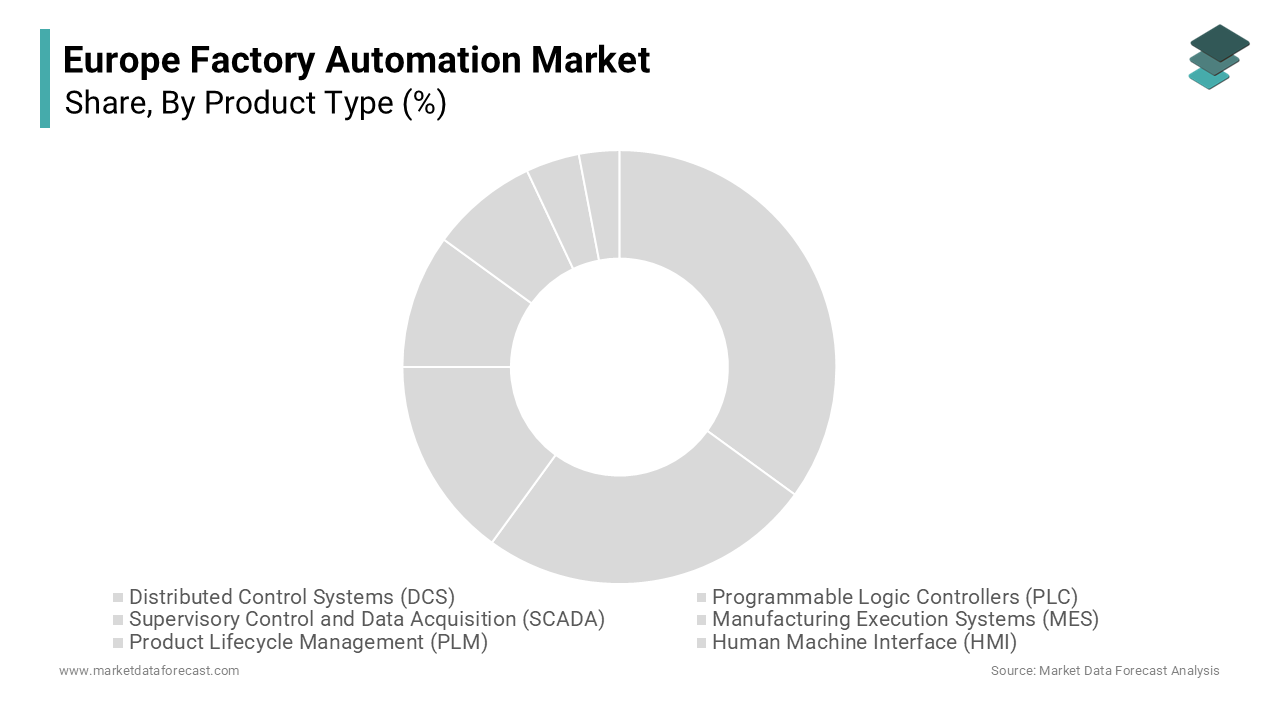
The industrial control systems segment was the largest by capturing 42.2% of the Europe factory automation market share in 2024 owing to their foundational role in orchestrating production processes across discrete and process industries. These systems, including distributed control systems programmable logic controllers and supervisory control and data acquisition platforms serve as the central nervous system of modern factories enabling real time monitoring sequencing and safety interlocks. According to the European Commission over 78% of large EU manufacturers rely on integrated control architectures to manage complex workflows in sectors like chemicals automotive and pharmaceuticals. The German Association of the Automotive Industry reports that every major OEM in Germany uses DCS and PLC networks to synchronize thousands of machines across multi plant operations ensuring traceability and compliance with ISO standards. Additionally, national energy efficiency mandates such as France’s Tertiary Decree require continuous monitoring of industrial consumption, where a function only achievable through SCADA and PLC integration. As per the VDMA these systems are now being upgraded with OPC UA communication protocols to support Industry 4.0 data exchange further entrenching their centrality in factory digitization strategies.
The manufacturing execution systems segment is likely to grow at a fastest CAGR of 13.6% throughout the forecast period with the urgent need for real time production visibility quality traceability and regulatory compliance in an era of supply chain volatility and sustainability reporting. According to the European Medicines Agency, all pharmaceutical manufacturers must implement batch genealogy tracking under Annex 11 of the EU GMP guidelines with a requirement efficiently fulfilled by MES platforms. In the food and beverage sector, the EU’s Digital Product Passport initiative mandates end to end ingredient and carbon footprint tracking which MES systems enable through integration with ERP and lab equipment. A 2024 study by the Fraunhofer Institute found that factories using MES reduced non-conformance events by 38% and improved on time delivery by 22%. As per the European Federation of National Engineering Associations, new MES deployments now include AI driven analytics for predictive quality control reinforcing their strategic value beyond basic shop floor execution.
By Field Device Type Insights
The industrial robots segment held 38.2% of the Europe factory automation market share in 2024 with their critical role in high precision high volume manufacturing particularly in automotive and electronics. According to the International Federation of Robotics, over 1.2 million industrial robots were operational in EU factories by the end of 2023 with Germany alone accounting for 29% of installations. The German Association of the Automotive Industry notes that robotic density in German car plants reached 1,200 units per 10,000 employees in 2024 more than double the global average by enabling consistent weld quality and assembly speed. Beyond automotive robotics are expanding into packaging logistics and metal fabrication where labor shortages persist. The European Commission’s Skills Pact identifies robotics operation as a priority competency with over 400,000 technicians trained in robot programming between 2021 and 2024. Additionally, safety standards like ISO 10218 ensure seamless integration into human workspaces. This combination of performance reliability and institutional support sustains industrial robots as the backbone of physical automation across Europe.
The machine vision systems segment is ascribed to register a fastest CAGR of 14.2% throughout the forecast period with the rising demand for zero defect manufacturing automated inspection and regulatory traceability across food pharmaceuticals and electronics. According to the European Food Safety Authority, over 90% of packaged food producers in the EU now use vision systems for label verification fill level control and foreign object detection to comply with strict hygiene regulations. In pharmaceuticals, the European Medicines Agency mandates 100% visual inspection of parenteral products, where a task only feasible through high resolution cameras and AI powered anomaly detection. A 2024 pilot by Novartis in Switzerland achieved 99.98% defect detection accuracy using deep learning algorithms. Additionally, the rise of electric vehicles has increased demand for battery cell inspection where micron level defects can cause thermal runaway, where BMW’s Leipzig plant uses 3D vision systems to inspect every cell module. This emergence of regulatory rigor quality expectations and technological maturity positions machine vision as a critical enabler of next generation manufacturing excellence.
By End-User Industry Insights
The automotive industry segment was the largest by capturing 28.3% of the Europe factory automation market share in 2024 due to its capital-intensive nature high production volumes and relentless drive for precision and efficiency. According to the European Automobile Manufacturers Association, over 14 million passenger vehicles were produced in the EU in 2023 requiring extensive automation for body-in-white assembly painting and powertrain integration. Every major OEM from Volkswagen to Stellantis operates fully automated welding lines with over 2,000 robots per plant ensuring sub millimeter tolerances. The shift toward electric vehicles further intensifies automation needs, where battery module assembly requires clean room environments and micron level alignment only achievable through robotic precision. As per the German Federal Ministry for Economic Affairs and Climate Action, EV production lines use 30% more automation than internal combustion engine counterparts. Additionally, the EU’s type approval regulations mandate full traceability of safety-critical components with a requirement met through integrated MES and RFID systems.
The food and beverage industry segment is anticipated to grow at a fastest CAGR of 12.8% throughout the forecast period from stringent EU hygiene regulations rising labor costs and consumer demand for transparency in sourcing and freshness. According to the European Food Safety Authority Regulation, EC No 852 2004 requires documented hygiene controls for all food processors, where a mandate driving adoption of automated cleaning validation and vision-based contamination detection. Companies like Nestlé and Danone have responded by deploying collaborative robots for palletizing and pick-and-place tasks in temperature-controlled environments. Furthermore, the EU’s Farm to Fork Strategy demands digital traceability from farm to shelf accelerating investment in automated labeling and batch tracking systems. This regulatory and operational pressure transforms automation from a luxury to a necessity in one of Europe’s most essential yet labor constrained industries.
By End-User Insights
The large enterprises segment was accounted in holding a dominant share of the Europe factory automation market in 2024 with their scale capital availability and strategic alignment with Industry 4.0 initiatives. According to Eurostat, 78% of large EU manufacturers have implemented advanced automation systems including robotics IoT sensors and digital twins. These companies operate multi-site global supply chains requiring standardized control architectures to ensure consistency and compliance. The European Commission’s Digital Europe Programme reports that large firms received 82% of public funding for automation pilots between 2021 and 2024 due to their capacity to demonstrate scalable impact. Additionally, they possess dedicated engineering teams capable of managing complex integrations with a resource scarce among smaller players. As per the VDMA German industrial giants like Siemens BASF and Bosch invest over 5% of annual revenue in digital transformation ensuring continuous automation upgrades. This combination of financial muscle technical expertise and regulatory leverage solidifies large enterprises as the primary drivers of automation adoption across Europe.
The small and medium enterprises segment is likely to grow at a fastest CAGR of 15.1% throughout the forecast period. The growth of the segment is attributed to grow with the targeted EU funding accessible modular technologies and rising competitive pressure to improve productivity. Programs like Germany’s “go-digital” and France’s “France Relance” provide grants covering up to 50% of automation costs for firms with fewer than 250 employees. The rise of plug-and-play cobots machine vision kits and cloud MES lowers entry barriers. Additionally, digital marketplaces like Siemens’ Xcelerator offer subscription based automation software eliminating upfront licensing fees.
REGIONAL ANALYSIS
Germany Factory Automation Market Analysis
Germany was the top performer of the Europe factory automation market by occupying 27.3% of share in 2024 with its world leading industrial base strong engineering culture and proactive Industry 4.0 strategy. According to the Federal Statistical Office, over 45,000 industrial robots were installed in German factories in 2023, where the highest in Europe in automotive machinery and chemical sectors. The government’s Plattform Industrie 4.0 initiative has mobilized over 20 billion euros in public private investment since 2013 to support digital transformation. Additionally, Germany’s dual education system produces many skilled technicians annually ensuring a robust talent pipeline. The presence of global automation leaders like Siemens, Bosch, and Festo, further reinforces ecosystem depth. This unique blend of policy industry and education sustains Germany’s undisputed leadership in European factory automation.
Italy Factory Automation Market Analysis
Italy factory automation market was ranked second by holding 14.3% of share in 2024 with the dense network of specialized small and medium enterprises in machinery textiles and food processing. Regions like Emilia, Romagna, and Lombardy host clusters of packaging and ceramic machinery makers that integrate robotics and vision systems into export ready solutions. As per Confindustria Italian, food exporters use automated lines to meet EU hygiene standards for global markets. Additionally, Italy leads in collaborative robotics adoption with over 8,000 cobots installed in 2023 primarily in artisanal manufacturing. This agile decentralized model allows Italy to punch above its weight in niche automation applications despite limited large-scale industry.
France Factory Automation Market Analysis
France factory automation market is significantly to have a fastest growth opportunity throughout the forecast period with the strong aerospace automotive and nuclear sectors alongside ambitious national digitization policies. According to the French Ministry of Economy, over 28,000 industrial robots were operational in 2023 with significant density in Airbus and Renault facilities. The “France 2030” investment plan allocated 8.5 billion euros to industrial reindustrialization including smart factory development. The aerospace cluster around Toulouse uses advanced automation for composite layup and inspection ensuring compliance with EASA safety standards. Public research institutes like CEA Tech develop open source automation modules for SMEs lowering adoption barriers. This combination of strategic industry policy and sustainability focus positions France as a dynamic and evolving automation market.
United Kingdom Factory Automation Market Analysis
The United Kingdom factory automation market growth is likely to grow with the pharmaceutical’s aerospace and advanced engineering. According to the Office for National Statistics, over 18,000 robots were in use in UK factories in 2023 with high concentration in vaccine manufacturing and jet engine production. Companies like AstraZeneca and Rolls Royce deploy fully automated lines with integrated MES and vision systems to meet MHRA and EASA requirements. Additionally, the UK leads in AI integration; the Alan Turing Institute collaborates with manufacturers on predictive maintenance algorithms deployed in real factories. As per the Society of Motor Manufacturers and Traders, EV battery gigafactories under construction will add significant automation demand by 2026.
Netherlands Factory Automation Market Analysis
The Netherlands factory automation market growth is likely to be driven by its logistics prowess high tech manufacturing and progressive digital infrastructure. According to the Dutch Central Bureau of Statistics, many industrial robots operated in 2023, primarily in semiconductor equipment food processing and port logistics. ASML’s extreme ultraviolet lithography machines, among the most complex automated systems globally are assembled in Veldhoven using micron precision robotics. The Port of Rotterdam uses automated guided vehicles and AI driven scheduling to handle 460 million tons of cargo annually. The government’s National Growth Fund allocated 1.1 billion euros in 2024 to smart sustainable manufacturing. As per the Netherlands Foreign Investment Agency, over 70% of new industrial sites include mandatory automation readiness clauses.
COMPETITITVE LANDSCAPE
The Europe factory automation market features intense competition among global technology leaders regional specialists and emerging software vendors each vying for differentiation through integration depth sustainability alignment and service agility. Established players like Siemens ABB and Rockwell leverage comprehensive portfolios strong brand trust and decades of industry relationships to dominate large enterprise contracts. Meanwhile niche providers such as Beckhoff and KUKA excel in specific domains like PC based control or robotic welding capturing high value segments. The competitive landscape is increasingly shaped by software capabilities as manufacturers shift from hardware centric purchases to outcome based subscriptions for analytics cybersecurity and digital twin services. Regulatory complexity under the EU Machinery Regulation and Cyber Resilience Act raises entry barriers but rewards companies with robust compliance infrastructures. Success requires balancing global scale with local responsiveness offering open architectures and demonstrating tangible contributions to Europe’s dual goals of industrial competitiveness and environmental sustainability.
KEY MARKET PLAYERS
Some of the companies that are playing a dominating role in the Europe Factory Automation Market include
- ABB
- Siemens
- Rockwell Automation
- Schneider Electric
- Mitsubishi Electric
- Honeywell
- Emerson Electric
- Bosch Rexroth
- FANUC
- Yaskawa Electric
- Omron
- Keyence
- Yokogawa Electric
- KUKA
Top Players in the Market
Siemens AG
Siemens AG is a cornerstone of the Europe factory automation market offering an integrated portfolio spanning programmable logic controllers human machine interfaces industrial PCs and digital enterprise software including its flagship Totally Integrated Automation platform. The company serves automotive machinery and process industries across the region with solutions aligned to EU cybersecurity and sustainability mandates. Siemens has deepened its European footprint by expanding its Industrial Edge computing ecosystem enabling real time AI analytics directly on the shop floor. In recent years it launched cloud based Xcelerator marketplace providing modular automation software for small and medium enterprises. It also partnered with national Industrie 4.0 initiatives in Germany, France, and Italy, to co-develop open architecture standards ensuring interoperability.
ABB Ltd
ABB Ltd maintains a strong presence in the Europe factory automation market through its robotics discrete automation and process control systems tailored for automotive food and beverage and heavy industries. Headquartered in Switzerland ABB leverages its European engineering base to deliver high precision robotic cells and machine vision solutions that meet stringent regional safety and quality standards. The company has intensified its focus on sustainable automation launching energy optimized robot lines and circular production systems that reduce waste and carbon intensity. Recently ABB expanded its Ability digital platform with predictive maintenance modules compliant with EU data sovereignty frameworks. It also established collaborative innovation hubs in Sweden and the Netherlands to co-develop cobot applications with local manufacturers. These initiatives position ABB as a key partner in Europe’s dual transition toward digitalization and decarbonization.
Rockwell Automation Inc
Rockwell Automation Inc has significantly strengthened its position in the Europe factory automation market by expanding its PlantPAx distributed control system and FactoryTalk software suite tailored for European process and hybrid industries. The company addresses regional needs through localized engineering support centers in Germany the UK and Poland ensuring rapid deployment and compliance with EU functional safety directives. Rockwell has prioritized interoperability by integrating its systems with European MES and ERP platforms using OPC UA and MQTT protocols. In 2024 it launched a sustainability analytics module that tracks real time energy consumption and emissions per production line aligning with EU Green Deal reporting requirements. Additionally, the company partners with European vocational schools to train technicians in its automation platforms building long term workforce readiness. These strategic investments enhance Rockwell’s relevance in a market increasingly defined by sustainability integration and skills development.
Top Strategies Used by the Key Market Participants
Key players in the Europe factory automation market prioritize interoperability by adopting open standards like OPC UA MQTT and PackML to ensure seamless integration across multi-vendor environments. They invest heavily in edge computing and artificial intelligence to enable real time predictive maintenance quality control and energy optimization directly on the factory floor. Companies expand cloud-based subscription models through digital marketplaces offering modular scalable solutions for small and medium enterprises. Strategic partnerships with national Industrie 4.0 initiatives vocational institutions and research centers strengthen local ecosystem engagement and talent development. Additionally, firms embed sustainability metrics into automation platforms to support compliance with EU Green Deal mandates and corporate decarbonization targets enhancing value beyond pure productivity gains.
MARKET SEGMENTATION
This research report on the Europe Factory Automation Market has been segmented and sub-segmented based on the following categories.
By Product Type
- Distributed Control Systems (DCS)
- Programmable Logic Controllers (PLC)
- Supervisory Control and Data Acquisition (SCADA)
- Manufacturing Execution Systems (MES)
- Product Lifecycle Management (PLM)
- Human Machine Interface (HMI)
- Enterprise Resource Planning (ERP)
By Field Device Type
- Industrial Robots
- Machine Vision Systems
- Sensors and Transmitters
- Motors and Drives
- Intelligent Actuators
By End-User Industry
- Automotive
- Food and Beverage
- Pharmaceutical and Biotech
- Chemical and Petrochemical
- Energy and Utilities
- Metals and Mining
- Other End-User Industries (Textile, Pulp and Paper, etc.)
By Deployment Model
- On-premise
- Cloud-enabled
- Hybrid Edge-Cloud
By Country
- UK
- France
- Spain
- Germany
- Italy
- Russia
- Sweden
- Denmark
- Switzerland
- Netherlands
- Turkey
- Czech Republic
- Rest of Europe
Frequently Asked Questions
What is meant by factory automation in the European context?
Factory automation in Europe refers to the deployment of control systems, robotics, software, and industrial communication technologies to automate manufacturing operations across industries.
What is the current growth outlook for the Europe Factory Automation Market?
The market is projected to witness steady growth driven by Industry 4.0 adoption, smart manufacturing initiatives, and rising labor costs.
Which European country dominates factory automation investments?
Germany leads the market due to its strong automotive manufacturing base and advanced industrial infrastructure.
What role does Industry 4.0 play in factory automation?
Industry 4.0 integrates IoT, AI, machine learning, and digital twins to enable intelligent, interconnected, and self-optimizing production systems.
What are the major components of factory automation systems?
Key components include PLCs, DCS, SCADA systems, industrial robots, sensors, drives, and industrial software platforms.
Which end-use industry contributes the largest revenue share?
The automotive sector accounts for a significant share due to heavy usage of robotic assembly lines and precision manufacturing.
How is artificial intelligence influencing factory automation?
AI enhances predictive maintenance, process optimization, quality inspection, and real-time analytics in smart factories.
What are collaborative robots (cobots)?
Cobots are robots designed to work safely alongside human operators without extensive safety barriers.
How does automation improve operational efficiency?
Automation reduces manual errors, improves production speed, enhances product consistency, and minimizes downtime.
What challenges hinder factory automation adoption in Europe?
High initial capital investment, cybersecurity risks, and shortage of skilled technical professionals are key barriers.
Access the study in MULTIPLE FORMATS
Purchase options starting from
$ 2000
Didn’t find what you’re looking for?
TALK TO OUR ANALYST TEAM
Need something within your budget?
NO WORRIES! WE GOT YOU COVERED!
Call us on: +1 888 702 9696 (U.S Toll Free)
Write to us: sales@marketdataforecast.com