- Product Description Description
- Table of Contents TOC
- List of Table & Figure LOT
- Get Free Sample PDF Sample PDF
Market Size, 2025
$6.68 BnMarket Estimate, 2026
$7.09 BnMarket Forecast, 2034
$11.45 BnCAGR, 2026–2034
6.17%Executive Summary: Europe Feed Amino Acids Market
- Market Scope: Comprehensive Europe feed amino acids market analysis covering amino acid types, livestock sectors, regional leadership frameworks, and low-protein diet regulatory trends.
- Market Valuation: Valued at USD 6.68 billion (2025), estimated at USD 7.09 billion (2026), and projected to reach USD 11.45 billion by 2034, registering a robust CAGR of 6.17% (2026–2034).
- Primary Growth Drivers: Stringent EU environmental regulations promoting low-protein diets (reducing ammonia emissions), phase-out of antibiotic growth promoters, expansion of precision feeding technologies, and alternative protein source rebalancing. Key challenges include raw material price volatility and lengthy regulatory approval processes.
Key Market Segment Metrics (2026–2034)
| Category | Leading Segment (2025 Position) | Fastest-Growing Segment |
|---|---|---|
| By Amino Acid Type | Lysine (led with a 49.5% share in 2025) | Tryptophan (predicted to grow at a CAGR of 11.5%) |
| By Livestock Segment | Poultry segment (held the major share of the market in 2025) | Aquaculture (estimated to witness a CAGR of 12.5% over the forecast period) |
| By Region / Country | Germany (dominated the regional market with a 20.9% share in 2025) | European sustainable feed manufacturing infrastructure leveraging nitrogen-reduction protocols |
Major Market Players & Market Structure
Market Structure: Highly competitive European animal nutrition landscape featuring major chemical and life science enterprises focusing on protected amino acid variants, digital balancing platforms, and production capacity expansions.
Key Companies: Archer Daniels Midland Company, Adisseo France SAS, Ajinomoto Co., Inc., Royal DSM N.V., dsm-firmenich, Cargill Inc., Cheil Jedang, Novus International, Inc., Evonik Industries AG, PHW Group, and Kemin Europa.
Europe Feed Amino Acids Market Size
The Europe feed amino acids market size was valued at USD 6.68 billion in 2025 and is anticipated to reach a valuation of USD 7.09 billion in 2026 and USD 11.45 billion by 2034, growing at a CAGR of 6.17%, 2026 to 2034.
Feed amino acids are essential nutritional additives incorporated into livestock and aquaculture diets to compensate for deficiencies in plant-based feedstuffs and optimize animal growth,h protein synthesis,s and feed efficiency. In Europe, the primary amino acids used include lysine, methionine, threonine, tryptophan, phenylalanine, phan and valine, aline which are critical for balancing the nutritional profile of grain and oilseed meal-based rations. According to the European Commission, more than 70% of compound feed in the European Union is based on soybean meal and cereals, which are naturally deficient in essential amino acids such as lysine, methionine, and threonine. To address this nutritional gap, the European Food Safety Authority regulates all feed amino acids under Regulation (EC) No 1831/2003, requiring comprehensive safety and efficacy dossiers before authorization. The EU’s Farm to Fork Strategy further promotes precision nutrition by encouraging reduced crude protein diets to lower nitrogen excretion and ammonia emissions. According to Eurostat data, the EU produces over 130 million tonnes of compound feed annually, which indicates the scale of demand. Within this context, the strategic use of feed amino acids has become indispensable for sustainable and efficient animal protein production across poultry, swine, aquaculture, and ruminant sectors, embedding them as a cornerstone of Europe’s transition toward environmentally responsible livestock systems.
MARKET DRIVERS
EU Environmental Regulations Promoting Low-Protein Diets
The European Union’s environmental policies targeting nitrogen pollution and greenhouse gas emissions are a primary driver of the European feed amino acids market. According to the European Environment Agency (EEA), agriculture accounts for 93% of ammonia emissions in the EU, which is largely from livestock manure and excess nitrogen excretion linked to high crude protein diets. The National Emission Ceilings Directive (Directive (EU) 2016/2284) sets a binding target of 19% ammonia reduction by 2030 compared to 2005 levels, which is pushing producers toward precision feeding. The European Commission’s 2022 BAT Reference Document for intensive livestock recommends lowering crude protein in diets by 2–4% points with amino acid supplementation. According to the INRAE field trials in France, such diets in swine reduce nitrogen excretion by around 25% without impairing growth performance. In Germany, ammonia reduction policies under TA‑Luft and the national action plan incentivize low‑protein feeding, with widespread adoption of synthetic amino acids across pig farms. This regulatory imperative transforms amino acids from performance enhancers into compliance tools for sustainable husbandry.
Phase Out of Antibiotic Growth Promoters and Focus on Gut Health
The EU’s 2006 ban on antibiotic growth promoters has intensified the need for nutritional strategies to maintain gut health and performance, which is further contributing to the expansion of the European feed amino acids market. According to FEFAC, increased use of threonine and tryptophan is due to their roles in mucin synthesis and immune modulation. The Farm to Fork Strategy reinforces this by targeting a 50% reduction in antimicrobial sales by 2030, which is further discouraging prophylactic drug use. According to Wageningen University, optimal threonine levels improve intestinal barrier function in broilers, which reduces pathogen translocation and inflammation. Similarly, as per the University of Milan research (2023), tryptophan supplementation in piglets lowered diarrhea incidence significantly through serotonin‑mediated gut motility regulation. National action plans in Denmark and the Netherlands now include amino acid balancing as a core component of antimicrobial reduction protocols, which is positioning amino acids as foundational in Europe’s drug‑free production systems.
MARKET RESTRAINTS
Volatility in Raw Material Prices and Energy‑Intensive Production
Synthetic amino acid production depends heavily on petrochemical derivatives and natural gas, exposing the market to cost volatility, which is a significant restraint to the growth of the European feed amino acids market. As per the Eurostat data, EU natural gas prices rose by ~40–45% between 2021 and 2022, which is driving sharp increases in lysine and threonine prices across the feed sector. As per the European Central Bank’s 2023 commodity risk report, margin compression occurred as manufacturers absorbed part of the cost to maintain contracts. Over 60% of Europe’s amino acid supply is imported from Asia, creating logistical vulnerability, as seen during the 2021 Suez Canal blockage, which delayed shipments by up to six weeks. According to the European Commission’s Industrial Raw Materials Scoreboard, precursors such as acrylonitrile and propylene are considered critical due to geopolitical concentration. While Evonik and ADM operate EU facilities, their combined capacity covers less than 40% of demand, leaving Europe exposed until bio‑based fermentation and circular carbon feedstocks scale up.
Stringent and Lengthy Regulatory Approval Processes
The authorization of new or modified feed amino acids in Europe is subject to rigorous evaluation by EFSA under Regulation (EC) No 1831/2003, which requires extensive safety and efficacy data and further hinders the growth of the European feed amino acids market. According to the European Commission’s 2023 review, the average approval timeline exceeds 28 months, with dossier costs often surpassing €1.2 million per substance. This burden disproportionately affects SMEs, which limits innovation diversity. Re‑evaluation of legacy amino acids has created uncertainty, with EFSA suspending certain DL‑methionine hydroxy analogues in 2022 pending further data. National variations also persist. France temporarily restricted a lysine source approved in Germany in 2023 due to differing impurity thresholds. These regulatory complexities delay the introduction of next‑generation amino acids such as hydroxy analogues and encapsulated forms, which could improve stability and bioavailability in complex feed matrices.
MARKET OPPORTUNITIES
Expansion of Precision Feeding and Digital Nutrition Platforms
The integration of digital tools and real‑time analytics into livestock management is creating a transformative opportunity for the European feed amino acids market. According to the European Joint Programme on Agricultural Systems, over 350 farms in the Netherlands, Denmark, and Germany now use precision feeding systems that adjust amino acid dosing based on animal weight, health status, and environmental conditions. These platforms employ near‑infrared spectroscopy (NIRS) to analyze raw material variability and automatically recalibrate feed formulas to maintain ideal amino acid profiles. The European Institute of Innovation and Technology (EIT Food) funded a 2023 consortium to develop AI‑driven nutrition models that predict optimal lysine‑to‑energy ratios for individual pig pens, reducing feed costs by around 4–5% while maintaining growth performance. Companies such as DLG and Lallemand have launched cloud‑based amino acid balancing services that integrate with farm management software in France and Spain. With the EU’s Digital Europe Programme allocating €180 million to smart farming by 2025, the shift toward data‑driven amino acid optimization is accelerating, enabling unprecedented efficiency and sustainability in European animal production.
Growth of Alternative Protein Sources and Amino Acid Rebalancing Needs
The rapid incorporation of novel protein ingredients such as insect meal, algae, and single‑cell proteins into European livestock diets is driving demand for customized amino acid supplementation to correct nutritional imbalances, which is another promising opportunity in the European feed amino acids market. According to the European Commission’s Protein Plan, insect‑based feed production in the EU reached 25,000 tons in 2023, with projections to exceed 100,000 tons by 2027. However, these alternative proteins often have skewed amino acid profiles. For example, University of Ghent studies confirm that black soldier fly meal is rich in lysine but deficient in methionine and threonine. Similarly, as per the Technical University of Munich trials, algae‑based proteins lack sufficient tryptophan for poultry. FEFAC reports that over 70% of feed mills using alternative proteins now implement dynamic amino acid rebalancing protocols. Regulatory support is emerging, with EFSA fast‑tracking amino acid dossiers linked to novel feed ingredients under the 2023 Sustainable Feed Innovation pathway. As Europe diversifies its protein sources to reduce soy dependency, feed amino acids will become increasingly critical to ensure nutritional adequacy and performance consistency across evolving feed formulations.
MARKET CHALLENGES
Limited Understanding of Ideal Amino Acid Ratios Across Species and Conditions
A persistent scientific gap in defining precise amino acid requirements under diverse production systems hampers optimal utilization and economic efficiency in European livestock farming. According to the European Federation of Animal Science (EAAP), current amino acid recommendations for swine and poultry are largely based on controlled trials conducted over a decade ago and do not reflect modern genetics, high health status, or low‑protein feeding contexts. As per a 2024 meta‑analysis by the University of Hohenheim, ideal lysine‑to‑threonine ratios in finishing pigs vary by up to 18% depending on diet composition and ambient temperature, yet most commercial feeds use fixed ratios. Similarly, optimal tryptophan levels for stress resilience in broilers during heat waves remain poorly quantified despite rising climate volatility. The European Commission’s Horizon Europe programme allocated €30 million in 2023 to map dynamic amino acid needs across breeds and environments, but results are years from practical application. Until these knowledge gaps are addressed, over‑supplementation or underfeeding will persist, which leads to economic loss or compromised welfare across Europe’s diverse livestock sectors.
Dependence on Non‑EU Amino Acid Suppliers and Geopolitical Risk
The European feed amino acids market remains heavily reliant on imports from Asia, particularly China and South Korea, which supply over 60% of lysine and methionine consumed in the EU, according to the European Commission’s 2023 Trade in Feed Ingredients report. This dependency creates significant supply chain vulnerability, as demonstrated during the 2022 export restrictions imposed by China on chemical precursors, which caused a 30% spike in lysine prices within six weeks. Geopolitical tensions and trade policy shifts further amplify risk, with the EU’s Carbon Border Adjustment Mechanism (CBAM) potentially affecting amino acid imports starting in 2026. Although domestic producers such as Evonik (Germany) and Lesaffre (France) have expanded capacity, their combined output meets less than 40% of regional demand. The European Raw Materials Alliance has identified amino acids as a strategic gap in the agri‑food value chain, yet investment in EU fermentation infrastructure remains limited by high energy costs and permitting delays. Without a coordinated industrial policy to scale local production, Europe’s feed sector will continue to face price volatility and supply insecurity in this critical nutritional input.
REPORT COVERAGE
| REPORT METRIC | DETAILS |
| Market Size Available | 2025 to 2034 |
| Base Year | 2025 |
| Forecast Period | 2026 to 2034 |
| CAGR | 6.17% |
| Segments Covered | By Livestock, Amino Acids, And By Country |
| Various Analyses Covered | Global, Regional & Country Level Analysis; Segment-Level Analysis, DROC, PESTLE Analysis, Porter’s Five Forces Analysis, Competitive Landscape, Analyst Overview of Investment Opportunities |
| Regions Covered | UK, France, Spain, Germany, Italy, Russia, Sweden, Denmark, Switzerland, Netherlands, Turkey, Czech Republic, & Rest of Europe |
| Market Leaders Profiled | Archer Daniels Midland Company, Adisseo France SAS, Ajinomoto Co., Inc., Royal DSM N.V., Cargill Inc., Cheil Jedang, and Novus International.NC, Evonik Industries AG, PHW Group, Kemin Europa. |
SEGMENTAL ANALYSIS
By Livestock Insights
The poultry segment held the major share of the European feed amino acids market in 2025. With over 2.8 billion broilers produced annually, it is the region’s largest monogastric livestock sector. Poultry diets are heavily based on corn and soybean meal, which are deficient in essential amino acids such as methionine, lysine, and threonine, necessitating precise supplementation to optimize feed conversion ratios. As per the European Commission’s Feed Protein Balance Report, over 75% of poultry feed in Western Europe incorporates synthetic amino acids to enable low crude protein formulations, which reduce nitrogen excretion by up to 20%. According to the European Environment Agency, poultry contributes 32% of livestock ammonia emissions, which makes it a regulatory priority under the National Emission Ceilings Directive. Since the 2006 ban on antibiotic growth promoters, amino acids like threonine and tryptophan have become critical for supporting gut health and immune function. Major integrators such as PHW Group and Aviagen have standardized amino acid balancing across all European hatcheries, ensuring consistent application from day one.
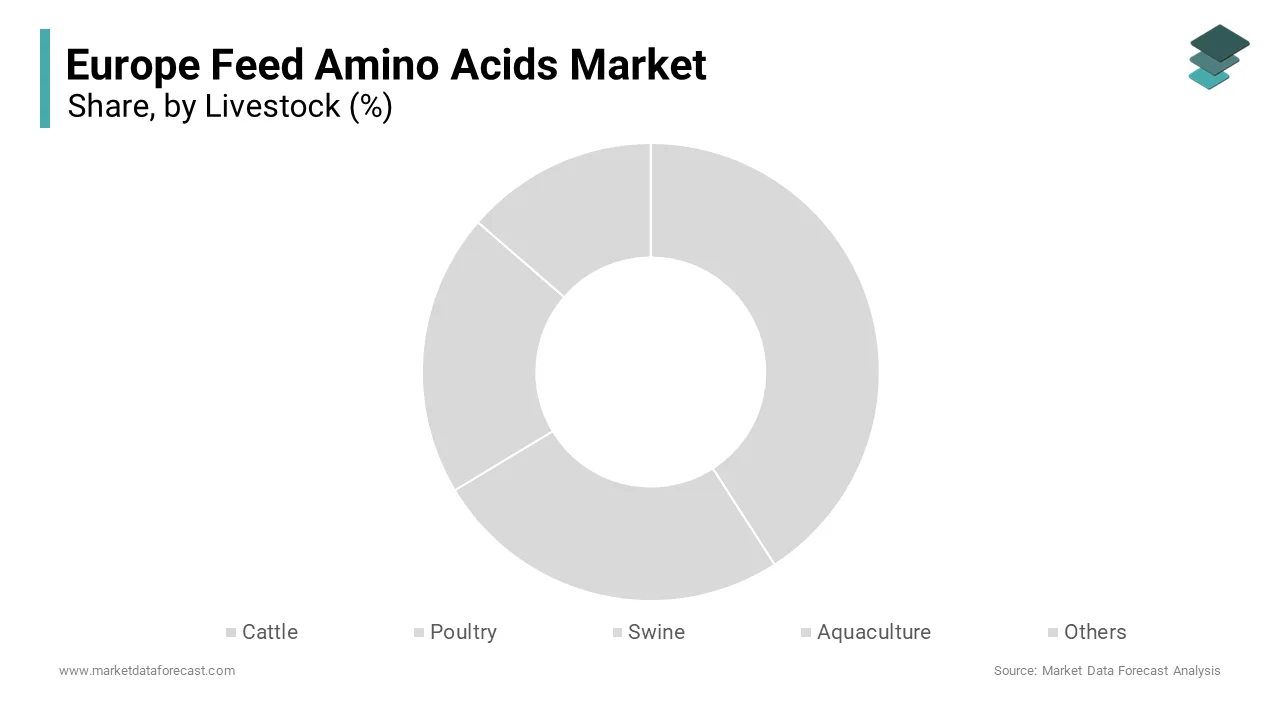
The aquaculture segment is the fastest-growing livestock segment and is estimated to witness a CAGR of 12.5% over the forecast period, owing to the EU’s strategic goal to increase domestic seafood production to 2.5 million tons by 2030, while adhering to strict antimicrobial and sustainability standards. Unlike terrestrial animals, fish cannot be treated with antibiotics after stocking, making preventive nutrition essential. As plant proteins such as soy and rapeseed now constitute over 60% of aquafeed, supplementation with amino acids like methionine, lysine, and taurine is necessary to meet nutritional requirements. Trials by the Hellenic Centre for Marine Research in sea bass showed that balanced methionine levels improved growth by 14% and reduced feed costs by 9%. While synthetic amino acids are prohibited in organic aquaculture, they are widely used in conventional systems, especially in Spain, Greece, and Norway. The EU’s €200 million Horizon Europe investment in plant-based aquafeeds further supports this segment’s expansion.
By Amino Acid Insights
The lysine segment led the market by holding 49.5% of the regional market share in 2025. As per Eurostat, more than 85% of compound feed in the EU is based on cereals like wheat, barley, and corn, all of which are lysine-deficient. Lysine is the first limiting amino acid in these diets, making its supplementation essential for optimal animal growth. Field trials by the French National Institute for Agricultural Research demonstrated that adding 0.8% lysine to a 14% crude protein pigdiet maintainedd growth while reducing nitrogen excretion by 22%. In poultry, lysine is vital for muscle development, with broiler diets typically requiring 1.1–1.3% standardized ileal digestible lysine, according to the European Branch of the World’s Poultry Science Association. Major producers such as Evonik and ADM operate dedicated lysine fermentation facilities in Germany and the Netherlands, ensuring a stable regional supply.
The tryptophan segment is the fastest-growing amino acid and is predicted to grow at a CAGR of 11.5% over the forecast period, owing to the expanding research on tryptophan’s role in gut health, stress resilience, and immune modulation. According to Wageningen University, increasing dietary tryptophan in weaned piglets raised serotonin levels and reduced post-weaning diarrhea by 28%. In poultry, the University of Bologna reported that optimal tryptophan-to-lysine ratios reduced aggression and feather pecking in cage-free systems, aligning with EU animal welfare mandates. The European Food Safety Authority granted full authorization to L-tryptophan for all livestock species in 2022, facilitating broader adoption. Following the 2022 phase-out of zinc oxide in piglet diets, tryptophan has gained traction as a gut health enhancer. Feed additive companies now offer protected tryptophan forms to withstand pelleting temperatures, improving bioavailability and efficacy.
COUNTRY ANALYSIS
Germany Feed Amino Acids Market Analysis
Germany dominated the European feed amino acids market in 2025 by accounting for 20.9% of the regional market share. The dominating position of Germany in the European market can be credited to its large intensive livestock sector, advanced feed manufacturing infrastructure, and stringent environmental regulations. Germany produces over 60 million pigs and 650 million broilers annually, which is creating massive demand for lysine, methionine, and threonine. The national Ammonia Reduction Strategy mandates low crude protein feeding in all pig and poultry operations, with over 70% of compound feed mills using dynamic amino acid balancing by 2023. Germany also hosts key production facilities, including Evonik’s lysine plant in Marl and ADM’s amino acid complex in Hamburg,g to ensure domestic supply security. The German Research Foundation has funded over €20 million since 2022 for precision nutrition research, with projects at the University of Hohenheim optimizing tryptophan for stress resilience. This ecosystem of production scale, regulatory rigor, and scientific investment ensures Germany remains the cornerstone of Europe’s feed amino acids landscape.
France Feed Amino Acids Market Analysis
France plays a central role in the European feed amino acids market. The growth of France in the European market is driven by its diverse livestock base, large poultry sector, and commitment to sustainable feed under the Écophyto Plan. The country produces over 800 million broilers annually, making it Europe’s largest poultry producer and a major consumer of methionine and lysine. The French National Institute for Agricultural Research has validated low-protein diets with amino acid supplementation that reduce nitrogen excretion by 25% in swine without compromising growth. France also leads in organic livestock farming, with over 25,000 certified operations that use synthetic amino acids in conventional feed streams. The government’s Protein Plan supports domestic amino acid production with subsidies for bio-based fermentation using sugar beet byproducts. Feed cooperatives like InVivo have integrated real-time amino acid balancing into their formulation software across 300 mills. This fusion of agricultural heritage, policy innovation, and industrial coordination sustains France’s role as a high-volume and high-impact amino acid market.
Spain Feed Amino Acids Market Analysis
Spain maintains a strong position in the European feed amino acids market. The dominant pork and poultry sectors and the rapid expansion of aquaculture are propelling the Spanish market growth. As the EU’s largest pork producer and second-largest broiler producer, Spain generates substantial demand for lysine, methionine, threonine, and tryptophan. The 2022 EU ban on zinc oxide in piglet diets accelerated adoption of amino acid-based gut health programs, with over 65% of integrators implementing tryptophan and threonine blends by 2023. In aquaculture, Spanish feed mills use methionine to balance plant-based diets for sea bass and bream, with trials showing 12% improved feed efficiency. Climate challenges, including summer heat stress, further amplify demand for tryptophan to support serotonin-mediated calmness in poultry. This combination of production scale, regulatory adaptation, and climatic necessity ensures Spain’s continued prominence in the European amino acid market.
Netherlands Feed Amino Acids Market Analysis
The Netherlands plays a pivotal role in the European feed amino acids market. The high livestock density, a pioneering approach to ammonia reduction, and leadership in feed innovation are contributing to the expansion of the feed amino acids market in the Netherlands. The Dutch “From Farm to Fork” covenant mandates a 70% reduction in nitrogen excretion since 2010, achieved through universal adoption of low crude protein diets with synthetic amino acids. Wageningen University serves as a European hub for amino acid research, with trials demonstrating that dynamic threonine dosing improves intestinal integrity in broilers by 19%. The Netherlands also hosts major feed additive producers, including Royal DSM and Orffa, which supply customized amino acid blends across Europe. Over 90% of Dutch dairy calf and piglet feeds now include tryptophan to support post-weaning resilience, according to the Dutch Feed Industry Association. This blend of policy ambition, scientific excellence, and industrial capacity sustains the Netherlands’ position as a high-efficiency and high-innovation amino acid market.
Denmark Feed Amino Acids Market Analysis
Denmark is anticipated to account for a notable share of the European feed amino acids market over the forecast period owing to the world-leading antimicrobial stewardship, integrated pig production systems, and scientific leadership in young animal nutrition. The “Yellow Card” scheme imposes penalties on farms exceeding antibiotic use thresholds, driving near-universal adoption of amino acid-based gut health strategies in piglet production. Over 95% of Danish pig farms use balanced lysine, threonine, and tryptophan formulations during the critical weaning window, according to the Danish Pig Research Centre. Denmark also pioneered the use of protected tryptophan in pelleted feed, with DLG collaborating on commercial formulations that survive thermal processing. The country’s organic sector, covering 12% of agricultural land, uses synthetic amino acids in conventional feed streams, supporting overall market volume. With a strong tradition of farmer cooperatives and data-driven management, Danish producers consistently achieve among the lowest feed conversion ratios and ammonia emissions in Europe, making amino acids a foundational element of national animal nutrition strategy.
COMPETITIVE LANDSCAPE
Competition in the Europe Feed Amino Acids Market is defined by scientific differentiation, regulatory alignment,t and sustainability integration among a few global specialty chemical companies. The landscape is dominated by Evonik Adisseo and D, SM, which leverage decades of fermentation expertise, strong R&D network,s and localized production to serve Europe’s stringent environmental and animal welfare standards. Unlike commodity markets, its value is determined by technical service formulation,, ion support,pport and proof of environmental benefit rather than price alone. Entry barriers remain high due to capital-intensive production, complex regulatory dossiers, and the need for long term customer relationships with feed mills and integrators. Innovation cycles are accelerating with protected amino acids digital balancing tools andmulti-additivee solutions becoming key differentiators. National policies on ammonia emissions and antibiotic use further shape competitive dynamics, favoring companies that embed sustainability into their core offerings. Success in this market requires deep collaboration with European research bodies,regulatory agencies, and agricultural stakeholders to deliver nutrition that is precise, effective,nt and ecologically responsible.
KEY MARKET PLAYERS
Some of the major leaders of the Europe feed amino acids market include
- Archer Daniels Midland Company
- Adisseo France SAS
- Ajinomoto Co., Inc.
- Royal DSM N.V.
- Cargill Inc.
- Cheil Jedang
- Novus International, Inc
- Evonik Industries AG
- PHW Group
- Kemin Europa.
Top Players In The Market
- Evonik Industries AG is a global leader in specialty chemicals and a cornerstone of the Europe Feed Amino Acids Market with its extensive portfolio of lysine, threonine, tryptophan,n and valine produced through advanced fermentation. The company supplies amino acids to major feed producers across the poultry, swine,e and aquaculture sectors in alignment with EU sustainability goals. In 2024, Evonik launched next-generationon protected tryptophan formulation that withstands high temperature pelleting while maintaining bioavailability in weaned piglets. It also expanded its amino acid production capacity at its site in Marl, GGerman,y, to support low protein feed strategies across Western Europe. Through scientific collaboration with institutions like the University of Hohenheim, Evonik reinforces its role as a trusted innovator in precision animal nutrition.
- Adisseo France SAS plays a pivotal role in the Europe Feed Amino Acids Market as a specialist in methionine and its hydroanalogog u,es essential for poultry and swine nutrition. The company leverages its integrated production chain from natural gas to finished feed additives to ensure supply reliability and cost efficiency. In early 2,024 Adisseo introduced a digital amino acid balancing platform that helps European feed mills optimize formulations based on real-time raw material analysis and environmental regulations. It also partnered with INRAE to validate methionine dosing protocols that reduce nitrogen excretion in broilers by 18%. By aligning its technology with Europe’s ammonia reduction and antibiotic-free production mandates, Adisseo strengthens its scientific and commercial relevance across the continent.
- Royal DSM N.V. exerts significant influence in the Europe Feed Amino Acids Market through its comprehensive animal nutrition portfolio that integrates amino acids with vitamins, enzymes, and gut health solutions. The company emphasizes sustainability by enabling low crude protein diets that lower the environmental footprint of livestock farming. In 2024, DSM launched a tailored threonine and tryptophan bundlecage-freee layer systems designed to reduce stress-related feather pecking while maintaining egg production. It also enhanced its MyNutriScan digital service to provide real-time amino acid recommendations based on on-farm performance data from Dutch and German poultry integrators. Through this holistic and data-driven approach, DSM supports European farmers in achieving efficiency, welfare ,re and regulatory compliance simultaneously.
Top Strategies Used By The Key Market Participants
Key players in the Europe Feed Amino Acids Market pursue four core strategies to reinforce their leadership. First,rst they invest in protected and stabilized amino acid forms that survive thermal processing and deliver targeted release in the gut.Seconde ,cond they develop digital nutrition platforms that integrate real-time feed formulation with environmental compliance and animal performance data. Third, they align product innovation with EU regulatory priorities such as ammoniareductiono,n antibioticminimizationin and low protein feeding through scientific validation with research institutions. Fourth, they expand local production capacity within Europe to ensure supply security and reduce dependence on Asian imports. AddAdditionallyc ourmpanies bundle amino acids with complementary additives like enzymes and probiotics to offer integrated gut health solutions. These strategies collectively address Europe’s unique demands for sustainability,ty precis,n and resilience in animal nutrition.
RECENT MARKET NEWS
- In March 2024, Evonik Industries A,G a German specialty chemicals company, launched a protected tryptophan formulation that maintains bioavailability afthigh-temperatureure pelleting for piglet feed. This launch is anticipated to improve gut health in weaned pigs and strengthen the Europe Feed Amino Acids Market presence.
- In May 2024, Adisseo France SAS, a global methionine producer,r introduced a digital amino acid balancing platform for European feed millsusing real-timee raw material analysis. This platform is anticipated to optimize low protein feed formulations and strengthen the Europe Feed Amino Acids Market presence.
- In February 2024, Royal DSM N.V., a Dutch health and nutrition company, launched a threonine and tryptophan bundle free-layer systems to reduce stress-related feather pecking. This launch is anticipated to support welfare-compliant egg production and strengthen the Europe Feed Amino Acids Market presence.
- In June 2024, Evonik Industries AG expanded its amino acid production capacity at its Marl, German,y facility to meet growing demand folow-proteinin feed solutions. This expansion is anticipated to enhance supply security and strengthen the Europe Feed Amino Acids Market presence.
- In January 2024, Adisseo France SAS partnered with INRAE to validate methionine dosing protocols that reduce nitrogen excretion in broilers by 18%. This partnership is anticipated to support EU environmental goals and strengthen the Europe Feed Amino Acids Market presence.
MARKET SEGMENTATION
This research report on the Europe feed amino acids market is segmented and sub-segmented into the following categories.
By Livestock
- Cattle
- Poultry
- Swine
- Aquaculture
- Others
By Amino Acids
- Under lysine
- Tryptophan
- Methionine
- Threonine
- Others
By Country
- UK
- France
- Spain
- Germany
- Italy
- Russia
- Sweden
- Denmark
- Switzerland
- Netherlands
- Turkey
- Czech Republic
- Rest of Europe