- Product Description Description
- Table of Contents TOC
- List of Table & Figure LOT
- Get Free Sample PDF Sample PDF
Market Size, 2025
$76.05 BnMarket Estimate, 2026
$79.88 BnMarket Forecast, 2034
$118.28 BnCAGR, 2026–2034
5.03%Executive Summary: Europe Feed Antioxidants Market
- Market Scope: Comprehensive market evaluation of the European feed antioxidants industry, covering livestock production sectors, antioxidant types (synthetic vs. natural variants), and country-level frameworks (including Germany, France, Spain, the Netherlands, and Italy).
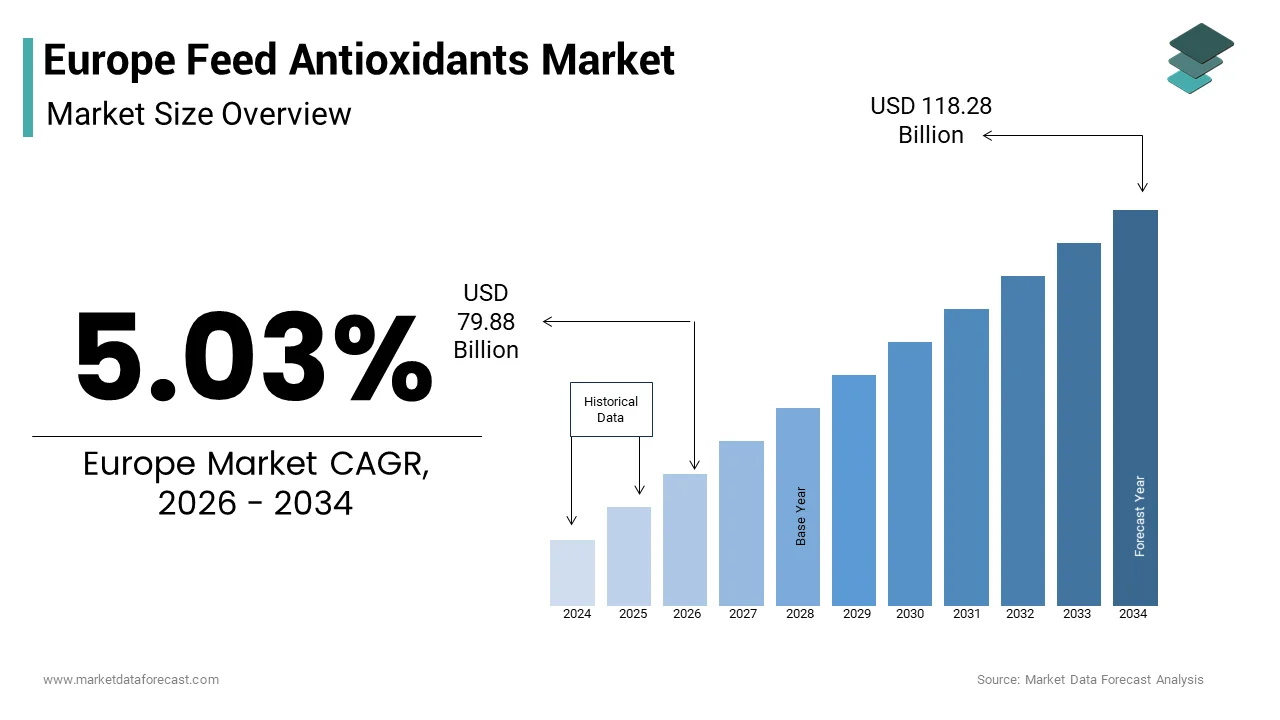
- Market Valuation: Valued at USD 76.05 billion (2025), estimated at USD 79.88 billion in 2026, and projected to reach USD 118.28 billion by 2034, registering a CAGR of 5.03% (2026–2034).
- Primary Growth Drivers: Stringent European Union regulations on feed safety and hygiene (Regulation EC No 1831/2003 and EC No 183/2005), rising demand for high-quality animal protein and nutrient-stable feeds under the Farm to Fork Strategy, and the expansion of organic and antibiotic-free livestock production systems.
Key Market Segment Metrics (2026–2034)
| Category | Leading Segment / Position | Fastest-Growing / Key Segment |
|---|---|---|
| By Livestock | Poultry (accounted for 38.2% of market share in 2025 due to intensive production systems, high metabolic rates, and sensitivity to oxidative stress) | Aquaculture (projected at a leading CAGR of 8.7% driven by high fish meal and fish oil usage requiring rigorous lipid oxidation control) |
| By Antioxidant Type | Butylated Hydroxytoluene / BHT (secured 32.5% market share in 2025 due to thermal stability during pelleting and EFSA safety validation) | Other Synthetics & Natural Extracts / Propyl Gallate & Ascorbyl Palmitate (growing at 7.9% CAGR for specialized aquafeed and weanling nutrition) |
| By Country & Region | Germany (leads the market with 21.3% share backed by a highly industrialized livestock sector and HACCP oxidation protocols) | Spain & France (strong regional demand driven by intensive pork/poultry output and hot climatic conditions accelerating rancidity) |
Major Market Participants & Market Structure
Market Structure: Highly competitive market characterized by a dual dynamic between global chemical conglomerates and specialized animal nutrition firms competing on technical service capabilities, regulatory compliance, and encapsulation innovations.
Key Companies: Adisseo France SAS, Anitox Corporation, Kemin Europa, BASF SE, Alltech, Cargill Inc., Archer Daniels Midland Company, Danisco, Nutreco N.V., DSM, Novus International, and Perstorp.
Europe Feed Antioxidants Market Size
The Europe feed antioxidants market size was valued at USD 76.05 billion in 2025 and is anticipated to reach a valuation of USD 79.88 billion in 2026 and USD 118.28 billion by 2034, growing at a CAGR of 5.03%, from 2026 to 2034.
Current Intro Definition of the Europe Feed Antioxidants Market
Feed antioxidants are specialized compounds incorporated into animal nutrition to inhibit oxidative degradation of essential nutrients, such as fats, vitamins, and pigments, thereby preserving feed quality, enhancing shelf life, and supporting animal health. In Europe, these additives are strictly regulated under Regulation EC No 1831 2003 on feed additives, which mandates comprehensive safety, efficacy, and environmental impact assessments before authorization by the European Commission. Demand is driven by the region’s intensive livestock systems, where feed stability directly impacts productivity and food safety. The regulatory emphasis on reducing antibiotic growth promoters has further elevated the role of antioxidants as essential tools for maintaining gut health and immune function, positioning them as non-negotiable components in modern European animal nutrition strategies.
MARKET DRIVERS
Stringent EU Regulations on Feed Safety Reinforce Antioxidant Necessity
European Union legislation mandates rigorous control over feed composition to ensure food safety and animal welfare, directly amplifying reliance on authorized antioxidants. The stringent EU regulations on feed safety reinforce the necessity of antioxidants, which is propelling the growth of Europe feed antioxidants market. Regulation EC No 1831 2003 requires all feed additives, including antioxidants, to undergo scientific evaluation by the European Food Safety Authority before placement, with re-evaluation every 10 years. This regulatory gatekeeping compels feed manufacturers to integrate only EFSA vetted antioxidants to comply with hygiene and traceability standards under the Feed Hygiene Regulation EC No 183 2005. The regulatory environment not only restricts ingredient choice but also incentivizes continuous innovation in stabilization technologies that meet evolving safety thresholds. The feed producers view antioxidants not as optional enhancers but as compliance-critical components by ensuring oxidative protection aligns with EU food chain integrity principles.
Rising Demand for High-Quality Animal Protein Fuels Need for Nutrient-Stable Feeds
The livestock sector faces mounting pressure to deliver consistent, high-quality animal protein amid shrinking per capita consumption and heightened consumer scrutiny. The growing demand for the high quality animal protein is substantially fuelling the growth of Europe feed antioxidants market. According to Eurostat, the EU produced 43.2 million metric tons of meat in 2024, with poultry and pork representing 78% of output, both reliant oenergy-densese feeds vulnerable to lipid oxidation. As per the European Commission’s Farm to Fork Strategy, producers must achieve higher output efficiency with fewer inputs by making feed stability a non-negotiable factor in sustainable intensification. Moreover, consumers increasingly associate meat and egg quality with animal diet integrity, where a 2024 survey by the European Consumer Organisation found that some othe f respondents would pay a premium for products derived from animals fed non oxidizedadditive-controlleded diets. This dual pressure from production efficiency and market differentiation compels integrators and compounders to embed robust antioxidant systems to preserve omega-3 fatty acidsfat-solublele vitamins, and colorants, thereby safeguarding both animal physiology and end product appeal across the European value chain.
MARKET RESTRAINTS
Regulatory Uncertainty Surrounding Synthetic Antioxidant Approvals
The European feed antioxidants market faces persistent disruption due to evolving scientific opinions and political scrutiny over synthetic compounds, creating formulation instability for feed manufacturers. The regulatory uncertainty surrounding synthetic antioxidants is solely declining the growth of Europe feed antioxidants market. Ethoxyquin is once the dominant antioxidant in fish and poultry feed, was effectively withdrawn from EU authorization in 2022 after the European Food Safety Authority concluded that available data could not rule out genotoxic potential. According to the European Feed Manufacturers Federation, this decision forced over 1,200 feed mills to reformulate within six months, incurring average adaptation costs of 350,000 euros per facility. Similarly, butylated hydroxytoluene remains under re-evaluation, with EFSA’s 2023 draft opinion indicating potential endocrine disruption concerns that could trigger restrictions. The absence of clear transition pathways or provisional approval mechanisms leaves producers in regulatory limbo, especially in sectors like aquaculture, where synthetic antioxidants were critical for stabilizing high fish oil diets. This uncertainty discourages long term investment isynthetic-baseded production systems and fragments the market between regions adopting precautionary phase-outs and those awaiting final rulings.
High Cost and Limited Scalability of Natural Antioxidant Alternatives
While natural antioxidants, such as mixed tocopherols and rosemary extract, ts are increasingly favored for their clean label appeal, their commercial adoption is constrained by cost volatility and inconsistent efficacy at scale. The high cost and limited scalability of natural antioxidant is additionally degrading the growth of Europe feed antioxidants market. At current rates, replacing synthetic antioxidants with tocopherols increases feed formulation costs by 18 to 25 euros per metric ton, a margin unabsorbable for livestock sectors like broiler production. Furthermore, natural extracts exhibit variable active compound concentrations, where a 2023 study by the University of Ghent found that rosemary extract potency varied by up to 35% across commercial batches depending on harvest season and extraction method, complicating dose standardization. As per the European Compound Feed Manufacturers Federationa, a few of the f EU feed mills have successfully transitioned fully to natural systems in premium pet food and organic layers.
MARKET OPPORTUNITIES
Expansion of Organic and Antibiotic-Free Livestock Production Systems
The rapid growth of organic antibiotic-reduced livestock farming is a strategic opening for natural feed antioxidants aligned with clean label mandates. The expansionof organic antibiotic-free livestock is anticipated to fuel the growth of Europe feed antioxidants market. EU Organic Regulation 2018 848 explicitly prohibits synthetic antioxidants in certified organic feed, mandating reliance on tocopherols, ascorbyl palmitate, oplant-deriveded phenolics. This regulator carve-out has catalyzed investment in vertically integrated natural antioxidant supply chain. For example, the French cooperative InVivo launched a dedicated tocopherol extraction unit in 20,23 sourcing non-GMO rapeseed oil from organic farms to serve its organic feed division. Additionally, as per the European Commission’s guidelines on antimicrobial reduction, producers in conventional systems are also minimizing antibiotic use, increasing reliance on gut health solutions, where antioxidants play a supportive role by reducing oxidative stress-induced inflammation. A 2024 trial by the Swedish University of Agricultural Sciences demonstrated that broilers fed rosemarextract-supplemented diets showed lower intestinal permeability markers compared to controls, validating antioxidant contribution tantibiotic-freeee resilience.
Advancement in Encapsulation and Stabilization Technologies
Innovations in delivery systems are unlocking new performance frontiers for feed antioxidants by enhancing stability, bioavailability, and targeted release in the gastrointestinal tract. The advancement in encapsulation and stabilization technologies is expected to leverage the growth of Europe feed antioxidants market. Microencapsulation using lipid or polysaccharide matricesnow enables the protection of sensitive actives like ascorbic acid and polyphenols during pelletization,g a process that routinely reaches 85 degrees Celsius and degrades up to 40% of unencapsulated antioxidants as per data from the Fraunhofer Institute for Process Engineering. Companies such as Lallemand and Anitox have commercialized encapsulated antioxidant blends that maintain over 90% active retention post processing, significantly improving cost efficiency. MoreovepH-responsiveive coatings allow sequential release of antioxidants in specific gut segments, maximizing redox modulation where lipid peroxidation peaks. In a 204, field trial across Dutch dairy farms, encapsulated tocopherol increased milk vitamin E content by 22% compared to conventional supplementation, demonstrating functional transfer to end products. These technological leaps not only extend the functional lifespan of antioxidants but also enable lower inclusion rates, mitigating cost barriers and opening avenues for synergistic blends with organic acids or probiotics by positioning advanced delivery as a cornerstone of next-generation feed preservation in Europe.
MARKET CHALLENGES
Inconsistent EFSA Evaluation Timelines Delay Market Adaptation
The operational inefficiencies stemming from prolonged and unpredictable timelines in the European Food Safety Authority’s re-evaluation of authorized additives. Under Regulation EC No 1831 2003, all feed additives must undergo cyclical safety reassessments, yet the process lacks standardized deadlines, creating prolonged uncertainty for manufacturers. Ethoxyquin’s re-evaluation, initiated in 2015, concluded only in 2022 with a non-renewal decision, leaving the aquaculture and poultry sectors without a cost-effective alternative for seven years. According to the European Feed Additives Association, a few of the currently authorized antioxidants are overdue for re-evaluation, including butylated hydroxyanisole and propyl gallate, both critical for high-fat ruminant and pet diets. This backlog forces feed producers to maintain contingency formulations at significant R and D expense while delaying investment in next generation solutions. The absence of interim guidance during review periods also fragments national enforcement.I n 2023, Germany suspended propyl gallate in 2023 based on preliminary EFSA concerns, while Spain permitted continued use pending final judgment. Such regulatory asymmetry disruptcross-borderer feed trade and complicates compliance for multinational integrators.
Limited Domestic Sourcing of Natural Antioxidant Raw Materials
The ambition to transition toward natural feed antioxidants by heavy reliance on imported botanical raw materialexposesng the supply chain to geopolitical and climatic volatility, which is a challenge for the growth of Europe feed antioxidants market. Over 75% of rosemary used for extract production is sourced from North Africa and Turkey, tocopherol precursors derive from South American soybean and palm oil industries, according to the European Spice Association and the Oil and Proteinmeal Industry Federation. Similarly, EU deforestation regulations targeting palm oil have constrained access to tocopherol-rich processing streams by limiting local refining capacity.
REPORT COVERAGE
| REPORT METRIC | DETAILS |
| Market Size Available | 2025 to 2034 |
| Base Year | 2025 |
| Forecast Period | 2026 to 2034 |
| CAGR | 5.03% |
| Segments Covered | By Livestock, Antioxidant Types, And By Country |
| Various Analyses Covered | Global, Regional & Country Level Analysis; Segment-Level Analysis, DROC, PESTLE Analysis, Porter’s Five Forces Analysis, Competitive Landscape, Analyst Overview of Investment Opportunities |
| Regions Covered | UK, France, Spain, Germany, Italy, Russia, Sweden, Denmark, Switzerland, Netherlands, Turkey, Czech Republic, & Rest of Europe |
| Market Leaders Profiled | Adisseo France SAS, Kemin Europa, AllTech, Ca Inc. ncc, Archer Daniels Midland Company, Danisco, Nutreco N.V., DSM, Novus International, Perstorp. |
SEGMENT ANALYSIS
By Livestock Insights
The poultry segment wccounted in holding 38.2% of the Europe feed antioxidants market share in 2025, with the sector’s intensive production systems, high metabolic rates, and extreme sensitivity to oxidative stress in feed. According to the European Commission’s Animal Nutrition Efficiency Report 2025 an increase in feed oxidation can reduce the feed conversion ratio by 0.03, translating to 150 million euros in annual losses across the EU poultry sector. European consumers are increasingly rejecantibiotic-treateded poultry by accelerating the shift to antibiotic-free production systems, where gut health and immunity rely heavily on nutritional support. Oxidative stress in feed directly compromises intestinal integrity, increasing susceptibility to pathogens like Salmonella. Antioxidants such as tocopherols and rosemary extracts help maintain mucosal barrier function by reducing reliance on therapeutic interventions.
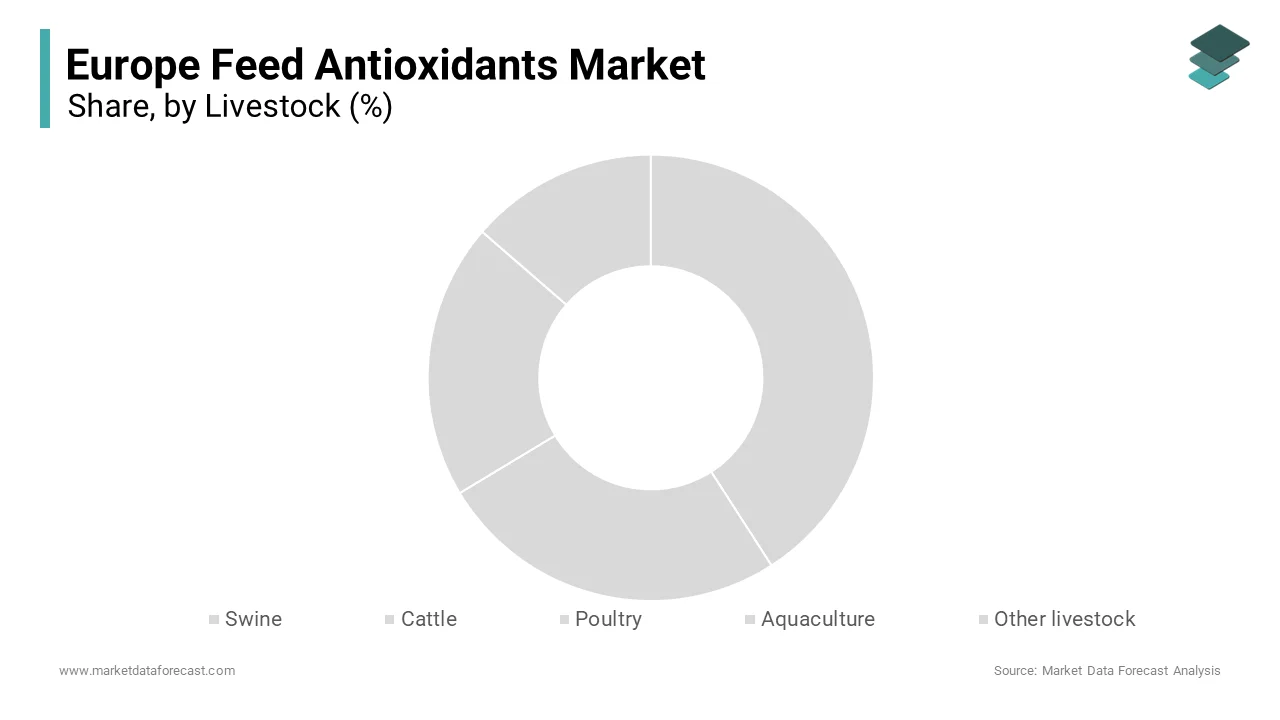
The aquaculture segment is anticipated to witness the fastest CAGR of 8.7% from 2025 to 2033. European aquaculture, particularly salmon and sea bass farming, ng relies on fish meal and fish oil for optimal growth aomega-3a 3 deposition, yet these ingredients are exceptionally vulnerable to oxidation. The EU partners demonstrated that unantioxidized feeds caused a 35% drop in EPA and DHA retention in fillets within 14 days of storage. Consequently, EU aquafeed producers uniformly incorporate antioxidants, with ethoxyquin alternatives like tocopherols or propyl gallate following the 2022 EU ban. The nutritional and economic imperative to preserve lipid integrity ensures sustained and growing antioxidant demand as aquaculture output expands. The European Commission’s 2023 updated guidelines on aquafeed safety require all lipid-containing feeds to demonstrate oxidative stability through peroxide and anisidine value testing before market release. This enforcement has compelled producers to adopt robust stabilization protocols. Moreover, eco-labeling schemes like the Aquaculture Stewardship Council now mandate antioxidant use documentation for certification, influencing procurement policies across retail giants like Carrefour and Tesco.
By Antioxidant Insights
The butylated hydroxytoluene BHT segment accounted in holding 32.5% of the Europe feed antioxidants market share in 2025. Modern compound feed production involves steam conditioning and pelleting at temperatures exceeding 80 degrees Celsius, conditions that degrade many natural antioxidants. BHT remains stable under these parameters and effectively prevents lipid peroxidation throughout the feed’s shelf life. This performance is for large-scale integrators producing millions of tons annually. Furthermore, BHT synergizes with other preservatives like citric acid, allowing lower inclusion rates and cost optimization. As per the European Food Safety Authority’s 2023 re-evaluation, BHT was deemed safe for target species consumers and the environment when used within limits, providing regulatory certainty absent for other synthetics. This approval allows uninterrupted use in exports to non-EU countries that reference EU standards. In 2024, Germany’s Federal Office of Consumer Protection confirmed no adverse residue findings in meat or milk from animals fedBHT-stabilizedd diets, reinforcing its safety profile. The combination of scientific validation, legal clarity, and processing reliability ensures BHT remains the backbone of synthetic antioxidant strategies across Europe’s diversified livestock landscape.
The “Other Synthetic Feed Antioxidants” segment is expected to grow with a CAGR of 7.9% from 2025 to 2033. Propyl gallate, for instance, excels in stabilizing fish oil-rich aquafeeds due to its solubility in lipids and synergistic action with citric acid. According to the Scottish Aquaculture Innovation Centre, feeds using propyl gallate retained more omega-3 fatty acids after extrusion compared to BHT-based systems. Ascorbyl palmitate, fat-solublele form of vitamin C, serves dual roles as an s antioxidant and an immune modulator in piglet and weanling diets. A 2025 trial by the Danish Agriculture and Food Council showed a reduction in post-weaning diarrhea incidence in piglets fed ascorbypalmitate-supplemented diets. These functional advantages enable premium pricing ansegment-specificic adoption in high-margin sectors like aquaculture and youngnutritiono,n where performance justifies cost.
COUNTRY ANALYSIS
Germany Feed Antioxidants Market Analysis
Germany was the top performer of the Europe feed antioxidants market by holding 21.3% of the share in 2025 wita a h highly industrialized livestock sector and rigorous feed safety enforcement. The country is home to over 380 compound feed mills producing 24 million metric tons annually, primarily for swine and poultry, both antioxidant-intensive segments. According to the Federal Ministry of Food and Agriculture, 92% of German feed manufacturers implement HACCP-based oxidation control protocols that mandate antioxidant inclusion in alfalfa-containing formulations. The presence of global additive producers like BASF and Evonik further strengthens technical access to advanced stabilization systems. Additionally, Germany’s stringent residue monitoring under the National Control Plan detected zero non-compliant antioxidant levels in 2023 across 12,000 meat and milk samples, as per the Federal Office of Consumer Protection. This regulatory reliability, ty combined with scale and scientific infrastructure, elements Germany’s role as the market’s technical and compliance benchmark.
France Feed Antioxidants Market Analysis
France feed antioxidants market was ranked second by holding 18.7%the market share in 2025. The nation’s strength lies in its integrated poultry and aquaculture chains that demand consistent oxidative protection. France is Europe’s largest duck and chicken producer, with over 850 million birds processed annually, requiring high-energy diets stabilized with antioxidants. Simultaneously, its Mediterranean and Atlantic aquaculture zones produce 220,000 metric tons of sea bass and bream yearly, fish species fed lipid-rich diets necessitating robust preservation. Moreover, cooperatives like InVivo have vertically integrated antioxidant procurement, ensuring supply chain traceability from additive producer to farm. This blend of production scale, regulatory discipline,ne and cooperative logistics makes France a resilient and high-volume market for both synthetic and natural antioxidant solutions.
Spain Feed Antioxidants Market Analysis
Spain'sin feed antioxidants market growth is propelled by its massive pork and aquaculture output operating under hot climatic conditions that accelerate feed rancidity. High ambient temperatures averaging 28 degrees Celsius in summer increase lipid oxidation rates, as documented by the University of Murcia’s Animal Nutrition Department. Climate-driven necessity combined with production intensity ensures Spain remains high-demandnd and technically adaptive market.
The Netherlands Feed Antioxidants Market Analysis
The Netherlands feed antioxidants market growth is likely to grow with its role as Europe’s feed technology and export hub. Dutch feed mills produce over 11 million metric tons annually,y with 40% exported to neighboring countries, including Germany, Belgium, and the UK. These exports must comply with both EU and destination country standards, requiring versatile antioxidant systems. The Netherlands is also home to leading feed additive distributors like Agrimprove and Nutr, which develop customized stabilization packages for global clients. This precision approach minimizes waste and maximizes efficacy. Furthermore, Wageningen University’s research on encapsulated antioxidants has been commercialized by local startups, ps enhancing the country’s innovation pipeline.
Italy Feed Antioxidants Market Analysis
Italy'sly feed antioxidants market growth is likely to be o driven by its diverse livestock base and strong domestic demand for high-quality animal products. Both sectors rely ohigh-fatat die, ts dairy rations often include protected, while pig feedsuse energy-densee oils, making oxidation control essential. The mills use dual antioxidant systems combining synthetics like BHT with natural tocopherols to meet both stability and clean label requirements from processors like Parmalat and Cremonini. Additionally, Italy’s southern regions face intense summer heat, exacerbating rancidity risks and justifying higher inclusion levels.
COMPETITIVE LANDSCAPE
Competition in the Europe feed antioxidants market is characterized by a dual dynamic between global chemical giants and specialized animal nutrition firms. The landscape is shaped by stringent regulatory oversight under EU feed additive legislati, on, which demands robust scientific validation for market access. Leading players differentiate through technical service capabilities, es formulatioe, se, and compliance infrastructure rather than price alone. The withdrawal of ethoxyquin has intensified competition among alternative synthetics and natural extracts, thus creating opportunities for agile innovators. Large corporations leverage scale and existing distribution networks while niche players focus on functional benefits, such as gut health support or sustainability credentials. Geographic disparities in livestock intensity, climate, t y cl, te and consumer preferences further fragment demand, nd requiring tailored strategies across Northern, Southern, rn Southern and Eastern Europe. Innovation in delivery systems,, ms such as encapsulation and syblendsdsi sticblendsn, ds is becoming a critical battleground.
KEY MARKET PLAYERS
Some of the major companies leading the Europe Feed Antioxidants market include
- Adisseo France SAS
- Anitox Corporation
- Kemin Europa
- BASF SE
- Alltech Cargill Inc.
- Archer Daniels Midland Company
- Danisco
- Nutreco N.V.
- DSM
- Novus International
- Perstorp.
Top Players In the Market
- BASF SE is a pivotal contributor to the Europe feeantioxidantssts market through its extensive portfolio of synthetic and natural stabilization solutions, including BHT, tocopherols, and proprietary blends like Santoflex. Headquartered in Germany, the company leverages its global chemical R and D infrastructure to develop feed additives that meet stringent EU regulatory standards. In 20,24 BASF expanded its Antioxidants Innovation Lab in Ludwigshafen to focus on oxidation control in high-fat aquafeeds anantibiotic-reduceded swine diets. The firm also launched a digital feed stability platform enabling European compounders to model peroxide value degradation and optimize antioxidant dosing in real time. These initiatives reinforce BASF’s role as science-drivenen enabler of feed safety and nutritional efficacy across both European and global livestock systems.
- Kemin Industries maintains a strong footprint in the Europe feed antioxidants market with science-backed natural solutions derived from rosemary green tea and mixed tocopherols under brands like Naturox and ENTRA. The company emphasizes clean label positioning aligned with EU consumer trends toward reduced synthetic additives. In recent years, Kemin has deepened its European regulatory engagement by submitting comprehensive dossiers to the European Food Safety Authority for novel plant extracts. This local manufacturing enhances supply chain resilience and supports Kemin’s commitment to sustainable sourcing and traceability for European integrators and feed mills.
- Anitox Corporation specializes in integrated feed safety systems that combine antioxidant protection with pathogen control primarily through its Termin family of products. Though headquartered in the United States,s the company has significantly expanded its European operations by establishing a technical support hub in Rotterdam, dthe Netherlandssan ando serve poultry, swiine and aquaculture clients across Western and Southern Europe. Anitox focuses on oxidation as a critical component of holistic feed hygiene, recognizing that rancid fats impair gut integrity and increase disease susceptibility. In 20, 24, the company partnered with several European veterinary research centers to validate the dual efficacy of its antioxidant formulations in reducing both peroxide values and Salmonella colonization in broilers.
Top strategies used by the key market participants
Key players in the Europe feed antioxidants market pursue regulatory excellence by aligning product portfolios with evolving European Food Safety Authority guidelines and proactively submitting safety dossiers for novel actives. They invest in localized production and technical service hubs to ensure supply chain reliability and rapid response to regional feed formulation needs. Companies increasingly adopt hybrid antioxidant systems combining synthetics with natural extracts to balance cost performance and clean label demands. Strategic collaborations with veterinary universities and livestock integrators facilitateon-farmm validation of oxidative stability and animal performance outcomes. Digital innovations,,n such as feed stability modeling software, real-time oxidation monitoring tools is also deployed to enhance precision dosing and reduce waste across compound feed operations.
MARKET SEGMENTATION
This research report on the European feed antioxidants market is segmented and sub-segmented into the following categories.
By Livestock
- Swine
- Cattle
- Poultry
- Aquaculture
- Other livestock
By Antioxidant Types
- BHA Antioxidants
- BHT Antioxidants
- Ethoxyquin Antioxidants
- Other Synthetic Feed Antioxidants
By Country
- UK
- France
- Spain
- Germany
- Italy
- Russia
- Sweden
- Denmark
- Switzerland
- Netherlands
- Turkey
- Czech Republic
- Rest of Europe