- Product Description Description
- Table of Contents TOC
- List of Table & Figure LOT
- Get Free Sample PDF Sample PDF
Europe Fermenters Market Size
The global fermenters market size was valued at USD 0.57 billion in 2024 and is anticipated to reach USD 0.61 billion in 2025 from USD 1.09 billion by 2033, growing at a CAGR of 5.66% during the forecast period from 2025 to 2033.
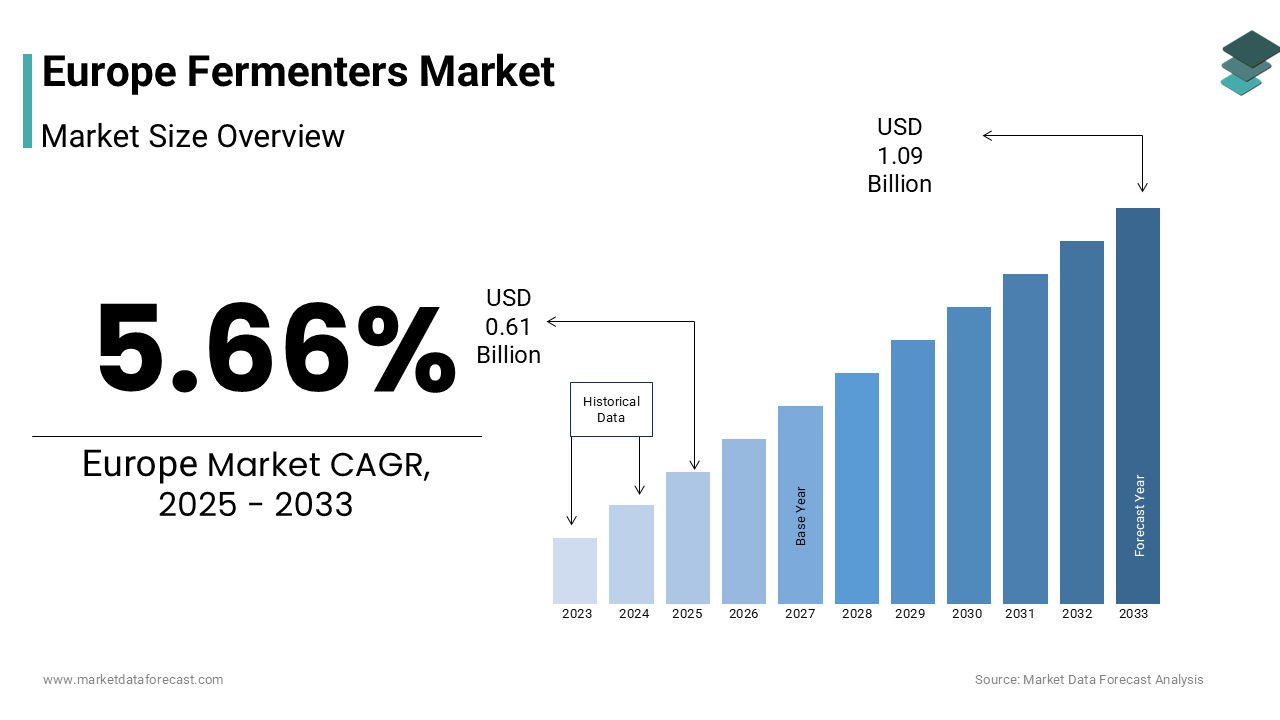
Fermenters are also known as bioreactor, which are engineered vessels designed to support controlled microbial or cellular cultivation for the production of biopharmaceuticals, enzymes, biofuels, food ingredients, and industrial chemicals. The region’s fermenter ecosystem is deeply integrated into its advanced biomanufacturing infrastructure, serving sectors such as pharmaceuticals, food and beverage, and renewable chemicals. The bioprocessing facilities across the European Union utilize fermentation as a core production method. Europe also hosts more than 40% of the world’s top 50 vaccine manufacturers, all of which rely on high integrity fermenters for antigen production. Regulatory frameworks like the European Medicines Agency’s guidelines on Good Manufacturing Practice further shape equipment design, emphasizing sterility, traceability, and process validation.
MARKET DRIVERS
Expansion of Biopharmaceutical Manufacturing Drives Fermenter Adoption
The rapid growth of Europe’s biopharmaceutical sector is a primary driving factor for the growth of for Europe Fermenters Market. According to the European Medicines Agency, new therapeutic approvals in the EU between 2020 and 2023 were biologics, nearly all requiring microbial or mammalian cell fermentation. Similarly, BioNTech’s mRNA vaccine production network across Germany includes fermentation based upstream processes for plasmid DNA, with its Marburg facility operating over 30 large scale bioreactors. This structural shift toward biologics not only increases volume demand but also elevates technical specifications by favoring advanced systems with integrated process analytical technology and single use flexibility.
Rising Demand for Precision Fermented Food Ingredients
The emergence of precision fermentation as a sustainable method to produce dairy proteins, egg whites, and flavor compounds is significantly boosting the growth of Europe Fermenters Market. Companies like Formo in Germany and Those Vegan Cowboys in Belgium use microbial hosts in controlled fermenters to biosynthesize casein and whey without animals. Consumer trends reinforce this shift 68% of EU citizens expressed willingness to try animal free dairy alternatives if proven safe and environmentally beneficial. These firms require scalable fermenters compliant with food grade standards, often favoring single use systems to avoid cross contamination.
MARKET RESTRAINTS
Stringent Regulatory Compliance Increases Capital and Time Costs
The region’s rigorous and multi layered regulatory environment governing bioprocessing equipment is hampering the growth of Europe fermenters market. Fermenters used in pharmaceutical and food applications must comply with European Medicines Agency guidelines, EU GMP Annex 1, and Regulation (EC) No 1935/2004 on materials in contact with food, among others. The validation and documentation for a single stainless steel fermenter system can take 9 to 14 months before operational clearance. This extended timeline delays production ramp up and increases total cost of ownership. Moreover, the 2022 revision of EU GMP Annex 1 mandates enhanced contamination control strategies, which is requiring real time monitoring, closed processing, and stricter material traceability features that necessitate costly retrofits or full replacements. The manufacturers postponed fermenter upgrades due to uncertainty around evolving regulatory interpretations.
High Initial Investment and Operational Complexity Deter SMEs
The substantial capital outlay and technical expertise required to operate industrial scale fermenters is also restraining factor for the growth of Europe fermenters market. The operational costs include specialized personnel, maintenance contracts, and utility consumption steam, cooling water, and compressed air systems can increase facility energy use. Even single use fermenters, though lower in upfront cost, require expensive disposable bags and proprietary control software, with annual operating expenses averaging 35% higher than reusable systems over a five-year horizon.
MARKET OPPORTUNITIES
Adoption of Single Use Fermenters Enables Agile Biomanufacturing
The accelerating shift toward single use fermenters by lowering entry barriers and enhancing production flexibility is creating new opportunities for the growth of Europe fermenters market. The single use bioreactors eliminate cleaning validation, reduce cross contamination risk, and enable rapid changeover between batches for multi product facilities and clinical trial material production. According to the European Biopharmaceutical Review, new biomanufacturing suites commissioned in the EU in 2023 incorporated single use fermenters up to 2000 liters. Regulatory acceptance has also improved; the European Medicines Agency issued updated guidance in 2022 confirming the suitability of single use systems for commercial biologics production when supported by extractables and leachables data.
Integration of Digital Twins and Process Analytical Technology
The incorporation of digital twins and advanced process analytical technology into fermenter systems for real time optimization and regulatory compliance in Europe is also gearing up new opportunities for the growth of Europe fermenters market. Digital twin models replicate physical fermentation processes in silico, enabling predictive control of parameters like temperature, agitation, and nutrient feed to maximize yield and consistency. The EU’s Industrial Digitalization Strategy actively promotes such technologies, with Horizon Europe allocating 220 million euros in 2023 specifically for smart bioprocessing projects. Simultaneously, the European Pharmacopoeia updated its guidelines in 2022 to endorse real time release testing based on in line analytics such as Raman spectroscopy and dielectric spectroscopy technologies increasingly embedded in next generation fermenters. Companies like Applikon Biotechnology now offer fermenters with native integration of AI driven analytics platforms that auto adjust setpoints based on metabolic feedback.
MARKET CHALLENGES
Supply Chain Vulnerabilities for Fermenter Components
The persistent supply chain fragility for high precision components such as sensors, seals, and single use bioreactor bags, many of which are sourced from a limited number of global suppliers is a challenging factor for the growth of Europe fermenters market. The 2022 semiconductor shortage severely impacted fermenter control systems by delaying deliveries by up to nine months, as per a survey. Single use supply chains are equally constrained as medical grade polymers used in bioprocess bags as strategic vulnerabilities due to concentrated production in North America and Asia. Geopolitical disruptions exacerbate this due to crisis in early 2024 increased lead times for imported fermenter components by 40 %.
Energy Intensity and Carbon Footprint Under Regulatory Scrutiny
The fermenters like large-scale stainless-steel systems due to their high energy consumption and associated carbon emissions, which conflict with Europe’s stringent climate mandates. The regulatory scrutiny is likely to degrade the growth of Europe fermenters market. The EU’s Carbon Border Adjustment Mechanism and Corporate Sustainability Reporting Directive now require companies to disclose and reduce process emissions by pushing biopharma and food producers to reevaluate equipment choices. The European Medicines Agency introduced sustainability criteria in its 2023 reflection paper on green manufacturing, encouraging energy efficient bioreactor designs. However, retrofitting existing facilities is costly. The energy reduction in legacy fermenters requires an average investment of 250000 euros per unit. This dual environmental challenge energy use versus waste generation that complicates procurement decisions and intensifies the need for truly sustainable fermenter innovations.
REPORT COVERAGE
| REPORT METRIC | DETAILS |
| Market Size Available | 2024 to 2033 |
| Base Year | 2024 |
| Forecast Period | 2025 to 2033 |
| Segments Covered | By Mode of Operation, Process, Material, Application and Region |
| Various Analyses Covered | Global, Regional & Country Level Analysis, Segment-Level Analysis, DROC, PESTLE Analysis, Porter’s Five Forces Analysis, Competitive Landscape, Analyst Overview of Investment Opportunities |
| Regions Covered | UK, France, Spain, Germany, Italy, Russia, Sweden, Denmark, Switzerland, the Netherlands, Turkey, the Czech Republic, and the Rest of Europe. |
| Market Leaders Profiled | Sartorius AG, Merck KGaA, Eppendorf AG, GE Healthcare (Cytiva), Thermo Fisher Scientific Inc., Bioengineering AG, BBI Biotech GmbH, Solaris Biotechnology, Applikon Biotechnology (Getinge), and Pierre Guérin Technologies. |
SEGMENTAL ANALYSIS
By Mode of Operation Insights
The automatic fermenters segment held a significant share of Europe fermenters market in 2024 with the emphasis on process consistency, regulatory compliance, and labor efficiency in biopharmaceutical and industrial biotechnology settings. Automated systems integrate programmable logic controllers, in line sensors, and data logging capabilities that align with EU Good Manufacturing Practice requirements for batch traceability and real time monitoring. Additionally, the European Medicines Agency’s 2022 guidance on continuous manufacturing strongly favors automated platforms capable of maintaining steady state parameters without manual intervention. Major vaccine producers like Bavarian Nordic and Valneva have standardized on fully automatic fermenters across their European plants to ensure batch to batch reproducibility.
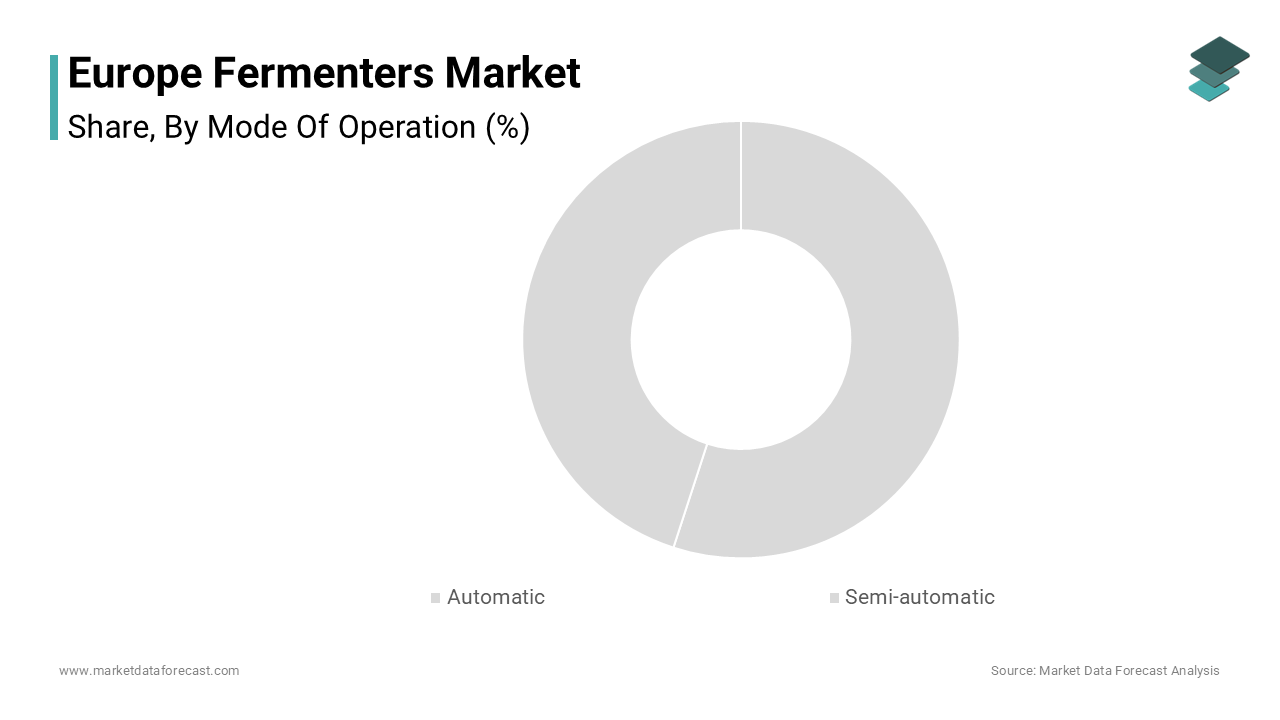
The semi-automatic segment is lucratively growing with an estimated CAGR of 9.3% in next coming years with the proliferation of academic research institutions, biotech incubators, and pilot scale food fermentation startups that require cost effective yet controllable systems. Shared laboratory networks like BioLabs Europe and High Tech Campus Eindhoven have also standardized on semi-automatic platforms to serve diverse user needs without excessive capital outlay. Furthermore, the European Commission’s Horizon Europe program allocated specifically for SME accessible bioprocessing equipment, with preference given to modular semi-automatic designs. These systems strike a balance between affordability and functionality, enabling innovation while remaining compliant with basic biosafety standards under Directive 2009/41/EC.
By Process Insights
The batch segment was accounted in holding 52.3% of the Europe fermenters market share in 2024 with its simplicity, regulatory familiarity, and suitability for high value, low volume products such as vaccines and therapeutic proteins. Most legacy biomanufacturing facilities across Germany, France, and the UK were originally designed for batch operations, and retrofitting to continuous systems remains cost prohibitive. Batch systems also offer containment advantages for genetically modified organisms, complying with EU Directive 2001/18/EC on contained use. The predictability of batch kinetics further supports quality by design frameworks mandated under EU GMP Annex 1.
The continuous segment is likely to grow with an expected CAGR of 11.7% throughout the forecast period with the European Medicines Agency’s 2022 endorsement of continuous manufacturing as a means to enhance product consistency and reduce facility footprint. Continuous systems operate 24/7 with steady state conditions, yielding up to 3.5 times more product per liter of reactor volume than batch. The European Commission’s Pharmaceutical Strategy for Europe explicitly promotes continuous processing to bolster supply chain resilience under Horizon Europe for related infrastructure. Moreover, the EU’s Industrial Emissions Directive incentivizes continuous processes due to their lower energy intensity per kilogram of output. These regulatory, economic, and environmental advantages are driving a paradigm shift among next generation biomanufacturers seeking efficiency and sustainability alignment.
By Material Insights
The stainless steel segment was the largest by capturing a significant share of Europe fermenters market in 2024 with its durability, scalability, and compliance with stringent hygiene standards required in commercial biopharmaceutical and food production. Grade 316L stainless steel resists corrosion from cleaning agents like sodium hydroxide and maintains surface smoothness for clean in place validation under EU GMP Annex 1. The material also supports high pressure steam sterilization at 121 degrees Celsius, a non-negotiable requirement for aseptic processing.
The glass segment is esteemed to grow with an expected CAGR of 10.2% throughout the forecast period with the exponential rise in academic and pre-clinical research activities that demand visual monitoring, chemical inertness, and rapid turnaround. Glass bioreactors allow real time observation of microbial morphology and foam behavior for strain development in synthetic biology. Additionally, the EU’s Marie Skłodowska Curie Actions program supports more than 5000 early stage researchers annually, many working in university labs equipped with glass fermenters due to their low cross contamination risk and ease of cleaning. The material’s transparency also facilitates integration with optical sensors for biomass and metabolite tracking by aligning with the EU’s push for data rich experimentation under the Digital Europe Programme.
Top Five Countries in the Europe Fermenters Market
Germany was the top performer in the Europe fermenters market with a 24.3% of share in 2024 with world class biopharmaceutical industry, robust engineering sector, and dense network of publicly funded research institutes. Home to global players like BioNTech, CureVac, and Bayer, Germany operates over 120 commercial scale biomanufacturing sites that rely heavily on advanced fermenters for mRNA and protein production. The government’s High-Tech Strategy 2025 allocated 1.8 billion euros in 2023 to strengthen biomanufacturing sovereignty, including grants for fermenter modernization. Technical standards set by the German Engineering Federation ensure equipment meets the highest levels of sterility and automation.
The United Kingdom was positioned second by occupying 15.3% of share in 2024. The UK remains a powerhouse in biologics and cell therapy manufacturing, anchored by the Cell and Gene Therapy Catapult and major facilities in Stevenage and Liverpool. The country hosts Europe’s largest concentration of viral vector production suites, all dependent on high integrity fermenters for plasmid DNA and viral seed stock. The Medicines and Healthcare products Regulatory Agency has also streamlined approvals for novel fermentation derived therapeutics by reducing time to market.
France fermenters market growth is expected to grow with significant growth opportunities throughout the forecast period with a strategic blend of public health imperatives, industrial policy, and scientific excellence. Sanofi’s massive biologics campus in Vitry sur Seine operates one of Europe’s largest stainless steel fermenter arrays for vaccine and insulin production. The Pasteur Institute and INRAE drive cutting edge research in microbial fermentation for food and health applications, utilizing both glass and single use systems.
COMPETETIVE LANDSCAPE
The Europe fermenters market features a dynamic competitive landscape shaped by the interplay of global technology leaders and specialized regional innovators. Competition is not solely based on hardware specifications but increasingly on integrated value propositions encompassing software intelligence, service support, and regulatory expertise. Global players leverage scale and broad portfolios to serve multinational pharmaceutical clients, while niche European firms excel in customization and rapid response for academic and industrial biotechnology applications. Differentiation hinges on the ability to deliver compliant, data rich, and sustainable fermentation solutions aligned with EU directives on good manufacturing practice, industrial emissions, and circular economy principles. The rise of single use systems has lowered entry barriers but intensified pressure on sensor accuracy, material safety, and supply chain reliability.
KEY MARKET PLAYERS
A few of the major companies in the europe fermenters market include
- Sartorius AG
- Merck KGaA
- Eppendorf AG
- GE Healthcare (Cytiva)
- Thermo Fisher Scientific Inc.
- Bioengineering AG
- BBI Biotech GmbH
- Solaris Biotechnology
- Applikon Biotechnology (Getinge)
- Pierre Guérin Technologies
Top Players in the Europe Fermenters Market
Sartorius
Sartorius is a German life science company with a strong footprint in the Europe fermenters market through its advanced bioprocess solutions division. The company offers a comprehensive portfolio of single use and stainless steel fermenters ranging from 0.5 liters to 2000 liters, widely adopted by biopharmaceutical and academic institutions across the continent. It also opened a new bioprocessing innovation center in Germany to support customer process development. These initiatives reinforce its global dominant in single use fermentation technologies and deepen engagement with Europe’s growing cell and gene therapy sector.
Thermo Fisher Scientific
Thermo Fisher Scientific is a US based global life sciences leader with significant operations in Europe through its HyPerforma bioproduction portfolio. The company supplies modular fermenters and bioreactor systems tailored for clinical and commercial scale biomanufacturing. In 2023 Thermo Fisher launched its HyPerforma DynaDrive single use bioreactor with improved mixing efficiency and oxygen transfer for high density cell cultures. It also expanded manufacturing capacity at its site in Bremen Germany to meet rising European demand. These actions strengthen its ability to serve both large pharma and emerging biotechs across the region with scalable and compliant fermentation solutions.
Applikon Biotechnology
Applikon Biotechnology is a Netherlands based specialist in advanced fermentation and cell culture systems with deep roots in the European market. The company provides glass and stainless-steel fermenters equipped with proprietary control software and in line analytics for research and industrial applications. It also partnered with several EU funded synthetic biology consortia to co-develop next generation bioreactor protocols. These efforts enhance its reputation as a technology innovator and trusted partner for complex fermentation challenges in academia and industry alike.
Top Strategies Used by the Key Market Participants
Key players in the Europe fermenters market are intensifying investments in single use technologies to address demand for flexible and contamination free bioprocessing. They are embedding advanced process analytical tools such as Raman spectroscopy and dielectric sensors directly into fermenter systems for real time monitoring. Companies are developing scalable platforms that seamlessly transition from lab to commercial scale to accelerate process development timelines. Strategic collaborations with academic institutions and biotech incubators are being formed to co innovate and capture early-stage demand. There is a strong focus on digitalization through cloud connected control systems and digital twin integration for predictive process optimization. Vendors are also
MARKET SEGMENTATION
This research report on the europe fermenters market has been segmented based on the following categories.
By Mode of Operation
- Automatic
- Semi-automatic
By Process
- Batch
- Fed-Batch
- Continuous
By Material
- Stainless-Steel
- Glass
- Others
By Application
- Food
- Beverages
- Healthcare & cosmetics
- Others
By Country
- UK
- France
- Spain
- Germany
- Italy
- Russia
- Sweden
- Denmark
- Switzerland
- Netherlands
- Turkey
- Czech Republic
- Rest of Europe