- Product Description Description
- Table of Contents TOC
- List of Table & Figure LOT
- Get Free Sample PDF Sample PDF
Market Size, 2025
$17.73 BnMarket Estimate, 2026
$19.08 BnMarket Forecast, 2034
$34.39 BnCAGR, 2026–2034
7.64%Europe Ferroalloys Market Report Summary
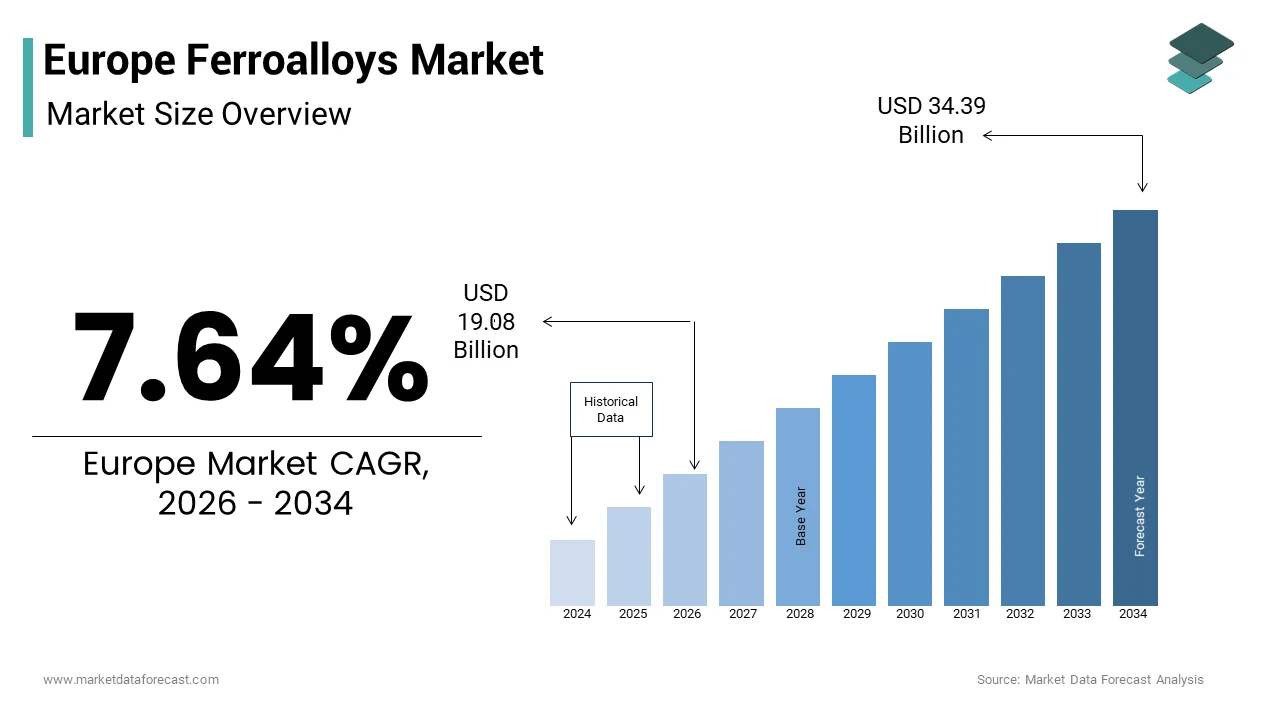
The Europe ferroalloys market was valued at USD 17.73 billion in 2025, is estimated to reach USD 19.08 billion in 2026, and is projected to reach USD 34.39 billion by 2034, growing at a CAGR of 7.64% during the forecast period from 2026 to 2034.
Market growth is driven by Europe’s rising demand for high-performance steel, expanding industrial manufacturing, and ongoing investments in automotive, construction, and energy infrastructure. The region’s push toward advanced steelmaking technologies and low-carbon metallurgy is further accelerating ferroalloy adoption, particularly in stainless steel and specialty alloy production. Additionally, Europe’s transition toward green steel initiatives is promoting the use of premium ferroalloys that enhance strength, corrosion resistance, and energy efficiency in steel production.
Key Market Trends
- Growing reliance on high-grade ferrochromium and ferromanganese to meet stainless steel and specialty steel performance requirements.
- Increasing adoption of low-carbon and energy-efficient ferroalloy production technologies is aligned with Europe’s decarbonization targets.
- Rising use of automation and digital furnace monitoring to improve smelting efficiency and reduce operational costs.
- Expansion of recycled alloy usage as circular economy principles gain momentum across European heavy industries.
- Strengthening supply-chain diversification as steel manufacturers seek stable sourcing of chromium, manganese, and nickel amid global ore market volatility.
Segmental Insights
- By Type, the ferrochromium segment was the largest and captured 42.5% of the Europe ferroalloys market in 2025. This dominance is attributed to strong demand from stainless steel producers who rely on chromium-rich alloys to enhance corrosion resistance and strength across automotive, construction, and industrial applications.
- By Application, the stainless-steel segment led the market with a 38.6% share in 2025. Stainless steel manufacturing remains the primary consumer of ferroalloys due to increasing requirements for durable, heat-resistant, and high-performance materials across Europe’s industrial, energy, and transportation sectors.
Regional Insights
- Germany was the top-performing country, accounting for 24.6% of the Europe ferroalloys market in 2025, supported by its advanced steel industry, strong automotive production, and robust manufacturing ecosystem.
- Italy held the second-largest share at 16.6% in 2025, driven by its specialty steel capacity, strong industrial base, and expanding metallurgical operations.
- Finland is experiencing steady growth, supported by its well-established ferroalloy production facilities and strategic investments in green steel technologies.
- Sweden is moderately expanding due to its focus on high-tech steel, innovative furnace processes, and leadership in low-carbon steelmaking initiatives.
- Turkey is expected to increase its market share from 2025 to 2033, leveraging its position as a regional ferroalloy processing hub and strategic supplier to European steelmakers.
Competitive Landscape
The Europe ferroalloys market is characterized by a mix of integrated steel producers, specialized alloy manufacturers, and regional suppliers. Competition is driven by product quality, energy efficiency, cost optimization, and the ability to meet Europe’s rising demand for sustainable and high-purity ferroalloys. Companies are focusing on capacity expansion, improved smelting technologies, and long-term sourcing agreements for key ores such as chromium and manganese. The shift toward green metallurgy and advanced steel applications is pushing manufacturers to innovate material blends and reduce carbon footprints across production lines.
Key Market Players
Key companies operating in the Europe ferroalloys market include: JAYESH, Tata Steel Ltd, Ferro Alloys Corporation Limited, Gulf Ferro Alloys Company, Nikopol Ferroalloy Plant, Sakura Ferroalloys SDN BHD, OM Holdings Limited, Brahm Group, Mortex Group, SAIL, Maithan Alloys Limited, and Salasar Techno Engineering Limited.
Europe Ferroalloys Market Size
The Europe ferroalloys market size was valued at USD 17.73 billion in 2025 and is anticipated to reach USD 19.08 billion in 2026 and USD 34.39 billion by 2034, growing at a CAGR of 7.64% from 2026 to 2034.
Ferroalloys are master alloys of iron combined with high proportions of elements such as manganese, silico,n chromium, um, and vanadium, which are essential for enhancing the mechanical strength, corrosion resistance, and thermal stability of steel. The Europe ferroalloys market serves as a critical upstream enabler of the region’s metallurgical and manufacturing sectors, particularly in automotive construction and specialty steel production. Europe's steel industry maintains a significant annual consumption of ferroalloys, with demand increasing for high-strength and corrosion-resistant steel types. The European Union's crude steel production in 2024 showed a modest recovery compared to the previous year, reflecting a continuing reliance on alloyed grades for a variety of industrial applications. The market is deeply influenced by energy availability, raw material sourcing, and environmental regulations, given the energy-intensive nature of ferroalloy smelting. The ferroalloy market is an energy-intensive industry contributing to the EU's total industrial emissions, and it is required to align its operations with evolving climate policies like the EU Emissions Trading System and the Carbon Border Adjustment Mechanism. This regulatory and industrial context defines the operational and strategic parameters of the Europe ferroalloys market.
MARKET DRIVERS
Stainless Steel Production Drives Chromium and Nickel-Based Ferroalloy Demand
The region’s robust stainless-steel industry constitutes a primary driver of the Europe ferroalloys market. This is particularly true for ferrochromium and ferronickel. According to the International Stainless Steel Forum (ISSF) or Worldstainless, Europe experienced a slight increase in stainless steel production in 2024 compared to 2023. Germany, Italy, and Finland remain significant manufacturing hubs within the European market. Stainless steel must contain a minimum percentage of chromium by weight to qualify as stainless, and most common industrial grades incorporate a higher range of this element. The expansion of stainless steel production is the primary driver of global ferrochromium demand. Automotive exhaust systems, heat exchangers, and food processing equipment represent major end uses where corrosion resistance is non-negotiable. The European Automobile Manufacturers Association (ACEA) collaborates on environmental standards and end-of-life vehicle directives that mandate high recycling targets for materials. The automotive sector is a critical consumer, with a rising demand trend for lightweight, corrosion-resistant stainless steel alloys in traditional components like exhaust systems and emerging applications such as electric vehicle battery enclosures. Additionally, the EU’s Green Deal Industrial Plan supports high-value steel manufacturing as a strategic sector, reducing reliance on imports and sustaining domestic ferroalloy demand. This industrial linkage ensures that as long as Europe maintains its stainless steel production capacity, ferrochromium and ferronickel will remain indispensable inputs.
Infrastructure and Automotive Sectors Fuel Demand for Silicon and Manganese Alloys
The construction and automotive industries are key consumers of ferrosilicon and ferromanganese, which are important for deoxidizing and strengthening carbon and low alloy steels, which fuels the expansion of the Europe ferroalloys market. High-strength reinforcement bars are used in new residential units. Manganese is incorporated into these bars for improved toughness. Ferrosilicon is used in advanced high-strength steel grades to control oxygen content during casting and enhance fatigue resistance. Infrastructure investments in transport, grid, and energy projects are boosting structural steel demand. Automotive lightweighting trends have increased reliance on high-strength low-alloy steels. Ferromanganese additions are used in these steels to achieve specific yield strengths without compromising formability. These structural and mechanical requirements cement silicon and manganese ferroalloys as foundational materials in Europe’s industrial value chain.
MARKET RESTRAINTS
High Energy Intensity and Carbon Pricing Increase Production Costs
The ferroalloy smelting process is among the most energy-intensive in the European industrial sector, which impedes the growth of the Europe ferroalloys market. This process requires significant kilowatt hours per metric ton of ferrochromium. This extreme electricity dependency exposes producers to volatile energy markets and escalating carbon compliance costs. The sector's operational expenses are significantly influenced by the cost of emissions allowances under the relevant system. This pricing structure has contributed to an increase in production costs in some regional facilities. Combined energy and carbon levies appear to be a contributing factor to this trend in operational expenses. Unlike integrated steel mills, ferroalloy plants often lack access to waste heat recovery or alternative fuel, making decarbonization technically challenging. The upcoming Carbon Border Adjustment Mechanism further complicates competitiveness as imported ferroalloys from regions with laxer climate policies may gain pricing advantages. European producers will continue to face constraints from regulatory and energy cost pressures until cost-effective green hydrogen or electrified smelting technologies achieve commercial scale.
Geopolitical Disruptions in Critical Raw Material Supply Chains
There is significant supply chain vulnerability due to its near-total reliance on imported raw materials from geopolitically sensitive regions, which further hinders the expansion of EEurope's ferroalloys. The supply of chromite ore is largely concentrated among a few key producing countries. Manganese ore supply also exhibits significant concentration in its source nations. The war in Ukraine and subsequent sanctions disrupted rail and port logistics through Eastern Europe, while export restrictions in Turkey, now a key chromite supplier, have tightened availability. Inventory levels for ferroalloys in Western Europe experienced a decline, indicating potential vulnerability in supply chains. This strategic dependence on external suppliers creates price volatility and operational uncertainty that constrains long-term investment in European smelting capacity.
MARKET OPPORTUNITIES
Circular Economy Initiatives Boost Ferroalloy Recycling from Steel Scrap
The expansion of closed-loop recycling systems that recover alloying elements from end-of-life steel products provides new opportunities for the Europe ferroalloys market. The majority of steel production within the European Union utilizes electric arc furnace technology. Initiatives are underway to increase the use of high-quality scrap materials in the region. Companies like Outokumpu and Acerinox have developed advanced sorting and refining techniques to isolate and purify alloying elements from shredded automobile scrap and demolition steel. Research suggests that recovered ferrochromium from recycled stainless steel could potentially meet a significant percentage of future European demand. National policies such as Germany’s Resource Efficiency Programme further incentivize scrap preprocessing infrastructure. This shift not only reduces primary ore dependency but also lowers the carbon footprint of ferroalloy production.
Development of Low-Carbon Ferroalloy Technologies Supported by EU Innovation Funds
The region is emerging as a global leader in the development of green ferroalloy production technologies driven by public funding and industrial collaboration, which creates fresh prospects for the expansion of the Europe ferroalloys market. Financial support is being directed toward pilot projects that aim to replace traditional coal-based reductants used in smelting processes with green hydrogen or biochar. One initiative is testing a hydrogen-based approach in ferromanganese production to significantly cut carbon dioxide emissions. Another development involves the joint effort to create an electrified submerged arc furnace. This new furnace is designed to operate on renewable electricity, capable of producing ferrosilicon with minimal process emissions. These technological shifts may lead to a substantial reduction in the sector's carbon intensity within the sector. The EU’s Net Zero Industry Act further prioritizes clean metallurgy as a strategic technology, ensuring continued R&D support. These initiatives position Europe to export not only ferroalloys but also decarbonization know-how to global markets.
MARKET CHALLENGES
Regulatory Misalignment Between the EU ETS and Global Competitors
The growing regulatory asymmetry between EU carbon pricing and the laxer environmental regimes of major exporting nations structures the growth of the Europe ferroalloys market. Producers in Europe participate in an emissions trading system. The costs associated with carbon allowances in the European system are substantial. Conversely, some other nations, including China, India, and South Africa, have minimal carbon pricing in place. This disparity creates different operational cost structures across various regions. The difference in carbon pricing is a factor in the international trade dynamics related to ferroalloys. This disparity creates a structural cost disadvantage. The Carbon Border Adjustment Mechanism (CBAM) is intended to create a level playing field, but its early stage has limitations, such as omitting crucial ferroalloy categories and depending on complicated embedded emissions calculations, which postpones full implementation. Meanwhile, European smelters face declining margins. Until the CBAM is fully enforced and harmonized with international standards, European producers will struggle to maintain capacity against lower-cost global rivals.
Limited Availability of Renewable Energy for Smelting Operations
The decarbonization of ferroalloy production is critically constrained by insufficient access to low-cost renewable electricity at the scale and reliability required for continuous smelting operations, which constrains the expansion of the Europe ferroalloys market. Ferroalloy furnaces cannot be intermittently operated without damaging refractory linings and compromising metal quality, necessitating24/77 baseload power. Industrial electricity for ferroalloy production tends to utilize a smaller portion of dedicated renewable sources. Grid congestion and permitting delays further limit new wind and solar connections. Approval periods for transmission infrastructure frequently extend beyond five years. In regions with significant hydropower, increasing local energy demands from industries like data centers and battery production are reducing surplus capacity. The inability of European ferroalloy producers to secure affordable clean power is a major obstacle to the capital investment needed for sustainable technologies such as green hydrogen and electrified smelting, thus hindering the sector's transition and posing a threat to its viability in an era of strict carbon limits.
REPORT COVERAGE
| REPORT METRIC | DETAILS |
| Market Size Available | 2025 to 2034 |
| Base Year | 2025 |
| Forecast Period | 2026 to 2034 |
| CAGR | 7.64% |
| Segments Covered | By Type, Application & Region |
| Various Analyses Covered | Global, Regional & Country Level Analysis, Segment-Level Analysis, DROC, PESTLE Analysis, Porter’s Five Forces Analysis, Competitive Landscape, Analyst Overview on Investment Opportunities |
| Regions Covered | UK, France, Spain, Germany, Italy, Russia, Sweden, Denmark, Switzerland, Netherlands, Turkey, Czech Republic & Rest of Europe |
| Market Leaders Profiled | JAYESH, Tata Steel Ltd, Ferro Alloys Corporation Limited, Gulf Ferro Alloys Company, Nikopol Ferroalloy Plant, Sakura Ferroalloys SDN BHD, OM Holdings Limited, Brahm Group, Mortex Group, SAIL, Maithan Alloys Limited, Salasar Techno Engineering Limited |
SEGMENTAL ANALYSIS
By Type Insights
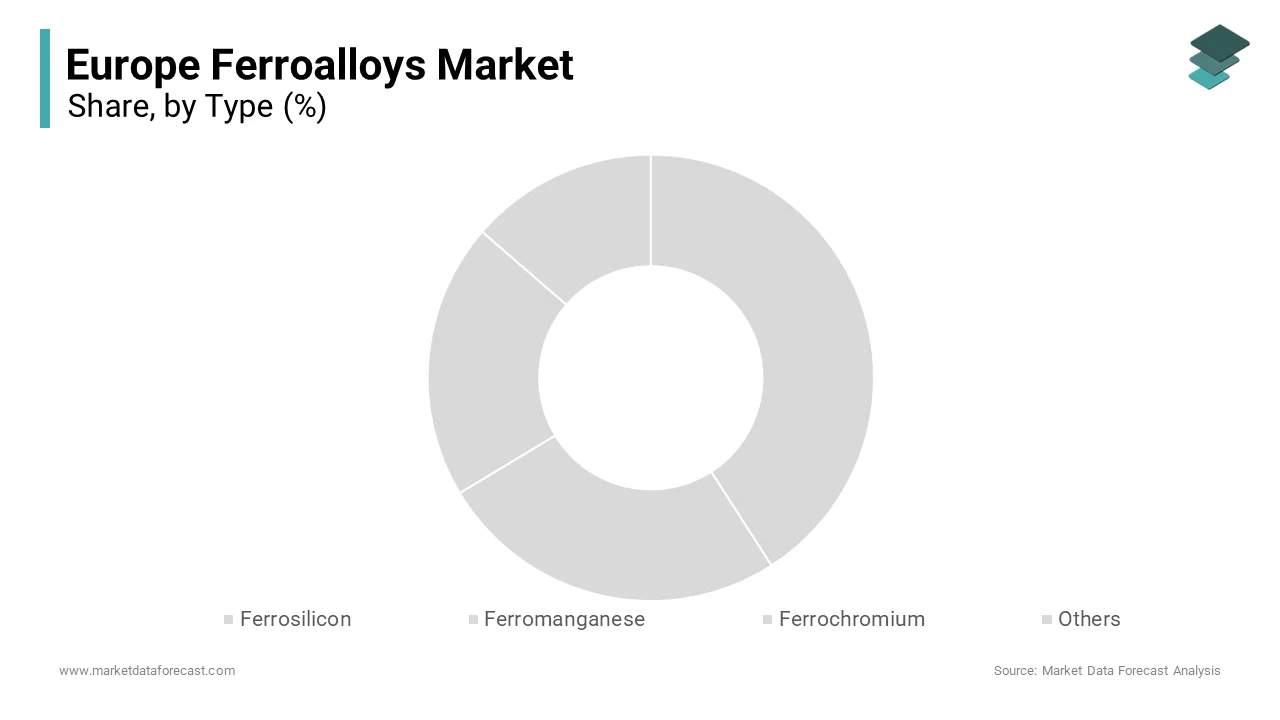
The ferrochromium segment was the largest segment of the Europe ferroalloys market by captured a share of 42.5% share in 2025. The dominance of the ferrochromium segment is directly tied to Europe’s position as a leading global producer of stainless steel, which requires chromium by weight for corrosion resistance and mechanical integrity. The automotive sector further amplifies demand as exhaust systems, catalytic converters, and structural reinforcements in most of EU EU-produced vehicles incorporate stainless grades. Besides, the EU’s Green Deal Industrial Plan prioritizes high-value specialty steel production to reduce strategic dependencies, making domestic ferrochromium essential for supply chain resilience. Unlike manganese or silicon alloys, which serve broader carbon steel applications, ferrochromium’s irreplaceable role in stainless production ensures its continued market leadership across Europe’s metallurgical landscape.
The ferromanganese segment is on the rise and is expected to be the fastest-growing segment in the market by witnessing a CAGR of 5.8% between 2025 and 2033. The rapid acceleration of the ferromanganese segment is fuelled by rising demand for high-strength low-alloy steels in infrastructure and electric vehicle manufacturing. Moreover, the shift toward lightweight automotive design has increased manganese usage in advanced high-strength steels, which reduces vehicle weight while maintaining crash performance. Furthermore, ferromanganese is critical in the production of silicon manganese alloys used in transformer cores for renewable energy grids. These converging industrial and energy transitions position ferromanganese as the most dynamically expanding ferroalloy category in Europe.
By Application Insights
The stainless-steel segment led the Europe ferroalloys market and captured a share of 38.6% in 2025. The leading position of the stainless-steel segment is driven by the region’s advanced manufacturing base, where stainless grades are indispensable for applications demanding hygiene, durability, t, nd high temperature performance. A significant portion of stainless steel produced in Europe is used for capital goods. Key applications for this material include equipment for chemical processing, machinery for the food and beverage sectors, and medical devices. European policy initiatives support the use of stainless steel as a strategic material in emerging green technology sectors. This includes applications within hydrogen infrastructure, electrolyzers, and heat pumps. A vast majority of passenger vehicles produced in the EU incorporate stainless components. These components are found in various systems, such as exhaust and battery enclosures for electric vehicles. Unlike carbon steel applications, which are price sensitive and cyclical, stainless steel’s premium nature ensures stable ferroalloy demand even during economic downturns. This structural reliance on corrosion-resistant alloys solidifies stainless steel as the primary driver of ferroalloy consumption across Europe.
The alloy steel segment is expected to exhibit a noteworthy CAGR of 6.2% during the forecast period, owing to the aerospace defense and renewable energy sectors, which require high-performance steels with precise manganese, chromium, and silicon additions. Defence procurement budgets are rising across EU member states. Increased budgets are driving up the demand for armor-grade and high-toughness alloy steels. The offshore wind industry is expanding significantly. This expansion creates a need for alloyed bearing and shaft steels designed to endure corrosive marine environments. Companies like Saab and Leonardo are scaling production of next-generation platforms using vacuum-melted alloy steels with controlled ferroalloy chemistries. Furthermore, the EU’s Chips Act and semiconductor strategy have spurred investment in high-purity tool steels for wafer fabrication equipment, which requires ultra-low impurity ferrosilicon and ferromanganese. These high-value applications command premium pricing and stringent quality standards, creating a resilient and growing niche for specialized ferroalloy formulations.
COUNTRY ANALYSIS
Germany Ferroalloys Market Analysis
Germany was the top performer in the Europe ferroalloys market and accounted for a share of 24.6% in 2025. The dominance of the German market is driven by a dense network of specialty steel mills, automotive OEMs, and machinery manufacturers that consume high volumes of ferrochromium and ferrosilicon. Companies like ThyssenKrupp and Salzgitter produce substantial metric tons of alloy and stainless steel annually, requiring consistent ferroalloy inputs. The automotive sector alone accounts for a notable share of national steel consumption, with electric vehicle platforms increasing demand for silicon manganese grades. Germany also hosts Europe’s most advanced scrap recycling infrastructure, recovering considerable metric tons of steel scrap yearly, which serves as a secondary source of alloying elements. The federal government’s High-Tech Strategy 2025 prioritizes resource-efficient metallurgy, further securing domestic ferroalloy demand. This integration of primary production, recycling, and high-value manufacturing establishes Germany as the continent’s core ferroalloy consumer.
Italy Ferroalloys Market Analysis
Italy was the second largest country in the Europe ferroalloys market and held a 16.6% share in 2025. The country is Europe’s largest producer of stainless steel, with mills in Terni and Genoa operated by Acerinox and Outokum,,pu supplying notable metric tons annually. This focus on stainless directly drives ferrochromium demand, which accounts for r significant share of Italy’s ferroalloy imports. Italy also leads in circularity with most stainless production derived from end-of-life scrap, a practice supported by national extended producer responsibility schemes. Additionally, Italy’s machinery and appliance sectors consume significant volumes of alloy steel for compressors and industrial tools. This combination of stainless specialization, scrap integration, and industrial diversification ensures Italy remains a high-intensity and strategically stable ferroalloy market.
Finland Ferroalloys Market Analysis
Finland is steadily growing in the Europe ferroalloys market due to strategic ferroalloy production and green steel ambition. Unlike most European nations, Finland is a net exporter of ferroalloys due to its abundant hydroelectric power and domestic chromite resources from the Kemi mine. Outokumpu’s Tornio complex—the largest stainless steel producer in Europe—vertically integrates mini, ng smel, ting and steelmakin, creating a self-sufficient ferrochromium loop. The country produced notable metric tons of ferrochromiumwithhaa a portion consumed domestically and the remainder exported to Germany and Sweden. Finland’s Climate Act mandates carbon carbon-neutral industry by 2035, accelerating investments in hydrogen-based steel and electrified furnaces. The Finnish Minerals Group is piloting a biochar reductant process that could cut ferroalloy emissions. This unique position as both producer and consumer supported by clean energy and policy foresight makes Finland a pivotal player in Europe’s ferroalloy ecosystem.
Sweden Ferroalloys Market Analysis
Sweden is moderately expanding in the European ferroalloys market owing to its focus on high-tech steel and its role as a decarbonization pioneer. The country’s demand is driven by its world-leading specialty steel sector, with companies like SSAB and Sandvik producing high-strength tool and wear-resistant steels for mining, automotive, and aerospace applications. SSAB’s fossil-free steel initiative, using HYBRIT green hydrogen technology, still requires precise ferromanganese and ferrosilicon additions, albeit with dramatically lower embedded carbon. The government’s Fossil Free Sweden program provides grants for clean metallurgy R&D &, and reinforces domestic demand for high-purity ferroalloys compatible with green production routes. This alignment of industrial excellence, sustainability, and innovation positions Sweden aa s forward-looking and technically advanced market.
Turkey Ferroalloys Market Analysis
Turkey is likely to increase its market share in the European ferroalloys market from 2026 to 2034 due to its role as a strategic supplier and regional processing center. While geographically bridging Europe and Asia, Turkey functions as a key ferroalloy supplier to the EU due to its large chromite reserves and competitive energy costs. The country exported considerable metric tons of ferrochromium to the European Union, leveraging its position as the second-largest chromite producer. Domestically, Turkey’s steel sector, producing millions of metric tons annually, consumes significant volumes of ferromanganese for construction rebar used in earthquake-resilient infrastructure. The Istanbul and Iskenderun industrial zones host integrated mills that increasingly serve European automotive and appliance manufacturers. Although not an EU member, Turkey’s alignment with European technical standards and participation in the EU Customs Union facilitate seamless trade. This dual role as supplier and regional processor ensures Turkey’s outsized influence on Europe’s ferroalloy supply security and pricing dynamics.
COMPETITIVE LANDSCAPE
Competition in the Europe ferroalloys market is defined by a convergence of industrial policy, energy access, and sustainability imperatives rather than price alone. The landscape features a mix of integrated producers, miners, smelters, and specialty alloy refiners competing on purity, reli, ability, and carbon footprint. Unlike in Asia or Africa, European players cannot leverage low labor or lax environmental stanstandardshey differentiate through traceability, circularity, and alignment with the EU Green Deal. Large stainless steel producers like Outokumpu operate captive ferroalloy facilities to secure supply, while independent smelters such as Eramet and Ferroglobe compete on technical grade consistency and decarbonization credentials. Regulatory pressure from the EU Emissions Trading System and Carbon Border Adjustment Mechanism has raised the cost of conventional production, favoring incumbents with access to renewables or recycling infrastructure. New entrants face formidable barriers in capital intensity permitting and raw material sourcing. As a result, the market rewards resilience, innovation, and strategic alignment with Europe’s industrial sovereignty and climate goals, ensuring only the most adaptable and vertically integrated players maintain long-term relevance.
KEY MARKET PLAYERS
A few of the market players in the Europe ferroalloys market
- JAYESH
- Tata Steel Ltd
- Eramet
- Outokumpu
- Ferroglobe
- Ferro Alloys Corporation Limited
- Gulf Ferro Alloys Company
- Nikopol Ferroalloy Plant
- Sakura Ferroalloys SDN BHD
- OM Holdings Limited
- Brahm Group
- Mortex Group
- SAIL
- Maithan Alloys Limited
- Salasar Techno Engineering Limited
- Others
Top Players In The Market
- Eramet is a leading European producer of specialty alloys and high-grade ferroalloys headquartered in France with significant operations in Norway and Greece. The company supplies ferromanganese and ferrochromium to global stainless and specialty steel producers with a strong footprint in Germany, Italy, and Finland. Eramet contributes to the global market through its vertically integrated operations from mining in Gabon to smelting inEuropep ensuring traceable and high-purity alloys. It also enhanced its manganese recycling capabilities at its French facility to support circular economy mandates. These initiatives reinforce Eramet’s leadership in sustainable ferroalloy production aligned with European industrial decarbonization goals.
- Outokumpu is a Finnish global leader in stainless steel and a major consumer and producer of ferrochromium through its integrated operations in Tornio, Finland. The company sources chromite from its own Kemi mine and operates one of Europe’s largest ferroalloy smelters, ensuring raw material security and cost control. Outokumpu supplies high-quality stainless products to the automotive, construction, and renewable energy sectors across Europe and globally. The company also partnered with Finnish research institutes to optimize ferroalloy dosing in electric arc furnaces, reducing energy use by 7 percent. These actions strengthen its position as a vertically integrated and sustainability-driven ferroalloy stakeholder in Europe.
- Ferroglobe is a multinational producer with key ferroalloy assets in Spain and France, specializing in ferrosilicon and silicon manganese for the European carbon and alloy steel industries. The company serves major steelmakers in Germany and the Benelux region with high-purity alloys tailored for automotive and electrical steel applications. Ferroglobe contributes globally by operating one of the largest silicon metal and ferroalloy portfolios outside China. It also secured long-term renewable power purchase agreements in Iberia to align with EU green steel initiatives. These strategic upgrades enhance Ferroglobe’s competitiveness and environmental compliance in a carbon-constrained European market.
Top Strategies Used By The Key Market Participants
Key players in the Europe ferroalloys market pursue vertical integration by controlling chromite and manganese mining to ensure raw material security and cost stability. They invest in decarbonization technologies such as hydrogen reduction, biochar reduction, and electrified smelting to cothe the mply with the EU Emissions Trading System and Carbon Border Adjustment Mechanism requirements. Companies expand closed-loop recycling systems to recover chromium,mium man, ganese, nd silicon from stainless and carbon steel scrap to enhance circularity. Strategic partnerships with steelmakers and research institutions accelerate the development of low-carbon ferroalloy production processes. Geographic positioning near hydroelectric or renewable energy sources reduces operational emissions and secures long-term competitiveness in Europe’s green industrial transition.
MARKET SEGMENTATION
This research report on the Europe ferroalloys market is segmented and sub-segmented into the following categories.
By Type
- Ferrosilicon
- Ferromanganese
- Ferrochromium
- Others
By Application
- Carbon & Low Alloy Steel
- Alloy Steel
- Stainless Steel
- Cast Iron
- Others
By Country
- UK
- France
- Spain
- Germany
- Italy
- Russia
- Sweden
- Denmark
- Switzerland
- Netherlands
- Turkey
- Czech Republic
- Rest of Europe