- Product Description Description
- Table of Contents TOC
- List of Table & Figure LOT
- Get Free Sample PDF Sample PDF
Market Size, 2025
$13.43 BnMarket Estimate, 2026
$14.23 BnMarket Forecast, 2034
$22.63 BnCAGR, 2026–2034
5.97%Europe Fertigation and Chemigation Market Size, Growth, Trends & Forecast (2026–2034)
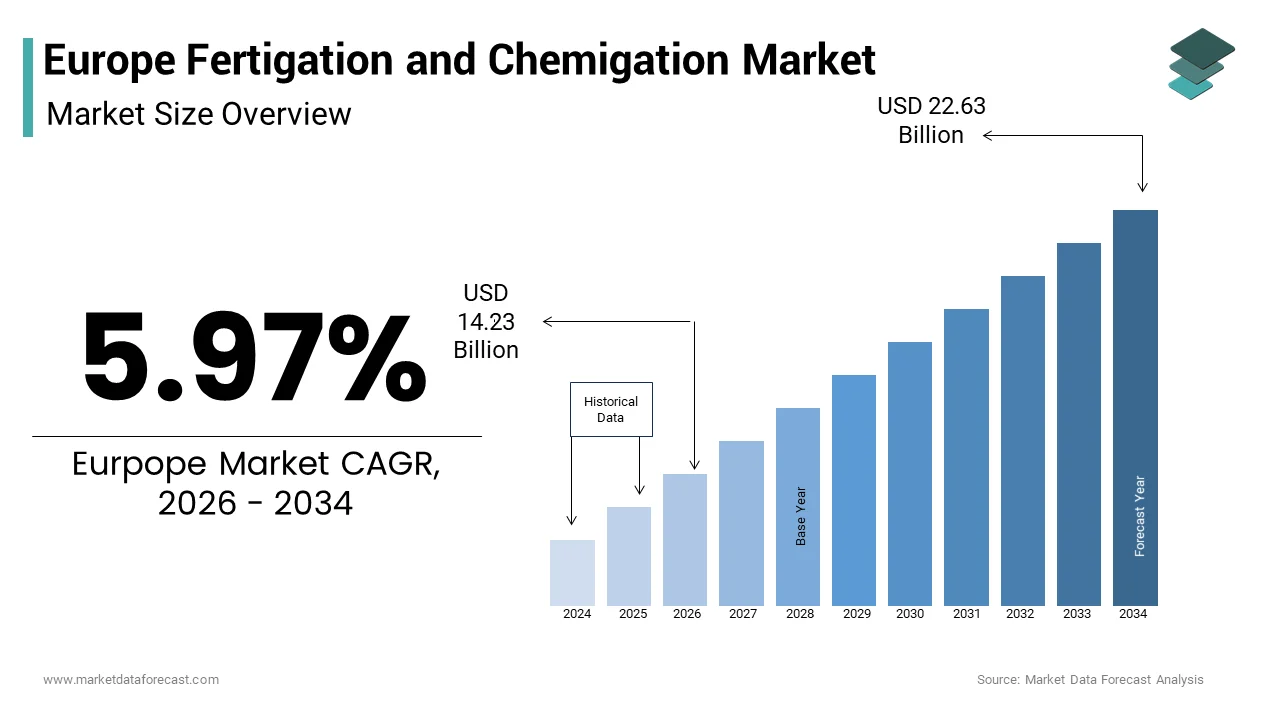
The European fertigation and chemigation market size was valued at USD 13.43 billion in 2025, is anticipated to reach USD 14.23 billion in 2026, and is projected to scale up to USD 22.63 billion by 2034, registering a compound annual growth rate (CAGR) of 5.97% during the forecast period from 2026 to 2034. Driven by strict EU environmental and pesticide reduction mandates, intensifying water scarcity across Southern Europe, and the ongoing digital transformation of precision agriculture, the regional market continues steady expansion.
Key Executive Metrics (At-a-Glance)
- 2025 Base Valuation: USD 13.43 Billion
- 2026 Current Valuation: USD 14.23 Billion
- 2034 Forecast Valuation: USD 22.63 Billion
- Compound Annual Growth Rate (CAGR): 5.97% (2026–2034)
- Dominant Agri Input Segment: Fertilizers (holding the largest share due to essential water-soluble macronutrient and nitrogen management under drip irrigation)
- Fastest-Growing Agri Input Segment: Fungicides (surging via climate-induced pathogen spread and protected greenhouse horticulture expansion)
- Dominant Crop Segment: Orchard Crops (commanding primary volume through high-value perennial tree systems like olives and citrus)
- Fastest-Growing Crop Segment: Forage & Turf Grasses (expanding through dairy intensification and precision sports turf management)
- Dominant Application Segment: Agricultural Irrigation (leading through vast open-field horticulture and water-scarce farming in Southern Europe)
- Fastest-Growing Application Segment: Greenhouse Irrigation (accelerating via high-tech glasshouses and controlled-environment agriculture)
- Dominant Regional Markets: Spain and Italy (commanding over 47% combined market share backed by extensive drip infrastructure and severe water stress)
Core Market Drivers
- Regulatory Compliance: EU directives mandating strict caps on nitrogen runoff, limited chemical drift, and high input application efficiency.
- Water Scarcity & Drought: Recurring hydrological droughts in Southern Europe compelling farmers to adopt water-saving drip-based delivery networks.
Primary Market Restraints & Challenges
- High Capital Costs & Maintenance: Substantial initial investments for small-scale farms combined with operational risks like emitter clogging and mineral precipitation.
Europe Fertigation and Chemigation Market Segmentation Breakdown
| Segment Category | Largest (Dominant) Sub-Segment | Fastest-Growing Sub-Segment |
|---|---|---|
| By Agri Input | Fertilizers | Fungicides |
| By Crop Type | Orchard Crops | Forage & Turf Grasses |
| By Application | Agricultural Irrigation | Greenhouse Irrigation |
| By Irrigation System | Drip Irrigation | Automated Micro-Irrigation |
| By Country | Spain & Italy | France & Netherlands |
Major Industry Players Profiled
Key corporations steering the European market include The Toro Company, Rivulis Irrigation, Jain Irrigation Systems Ltd., Valmont Industries Inc., Lindsay Corporation, Rain Bird Corporation, Netafim, EPC Industrie Limited, Nelson Irrigation Corporation, and T-L Irrigation Co.
Europe Fertigation And Chemigation Market Size
The European fertigation and chemigation market size was valued at USD 13.43 billion in 2025 and is anticipated to reach USD 14.23 billion in 2026 to USD 22.63 billion by 2034, growing at a CAGR of 5.97% during the forecast period from 2026 to 2034.
Fertigation and chemigation refer to the precision agricultural techniques that integrate the delivery of water-soluble fertilizers and crop protection chemicals directly into irrigation systems, ensuring targeted nutrient and pesticide application. Fertigation primarily addresses macro and micronutrient efficiency, while chemigation optimizes pest, weed, and disease control through controlled chemical infusion via drip, sprinkler, or micro-irrigation networks. This approach aligns with Europe’s policy-driven shift toward sustainable intensification and reduced environmental externalities in farming. A significant amount of agricultural land across the European Union is set up for irrigation, primarily concentrated in the Southern regions. Farming activities contribute to greenhouse gas emissions within the EU. EU strategies encourage specific reductions in fertilizer and chemical pesticide use in the coming years. These conditions are prompting investment in technologies for efficient resource delivery in agriculture. These regulatory, climatic, and infrastructural realities position fertigation and chemigation as pivotal technologies in Europe’s transition toward climate-resilient and ecologically accountable agriculture.
MARKET DRIVERS
Stringent EU Regulations Driving Demand for Precision Input Application
The European Union’s aggressive regulatory framework on nutrient and pesticide management is a key accelerator of the Europe fertigation and chemigation market. This compels farmers to optimize input efficiency while minimizing environmental leakage. Pesticide application methods should limit drift and runoff. Drip-based systems are recognized as a useful method for certain types of crop production. There are limits on nitrogen application in vulnerable areas, and meeting these limits with some traditional fertilization methods can be challenging. Fertigation use in some agricultural sectors is increasing, and financial support for certain nutrient application systems is available for farms following specific agricultural practices. These policies transform regulatory compliance from a cost burden into a catalyst for technology investment, accelerating the shift from conventional to precision delivery systems across European agriculture.
Escalating Water Scarcity and Drought Frequency Across Southern Europe
Recurrent and intensifying droughts are compelling the regional farmers to maximize water productivity, which contributes to the growth of the Europe fertigation and chemigation market. This is directly boosting the uptake of drip-based fertigation and chemigation systems that couple irrigation with nutrient delivery. Southern Europe is experiencing ongoing severe hydrological drought conditions, impacting normal reservoir levels in several regions. In response to these dry conditions, the installation of drip irrigation systems, predominantly integrated with units for combined water and nutrient delivery (fertigation), has increased significantly in affected areas. Following periods of reduced crop yields due to dry spells, applications for subsidized modern irrigation systems have risen markedly. Drip systems are recognized for reducing water consumption and improving nutrient uptake efficiency compared to traditional methods, and the practice of integrating water and input delivery through fertigation and chemigation is evolving into a crucial strategy for agricultural resilience across Europe's most vulnerable regions.
MARKET RESTRAINTS
High Initial Investment and Fragmented Farm Structures
High capital costs and the prevalence of small and fragmented landholdings obstruct the growth of the Europe fertigation and chemigation market. Most farms in the region are small in size, making large, permanent water management systems difficult for individual operators to justify financially. Basic nutrient and water delivery systems require an initial investment that may be substantial for small-scale operations. Financial aid programs exist for rural development. However, accessing these programs can be complicated, and successful application rates vary significantly across different areas. Moreover, many smallholders lack access to agronomic advisory services needed to manage nutrient formulations and system calibration, leading to suboptimal use or abandonment. This structural mismatch between technology design and farm reality limits scalability, particularly in Central and Eastern Europe, where economic margins are narrow, and mechanization levels lag, thereby restricting market penetration despite clear agronomic benefits.
Regulatory Ambiguity Surrounding Chemigation of Certain Agrochemicals
Legal uncertainty over the compatibility of specific pesticides and biocides with chemigation systems poses a significant barrier to consistent adoption across the regional farms, which thereby constrains the expansion of the Europe fertigation and chemigation market. Many approved substances used in farming lack clear instructions for use within modern irrigation systems, which can lead to questions about responsibility for both growers and equipment makers. In Germany and France, national plant protection agencies have issued contradictory guidance on the chemigation of neonicotinoid alternatives, with some state-level authorities permitting use while others prohibit it pending environmental risk reassessments. This inconsistency complicates cross-border farming operations and discourages investment in chemigation infrastructure. Furthermore, Recent regulatory discussions highlight a growing requirement for each substance to receive specific approval for use with irrigation methods, a process that often takes a significant amount of time for every product. As a result, many growers revert to foliar spraying despite its lower efficiency and higher drift potential. Regulatory fragmentation will continue to stifle demand and innovation in integrated chemical delivery systems until EU-level protocols for chemigation compatibility are harmonized.
MARKET OPPORTUNITIES
Integration with Digital Farming and IoT-Based Monitoring Platforms
The convergence of fertigation and chemigation with digital agriculture tools offers a key opportunity in European crop production, which is predicted to drive the growth of the Europe fertigation and chemigation market. This convergence works to enhance precision, traceability, and compliance. These systems adjust fertilizer dosing in real time based on crop stage, weather forecasts, and soil electrical conductivity, reducing nitrogen leaching. Companies have launched cloud-based platforms that generate audit-ready records of input applications, directly supporting compliance with the EU’s upcoming Carbon Farming Certification scheme. This digital layer not only optimizes resource use but also enables data-driven sustainability claims for export markets, positioning smart fertigation as a cornerstone of Europe’s future-proof agricultural strategy.
Expansion into Organic and Protected Crop Systems
The growing demand for certified organic produce and high-value protected cultivation provides potential prospects for the expansion of the Europe fertigation and chemigation market. This is opening new pathways for non-chemical and organic-compliant fertigation applications across the region. Farmland designated for organic farming is seeing continued expansion across the region, especially in the cultivation of greenhouse vegetables and berries. Organic regulations prohibit synthetic pesticides but allow water-soluble organic fertilizers, such as fish hydrolysates and compost teas, through fertigation, provided systems prevent cross-contamination. Many facilities growing organic produce are employing resource-efficient irrigation systems that incorporate monitoring of nutrient levels. Certain agricultural areas are testing irrigation methods that utilize organic-approved pest control substances. Certification bodies have updated guidelines to recognize precision delivery as a best practice for organic input management. This alignment between regulatory permissibility and market premiums for organic produce is causing niche yet high-growth adoption of tailored fertigation solutions in Europe’s premium horticulture sector.
MARKET CHALLENGES
Risk of System Clogging and Maintenance Complexity
Emitter clogging and chemical incompatibility deter adoption among risk-averse farmers, which in turn challenges the growth of the Europe fertigation and chemigation market. This affects the operational reliability of fertigation and chemigation systems. A significant challenge for drip irrigation systems involves the precipitation of mineral deposits, such as calcium phosphates or iron oxides, when specific types of fertilizers are used without proper water treatment. System failures often occur because incompatible fertilizer blends are injected without adequate filtration or acidification processes. In certain regions, small-scale farmers have quickly stopped using fertigation technology when faced with recurrent blockages and insufficient technical support. The abandonment rate of drip technology in some areas highlights a need for more practical technical assistance and robust maintenance strategies. Unlike conventional spraying, fertigation requires precise knowledge of solubility thresholds, pH interactions, and water hardness, factors often overlooked in fragmented advisory systems. Moreover, cleaning protocols demand regular backflushing and acid injections, increasing labor and chemical costs. A lack of standardized farming practices and easy maintenance options makes these technical difficulties reduce trust in how long the system will last and whether it is worth the money, which stops it from growing even with good government help.
Limited Farmer Awareness and Technical Capacity in Eastern Europe
A significant gap in knowledge transfer and extension services restricts the effective deployment of fertigation and chemigation technologies in Central and Eastern European member states. This holds back the expansion of the Europe fertigation and chemigation market. Agricultural advisory training on integrated irrigation and nutrient management is limited in some regions. Many smallholders in these areas believe fertigation is complex. Smallholders also seem to perceive fertigation as an approach primarily suited for large commercial farms. This knowledge deficit is exacerbated by language barriers and limited access to demonstration farms showcasing localized best practices. In contrast, Western European countries like France and the Netherlands maintain robust public-private extension networks with mobile agronomists and digital decision-support tools. Failure to implement targeted capacity-building initiatives, such as EU-funded programs, will ensure the benefits of precision agriculture remain out of reach for a major EU farming region, cementing existing inequalities in sustainable practices.
REPORT COVERAGE
| REPORT METRIC | DETAILS |
| Market Size Available | 2024 to 2033 |
| Base Year | 2024 |
| Forecast Period | 2024 to 2033 |
| CAGR | 5.97% |
| Segments Covered | By Agri Input, Crop Type, Application, Irrigation System, & Region |
| Various Analyses Covered | Global, Regional & Country Level Analysis, Segment-Level Analysis, DROC, PESTLE Analysis, Porter’s Five Forces Analysis, Competitive Landscape, Analyst Overview on Investment Opportunities |
| Regions Covered | UK, France, Spain, Germany, Italy, Russia, Sweden, Denmark, Switzerland, Netherlands, Turkey, Czech Republic & Rest of Europe |
| Market Leaders Profiled | Toro Company, Rivulis Irrigation, Jain Irrigation Systems Ltd., Valmont Industries Inc., Lindsay Corporation, Rain Bird Corporation, Netafim, EPC Industrie Limited, Nelson Irrigation Corporation, T-L Irrigation Co. |
SEGMENTAL ANALYSIS
By Agri Input Insights
The fertilizers segment dominated the Europe fertigation and chemigation market by capturing a 62.45%% share in 2025. The leading position of the fertilizers segment drives the fundamental role of water-soluble nutrients in sustaining high yields under precision irrigation, particularly for nitrogen, phosphorus, and potassium delivery. Drip irrigated horticultural areas, particularly in Southern Europe, heavily rely on applying nutrients through the irrigation system. This reliance may be connected to efforts to manage nitrogen loss in sensitive areas. Applying nutrients via the irrigation system generally leads to better nitrogen use compared to applying them to the surface. This practice is aligned with general sustainability targets focused on managing nutrient inputs in agriculture. Besides, the rise of controlled environment agriculture, especially in the Netherlands and Belgium, requires continuous nutrient infusion through closed-loop systems. Water scarcity further amplifies reliance on integrated nutrient delivery, as drip-based fertilization minimizes runoff and volatilization. These regulatory, agronomic, and environmental imperatives cement fertilizers as the core input driving technology adoption across Europe’s irrigated farmland.
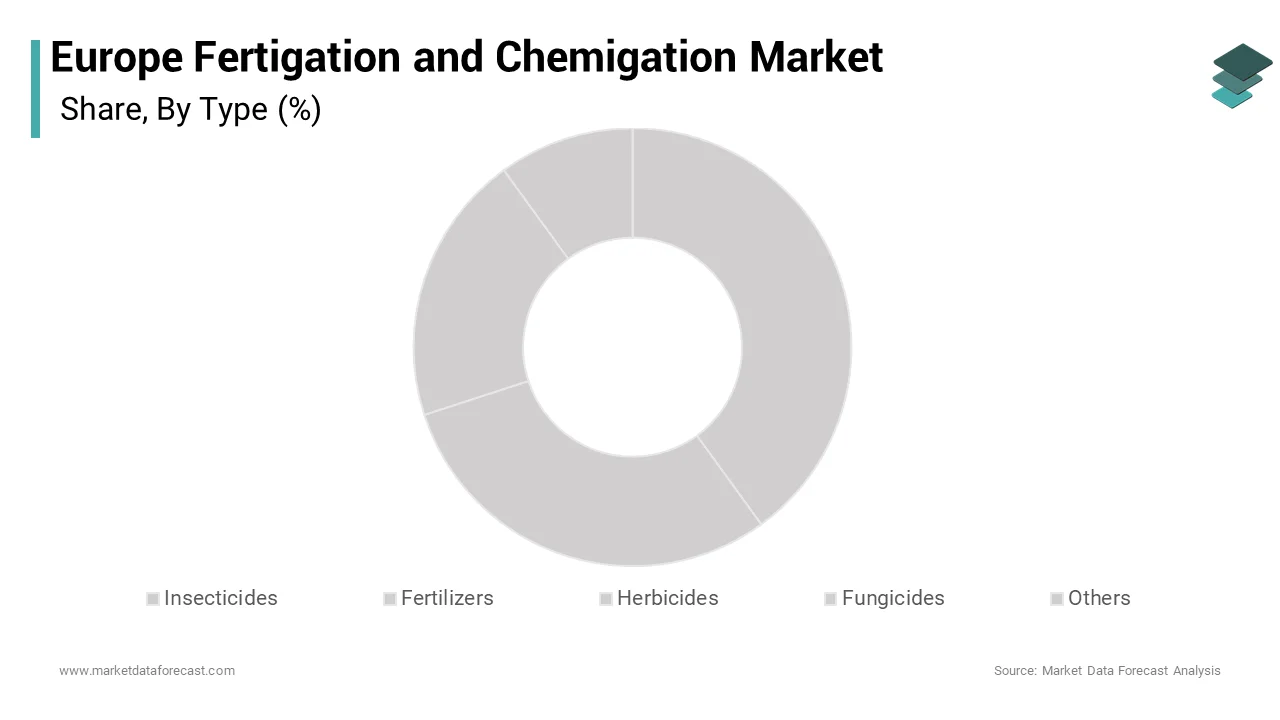
The fungicides segment is on the rise and is expected to be the fastest-growing segment in the market by witnessing a CAGR of 9.7% from 2025 to 2033 due to the increasing prevalence of fungal diseases, high-humidity protected cultivation, and climate-induced pathogen spread. As per sources, outbreaks of powdery mildew and botrytis in greenhouse vegetables rose due to warmer winters and extended growing seasons. Chemigation enables precise delivery of systemic fungicides like azoxystrobin directly to the root zone, reducing foliar spray frequency and worker exposure. Greenhouse farms in a particular region have an established use of chemigation for preventative fungicide application. Regulatory changes have encouraged the use of certain drip-compatible biofungicides. This regulatory shift may lead to increased adoption of these biofungicides in organic cultivation systems. With protected horticulture expanding annually across Western Europe and fungal resistance to conventional sprays mounting, chemigation of fungicides is emerging as a critical tool for sustainable disease management, propelling this segment’s rapid growth.
By Crop Insights
The orchard crops segment led the Europe fertigation and chemigation market and accounted for a 44.3% share in 2024. The dominance of the orchard crops segment is credited to the perennial nature, high value, and water sensitivity of tree crops like olive, citrus, tree apple, and almonds, which benefit significantly from precise nutrient and pesticide delivery. Drip fertigation adoption is a noticeable trend in olive cultivation, a practice potentially influenced by water scarcity and environmental regulations. Chemigation is a prevalent method in citrus-growing areas, used for managing pests and fungi, and may assist in minimizing the application impact in varied terrain. Orchard systems that use fertigation show potential for reduced water use and may also lead to improvements in fruit metrics like size and sugar levels. Furthermore, long-term orchard investments justify the capital cost of integrated systems, as returns are realized over years. These economic, agronomic, and environmental synergies make orchard crops the primary adopters of advanced input delivery technologies across Southern and Central Europe.
The forage and turf grasses segment is expected to exhibit a noteworthy CAGR of 8.9% over the forecast period, owing to the intensification of dairy farming and the premiumization of sports and ornamental landscapes. The use of fertigation is becoming a standard practice for maintaining optimal crude protein levels in irrigated forage maize and alfalfa. Precision nutrient delivery in forage systems has been shown to improve dry matter yield while also leading to a reduction in nitrogen excretion in manure. Elite turf farms utilize chemigation as an efficient method for applying necessary fungicides and wetting agents uniformly over extensive areas. Agricultural policies and incentive programs are encouraging nutrient-balanced forage production, which is expected to further drive the adoption of these practices. This dual demand from livestock efficiency and high aesthetic standards positions forage and turf as the most dynamically expanding segment in Europe’s precision irrigation landscape.
By Application Insights
The agricultural irrigation segment was the largest in the Europe fertigation and chemigation market and occupied a substantial share in 2024. The prominence of the agricultural irrigation segment is attributed to the vast scale of open-field horticulture and orchard farming across Southern Europe, where water scarcity and regulatory pressure necessitate input-efficient systems. Agricultural land in some European countries utilizes specific irrigation networks. A majority of this irrigated land incorporates nutrient application systems for a range of crops. Relevant policies encourage the adoption of modern irrigation practices. Government programs may incentivize new irrigation projects to include nutrient injection capabilities. The economic imperative is clear: field-level fertigation reduces fertilizer costs while boosting yields. These agronomic returns, combined with policy mandates and climate resilience needs, ensure agricultural irrigation remains the primary application channel for input delivery technologies across Europe.
The greenhouse irrigation segment is predicted to witness the highest CAGR of11.25%%5 from 2025 to 2033. The rapid expansion of the greenhouse irrigation segment is driven by the expansion of high-tech glasshouses, semi-closed tunnels producing vegetables,les berries, and ornamentals under controlled environments. Most tomato growing areas in the Netherlands utilize advanced closed-loop irrigation systems, which incorporate real-time sensor feedback for managing water quality. Investments in new greenhouses in Denmark are increasing, with a focus on cultivating leafy greens and strawberries using automated systems for managing plant health. Funding programs within Europe are supporting the development of innovative nutrient delivery systems for protected agriculture, highlighting a technological shift toward precise cultivation methods. Greenhouse systems provide a compliant, high-yield solution for meeting growing urban food demand, especially with stricter EU pesticide regulations limiting spray use. This convergence of food security, sustainability, and automation is transforming greenhouse irrigation into Europe’s most rapidly advancing frontier for precision input delivery.
COUNTRY ANALYSIS
Spain Fertigation And Chemigation Market Analysis
Spain outperformed other regions in the Europe fertigation and chemigation market and accounted for a 26.7% share in 2024. The domination of the Spanish market is driven by extensive irrigated agriculture and chronic water stress. Farmland in Spain generally depends on irrigation, with a preference for drip systems in many areas. The country faces severe hydrological pressure. Extreme drought conditions have been widely noted across a significant portion of Europe. There is a policy to update some gravity irrigation systems to modern pressurized networks with fertigation capacity. Regional governments in Andalusia and Murcia offer subsidies covering a portion of system costs for farms adopting nutrient monitoring. Furthermore, Spain is Europe’s largest producer of table olives and greenhouse vegetables, both high-value crops where input precision directly impacts quality and export competitiveness. These climatic, agronomic, mic, and policy factors establish Spain as the largest and most technologically active market for fertigation and chemigation in Europe.
Italy Fertigation And Chemigation Market Analysis
Italy was the second largest country in the Europe fertigation and chemigation market and held a 20.4% share in 2024. The growth of the Italian market is propelled by its high-value agricultural output and stringent environmental regulations. A significant amount of Italy's irrigated land is located in the Po Valley and the Southern regions. Italy is Europe’s top producer of kiwifruit, olives, andgrapesa whiwhichcreasingly use drip fertigation to manage nutrient timing and reduce salinity stress. Most recent irrigation projects in Italy have begun incorporating capabilities for chemigation. Agricultural policy is encouraging approaches that aim to reduce nutrient runoff. There is growing regional interest in methods of organic nutrient application that are compatible with modern irrigation infrastructure. Hence, Italy’s regulatory landscape ensures sustained investment in precision input delivery, making it a core market for advanced agronomic solutions.
France Fertigation And Chemigation Market Analysis
France is moving ahead steadfastly in the Europe fertigation and chemigation market because of a balanced mix of field crops, orchards, and emerging protected cultivation. There is a general trend toward the expansion of land equipped with advanced irrigation systems. This adoption appears across a range of agricultural areas. Efforts are in place to reduce the use of pesticides in agriculture. This trend is encouraging the use of alternative application methods like chemigation in certain types of crop cultivation, such as in orchards and vineyards, where precise delivery of inputs is beneficial for managing environmental effects. A significant portion of funding for new irrigation projects is being directed towards systems that can facilitate fertigation (the application of nutrients through irrigation). France also leads in resea,,rch with INRAE developing low water-soluble fertilizers optimized for calcareous soils prevalent in the south. Besides, the rise of organic market gardening near urban centers has spurred demand for biofertilizer-compatible drip systems. So, France maintains steady growth in precision agriculture technologies across diverse farming systems.
Netherlands Fertigation And Chemigation Market Analysis
The Netherlands expanded gradually in the Europe fertigation and chemigation market due to its global leadership in high-tech greenhouse agriculture. Protected cultivation areas widely implement closed-loop fertigation systems, featuring real-time nutrient recycling and advanced dosing mechanisms. Growers utilize precision input delivery methods to achieve resource efficiency and high-quality produce. There is an ongoing shift towards integrating advanced irrigation techniques for disease management, reducing the reliance on alternative application methods. Industry regulations encourage the adoption of technologies that minimize nutrient discharge to the environment. Companies like Priva and Ridder provide integrated climate and fertigation control systems exported across Europe. Innovation-driven ecosystems, supported by policy and research, cement the Netherlands ashigh-intensityity hihigh-efficiencyncy hub for fertigation and chemigation technologies.
Germany Fertigation And Chemigation Market Analysis
Germany is anticipated to grow in the Europe fertigation and chemigation market over the forecast period, owing to its focus on forage productiodairyifarminggnd sustainable intensification. Irrigated areas dedicated to forage maize and alfalfa are increasing in size. There is a rising trend of integrating fertigation practices to enhance the nutritional quality of feed crops for livestock. Dairy farms are adopting precision nutrient delivery methods to comply with regulations that cap nitrogen application rates on sensitive land. A significant portion of recent agricultural grants has been allocated to support the implementation of fertigation technology in grassland and maize cultivation. Additionally, Germany leads in turf management with elite grass farms in North Rhine-Westphalia using chemigation for uniform fungicide and wetting agent application on sports surfaces. The country’s strong engineering sector also supplies high-accuracy dosing pumps and filtration units to the European market. So, Germany’s adoption is steadily expanding beyond horticulture into broadacre and specialty applications.
COMPETITIVE LANDSCAPE
The Europe fertigation and chemigation market features dynamic competition among global irrigation leaders and regional specialists differentiated by technological sophistication, ion agronomic support, and regulatory alignment. Companies compete not only on hardware reliability but on integrated digital services that enable compliance with the EU’s Farm to Fork and Nitrates Directives. Israeli and European firms dominate with advanced drip systems while Indian and Chinese players gain traction through cost-effective solutions for small farms. Competition is intensified by the need for localized technical support due to fragmented farm structures and varied water chemistries across regions. Differentiation increasingly hinges on compatibility with organic inputs and anti-clogging performance, since data-driven advisory services. Regulatory complexity,,ity high initial co,, sts and maintenance challenges create barriers to e,n, try yet also reward companies that invest in education,n interoperability sustainability. As climate pressure mountslenforcementaragainst against those who combine engineering excellence with on-ground agronomic partnership across Europe’s diverse agricultural landscape.
KEY MARKET PLAYERS
Some of the major companies dominating the market, by their products and services, include
- The Toro Company
- Rivulis Irrigation
- Jain Irrigation Systems Ltd.
- Valmont Industries Inc.
- Lindsay Corporation
- Rain Bird Corporation
- Netafim
- EPC Industrie Limited
- Nelson Irrigation Corporation
- T-L Irrigation Co.
Top Players In The Market
- Netafim Ltd is a global pioneer in precision irrigation and a key contributor to the Europe fertigation and chemigation market through its integrated drip systems and digital agronomy platforms. The company enables European farmers to comply with the EU’s stringent nutrient and pesticide regulations by offering closed-loop fertigation solutions with real-time monitoring. Recently, Netafim expanded its agronomic advisory services across Southern Europe,,e launching soil climate-specific nutrient plans for olive and citrus growers in Spain and Italy. It also introduced a new generation of anti-clogging emitters compatible with organic fertilizers,, ers supporting the region’s organic farming expansion. These initiatives reinforce Netafim’s role as a technology and sustainability partner in Europe’s transition to resource-efficient agriculture while strengthening its influence in global horticultural markets.
- Valmont IndustriInc..Inc plays a strategic role in the European fertigation and chemigation landscape through its advanced center pivot and drip solutions tailored for diverse cropping systems. The company supports European growers with its Valley S3 smart control platform, which integrates weather data, soil sensensond fertilizer injection for precise input management. In recedevelopmentspme,, Valmont enhanced its digital offering in France and Germany by partnering with local agronomists to deliver crop-specific fertigation prescriptions compliant with national nitrate regulations. It also invested in training programs on chemigation safety for pesticide delivery in orchard systems. These efforts demonstrate Valmont’s commitment to localized digital agriculture services that align with Europe’s sustainability mandates while extending its global footprint in precision irrigation innovation.
- Jain Irrigation Systems Ltd contributes significantly to the Europe fertigation and chemigation market by providing cost-effective water-efficient drip technologies suited for small and medium-sized farms. The company leverages its expertise in biodegradable tubing and water-soluble fertilizer formulations to support organic and conventional growers in Italy and Greece. Recently, Jain established a technical support center in Athens to offer on-ground assistance for system installation and maintenance, addressing a key barrier in Eastern Europe. It also launched a line of low-pressure fertigation kits compatible with solasolar-poweredepowered r, aligning with the EU’s rural energy transition goals. Through affordability, adaptability, and localized service, Jai n strengthens access to precision irrigation for Europe’s fragmented farm sector while reinforcing its global mission of inclusive agricultural sustainability.
Top Strategies Used By The Key Market Participants
Key players develop integrated digital platforms that combine soil sensors,ors weather, data, and automated dosing to optimize fertilizer and pesticide application in compliance with EU regulations. They expand localized agronomic advisory services to support smallholder adoption and system maintenance, particularly in Southern and Eastern Europe. Companies invest in anti-clogging emitter technologies and organic compatible formulations to address water quality and sustainability demands. Strategic partnerships with national agricultural extension services and cooperatives facilitate large-scale training and demonstration programs. Product innovation includes solar energy and biodegradable components to align with Europe’s green farming and circular economy objectives.
MARKET SEGMENTATION
This research report on the European Fertigation and Chemigation Market is segmented and sub-segmented into the following categories.
By Agri Input
- Insecticides
- Fertilizers
- Herbicides
- Fungicides
- Others
By Crop Type
- Field Crops
- Orchard Crops
- Plantation Crop
- Forage & Turf Grasses
By Application
- Agricultural Irrigation
- Greenhouse Irrigation
- Landscape Irrigation
By Irrigation Systems
- Drip
- Sprinkler Irrigation
By Country
- UK
- France
- Spain
- Germany
- Italy
- Russia
- Sweden
- Denmark
- Switzerland
- Netherlands
- Turkey
- Czech Republic
- Rest of Europe