- Product Description Description
- Table of Contents TOC
- List of Table & Figure LOT
- Get Free Sample PDF Sample PDF
Market Size, 2025
$5,934.73 MnMarket Estimate, 2026
$6,276.57 MnMarket Forecast, 2034
$9824.13 MnCAGR, 2026–2034
5.76%Europe Fiberglass Market Report Summary
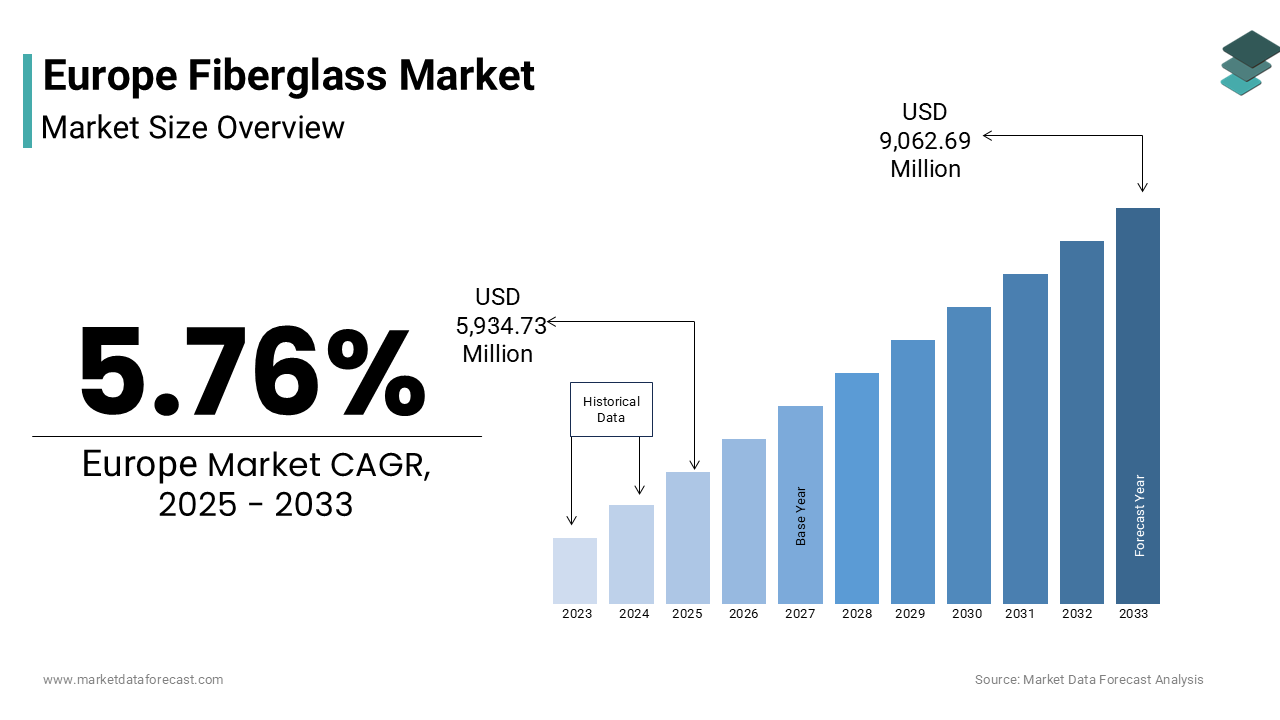
The Europe fiberglass market was valued at USD 5,934.73 million in 2025, is estimated to reach USD 6,276.57 million in 2026, and is projected to reach USD 9824.13 million by 2034, growing at a CAGR of 5.76% during the forecast period from 2025 to 2033. The growth of the Europe fiberglass market is driven by expanding wind energy infrastructure, mandatory energy renovation of existing buildings, and rising demand for lightweight, high-strength composite materials across construction, transportation, and renewable energy sectors. Stringent EU energy efficiency regulations and decarbonization targets have reinforced the adoption of fiberglass-based insulation and composites. Moreover, increasing use of fiberglass in electric vehicles, wind turbine blades, and thermal insulation systems positions the market as a critical enabler of Europe’s industrial modernization and climate objectives.
Key Market Trends
- Rising adoption of fiberglass composites in wind turbine blade manufacturing due to high fatigue resistance and cost efficiency.
- The growing use of fiberglass insulation in residential and commercial buildings is driven by EU renovation mandates.
- Shift toward closed-mold composite processing technologies, such as vacuum infusion and resin transfer molding.
- Increasing focus on recycled and circular fiberglass solutions to address end-of-life sustainability concerns.
- Gradual integration of fiberglass in electric vehicle structures for weight reduction and electrical insulation.
Segmental Insights
- Based on application, the composites segment held the largest share of the Europe fiberglass market in 2024. The segment’s dominance is attributed to extensive usage in wind energy, automotive lightweighting, and infrastructure components, where fiberglass offers an optimal balance of mechanical performance, durability, and cost compared to alternative reinforcements.
- Based on type, the glass wool segment accounted for a significant share of the market in 2024. Its leadership is driven by widespread adoption in building insulation, supported by Euroclass A1 fire safety compliance, low thermal conductivity, and compatibility with Europe’s energy efficiency regulations.
- Based on end use, the construction segment captured the largest share of the Europe fiberglass market in 2024, owing to large-scale renovation programs, mandatory insulation upgrades, and increasing investment in energy-efficient buildings across the European Union.
Regional Insights
The Europe fiberglass market shows strong performance across major economies, supported by renewable energy expansion, construction activity, and regulatory enforcement.
- Germany was the largest contributor, accounting for 24.3% of the Europe fiberglass market share in 2024, driven by its leadership in wind turbine manufacturing, energy-efficient construction, and advanced composite processing technologies.
- France followed with a 17.3% market share, supported by aggressive housing renovation programs and centralized enforcement of energy performance standards.
- Italy continues to be a key market due to its aging building stock, extensive retrofit requirements, and access to EU recovery funds focused on energy efficiency upgrades.
- Spain is emerging as a high-growth market, fueled by wind energy capacity expansion and residential construction recovery, while the Netherlands stands out for its leadership in composite recycling pilots and circular construction applications.
Competitive Landscape
The Europe fiberglass market is characterized by the presence of established multinational manufacturers and regional specialists with strong technical expertise and regulatory alignment. Market competition is driven by product performance, sustainability credentials, and integration with EU energy and circular economy policies, rather than price alone. Leading players are investing in low-carbon production, recycled fiberglass integration, and application-specific engineered solutions for wind energy, construction, and automotive sectors. Collaboration through industry consortia and R&D partnerships is accelerating innovation in recycling technologies and lifecycle assessment. Prominent players in the Europe fiberglass market include Owens Corning, Saint-Gobain Vetrotex, PPG Industries, Nippon Electric Glass, Johns Manville, China Jushi Co., Ltd., Taishan Fiberglass Inc., Ahlstrom-Munksjö, Chongqing Polycomp International Corp. (CPIC), AGY Holding Corp., 3B-the fibreglass company, and Valmiera Fibreglass.
Europe Fiberglass Market Size
The Europe Fiberglass Market size was valued at USD 5934.73 million in 2025 and is anticipated to reach USD 6276.57 million in 2026 from USD 9824.13 million by 2034, growing at a CAGR of 5.76% during the forecast period from 2026 to 2034.
Fiberglass (or fibreglass) is a versatile composite material made from extremely fine glass fibers embedded in a resin matrix. This composite material is renowned for its high strength to weight ratio corrosion resistance and versatility in manufacturing complex shapes. It serves as a critical component in various industries including construction automotive aerospace and wind energy. The material is primarily available in forms such as rovings mats and chopped strands which are integrated into resins to create durable structures. As per Eurostat, the manufacture of basic metals and fabricated metal products remains a cornerstone of the EU economy, accounting for 13.6 percent of the total value of sold industrial production in 2023, providing a massive material base for high-value manufacturing. The transition towards lightweight materials in transportation sectors is further propelled by regulatory pressures to reduce emissions. According to the International Energy Agency, the transport sector is responsible for approximately 20 percent of global energy-related CO2 emissions, a figure that is driving the rapid adoption of high-performance carbon fiber composites, which are roughly 15% lighter than fiberglass, to meet stringent new fuel efficiency standards. The European Environment Agency emphasizes the importance of sustainable material usage noting that the construction sector consumes about 50 percent of all raw materials in Europe. This statistic underscores the potential for fiber glass to replace traditional heavier materials in building applications. The market operates within a framework that prioritizes innovation and sustainability ensuring that fiber glass remains a pivotal material in modern engineering and infrastructure development across the continent.
MARKET DRIVERS
Expansion of Wind Energy Infrastructure and Renewable Power Generation
The rapid expansion of wind energy infrastructure across the region serves as a key driver for the Europe fiber glass market. This is due to the material's essential role in manufacturing wind turbine blades. Fiber glass reinforced plastics are preferred for blade construction because they offer an optimal combination of lightness strength and fatigue resistance which are critical for efficient energy capture. According to WindEurope, the European Union installed a record 16.2 gigawatts of new wind power capacity in 2023, with Germany and the Netherlands leading additions, marking a significant step toward the region's 2030 climate goals. This growth is supported by the European Green Deal which aims to make Europe the first climate neutral continent by 2050. The demand for larger and more efficient turbines requires advanced composite materials that can withstand harsh environmental conditions while maintaining structural integrity. As per the International Renewable Energy Agency (IRENA), achieving the 1.5°C pathway requires a tripling of global renewable capacity by 2030, a target that will drive a projected demand increase of 160,200 metric tons for glass fibre in the EU to manufacture wind turbine blades, nacelles, and hub covers. The offshore wind segment particularly drives demand for high performance fiber glass variants that resist saltwater corrosion and extreme weather events. Government incentives and subsidies for renewable energy projects further stimulate investment in wind farm developments. The continuous innovation in blade design to enhance energy output also relies on the superior mechanical properties of fiber glass. Consequently the sustained commitment to decarbonization and energy security ensures a steady and growing demand for fiber glass in the wind energy sector.
Lightweighting Trends in Automotive and Transportation Industries
There is an increasing emphasis on vehicle lightweighting to improve fuel efficiency and reduce emissions, which accelerates the expansion of the Europe fiber glass market. This trend significantly drives the demand for fiber glass in the automotive and transportation sectors. Automakers are increasingly replacing traditional steel and aluminum components with fiber glass reinforced composites to reduce overall vehicle weight without compromising safety or performance. According to the European Automobile Manufacturers Association (ACEA), the average CO2 emissions from new passenger cars in the EU fell to 106.4 grams per kilometer in 2023, as the market share of battery electric vehicles reached 15.5% before seeing a slight provisional increase in early 2024. Fiber glass is utilized in various automotive parts including body panels underbody shields and interior components due to its design flexibility and cost effectiveness compared to carbon fiber. As per the International Council on Clean Transportation reducing vehicle mass by 10 percent can improve fuel economy by 6 to 8 percent making lightweight materials crucial for compliance with regulatory requirements. The rise of electric vehicles further amplifies this trend as manufacturers seek to offset the weight of battery packs to extend driving range. Fiber glass offers a viable solution for producing large structural components that contribute to weight reduction. The material's ability to be molded into complex shapes allows for aerodynamic designs that enhance vehicle efficiency. Additionally the durability and corrosion resistance of fiber glass reduce maintenance costs and extend vehicle lifespan. These factors collectively drive the adoption of fiber glass in the evolving automotive landscape.
MARKET RESTRAINTS
Stringent Environmental Regulations on Waste and Recycling
Strict environmental regulations concerning waste management and recycling are a major limitation to the Europe fiber glass market. Fiber glass composites are challenging to recycle due to the thermosetting nature of the resins used which do not melt upon heating and are difficult to separate from the glass fibers. According to the European Environment Agency only a small fraction of composite waste is currently recycled in Europe with the majority ending up in landfills or incineration facilities. The Landfill Directive ((EU) 2018/850) mandates that by 2035, the amount of municipal waste sent to landfill must be reduced to 10 percent or less, and it imposes a total ban by 2030 on landfilling any waste suitable for recycling or recovery. As per the European Commission, the current circular material use rate of 12.2 percent must nearly double to reach the new 24 percent target set by the 2025 Clean Industrial Deal, compelling industries to accelerate the commercialisation of composite recycling technologies. The lack of established recycling infrastructure for fiber glass increases disposal costs and creates logistical challenges for manufacturers and end users. Regulatory bodies are increasingly scrutinizing the lifecycle impact of composite materials leading to potential restrictions on their use in certain applications. The development of recyclable resin systems and efficient separation technologies is still in early stages and not yet widely adopted. This regulatory uncertainty and the high cost of compliant waste management solutions hinder the widespread adoption of fiber glass in applications where end of life disposal is a critical concern. Companies face increased operational burdens to ensure compliance with evolving environmental standards.
Volatility in Raw Material Prices and Energy Costs
Fluctuations in the prices of raw materials such as silica sand soda ash and limestone, along with volatile energy costs, significantly constrain the Europe fiber glass market. The production of glass fibers is energy intensive requiring high temperatures for melting raw materials which makes it susceptible to energy price fluctuations. According to the International Energy Agency natural gas prices in Europe experienced significant volatility in recent years due to geopolitical tensions and supply disruptions impacting industrial production costs. As per Eurostat, industrial producer prices for non-metallic mineral products, essential for composite and construction applications, primarily due to the historic spike in natural gas prices and electricity input costs. These increased input costs squeeze profit margins for fiber glass manufacturers who may struggle to pass on the full extent of price increases to downstream customers. The reliance on imported raw materials exposes the market to currency exchange rate risks and supply chain disruptions. Additionally the transition to renewable energy sources while beneficial long term introduces short term operational challenges and investment requirements. Manufacturers face difficulties in long term planning and contracting due to unpredictable input costs. This economic uncertainty discourages investment in new capacity and may lead to the rationalization of existing assets. The cumulative effect of raw material volatility and energy cost instability restricts market expansion and competitiveness against alternative materials with more stable pricing structures.
MARKET OPPORTUNITIES
Development of Recyclable Composite Technologies
The development of recyclable composite technologies offers a potential growth possibility for the Europe fiber glass market. This is achieved by addressing environmental concerns and regulatory pressures. Innovations in thermoplastic resins and chemical recycling processes enable the recovery and reuse of glass fibers and matrix materials reducing waste and environmental impact. According to the European Composites Industry Association research and development efforts are focused on creating circular economy solutions for composite materials including design for recycling and closed loop systems. As per the European Commission the Horizon Europe program funds projects aimed at improving the sustainability of composite materials through innovative recycling techniques. These advancements allow manufacturers to produce fiber glass components that can be easily disassembled and recycled at the end of their life cycle. The adoption of recyclable composites aligns with corporate sustainability goals and enhances brand reputation among eco conscious consumers. Partnerships between material suppliers recyclers and end users facilitate the establishment of efficient collection and processing networks. The creation of certified recycled content products opens up new market segments in construction and automotive applications where sustainability credentials are increasingly valued. Regulatory incentives for using recycled materials further support this transition. Fiber glass manufacturers can mitigate regulatory risks by embracing these technological advancements. Consequently, they can capture new growth opportunities in a market that prioritizes environmental responsibility and resource efficiency.
Integration in Aerospace and Defense Applications
The integration of fiber glass in aerospace and defense applications provides a lucrative opportunity for the Europe fiber glass market growth. This is due to the material's high performance characteristics. The aerospace industry requires materials that offer exceptional strength to weight ratios durability and resistance to extreme conditions. According to the Aerospace and Defence Industries Association of Europe (ASD), the European civil aeronautics sector generated a turnover of €114 billion in 2022, an 11.1% increase over the previous year, while the total aerospace and defence turnover reached €260.5 billion, underscoring the massive economic scale and demand for advanced composite materials. Fiber glass is used in various aircraft components including radomes interior panels and secondary structures due to its electromagnetic transparency and mechanical properties. As per the European Aviation Safety Agency stringent safety and performance standards drive the adoption of high quality composite materials in aircraft manufacturing. The growth of the unmanned aerial vehicle market also contributes to demand for lightweight and durable materials. Fiber glass offers a cost effective alternative to carbon fiber for certain applications while providing adequate performance. Advances in manufacturing techniques such as automated fiber placement enable the production of complex aerospace components with high precision. Collaborations between material suppliers and aerospace manufacturers drive innovation in product development. The increasing focus on fuel efficiency and emission reduction in aviation further supports the use of lightweight composites. Fiberglass producers are expanding into high-value sectors to diversify their revenue streams. Consequently, this enhances their competitive position in the European market.
MARKET CHALLENGES
Complexity of Supply Chain and Logistics Management
The complexity of supply chain and logistics management is one of the serious hurdles to the European fiber glass market. This is because of the bulky and fragile nature of the material. Transporting fiber glass products requires specialized handling and packaging to prevent damage during transit which increases logistical costs and operational complexity. According to the European Logistics Association the transport sector faces significant challenges related to infrastructure congestion and labor shortages which impact the timely delivery of goods. As per Eurostat, while maritime shipping accounts for the largest portion of total goods moved within the EU, road transport is the primary method for moving freight across land. This heavy reliance on road networks leaves the supply chain vulnerable to traffic volume and changing environmental laws. The just in time manufacturing practices adopted by many downstream industries require reliable and punctual supply chains which can be difficult to maintain given the vulnerabilities in current logistics networks. Disruptions caused by port strikes border controls or extreme weather events can lead to production stoppages and inventory shortages. Additionally the cross border nature of the European market involves navigating varying national regulations and customs procedures which adds administrative burdens. Manufacturers must invest in advanced supply chain management systems and collaborate closely with logistics providers to mitigate these risks. The inability to ensure consistent and efficient delivery can result in lost contracts and damaged customer relationships. Addressing these logistical challenges requires strategic investments in infrastructure and technology to enhance supply chain resilience.
Competition from Alternative Composite Materials
Intense competition from alternative composite materials such as carbon fiber and natural fiber composites impedes the expansion of the Europe fiber glass market. Carbon fiber offers superior strength and stiffness although at a higher cost making it attractive for high performance applications in aerospace and automotive sectors. According to the European Composites Industry Association the demand for carbon fiber composites is growing rapidly driven by the need for ultra lightweight materials in advanced engineering applications. Natural fiber composites derived from flax hemp and jute are gaining traction due to their biodegradability and lower environmental impact. As per the European Bioplastics Association the market for bio based composites is expanding as industries seek sustainable alternatives to synthetic materials. These alternatives appeal to eco conscious consumers and businesses aiming to reduce their carbon footprint. The continuous innovation in alternative materials enhances their performance and cost competitiveness posing a threat to the market share of fiber glass. Manufacturers of fiber glass must invest in research and development to improve the properties and sustainability profile of their products. Failure to differentiate effectively against these alternatives may result in market share erosion in key sectors. The dynamic competitive landscape requires constant adaptation and innovation to maintain relevance and competitiveness in the European composite materials market.
REPORT COVERAGE
| REPORT METRIC | DETAILS |
| Market Size Available | 2024 to 2033 |
| Base Year | 2024 |
| Forecast Period | 2025 to 2033 |
| Segments Covered | By Application, Type, End-Use and Region. |
| Various Analyses Covered | Global, Regional, and Country Level Analysis, Segment-Level Analysis, DROC, PESTLE Analysis, Porter’s Five Forces Analysis, Competitive Landscape, Analyst Overview of Investment Opportunities |
| Regions Covered | United Kingdom, France, Spain, Germany, Italy, Russia, Sweden, Denmark, Switzerland, the Netherlands, Turkey, and the Czech Republic. |
| Market Leaders Profiled | Owens Corning, Saint-Gobain Vetrotex, PPG Industries, Nippon Electric Glass, Johns Manville, China Jushi Co., Ltd., Taishan Fiberglass Inc., Ahlstrom-Munksjö, Chongqing Polycomp International Corp. (CPIC), AGY Holding Corp., 3B-the fibreglass company, and Valmiera Fibreglass. |
SEGMENTAL ANALYSIS
By Application Insights
The Composites segment was the largest segment in the Europe fiber glass market and occupied a 55.8% share in 2025. This prominence of the segment is supported by the extensive use of fiber glass reinforced plastics in manufacturing lightweight and durable components for various industries including automotive aerospace and wind energy. One of the key factors fueling this leadership is the critical role of composites in the wind energy sector where fiber glass is the material of choice for turbine blades due to its high strength to weight ratio and fatigue resistance. According to WindEurope, the European Union saw a significant increase in wind energy capacity last year. This expansion has created a high demand for specialized materials, particularly the composite resins and fibers used to manufacture large turbine blades. The transition towards larger offshore turbines further amplifies demand as these structures require advanced composite materials to withstand harsh marine environments. As per the International Renewable Energy Agency, wind power capacity across the continent is expected to grow substantially over the next decade to meet climate targets. This rapid scaling up of infrastructure will provide a consistent market for the advanced materials sector. Additionally, the automotive industry’s shift towards electric vehicles necessitates lightweight materials to offset battery weight and extend range. Fiber glass composites offer a cost effective solution for producing body panels and structural components that reduce vehicle mass. The versatility of composites allows for complex geometries and integrated functions which streamline manufacturing processes. These factors combined with regulatory pressures for emission reduction solidify the composites segment as the dominant application area in the European fiber glass market.
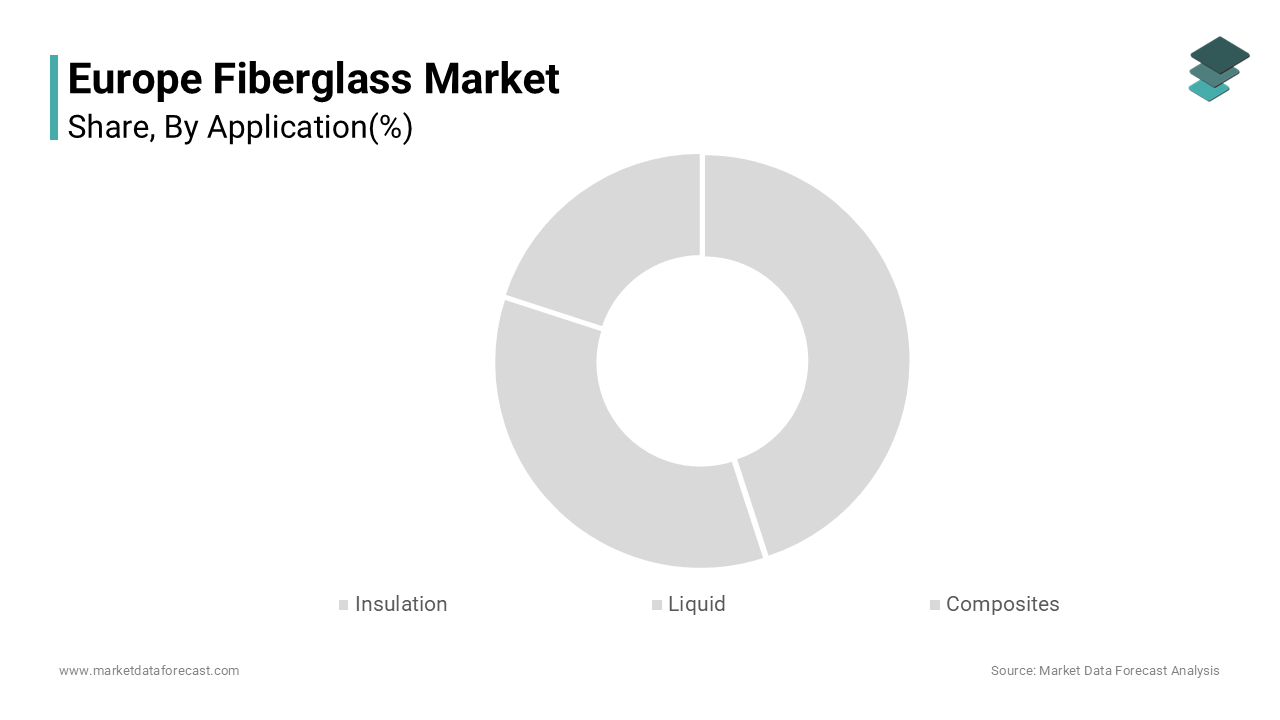
The insulation segment is estimated to register the fastest CAGR of 4.5% from 2026 to 2034 due to stringent energy efficiency regulations and the renovation of existing building stock. This rapid growth is further attributed to the superior thermal and acoustic insulation properties of glass wool which is primarily made from fiber glass. The main driver is the European Green Deal which mandates significant improvements in building energy performance to achieve climate neutrality by 2050. According to the European Commission the Renovation Wave strategy aims to at least double the annual energy renovation rate of buildings by 2030 creating massive demand for insulation materials. Glass wool is favored for its non combustible nature and ease of installation in walls roofs and floors. As per Eurostat, the energy used by residential and commercial buildings represents a major portion of total energy use in the region. Consequently, these structures are the primary focus for efficiency measures aimed at reducing environmental impact. The rising cost of energy further incentivizes homeowners and businesses to invest in high quality insulation to reduce heating and cooling expenses. Additionally the acoustic insulation benefits of glass wool are increasingly valued in urban environments where noise pollution is a concern. The material’s sustainability profile including recyclability and low embodied carbon also aligns with green building certifications. These regulatory and economic drivers ensure that the insulation segment experiences the fastest growth rates in the European fiber glass market.
By Type Insights
The roving segment held the majority share of 48.2% of the Europe fiber glass market in 2025 because of the widespread use of roving as a reinforcement material in composite manufacturing processes such as pultrusion filament winding and spray up. A key factor fueling this leadership is the demand for high strength structural components in the transportation and infrastructure sectors. Rovings provide excellent mechanical properties and processability making them ideal for large scale industrial applications. The versatility of roving allows it to be combined with various resin systems to tailor performance characteristics for specific end uses. Additionally the growth of the wind energy sector drives demand for direct rovings used in the manufacture of turbine blades. The ability of rovings to be processed efficiently in automated manufacturing lines reduces production costs and enhances consistency. These factors combined with the established supply chain infrastructure for roving products ensure its continued dominance in the European fiber glass market.
On the other hand, the yarn segment is anticipated to witness the fastest CAGR of 3.8% during the forecast period owing to increasing applications in electronics and specialized textiles. The rising need for fine-diameter fiber glass yarns, known for their exceptional electrical and thermal properties, is accelerating growth in this segment. The expansion of Europe's electronics industry, specifically in PCB production and semiconductor packaging, is the primary driver. According to sources, the demand for high performance electronic materials is rising due to the proliferation of smart devices and electric vehicles. Fiber glass yarns are essential for creating the woven fabrics used as substrates in printed circuit boards which require precise dimensional stability and dielectric properties. Additionally the aerospace sector utilizes fiber glass yarns for lightweight composite prepregs that require high tensile strength and flexibility. The development of hybrid yarns combining glass fibers with thermoplastic matrices also opens new opportunities in automotive interior applications. The ability of yarns to be woven into intricate patterns allows for customized reinforcement solutions. These technological advancements and expanding application areas contribute to the rapid growth of the yarn segment in the European market.
By End Use Insights
The construction segment led the Europe fiber glass market and accounted for a 60.2% share in 2025. This leading position of the segment is driven by the extensive use of fiber glass in insulation materials roofing membranes and reinforcement meshes for concrete and plaster. The top factor setting this segment apart is the regulatory push for energy efficient buildings across the European Union. Glass wool derived from fiber glass is the most widely used insulation material in Europe due to its thermal efficiency and fire safety characteristics. The renovation of older building stock to improve energy ratings further sustains demand for fiber glass products. Additionally the durability and corrosion resistance of fiber glass make it ideal for reinforcing concrete structures in infrastructure projects such as bridges and tunnels. The material’s lightweight nature simplifies handling and installation reducing labor costs. The integration of fiber glass in sustainable building practices including recyclable insulation systems also supports its market leadership. These factors ensure that the construction segment remains the largest consumer of fiber glass in Europe.
In the contrary, the automobiles segment is likely to experience the fastest CAGR of 5.2% between 2026 and 2034. This quick surge of the segment is propelled by the industry’s focus on lightweighting and electrification, and the increasing adoption of fiber glass reinforced composites in vehicle structures to reduce weight and improve fuel efficiency. The main driver is the stringent emission standards imposed by the European Union which mandate lower CO2 emissions from new vehicles. Fiber glass offers a cost effective alternative to carbon fiber for semi structural components such as underbody shields seat frames and battery enclosures. The rise of electric vehicles further accelerates this trend as manufacturers seek to offset the weight of battery packs to maximize driving range. Fiber glass composites also provide design flexibility allowing for aerodynamic shapes that enhance efficiency. The material’s resistance to corrosion and chemicals ensures long term durability in automotive applications. These dynamics drive the fastest growth in the automobiles segment of the European fiber glass market.
REGIONAL ANALYSIS
Germany Fiber Glass Market Analysis
Germany outperformed other countries in the Europe fiber glass market and occupied a 21.9% share in 2025. The demand for fiber glass in Germany is driven by its robust automotive and construction industries. An emphasis on innovative composite material development combined with cutting-edge production technologies characterizes the country’s current market position. A key driving factor is the presence of major automotive manufacturers who are increasingly adopting fiber glass composites for lightweight vehicle components to meet emission standards. According to sources, the automotive sector is undergoing a significant transformation towards electrification which requires lightweight materials to extend battery range. The Energiewende policy promotes renewable energy leading to increased installation of wind turbines which utilize fiber glass blades. Germany’s strong industrial base supports the production of high quality fiber glass products for export and domestic use. The country’s commitment to sustainability drives research into recyclable composite technologies. The presence of leading chemical and material companies facilitates collaboration and innovation in the fiber glass value chain. Germany’s strategic position as an industrial hub ensures steady demand for fiber glass across multiple sectors.
France Fiber Glass Market Analysis
France was the second largest player in the Europe fiber glass market and accounted for a 15.6% in 2025 because of its ambitious renewable energy goals and construction activities. Significant capital injection into wind power infrastructure and building renovations dictates the current market status. France's pledge to increase the percentage of renewable energy sources in its national energy mix is a major motivating factor. As per research, the construction sector continues to invest in energy efficient insulation materials to comply with environmental regulations. The MaPrimeRénov scheme provides financial incentives for homeowners to upgrade insulation boosting the consumption of glass wool. France’s aerospace industry also contributes to demand for high performance fiber glass composites used in aircraft interiors and structures. The country’s focus on circular economy principles encourages the development of recycling solutions for composite waste. French manufacturers are investing in sustainable production methods to reduce environmental impact. The combination of renewable energy targets and construction regulations sustains a robust market for fiber glass in France.
Italy Fiber Glass Market Analysis
Italy holds a significant position in the Europe fiber glass market due to its strong construction and marine industries. The market status is characterized by a high demand for fiber glass reinforced plastics in boat building and architectural applications. A key driving factor is the prominence of the luxury yacht manufacturing sector in Italy which relies heavily on fiber glass composites for hulls and decks. According to studies, the country is a global leader in yacht production exporting high value vessels that utilize advanced composite materials. As per sources, the construction sector also contributes significantly to fiber glass demand through the use of insulation and reinforcement meshes. The seismic retrofitting of older buildings often involves fiber glass reinforced polymers due to their high strength and lightweight properties. Italy’s warm climate increases the need for thermal insulation to maintain indoor comfort driving the use of glass wool. The country’s design oriented approach favors the aesthetic versatility of fiber glass in architectural elements. Italian manufacturers are known for their expertise in processing composites for specialized applications. The combination of marine excellence and construction needs ensures Italy’s prominent position in the European fiber glass market.
United Kingdom Fiber Glass Market Analysis
The United Kingdom witnessed a consistent growth in the European market owing to its offshore wind energy ambitions and housing market. The market status is defined by significant investments in renewable energy infrastructure particularly offshore wind farms. A primary driving factor is the UK government’s target to reach significant gigawatts of offshore wind capacity by 2030 as part of its net zero strategy. According to sources, this expansion requires large quantities of fiber glass for turbine blades capable of withstanding marine conditions. The UK’s aging housing stock presents opportunities for retrofitting with improved insulation materials to reduce energy bills. The automotive industry in the UK is also transitioning towards electric vehicles increasing the need for lightweight composite components. The country’s focus on sustainable construction practices supports the adoption of recyclable fiber glass products. Regulatory frameworks promoting low carbon buildings further stimulate market growth. The UK’s strategic focus on renewable energy and housing efficiency sustains demand for fiber glass.
Spain Fiber Glass Market Analysis
Spain is anticipated to expand notably in the regional market over the forecast period due to its renewable energy projects and tourism related construction. The market status is characterized by growing investment in wind and solar energy infrastructure. A key driving factor is Spain’s National Energy and Climate Plan which aims to significantly increase renewable energy capacity by 2030. The warm climate in Spain increases the demand for thermal insulation to reduce air conditioning loads. The marine industry also contributes to demand with fiber glass used in recreational boats and yachts. Spain’s focus on sustainable tourism encourages the use of eco friendly building materials. The government’s support for renewable energy projects creates a favorable environment for fiber glass manufacturers. The combination of energy transition goals and construction activity ensures Spain’s growing importance in the European fiber glass market.
COMPETITIVE LANDSCAPE
Competition in the Europe fiberglass market is characterized by a triad of multinational leaders complemented by regional specialists and emerging circular economy innovators. The landscape is not defined by price wars but by differentiation through sustainability credentials technical service and regulatory foresight. Incumbents leverage decades old manufacturing infrastructure while simultaneously retrofitting plants for decarbonization and recycled content integration. New entrants focus on niche applications such as recycled fiber composites or bio hybrid reinforcements but struggle to scale without access to collection networks. The market is heavily influenced by EU legislation including the Energy Performance of Buildings Directive Industrial Emissions Directive and upcoming Ecodesign for Sustainable Products Regulation which collectively raise the compliance bar for emissions recyclability and embodied carbon. As a result, competitive advantage accrues to companies that embed policy intelligence into product development and supply chain design. Consolidation remains limited due to the capital intensity of fiber drawing lines yet collaboration through industry consortia like EURIMA and EuCIA accelerates pre competitive innovation in recycling and life cycle assessment.
KEY MARKET PLAYERS
Some of the companies that are playing a dominating role in the Europe Fiberglass Market include
- Owens Corning
- Saint-Gobain Vetrotex
- PPG Industries
- Nippon Electric Glass
- Johns Manville
- China Jushi Co., Ltd.
- Taishan Fiberglass Inc.
- Ahlstrom-Munksjö
- Chongqing Polycomp International Corp. (CPIC)
- AGY Holding Corp.
- 3B-the fibreglass company
- Valmiera Fibreglass
Top Players in the Market
Owens Corning
Owens Corning is a global leader in building materials and composite solutions with a significant presence in the Europe fiber glass market. The company produces high performance glass fibers for insulation and reinforcement applications serving construction automotive and industrial sectors. Owens Corning focuses on sustainability by developing energy efficient insulation products and recyclable composite technologies. Recent actions include expanding its manufacturing capabilities in Europe to meet growing demand for sustainable building materials. The company invests heavily in research and development to innovate product offerings that reduce carbon footprints. Owens Corning collaborates with industry partners to promote circular economy practices within the fiber glass value chain. Their commitment to safety and environmental stewardship strengthens their reputation among customers. By leveraging digital tools for supply chain optimization Owens Corning enhances operational efficiency. The company’s strategic initiatives aim to support the transition towards low carbon economies while maintaining competitive advantage in the European market.
Saint Gobain
Saint Gobain is a multinational corporation renowned for its expertise in light and sustainable construction materials including fiber glass insulation. The company plays a pivotal role in the Europe fiber glass market through its Isover brand which offers comprehensive thermal and acoustic solutions. Saint Gobain prioritizes innovation by developing next generation glass wool products with improved performance and reduced environmental impact. Recent strategies involve increasing production capacity for recycled content insulation materials to align with circular economy goals. The company actively participates in green building initiatives and certifications across Europe. Saint Gobain invests in digital platforms to enhance customer experience and streamline distribution networks. Their focus on decarbonization drives investments in renewable energy for manufacturing processes. By partnering with architects and builders Saint Gobain promotes the adoption of high efficiency insulation systems. The company’s dedication to sustainability and innovation solidifies its position as a key player in the European fiber glass industry.
Johns Manville
Johns Manville is a prominent manufacturer of premium quality insulation and building materials with a strong footprint in the Europe fiber glass market. The company provides a wide range of fiber glass products for commercial and residential applications emphasizing energy efficiency and durability. Johns Manville is committed to sustainability by producing insulation materials that contribute to LEED and other green building certifications. Recent actions include upgrading facilities to incorporate advanced manufacturing technologies that reduce waste and energy consumption. The company expands its product portfolio to include bio based binders and recyclable insulation solutions. Johns Manville engages in educational programs to raise awareness about the benefits of proper insulation. Their strategic partnerships with distributors ensure wide availability of products across European markets. By focusing on customer centric innovation and operational excellence Johns Manville strengthens its competitive position. The company’s efforts to minimize environmental impact resonate with eco conscious consumers and regulators in Europe.
Top Strategies Used by Key Market Participants
Key players in the Europe fiber glass market primarily focus on sustainability and innovation to address environmental concerns and regulatory requirements. Companies invest in developing recyclable fiber glass products and improving energy efficiency in manufacturing processes. Strategic expansions into high growth segments such as wind energy and electric vehicles drive revenue growth. Partnerships with downstream industries facilitate the adoption of fiber glass composites in new applications. Digitalization of supply chains enhances operational agility and customer service. Compliance with strict environmental regulations is maintained through continuous improvement in emission controls and waste management. Companies also engage in advocacy efforts to promote the benefits of fiber glass in sustainable construction. These strategies enable participants to maintain competitiveness and achieve long term growth in the European region.
MARKET SEGMENTATION
This research report on the Europe Fiberglass Market has been segmented and sub–segmented into the following categories.
By Application
- Insulation
- Liquid
- Composites
By Type
- Glass Wool
- Yarn
- Roving
By End Use
- Automobiles
- Construction
By Country
- UK
- France
- Spain
- Germany
- Italy
- Russia
- Sweden
- Denmark
- Switzerland
- Netherlands
- Turkey
- Czech Republic
- Rest of Europe