- Product Description Description
- Table of Contents TOC
- List of Table & Figure LOT
- Get Free Sample PDF Sample PDF
Market Size, 2025
$1.88 BnMarket Estimate, 2026
$1.96 BnMarket Forecast, 2034
$2.77 BnCAGR, 2026–2034
4.39%Executive Summary: Europe Flight Simulator Market
- Market Scope: Comprehensive Europe flight simulator market analysis covering platform types, solution categories, simulator types, key geographic countries, and adoption metrics.
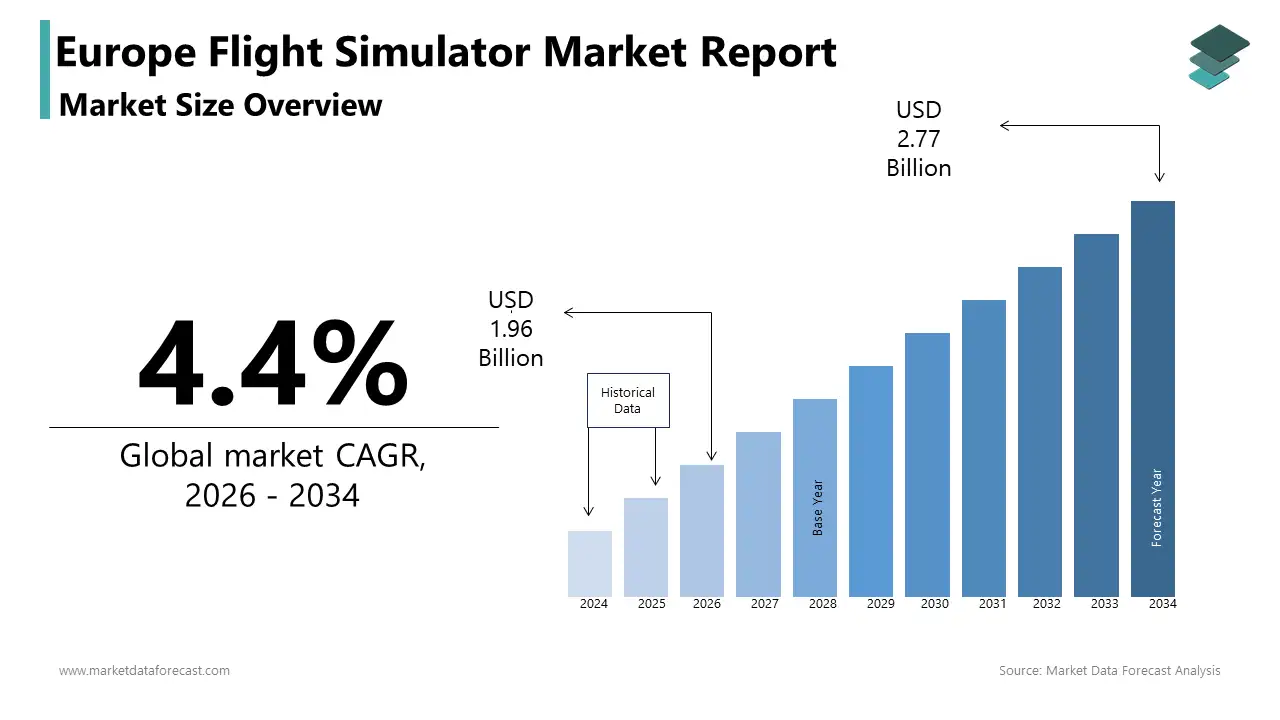
- Market Valuation: Valued at USD 1.88 billion (2025), estimated at USD 1.96 billion (2026), and projected to reach USD 2.77 billion by 2034, registering a CAGR of 4.39% (2026–2034).
- Primary Growth Drivers: Stringent European Union air traffic and safety regulations, rising demand for safe and cost-effective pilot training solutions, and increasing defense budgets supporting airforce fleet modernization. Key operational advantages include ease of ownership and maintenance compared to real aircraft.
Key Market Segment Metrics (2026–2034)
| Category | Leading Segment (2025 Position) | Fastest-Growing Segment |
|---|---|---|
| By Platform | Commercial Aircraft Simulator & Military Aircraft Simulator (driven by high commercial pilot demand and military airforce training needs) | Unmanned Aerial Vehicles (UAVs) Simulator |
| By Solution | Hardware (representing the foundational and largest capital outlay segment) | Software and Hardware Upgrades |
| By Type | Full Flight Simulators and Flight Training Devices (widely adopted for comprehensive pilot certification) | Virtual Flight Training and Line Flight Training |
| By Country / Region | Germany, UK, France, and Russia (contributing significant revenue shares due to dense air traffic and growing defense budgets) | Rest of Europe and Eastern European regional markets |
Major Market Players & Market Structure
Market Structure: Highly competitive aerospace and defense training landscape featuring global technology leaders and defense contractors competing on simulation fidelity, software precision, hardware reliability, and strategic business contracts.
Key Companies: CAE Inc., L3Harris Technologies, Inc., Lockheed Martin Corporation, Advanced Rotorcraft Technology, Inc., Boeing, FlightSafety International, FRASCA International Inc., Thales Group, TRU Simulation + Training Inc., and United Technologies Corporation (UTC).
 Download Free Sample Report
Europe Flight Simulator Market Size
The size of the Europe flight simulator market was worth USD 1.88 billion in 2025 and is anticipated to grow at a CAGR of 4.39% from 2026 to 2034 and be worth USD 2.77 billion by 2034 from USD 1.96 billion in 2026.
Market Scenario
A flight simulator is a technology that can artificially re-create the aircraft flight experience and the environment for pilot training, design, or other purposes. This procedure includes duplicating the equations that govern how aircraft fly, how they react to the flight controls applications, how the aircraft reacts to external factors such as air density, turbulence, wind shear, precipitation, cloud, etc., and, the effects of other aircraft systems. This flight simulation technology is utilized for a variety of reasons which includes flight training (mainly of pilots), the design & development of the aircraft itself, and the research into aircraft characteristics & qualities of control handling.
Market Drivers and Restraints
The growth of the Europe flight simulator market is attributed to the rules and regulations of the European Union regarding air traffic and safety concerns and the demand for the pilots. The surge in demand for the new pilots in a safe way and the factor like inexpensiveness & safety while using them for a trainee are the major drivers of the growth of the Europe Flight Simulator Market.
The ease of owning and maintaining these flight simulators, when compared to real airplanes, and the stringent regulation in air traffic by the European Union are bolstering the growth of the target market in the European area.
Market Segmentation
Europe Flight Simulator Market Analysis By Platform
- Commercial Aircraft Simulator
- Narrow Body Aircraft
- Wide-Body Aircraft
- Very Large Aircraft
- Regional Transport Aircraft
- Military Aircraft Simulator
- Combat Aircraft
- Transport/Tankr Aircraft
- Training Aircraft
- Special Mission Aircraft
- Helicopter Simulator
- Unmanned Aerial Vehicles (UAVs) Simulator
Europe Flight Simulator Market Analysis By Solution
- Hardware
- Software
- Services
- Hardware Upgrade
- Software
Europe Flight Simulator Market Analysis By Type
- Flight Simulators
- Full Flight Simulators, Flight Training Devices
- Flight Mission Simulators
- Fixed Base Simulators
- Flight Simulator Training
- Line Flight Training
- Virtual Flight Training
Geographical Analysis
- UK
- France
- Spain
- Germany
- Italy
- Russia
- Sweden
- Denmark
- Switzerland
- Netherlands
- Turkey
- Czech Republic
- Rest of Europe
In the regional analysis of the Europe Flight Simulator Market, Germany, UK, France, and Russia are contributing the significant share of the market's revenue. The growth of the flight simulators market in these countries is due to the growing air traffic and the culture of traveling in these countries. Notably, the increasing budget of defence by the Russian government for the growth of their airforce units is boosting the demand for the flight simulators in this area.
Market Key Players
The key players of the Europe flight simulator market include CAE Inc. (Switzerland), L3Harris Technologies, Inc. (US), Lockheed Martin Corporation (US), Advanced Rotorcraft Technology, Inc. (US), Boeing (US), FlightSafety International (US), FRASCA International Inc. (US), Thales Group (France), TRU Simulation + Training Inc. (US), and United Technologies Corporation (UTC) (US)., and Others.
Market Recent Developments
-
L3Harris Technologies, an American technology company, defense contractor and information technology services provider that produces flight simulators has announced that they have signed a definitive agreement under which American Holoptics, an affiliate of Koucar Management, will acquire the EOTech business.
-
Lockheed Martin Corporation's business unit, Sikorsky, has selected by the US army to build prototype aircraft for its Future Attack Reconnaissance Aircraft (FARA) program for replacing the army's AH-65 Apache and OH-58D Kiowa Warrior helicopters.