- Product Description Description
- Table of Contents TOC
- List of Table & Figure LOT
- Get Free Sample PDF Sample PDF
Market Size, 2025
$366.5 MnMarket Estimate, 2026
$411.1 MnMarket Forecast, 2034
$1028 MnCAGR, 2026–2034
12.15%Executive Summary: Europe Flow Battery Market
- Market Scope: Comprehensive European flow battery market analysis covering battery types, application sectors, national leadership shares, long-duration energy storage demands, and renewable energy policy targets.
- Market Valuation: Valued at USD 326.79 million (2024), estimated at USD 366.56 million (2025), and projected to reach USD 837.08 million by 2033, registering a robust CAGR of 12.15% (2025–2033).
- Primary Growth Drivers: Escalating need for long-duration energy storage (LDES) to support massive renewable energy expansion. Key structural and policy benchmarks include Europe’s wind energy capacity reaching 278 GW in 2024, the European Commission targeting 425 GW of installed solar PV capacity by 2030, the EU’s revised Renewable Energy Directive aiming for a 42.5% to 45% renewable share by 2030, Europe requiring at least 187 GW of new storage capacity by 2040 (alongside 83 GW of flexible capacity by 2030), and vanadium redox systems offering 4–12 hours of discharge scaling beyond 20 hours.
Key Market Segment Metrics (2025–2033)
| Category | Leading Segment (2024 Position) | Fastest-Growing Segment |
|---|---|---|
| By Battery Type | Redox flow batteries (dominated the European market in 2024, driven by the maturity and commercial deployment of vanadium redox technology) | Advanced iron-flow and alternative chemistry systems for long-duration storage |
| By Application Sector | Utilities (held the dominant market share in 2024, supported by grid-scale renewable integration and transmission mandates) | Commercial, industrial, and microgrid backup storage sectors |
| By Duration / Scale | Medium-to-long duration storage systems (4–12 hours discharge capability) | Ultra-long duration systems scaling beyond 20 hours |
| By Country / Region | Germany (led Europe with a 27.7% market share in 2024, with the United Kingdom holding the second-largest share) | High-growth Western European energy transition markets |
Major Market Players & Market Structure
Market Structure: Highly competitive European flow battery landscape featuring specialized clean-tech innovators, energy storage developers, and international industrial leaders competing intensely on electrolyte chemistry optimization, stack design efficiency, operational longevity, scalability, material recycling, local manufacturing capabilities, digital integration, and minimizing total cost of ownership (TCO).
Key Companies: ESS Inc., Invinity Energy Systems, Gildemeister Energy Solutions, Elestor, VoltStorage, CellCube Energy Storage Systems, Redflow Limited, Sumitomo Electric Industries, Primus Power, ViZn Energy Systems, RedT Energy, EnSync Energy Systems, and Schmid.
Europe Flow Battery Market Size
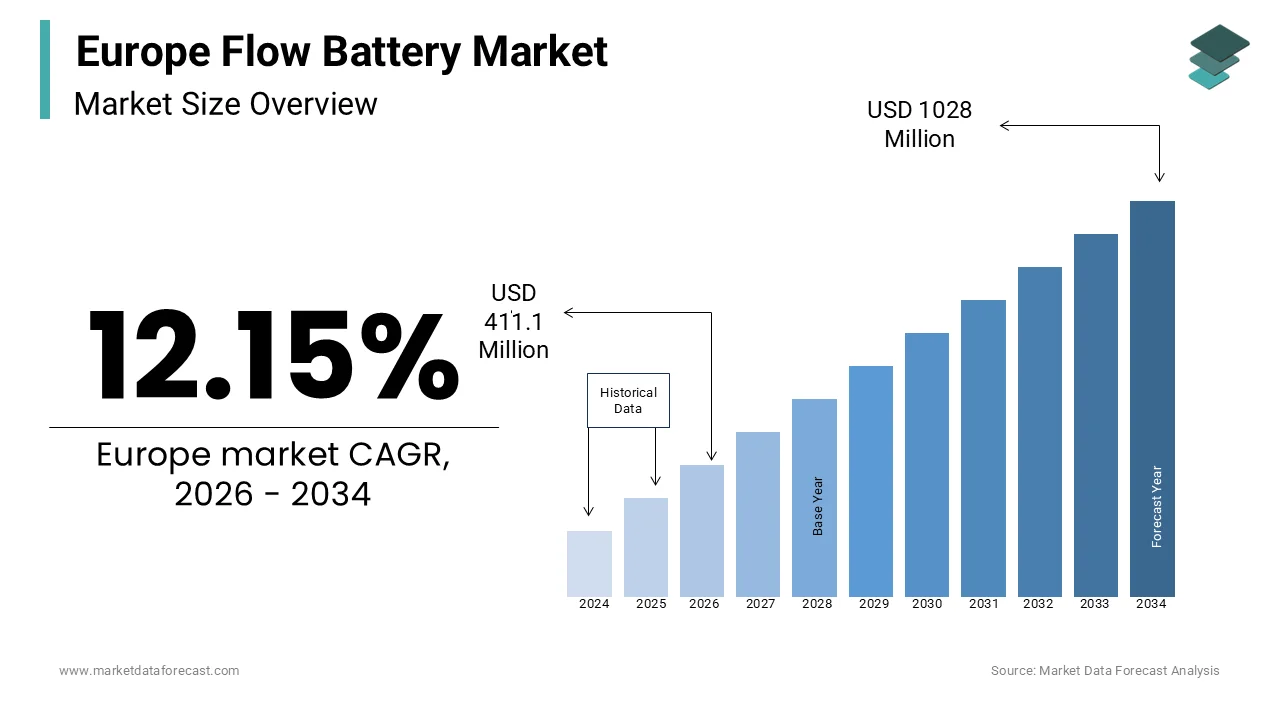
The Europe flow battery market size was valued at USD 366.56 million in 2025 and is anticipated to reach a valuation of USD 411.10 million in 2026 and USD 1028.82 million by 2034, growing at a CAGR of 12.15% from 2026 to 2034.
Flow batteries are rechargeable electrochemical energy storage systems wherein energy is stored in liquid electrolyte solutions held in external tanks, which is enabling scalable and long-duration discharge capabilities. Within Europe, this technology is gaining strategic relevance due to its suitability for grid-scale applications requiring multi-hour discharge cycles and enhanced safety profiles compared to conventional lithium-ion systems. Unlike solid-state batteries, flow batteries decouple power and energy capacity, offering design flexibility critical for renewable integration and industrial backup solutions. Europe hosted a growing number of large-scale energy storage projects by the end of 2023, with redox flow configurations accounting for a rising share in long-duration deployments. The European Commission has identified long-duration storage as essential to meet its 2030 target of 425 gigawatts of installed solar photovoltaic capacity, more than double the 165 gigawatts reported in 2021 by SolarPower Europe. Additionally, the continent’s wind energy capacity reached 278 gigawatts in 2025, according to WindEurope, intensifying intermittency management needs that favor flow battery deployment. These underlying energy infrastructure dynamics underscore the technology’s emergent role in Europe’s decarbonization architecture beyond mere market metrics.
MARKET DRIVERS
Expansion of Renewable Energy Integration Mandates Drives Flow Battery Adoption
The binding legislative frameworks of Europe mandating renewable energy integration have created a structural need for long-duration energy storage, which is propelling interest in flow battery systems and driving the European flow battery market growth. The European Union’s revised Renewable Energy Directive requires member states to collectively achieve a 42.5% share of renewables in final energy consumption by 2030, with an aspirational clause to reach 45%. This ambitious target necessitates grid resilience mechanisms capable of managing prolonged supply gaps, especially during low wind or solar periods in winter months. Renewable generation lulls in Central and Northern Europe can last several days during December and January, which is far beyond the four-to-eight-hour window addressed by conventional lithium-ion solutions. Vanadium redox flow batteries, with discharge durations ranging from 4 to 12 hours and scalable beyond 20 hours these offer a technically viable response. Germany’s grid operator Amprion has already piloted a 5-megawatt 20-megawatt-hour vanadium flow system near Düsseldorf to buffer regional solar intermittency. Moreover, as per the forecasts of the European Network of Transmission System Operators for Electricity, at least 187 gigawatts of new storage capacity will be required across the bloc by 2040 to support renewable integration, a demand profile increasingly aligned with flow battery attributes.
Industrial Decarbonization Policies Amplify Demand for Stationary Long-Duration Storage
The stringent industrial decarbonization agenda of Europe, particularly under the Carbon Border Adjustment Mechanism and the Industrial Emissions Directive, is compelling energy-intensive sectors to adopt on-site clean energy solutions supported by reliable storage and contributing to the regional market growth. Industries such as chemicals, steel, and cement that account for nearly 20% of the European Union’s total carbon emissions, as per the European Environment Agency, are transitioning to hybrid microgrids combining solar or wind generation with long-duration storage to ensure uninterrupted low-carbon operations. Flow batteries present a compelling alternative due to their non-flammable aqueous electrolytes and minimal thermal runaway risk, which is a critical safety consideration for facilities handling volatile substances. In 2025, according to the European Chemical Industry Council, a significant share of its member companies had initiated feasibility studies for installing multi-hour storage to support on-site renewable consumption, with flow chemistries prominently evaluated. Notable example includes BASF’s Ludwigshafen site, where a pilot 2 2-megawatt 8-megawatt-hour anadium flow installation was commissioned in collaboration with Invinity Energy Systems to stabilize green hydrogen electrolyzer operations. The European Commission’s Net Zero Industry Act further accelerates this trend by prioritizing strategic projects that enhance energy system flexibility, explicitly listing flow batteries among technologies eligible for streamlined permitting and state support.
MARKET RESTRAINTS
High Initial Capital Expenditure Remains a Significant Market Barrier
Flow battery systems face persistent commercial headwinds due to elevated upfront capital costs compared to more mature alternatives, which is one of the major restraints to the growth of the European flow battery market. Vanadium redox flow battery installations in Europe typically range from 600 to 900 euros per kilowatt hour of storage capacity, whereas lithium iron phosphate systems average between 250 and 400 euros per kilowatt hour. This cost differential stems from expensive raw materials, particularly vanadium pentoxide, which can account for a significant share of total system costs. Vanadium prices stabilized around 7 euros per kilogram in early 2025 following a 2022 peak of 14 euros, but they remain volatile due to concentrated supply chains dominated by China and Russia, which together supply more than two-thirds of global vanadium. European project developers often struggle to secure financing for flow battery deployments given the higher levelized cost of storage, which averages about 210 euros per megawatt hour over a 20-year lifespan, compared to 130 euros for lithium-based systems. Without targeted subsidies or innovative financing mechanisms such as electrolyte leasing, capital intensity will continue to suppress widespread adoption despite superior longevity.
Limited Domestic Electrolyte Supply Chain Constrained Scalability
Europe’s nascent flow battery sector is heavily reliant on imported electrolyte materials, particularly high-purity vanadium, which is creating supply chain vulnerabilities that impede large-scale deployment and hinder the regional market growth. The European Union produces less than 5% of the vanadium required to meet its projected long-duration storage needs by 2035. Domestic recovery from steel slag remains underdeveloped, with current recycling rates below 8%. This dependency exposes the continent to geopolitical risks and price fluctuations, especially given that China controls over half of global vanadium production and the majority of refining capacity. Although the European Critical Raw Materials Act aims to boost domestic processing and recycling, no commercial-scale vanadium electrolyte production facility exists in Europe as of mid-2025. Pilot initiatives such as the VanadiumCorp refinery project in Sweden remain in pre-commercial phases, which is delaying the establishment of a secure localized supply. Consequently, European integrators must source electrolytes from Asia or South Africa, which incurs logistics complexity and extended lead times averaging several months. Such constraints not only inflate project timelines but also deter utility-scale procurement decisions where supply certainty is paramount.
MARKET OPPORTUNITIES
Retrofitting Aging Grid Infrastructure Creates Lucrative Deployment Pathways
The aging transmission and distribution infrastructure of Europe presents a unique opportunity for the European flow battery market as grid operators seek non-wire alternatives to defer costly upgrades. Over 30% of the continent’s high voltage transformers and 40% of medium voltage lines are older than 40 years, with replacement costs projected to exceed 580 billion euros by 2040. Flow batteries offer a cost-effective solution by providing voltage support, congestion relief, and black start capabilities without requiring physical line reinforcements. In the United Kingdom, National Grid has already deployed a 2.5-megawatt 10-megawatt-hour vanadium flow system in Yorkshire to manage distribution congestion caused by rapid solar uptake, which is avoiding a 12-million-pound substation upgrade. Similarly, Italy’s grid operator Terna has allocated 320 million euros under its 2025 2026 investment plan specifically for non-traditional grid reinforcement, including long-duration storage. According to the estimations of the European Network of Transmission System Operators for Electricity, up to 17% of planned grid investments could be deferred through strategic storage placement, which is creating a pipeline of over 22 gigawatt hours of potential flow battery demand by 2032. This infrastructure modernization imperative aligns precisely with flow batteries’ long cycle life and deep discharge tolerance, positioning them as enablers of smarter grid economics.
Emerging Green Hydrogen Ecosystems Demand Complementary Long-Duration Storage
The rapid development of Europe’s green hydrogen sector is generating new demand for long-duration storage solutions that can stabilize electrolyzer operations and ensure a consistent renewable feedstock supply, which is another promising opportunity for the European flow battery market. Under the European Hydrogen Backbone initiative, around 90 to 100 gigawatts of electrolyzer capacity are projected by 2030, which requires stable power inputs to maintain efficiency and avoid catalyst degradation. Intermittent operation is known to reduce proton exchange membrane electrolyzer performance and accelerate membrane wear, which increases lifetime. Flow batteries mitigate these risks by smoothing power delivery over multi‑hour windows, which enables near continuous electrolysis. As per the European Clean Hydrogen Partnership, 26 new hydrogen projects were funded in 2025, many of which addressed long‑duration storage solutions. In Spain, the Puertollano green hydrogen plant operated by Iberdrola integrates a 100-megawatt solar array, a 20-megawatt electrolyzer, and a 20-megawatt-hour lithium‑ion battery system to ensure stable renewable hydrogen production. The European Commission’s Innovation Fund has allocated €4.8 billion in 2025 alone, with hydrogen projects making up about one‑third of total awards, which indicates the institutional recognition of this synergy. As green hydrogen becomes central to Europe’s industrial decarbonization, flow batteries are poised to serve as critical enablers of system reliability.
MARKET CHALLENGES
Performance Limitations in High Power Density Applications Impede Broader Utility Adoption
Flow batteries exhibit inherent technical constraints in high power density scenarios, which limit their applicability in frequency regulation and other fast response grid services that dominate short-duration storage markets, and are one of the major challenges to the regional market expansion. Power-to-energy ratio in conventional vanadium redox systems typically ranges from 0.2 to 0.3, meaning a 10-megawatt-hour system delivers only 2 to 3 megawatts of peak power. In contrast, lithium-ion systems achieve ratios between 0.8 and 1.0, which makes them far more suitable for sub‑second response applications. Over 65% of contracted grid balancing capacity in Europe requires response times under two seconds, which is a domain where flow batteries are fundamentally unsuited due to fluid dynamics and ion diffusion kinetics. This technical mismatch excludes them from lucrative markets such as primary control reserve, where Germany procured more than 3 gigawatts of capacity in 2023. While hybrid configurations pairing flow and lithium systems are emerging, they add complexity and cost. Until breakthroughs in electrode architecture or electrolyte formulation improve power density, flow batteries will remain confined to niche long‑duration roles and be unable to compete in the broader utility storage landscape.
Lack of Standardized Regulatory and Interconnection Protocols Hinders Market Maturation
The absence of harmonized technical and regulatory frameworks for long-duration storage across European markets creates uncertainty that deters investor commitment and complicates project execution, which further challenges the growth of the European flow battery market. Unlike lithium-ion systems, which benefit from established grid codes under ENTSO-E’s Network Code on Demand Connection, flow batteries face inconsistent treatment in national permitting regimes regarding classification, safety certification, and grid interconnection requirements. As per a 2025 review by the European Association for Storage of Energy, many EU member states still lack specific provisions for flow battery electrolyte containment, fire safety, or end‑of‑life handling, which is forcing developers to navigate ad hoc interpretations that often delay approvals. For instance, a vanadium flow project in Normandy faced lengthy delays due to ambiguous categorization under industrial installation regulations in France, whereas a comparable lithium project received clearance in under six months. Furthermore, the European Committee for Electrotechnical Standardization has yet to finalize performance testing protocols specific to flow chemistries, which is leading to discrepancies in warranty claims and lifecycle assessments. This regulatory fragmentation not only increases soft costs but also fragments the market, which is preventing economies of scale. Without coordinated policy action through bodies like ACER or the Clean Energy Package implementation group, the flow battery market in Europe will struggle to transition from pilot demonstrations to commercial scalability.
REPORT COVERAGE
| REPORT METRIC | DETAILS |
| Market Size Available | 2025 to 2034 |
| Base Year | 2025 |
| Forecast Period | 2026 to 2034 |
| CAGR | 12.15% |
| Segments Covered | By Type, Material, Application, By Country |
| Various Analyses Covered | Global, Regional & Country Level Analysis; Segment-Level Analysis, DROC, PESTLE Analysis, Porter’s Five Forces Analysis, Competitive Landscape, Analyst Overview of Investment Opportunities |
| Regions Covered | UK, France, Spain, Germany, Italy, Russia, Sweden, Denmark, Switzerland, Netherlands, Turkey, Czech Republic & Rest of Europe |
| Market Leaders Profiled | Ess Inc. (U.S.), Gildemeister Energy Solutions (Austria), Elestor (Europe), Redflow Limited (Australia), Sumitomo Electric Industries, Ltd. (Japan), Primus Power (U.S.), Vizn Energy Systems (U.S.), Redt Energy Plc. (U.K.), Ensync Energy Systems (U.S.), Schmid (Germany) |
SEGMENTAL ANALYSIS
By Type Insights
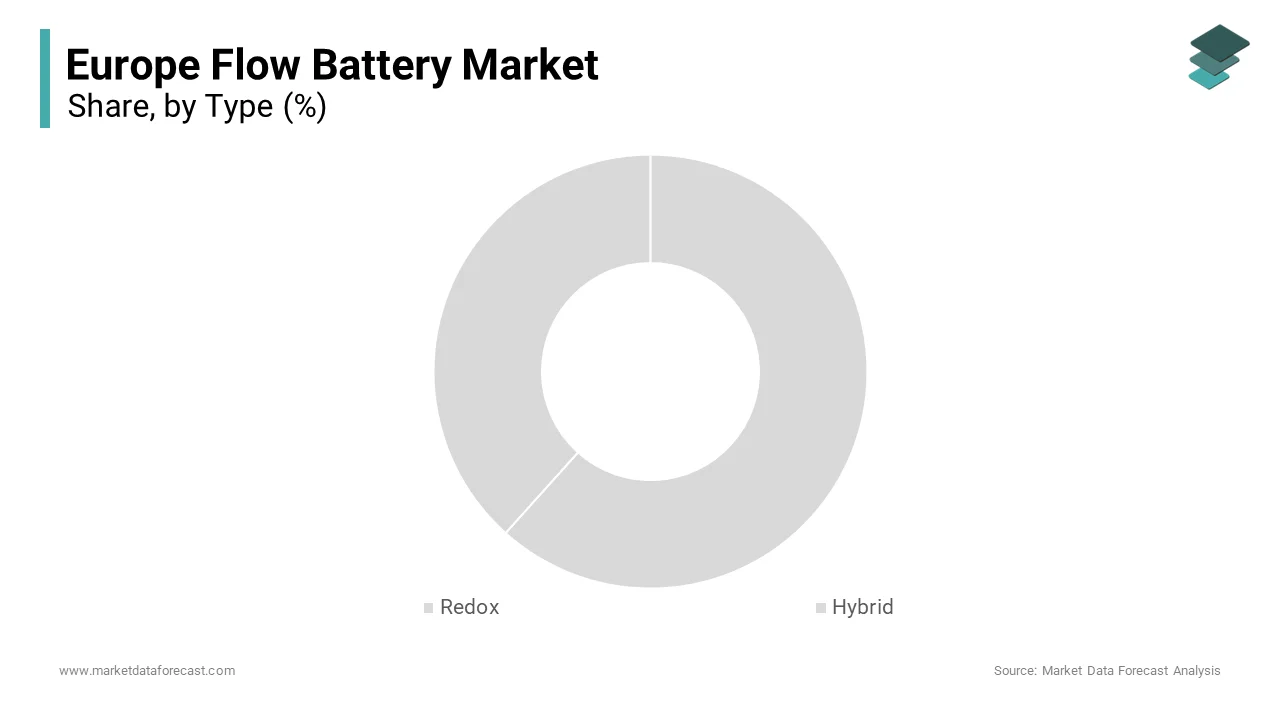
The redox flow battery segment dominated the Europe flow battery market with the highest share of the regional market in 2025. The dominance of the redox flow battery segment in the European market is primarily attributed to the technological maturity, commercial availability, and scalability of vanadium redox chemistry that forms the backbone of most grid-scale deployments across the continent. Vanadium redox flow batteries benefit from a well-established deployment track record and robust performance validation across European pilot and commercial projects. Unlike emerging hybrid chemistries, redox systems offer near infinite cycle life with minimal degradation due to the identical active material in both half cells, which eliminates cross-contamination risks. According to recent studies, vanadium redox installations have demonstrated long lifespans with minimal capacity fade, which is a critical metric for utilities planning 20‑year asset lifespans. Furthermore, as per reports, vanadium redox flow batteries are increasingly specified in publicly funded long‑duration storage tenders due to their bankability and predictable performance. The existence of standardized electrolyte formulations and modular stack designs from European integrators such as Invinity Energy Systems and CellCube has further accelerated procurement decisions. This combination of technical reliability and institutional trust solidifies redox flow batteries as the default choice for European energy storage planners seeking de‑risked decarbonization pathways, which is significantly driving the dominance of the redox flow battery segment in the European market.
By Application Insights
The utility segment accounted for the dominating share of the European flow battery market in 2025 due to the urgent need for grid-scale, long-duration storage to manage renewable intermittency and defer transmission upgrades across the continent. European transmission and distribution operators are under regulatory and operational pressure to integrate growing volumes of variable renewable generation, which is creating a structural demand for multi-hour storage. According to the estimations of the European Network of Transmission System Operators for Electricity, 83 gigawatts of flexible capacity will be required by 2030 to maintain grid stability under the EU’s Fit for 55 package. Flow batteries are uniquely suited for this role due to their ability to discharge continuously for six hours or more without thermal degradation. In 2025, National Grid ESO in the United Kingdom awarded 120 megawatts of long-duration storage contracts to support voltage stability and congestion management. Similarly, Germany’s transmission operators collectively identified several gigawatts of storage need by 2028 in their latest network development plan, which is prioritizing technologies with long cycle lifespans. The European Investment Bank has committed billions of euros since 2022 to finance utility-scale storage projects that demonstrate duration beyond four hours, with flow batteries representing a significant share of approved applications. This alignment between policy, grid needs, and technical suitability is propelling the growth of the utility segment in the European market.
COUNTRY ANALYSIS
Germany Flow Battery Market Analysis
Germany led the flow battery market in Europe in 2025 by holding 27.7% of the regional market share. The dominance of Germany in the European market can be credited to its aggressive Energiewende policy, which targets 80% renewable electricity by 2030 and requires massive grid flexibility solutions. Germany’s transmission system operators have identified significant storage needs in their latest Network Development Plan, with long-duration technologies prioritized for regions experiencing solar curtailment. The federal government’s 2023 Grid Expansion Acceleration Act streamlined permitting for storage projects co‑located with renewables, reducing approval timelines substantially. Commercial deployments are already evident, including vanadium systems by CellCube near Berlin and installations by EWE in Lower Saxony. Additionally, Germany hosts Europe’s most active flow battery supply chain, with electrolyte recyclers like Voltstorage and stack manufacturers such as JenaBatteries operating at commercial scale. The combination of policy support, grid need, and domestic manufacturing capability is contributing to the dominance of Germany in the European flow battery market.
United Kingdom Flow Battery Market Analysis
The United Kingdom held the second-largest share of the European flow battery market in 2025. The prominence of the UK in the European market is attributed to the mature electricity market design that explicitly values duration and reliability, unlike many continental auctions focused solely on power capacity. The UK’s Electricity System Operator launched the first multi‑hour storage tender in Europe in 2022, awarding contracts for systems capable of discharging beyond four hours. By 2025, vanadium flow capacity was operational or under construction, including Invinity’s project in Scotland. The government’s Long Duration Electricity Storage Net Zero Innovation Portfolio has disbursed millions of pounds since 2021 to de‑risk first‑of‑a‑kind deployments. Furthermore, the UK’s islanded grid structure increases vulnerability to intermittency, which is making long-duration storage economically compelling. This market‑led approach, coupled with regulatory clarity, positions the UK as a key growth corridor.
Italy Flow Battery Market Analysis
Italy is predicted to register a promising CAGR in the Europe flow battery market during the forecast period, owing to the high solar penetration and chronic grid congestion in southern regions where renewable generation exceeds local demand. Terna is Italy’s transmission operator and has designated priority zones for non‑wire alternative investment,,s with storage playing a central role in its 2025‑2026 Strategic Plan, allocating hundreds of millions of euros to flexibility assets. A vanadium flow project by Elettricità Futura in Puglia became operational in 2025 to relieve transformer overloads without constructing new lines. Additionally, Italy’s National Recovery and Resilience Plan dedicates billions of euros to smart grid modernization, including long-duration storage grants covering a significant share of capital costs for industrial and utility projects. This blend of grid necessity and financial incentive creates a fertile environment for continued flow battery deployment in Italy.
France Flow Battery Market Analysis
France is expected to witness a prominent share of the European flow battery market over the forecast period. While historically reliant on nuclear baseload, France is now accelerating renewable integration to meet its 2030 target of 40% clean electricity, which requires flexible assets to manage variability. The government’s Multi-Annual Energy Program mandates large-scale solar and onshore wind additions by 2028, which is significantly increasing intermittency exposure. In response, RTE, the national grid operator, launched its first long duration storage call for tenders in 2025 and selecting vanadium flow projects for demonstration in Brittany and Grand Est. France also benefits from strong research ecosystems with the CNRS and CEA leading electrolyte innovation under the France 2030 investment plan, which allocated hundreds of millions of euros to next generation storage in 2023. Recent policy shifts, including the 2025 decree classifying flow batteries as “strategic infrastructure,” have further reduced permitting barriers. These coordinated efforts are positioning France as a rising force in European long-duration storage deployment.
Sweden Flow Battery Market Analysis
Sweden is anticipated to progress at a notable CAGR in the European flow battery market during the forecast period. The pioneering role of Sweden in fossil-free industrial transformation is propelling the market growth in Sweden. Sweden aims to achieve net zero emissions by 2045 with heavy industry as a focal point. The world’s first fossil‑free steel plant by HYBRIT, which is a joint venture between SSAB, LKAB, and Vattenfall, relies on continuous renewable power supported by long-duration storage. According to the Swedish Energy Agency, industrial storage projects received substantial state grants under the Climate Leap initiative in 2023. Additionally, Sweden’s abundant hydropower provides low‑cost electricity for vanadium electrolyte reconditioning, enhancing system economics. This unique industrial decarbonization imperative, backed by public funding and corporate ambition, distinguishes Sweden’s flow battery trajectory from other European nations.
COMPETITIVE LANDSCAPE
The Europe flow battery market features a dynamic competitive landscape characterized by a mix of specialized technology developers and industrial conglomerates. Competition centers on system longevity, safety, scalability, type, and total cost of ownership rather than upfront price alone. Companies differentiate through electrolyte chemistry, try, proprietary stack design, digital integration capabilities, and circular economy strategies. While vanadium redox dominates the technology portfolio, emerging organic and hybrid chemistries are gaining research traction supported by EU funding. Market participants increasingly compete on project execution speed, regulatory navigation expertise, and local content compliance under the Net Zero Industry Act. Strategic collaborations with utilities,s, steel recyclers, and hydrogen project developers are becoming critical to secure anchor off-takers. Although the market remains niche compared to lithium-ion, the focus on long-duration applications creates a less crowded but highly technical contest where engineering excellence and policy alignment determine leadership.
KEY MARKET PLAYERS
A few of the market players in the Europe flow battery market include
- Ess Inc. (U.S.)
- Invinity Energy Systems
- Gildemeister Energy Solutions (Austria)
- Elestor (Europe)
- Voltstorage
- CellCube Energy Storage Systems
- Redflow Limited (Australia)
- Sumitomo Electric Industries, Ltd. (Japan)
- Primus Power (U.S.)
- Vizn Energy Systems (U.S.)
- Redt Energy Plc. (U.K.)
- Ensync Energy Systems (U.S.)
- Schmid (Germany)
Top Players In The Market
- Invinity Energy Systems is a leading developer of vanadium redox flow batteries with a strong operational footprint across Europe. The company has deployed multi-megawatt-hour systems in the United Kingdom, Germany, and Spain to support grid stability and industrial decarbonization. Invinity actively collaborates with utilities and renewable developers to integrate long-duration storage into hybrid energy projects. In early 2025, the company commissioned a 20megawatt-hourr installation in Scotland alongside a wind farm to provide firm renewable power. It also expanded its service network across Southern Europe to accelerate project execution. Through partnerships with electrolyte recyclers and participation in EU-funded innovation consortia, Invinity continues to enhance system sustainability and reduce lifecycle costs, reinforcing its role as a cornerstone player in Europe’s energy transition infrastructure.
- CellCube Energy Storage Systems is Auan strian-based manufacturer specializing in vanadium flow battery technology with extensive project experience in Germany, Italy, and the Netherlands. The company focuses on utility-scale and industrial applications where long cycle life and safety are paramount. CellCube has delivered multiple multi-megawatt-hour installations, including a landmark 10-megawatt-hour system in Berlin for grid congestion management. In 2025, CellCube launched a closed-loop vanadium recycling initiative in partnership with European steel producers to secure raw material supply and lower environmental impact. It also established a new stack assembly line in Graz to meet rising regional demand. By vertically integrating key components and aligning with EU critical raw materials strategies, CellCube strengthens its supply chain resilience and project delivery capability across the continent.
- Voltstorage is a German innovator in flow battery technology, developing cost-efficient vanadium and organic redox systems tailored for European energy markets. The company distinguishes itself through modular architecture and digital energy management integration, enabling rapid deployment across utility and commercial segments. Voltstorage has executed pilot projects with municipal utilities in Bavaria and North Rhine-Westphalia, demonstrating grid support during peak demand periods. In late 2025, it inaugurated a 100megawatt-hourr annual production facility in Munich, supported by grants from the German Federal Ministry for Economic Affairs and Climate Action. The company also launched a d-life electrolyte program, allowing industrial customers to lease rather than purchase vanadium, reducing upfront investment barriers. Through technology standardization and business model innovation, Voltstorage is accelerating market accessibility for long-duration storage solutions.
Top Strategies Used By The Key Market Participants
Key players in the Europe flow battery market prioritize strategic partnerships with grid operators and renewable developers to co-locate storage with generation assets, enhancing project economics and grid value. They invest heavily in vertical integration, particularly in electrolyte recycling and stack manufacturing, to mitigate supply chain risks and reduce costs. Companies actively pursue participation in publicly funded innovation programs such as Horizon Europe and nationanet-zeroro initiatives to de-risk technology development. They also adopt service-oriented business models, including electrolyte leasing and performance-based contracts, to lower customer entry barrieAdditionallynll, they expand local assembly and service networks to shorten delivery timelines and improvafter-saleses support, reinforcing regional presence and customer trust.
MARKET SEGMENTATION
This research report on the Europe flow battery market is segmented and sub-segmented into the following categories.
By Type
- Redox
- Hybrid
By Material
- Vanadium
- Zinc Bromine
- Others
By Application
- Utilities
- Commercial and Industrial
- EV Charging
- Others
By Country
- UK
- France
- Spain
- Germany
- Italy
- Russia
- Sweden
- Denmark
- Switzerland
- Netherlands
- Turkey
- Czech Republic
- Rest of Europe